Received 21 November 2018 Accepted 15 January 2019
Edited by C. Rizzoli, Universita degli Studi di Parma, Italy
Keywords:crystal structure; 4-fluorophenyl ring; nitro-substituted benzene ring; hydrogen bonding; Hirshfeld surface analysis.
CCDC reference:1876976
Supporting information:this article has supporting information at journals.iucr.org/e
Crystal structure and Hirshfeld surface analysis of
(
E
)-1-[2,2-dichloro-1-(4-nitrophenyl)ethenyl]-2-(4-fluorophenyl)diazene
Zeliha Atiog˘lu,aMehmet Akkurt,bNamiq Q. Shikhaliyev,cGulnar T. Suleymanova,c Khanim N. Bagirovacand Flavien A. A. Tozed*
a
¤lke Education and Health Foundation, Cappadocia University, Cappadocia Vocational College, The Medical Imaging Techniques Program, 50420 Mustafapas¸a, U¨ rgu¨p, Nevs¸ehir, Turkey,bDepartment of Physics, Faculty of Sciences, Erciyes
University, 38039 Kayseri, Turkey,cOrganic Chemistry Department, Baku State University, Z. Xalilov str. 23, Az, 1148
Baku, Azerbaijan, anddDepartment of Chemistry, Faculty of Sciences, University of Douala, PO Box 24157, Douala,
Republic of Cameroon. *Correspondence e-mail: [email protected]
In the title compound, C14H8Cl2FN3O2, the 4-fluorophenyl ring and the nitro-substituted benzene ring form a dihedral angle of 63.29 (8). In the crystal,
molecules are linked by C—H O hydrogen bonds into chains running parallel to thecaxis. The crystal packing is further stabilized by C—Cl , C—F
and N—O interactions. The Hirshfeld surface analysis of the crystal structure indicates that the most important contributions to the crystal packing are from H O/O H (15.5%), H H (15.3%), Cl H/H Cl (13.8%), C H/H C (9.5%) and F H/H F (8.2%) interactions.
1. Chemical context
Non-covalent interactions, such as hydrogen, aerogen, halogen, chalcogen, pnicogen, tetrel and icosagen bonds, as well as n–*, – stacking, –cation, –anion and hydro-phobic interactions, can control or organize the conformation, aggregation, tertiary and quaternary structures of the mol-ecule, its stabilization and particular properties (Akbari Afkhami et al., 2017; Desiraju, 1995; Gurbanovet al., 2018; Hazraet al., 2018; Jlassiet al., 2014; Kvyatkovskayaet al., 2017; Legon, 2017, Maharramovet al., 2009, 2018; Mahmoudiet al., 2018a,b,c; Mahmudov et al., 2014, 2017; Mahmudov & Pombeiro, 2016; Scheiner 2013; Shikhaliyevet al., 2013, 2018). On the other hand, azo dyes and related hydrazone ligands and their complexes have attracted attention over the past decades because of their potential biological, pharmacological and analytical applications (Borisovaet al., 2018; Gadzhievaet al., 2006; Gurbanov et al., 2017; Shetnev & Zubkov, 2017). Herein we report the structure and non-covalent interactions of the title compound.
2. Structural commentary
The molecular conformation of the title compound (Fig. 1) is not planar, the 4-fluorophenyl ring and the nitro-substituted benzene ring forming a dihedral angle of 63.29 (8). The C2—
C1—N1—N2, C1—N1—N2—C7, N1—N2—C7—C8, N2— C7—C8—Cl1, N2—C7—C8—Cl2, Cl1—C8—C7—C9 and C8—C7—C9—C14 torsion angles are 1.1 (2), 178.86 (13), 174.62 (14), 176.19 (11), 2.9 (2), 5.1 (2) and 63.4 (2),
respectively. Bond lengths (Allenet al., 1987) and angles are within normal ranges and are comparable to those observed in related structures, viz: (2E )-1-(2-hydroxy-5-methylphenyl)-3-(4-methoxyphenyl)prop-2-en-1-one (Funet al., 2011a), (2E )- 3-(3-benzyloxyphenyl)-1-(2-hydroxy-5-methylphenyl)prop-2-en-1-one (Funet al., 2011b), (2E )-3-[3-(benzyloxy)phenyl]-1-(2-hydroxyphenyl)prop-2-en-1-one (Funet al., 2011c), (2E )-1-(2,5-dimethoxyphenyl)-3-(3-nitrophenyl)prop-2-en-1-one (Funet al., 2011d) and (2E )-3-(3-nitrophenyl)-1-[4-(piperidin-1-yl)phenyl]prop-2-en-1-one (Funet al., 2012).
3. Supramolecular features and Hirshfeld surface analysis
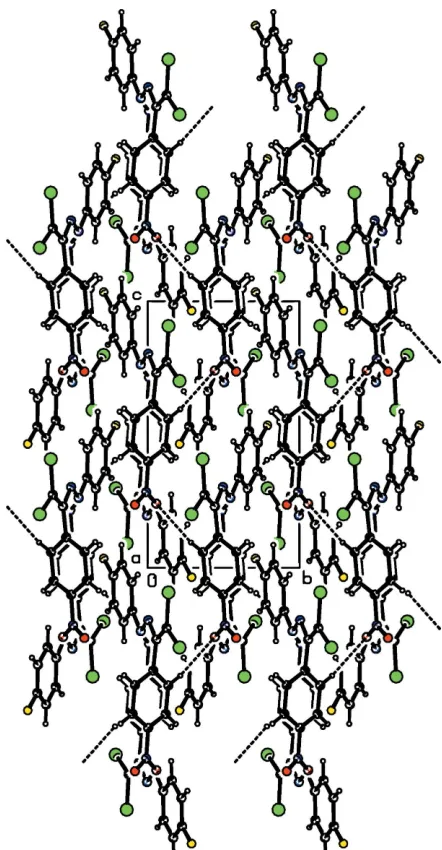
In the crystal, molecules are linked by C—H O hydrogen bonds into chains parallel to thec axis (Table 1; Fig. 2). The crystal packing is further stabilized by weak C—Cl
[Cl Cg2(x, 5 2 y,
1
2 + z) = 3.6792 (8) A˚ ], C—F [F Cg1(1x, 2y, 2z) = 3.5408 (16) A˚ ] and N—O
interactions [O Cg1(x,3 2y,
1
2+z) = 3.9815 (16) A˚ ] where
Cg1 andCg2 are the centroids of the C1–C6 and C9–C14 rings, respectively.
Hirshfeld surfaces and fingerprint plots were generated for the title compound using CrystalExplorer (McKinnon et al., 2007) to quantify and visualize the intermolecular interactions and to explain the observed crystal packing. The Hirshfeld surface mapped overdnormusing a standard surface resolution with a fixed colour scale of0.1603 (red) to 1.2420 (blue) a.u. is shown in Fig. 3. The dark-red spots on thednormsurface arise as a result of short interatomic contacts (Table 2), while the
other weaker intermolecular interactions appear as light-red spots. The red points, which represent closer contacts and negative dnorm values on the surface, correspond to the C— H O interactions.
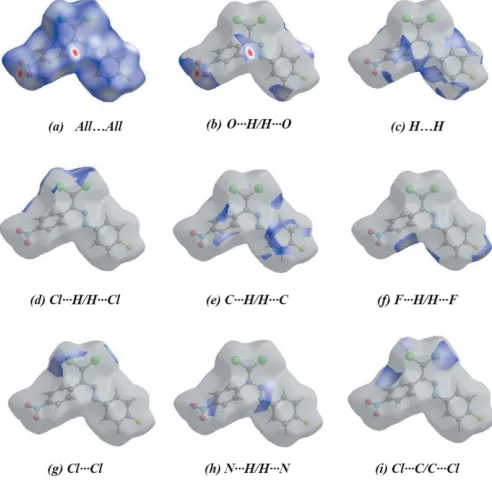
The percentage contributions of various contacts to the total Hirshfeld surface are shown in the two-dimensional fingerprint plots in Fig. 4. The reciprocal O H/H O inter-actions appear as two symmetrical broad wings withde+di’
Figure 1
[image:2.610.312.565.85.124.2]The molecular structure of the title compound with displacement ellipsoids drawn at the 50% probability level.
Table 1
Hydrogen-bond geometry (A˚ ,).
D—H A D—H H A D A D—H A
C10—H10 O1i 0.93 2.52 3.369 (2) 152
Symmetry code: (i)x;yþ5 2;zþ
[image:2.610.328.549.276.701.2] [image:2.610.46.292.551.713.2]1 2.
Figure 2
2.2 A˚ and contribute 15.5% to the Hirshfeld surface (Fig. 5b). The reciprocal Cl H/H Cl, C H/H C and F H/H F interactions (13.8, 9.5 and 8.2% contributions, respectively) are present as sharp symmetrical spikes at diagonal axes
[image:3.610.313.566.67.375.2]de+di’2.9, 3.0 and 2.4 A˚ , respectively (Fig. 5d–f). The small percentage contributions to the Hirshfeld surfaces from the various other interatomic contacts are listed in Table 3.
Figure 4
The full two-dimensional fingerprint plots for the title compound, showing (a) all interactions, and delineated into (b) O H/H O, (c) H H, (d) Cl H/H Cl, (e) C H/H C, (f) F H/H F, (g) Cl Cl, (h) N H/H N and (i) Cl C/C Cl interactions. Thedianddevalues are the closest internal and external distances (in A˚ ) from given points on the Hirshfeld surface.
Table 2
Summary of short interatomic contacts (A˚ ) in the title compound.
Contact Distance Symmetry operation
(C8) Cl1 C8 (Cl1) 3.6040 (16) 2x,1
2+y,32z
(C13) H13 Cl1 (C8) 3.08 2x, 2y, 1z
(C8) Cl2 Cl2 (C8) 3.6506 (7) 2x, 2y, 2z
(C10) H10 O1 (N3) 2.52 x,5
2y, 1 2+z
(C4) F1 H11 (C11) 2.60 1x,1
2+y, 3 2z
(C4) F1 H6 (C6) 2.56 x,3
2y, 1 2+z
(N3) O1 H3 (C3) 2.67 x,y,1 +z
(C5) H5 O1 (N3) 2.74 1x, 2y, 1z
(N3) O1 H10 (C10) 2.52 x,5
2y, 1 2+z
[image:3.610.44.295.92.205.2](F1) C4 C4 (F1) 3.541 (3) 1x, 2y, 2z
Figure 3
[image:3.610.45.296.250.417.2]View of the three-dimensional Hirshfeld surface of the title compound plotted overdnormin the range0.1603 to 1.2420 a.u.
Table 3
Percentage contributions of interatomic contacts to the Hirshfeld surface for the title compound.
Contact Percentage contribution
O H/H O 15.5
H H 15.3
Cl H/H Cl 13.8
C H/H C 9.5
F H/H F 8.2
Cl Cl 6.4
N H/H N 5.6
Cl C/C Cl 5.5
C C 4.1
O C/C O 3.7
Cl O/O Cl 3.1
F C/C F 3.1
N C/C N 2.2
O N/N O 2.1
F F 0.9
N N 0.8
Figure 5
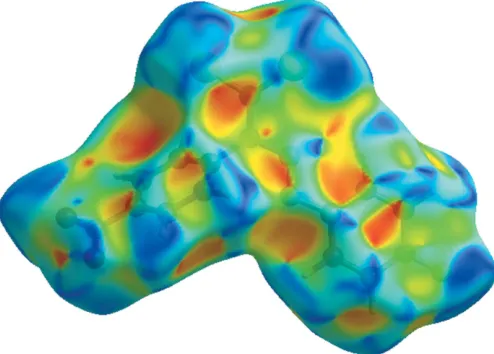
[image:3.610.316.562.458.698.2] [image:3.610.45.296.542.720.2]Hirshfeld surface representations with the function dnorm plotted onto the surface for all interactions are shown in Fig. 5. The large number of O H/H O, H H, Cl H/H Cl, C H/H C, F H/H F, Cl Cl, N H/H N and Cl C/C Cl interactions suggest that van der Waals inter-actions and hydrogen bonding play a major role in the crystal packing (Hathwar et al., 2015). The shape-index of the Hirshfeld surface is a tool for visualizing the–stacking by the presence of adjacent red and blue triangles; if there are no such triangles, then there are no–interactions. The plot of the Hirshfeld surface mapped over shape-index shown in Fig. 6 clearly suggests that there are no–interactions in the title compound.
4. Synthesis and crystallization
The title compound was synthesized according to the method reported by Shikhaliyevet al.(2018). A 20 mL screw-neck vial was charged with DMSO (10 mL), (E )-1-(4-fluorophenyl)-2-(4-nitrobenzylidene)hydrazine (259 mg, 1 mmol), tetra-methylethylenediamine (TMEDA; 295 mg, 2.5 mmol), CuCl (2 mg, 0.02 mmol) and CCl4(20 mmol, 10 equiv). After 1–3 h (until TLC analysis showed complete consumption of the corresponding Schiff base), the reaction mixture was poured into a 0.01 M solution of HCl (100 mL, pH = 2–3), and extracted with dichloromethane (320 mL). The combined organic phase was washed with water (3 50 mL), brine (30 mL), dried over anhydrous Na2SO4 and concentratedin
vacuo by rotary evaporator. The residue was purified by column chromatography on silica gel using appropriate mixtures of hexane and dichloromethane (3:1-1:1v/v). Crys-tals suitable for X-ray analysis were obtained by slow evaporation of an ethanol solution. Yield (62%); m.p. 421 K. Analysis calculated for C14H8Cl2FN3O2(M =340.14): C, 49.44; H, 2.37; N, 12.35; found: C, 49.38; H, 2.40; N, 12.24%.1H NMR (300 MHz, CDCl3) 8.32–8.29 (d, 2H,J= 9.21Hz), 7.81–7.77 (m2H), 7.40–7.37 (d, 2H, J= 9.02Hz), 7.17–7.12 (t, 2H,J= 9.22Hz).13C NMR (75 MHz, CDCl3) 166.69, 163.32, 150.43,
149.17, 147.95, 139.40, 131.26, 125.51, 125.39, 123.41, 116.42, 116.11. ESI–MS:m/z: 341.06 [M+ H]+.
5. Refinement
Crystal data, data collection and structure refinement details are summarized in Table 4. C-bound H atoms were constrained to an ideal geometry with C—H = 0.93 A˚ and refined as riding withUiso(H) = 1.2Ueq(C). Three outliers (100, 110, 200) were omitted in the last cycles of refinement.
Funding information
This work was supported by the Science Development Foun-dation under the President of the Republic of Azerbaijan – Grant No. EI˙F-/MQM/Elm-Tehsil-1-2016-1(26)-71/06/4.
References
Akbari Afkhami, F., Mahmoudi, G., Gurbanov, A. V., Zubkov, F. I., Qu, F., Gupta, A. & Safin, D. A. (2017).Dalton Trans.46, 14888– 14896.
Allen, F. H., Kennard, O., Watson, D. G., Brammer, L., Orpen, A. G. & Taylor, R. (1987).J. Chem. Soc. Perkin Trans. 2, pp. S1–19. Borisova, K. K., Nikitina, E. V., Novikov, R. A., Khrustalev, V. N.,
Dorovatovskii, P. V., Zubavichus, Y. V., Kuznetsov, M. L., Zaytsev, V. P., Varlamov, A. V. & Zubkov, F. I. (2018).Chem. Commun.54, 2850–2853.
Bruker (2003). SADABS. Bruker AXS Inc., Madison, Wisconsin, USA.
[image:4.610.47.294.71.248.2]Bruker (2007). APEX2 and SAINT. Bruker AXS Inc., Madison, Wisconsin, USA.
Table 4
Experimental details.
Crystal data
Chemical formula C14H8Cl2FN3O2
Mr 340.13
Crystal system, space group Monoclinic,P21/c
Temperature (K) 296
a,b,c(A˚ ) 15.8644 (5), 7.2242 (2), 12.7595 (4)
() 97.038 (2)
V(A˚3) 1451.32 (8)
Z 4
Radiation type MoK
(mm1) 0.47
Crystal size (mm) 0.340.230.14
Data collection
Diffractometer Bruker APEXII CCD
Absorption correction Multi-scan (SADABS; Bruker,
2003)
Tmin,Tmax 0.861, 0.925
No. of measured, independent and observed [I> 2(I)] reflections
11383, 2851, 2359
Rint 0.019
(sin/ )max(A˚
1) 0.618
Refinement
R[F2> 2(F2)],wR(F2),S 0.031, 0.089, 1.05
No. of reflections 2851
No. of parameters 199
H-atom treatment H-atom parameters constrained
max,min(e A˚
3) 0.18,0.21
[image:4.610.312.556.89.358.2]Computer programs:APEX3andSAINT(Bruker, 2007),SHELXT2016 (Sheldrick, 2015a),SHELXL2016(Sheldrick, 2015b),ORTEP-3 for Windows(Farrugia, 2012) and PLATON(Spek, 2009).
Figure 6
Desiraju, G. R. (1995).Angew. Chem. Int. Ed. Engl.34, 2311–2327. Farrugia, L. J. (2012).J. Appl. Cryst.45, 849–854.
Fun, H.-K., Arshad, S., Sarojini, B. K., Khaleel, V. M. & Narayana, B. (2011a).Acta Cryst.E67, o1248–o1249.
Fun, H.-K., Arshad, S., Sarojini, B. K., Khaleel, V. M. & Narayana, B. (2011b).Acta Cryst.E67, o1372–o1373.
Fun, H.-K., Chia, T. S., Narayana, B., Nayak, P. S. & Sarojini, B. K. (2011d).Acta Cryst.E67, o3058–o3059.
Fun, H.-K., Chia, T. S., Nayak, P. S., Narayana, B. & Sarojini, B. K. (2012).Acta Cryst.E68, o974.
Fun, H.-K., Loh, W.-S., Sarojini, B. K., Khaleel, V. M. & Narayana, B. (2011c).Acta Cryst.E67, o1313–o1314.
Gadzhieva, S. R., Mursalov, T. M., Makhmudov, K. T. & Chyragov, F. M. (2006).Russ. J. Coord. Chem.32, 304–308.
Gurbanov, A. V., Maharramov, A. M., Zubkov, F. I., Saifutdinov, A. M. & Guseinov, F. I. (2018).Aust. J. Chem.71, 190–194. Gurbanov, A. V., Mahmudov, K. T., Kopylovich, M. N., Guedes da
Silva, F. M., Sutradhar, M., Guseinov, F. I., Zubkov, F. I., Maharramov, A. M. & Pombeiro, A. J. L. (2017).Dyes Pigments,
138, 107–111.
Hathwar, V. R., Sist, M., Jørgensen, M. R. V., Mamakhel, A. H., Wang, X., Hoffmann, C. M., Sugimoto, K., Overgaard, J. & Iversen, B. B. (2015).IUCrJ,2, 563–574.
Hazra, S., Martins, N. M. R., Mahmudov, K. T., Zubkov, F. I., Guedes da Silva, M. F. C. & Pombeiro, A. J. L. (2018).J. Organomet. Chem.
867, 193–200.
Jlassi, R., Ribeiro, A. P. C., Guedes da Silva, M. F. C., Mahmudov, K. T., Kopylovich, M. N., Anisimova, T. B., Naı¨li, H., Tiago, G. A. O. & Pombeiro, A. J. L. (2014).Eur. J. Inorg. Chem.pp. 4541–4550. Kvyatkovskaya, E. A., Zaytsev, V. P., Zubkov, F. I., Dorovatovskii,
P. V., Zubavichus, Y. V. & Khrustalev, V. N. (2017).Acta Cryst.E73, 515–519.
Legon, A. C. (2017).Phys. Chem. Chem. Phys.19, 14884–14896. Maharramov, A. M., Alieva, R. A., Mahmudov, K. T., Kurbanov, A. V.
& Askerov, R. K. (2009).Russ. J. Coord. Chem.35, 704–709.
Maharramov, A. M., Shikhaliyev, N. Q., Suleymanova, G. T., Gurbanov, A. V., Babayeva, G. V., Mammadova, G. Z., Zubkov, F. I., Nenajdenko, V. G., Mahmudov, K. T. & Pombeiro, A. J. L. (2018).Dyes Pigments,159, 135–141.
Mahmoudi, G., Seth, S. K., Bauza´, A., Zubkov, F. I., Gurbanov, A. V., White, J., Stilinovic´, V., Doert, Th. & Frontera, A. (2018c).
CrystEngComm,20, 2812–2821.
Mahmoudi, G., Zangrando, E., Mitoraj, M. P., Gurbanov, A. V., Zubkov, F. I., Moosavifar, M., Konyaeva, I. A., Kirillov, A. M. & Safin, D. A. (2018a).New J. Chem.42, 4959–4971.
Mahmoudi, G., Zare˛ba, J. K., Gurbanov, A. V., Bauza´, A., Zubkov, F. I., Kubicki, M., Stilinovic´, V., Kinzhybalo, V. & Frontera, A. (2018b).Eur. J. Inorg. Chem.pp. 4763–4772.
Mahmudov, K. T., Kopylovich, M. N., Guedes da Silva, M. F. C. & Pombeiro, A. J. L. (2017).Dalton Trans.46, 10121–10138. Mahmudov, K. T., Kopylovich, M. N., Sabbatini, A., Drew, M. G. B.,
Martins, L. M. D. R. S., Pettinari, C. & Pombeiro, A. J. L. (2014).
Inorg. Chem.53, 9946–9958.
Mahmudov, K. T. & Pombeiro, A. J. L. (2016). Chem. Eur. J. 22, 16356–16398.
McKinnon, J. J., Jayatilaka, D. & Spackman, M. A. (2007).Chem. Commun.pp. 3814–3816.
Scheiner, S. (2013).Acc. Chem. Res.46, 280–288. Sheldrick, G. M. (2015a).Acta Cryst.A71, 3–8. Sheldrick, G. M. (2015b).Acta Cryst.C71, 3–8.
Shetnev, A. A. & Zubkov, F. I. (2017).Chem. Heterocycl. C.53, 495– 497.
Shikhaliyev, N. Q., Ahmadova, N. E., Gurbanov, A. V., Maharramov, A. M., Mammadova, G. Z., Nenajdenko, V. G., Zubkov, F. I., Mahmudov, K. T. & Pombeiro, A. J. L. (2018).Dyes Pigments,150, 377–381.
Shikhaliyev, N. Q., Maharramov, A. M., Gurbanov, A. V., Nenaj-denko, V. G., Muzalevskiy, V. M., Mahmudov, K. T. & Kopylovich, M. N. (2013).Catal. Today,217, 76–79.
sup-1 Acta Cryst. (2019). E75, 237-241
supporting information
Acta Cryst. (2019). E75, 237-241 [https://doi.org/10.1107/S2056989019000707]
Crystal structure and Hirshfeld surface analysis of (
E
)-1-[2,2-dichloro-1-(4-nitro-phenyl)ethenyl]-2-(4-fluorophenyl)diazene
Zeliha Atio
ğ
lu, Mehmet Akkurt, Namiq Q. Shikhaliyev, Gulnar T. Suleymanova, Khanim N.
Bagirova and Flavien A. A. Toze
Computing details
Data collection: APEX3 (Bruker, 2007); cell refinement: SAINT (Bruker, 2007); data reduction: SAINT (Bruker, 2007); program(s) used to solve structure: SHELXT2016 (Sheldrick, 2015a); program(s) used to refine structure: SHELXL2016
(Sheldrick, 2015b); molecular graphics: ORTEP-3 for Windows (Farrugia, 2012); software used to prepare material for publication: PLATON (Spek, 2009).
(E)-1-[2,2-Dichloro-1-(4-nitrophenyl)ethenyl]-2-(4-fluorophenyl)diazene
Crystal data
C14H8Cl2FN3O2 Mr = 340.13
Monoclinic, P21/c a = 15.8644 (5) Å
b = 7.2242 (2) Å
c = 12.7595 (4) Å
β = 97.038 (2)°
V = 1451.32 (8) Å3
Z = 4
F(000) = 688
Dx = 1.557 Mg m−3
Mo Kα radiation, λ = 0.71073 Å Cell parameters from 4877 reflections
θ = 3.1–25.9°
µ = 0.47 mm−1 T = 296 K Block, orange
0.34 × 0.23 × 0.14 mm
Data collection
Bruker APEXII CCD diffractometer
φ and ω scans
Absorption correction: multi-scan (SADABS; Bruker, 2003)
Tmin = 0.861, Tmax = 0.925
11383 measured reflections
2851 independent reflections 2359 reflections with I > 2σ(I)
Rint = 0.019
θmax = 26.0°, θmin = 3.2° h = −14→19
k = −8→8
l = −15→15
Refinement
Refinement on F2
Least-squares matrix: full
R[F2 > 2σ(F2)] = 0.031 wR(F2) = 0.089 S = 1.05 2851 reflections 199 parameters 0 restraints
Primary atom site location: structure-invariant direct methods
Secondary atom site location: difference Fourier map
Hydrogen site location: inferred from neighbouring sites
sup-2 Acta Cryst. (2019). E75, 237-241
w = 1/[σ2(F
o2) + (0.0427P)2 + 0.3915P]
where P = (Fo2 + 2Fc2)/3
(Δ/σ)max = 0.001
Δρmax = 0.18 e Å−3
Δρmin = −0.21 e Å−3
Special details
Geometry. All esds (except the esd in the dihedral angle between two l.s. planes) are estimated using the full covariance matrix. The cell esds are taken into account individually in the estimation of esds in distances, angles and torsion angles; correlations between esds in cell parameters are only used when they are defined by crystal symmetry. An approximate (isotropic) treatment of cell esds is used for estimating esds involving l.s. planes.
Fractional atomic coordinates and isotropic or equivalent isotropic displacement parameters (Å2)
x y z Uiso*/Ueq
Cl1 0.97386 (3) 1.20992 (9) 0.70124 (4) 0.07088 (18) Cl2 0.92856 (3) 1.13756 (8) 0.90771 (4) 0.06189 (17) F1 0.47733 (7) 0.7105 (2) 1.03511 (10) 0.0765 (4) O1 0.68767 (10) 1.0573 (2) 0.24070 (11) 0.0720 (4) O2 0.80699 (11) 0.9169 (2) 0.23689 (11) 0.0788 (5) N1 0.69628 (8) 0.95452 (19) 0.76270 (10) 0.0402 (3) N2 0.76871 (8) 1.00408 (18) 0.80363 (10) 0.0390 (3) N3 0.75395 (11) 0.9908 (2) 0.28420 (12) 0.0521 (4) C1 0.64239 (9) 0.8985 (2) 0.83834 (12) 0.0365 (3) C2 0.66658 (10) 0.8947 (2) 0.94654 (12) 0.0406 (4) H2 0.720428 0.934987 0.974163 0.049* C3 0.61096 (11) 0.8315 (3) 1.01287 (13) 0.0481 (4) H3 0.626481 0.828004 1.085535 0.058* C4 0.53205 (11) 0.7736 (3) 0.96946 (14) 0.0488 (4) C5 0.50562 (11) 0.7772 (3) 0.86378 (15) 0.0539 (5) H5 0.451398 0.737848 0.837092 0.065* C6 0.56182 (10) 0.8409 (3) 0.79752 (13) 0.0485 (4) H6 0.545439 0.845134 0.725037 0.058* C7 0.82440 (9) 1.0572 (2) 0.73073 (12) 0.0379 (3) C8 0.89916 (10) 1.1249 (2) 0.77426 (13) 0.0440 (4) C9 0.80338 (9) 1.0366 (2) 0.61456 (12) 0.0364 (3) C10 0.73747 (10) 1.1361 (2) 0.55905 (13) 0.0426 (4) H10 0.704682 1.214863 0.595145 0.051* C11 0.72030 (10) 1.1192 (2) 0.45128 (13) 0.0433 (4) H11 0.675811 1.184705 0.414101 0.052* C12 0.77022 (10) 1.0035 (2) 0.39955 (12) 0.0392 (4) C13 0.83517 (11) 0.9005 (2) 0.45209 (13) 0.0456 (4) H13 0.867698 0.822187 0.415369 0.055* C14 0.85078 (10) 0.9161 (2) 0.55996 (13) 0.0433 (4) H14 0.893493 0.845300 0.596958 0.052*
Atomic displacement parameters (Å2)
U11 U22 U33 U12 U13 U23
sup-3 Acta Cryst. (2019). E75, 237-241
F1 0.0605 (7) 0.1118 (10) 0.0615 (7) −0.0204 (7) 0.0249 (6) 0.0118 (7) O1 0.0832 (10) 0.0843 (10) 0.0443 (7) −0.0050 (9) −0.0089 (7) 0.0071 (7) O2 0.1061 (12) 0.0883 (11) 0.0464 (8) 0.0037 (9) 0.0273 (8) −0.0124 (7) N1 0.0380 (7) 0.0491 (8) 0.0341 (7) 0.0013 (6) 0.0068 (5) −0.0010 (6) N2 0.0381 (7) 0.0441 (7) 0.0352 (7) 0.0023 (6) 0.0062 (5) 0.0007 (6) N3 0.0712 (10) 0.0461 (8) 0.0395 (8) −0.0162 (8) 0.0090 (8) 0.0005 (7) C1 0.0369 (8) 0.0395 (8) 0.0337 (7) 0.0030 (6) 0.0077 (6) −0.0024 (6) C2 0.0386 (8) 0.0453 (9) 0.0374 (8) −0.0011 (7) 0.0031 (6) −0.0021 (7) C3 0.0510 (10) 0.0597 (11) 0.0342 (8) −0.0030 (8) 0.0076 (7) 0.0020 (8) C4 0.0464 (9) 0.0572 (11) 0.0458 (9) −0.0041 (8) 0.0180 (8) 0.0021 (8) C5 0.0372 (9) 0.0727 (12) 0.0517 (10) −0.0091 (8) 0.0056 (8) −0.0067 (9) C6 0.0428 (9) 0.0670 (12) 0.0353 (8) −0.0010 (8) 0.0031 (7) −0.0046 (8) C7 0.0361 (8) 0.0395 (8) 0.0384 (8) 0.0044 (6) 0.0065 (6) 0.0013 (7) C8 0.0382 (8) 0.0491 (9) 0.0446 (9) 0.0023 (7) 0.0048 (7) −0.0012 (8) C9 0.0331 (7) 0.0395 (8) 0.0376 (8) −0.0017 (6) 0.0079 (6) 0.0027 (7) C10 0.0416 (8) 0.0463 (9) 0.0414 (9) 0.0092 (7) 0.0116 (7) 0.0022 (7) C11 0.0400 (8) 0.0475 (9) 0.0422 (9) 0.0032 (7) 0.0046 (7) 0.0087 (7) C12 0.0457 (9) 0.0389 (8) 0.0343 (8) −0.0099 (7) 0.0093 (7) 0.0016 (7) C13 0.0455 (9) 0.0467 (9) 0.0469 (9) 0.0038 (8) 0.0154 (7) −0.0044 (8) C14 0.0384 (8) 0.0473 (9) 0.0447 (9) 0.0086 (7) 0.0069 (7) 0.0031 (7)
Geometric parameters (Å, º)
Cl1—C8 1.7088 (17) C5—C6 1.381 (2)
Cl2—C8 1.7120 (17) C5—H5 0.9300
F1—C4 1.3569 (19) C6—H6 0.9300
O1—N3 1.225 (2) C7—C8 1.339 (2)
O2—N3 1.217 (2) C7—C9 1.486 (2)
N1—N2 1.2547 (18) C9—C10 1.389 (2)
N1—C1 1.4242 (19) C9—C14 1.392 (2)
N2—C7 1.4123 (19) C10—C11 1.374 (2)
N3—C12 1.466 (2) C10—H10 0.9300
C1—C6 1.384 (2) C11—C12 1.375 (2)
C1—C2 1.387 (2) C11—H11 0.9300
C2—C3 1.373 (2) C12—C13 1.377 (2)
C2—H2 0.9300 C13—C14 1.373 (2)
C3—C4 1.371 (2) C13—H13 0.9300
C3—H3 0.9300 C14—H14 0.9300
C4—C5 1.362 (3)
sup-4 Acta Cryst. (2019). E75, 237-241
C3—C2—C1 119.97 (15) C11—C10—C9 120.58 (15)
C3—C2—H2 120.0 C11—C10—H10 119.7
C1—C2—H2 120.0 C9—C10—H10 119.7
C4—C3—C2 118.44 (15) C10—C11—C12 118.64 (15)
C4—C3—H3 120.8 C10—C11—H11 120.7
C2—C3—H3 120.8 C12—C11—H11 120.7
F1—C4—C5 118.34 (16) C11—C12—C13 122.39 (15) F1—C4—C3 118.34 (16) C11—C12—N3 118.64 (15) C5—C4—C3 123.32 (16) C13—C12—N3 118.96 (15) C4—C5—C6 117.96 (16) C14—C13—C12 118.43 (15)
C4—C5—H5 121.0 C14—C13—H13 120.8
C6—C5—H5 121.0 C12—C13—H13 120.8
C5—C6—C1 120.38 (16) C13—C14—C9 120.72 (15)
C5—C6—H6 119.8 C13—C14—H14 119.6
C1—C6—H6 119.8 C9—C14—H14 119.6
C8—C7—N2 114.83 (14)
C1—N1—N2—C7 178.86 (13) C8—C7—C9—C10 −116.26 (18) N2—N1—C1—C6 −179.49 (15) N2—C7—C9—C10 65.2 (2) N2—N1—C1—C2 −1.1 (2) C8—C7—C9—C14 63.4 (2) C6—C1—C2—C3 0.9 (2) N2—C7—C9—C14 −115.15 (17) N1—C1—C2—C3 −177.43 (16) C14—C9—C10—C11 −1.4 (2) C1—C2—C3—C4 −0.1 (3) C7—C9—C10—C11 178.25 (15) C2—C3—C4—F1 179.75 (16) C9—C10—C11—C12 −0.7 (2) C2—C3—C4—C5 −0.6 (3) C10—C11—C12—C13 1.8 (2) F1—C4—C5—C6 −179.76 (17) C10—C11—C12—N3 −177.72 (14) C3—C4—C5—C6 0.6 (3) O2—N3—C12—C11 166.51 (16) C4—C5—C6—C1 0.2 (3) O1—N3—C12—C11 −12.8 (2) C2—C1—C6—C5 −0.9 (3) O2—N3—C12—C13 −13.0 (2) N1—C1—C6—C5 177.56 (16) O1—N3—C12—C13 167.66 (16) N1—N2—C7—C8 174.62 (14) C11—C12—C13—C14 −0.7 (2) N1—N2—C7—C9 −6.7 (2) N3—C12—C13—C14 178.84 (15) N2—C7—C8—Cl1 −176.19 (11) C12—C13—C14—C9 −1.6 (2) N2—C7—C8—Cl2 2.9 (2) C10—C9—C14—C13 2.6 (2) C9—C7—C8—Cl2 −175.78 (12) C7—C9—C14—C13 −177.11 (15)
Hydrogen-bond geometry (Å, º)
D—H···A D—H H···A D···A D—H···A
C10—H10···O1i 0.93 2.52 3.369 (2) 152