Fire Detection & Prevention using Robot in WSN
Mr. Morde Nikhil1, Miss. Pawase Kalyani2, Miss. Shirke Rohini3,Prof. Rakibe Rupali4
1, 2, 3
Students, 4 Professor, Department of Electronics and Telecommunications, Jspms Bhivarabai Sawant Institute of Technology and Research, Wagholi, Pune, Maharashtra, India.
Abstract: Wireless Sensor Networks (WSNs) can be used for many applications, such as industrial automatic control, remote environmental monitoring and target tracking. The similar system is promising applications in fires can make a real-time monitoring and detection.
Wireless sensor network consists of numerous small nodes in most situations, which small nodes are deployed in remote and inaccessible hostile environments or over large geographical areas. We use NodeMCU microcontroller and sensors for making hardware system working.
The proposed approach can provide faster and efficiently reaction to fires while consuming economically WSN’s energy, which has been validated and evaluated in extensive simulation experiments with robot. The IOT based WIFI gives us the wireless working of robot.
Keywords: WSN, WIFI, IOT, NodeMCU, Wireless Operation of Robot.
I. INTRODUCTION
An Industrial fire is a type of industrial disaster involving a conflagration which occurs in an industrial setting. Industrial fires often, but not always, occur together with explosions.
They are most likely to occur in facilities where there is a lot of flammable material present. Such material can include petroleum, petroleum products such as petrochemicals, or natural gas. Processing flammable materials such as hydrocarbons in units at high temperature and/or high pressure makes the hazards more severe. Facilities with such combustible material include oil refineries, tank farms (oil depots), natural gas processing plants, and chemical plants, particularly petrochemical plants. Such facilities often have their own fire departments for firefighting.
Sometimes large amounts of dust or powder are vulnerable to combustion and their ignition can cause dust explosions. Severe industrial fires have involved multiple injuries, loss of life, costly financial loss, and damage to the surrounding community or environment.
Everyone knows that fires can cause devastating destruction. If you have been personally affected by a residential or commercial fire, you understand this better than most. But what are the overall costs of fire damage and loss? In our day to day life fire accidents are very common and sometime it becomes very difficult for fireman to save human life. In such case fire fighting robot comes in picture. The goals of this project are listed below
1) It must run automatically
2) It must track and find fires and extinguish them without making direct contact
II. LITERATURE SURVAY
This proposed scheme uses a low-cost Espressif Wi-Fi module ESP-32, Flame detection sensor. Smoke detection sensor (MQ-5), Flammable gas detection sensor and one GPS module are used.
The sensors detects the hazard and alerts the local emergency rescue organizations like fire departments and police by sending the hazard location to the cloud-service through which all are connected.
The overall network utilizes a light weighted data oriented publish-subscribe message protocol services for fast and reliable communication.
Thus, an intelligent integrated system is designed with the help of IoT.
Wireless Sensor Networks (WSNs) can be used for many applications, such as industrial automatic control, remote environmental monitoring and target tracking.
The large number of small nodes sense environmental changes and report them to cluster head node over network architect, which the deployment and maintenance should be easy and scalable. A new approach for forest fire monitoring detection was present in this paper, which it is by using data aggregation in wireless sensor network. The proposed approach can provide faster and efficiently reaction to forest fires while consuming economically WSN’s energy, which has been validated and evaluated in extensive simulation experiments.
III. RELATED WORK
A. Problem Definition
Major fire accidents do occur in industries like nuclear power plants, petroleum refineries, gas tanks, chemical factories and other large-scale fire industries resulting in quite serious consequences. Thousands of people have lost their lives in such mishaps. Therefore, this report is enhanced to control fire through a robotic vehicle with the advancement in the field of Robotics, human intervention is becoming less every day and robots are used widely for purpose of safety. In our day to day life fire accidents are very common and sometime it becomes very difficult for fireman to save human life. In such case fire fighting robot comes in picture.
B. Motivation
Fire departments uses the vehicles which are driven by the human, so that it’s totally depend on the human, to operate the vehicles it must be a well-trained person else there are more chances of human errors In the existing system the fire fighting robots are controlled remotely after catching the industry by fire, so this system requires more time to reach the fire fighting robot to the location, it has to be controlled by a human being, so that human errors can take place in controlling the fire is the drawback of this system [2].
There are lots of disadvantages in the available fire detection, monitoring and alarm system. The few disadvantages are small surveillance capacity, simple human computer interface system, poor reliable in detection, slow response time and non-flexible network interface system.
The traditional fire monitoring system has false negative responses and false positive responses are high in number. The rates of occurrence of malfunctions in these systems are large and the time delay in detection is very serious. It is necessary to design a system to overcome these problems and satisfy the application user requirements.
IV. PROPOSED SYSTEM
Traditional fire detection methods based on flame are subject to detection delays due to the later appearance of flame than smoke. When the flame is detected, the fire might have already been spread and out of control [3].
Therefore, the objective of this project is to study new fire detection method based on WSN. Also to prevent fire as early as possible we use robot to prevent from fire hazards.
The proposed fire fighting robot has a water tank mounted on it. Robot has ESP Wi-Fi module which is always in the active condition and it waits for fire detection signal from the other hotspot.
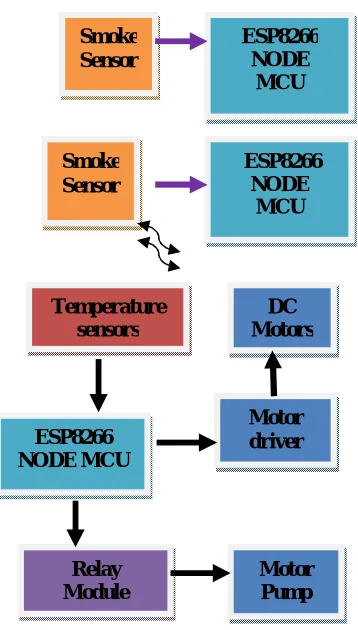
From the block diagram of the fire fighting robot understand that this is made up of two main blocks one is Robot, and another is fire detection side.
A. Robot Unit
The robot is a movable small size which is built with two temperature sensors, a tiny water tank mounted on it, water pump to spray the water, battery as power supply, and Node MCU as a Wi-Fi module to make the connections and communicate with the fire detection side.
B. Fire Detection Unit
Fig. 1 Block Diagram.
1) Temperature Sensor
Fig. 2 Temperature sensor (DHT11) Specification of Temperature Sensor
a) Measurement Range :20-90%RH 0-50
b) Accuracy:25 &0-50
c) Response Time (Seconds):1/e (63%)
2) Smoke/Gas Sensor
Features
a) High sensitivity to CH4, Natural gas.
b) Small sensitivity to alcohol, smoke.
c) Fast response.
d) Stable and long life
e) Simple drive circuit
Motor driver Temperature
sensors
ESP8266 NODE MCU
ESP8266 NODE
MCU Smoke
Sensor
Relay Module
DC Motors
Motor Pump Smoke
Sensor
ESP8266 NODE
Fig. 3 Smoke sensor
V. ALGORITHM
The algorithm of project flow has the following steps
A. Start.
B. Initialize.
C. Check for smoke sensor value.
D. If any sensor cross threshold values?
E. Turn on hotspot of Node MCU of respective sensor node.
F. Initialize Wi-Fi on robot unit.
G. Find the hotspot which is activated.
H. If T1>T2
I. Turn on dc motor 2, 4.
J. If T1<T2
K. Turn on dc motor 1, 3.
L. Else T1=T2
M. Turn on water pump.
N. Stop.
VI. EXPERIMENTALMODEL
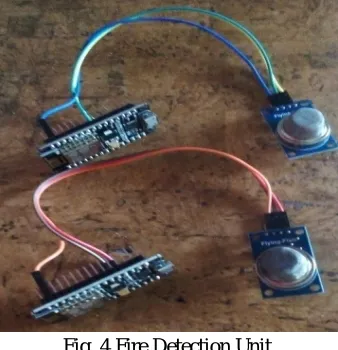
The experimental model contains two units mainly fire detection and robot section. The fig 4 shows the fire detection unit This block is made up of fire sensor or gas sensor which will sense the fire occurrence and if the fire is detected it will switch on the ESP 8266 module so that the robot will be known where the fire is detected by sensing the data from the ESP 8266.Hence our proposed project will work to fight the fire automatically.
Fig. 4 Fire Detection Unit.
[image:4.612.227.396.493.668.2]Fig. 5 Robot unit.
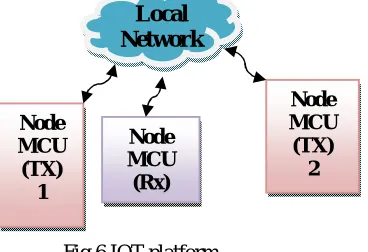
Fig 6 below shows the IOT platform which describes the interconnection of 3 node MCU unit with local network.
Fig.6 IOT platform
VII. OTHERSPECIFICATION
A. Advantages
1) Prevention from dangerous incidents
2) Minimization of –ecological consequences –financial loss –a threat to a human life.
3) Real time fire monitoring and Detection as well as fighting the fire
4) Human less so that Errors are less
5) Saving Human Lives as well as wealth
6) Short Response Time
7) Reduces human effort
8) Detect exact fire source
B. Applications
1) It is used in server rooms
2) In power plant control rooms
3) Industries of power plants.
4) Oil Refineries
5) Petroleum industries
6) Oil And Gas Industries
C. Future Work
We can use the Rasberry pie as controller so that we can control the robot in RSS manner. Also we can reduce required power unit to each component. We can use ultrasonic sensor for avoid the obstructions in path.
Node MCU (TX)
1
Node MCU (Rx)
Node MCU (TX)
2
[image:5.612.236.420.279.405.2]VIII. CONCLUSION
Hence we conclude that we can use the proposed system for detection of fire. The forest, industry areas we can use the fire detection using wireless network. The fire fighting robot will reach its destination and extinguish the fire within less time. Temperature, smoke sensors gives there better accuracy for application
REFERENCES
[1] Yuan C, Zhang Y M, Liu Z X, “A survey on technologies for automatic forest fire monitoring, detection, and fighting using unmanned aerial vehicles and remote sensing techniques,” Canadian Journal of Forest Research, 2015, 45(7):3573-3575.
[2] T X, Kim JM, “An effective four-stage smoke-detection algorithm using video images for early fire-alarm systems,” Fire Safety Journal, 2011, 46(5):276-282.
[3] M. S. Bin Bahrudin, R. A. Kassim, and N. Buniyamin, “Development of Fire alarm system using Raspberry Pi and Aurdino Uno,” 2013 Int. Conf. Electra Syst.
Eng. ICEESE 2013, pp. 43–48, 2013.
[4] S. Chandana, “Real time video surveillance system using motion detection, “dept. of Electron. & Commun. Eng., Dayananda Sagar Coll. of Eng., Bangalore,
India
[5] Y Appu Solom1, R Bhargav2, M P David Kingsley3, Nikil Sathish, “Internet Controlled Robotic System Using Raspberry Pi,”U.G Student, Department of
ECE,Adhiyamaan College of Engineering, Hosur, Tamilnadu, India1,2,3
[6] SonaliK.Kalmegh, Dharmesh, Samra, Nishant .M.Rasegao nka, “Obstacle avoidance for a mobile exploration robot using a single ultrasonic range sensor,”
Department of Information Tech. Jawaharlal Darda Institute of Eng. & Tech. Yavatmal (M.S).
[7] Wang Zai-ying, “Design of mobile phone video surveillance system for home security based on embedded system,” School of Electrical and Control
Engineering, Xi'an University of Science and Technology, Xi'an 710054, China, Chen Liu School of Electrical and Control Engineering, Xi'an University of Science and Technology, Xi'an 710054, China
[8] Ahmad AA, “Wireless Sensor Network for Forest Fire Detection and Decision Making,” International Journal of Advances in Engineering Science and
Technology 299-309, 2015.
[9] Hongyan, “Research and Implementation of Historical Building Wireless Fire Monitoring System,” Ninth International Conference on Intelligent Information
Hiding and Multimedia Signal Processing, 2013, pp. 575-577 Books