Uncontrolled headache induced
by oxcarbazepine
Elcio Juliato Piovesan Helio Ghizoni Teive Luciano de Paola Carlos Eduardo Silvado Ana Crippa
Vanise Campos Gomes Amaral Marcos Vinicius Della Colleta Fabrizio Di Stani
Lineu Cesar Werneck
Abstract Headache induced by acute exposure to a specific drug constitutes an idiosyncratic side effect. Metabolic imbalanceff appears as the leading aetiology, among several other hypotheses. Either primary headaches show a higher susceptibility to this idio-syncratic reaction or a drug-induced primary headache evolves in intensity and duration, becom-ing uncontrolled until the complete discontinuation of the drug in con-sideration. The goal of this study is to describe three patients diag-nosed with migraine and epilepsy (both under control) who evolved into status migrainosus after the introduction of oxcarbazepine (OXC), as part of a switch off from carbamazepine (CBZ). Twenty-four to seventy-two hours following the switch, all patients
developed intractable headache, despite the use of different symp-tomatic drugs. Complete recovery of the headache symptoms occurred only after OXC was dis-continued. WeWW discuss the potential mechanisms associated to OXC and status migrainosus, drug-induced headaches and uncon-trolled headaches.
KeywordsHeadache • Migraine • Oxcarbazepine • Side effects • Status migrainosus
Received: 2 August 2007
Accepted in revised form: 20 September 2007 Published online: 25 October 2007
E.J. Piovesan (쾷) • H.G. Teive • L. de Paola • C.E. Silvado • A. Crippa • V.C.G. Amaral • M.V. Della Colleta • L.C. Werneck Headache Clinic, Neurology Service, Department of Internal Medicine, Hospital de Clínicas,
Federal University of Paraná, Rua General Carneiro 181, 120 andar, sala 1236,
CEP-80060-900, Curitiba – Paraná, Brazil e-mail: [email protected] Tel.: +41-3283-5512
Fax: +41-3283-5512
F. Di Stani
Department of Neurological Sciences -University of Rome "La Sapienza” Rome, Italy
Introduction
Headaches induced by acute substance use or exposure are common conditions in which there is a clear relationship between the onset of symptoms and the intake of one drug for therapeutic purposes. The Second Edition of the International Classification of Headache Disorders (ICHD-II) subdivided this group in 11 subgroups [1]. Nitric oxide, phosphodiesterase inhibitors, carbon
monox-ide, alcohol, monosodium glutamate, cocaine, cannabis, histamine and calcitonin gene-related peptide are the main drugs that induce headaches. However, other drugs or ther-apeutic agents may be involved, depending on various patient susceptibility factors.
to provoke or activate migraine in susceptible individu-als1. The association is often based on anecdotal data and reports of adverse drug reactions. Thus, the mere use of a given drug leading to headache does not prove causation, because these common events happen commonly and probably reflect a pure coincidence. Headache can be a symptom of a systemic disease, and drugs given to treat such a condition will be associated with headache. In acute migraine drug trials, headache, as well as associated symp-toms, is listed as an adverse drug reaction despite the fact that it is a symptom of the treated disorder and not the result of the treatment. However some acute or chronic substance exposures have been proven to be causally relat-ed to headache. Mrelat-edications are a well known cause of secondary headache, especially in the elderly.
A variety of drugs can induce headache (Table 1). Interestingly, some are commonly employed as either pre-ventive or symptomatic medications in the treatment of migraine or other headaches [2,3]. Vasodilation and increase of intracranial pressure are some of the putative mechanisms underlying drug-related headaches.
Three patients in whom oxcarbazepine (OXC) is poten-tially implicated in the development of status migrainosus are presented. WeWW reviewed the literature and discuss con-cepts that may be related to such cases in the context of uncontrolled headache and drug-induced headaches.
Materials and methods
Patient 1
A 33-year-old female was referred to the Headache Clinic due to
severe and intractable headache. She started having headaches at the age of 10, with unilateral, pulsating headache, associated with photophobia, phonophobia, nausea and vomiting, lasting from 6 to 18 h. Typically, the headache attacks were related to the menses and tended to subside entirely following the use of 50 mg of sumatrip-tan. At age 16 the patient presented with secondarily generalised seizures. MR imaging showed a small mass on the left temporal lobe, consistent with a dysembryoplastic neuroepithelial tumour. She was put on carbamazepine (CBZ) and subsequently on leve-tiracetam with poor results. CBZ (at daily dose of 1400 mg) was switched to OXC (at daily dose of 2100 mg), as an attempt to improve her seizure control. On day 2 of OXC a diffuse pulsating headache of severe intensity, associated with nausea and vomiting and aggravated by physical activity, was reported. By the time of her evaluation at the outpatient clinic the headache had proven to be resistant to oral sumatriptan (100 mg), IV metroclopramide, Cox-2 inhibitors, IM nonsteroid anti-inflammatory (NSAI), IV dexam-ethasone (4 mg) and IV chlorpromazine. She was admitted for fluid hydration. OXC was discontinued and CBZ was reintroduced lead-ing to complete headache cessation within a 48-h period. Sodium levels were not requested during admission.
Patient 2
A 38-year-old female was referred to the Headache Clinic due to disabling headaches. At age 13 she started with visual and/or senso-ry symptoms evolving gradually over approximately one hour, fol-lowed by headache. The latter was unilateral, pulsating and moder-ate to severe in intensity pain, lasting up to 24 h. Associmoder-ated symp-toms included nausea and vomiting. At the onset of sympsymp-toms the attacks occurred 3 times a month but frequency had increased sig-nificantly over the past 8 years. MR imaging showed a large vascu-lar malformation in the right occipital lobe. An attempt at
intravas-Table 1 T
T Drugs that may induce headache or worsen pre-existing headache [1-3]
Acetazolamine Didanosine Isoniazid Perhexiline
Ajmaline Dihydralazine Meprobamate Primidone
Amantadine Dihydroergotamine Methaqualone Propranolol
Antihistaminics Dipyridamole Metronidazole Prostacyclines
Atenolol Disopyramide Metoprolol Ranitidine
Barbiturates Disulfiram Morphine Rifampicin
Beta-interferon Ergotamine Nalidixic acid Sildenafil
Bromocriptine Ethynilestradiol Nifedipine Tamoxifen
Caffeine Gestagens Nitrofurantoin Tetracycline
Calcium antagonists Glycerol trinitrate Nitrates Theophylline
Carbimazol Glycosides Non steroidal anti-inflammatory Thiamazole
Chinidine Griseofulvin Octreotide Trimethoprim+sulfamethoxazole
Chloroquine Guanathidine Oestrogens Triptans
Cimetidine Immunoglobulins Omeprazole Verapamil
Clofibrate Indomethacin Ondansetron Vitamin A
Codeine Interferons Paroxitine Oxcarbazepine
cular treatment (embolisation) was complicated by intracerebral haemorrhage (including intraventricular bleeding) that required surgical drainage and the placement of a ventriculoperitoneal shunt. Shortly after the procedures, simple partial seizures with secondary generalisation developed. She was put on CBZ 600 tid and clobazam 10 mg/day. In spite of adequate seizure control the patient complained of dyspepsia and weight gain. CBZ was replaced by OXC 1200 mg (daily dosage). Hours after the switch the headache transformed into daily, severe, bilateral, pulsating pain, accompa-nied by nausea and vomiting, photo- and phonophobia, increasing with physical effort. The patient was admitted and treated with IM NSAI, IV metroclopramide, IV dexamethasone and IV chlorpro-mazine with virtually no results. Sodium levels were not obtained. OXC was withdrawn and CBZ was re-established, leading to com-plete remission of the symptoms within a 3-day period.
Patient 3
A 30-year-old female was referred to the Headache Clinic due to intractable epilepsy. Headaches started at age 12, with bilateral, pul-sating and severe pain, associated with nausea, vomiting, photo-and phonophobia, lasting up to 32 h. Headaches occurred twice a month and were easily treated by oral isometheptene. History was also positive for primary generalised epilepsy. Interestingly, the patient was seizure-free on 1200 mg (daily dose) of CBZ. For unclear reasons the primary physician decided to switch the patient to OXC 1800 mg (daily dose), after which she developed severe, pulsating, holocranial pain, increased by movement and associated with nausea, vomiting, photo- and phonophobia. IM metroclo-pramide, IV ketoprofen and SC sumatriptan were tried at the outpa-tient clinic. The paoutpa-tient was admitted and tried on IV dexametha-sone and IV chlorpromazine with no results. OXC was discontinued and CBZ reintroduced. The pain subsided over a 3-day period.
All subjects provided written informed consent, as required by the appropriate local committee (Human Ethical committee of Universidade Federal do Paraná) on the protection of research subjects.
Discussion
We report on three cases of OXC-induced difficult-to-con-trol pain suggesting status migrainosus and subsequently bona fide intractable headache. We felt that an association between both headache and OXC, status migrainosus and OXC and intractable headache and OXC could be clearly established, as symptoms developed shortly after the intro-duction of the drug and completely subsided following its withdrawal.
OXC is a new antiepileptic (AED), available since 1990, which has been proven effective in the treatment of
partial seizures [4]. Hyponatraemia, defined as serum sodi-um concentration of 134 mEq/l or less, tends to occur in about 30% of OXC-treated patients and may be severe (i.e., serum sodium below 128 mEq/l) in 12% of the patients [5]. This effect is thought to be mediated by either a direct action of the drug on the renal collecting tubules or an enhancement of their responsiveness to circulating antidiuretic hormone [6].
Serum sodium levels maybe relevant, as shown in a recent paper describing OXC-induced headache [7]. That was a single case in which hyponatraemia (131 mEq/l) was detected during the course of the headache and improved (141 mEq/l) after OXC withdrawal, when the patient became free of symptoms. Hyponatraemia manifests itself by headache, dizziness and lethargy, though such symp-toms are rarely seen with serum sodium levels above 125 mEq/l8. However, hyponatraemia might induce headache in predisposed subjects before the appearance of overt encephalopathy, particularly if associated with other drugs. In the previously described case of OXC-induced headache the patient had a positive family history for headache (probably migraine headache) [7].
OXC was evaluated as preventive therapy in patients suffering from migraines in a multicentre, double-blind,ff randomised, placebo-controlled, parallel-group study. The double-blind treatment between the OXC and placebo groups was not statistically significant. In this study, headache, as a side effect in migraine patients, was reportff -ed in 5.9% of the cases [9]. Regretfully, clinical features of this specific population were not described in the study.
The IHS defines status migrainosus as an attack of migraine, the headache phase of which last more than 72 h whether it is treated or not [1]. Factors responsible for trig-gering status migrainosus include emotional stress, depres-sion, abuse of medications, anxiety, diet, hormonal factors and multiple nonspecific factors [10]. Status migrainosus may be secondary to an acute neurologic disorder. However, acute central nervous system events can trigger an otherwise typical migraine.
Patients with status migrainosus can evolve to intractable headache. Intractable is defined as uncontrol-lable, refractory or unmanageable [11], and thus the term can be used for a headache that requires either acute or preventive treatment [12]. Recently, criteria of uncon-trolled headache have been suggested for preventive treat-ment: failure of at least four classes, where three should come from 1–4 groups of medicines, including (1) ‚-block-ers; (2) anticonvulsants; (3) calcium channel block‚-block-ers; (4) tricyclic antidepressants; (5) other treatments with at least one positive randomised controlled trial; (6) non-steroidal anti-inflammatory drugs; and (7) metabolic enhancers, such as vitamin B2 or coenzyme Q10.
sug-gested until the present moment, we used this term to refer to the three cases that used different lines of the acute treatment for migraine with no success, for a period over 72 h. Only after the OXC was discontinued did the pain subside, reinforcing a direct relationship between OXC and pain in those cases.
When a new headache occurs for the first time in close temporal relation to substance exposure, it is coded as a secondary headache attributed to the substance. This is also true if the headache has the characteristics of migraine, tension-type headache or cluster headache. When a pre-existing, primary headache, as in our cases, is made worse in close temporal relation to substance expo-sure, there are two possibilities, and careful judgement is required [1]. The patient can either be given only the diag-nosis of the pre-existing primary headache or be given both this diagnosis and the diagnosis of headache attrib-uted to the substance. A very close temporal relationship to the substance exposure, a marked worsening of the pre-existing headache, very good evidence that the substance can aggravate the primary headache and, finally, improve-ment or resolution of the headache after termination of effect of the substance [1] are required. Headaches attrib-uted to medication are not very well defined in the litera-ture but most are dull, continuous, diffuse and moderate toff severe intensity. The diagnostic criteria are described in Table 2.
We W
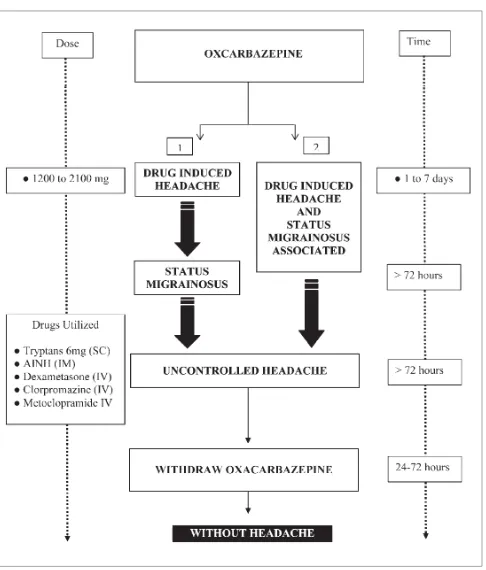
W devised two working hypothesis regarding our 3 cases. First, OXC-induced headache and the pain were directly related to acute medication and symptoms were exclusively related to OXC. Secondly, OXC-induced headache and the pain were directly related to acute medica-tion, however, the patients, who had a primary headache his-tory – in these cases, migraine – developed a migraine attack that progressed to status migrainosus, and finally intractable headache (Fig. 1). We will provide substantial evidence for both hypotheses.
Symptoms may be related exclusively to OXC as their onset took place one hour after its introduction and patients experienced complete remission within 72 h fol-lowing OXC withdrawal. Standard medications for the treatment of acute migraine attacks failed to resolve the symptoms in all patients. Interestingly enough, headaches induced by medication are generally not severe in intensi-ty and the nausea and vomiting promptly subside. That was not the case in our patients, who required admission, IV fluids and IV metoclopramine.
OXC evolving into status migrainosus is suggested by the presence of severe persistent headache, often associat-ed with nausea and vomiting, seen in all our patients.
It seems that status migrainosus could be induced by OXC as this drug produces hyponatraemia, an atypical situ-ation of the brain. Unfortunately we are unable to provide complete data in that regard, as sodium levels were not mon-itored during admission in all cases. The literature suggests that in newly diagnosed cases of status migrainosus a sec-ondary aetiology must be sought after and OXC may be the case in our patients. The interactions of OXC and other med-icines utilised in our patients could also explain the induced status migrainosus, but the relationship between headache and OXC was seemingly clear.
Fig. 1 Sequence of the events of OXC-induced headache and status migrainosus
Table 2International Headache Society classification for headache as an acute adverse event attributed to medication used for other indications [1]
8.1.10. Diagnostic criteria:
A. Headache fulfilling criteria C and D
B. Use of a medication for a therapeutic indication other than headache C. Headache develops within minutes to hours after use
References
1. Headache Classification Committee of the International Headache Society. The International Classification of Headache Disorders, 2nd Edition (2004)
Cephalalgia 24 [Suppl 1]:1–160 2. Askmark H, Lundberg PO, Olsson S
(1989) Drug related headache. Headache 29:441–444
3. Monteiro JM, Dalhof CG (2000) Single use of substances. In: Olesen J, Tfelt-Hansen P, Welch KMA, (eds) The headaches. Lippincott Williams & Wilkins, Philadelphia 861–869 4. Glauser TA (2001) Oxcarbazepine in
the treatment of epilepsy. Pharmacotherapy 21:904–919 5. Dong X, Leppik IE, White J, Rarick J
(2005) Hyponatremia from oxcar-bazepine and carbamazepine. Neurology 65:1976–1978
6. Sachdeo RC, Wasserstein A, Mesenbrink PJ, D´Souza J (2002) Effects of oxcarbazepine on sodium concentration and water handling. Ann Neurol 51:613–620
7. Palmieri A (2007) Oxcarbazepine-induced headache. Cephalalgia 27:91–93
8. Goh KP (2004) Management of hyponatremia. Am Fam Physician 69:2387–2394
9. Saper J, Silberstein S, Somogyi M, McCague K (2005) Efficacy and safety of oxcarbazepine in patients with migraine headaches: a multicenter, double-blind, randomized, placebo-controlled study. Neurology (P05):152 9. Couch JR, Diamond S (1983) Status
migrainosus: causative and therapeutic aspects. Headache 23:94–101
10. Oxford English Dictionary. http//dic-tionary.oed.com. Last accessed 20 March 2007
11. Goadsby PJ, Schoenen J, Ferrari MD et al (2006) Towards a definition of intractable headache for use in clinical practice and trials. Cephalalgia 26:1168–1170
![Table 1TDrugs that may induce headache or worsen pre-existing headache [1-3]](https://thumb-us.123doks.com/thumbv2/123dok_us/9556355.1938612/2.618.65.560.518.710/table-tdrugs-induce-headache-worsen-pre-existing-headache.webp)