152
_______________________________________________________________
_______________________________________________________________
DEVELOPMENT, STANDARDIZATION AND VALIDATION OF
HPLC METHOD FOR ESTIMATION OF βSITOSTEROL IN
VITEX
NEGUNDO
SEED EXTRACT
Divya K Shetty* and Swati S Patil
Dept. of Pharmacognosy and Phytochemistry, Prin. K. M. Kundnani College of Pharmacy, Cuffe Parade, Colaba, Mumbai – 400005, Maharashtra, India.
ABSTRACT
A simple, precise and accurate high-performance liquid chromatographic method has been developed for determination of β-sitosterol in the hydroalcoholic extact of Vitex negundo Linn. A Reverse phase HPLC column CrestPack RP C18 (Make: Jasco; 250 mm x 4.6 mm I.D; particle size 5μm) was used as stationary phase with a mobile phase comprising of acetonitrile : methanol (70:30) v/v at a flow rate of 1.0 mL min-1 and UV detection at 210nm with a run time of 6 mins. The proposed method was validated for linearity, accuracy, precision, LOD and LOQ. LOD for beta-sitosterol was found to be 0.5µg/mL whereas LOQ for the same was found to be 1.5µg/mL. The method was found to be linear over the range 1 µg/mL to 5µg/mL with coefficient of regression 0.9732 for betasitosterol. Intra-day and inter-day precision studies showed % RSD to be less than 2 and hence the method was precise. Stock solution stability studies were carried out for beta-sitosterol. Stability samples in methanol after a week revealed that all beta-sitosterol in solution form were stable. The validated HPLC method can be used for a routine quality control analysis and quantitation of β-sitosterol from Vitex negundo Linn.
Key words: β-sitosterol, HPLC, nirgundi, validation, Vitex negundo, seed extract. INTRODUCTION
Vitex negundo belonging to family Verbenaceae is a large aromatic shrub distributed throughout the greater part of India up to an altitude of 1500 meter in the Himalayas. The shrub is very common in many part of the country and often occurs gregariously. It is abundant along the banks, rivers in moist situations, and open waste lands. It is widely planted as hedge plant along the roads and between fields. The shrub can be reproduces readily from cutting and as it produces roots, suckers it is useful for planting against soil erosion [1]. The traditional systems of Siddha and Ayurvedic medicine use this plant alone or in combination with other medicinal plants for the treatment of various diseases. It contains various chemical classes such as steroids, flavonoids, glycosides, alkaloids, proteins, tannins and phenolic compounds. One of the important constituent being betasitosterol.
β-Sitosterol is white, waxy phytosterol (plant sterols) with chemical structures similar to that of cholesterol. It is widely distributed in the plant kingdom [2] responsible for reduction of cholesterol level in plasma [3] and improves liver function activity (GDP, GOP) [4].
HPTLC [5-9] and HPLC [2,10,11] methods have also been reported for analysis of β- sitosterol either individually or in combination with other marker compounds. Over the past decade HPLC has been successfully used in the analysis of pharmaceuticals, plant constituents, and biomacromolecules [12]. A major advantage of HPLC is that it has the ability to easily separate a wide variety of chemical mixtures. Hence the present study was undertaken to develop and validate simple, accurate, precise and robust analytical procedure for estimation of β-sitosterol in Vitex negundo seed extract by HPLC.
MATERIAL AND METHODS Collection
Vitex negundo Linn. (Chaste tree) seeds were collected from the local market Borivali, Mumbai, Maharashtra in the month of June 2013.Authentication of the collected material was carried out at Blatter Herbarium St. Xavier’s College, Mumbai by Dr. Rajendra D. Shinde, and its identity was confirmed to be Vitex negundo Linn. (Chaste tree), family Verbenaceae, with herbarium
*Corresponding Author Divya K Shetty E mail: [email protected]
International Journal
of
Pharmacy Review & Research
www.ijprr.com
153 accession no. 2888.
Processing of Vitex negundo Seeds
Vitex negundo seeds were garbled and unwanted plant parts, was remove. Seeds were then allowed to dry at room temperature. Dried seeds were ground to powder in mixer and sieved through 20# to get seed powder.
Extraction
Extraction of seeds of Vitex negundo was carried in soxhlet extractor using ethanol and water (70:30) as solvent. 100gm of dried and powdered seeds were weighed and packed in filter paper, then extracted with solvent (500ml) at a temperature not exceeding 80ºC in a soxhlet apparatus for 72 hrs. After completion of extraction the solvent was evaporated in evaporating dish on the water bath to obtain dry extract. The weight of dry extract was taken to find out extractive value. The extractive value of the hydroalcoholic extract of V. negundo was found to be 6.4%w/w.
Quantification of β-sitosterol in V.negundo seed extract Instrumentation
The analysis of the drug was carried out on a Jasco LC system equipped with 2089 pump and photo-diode array detector (PDA) was used and a Reverse phase HPLC column CrestPack RP C18 (Make: Jasco; 250 mm x 4.6 mm I.D; particle size 5μm) was used. The output of signal was monitored and integrated using Chromnav software.
Chemicals and solvents
Milli-Q Water, Acetonitrile (ACN) (HPLC Grade), Methanol (MeOH) (HPLC Grade) was obtained from Merck, Mumbai.
Mobile phase preparation
Prepare a filtered and degassed mixture of Acetonitrile and Methanol in the ratio of 70:30 v/v respectively.
Standard preparation
Accurately weigh and transfer about 10 mg of beta sitosterol into a 10 ml volumetric flask, add 4 ml of Methanol, sonicate to dissolve and dilute to volume with Methanol to yield solutions of 1000 µg/mL. This solution was further diluted equimolarly to give stock solution of 100 µg/mL concentration. Further dilutions were made as required with methanol.
Sample preparation
Accurately weigh and transfer about 100 mg of
Vitex negundo seed extract into a 10 ml volumetric flask, add 4 ml of Methanol, sonicate to dissolve and dilute to volume with Methanol to yield solutions of 10000 µg/mL.
Chromatographic conditions
CrestPack RP C18 (Make: Jasco; 250 mm x 4.6 mm I.D; particle size 5 μm) Column was used for analysis at ambient column temperature. The mobile phase was
pumped through the column at a flow rate of 1.0 ml/min. The sample injection volume was 20 μl. The photodiode array detector was set to a wavelength of 210 nm for the detection and Chromatographic run time was 6 minutes.
RESULTS AND DISCUSSION 1) Method development
Choice of column
Choice of the column was made depending on the physicochemical properties of the drug. Since beta-sitosterol is hydrophobic in nature therefore reverse – phase chromatography was considered to be the best choice. C18 column being more hydrophobic as compared to C8, retention of drug on C18 column was better. Hence C18 column was selected.
Development and optimization of mobile phase
Many mobile phases were initially used however the peaks obtained were broad and retention time was a problem. This was solved by using a different mobile phase ACN: Methanol (70:30) This mobile phase composition resulted in symmetric peak and good retention time.
Detection system
The presence of chromophore makes UV-visible detection more suitable for determination of β-sitosterol using PDA Detector. Selection of λmax was done based on spectrophotometric scan of compounds. Betasitosterol showed appropriate absorption at 210 nm. PDA detector enabled to determine peak identity and purity.
Method validation
The developed RP-HPLC method extensively validated for the determination betasitosterol Content using the following Parameters.
a) Linearity and Range
The calibration curve was prepared by injecting various concentrations of the standard solutions. The calibration plot was found to be linear in the range 1µg/mL to 5µg/mL with a correlation coefficient 0.9732 for betasitosterol.
b) Limit of Detection
The limit of detection (LOD) was obtained by successively decreasing the concentration of beta-sitosterol as long as a signal-to-noise ratio of 3:1 appeared. The LOD for beta-sitosterol was found to be 0.5µg on column (volume of injection was 20µl).
c) Limit of Quantification
The limit of quantification (LOQ) for beta-sitosterol was found to be 1.5µg on column (volume of injection was 20µl).
d) Precision and Accuracy
154 (Intraday) and for a series of experiments in which
standards were assayed in over several experiments (Interday).
e) Specificity and Selectivity
The method was quite selective for beta-sitosterol since there was no other interfering peak around their retention time. The baseline did not show any significant peak.
f) Stability
The stability studies was evaluated for three different concentration i.e. 2 µg/mL, 3 µg/mL and 4 µg/mL. For stock solution stability, solutions corresponding to the above three concentrations were stored at refrigerated temperature (2-8oC) for a week. Stability was calculated by comparing the results of six
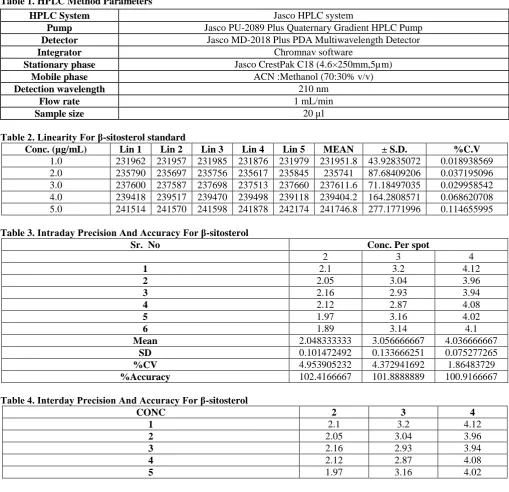
Table 1. HPLC Method Parameters
replicate injections of stored solutions with fresh samples.
Application of Validated Method to The Analysis Of Samples
Sample Preparation
10 mg of dried extract was weighed and diluted suitably with methanol for HPLC analysis.
Content in plants
The extracts of samples were injected in the concentration that would fall within the linearity of standards injected. For calculation, from the calibration curve we get concentration for extract.Amount of betasitosterol present in the hydro-ethanolic extract of
V.negundo seeds is approximately 0.7266 % w/w. Therefore amount of betasitosterol present in the seeds is 0.0465%w/w.
Table 2. Linearity For β-sitosterol standard
Conc. (µg/mL) Lin 1 Lin 2 Lin 3 Lin 4 Lin 5 MEAN ± S.D. %C.V 1.0 231962 231957 231985 231876 231979 231951.8 43.92835072 0.018938569 2.0 235790 235697 235756 235617 235845 235741 87.68409206 0.037195096 3.0 237600 237587 237698 237513 237660 237611.6 71.18497035 0.029958542 4.0 239418 239517 239470 239498 239118 239404.2 164.2808571 0.068620708 5.0 241514 241570 241598 241878 242174 241746.8 277.1771996 0.114655995
Table 3. Intraday Precision And Accuracy For β-sitosterol
Sr. No Conc. Per spot
2 3 4
1 2.1 3.2 4.12
2 2.05 3.04 3.96
3 2.16 2.93 3.94
4 2.12 2.87 4.08
5 1.97 3.16 4.02
6 1.89 3.14 4.1
Mean 2.048333333 3.056666667 4.036666667
SD 0.101472492 0.133666251 0.075277265
%CV 4.953905232 4.372941692 1.86483729
%Accuracy 102.4166667 101.8888889 100.9166667
Table 4. Interday Precision And Accuracy For β-sitosterol
CONC 2 3 4
1 2.1 3.2 4.12
2 2.05 3.04 3.96
3 2.16 2.93 3.94
4 2.12 2.87 4.08
5 1.97 3.16 4.02
HPLC System Jasco HPLC system
Pump Jasco PU-2089 Plus Quaternary Gradient HPLC Pump Detector Jasco MD-2018 Plus PDA Multiwavelength Detector
Integrator Chromnav software
Stationary phase Jasco CrestPak C18 (4.6×250mm,5µm)
Mobile phase ACN :Methanol (70:30% v/v)
Detection wavelength 210 nm
Flow rate 1 mL/min
155
6 1.89 3.14 4.1
7 2.16 3.15 4.11
8 1.98 3 3.93
9 2.17 2.97 3.94
10 2.02 2.89 4.15
11 1.99 3.06 4.01
12 1.86 3.1 4.08
Mean 2.039166667 3.0425 4.036666667
SD 0.105352942 0.111202109 0.079696394
%CV 5.166470397 3.654958396 1.97431198
% Accuracy 101.9583333 101.4166667 100.9166667
Table 5. Stability For β-sitosterol
Sr. No.
Conc. of Fresh Solution Conc. of Stability Solution 2 µg/mL 3 µg/mL 4 µg/mL 2 µg/mL 3 µg/mL 4 µg/mL
1 2.1 3.2 4.02 2.06 3.05 4.01
2 2.05 3.04 3.96 1.98 3 3.93
3 2.06 2.97 3.94 2.07 2.97 3.97
4 2.11 2.97 4.08 2.02 2.89 4.1
5 1.97 3.06 4.02 1.99 3.06 4.01
6 1.93 3.09 4.1 1.87 3.02 4.08
MEAN 2.037 3.055 4.02 1.9983 2.9983 4.017
±S.D 0.072 0.085 0.063 0.072 0.062 0.064
% CV 3.536 2.814 1.573 3.628 2.082 1.603
% STABILITY 101.833 101.833 100.5 99.917 99.944 100.416
Table 6. HPLC Calibration Data
Conc. Area
1 µg/ml 231962
2 µg/ml 235790
3 µg/ml 237600
4 µg/ml 239418
5 µg/ml 241514
extract (10000µg/ml) 395612
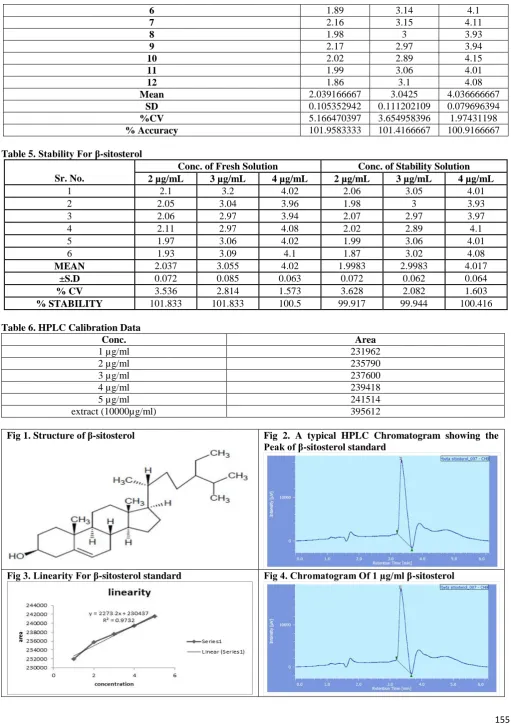
Fig 1. Structure of β-sitosterol Fig 2. A typical HPLC Chromatogram showing the Peak of β-sitosterol standard
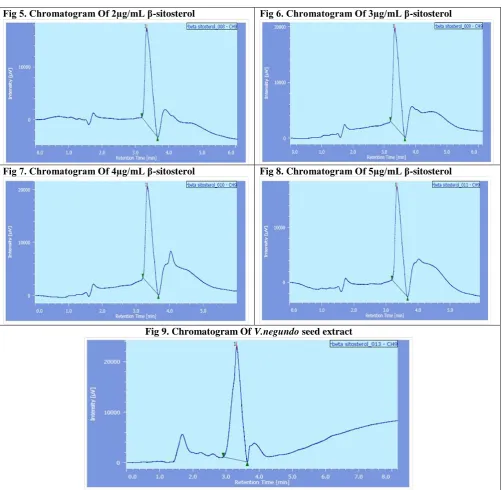
156 Fig 5. Chromatogram Of 2µg/mL β-sitosterol Fig 6. Chromatogram Of 3µg/mL β-sitosterol
Fig 7. Chromatogram Of 4µg/mL β-sitosterol Fig 8. Chromatogram Of 5µg/mL β-sitosterol
Fig 9. Chromatogram Of V.negundo seed extract
CONCLUSION
We have developed a fast, simple and reliable analytical method for determination of betasitosterol in
Vitex negundo seed extract using HPLC. It is very fast, with good reproducibility and good response. Validation
of this method was accomplished, getting results meeting all requirements. The method is simple, reproducible, with a good accuracy and precision. It allows reliable analysis of betasitosterol in Vitex negundo seed extract.
REFERENCES
1. Gupta M, Mazumdar UK and Bhawal SR. CNS activity of Vitex negundo Linn. in mice. Indian J Exp Biol, 37, 1999, 143-146.
2. Kakade AN, Magdum CS. HPLC analysis of β-sitosterol in herbal medicine and vegetable oils. Int J Pharm & Life Sci
(IJPLS) 3(5), 2012, 1666-1669.
3. MacLatchy DL, Van Der Kraak GJ. The phytoestrogen betasitosterol alters the reproductive endocrine status of goldfish.
Toxicol Appl Pharmacol, 134, 1995, 305-312.
4. Zak A, Vecka M, Tvrzicka E, Hruby M, Novak F, Papezova H, Lubanda H, Vesela L, Stankova B. Composition of plasma fatty acids and non-cholesterol sterols in anorexia nervosa. Physiol Res, 54, 2005, 443-451.
157 6. Dighe V, Adhyapak S, Tiwari K. Quantitation of β-sitosterol from Celastrus paniculatus Willd. using validated high
performance thin layer chromatography method. Int Pharma and Bio Sci, 2(2), 2011, 117-123.
7. Shailajan S, Shah S, Sayed N. HPTLC method development and validation of a secondary metabolite – β - sitosterol from
Caesalpinia Bonduc (linn.) Roxb. Emend. Dandy & exell. Seeds. Int Pharma and Bio Sci, 1(3), 2010, 1-10.
8. Bumrela SB, Naik SR. Identification of β-carotene and β- sitosterol in methanolic extract of Dipteracanthus patulus (Jacq) nees and their role in antimicrobial and antioxidant activity. Int J Phytomed, 3, 2011, 204-215.
9. Misar A, Mujumdar AM, Ruikar A, Deshpande NR. Quantification of β-sitosterol from barks of three Acacia species by HPTLC. J Pharm Res, 3(11), 2010, 2595-2596.
10. Lopez Ortiz CM, Prats Moya MS, Berenguer NV. A rapid chromatographic method for simultaneous determination of β- sitosterol and tocopherol homologues in vegetable oils. J Food Compos Anal, 19, 2006, 141-149.
11. Nair VDP, Kanfer I, Hoogmartens J. Determination of stigmasterol, beta-sitosterol and stigmastanol in oral dosage forms using high performance liquid chromatography with evaporative light scattering detection. J Pharmaceut Biomed, 41, 2006, 731-737.
12. Kadam AB, Havele SS, Dhaneshwar SR.Validated HPTLC method for simultaneous estimation of lafutidine and domperidone in bulk drug and formulation. Int J Pharm Pharm Sci, 4(4), 2012, 221-225.