55 Available online at www.ijiere.com
International Journal of Innovative and Emerging
Research in Engineering
e-ISSN: 2394 – 3343 p-ISSN: 2394 – 5494
SMART BIN
Akshay Goyal
a, Kshitij Shinghal
b, Aastha Gupta
c,Akash Diwakar
d,Kanika Rastogi
da B.Tech Student, Electronics Department, Railway Station Road, Bijnor, India b Associate Prof. & Dean, Electronics Department, Ram Ganga Vihar, Moradabad, India
c B.Tech Student, Electronics Department, Malviya Nagar, Moradabad, India d B.Tech Student, Electronics Department, Faiz Ganj, Moradabad, India e B.Tech Student, Electronics Department, Ram Ganga Bihar, Moradabad, India
Abstract:
Being aware of the current situation of waste management in India, this project has been initiated. Even after so many initiatives taken up by PM Shri Narendra Modi, not much improvement have been seen in the situation of Waste Management. In order to support our Prime Minister in the best way we could, we have come up with the solution for the littering of the waste and overflowing of the garbage bins by using the sensor technology and placing them inside the bins thus, naming such bins as Electronic bins or Smart bins.
Keywords: Arduino, GSM module, RF module, Ultrasonic, LCD.
I.Introduction
As human population grow, so does the demand for and consumption of resources and consumer goods. If not properly disposed of, these types of garbage accumulate quickly and pose significant harms. The increased volume of trash threatens standards of hygiene at micro and macro levels. Improper disposal of trash jeopardizes the health of human and animal residents in towns, cities and entire nations. Waste and garbage containing organic matter, such as food particles, frequently attracts scavenger animals, such as bears and raccoon.
These animals find their way into loosely secured trash bins, scattering trash and spread of bacteria and pathogens in the process. Improperly disposing waste also causes aesthetic harm, an unslightly piles of trash build up in communities. To avoid contributing to the global problem of trash disposal, the proposed system of continuously monitoring the status of garbage bins is a good place to start.
The problem in the present scenario is that sometimes the bins are full and the garbage vans don’t pick up the garbage due to which garbage bins overflows and litter on the road and sometimes when a garbage when reaches to pick up the garbage the garbage bins are empty this causes the wastage of fuel of the van.
The absence of efficient waste management has caused serious environmental problems and cost issues. Therefore, these Electronic bins are proposed to reduce the amount of waste as much as possible. In an electronic bin, battery-based garbage bins deliver the information wirelessly to the authority using GSM module and analyse the information for service provisioning. The main objective of this system is to:
Reduce the amount of waste overflowing from the bins.
Create a change in perception and raise a global awareness for the long term.
Implement the process in house works, farms and among the tourist sector around the globe, by efficiency and improvement of recycling services.
Make the young generation a change agent of the environmental change.
II. Literature Survey
In [1], they proposed a system which consists of Zigbee, GSM and ARM7 controller. Sensors are used in this system which senses the level of garbage and give the data to the controller. The controller will further send the data to the driver of the garbage collecting truck using GSM.
In [2], they presented a model which consists of a camera and load sensors which monitor the status and the weight of the garbage in the bins. The output of the camera and load sensor is compared with a threshold value and accordingly the information is transmitted to the authorities.
In [3], they proposed a method to dispose waste with the help of wireless sensor networks (WSN), using VANETs (Vehicular Ad-hoc Network). Multicast routing is proposed to be implemented in garbage collecting vehicles and IEEE 802.11p protocol has been adopted. This project is not economical.
56 In [5], their objective was to determine the characterization of the waste and the current system of management activities. It gives an overview of the current municipal solid waste management (MSWM) system of Thoubal Municipality and it concludes with a few suggestions, which may be beneficial to the authorities to work towards further improvement of the current management systems.
III.Components & Tools Used Hardware Used:
1) Arduino Nano
2) Arduino Uno
3) Ultrasonic Sensor(HC-SR04)
4) RF module
5) GSM module
Software Used 1) Arduino
2) Proteus
IV.Construction & Working
Fig. 1: Flow Chart of Proposed System
Basically construction and working of this project is divided into three modules.
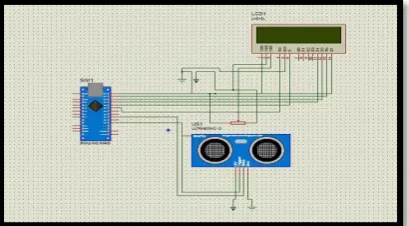
Very first module is developed with the help of a microcontroller board arduino nano and a ultrasonic sensor HCSR 04, combination of these two components are used for calculating the level of Garbage in the bins, a program is developed in such a way that the data collected by microcontroller with the help of ultrasonic sensor can be directly converted into level of garbage filled in the garbage bin, it gives the level in centimetres and this converted data is used for comparison with the threshold level of garbage, if threshold level is reached a notification is to be generated to immediately clean the garbage bin.
Fig. 2: Proteus Simulation of Module 1. Fig.3: Ultrasonic Sensor(HC-SR04) STA
Check whether dustbin is
Send message to authority
57 As it is shown in the figure ultrasonic sensor has 4 pins, named as VCC, GND, Trigger and Echo. VCC is for +5 volt supply, ground pin is to be connected to the ground (zero potential) and trigger and echo is connected to the pins D2 and D4 of the microcontroller.
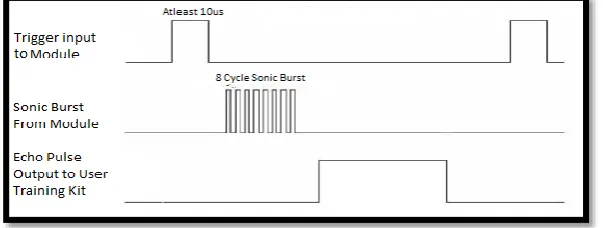
Fig. 4: Timing Diagram for Ultrasonic Sensor
Working of ultrasonic sensor can be easily understood by its timing diagram, 1) a high signal is given to the trigger pin for at least 10 microsecond.
2) A 8 cycle ultrasonic signal of 40 khz frequency is launched by the ultrasonic sensor.
3) At last the ECHO pin generates a output signal when it receives the echo of the transmitted wave.
Fig 5: Circuit for Module 1
As we already know the speed of the sound wave distance travelled by the ultrasonic wave can be calculated by finding the time lapse by the echo pin to turn high after the triggering of trigger pin. This is done with the help of a program and after that a simple formula is used to calculate the distance.
distance= [high level time x velocity (340m/s)/2]
The velocity of the ultrasonic burst is 340m/s in air. Based on the number of counts by the timer, the distance between the object and transmitter the TRD measurement formula is expressed as:
D = R X T
Which is known as the time/ rate/ distance measurement formula where D is the measured distance, and R is the propagation velocity (rate) in air (speed of sound) and T represents time. In this application T is divided by 2 as T is double the time value from transmitter to object back to receiver. This is the working of module 1.
Second module consists of microcontroller RF transmitter and receiver. This module is used for the wireless transmission of the data collected at the garbage bin to the authority office from where the monitoring of the overall system will take place.
58 An RF Module is a (usually) small electronic circuit used to transmit, receive, or transceiver radio waves on one of a number of carrier frequencies. To secure the data at both the end Encoding and decoding of data is required. We have used RF434 module for wireless communication. RF stands for Radio frequency. And 434 mean this module operates on 434MHz of frequency.
Fig. 8: Circuit of Transmitter side. Fig. 9: Circuit of Receiver side.
This RF module can communicate upto a distance of 100 m in an open space. So this system can be employed in a circular area of radius 100m by keeping the receiver at the centre. A single receiver is enough to take the data from multiple transmitters, only we have to take care that these transmitters should send data at different time, which can be achieved by making some changes in the program at transmitter side.
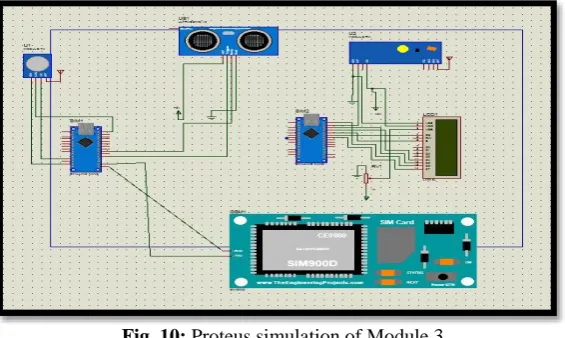
In module 3 we have added a GSM module at the receiver side to send the alert message at the mobile of authority person when the garbage bin is filled so that an immediate action can be taken to empty the garbage bin.
GSM stands for Global System for Mobile Communication. The idea of GSM was developed at Bell Laboratories in 1970. GSM is a open and digital cellular technology use for transmitting mobile voice and data services. It operates at the frequency band of 850MHz, 900MHz, 1800MHz and 1900MHz. It was developed as a digital system using TDMA technique for communication purposes. TDMA stands for Time Division Multiple Access, this technique assigns different time slots to different users at same frequencies. GSM digitalises and reduces data and has an ability to carry 64kbps to120Mbps of data rates. According to the area covered by GSM it is available in different types of cell sizes namely macro, micro, pico and umbrella cells.
Some features of GSM module are- Improved spectrum efficiency International roaming
Real time clock with alarm management Short message services (SMS)
High quality speech
SIM phonebook management
It can be mobile or a modem device, which can make a computer or any other processor to communicate over a network. It requires a SIM card to be operated and it can be connected using serial, USB or Bluetooth communication. It is interfaced with a microcontroller using level shifter.
Fig. 10: Proteus simulation of Module 3
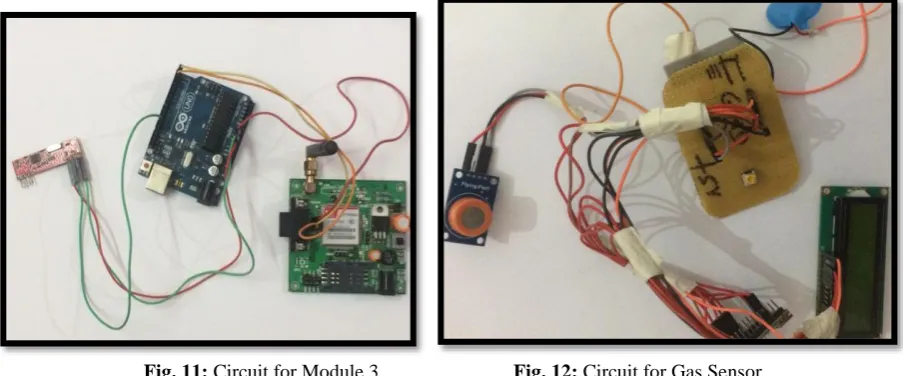
59 In the module shown in fig. 11 RF receiver is also connected to arduino for the wireless reception of data which is further processed with the help of microcontroller. Only one receiver module is made and is programmed in such a way that it can process the data sent by the different transmitters placed on different smart bins.
Fig. 11: Circuit for Module 3 Fig. 12: Circuit for Gas Sensor
At last one more module is added to this smart bin, which is used for smell sensing as shown in fig. 12. With the help of MQ3 sensor presence of smell can be detected. This same concept is used when the garbage produces bad odour the output of the MQ3 sensor rises and when it crosses the threshold level a alert could be generated that it immediately required to be cleaned. This is also achieved in the same hardware just by adding a MQ3 sensor to it and some programming is also added for the same.
VI. RESULTS AND COMPARISION
These three modules are being combined and a smart bin is made out of it.
Fig. 13: Dustbin A Fig. 14: Dustbin B
The fig. 13 and fig. 14 shows the two dustbins. The dustbins can be given any name or ID so that it is easy to recognise at receiver side that the data is coming from which dustbin.
60
Fig. 15: Display Depicting Garbage Levels in both Smart Bins
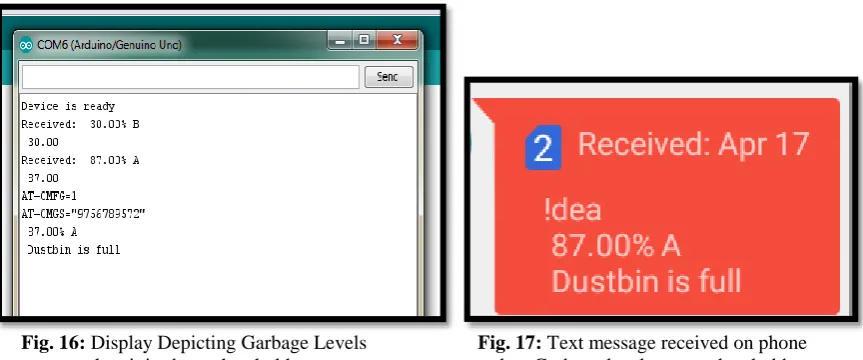
When the level of garbage in bin is above a threshold value then the AT commands of GSM are executed and a message is send to the concerned authority. The message indicates the level of the garbage in the bin and will also indicate the ID or name of the bin which is filled above threshold. Fig. 16 shows the execution of the AT commands on display and fig. 17 shows the screenshot of the message on the mobile phone of the concerned authority.
Fig. 16: Display Depicting Garbage Levels Fig. 17: Text message received on phone when it is above threshold when Garbage level crosses threshold
In this paper we have shown some other approaches also for “Smart Bin”. In [1], they have used the same concept but in that system Zigbee is used. The range of Zigbee is 10-100m only when there is Line of Sight. This disadvantage of Zigbee is removed by using RF module for transferring data. In [2], they have used webcam and load sensor which increases the cost of the system and when a low density garbage is thrown in the bin the weight of the garbage bin will not increase much the but the area occupied by that garbage will be more this may result in accurate interpretation of how much the bin full. This disadvantage is overcome by using ultrasonic sensor which works on the level of garbage and the cost of whole system is economical. One more advantage of our system is that it can detect the foul smell coming from the garbage and can alert the authorities for taking immediate action for cleaning the bin irrespective of the level of the garbage in the bin.
VII. CONCLUSION
In this paper we have presented design and implementation of smart bin. This smart bin is capable of sending its garbage level upto a range of 100m wirelessly to the receiver in an open area. A single receiver is synchronized with two smart bins and it can process data send by both the transmitters simultaneously. A GSM module is connected at the receiver side which sends a message to the authority when the level of garbage in any bin crosses the threshold level. Threshold level could be set and altered through programming. This is a cost effective measure to deal with the problem of Garbage Bin Monitoring and it can effectively tackle the problem of overloading of garbage bins and littering of garbage out of the bins. It could be a effective tool to make our environment and society clean.
VIII. ACKNOWLEDGEMENT
61
BIOGRAPHY
Akshay Goyal was born in Bijnor, and done his schooling from Modern Era Public School Bijnor, Uttar Pradesh, India. Presently he is pursuing B.Tech from Moradabad Institute of Technology, Moradabad, India and his branch is Electronics and Communication Engineering.
Kshitij Shinghal was born in Moradabad, andhe has completed his B.tech (E.C.) from Shivaji University in 1999 and M.tech (E.C.) from U.P. Technical University (U.P.T.U.) Lucknow in 2006. He has completed his Ph.D. from research center CDAC Noida in affiliation with Shobhit University, Meerut in 2013. At present he is working as Associate Professor & Head of the E.C. department, Moradabad Institute of Technology, Moradabad.
Aastha Gupta was born in Moradabad, and done her schooling from K.C.M Senior Secondary School, Moradabad, Uttar Pradesh, India. Presently she is pursuing B.Tech from Moradabad Institute of Technology, Moradabad, India and her branch is Electronics and Communication Engineering.
Akash Diwakar was born in Moradabad, and done his schooling from Moradabad Inter College Moradabad, Uttar Pradesh, India. Presently he is pursuing B.Tech from Moradabad Institute of Technology, Moradabad, India and his branch is Electronics and Communication Engineering.
Kanika Rastogi was born in Moradabad, and done her schooling from St. Marys Senior Secondary school, Moradabad, Uttar Pradesh, India. Presently she is pursuing B.Tech from Moradabad Institute of Technology, Moradabad, India and her branch is Electronics and Communication Engineering.
REFERENCES
[1] Kanchan Mahajan, Prof.J.S.Chitode, “Waste Bin Monitoring System Using Integrated Technologies”, International Journal of Innovative Research in Science, Engineering and Technology (An ISO 3297: 2007 Certified Organization) Vol. 3, Issue 7, July 2014.
[2] Gaikwad Prajakta, Jadhav Kalyani, Machale Snehal, “Smart Garbage Collection System In Residential Area”, IJRET: International Journal of Research in Engineering and Technology eISSN: 2319-1163 | pISSN: 2321-7308. [3] Narendra Kumar G., Chandrika Swamy, and K. N. Nagadarshini, “Efficient Garbage Disposal Management in
Metropolitan Cities Using VANETs”, Journal of Clean Energy Technologies, Vol. 2, No. 3, July 2014.
[4] M. Al-Maaded, N. K. Madi, Ramazan Kahraman, A. Hodzic, N. G. Ozerkan , “An Overview of Solid Waste Management and PlasticRecycling in Qatar”, Springer Journal of Polymers and the Environment, March 2012, Volume 20, Issue 1, pp 186-194.
[5] Raghumani Singh, C. Dey, M., “Solid waste management of Thoubal Municipality, Manipur- a case study”, Green Technology and Environmental Conservation (GTEC 2011), 2011 International Conference Chennai 21 – 24. [6] Monika K A, Nikitha Rao , Prapulla S B, Shobha G. “Smart Dustbin-An Efficient Garbage Monitoring System”,
62 [7] Parkash, Prabu V, “IoT Based Waste Management for Smart City”, International Journal of Innovative Research in Computer and Communication Engineering (An ISO 3297: 2007 Certified Organization) Vol. 4, Issue 2, February 2016.
[8] S.S.Navghane, M.S.Killedar, Dr.V.M.Rohokale, “IoT Based Smart Garbage and Waste Collection Bin”, International Journal of Advanced Research in Electronics and Communication Engineering (IJARECE) Volume 5, Issue 5, May 2016.
[9] Sonam Sahu, Dr. Sindhu J. Nair, Pankaj Kumar Sharma, “Review On Solid Waste Management Practice in India: A State of Art”, International Journal of Innovative Research And Development, Volume 3 Issue 3 March 2014. [10]Vijay Kumar, Dr R.K.Pandit “Problems of Solid Waste Management in Indian Cities” International Journal of
Scientific and Research Publications, Volume 3, Issue 3, March 2013.
[11]Alessio Carullo and Marco Parvis, “An Ultrasonic Sensor for Distance Measurement in Automotive Applications”, IEEE Sensors Journal, Vol. 1, No. 2, August 2001.
[12]G. Andria, F. Attivissimo, and A. Lanzolla, “Digital Measuring Techniques for High Accuracy Ultrasonic Sensor Application”, in Proc. IMTC, vol. II, St. Paul, MN, May 18–21, 1998, pp. 1056–1061.
[13]Twinkle Sinha, K.Mugesh Kumar, P.Saisharan, “Smart Dustbin”, International Journal of Industrial Electronics and Electrical Engineering, ISSN: 2347-6982 Volume-3, Issue-5, May-2015.
[14]Prof. R.M.Sahu, Akshay Godase, Pramod Shinde, Reshma Shinde, “Garbage and Street Light Monitoring System Using Internet of Things”, International Journal of Innovative Research In Electrical, Electronics, Instrumentation And Control Engineering Vol. 4, Issue 4, April 2016.
[15]Arunkumar.G, Bhanu Priya.G, Prof.R.Santhosh Kumar, “Smart Garbage Collecting Bin For Municipal Solid Waste”, International Journal of Modern Trends in Engineering and Science ISSN: 2348-3121.
[16]Vikrant Bhor, “Smart Garbage management System”, International Journal of Engineering Research & Technology (IJERT),Vol. 4 Issue 03, March-20152000.
[17] Mrs. Kanchan Mahajan, Prof.J.S.Chitode, “Zig-Bee Based Waste Bin Monitoring System”, International Journal