Open Access
R E S E A R C H A R T I C L E
BioMed
Central
© 2010 Wild et al; licensee BioMed Central Ltd. This is an Open Access article distributed under the terms of the Creative Commons At-tribution License (http://creativecommons.org/licenses/by/2.0), which permits unrestricted use, distribution, and reproduction in any medium, provided the original work is properly cited.Research article
A graphical vector autoregressive modelling
approach to the analysis of electronic diary data
Beate Wild*
1, Michael Eichler*
2, Hans-Christoph Friederich
1, Mechthild Hartmann
1, Stephan Zipfel
3and
Wolfgang Herzog
1Abstract
Background: In recent years, electronic diaries are increasingly used in medical research and practice to investigate patients' processes and fluctuations in symptoms over time. To model dynamic dependence structures and feedback mechanisms between symptom-relevant variables, a multivariate time series method has to be applied.
Methods: We propose to analyse the temporal interrelationships among the variables by a structural modelling approach based on graphical vector autoregressive (VAR) models. We give a comprehensive description of the underlying concepts and explain how the dependence structure can be recovered from electronic diary data by a search over suitable constrained (graphical) VAR models.
Results: The graphical VAR approach is applied to the electronic diary data of 35 obese patients with and without binge eating disorder (BED). The dynamic relationships for the two subgroups between eating behaviour, depression, anxiety and eating control are visualized in two path diagrams. Results show that the two subgroups of obese patients with and without BED are distinguishable by the temporal patterns which influence their respective eating behaviours. Conclusion: The use of the graphical VAR approach for the analysis of electronic diary data leads to a deeper insight into patient's dynamics and dependence structures. An increasing use of this modelling approach could lead to a better understanding of complex psychological and physiological mechanisms in different areas of medical care and research.
Background
In recent years, the use of electronic diaries in clinical research has become increasingly popular [1,2]. In many different medical areas--such as neurology [3], sleep medicine [4], paediatrics [5], dermatology [6], gynaecol-ogy [7], psychosomatic medicine [8], and rheumatolgynaecol-ogy [9]--electronic diary data provide new insights into pro-cesses and temporal relationships. Particularly, in clinical practice and research regarding chronic pain electronic diary assessment is frequently used to examine day-to-day variation in symptoms as well as to investigate the impact of constant self-monitoring on the patient's behaviour [10-12]. Also, in psychosomatic research, the
application of electronic diaries is of particular interest to mirror development processes over time and to capture complex dynamical systems with several interacting vari-ables [13]. For instance, in patients with fibromyalgia, pain symptoms early in the day show associations with salivary cortisol levels [14]. As in studies with healthy control persons, elevated cortisol levels have been associ-ated with increased negative mood, anxiety, and fear, it could be possible that cortisol influences pain via mood-induced alterations. However, to date, the dynamic dependence structure of these interacting variables still remains unclear.
In general, in psychosomatic research--but also in other medical domains--there is an urgent need to analyse treatment courses in order to optimise treatment and prevent relapse. Recent randomized controlled trials mir-ror this necessity by including longitudinal process mea-sures in addition to the standard pre-post-outcome measurements [15-17]. Electronic diaries can be used as a * Correspondence: [email protected]
1 Department of General Internal Medicine and Psychosomatics, Medical
University Hospital Heidelberg, Heidelberg, Germany
2 Department of Quantitative Economics, Maastricht University, Maastricht, The
Netherlands
powerful and efficient tool for the investigation of pro-cesses and associations between physical symptoms and psychosocial variables. Nevertheless, a possible drawback of using electronic diaries with daily or even more fre-quent monitoring is that high motivation is required from the patients to complete the study. Also, for completers, the daily monitoring may become burdensome, which can cause a bias in the data collection. To ensure continu-ing patient compliance, periodic feedback should be given. However, the use of electronic diaries also reduces the possibility of distortions due to retrospective recall and therefore excludes a bias which is common in retro-spective data collection.
Despite the increased availability of electronic diary data and the thus offered opportunity to learn more about the dynamic interrelationships among the variables of interest, appropriate multivariate statistical methods have been applied to date very rarely to the analysis of such data [18]. Most studies use a mixed modelling approach for the analysis of diary data [1]. The applica-tion of this approach is limited by the fact that estimaapplica-tion of mixed models is computationally infeasible for multi-variate responses of dimension four and larger [19]. Therefore, to be able to answer intriguing questions about dependence structures between several variables and group characteristic processes, more advanced mul-tivariate time series methods are required.
In the past years, Eichler [20,21] presented a new approach for analysing systems of time series that merges the concepts of Granger causality [22] and graphical modelling [23,24]. It is based on vector autoregressive (VAR) models that have been known in multivariate time series analysis for many years [25]. In the research area of functional brain imaging, VAR models have been used in the context of Granger causality for the investigation of directed influences between activated brain areas [26,27]. The new graphical VAR approach extends this method by investigating all possible constrained VAR models, select-ing the best fittselect-ing model and reflectselect-ing it in a clearly directed graph. Therefore, this method offers outstanding possibilities not only to answer important research ques-tions regarding mutual dependencies and temporal group patterns but also to mirror the results in an easily under-standable way.
The aim of this article is, first, to give a comprehensive description of the graphical modelling approach for VAR models and, second, to illustrate the relevancy and use-fulness of the statistical method by giving a first applica-tion to electronic diary data in the psychosomatic research field of binge eating disorder (BED). Binge eat-ing disorder (BED) is characterized by the consumption of large amounts of food over short periods of time, accompanied by a sense of loss of control, and not com-pensated by inappropriate weight control behaviours
[28]. 30-65% of the patients with BED have comorbid obesity involved with an increased risk for subsequent chronic diseases and mortality [29]. The validity of the diagnosis of BED has been contentiously discussed since 1994 [30]. Nevertheless, the association of BED with an extensive psychopathology, impaired quality of life, and social functioning suggests that differentiating BED from obesity and other forms of psychopathology is a critical clinical issue [31,32]. To date, some diary studies exist which investigated the differences between BED and non-BED participants regarding the association between mood and eating behaviour. For instance, Le Grange et al. [33] showed that for BED as well as non-BED partici-pants, negative affect and restraint were immediate ante-cedents of binge eating. In contrast, Greeno et al. [34] found different patterns of immediate binge antecedents between patients with and without BED which was repli-cated by Hilbert and Tuschen-Caffier [35]. However, none of the studies analysed the time series of the patients using a multivariate time series approach. There-fore, no statement could be made regarding feedback loops and dynamic dependence structures of a system of variables. In the present study, we used the graphical vec-tor-autoregressive approach to analyse electronic diary data of 35 obese patients, both with and without a binge eating disorder (BED), who participated in a multi-modal outpatient intervention program [36]. Throughout the course of the treatment period, participants recorded on a daily basis their eating behaviour, levels of depression, anxiety and self-perceived eating control. The aim of the analysis was to investigate the dependence structure between eating behaviour and associated variables for obese patients with and without BED and to find possible differences between these two groups.
Methods and Results
Before we apply the graphical modelling approach to electronic diary data, we briefly introduce the underlying concepts from multivariate time series.
Methodological issues Granger causality
vari-ables that might affect the dependence between X and Y. We say that X Granger-causes Y if the current value of Y can be better predicted from the past values of all three series X, Y, and Z than from the past values of the two processes Y and Z alone. Here, "better predicted" means a smaller mean square prediction error. We note that the definition depends on the set of variables Z included in the analysis.
In practice, the concept of Granger-causality mostly has been used in the framework of vector autoregressive models for the investigation of linear relationships among the variables.
Vector autoregressive models
The vector autoregressive (VAR) model is a straightfor-ward extension of the univariate autoregressive model [25] and describes how the values of the variables at time t depend linearly on the values at previous time points. For the sake of simplicity, we restrict ourselves in the fol-lowing to the simplest case where only the past values at time t - 1 are taken into account. Thus a VAR model of order 1--also abbreviated as VAR(1) model--is a linear regression model in which the vector of values at time t is regressed on the vector of values at the previous point in time t - 1. The model can be thought as a linear predic-tion model that predicts the current value of a variable based on its own past value on the previous point in time and the past values of the other variables.
When analysing electronic diary data, we are con-cerned with several vector time series, one for each sub-ject included in the study. For the investigation of the dynamics common to all subjects, we model these vector time series jointly by one common VAR(1) process assuming that there are no dependences between sub-jects. Thus, if the time series of K subjects in n variables are given and Xi,k(t) represents the score of the kth person in the ith variable at time t, we consider the joint regres-sion model
for i = 1,..., n and k = 1,..., K, which yields n2 regression
coefficient βij, i, j = 1,..., n. For the errors εi,k(t), we assume that they have mean zero and are uncorrelated between different points in time or different subjects, that is,
for all i = 1,..., n, k = 1,..., K and
whenever t ≠ s or k ≠ l.
Intuitively, the regression coefficients measure the direct influences of the explanatory lagged variables on the dependent variables. Thus, in the above VAR(1) model, variable Xj Granger-causes Xi if the coeffcient βij differs from zero. For the general case of a VAR model of order p, we refer to Eichler [20,21,37]. Furthermore, the strength of the direct same-time relationships among the variables is quantified by the entries in the inverse of the variance-covariance matrix--the so-called concentration matrix--of the residuals ε1, k(t),..., εn, k(t).
The VAR analysis is carried out under the assumption of normality of the data. The method, however, is known to be reasonably robust against departures from the dis-tributional assumptions. In such cases, the fitted model describes the linear relationships found in the data. Fur-thermore, the assumption of stationarity can be relaxed by defining VAR models with a deterministic or a sto-chastic trend. Fitting of a deterministic trend basically results in removing the fitted trend whereas a stochastic trend (random walk behavior) does not require special treatment when fitting by least squares or conditional maximum likelihood. These estimation methods do not necessarily require stationarity, which means that time series have time invariant expected values, variances and covariances, but only stationary dynamics in the sense that the internal dependence of the process does not change between different time points. We note that removing of trends frequently is achieved by differencing the series. We do not recommend this practice since in the case of a deterministic trend this will create a serial dependence not previously in the data that cannot be modelled by a VAR process [25,38]. Likewise in the case of a stochastic trend, fitting of a VAR model upon differ-encing is inadequate if the series are cointegrated [25]. Structural modelling approach
The VAR(1) model above allows all lagged and same-time relationships among all variables to be present. By setting certain regression coefficients and entries in the concen-tration matrix to zero, we obtain a structural VAR model that is associated with a specific pattern of (temporal) interrelationships among the variables. Such constrained VAR models are also called graphical VAR models [21] since their temporal relationships can be visualized by a path diagram or graph. Here, a graph or path diagram consists of a finite set of nodes which are connected by edges depicted as arrows or lines. Each variable of a mul-tivariate time series is represented by a single node [21]. For each regression coefficient that is not constrained to zero a directed edge (i.e. an arrow) pointing from the explanatory variable to the dependent variable is drawn. Undirected edges (i.e. lines) are used to visualize direct contemporaneous relationships among the variables.
Xi k t ijXj k t i k t
j n
,( )= , ( − +) ,( )
=
∑
b 1 e1
E(ei k, ( ))t =0
The aim of the structural or graphical modelling approach is to determine the constrained VAR model that best describes the pattern of interrelationships present in the electronic dairy data. This best fitting model is identi-fied by an exhaustive search over the space of all possible graphical VAR(1) models. For each model, the parame-ters are estimated by the conditional likelihood method [25] through an iterative algorithm described in Eichler [37], and the Akaike information criterion (AIC) scores are calculated. Low AIC values reflect model parsimony, favouring a high log likelihood along with a low number of parameters. Measuring the goodness-of-fit of the restricted models by AIC, the model with lowest AIC score is selected as the best fitting model. Instead of the AIC, other model selection criteria such as Bayesian information criterion (BIC) [39] could be used. Further-more, we note that the standard errors of the parameters are based on the usual asymptotic considerations and as such reasonably robust e.g. against departures from the underlying assumptions. In particular, the asymptotic normality of the quasi-maximum likelihood estimators does not require normally distributed innovations in the VAR model. One problem with the described model selection approach is that, although there may be many models that describe the data almost equally well, it pro-vides only one optimal model. For those dependencies that have been included in the optimal model, this uncer-tainty can be simply evaluated by significance tests for the corresponding parameters. If the null hypothesis that a particular parameter is zero cannot be rejected, we can-not decide between the optimal model and the smaller model with this parameter constrained to zero. In that case, the corresponding relationship is not well identified by the data and should therefore not be interpreted. This approach, however, does not allow to evaluate the uncer-tainty of having a parameter falsely constrained to zero. Alternatively, the model uncertainty can be evaluated by comparing all models with lowest AIC score. It has been suggested that models with AIC scores within 2 units of the minimal score should be considered as competitive [40], that is, not statistically significant different from the best model. Finally, we note that in graphical VAR models of an order larger than 1, the significance of edges can be evaluated by Granger causality tests, which simultane-ously test for the coefficients at all lags to be zero [25]. Estimation of partial contemporaneous and partial directed correlations
After the graphical VAR model with minimal AIC score has been identified, the strength of the links in the model can be assessed by computing the so-called partial directed correlations and partial contemporaneous corre-lations as measures of strength of the lagged respectively same-time associations between variables [41]. Here, the partial contemporaneous correlation (PCC) is defined as
the correlation between two variables at the same point in time after removing the linear effects of the other vari-ables at the same point in time and all varivari-ables at previ-ous times. In a VAR(1) model, the partial contemporaneous correlations can be directly computed from the concentration matrix Kij of the residuals.
More precisely, the estimates of the PCCs are given by
Here, the entries of the concentration matrix are
the parameter estimates obtained by fitting the structural
VAR model.
As noted above, the direct relationships among the
variables across time are modelled in the VAR model by
the regression coefficients. Since regression coefficients
depend on the unit of measurement, Dahlhaus and
Eichler [41] proposed to measure the strength of lagged
associations between variables by so-called partial
directed correlations (PDC) (see also [20]). In a VAR(1)
model, the PDCs measure the linear association between
a dependent variable at time t and an explanatory variable
at time t-1 after removing the linear effects of all other
variables at time t-1. They thus quantify the direct
influ-ence of the explanatory variable on the dependent
vari-able. The PDC can be obtained by rescaling the
autoregressive coefficients ,
where are the diagonal entries in the
variance-covariance matrix of the residuals. In a graphical VAR
model these are estimated by inversion of the
concentra-tion matrix . For more details and the case of VAR
models of order larger than 1, we refer to Eichler [20]. Comparison of graphical VAR models between two subgroups For the comparison of the dependence structure in the time series data of two subgroups, the data analysis can be performed in three steps. Firstly, in order to determine
PCC(X t X t( ), ( )) K ij .
K iiK jj
i j = −
ˆ
Kij
ˆ
bij
PDC(X t X t( ), ( )) ij ,
iiK jj ij
i j − =
+ 1
2
b
b
Σ
ˆ Σii
ˆ
whether there is a significant overall difference in the temporal relationships between the two subgroups, a common VAR model for all subjects is tested against a VAR model with separate parameters for each group using a likelihood ratio test. Secondly, a structural model-ling approach is applied to identify the pattern of tempo-ral relationships for each subgroup. In a last step, the differences in the temporal relationships between two subgroups can be further investigated by comparing the PCCs and PDCs in the respective best fitting reduced models [20].
Software
The routines for fitting and selecting constrained VAR models were implemented in the statistical software R http://www.r-project.org.
Application study in the research field of binge eating disorder
Study sample and assessment
We analysed electronic diary data from 35 obese German patients—28 women and 7 men--who took part in a muli-model outpatient intervention program. At the beginning of the treatment, 16 patients fulfilled the DSM-IV diag-nostic criteria for BED [28]; the other 19 patients were diagnosed as obese without BED. Over the entire course of the treatment, patients answered questions daily regarding their eating behaviour such as the number of meals consumed each day, the amount of food consumed at each meal, as well as the occurrence of binge eating episodes. The daily assessment of the patients (regarding the number of meals eaten, the amount eaten at each meal and the occurrence of the binge episodes) was used to calculate the variable 'eating behaviour' [42]. The vari-able 'eating behaviour' is a discrete measurement for the daily amount of food consumed. The correlation between the variable 'eating behaviour' and the occurrence of binge episodes is 0.79. In addition to an assessment of their eating habits, the patients answered questions daily about levels of depression, anxiety, and control over their eating behaviour. The items were rated on a visual ana-logue scale (VAS) with bipolar anchor statements. The computer program converted the marked points to a numeric scale. Handheld computers of type Palm m100 were used for the electronic diaries. A specific software was developed in Java 2 Micro Edition for the portable computers [43]. An electronic alarm signal daily reminded patients to complete the data assessment. Pre-processing of the diary data
Each time series had a length of 112 measurement points, equivalent to 112 days of monitoring. Missing values (6.3%) were replaced using the weighted averages of uni-variate autoregressive forward and backward predictions. Some of the time series showed a clearly visible trending behaviour, which was removed by subtracting a
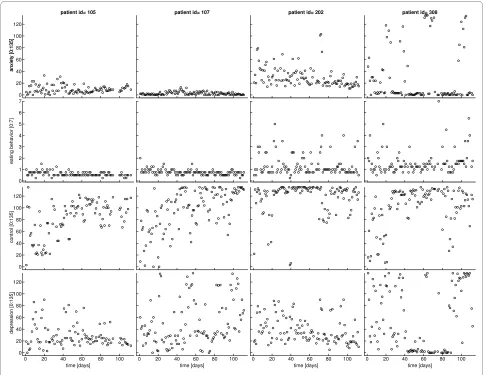
fifth-order polynomial trend from the individual time series; additionally, each series was standardized by dividing by its standard deviation [44]. In the dynamic analysis of the diary data, we included four variables: eating behaviour (eat), depression (dep), anxiety (anx), and sense of control over eating (ctl). Figure 1 shows exemplary plots of the raw time series of these four variables for four patients. In principle, it would have been interesting to include the treatment variable as an exogenous on-off-variable. How-ever, preliminary to this study the same data were ana-lyzed using a mixed modeling approach to investigate time trends. In these analyses, the treatment variable had been included as a covariate but did not show any signifi-cant influence on the eating behaviour or other variables. Therefore, it has been omitted in the present study. In an preliminary analysis, we investigated AR(1) and AR(2) models. Results showed that the structure of the dynamic first-order relationships was not different and the correla-tions across two days were very weak. As, in addition, a second order model requires estimation of more parame-ters, we decided for the first-order model.
Results of structural analysis
Testing a common VAR model for all patients against a VAR model with separate parameters for each subgroup, we found a significant difference in the structure of tem-poral relationships between the two subgroups (likeli-hood ratio test: T = 61.04, p = 0.006).
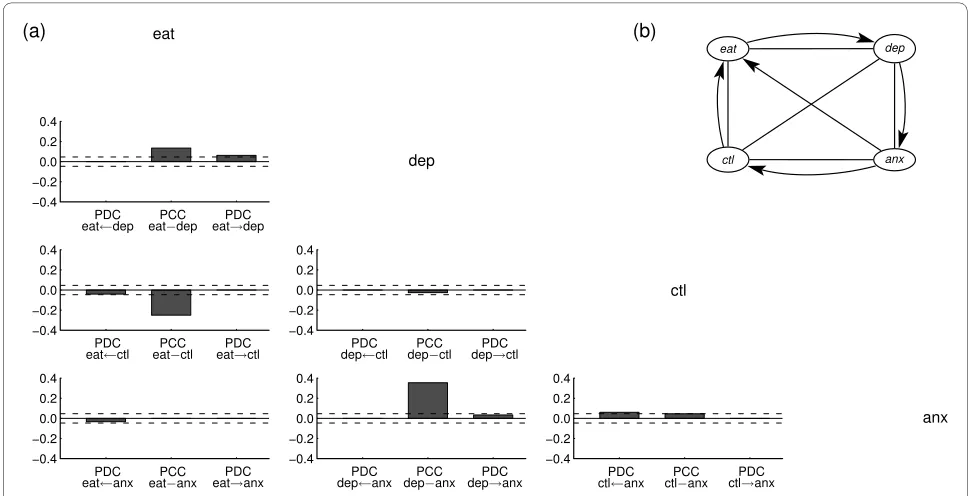
The temporal relationships for the two subgroups iden-tified by the structural modelling approach are visualized by the path diagrams in figures 2 and 3.
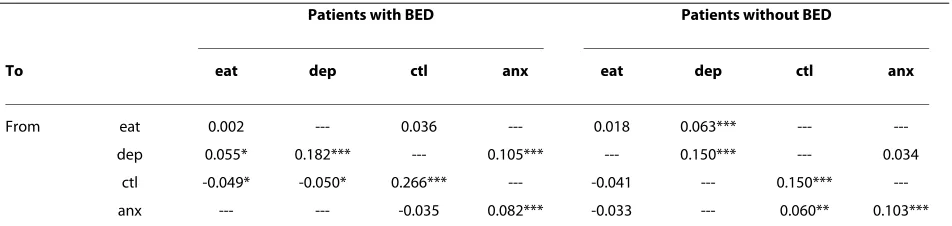
The path diagrams reflect the best fitting graphical VAR(1) models for the two subgroups, that is, the models with the lowest AIC score. The partial correlations for the same-day (PCC) and lagged relationships (PDC) in the reduced models are visualized by the bar diagrams in fig-ure 2 and 3. Numeric values of the PCCs and PDCs are shown in table 1 and 2.
self-loops do not play any role in the graphical analysis of Granger-causal relationships and therefore are usually omitted. Correspondingly, the structural analysis has been carried out without imposing constraints on the autocorrelations.
The most obvious difference between the two sub-groups lies in the lagged relationships, that is, the partial directed correlations (PDC) that reflect associations between variables across adjacent days. The positive PDC from depression to eating behaviour in the group with BED (PDCBED = 0.055) indicates that, for obese patients with BED, after a day of high depression, a high level of eating becomes more probable. One could interpret the results to mean that for obese patients with BED, eating becomes a dysfunctional mean to regulate emotions and to compensate for a bad previous day. In contrast, obese patients without BED show the opposite dependency; in this group, a high level of eating on any one day predicts a higher depression level on the following day. Additional
smaller differences between the two subgroups are shown in Table 2.
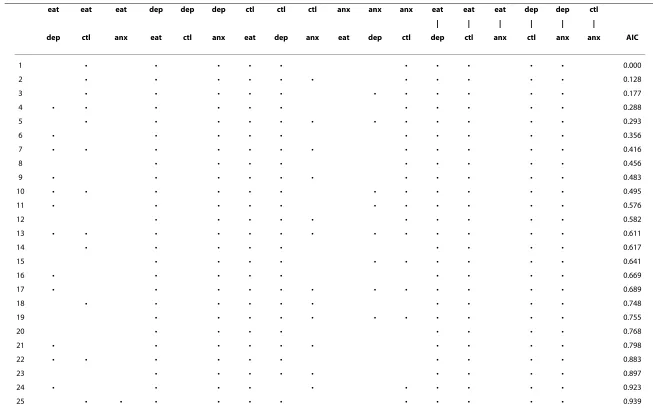
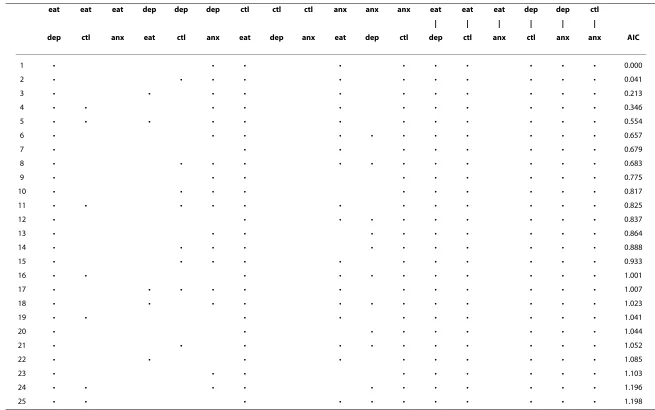
For an assessment of the uncertainty about the selected optimal model, Tables 3 and 4 list for each subgroup the 25 models with the lowest AIC score. On the one hand, these lists confirm the conclusions drawn from signifi-cance tests on the unconstrained coefficients: For patients with BED, we consistently detect that "eating behaviour" Granger-causes "depression" whereas for patients without BED the relationship is reversed. On the other hand, the tables indicate a large uncertainty about many lagged relationships which indicates that the amount of data is not sufficient for identifying the com-plete pattern of relationships among the variables.
Discussion and conclusion
In medical research, electronic diaries are widely used to measure fluctuations in patients' symptoms and to reflect developments over treatment courses. Using the graphi-cal VAR approach to model electronic diary data has sev-Figure 1 Raw time series for four patients. Courses of anxiety, eating behaviour, eating control, and depression during treatment.
anxiety [0:135]
0 20 40 60 80 100 120
patient id= 105
anxiety [0:135]
0 1 2 3 4 5 6 7
eating behavior [0:7]
0 20 40 60 80 100 120
control [0:135]
0 20 40 60 80 100
0 20 40 60 80 100 120
time [days]
depression [0:135]
patient id= 107
0 20 40 60 80 100
time [days]
patient id= 202
0 20 40 60 80 100
time [days]
patient id= 308
0 20 40 60 80 100
eral outstanding advantages. The diary data of whole patient groups are analysed simultaneously and dynamic dependence structures of two different patient groups can be compared. Feedback mechanisms can be modelled
and information about influence directions between vari-ables is provided. Furthermore, dynamic dependencies among variables are visualized in a clearly directed graph. Finally, the statistical techniques required for fitting the Figure 2 Structural results for patients with BED.(a) Partial directed and contemporaneous correlations for best VAR(1) model. Dashed horizontal lines indicate pointwise 95% test bounds for the hypothesis that the PDC respectively PCC is zero. (b) Path diagram associated with best VAR(1) model. Arrows indicate lagged associations; lines indicate contemporaneous associations.
eat dep
ctl anx
(a) (b)
−0.4 −0.2 0.0 0.2 0.4
−0.4 −0.2 0.0 0.2 0.4
−0.4 −0.2 0.0 0.2 0.4
−0.4 −0.2 0.0 0.2 0.4
−0.4 −0.2 0.0 0.2 0.4
−0.4 −0.2 0.0 0.2 0.4 eat
dep
ctl
anx PDC
eat←dep eatPCC−dep eatPDC→dep
PDC
eat←ctl eatPCC−ctl eatPDC→ctl
PDC
eat←anx eatPCC−anx eatPDC→anx
PDC
dep←ctl depPCC−ctl depPDC→ctl
PDC
dep←anx depPCC−anx depPDC→anx ctlPDC←anx ctlPCC−anx ctlPDC→anx
Figure 3 Structural results for patients without BED. (a) Partial directed and contemporaneous correlations for best VAR(1) model. Dashed hori-zontal lines indicate pointwise 95% test bounds for the hypothesis that the PDC respectively PCC is zero. (b) Path diagram associated with best VAR(1) model. Arrows indicate lagged associations; lines indicate contemporaneous associations.
eat dep
ctl anx
(a) (b)
−0.4 −0.2 0.0 0.2 0.4
−0.4 −0.2 0.0 0.2 0.4
−0.4 −0.2 0.0 0.2 0.4
−0.4 −0.2 0.0 0.2 0.4
−0.4 −0.2 0.0 0.2 0.4
−0.4 −0.2 0.0 0.2 0.4 eat
dep
ctl
anx PDC
eat←dep eatPCC−dep eatPDC→dep
PDC
eat←ctl eatPCC−ctl eatPDC→ctl
PDC
eat←anx eatPCC−anx eatPDC→anx
PDC
dep←ctl depPCC−ctl depPDC→ctl
PDC
models can be easily and efficiently implemented, which allows estimating large numbers of models in reasonably short computing time.
We note that the graphical modelling approach pre-sented here is not restricted to VAR models but could also be used for dynamic non-linear time series models very similar to the mixed models commonly used in the analysis of longitudinal data. However, estimation of mixed models for multivariate response of dimension four or larger is computationally not feasible. Other mod-ern approaches such as the one by Fieuws et al. [19], which uses pairwise modelling, are not suitable when one is interested in the multivariate dynamic (in the sense of Granger-causality) interrelationships among the vari-ables. Moreover, we are not only interested in the dynamic interrelationships (as represented by the autore-gressive coefficients in our model) but also in the con-temporaneous associations. For this, it is necessary to impose conditional independence constraints on the dis-tribution of the multivariate response. For mixed models, the authors are not aware of a feasible solution to this problem.
Dahlhaus [45] proposed another interesting approach to the analysis of multivariate time series using graphical interaction models. This method is based on the calcula-tion of partial coherences. The coherence between two time series indicates which frequencies (rhythms) are
present in both time series. The graphical interaction modelling allows one to model feedback loops; both the direct and indirect relationships between therapy-rele-vant variables can be identified. In the literature, we find a few applications of this method to the analysis of elec-tronic diary or monitoring data. Gather et al. [46] applied this method to the haemodynamic system of patients monitored in intensive care; Feiler et al. [11] analysed the therapy process of fibromyalgia patients using such inter-action graphs. However, the main difference of this method to the graphical VAR modelling approach is that the calculations are made in the frequency domain. Therefore, it can not differentiate between same-time and lagged relationships. In comparison, the graphical VAR approach leads to time-related results. These results are probably of more interest as well as better interpreta-ble and illustrative because the dynamic relationships between the variables are calculated in the time range and not in the frequency range. That is, we do not only obtain information about the strengths of associations in a sys-tem of multivariate time series, we obtain also informa-tion about the direcinforma-tion of influence in a relainforma-tionship. Using, for instance, this analysis method in the electronic diary studies that investigated the association between cortisol and pain symptoms or psychosocial variables, the mutual influences of these variables could be modelled, thus overcoming the limitation that only associations but Table 1: Partial contemporaneous correlations (PCCs) for the optimal VAR(1) models.
Link eat-dep eat-ctl eat-anx dep-ctl dep-anx ctl-anx
Patients with BED
0.190*** -0.244*** -- -0.044 0.268***
--Patients without BED
0.135*** -0.255*** -- -0.026 0.354*** 0.047
Dashed lines instead of a PCC values indicate that in the optimal graphical VAR(1) model this association is constrained to zero. eat = eating behaviour, dep = depression, ctl = sense of control over eating, anx = anxiety
* p < 0.05; ** p < 0.01; *** p < 0.001
Table 2: Partial directed correlations (PDCs) for the optimal graphical VAR(1) models.
Patients with BED Patients without BED
To eat dep ctl anx eat dep ctl anx
From eat 0.002 --- 0.036 --- 0.018 0.063*** ---
---dep 0.055* 0.182*** --- 0.105*** --- 0.150*** --- 0.034
ctl -0.049* -0.050* 0.266*** --- -0.041 --- 0.150***
---anx --- --- -0.035 0.082*** -0.033 --- 0.060** 0.103***
Dashed lines instead of a PDC values indicate that in the optimal graphical VAR(1) model this association is constrained to zero. eat = eating behaviour, dep = depression, ctl = sense of control over eating, anx = anxiety
Wild
et
a
l.
BMC Medi
ca
l R
ese
ar
ch
Me
tho
d
ol
ogy
20
10,
10
:2
8
htt
p
:/
/ww
w
.biom
e
dcentr
al.
com/147
1-22
88/1
0
/28
| | | | | |
dep ctl anx eat ctl anx eat dep anx eat dep ctl dep ctl anx ctl anx anx AIC
1 • • • • • • • • • • 0.000
2 • • • • • • • • • • • 0.128
3 • • • • • • • • • • • 0.177
4 • • • • • • • • • • • 0.288
5 • • • • • • • • • • • • 0.293
6 • • • • • • • • • • 0.356
7 • • • • • • • • • • • • 0.416
8 • • • • • • • • • 0.456
9 • • • • • • • • • • • 0.483
10 • • • • • • • • • • • • 0.495
11 • • • • • • • • • • • 0.576
12 • • • • • • • • • • 0.582
13 • • • • • • • • • • • • • 0.611
14 • • • • • • • • • 0.617
15 • • • • • • • • • • 0.641
16 • • • • • • • • • 0.669
17 • • • • • • • • • • • • 0.689
18 • • • • • • • • • • 0.748
19 • • • • • • • • • • • 0.755
20 • • • • • • • • 0.768
21 • • • • • • • • • • 0.798
22 • • • • • • • • • • 0.883
23 • • • • • • • • • 0.897
24 • • • • • • • • • • 0.923
25 • • • • • • • • • • • 0.939
Wild
et
a
l.
BMC Medi
ca
l R
ese
ar
ch
Me
tho
d
ol
ogy
20
10,
10
:2
8
htt
p
:/
/ww
w
.biom
e
dcentr
al.
com/147
1-22
88/1
0
/28
Pa
| | | | | |
dep ctl anx eat ctl anx eat dep anx eat dep ctl dep ctl anx ctl anx anx AIC
1 • • • • • • • • • • 0.000
2 • • • • • • • • • • • 0.041
3 • • • • • • • • • • • 0.213
4 • • • • • • • • • • • 0.346
5 • • • • • • • • • • • • 0.554
6 • • • • • • • • • • • 0.657
7 • • • • • • • • • 0.679
8 • • • • • • • • • • • • 0.683
9 • • • • • • • • • 0.775
10 • • • • • • • • • • 0.817
11 • • • • • • • • • • • • 0.825
12 • • • • • • • • • • 0.837
13 • • • • • • • • • • 0.864
14 • • • • • • • • • • • 0.888
15 • • • • • • • • • • • 0.933
16 • • • • • • • • • • • 1.001
17 • • • • • • • • • • • • 1.007
18 • • • • • • • • • • • • 1.023
19 • • • • • • • • • • 1.041
20 • • • • • • • • • 1.044
21 • • • • • • • • • • • 1.052
22 • • • • • • • • • • 1.085
23 • • • • • • • • • 1.103
24 • • • • • • • • • • • 1.196
25 • • • • • • • • • • • 1.198
not influence directions between variables could be determined [9,14].
Both methods - the graphical VAR and the graphical interaction approach - use interaction graphs to elucidate the dependence structure in a system of variables. The mutual dependencies and directed influences in a system of variables may be complex and not easy to interpret. The visualization of temporal relationships among sev-eral variables in a clearly directed graph fosters an intui-tive understanding of a complex dependence structure in a system of variables. Illustrating the model structure in a graph may help to clarify structural differences between various models and identify equivalences among them [23,46].
In our application study, data was collected only once per day. However, many EMA studies collect multiple measures per day. The fitting of a VAR model depends on the sampling frequency. For example, if a variable responds to changes in another variable very fast com-pared to the sampling frequency such an interrelation-ship will not show up in the autoregressive structure but only in the contemporaneous correlation structure. Thus, in principle, a high sampling frequency would be desir-able. However, more frequent sampling also requires higher motivation of the participants. It would probably not be feasible to sample over several month with a high frequency per day. In general, some extra care should be taken when adapting the proposed approach to data from EMA studies with multiple measurements per day. There are two potential problems: First, measurement points are often not equally distant, and, second, circadian rhythms may be present. If measurement points during daytime are approximately equally distant and frequent enough, one could view the data as very short time series (longitudinal data) with different days being treated as (approximately) independent repetitions per subject. This would solve the absence of measurements during nighttime. Additionally, circadian rhythms could be mod-eled by a time-dependent deterministic mean. More gen-erally, the interrelations among the variables may themselves be affected by circadian rhythms and thus be modeled as time-varying. Such general models, however, become soon computationally as well as--because of the large number of parameters--statistically infeasible for typical EMA studies. Therefore, in an electronic diary study, advantages and disadvantages of different sampling frequencies regarding the research question and analyses methods must be weighed against each other. In the fol-lowing we want to discuss several possible limitations of the proposed method and application study.
Firstly, an essential feature of the graphical VAR method is that it makes Granger causality operational. As a limitation, we have to emphasize that Granger causality is not true causality. It merely states that prediction is
improved if the entire information at the previous time point is included in the model. This definition inherently provides the limitation of all real-world studies - proba-bly, we are not able to measure the entire information at the previous time point. That is, the VAR modelling is open to confounding from unmeasured variables. Never-theless, knowledge about temporal--if not causal--influ-ences could lead to the conceptualisation of new treatments to target specific variables which temporally precede changes in symptoms. If confounding is to be taken into account, a different modelling approach has to be used. One possibility would be Hidden Markov mod-els, which explicitly include latent confounding variables in the model. However, as we do not know which associa-tions among the variables might be affected by confound-ing, this would lead to an enormous amount of possible models thus increasing the computational burden of the model selection task by a multiple. Another possibility for identifying the causal structure of a system possibly affected by confounding has been proposed by one the authors [47]. However, efficient algorithms for imple-menting this approach still need to be developed.
Secondly, a limitation of the graphical VAR method could be seen in the selection approach. At the end of the exhaustive search over all possible constrained VAR models, one "optimal" model is selected although there could be many models that describe the data almost equally well. However, this uncertainty can be evaluated by significance tests; the discrimination between stable and unstable edges gives an additional basis of decision-making for the selection of the best fitting model.
Lastly, as mentioned above, our approach focuses on the linear relationships among the variables. This includes the correlation as a measure for contemporane-ous associations. Modeling conditional independences in multivariate responses is an open problem. In absence of a more general model, the VAR approach is a feasible alternative which yields reasonable approximations.
For medical research, one of the main advantages of the application of the graphical VAR method is the possibility to model feedback mechanisms. In many contexts, we have to assume that feedback loops in variable systems exist. Process patterns and temporal dependencies can be differentiated for specific subgroups of patients which could lead to differentiation and improvement of treat-ments. The present application study gives a good exam-ple of the new possibilities to characterize patient groups during treatment. The findings of the application study in obese patients with and without BED indicate that the two subgroups are distinguishable by the patterns which influence their respective eating behaviours. The findings support previous claims that the treatment of patients with BED should be focused not only on the improve-ment of disordered eating behaviour, but also on the improvement of depressive symptoms [48,49]. The appli-cation results point out that the use of the graphical VAR approach for the analysis of electronic diary data leads to a deeper insight into patients' dynamics and dependence structures. An increasing use of this modelling approach could lead to a better understanding of complex psycho-logical and physiopsycho-logical mechanisms in different areas of medical care and research.
Competing interests
The authors declare that they have no competing interests.
Authors' contributions
The modelling and data analysis has been performed by BW and ME. HCF, SZ, MH and WH were responsible for the clinical conduct of the BED study and made contributions to the development of the manuscript. All authors read and approved the final manuscript.
Acknowledgements
The BED diary study was funded by the Medical University Hospital Heidelberg (grant number F.203594). We would like to thank the participants who made the BED study possible. We would also like to express our thanks to Doro Nie-hoff for her excellent data management.
Author Details
1Department of General Internal Medicine and Psychosomatics, Medical
University Hospital Heidelberg, Heidelberg, Germany, 2Department of
Quantitative Economics, Maastricht University, Maastricht, The Netherlands and 3Department of Psychosomatic Medicine and Psychotherapy, Medical
University Hospital Tübingen, Tübingen, Germany
References
1. Burton C, Weller D, Sharpe M: Are electronic diaries useful for symptoms research? A systematic review. J Psychosom Res 2007, 62:553-561.
2. Morren M, van Dulmen S, Ouwerkerk J, Bensing J: Compliance with momentary pain measurement using electronic diaries: a systematic review. Eur J Pain 2009, 13:354-365.
3. Hall CB, Lipton RB, Tennen H, Haut SR: Early follow-up data from seizure diaries can be used to predict subsequent seizures in same cohort by borrowing strength across participants. Epilepsy Behav 2009,
14:472-475.
4. Hajak G, Hedner J, Eglin M, Loft H, Storustovu SU, Lutolf S, et al.: A 2-week efficacy and safety study of gaboxadol and zolpidem using electronic diaries in primary insomnia outpatients. Sleep Med 2009, 10:705-712. 5. Whalen CK, Henker B, Ishikawa SS, Floro JN, Emmerson NA, Johnston JA, et
al.: ADHD and anger contexts: electronic diary mood reports from mothers and children. J Pediatr Psychol 2009, 34:940-953.
6. Langan SM, Williams HC: The use of electronic diaries in dermatology research. Dermatology 2009, 218:344-346.
7. Anderson FD: Safety and efficacy of an extended-regimen oral contraception utilizing low-dose ethinyl estradiol. Contraception 2006,
74:355.
8. Burton C, Weller D, Sharpe M: Functional somatic symptoms and psychological states: an electronic diary study. Psychosom Med 2009,
71:77-83.
9. Harris RE, Williams DA, McLean SA, Sen A, Hufford M, Gendreau RM, et al.:
Characterization and consequences of pain variability in individuals with fibromyalgia. Arthritis Rheum 2005, 52:3670-3674.
10. Stinson JN: Improving the assessment of pediatric chronic pain: harnessing the potential of electronic diaries. Pain Res Manag 2009,
14:59-64.
11. Feiler S, Müller KG, Müller A, Dahlhaus R, Eich W: Using interaction graphs for analysing the therapy process. Psychother Psychosom 2005, 74:93-99. 12. Sorbi MJ, Peters ML, Kruise DA, Maas CJ, Kerssens JJ, Verhaak PF, et al.:
Electronic momentary assessment in chronic pain I: psychological pain responses as predictors of pain intensity. Clin J Pain 2006, 22:55-66. 13. Tschacher W, Baur N, Grawe K: Temporal interaction of process variables
in psychotherapy. Psychother Res 2000, 10:296-309.
14. McLean SA, Williams DA, Harris RE, Kop WJ, Groner KH, Ambrose K, et al.:
Momentary relationship between cortisol secretion and symptoms in patients with fibromyalgia. Arthritis Rheum 2005, 52:3660-3669. 15. Burke LE, M SS, Music E, Warziski M, Styn MA, Stone A: Using
instrumented paper diaries to document self-monitoring patterns in weight loss. Contemp Clin Trials 2008, 29:182-193.
16. Lauritsen K, Degl' IA, Hendel L, Praest J, Lytje MF, Clemmensen-Rotne K, et al.: Symptom recording in a randomised clinical trial: paper diaries vs. electronic or telephone data capture. Control Clin Trials 2004,
25:585-597.
17. Wild B, Friederich HC, Gross G, Teufel M, Herzog W, Giel KE, et al.: The ANTOP study: focal psychodynamic psychotherapy, cognitive-behavioural therapy, and treatment-as-usual in outpatients with anorexia nervosa-a randomized controlled trial. Trials 2009, 10:23. 18. Tschacher W, Ramseyer F: Modeling psychotherapy processes by
time-series panel analysis (TSPA). Psychother Res 2009, 19:469-481. 19. Fieuws S, Verbeke G, Molenberghs G: Random-effects models for
multivariate repeated measures. Statistical Methods in Medical Research
2007, 16:387-397.
20. Eichler M: A graphical approach for evaluating effective connectivity in neural systems. Philosophical Transactions of The Royal Society B 2005,
360:953-967.
21. Eichler M: Granger causality and path diagrams for multivariate time series. Journal of Econometrics 2007, 137:334-353.
22. Granger CWJ: Investigating causal relations by econometric models and cross-spectral methods. Econometrica 1969, 37:424-438. 23. Lauritzen SL: Graphical Models Oxford: Oxford University Press; 1996. 24. Edwards D: Introduction to Graphical Modelling 2nd edition. New York:
Springer; 2000.
25. Lütkepohl H: Introduction to Multiple Time Series Analysis 2nd edition. New York: Springer; 2005.
26. Goebel R, Roebroeck A, Kim DS, Formisano E: Investigating directed cortical interactions in time-resolved fMRI data using vector autoregressive modeling and Granger causality mapping. Magn Reson Imaging 2003, 21:1251-1261.
27. Thompson WK, Siegle G: A stimulus-locked vector autoregressive model for slow event-related fMRI designs. Neuroimage 2009, 46:739-748.
Received: 24 November 2009 Accepted: 1 April 2010 Published: 1 April 2010
This article is available from: http://www.biomedcentral.com/1471-2288/10/28 © 2010 Wild et al; licensee BioMed Central Ltd.
This is an Open Access article distributed under the terms of the Creative Commons Attribution License (http://creativecommons.org/licenses/by/2.0), which permits unrestricted use, distribution, and reproduction in any medium, provided the original work is properly cited.
28. American Psychiatric Association: Diagnostic and Statistical Manual of Mental Disorders. (DSM-IV) 4th edition. Washington, DC: APA; 1994. 29. Striegel-Moore RH, Franko DL: Epidemiology of binge eating disorder.
Int J Eat Disorder 2003, 34(Suppl):S96-S106.
30. Schmidt U: Binge Eating and Binge Eating Disorder. Eur Eat Dis Rev 2000,
8:340-343.
31. Wilfley DE, Wilson GT, Agras WS: The clinical significance of binge eating disorder. Int J Eat Disord 2003, 34:S96-S106.
32. Rieger E, Wilfley DE, Stein RI, Marino V, Crow SJ: A comparison of quality of life in obese individuals with and without binge eating disorder. Int J Eat Disord 2005, 37:234-240.
33. Le Grange D, Gorin A, Catley D, Stone AA: Does momentary assessment detect binge eating in overweight women that is denied at interview?
Eur Eat Dis Rev 2001, 9:309-324.
34. Greeno CG, Wing RR, Shiffman S: Binge antecedents in obese women with and without binge eating disorder. J Consult Clin Psych 2000,
68:95-102.
35. Hilbert A, Tuschen-Caffier B: Maintenance of binge eating through negative mood: a naturalistic comparison of binge eating disorder and bulimia nervosa. Int J Eat Disord 2007, 40:521-530.
36. Friederich HC, Schild S, Wild B, de Zwaan M, Quenter A, Herzog W, Zipfel S:
Treatment outcome in people with subthreshold compared with full-syndrome binge eating disorder. Obesity 2007, 15:283-287.
37. Eichler M: Graphical modelling of dynamic relationships in multivariate time series. In Handbook of Time Series Analysis Edited by: Winterhalder M, Schelter B, Timmer J. Berlin: Wiley-VCH; 2007:335-372.
38. Yue S, Pilon P: Interaction between deterministic trend and autoregressive process. Water Resources Research 2003, 39:1077. 39. Schwarz G: Estimating the dimension of a model. Annals of Statistics
1978, 6:461-464.
40. Duong QP: On the choice of the order of autoregressive models: a ranking and selection approach. Journal of Time Series Analysis 1984,
5:145-157.
41. Dahlhaus R, Eichler M: Causality and graphical models in time series analysis. In Highly structured stochastic systems Edited by: Green P, Hjort N, Richardson S. Oxford: University Press; 2003:115-137.
42. Wild B, Quenter A, Friederich HC, Schild S, Herzog W, Zipfel S: A course of treatment of binge eating disorder: a time series approach. Eur Eat Disorders Rev 2006, 14:79-87.
43. Quenter A, Bludau HB, Friedrich HC, Schild S, Riepe T, Zipfel S: Use of Electronic Diaries within Treatment of Obesity and Binge Eating Disorder: First Experiences. Mobile Computing in Medicine 2002:25-33. 44. Schlittgen R, Streitberg BHJ: Zeitreihenanalyse München: Oldenbourg;
1997.
45. Dahlhaus R: Graphical interaction models for multivariate time series.
Metrika 2000, 51:157-172.
46. Gather U, Imhoff M, Fried R: Graphical models for multivariate time series from intensive care monitoring. Statistics in Medicine 2002,
21:2685-2701.
47. Eichler M: Causal inference from multivariate time series: What can be learned from Granger causality. In Proceedings from the 13th International Congress of Logic, Methodology and Philosophy of Science
Edited by: Glymour C, Wang W, Westerståhl D. London: College Publications; 2009.
48. Stunkard AJ, Allison KC: Binge eating disorder: disorder or marker? Int J Eat Disord 2003, 34:S17-S116.
49. de Zwaan M: Binge eating disorder and obesity. Int J Obesity 2001,
25:51-55. Pre-publication history
The pre-publication history for this paper can be accessed here: http://www.biomedcentral.com/1471-2288/10/28/prepub
doi: 10.1186/1471-2288-10-28