The
Callerya
Group redefined and Tribe Wisterieae
(Fabaceae) emended based on morphology and data
from nuclear and chloroplast DNA sequences
James A. Compton1, Brian D. Schrire2,Kálmán Könyves3, Félix Forest2,
Panagiota Malakasi2, Sawai Mattapha4, Yotsawate Sirichamorn5
1 Spilsbury Farm, Tisbury, SP3 6RU, UK 2 Comparative Plant and Fungal Biology Department, Royal
Bo-tanic Gardens, Kew, Richmond, Surrey, TW9 3AE, UK 3 Herbarium, Royal Horticultural Society Garden,
Wisley, Woking, Surrey, GU23 6QB, UK 4 Udon Thani Rajabhat University, Department of Biology, Faculty
of Science, Udon Thani 41000, Thailand 5 Silpakorn University, Department of Biology, Faculty of Science,
Sanam Chandra Palace campus, Nakhon Pathom 73000, Thailand
Corresponding author:James Compton ([email protected])
Academic editor:P. Herendeen | Received 26 March 2019 | Accepted 21 May 2019 | Published 26 June 2019
Citation: Compton JA, Schrire BD, Könyves K, Forest F, Malakasi P, Mattapha S, Sirichamorn Y (2019) The Callerya
Group redefined and Tribe Wisterieae (Fabaceae) emended based on morphology and data from nuclear and chloroplast
DNA sequences. PhytoKeys 125: 1–112. https://doi.org/10.3897/phytokeys.125.34877
Abstract
The Tribe Wisterieae (Zhu 1994), founded on the single genus Wisteria, is emended and recircumscribed
based on morphology and data from nuclear ITS and ndhJ-trnF, matK and rbcL chloroplast DNA
se-quences. This newly enlarged tribe comprises 36 species and 9 infraspecific taxa within 13 described genera. Six genera are new, two are reinstated and five were previously placed in Tribe Millettieae. The
genus Adinobotrys is also reinstated comprising two species including the new combination A. vastus.
Other reinstated genera include Whitfordiodendron, with four species, and Padbruggea, with three species, including the reinstatement of P. filipes and the new combination P. filipes var. tomentosa. The existing genera Afgekia, Callerya, Endosamara (with the new combination E. racemosa var. pallida), Sarcodum and
Wisteria, with the new combinations W. frutescens subsp. macrostachya are evaluated. The new genera
comprise three Australasian species in Austrocallerya: A. australis, A. megasperma and A. pilipes; Wisteriopsis
with five species from east Asia has six new combinations: W. japonica, W. kiangsiensis, W. championii, W.
eurybotrya, W. reticulata and W. reticulata var. stenophylla. Two species comprise the new Thai genus
Kan-buria: K. tenasserimensis and K. chlorantha. Nanhaia comprises the two species: N. fordii and N. speciosa
and the monotypic genera Sigmoidala and Serawaia are based respectively on the species S. kityana and S.
strobilifera. Lectotypes are designated for the names Adinobotrys filipes, A. myrianthus, Millettia bonatiana,
M. bracteosa, M. championii, M. cinerea, M. dielsiana, M. kityana, M. maingayi, M. nitida, M. oocarpa,
http://phytokeys.pensoft.net
Copyright James A. Compton et al. This is an open access article distributed under the terms of the Creative Commons Attribution License (CC BY 4.0), which permits unrestricted use, distribution, and reproduction in any medium, provided the original author and source are credited.
M. purpurea, M. reticulata, M. reticulata var. stenophylla, Padbruggea dasyphylla, Pterocarpus australis,
Ro-binia racemosa, Whitfordiodendron scandens, W. sumatranum and Wisteria pallida. A neotype is designated
for the name Millettia leiogyna.
Keywords
Tribe Wisterieae emended, Leguminosae, new genera, Austrocallerya, Kanburia, Nanhaia, Serawaia,
Sig-moidala, Wisteriopsis, molecular phylogeny, morphological key
Table of Contents
Introduction ... 3
Materials and methods ... 9
Molecular preparation and sequencing ... 9
Phylogenetic procedures and analyses ... 16
Morphological study ... 17
Results ... 17
Discussion ... 22
Morphology of the Callerya Group ... 22
Callerya group taxonomy 1: The genus Callerya including genera previously placed in synonymy prior to this study ... 25
Callerya group taxonomy 2: Additional genera within the Callerya group as de-fined in treatments prior to this study. ... 35
Callerya group taxonomy 3: New genera within the Callerya group as delimited in this study ... 37
Integrating our results: the Callerya group to Tribe Wisterieae ... 40
Taxonomic treatment of Tribe Wisterieae ... 43
Emended diagnosis of Tribe Wisterieae ... 44
Morphological key to the genera in Tribe Wisterieae together with Adinobotrys .... 44
Key to species of Adinobotrys ... 50
Clade A – Sarcodum, Endosamara and Sigmoidala ... 51
Key to species of Sarcodum ... 52
Key to varieties of Endosamara racemosa ... 54
Clade B – Nanhaia and Wisteriopsis ... 58
Key to species of Nanhaia ... 59
Key to species of Wisteriopsis ... 63
Key to the varieties of Wisteriopsis japonica ... 63
Key to varieties of Wisteriopsis reticulata ... 66
Clade C – Callerya, Serawaia, Whitfordiodendron, Kanburia and Afgekia ... 68
Key to species of Callerya recognized in this treatment ... 69
Key to varieties of Callerya nitida ... 70
Key to species of Whitfordiodendron ... 75
Key to species of Afgekia ... 80
Clade D – Padbruggea and Austrocallerya ... 81
Key to species of Padbruggea ... 82
Key to varieties of Padbruggea filipes ... 84
Key to species of Austrocallerya ... 86
Clade E – Wisteria ... 89
Key to species of Wisteria ... 91
Key to subspecies of Wisteria frutescens ... 91
Key to varieties of Wisteria sinensis ... 95
Acknowledgements ... 96
References ... 97
Appendix 1 ... 104
Supplementary material 1 ... 112
Introduction
The Tribe Millettieae was first described by Miquel (1855: 137), based on the type
genus Millettia Wight & Arn. (Wight and Arnott 1834: 263). This genus of six species
was characterised largely by the pods of the southern Indian type species M. rubiginosa
Wight & Arn. Miquel emphasised the compressed nature of the pods as a significant distinguishing character and his tribal description very loosely defined the new Tribe
Millettieae, which included eight genera: Brachypterum (Wight & Arn.) Benth., Derris
Lour., Pongamia Adans., Padbruggea Miq., Aganope Miq., Millettia, Otosema Benth.
and Mundulea Benth. (Miquel 1855: 137). Miquel (1855: 137) stated:
stamens monadelphous or diadelphous; calyx campanulate, more or less bilabiate; seed pod indehiscent, woody or leathery, sometimes opening tardily; leaves opposite and pin-nate; flowers in racemes
Millettia was, furthermore, distinguished from the genera Pongamia Adans. and
Dalbergia L.f. by the legume being compressed around the seeds and by the fruit’s thick
woody texture (Wight and Arnott 1834: 263). Dunn (1912a) in his revision of
Mil-lettia placed the genus in Tribe Galegeae (Bronn) Torr. & Gray subtribe Tephrosiinae Benth. (as Subtribe “Tephrosieae”). Geesink (1984: 3) described Tribe Millettieae with the characters:
Inflorescence of panicles, pseudopanicles or derived pseudopanicles; wing petals adher-ent to the keel; keel petals usually valvately connate; pod dehiscadher-ent or indehiscadher-ent; seed chamber mostly absent; seeds 1 or few; and without any uniquely defining character”.
Geesink (1984: 4) admitted that “the contents of this chapter [Delimitations of
Geesink’s major revision of this alliance, which he much enlarged to comprise 43 genera within Tribe Millettieae, was clearly polyphyletic with an assemblage of taxa having a range of unifying as well as contradicting characters. Although far from de-finitive, this revision was a major step forward and did lay a sound basis for subsequent research in the tribe. Geesink’s (1984) generic treatment included a set of genera in the “Callerya Group” (Hu et al. 2002; Hu and Chang 2003): Wisteria Nutt. (1818),
Call-erya Endl. (1843), Afgekia Craib (1927) and Endosamara Geesink (1984).
Subsequent-ly, Sarcodum Lour. (1790) was also placed in this group (Schrire 2005; Clark 2008)
(see Table 1). The genus Antheroporum Gagnep., placed tentatively in this grouping
by Schrire (2005), has subsequently been shown to belong within the core-Millettieae (LPWG 2016; Mattapha 2017: 53).
Over the past 30 years a large number of DNA-based phylogenies have analysed many taxa from Tribe Millettieae (Palmer et al. 1987; Lavin et al. 1990; Doyle et al. 1997; Lavin et al. 1998; Doyle et al. 2000; Kajita et al. 2001; Hu et al. 2000; Hu et al. 2002; Hu and Chang 2003; Wojciechowski et al. 2004; Schrire 2005; Schrire et al. 2009; Wink 2013; Li et al. 2014; de Quieroz et al. 2015). Analysis of data from the phytochrome gene family PHY (Lavin et al. 1998) has shown that a core-Millettieae group is monophyletic and may be defined by the presence of pseudoracemes and pseudopanicles. Moreover, while the millettioid-phaseoloid alliance as a whole falls within the large non-protein amino acid accumulating (NPAAA) clade (Wojciechows-ki et al. 2004; Cardoso et al. 2012; 2013; Wink 2013; Wojciechows(Wojciechows-ki 2013; De Qui-eroz et al. 2015), Lavin et al. (1998) showed that the core-Millettieae group are diag-nosed by a loss of the ability to accumulate the non-protein amino acid canavanine.
In these studies the Callerya group does not belong with the Millettioid group but
rather is accommodated in the Hologalegina clade (Wojciechowski et al. 2000; Lavin
et al. 2005). Lavin et al. (1998) also revealed that Afgekia, Callerya, Endosamara and
Wisteria, i.e. a significant part of the Callerya group, did accumulate canavanine rather than alkaloids in their seeds and that they all possessed either true panicles or true ra-cemes. Furthermore, Lavin et al. (1998) postulated that owing to the presence of true
racemes, Sarcodum was also likely to accumulate canavanine and would therefore not
be part of the core-Millettioid group. The morphological distinction between true and pseudoracemes is that in “true” racemes the flowers are inserted singly on the rachis (the unit comprising a flower, pedicel and bract). Pseudoracemes (Lackey 1981) on the other hand, consist of more than one flower inserted at a node on the rachis (the unit comprising two or more flowers, pedicels and bracts all subtended by a secondary bract representing branch reduction). Racemes and pseudoracemes are further compounded into panicles and pseudopanicles.
The Callerya group occurs in a more inclusive subset of taxa that all lack one copy of chloroplast DNA, the Inverted Repeat Lacking Clade or IRLC (Palmer et al. 1987; Lavin et al. 1990; Liston 1995; Doyle et al. 1997; Wojciechowski et al. 2000). The loss of a prominent inverted repeat structure in cpDNA in legumes had previously
been observed in the genera Vicia (Koller and Delius 1980) and Pisum (Palmer and
of the inverted repeat amounting to 25 kb of DNA (Palmer et al. 1987). It was ap-parent that whereas the other legume genera were rearranged genetically as a result of
the loss of the inverted repeat, both Wisteria floribunda and Medicago sativa remained
otherwise unrearranged (Palmer et al. 1987). The IRLC is sister to Tribes Loteae, Ses-banieae and Robinieae (Lewis et al. 2005), which retain the inverted repeat (Lavin et al. 2005; Cardoso et al. 2012; Cardoso et al. 2013; LPWG 2013, 2017). Additional
evidence from chloroplast rbcL sequence data has also revealed that the Millettieae lie
outside the IRLC (Lavin et al. 1990; Doyle et al. 1997; Kajita et al. 2001; Hu and
Chang 2003), while the Callerya group all fall within the IRLC. These data refute the
previously made assumptions that the group belongs with the Millettieae. Lavin et al.
(1990) noted that although Wisteria and Millettia japonica both showed hypogeal seed
germination and a lianescent habit, which are characteristic of many Millettieae gen-era, these species differed from the Millettieae in their wholly temperate distribution, the lack of the inverted repeat and both had a base chromosome number of x = 8 as
opposed to x = 11 or 12. The analyses of Hu and Chang (2003), based on plastid rbcL
sequence data, confirmed that Afgekia sericea, Callerya vasta, Endosamara racemosa,
Millettia japonica and two Wisteria species all belonged within the large IRLC. Their results, however, were based on comparatively limited taxon sampling of taxa within the Callerya group.
Wink (2013) examined 1276 species of Leguminosae for the distribution of sec-ondary metabolites mapped against phylogenetic trees generated by combined
se-quence data from cpDNA rbcL, matK and nrDNA ITS. In the study, it was shown
that Wisteria and Callerya nested within the IRLC and that they possessed isoflavones
in common with most but not all other taxa within the IRLC.
A unique marker further distinguishes the Callerya group, adding weight to the
distinctiveness of this assemblage of genera. Jansen et al. (2008) undertook a compre-hensive survey for the retention or loss of two chloroplast introns among 301 legume species representing three subfamilies and 198 genera. Their survey of the presence or
absence of the rps12 intron revealed that along with 49 of the millettioid-phaseoloids
sampled from outside the IRLC, Afgekia filipes, A. sericea, Callerya atropurpurea, C.
australis, C. megasperma, C. pilipes, Endosamara racemosa, Millettia (sic) japonica, Wis-teria brachybotrys, W. floribunda, W. frutescens, W. macrostachya and W. sinensis - each from inside the IRLC - all retained the intron. Of the 77 other taxa sampled from within the IRLC all - without exception - had lost the intron. Significantly, therefore,
all genera within the IRLC surveyed for the presence or absence of the rps12 intron
showed it to be lacking, except for the Callerya group, marking out the latter as unique
within the IRLC (Jansen et al. 2008). Seven species of Glycyrrhiza surveyed by Jansen
et al. (2008), whose position in recent phylogenies (Doyle et al. 2000; Lewis et al.
2005; LPWG 2013, 2017; Li et al. 2014), was placed sister to the Callerya group
within the IRLC, all lacked the rps12 intron. Glycyrrhiza, which is represented in our
analyses, has therefore not been included as part of the Callerya group.
The Callerya group is thus uniquely diagnosed by a combination of lacking the 25
Representa-Tab
le 1.
P
ublished
treatments
of species in
the C aller ya gr oup
based on their assignment
to genus, fr
om
1984 to the pr
esent. Those taxa highlighted
in bold r
epr
e-sent Chinese species of
C
aller
ya s.l.
for which w
e w
er
e unable to see material. All species epithets ar
e transferable acr
oss genera for comparison purposes.
G
enus
G
eesink (1984) Millettieae
Zhu
(1994) W
isterieae
Schot (1994) M
illettieae
Lôc (1996) M
illettieae
W
ei et al. (2010) Millettieae
Sirichamor
n et al. (2016)
G
enus
G
eesink (1984) Millettieae
Zhu
(1994) W
isterieae
Schot (1994) M
illettieae
Lôc (1996) M
illettieae
W
ei et al. (2010) Millettieae
Sirichamor
n et al. (2016)
tives of Afgekia, Callerya and Wisteria from this subgroup of taxa have also been found to group together according to data from sequences of nuclear DNA ITS spacer re-gions (Hu et al. 2002; Li et al. 2014).
Zhu (1994) defined her new Tribe Wisterieae comparing only pollen from four
species of Wisteria to the millettioid-phaseoloid genera Craspedolobium Harms, Derris,
Millettia, Pongamia and Tephrosia Pers. The genus Pongamia Adans. is now considered
synonymous with Millettia Wight & Arn. (Schrire 2005: 383). The pollen grains of the
four Wisteria species exhibited much broader polar regions (apocolpia) and a distinctive
reticulate pollen surface compared to the other taxa examined. Zhu (1994) also made
comparisons of Wisteria and other millettioid-phaseoloid genera using data from
phyto-chemical and embryological analyses as well as noting the chromosome count of 2n =16 in Wisteria compared to those of other genera whose members frequently have 2n = 22
or 2n = 24. It is notable that within the Callerya group, two species of Afgekia; A. sericea
and A. mahidoliae also have chromosome counts of 2n = 16 (Prathepha 1994; Prath-epha and Baimai 2003). Zhu’s (1994) concept of Tribe Wisterieae thus was based solely
on four samples of Wisteria and one accession of Millettia [Callerya] reticulata (Table 1).
One taxon recently recognised as belonging in the Callerya group was included
under the names Wisteria japonica or Millettia japonica (Doyle et al. 1997; Doyle et al.
2000; Kajita et al. 2001; Hu and Chang 2003). The inclusion of this taxon in Wisteria
was originally based on the deciduous leaves, twining habit, pendulous inflorescences and flowers where the wing petals are free from the keel (Siebold and Zuccarini 1839; Bailey and Bailey 1949; Geesink 1984; Iwatsuki et al. 2001; Compton and Thijsse 2013; Compton 2015c). Its summer flowering habit, paniculate inflorescences and
ab-sence of callosities on the standard petals have also been used to segregate it from
Wiste-ria (Gray 1858; Dunn 1912a; Schot 1994; Valder 1995).
All genera currently comprising the Callerya group (Table 1): Afgekia, Callerya,
Endosamara, Wisteria [incl. Millettia japonica)] and Sarcodum possess bracts enclosing the apical floral buds prior to anthesis and all bear either true racemes or true panicles.
All are lianas with the exception of two tree species Callerya atropurpurea (Wall.) Schot
and C. vasta (Kosterm.) Schot.
The genus Sarcodum was not included in the analysis of Jansen et al. (2008) and
has not been sampled for DNA analysis prior to this paper but the generic
morphologi-cal characters (Table 4) place it firmly within the Callerya group.
The genus Callerya Endl., the largest genus within the group with 33 species (Table
1) has subsequently been found to be polyphyletic (Li et al. 2014). Without a com-prehensive morphological study of the genus and its near relations and in the absence of additional DNA evidence, it is fair to state that the genus has been something of a catch-all for taxa that bear some morphological affinities with each other (Schot 1994; Lôc 1996). The purpose of this paper therefore is to test generic boundaries within the
Materials and methods
Molecular preparation and sequencing
Taxon sampling included those taxa in the DNA based phylogenies of Doyle et al. (1997), Hu et al. (2002), Hu and Chang (2003), Jansen et al. (2008) and Li et al.
(2014 – but not including several species they recognised in the Callerya cinerea
com-plex). Three chloroplast regions were included in the study. Two protein coding genes:
matK and rbcL, and the intergenic spacer ndhJ-trnF. One nuclear gene region was also
included in the study ITS1, 5.8S and ITS2. Fresh DNA was extracted from the
previ-ously unsampled Sarcodum scandens (Tables 1, 2). For the ITS dataset, 12 additional
sequences representing the Callerya group and 26 outgroup sequences were included
from GenBank; the matK dataset comprised an additional five Callerya group
sequenc-es and 17 outgroup sequencsequenc-es from GenBank and the rbcL dataset, a further two
in-group and 12 outin-group sequences from GenBank (Table 2). Millettia japonica has also
been confused with Wisteria floribunda in DNA sampling (see GenBank KT119544)
and as a result of this, we have chosen to include three different verified samples in this
study in order to ascertain its placement within the Callerya group.
Outgroup taxa (Table 2) for each analysis comprised several accessions that repre-sented taxa from other Tribes within the IRLC e.g. Hedysareae, Galegeae and Trifolieae (Lewis et al. 2005) and several from outside the IRLC, e.g. Robineae, Loteae,
Ses-baneae, Millettieae, Abreae, Phaseoleae and Indigofereae. The genus Schfflerodendron
Harms was selected as the outgroup upon which to root all trees owing to its position in the LPWG (2017) RAxML Maximum Likelihood analysis. Its position as sister to
Callerya atropurpurea – and these two to Glycyrrhiza – in turn all sister to the Callerya
group and the rest of the IRLC suggest that it is the most appropriate candidate for choice as outgroup. Additional outgroup sequences were generated of W095 (see codes
to samples, Table 2) Schefflerodendron usambarense (Tribe Millettieae), W113 Lotus
uliginosus (Tribe Loteae) and W115 Austrosteenisia glabristyla (Tribe Millettieae) with the addition of 14 other legume genera from GenBank representing additional Tribes all of which sit outside the IRLC (Table 2).
We generated 49 sequences of the nrDNA ITS spacer region, including one for
the outgroup taxon Schefflerodendron usambarense. Sequence data was also generated
for three plastid markers: 51 Callerya group sequences from the ndhJ-trnF cpDNA
intergenic spacer, 53 sequences from the matK gene and 57 sequences from the rbcL
gene. Sequences of three outgroup taxa (i.e. Austrosteenisia glabristyla, Lotus uliginosus
and Schefflerodendron usambarense) were also obtained for these three plastid markers (see Table 2). Summary statistics of support levels at critical nodes of all trees generated in this study (Suppl. material 1 Figs S1–S6), derived from Maximum Likelihood (ML) analysis and Bayesian inference (BI) analysis, are shown in Table 3.
(Table 2) used a modified CTAB protocol (Doyle and Doyle 1987). DNA extraction from herbarium specimens followed the protocol used by Särkinen et al. (2012) with some minor amendments.
For all accessions labelled W002 to W115 (Table 2), a circa 800 bp part of matK
was amplified with the previously unpublished primers designed by Ki-Joong Kim: 1RKIM-f – ACCCAGTCCATCTGGAAATCTTGGTTC and 3FKIM-r – CGTACA-GTACTTTTGTGTTTACGAG (Dunning and Savolainen 2010). PCR reactions were performed in 25μl volumes containing final concentrations of 1× Bioline Biomix Red, 0.35μM of each primer, 0.2mg/ml BSA (bovine serum albumin), 4% v/v DMSO (dime-thyl sulfoxide) and 20ng DNA template. Cycling conditions were 94 °C for 120s, then 35 cycles of 94 °C for 30s, 48 °C for 30s, 72 °C for 60s, and finally 72 °C for 7 minutes.
For all accessions (Table 2) the gene rbcL was amplified with primers 1F (Fay
et al. 1997) and 1460R (Fay et al. 1998). To amplify degraded and/or low quality DNA two overlapping shorter fragments were amplified with the original primers and internal primers 636F and 724R (Fay et al. 1997). PCR reactions for all primer combinations were performed in 25μl volumes containing final concentrations of 1× Bioline Biomix Red, 0.35μM of each primer, 0.2mg/ml BSA (bovine serum albumin), and 20ng DNA template. Cycling conditions for the reactions using primers 1F and 1460R were 94 °C for 120s, then 30 cycles of 94 °C for 60s, 51 °C for 30 s, 72 °C for 120s, and finally 72 °C for 7 minutes. For the shorter fragments this protocol was modified by decreasing the elongation time to 90s and increasing the number of cycles to 40 for weaker amplicons.
Again for all accessions, the intergenic spacer ndhJ-trnF was amplified with the
primers ndhJ and TabE using the PCR protocol listed in Shaw et al. (2007). Low
quality or degraded DNA necessitated the utilisation of primers that amplified two shorter, overlapping segments of this region. We designed two additional primers
in-ternal to the ndhJ-trnF spacer in order to overcome this problem: 456F –
ATGGGC-CGGATTCTATTTGT and 725R – TGATTAGTGGTCTAGATCATCAT. The PCR protocol for the shorter fragments was the same as above, apart from increasing the number of cycles to 40 for weaker amplicons.
For all accessions the nrDNA Internal Transcribed Spacers (ITS1 and ITS2) were amplified with primers ITS4 and ITS5 (White et al. 1990; Baldwin et al. 1995) or with 17SE and 26SE (Sun et al. 1994). The PCR reactions for ITS4 and ITS5 were performed in 25μl volumes containing final concentrations of 1× Bioline Biomix Red, 0.5μM of each primer, 0.2mg/ml BSA (bovine serum albumin), and 10 - 25 ng DNA template. Cycling conditions were 94 °C for 120s, then 30 cycles of 94 °C for 60s, 48 °C for 60 s, 72 °C for 90s, and finally 72 °C for 7 minutes. The PCR reactions for 17SE and 26SE were performed in 25μl volumes containing final concentrations of 1× Bioline Biomix Red, 0.35μM of each primer, 0.2mg/ml BSA (bovine serum albumin), and 20ng DNA template. Cycling conditions were 94 °C for 120s, then 40 cycles of 94 °C for 30s, 63 °C for 60 s, 72 °C for 60s, and finally 72 °C for 7 minutes.
Sequencing of 44 taxa for ITS and 54 taxa for ndhJ-trnF, matK and rbcL were
Tab
le 2.
V
ouchers of taxa used in the phylogenetic analyses. I
ncluded ar
e all the
C
aller
ya
gr
oup taxa as w
ell as all outgr
oup taxa used (mar
ked x in the last column).
The
W numbers r
epr
esent taxa sampled in this analysis for one or mor
e of thr
ee plastid genes (
rbcL , ndhJ-T abE and matK
) and/or the IT
S nuclear spacer r
egions and
G numbers ar
e additional sequences of both ingr
oup and outgr
oup taxa do
wnloaded fr om G enB ank. DNA Extract Tax on IT S + G enB ank ndhJ-T abE + G enB ank matK + G enB ank rbcL + G enB ank Vouchers O utgr oup G7 Abr us pr ecatorius AF467015.1 Hu 1136 (DA V ) x G52 Abr us pr ecatorius JN407123.2 Shawpc 1046K x G74 Abr us pr ecatorius U74224.1 no v
oucher data in G
enB ank x G44 Adinobotr ys atr opurpur eus AF142734.1 Caller ya atr opurpur ea G9 Adinobotr ys atr opurpur eus AF467015.1 Liston
876 (OSC) as
C aller ya atr opurpur ea W061 Adinobotr ys atr opurpur eus MK953946 MK953996 MK965686 MK954049 S.M attapha s.n. S ongkhla U niv ersity , S ongkhla P ro v. C
ult. Thailand (BKF) as
Caller ya atr opurpur ea G66 Adinobotr ys v astus AY308806.1 Caller ya v asta W069 Afgekia mahidoliae MK953947 MK953997 MK965687 MK954050 Y.S irichamor n s.n.
Kanchanaburi, Thailand (BKF)
W073 Afgekia mahidoliae MK953998 MK965688 MK954051 Y.S irichamor n C ult. S uan L
uang Rama IX P
ar
k, B
angkok, Thailand (BKF)
G41 Afgekia sericea KF294863 John M ood 85s47 W071 Afgekia sericea MK953999 MK965689 MK954052 Y.S irichamor n C ult. S uan L
uang Rama IX P
ar
k, B
angkok, Thailand (BKF)
W096 Afgekia sericea MK954000 MK965690 MK954053 S.M attapha 1158 (BKF) G75 Alhagi gr aecor um KX298978 KX298978 x G76 Alhagi gr aecor um AB854475 TARI 62837 x G77 Alhagi gr aecor um AB854561 TARI 62837 x G73 Alhagi maur or um JF501101 no v
oucher data in G
enB ank x G74 Alhagi maur or um AB854476 Ta b iat M odar es U niv ersity H erbarium 2008-1 x G1 Astr agalus er emiticus AF121736.1 no v
oucher data in G
enB ank x G22 Astr agalus mongholicus EF685969.1 no v
oucher data in G
enB ank x G50 Astr agalus mongholicus EF685993.1 no v
oucher data in G
enB ank x G67 Astr agalus mongholicus EF685979.1 no v
oucher data in G
enB ank x G10 Austr ocaller ya austr alis AF467024.1 Beesely 1053 as Caller ya austr alis W087 Austr ocaller ya austr alis MK953949 MK954001 MK965691 MK954054 R.J ohnstone, G.E
rrington & K.K
upsch
3251, 4 F
eb
. 2013. Limpinwood v
alley Rd.
NSW
., A
ustralia (K) as
Caller ya austr alis W068 Austr ocaller ya megasper ma MK953950 MK954002 MK965692 MK954055 E19697220A C
ult. RBG E
dinburgh v
oucher: BR
O
WP1121 (E) as
Caller ya megasper ma W084 Austr ocaller ya megasper ma MK953951 MK954003 MK965693 MK954056 J.A.E lsol
121, 11 M
ay 1977. M
or
eton D
istr
. Kinder P
ar
k, Qeensland, A
ustralia (K) as
Caller ya megasper ma W092 Austr ocaller ya pilipes MK953952 B.G ray 05144
, 25 O
ct. 1989. Cape
Yor
k, Riflemead, Lerra Logging Ar
ea,
Q
ueensland, A
ustralia (K) as
C
aller
DNA Extract Tax on IT S + G enB ank ndhJ-T abE + G enB ank matK + G enB ank rbcL + G enB ank Vouchers O utgr oup W6 Austr ocaller ya pilipes MK953953 B.G ray 20267v , A ustralia, Cape Yor k, H ar vey C
reek, 23 O
ctober 1989 (K) as
Caller ya pilipes W115 Austr osteenisia glabristyla MK953954 MK954004 MK965694 MK954057 D.L.J ones 1807 KE W DNA bank 45392 x W10 Caller ya bonatiana MK953955 MK965695 MK954058 E.E.M air e 1603, China, Yunnan, r eceiv
ed 28 O
ctober 1912 (K)
W063 Caller ya ciner ea MK953956 MK954005 MK965696 MK954059 S.M attapha 1113. D oi P
hu Ka, N
an P
ro
vince, Thailand (BKF)
W080 Caller ya ciner ea MK953957 MK954006 MK965697 MK954060 E00287111, C aller ya ciner ea , G aoligong S han E xped. 26273,
Yunnan, Longyang, 2
June 2005 G31 Caller ya cochinchinensis KF294864.1 Tang S haoqing 201152907 (GNU) G56 Caller ya cochinchinensis KF294877.1 Tang S haoqing 201152907 (GNU) W029 Caller ya dielsiana MK953958 MK954007 MK965698 MK954061 Song Xianghou 291, A
ugust 1982, Lipo County
, G
uizhou, China (K)
W099 Caller ya nitida MK953959 MK954008 MK965699 MK954062 Shiu Ying H u
6239, 31 O
ctober 1971.
Tiu K
eng Ling, Cha K
uo Ling, H
ong K ong, China (K) W101 Caller ya nitida MK953960 MK954009 MK965700 MK954063 Shiu Ying H u 11126, N ov
. 24 1968.
V
ictoria I
sland,
W
ong N
ai Chung, H
ong K ong, China (K) G33 Caller ya oosper ma KF294870.1 Tang S haoqing 201161901.2 (GNU) G15 Clitoria ter natea AF467038.1 Hu 1068 (DA V ) x G75 Clitoria ter natea U74237.1 no v
oucher data in G
enB ank x G29 Cor onilla cor onata GQ246136.1 no v
oucher data in G
enB ank x G54 Cor onilla cor onata JQ619970.1 A.M ay er 39 (M) x G73 Cor onilla v aria U74222.1 no v
oucher data in G
enB ank x G46 Coursetia axillaris AF543854.1 no v
oucher data in G
enB ank x G36 Coursetia polyphylla KT281061.1 no v
oucher data in G
enB ank x G23 Disynstemon paullinioides EU729484.1 no v
oucher data in G
enB ank x W075 Endosamar a r acemosa MK954010 MK965701 MK954064 S.M
attapha & K.Chantav
ongsa
PK21 P
hou Khao Khouay N
at. P ar k, V ientiane P ref .
Laos, 31/10/2105 (HNL)
W097 Endosamar a r acemosa MK953961 MK954011 MK965702 MK954065 S.M attapha s.n. S akon N akhon P ro
v. Thailand (BKF)
W107 Endosamar a r acemosa MK953962 MK954012 MK965703 MK954066 S.M
attapha & M.N
orsaengsri s.n.
M
ae Kam P
ong water fall, M ai O n D istr . Chiang M ai P ro
v. Thailand (QBG)
G5 G liricidia br enningii AF398809.1 CEH 1009 x G6 G liricidia sepium AF398816.1 no v
oucher data in G
enB ank 01/11/1986 x G47 G liricidia sepium AF547197.1 no v
oucher data in G
enB ank x G71 G liricidia sepium KX119294.1 no v
oucher data in G
enB ank x G38 G lycyrr hiza glabr a KY645509.1 no v
oucher data in G
enB ank x G63 G lycyrr hiza glabr a AB045804.1 no v
oucher data in G
enB ank x G48 G lycyrr hiza lepidota AY386883.1 no v
oucher data in G
enB ank x G51 G lycyrr hiza pallidiflor a EF685997.1 no v
oucher data in G
enB
ank
DNA Extract Tax on IT S + G enB ank ndhJ-T abE + G enB ank matK + G enB ank rbcL + G enB ank Vouchers O utgr oup G68 G lycyrr hiza pallidiflor a EF685983.1 no v
oucher data in G
enB ank x G16 G lycyrr hiza ur alensis AF467050.1 Hu 1142 (DA V ) x W074 Kanburia chlor antha MK953963 MK954013 MK965704 MK954067 Y.S irichamor n Y2014-15-1, S ai Yok D istr
. Kanchanaburi, Thailand (BKF)
W066 Kanburia tenasserimensis MK953964 MK954014 MK965705 MK954068 Y.S irichamor n
YS2015-8 , S
uan P
hueng D
istr
. Khoa Chon, Ratchaburi, Thailand
(BKF)
G25
Lotus cytisoides
FJ938329.1
no v
oucher data in G
enB ank x W113 Lotus uliginosus MK954015 MK965706 MK954069 J.Compton s.n. 2018, W iltshir e, E ngland ( WSY ) x G20 M illettia gr andis AY009139.1 no v
oucher data in G
enB ank x G64 M illettia pulchr a AB045810.1 no v
oucher data in G
enB ank x G65 M illettia richar diana AF308714.1 no v
oucher data in G
enB ank x G60 M illettia x ylocarpa KY241807.1 no v
oucher data in G
enB ank x W2 N anhaia for dii MK965707 MK954070 Yinkun L i
401972 China, G
uangxi P
ro
v. 9 O
ctober 1958 (K) as
Caller ya for dii W114 N anhaia speciosa MK953965 MK954016 MK965708 MK954071 K ew DNA bank 46791 Shiu Ying H u 8420; IT S, K C441034 as Caller ya speciosa G17 O phr estia r adicosa AF467484.1 no v
oucher data in G
enB ank x G26 Padbr uggea dasyphylla ITS GQ246023.1 Caller ya dasyphylla W103 Padbr uggea dasyphylla MK954017 MK965709 MK954073 Y.S irichamor n
YSM2017-4 , S
ongkhla, Thailand (BKF) as
Caller ya dasyphylla W102 Padbr uggea filipes MK953968 MK954018 MK965710 MK954074 Y.S irichamor n
YSM2017-9, Kanchanaburi, Thailand (BKF)
as Afgekia filipes
W104 Padbr uggea filipes MK953969 MK954019 MK965711 MK954075 BKF5208, Thung Yai N ar esuan, U mphang,
Tak, Thailand (BKF) as
Afgekia filipes W105 Padbr uggea filipes MK953970 MK954020 MK965712 MK954076 Y.S irichamor n
YSM2017-1, Chiang M
ai, Thailand (BKF) as
Afgekia filipes W036 Padbr uggea filipes v ar. tomentosum MK953967 MK954021 MK965713 MK954077 P.J.C
ribb et al.
ASBK 230, 28 M
ar
ch 1997. N
apo County , N onghua, N ongli, G uangxi P ro
v. China (K) as
Afgekia tomentosa G28 Par ochetus africanus GQ246124.1 no v
oucher data in G
enB ank x G55 Par ochetus africanus JQ619993.1 J.M.G rimshaw 94204 (K) x G21 Par ochetus communis DQ311987.1 AL4979 x G45 Par ochetus communis AF522115.1 no v
oucher data in G
enB ank x G3 Phyllo xylon x yllophylloides AF274684.1 no v
oucher data in G
enB ank x G19 Platy cyamus r egnellii AF467491.1 no v
oucher data in G
enB ank x G30 Poissonia orbicularis HQ283438.1 H ughes 2384 FHO x G4 Poitea dubia AF398803.1 no v
oucher data in G
enB ank x G49 Poitea gly ciphylla AY650278.1 no v
oucher data in G
enB ank x W108 Sar codum scandens MK953971 MK954022 MK965714 MK954078 Phan K
e Loc &
Vu X
uan Q
uang
P11554, 27 A
pril 2017, Q
uang B inh P ro v. V ietnam (CPNP , IBSC) W112 Sar codum scandens MK953972 ndh J-T abE (MK954023 MK965715 MK954079 S.Lanorsav anh 1299, J
uly 2017. S
op Teuang, Xay champhone D istr . Bolikhamxai Pr ov
. Laos (HNL, FOF)
G24 Scheffler odendr on usambar ense EU752495.1 no v
oucher data in G
enB
ank
DNA Extract Tax on IT S + G enB ank ndhJ-T abE + G enB ank matK + G enB ank rbcL + G enB ank Vouchers O utgr oup G59 Scheffler odendr on usambar ense KX652187.1 no v
oucher data in G
enB ank x W095 Scheffler odendr on usambar ense MK953973 MK954024 MK965716 MK954080 H.F andey , K.A.S
iwa & H.O.S
uleiman
T
TSA/MSB 48, 28 J
uly 2007. Tanga R eg, M uhe za D istr , Kisiwani, Tanzania (K) x G2 Securiger a v aria AF218537.1 no v
oucher data in G
enB ank x G62 Securiger a v aria MG221137.1 JA G 0617 x W3 Ser awaia str obilifer a MK953966 MK954072 Lomudin T adong 308, S
abah, Ranau distr
. 15 M
ay 1995 (K) as
Caller ya str obilifer a G39 Sesbania arbor ea JX453663 W .W
agner et al.
4912 (F) x G40 Sesbania cav anillesii JX453671 T.G onzalez G uiz er x G43 Sesbania herbacea HQ730419 no v
oucher data in G
enB ank x G76 Sesbania herbacea KJ773881 no v
oucher data in G
enB ank x G42 Sesbania punicea HQ730418 no v
oucher data in G
enB ank x G77 Sesbania v esicaria KJ773882 no v
oucher data in G
enB ank x G61 Sigmoidala kityana KY241809.1 Caller ya kityana v oucher 1117 W064 Sigmoidala kityana MK953974 MK954025 MK965717 MK954081 S.M attapha
1117, Chalerm P
rakiat D
istr
. N
an P
ro
vince, Thailand (BKF) as
Caller ya kityana W5 Sigmoidala kityana MK953975 MK954082 R.P .Clar k
245,Thailand, Loei P
ro
v. N
ong H
in, 15 N
ov
ember 2011 (K) as
Caller ya kityana W106 Whitfor diodendr on erianthum MK953976 MK954026 MK965718 MK954083 Y.S irichamor n YSM2017-3, S
ongkhla, Thailand (BKF) as
Caller ya eriantha G12 Whitfor diodendr on nieuw enhuisii AF467029.1
Ambriansya & A
rifiu 293 (L)
as C aller ya nieuw enhuisii G27 Whitfor diodendr on nieuw enhuisii GQ246025.1 no v
oucher data in G
enB ank as C aller ya nieuw enhuisii W098 Whitfor diodendr on scandens MK953977 MK954027 MK965719 MK954084 S.M.H i
416, 11 M
ar
ch 1984. P
alawan, Taytay municip . P hilippines (K) Caller ya scandens W009 W isteria br achybotr ys MK953978 MK954028 MK965720 MK954085 Yuri K urishigi 581, I shimi riv er , H onshu, J apan (GENT ) W021 W isteria br achybotr ys MK953979 MK954029 MK965721 MK954086 J.Compton W021. U shijima, H onshu, J
apan, cult. (
WSY ) W043 W isteria br achybotr ys MK953980 MK954030 MK965722 MK954087 J.Compton
W043. Kitakyushu, K
yushu, J apan (RNG) W017 W isteria floribunda MK953981 MK954031 MK965723 MK954088 J.Compton W017. U shijima, H onshu, J
apan cult. (
WSY ); f . multijuga W019 W isteria floribunda MK953982 MK954032 MK965724 MK954089 J.Compton W019. U shijima, H onshu, J
apan cult. (
WSY ) W020 W isteria floribunda MK953983 MK954033 MK965725 MK954090 J.Compton W020. Kameido Tenjin shrine, Toky o, H onshu, J
apan cult. (
DNA Extract Tax on IT S + G enB ank ndhJ-T abE + G enB ank matK + G enB ank rbcL + G enB ank Vouchers O utgr oup W038 W isteria fr utescens subsp . macr ostachya MK954126 MK954039 MK965730 MK954096 C. Lane C ult. ( WSY
); ‘Clara M
ack ’ W002 W isteria sinensis MK954113 MK954040 MK965731 MK954099 M L iber t
ML 211A , B
eijing Botanic G
ar
den seed, C
ult. (GENT ) W024 W isteria sinensis MK954121 MK954041 MK965732 MK954100 J.Compton W024 C ult. K
oishikawa Bot. G
ar den ( WSY ) W025 W isteria sinensis MK954122 MK954042 MK965733 MK954101 J.Compton C ult. F orbes P lace, Chichester
, UK (RNG)
W110 W isteria sinensis MK954156 MK954044 MK965734 MK954102 W2006.0790 H engshan, H
unan, China (ML234 G
hent B. G.) C
ult. (GENT ) W8 W isteriopsis championii MK954103 Shiu Ying H u 10476, H ong K ong, F o-tan v alley
, 20 J
une 1970 (K) as
Caller ya championii G11 W isteriopsis eur ybotr ya AF467027.1 Ta o
578 KUN as
Caller ya eur ybotr ya G32 W isteriopsis eur ybotr ya KF294868.1 Tang S haoqing
201161501 (GNU) as
Caller ya eur ybotr ya G57 W isteriopsis eur ybotr ya KF294879.1 Tang S haoqing
201161501 (GNU) as
Caller ya eur ybotr ya W032 W isteriopsis japonica MK954046 MK965737 MK954104 M.F ur use
9745, 22 O
ct. 1975. K
yushu I sland, Tar umi K u, K oobe-shi, J apan (K) W045 W isteriopsis japonica MK954129 MK954047 MK965738 MK954105 J.Compton s.n. N agasaki, nor
th side of harbour
, K yushu, J apan (RNG) W088 W isteriopsis japonica MK954048 MK965739 MK954106 M.T ogashi
7888, 20 A
ug. 1961. H
onshu, M inoo, H igashidani P ref . O osaka, J apan (K) as W isteria japonica W1 W isteriopsis japonica MK954147 MK965740 MK954107 JCRaulston Arbor
etum, N. Car
olina, USA. 980008-17 C
ult. E x J apan. as M illettia japonica G13 W isteriopsis r eticulata AF467031.1 Liston
877 (OSC) as
Caller ya r eticulata G34 W isteriopsis r eticulata KF294872.1 Tang S haoqing
201152906 (GNU) as
Caller ya r eticulata G53 W isteriopsis r eticulata JQ619954.1 M.F .W ojciecho wski
1278 (ASU) as
Caller ya r eticulata G72 W isteriopsis r eticulata KX527123.1 CPG10050 as Caller ya r eticulata W109 W isteriopsis r eticulata MK954049 MK965741 MK954108 J.Compton s.n. C ult. ( WSY ) as Caller ya r eticulata G18 Xer oderris stuhlmannii AF467485.1 no v
oucher data in G
enB
ank
For the seven accessions labelled W1 to W10 (see Table 2) DNA extractions used a similar protocol to that mentioned above. PCR amplifications were performed using
the same primers as already mentioned for nrDNA ITS, cpDNA matK and cpDNA
rbcL with the following different protocol: PCRs were performed in 25 μL volumes,
containing 12.5 μL DreamTaq PCR Master Mix (2×) (4 mM MgCl2; Thermo Fisher Scientific, Waltham, MA, USA), 0.5 μL of each primer (100 ng μL−1), and 1 μL DNA template. TBT-PAR [trehalose, bovine serum albumin (BSA) and polysorb-ate-20 (Tween-20)] was added to reduce the inhibitory effects of polysaccharide and phenolic compounds (Samarakoon et al. 2013).
For the accessions W1 to W10 (Table 2) all amplifications were performed on a 9700 GeneAmp thermocycler (ABI, Warrington, UK). All PCR products were puri-fied with either the QIAquick PCR kit (Qiagen, Hilden, Germany) or the Nucleospin Extract II kit (Machery-Nagel, Düren, Germany), following the manufacturers’ pro-tocols. Cycle sequencing reactions were performed in 5 μL reactions using 0.5 μL Big-Dye Terminator cycle sequencing chemistry (v3.1; ABI) and the same primers as for PCR. Complementary strands were sequenced on an ABI3730 automated sequencer.
Phylogenetic procedures and analyses
Sequences of each region were edited and compiled in Geneious (version 8.1.9; Kearse et al. 2012) and aligned with the MUSCLE algorithm (Edgar 2004) implemented in AliView (Larsson 2014). The ends of the alignments were trimmed to the point where all sequences were present and base calls were unambiguous.
Phylogenetic analyses were conducted on the plastid, ITS and combined plastid/ ITS matrices using two approaches, Maximum likelihood (ML) and Bayesian infer-ence (BI). For the ML approach, we used the software RAxML (v. 8.2.8; Stamatakis 2014) as implemented on the CIPRES portal (www.phylo.org) with 1,000 rapid boot-strap replicates followed by the search of the best ML tree; the GTRCAT model was used and all the other parameters were set as default settings. The Bayesian Markov Chain Monte Carlo (MCMC) approach was performed using the software MrBayes (version 3.2.6; Ronquist and Huelsenbeck 2003) as implemented on the CIPRES por-tal. The best-fit DNA substitution model was tested using JModelTest 2 (version 2.1.6; Darriba et al. 2012) as implemented on the CIPRES portal. The General Time Revers-ible (GTR) model with a proportion of invariable sites and a gamma shape to account for rate heterogeneity among sites (GTR+I+G) was selected for both partitions. The
analyses were run twice each for 10 million generations and sampled every 1000th
each node. In both combined ML and BI analyses, the plastid and ITS partitions were
allowed to have partition-specific model parameters. Schefflerodendron usambarense was
designated as outgroup taxon in all analyses. Support values for nodes of critical taxa in the Discussion are shown in Table 3.
Morphological study
The morphological key to the species was based on examination of living material in cultivation in UK and USA and in the wild in China, Japan, Laos, Myanmar, Thai-land and Vietnam. Herbarium specimens were examined including the collection of all
relevant genera in the Callerya group at K and BM. Online collections were examined
at the Chinese Virtual Herbarium, CVH (http://www.cvh.ac.cn/en); JSTOR Global Plants (https://plants.jstor.org/); Herbarium, Muséum National d’Histoire Naturelle, Paris, MNHN (https://science.mnhn.fr/institution/mnhn/collection/p/item/search/ form?lang=en_US); Herbarium Royal Botanic Garden, Edinburgh, RBGE (http://data. rbge.org.uk/search/herbarium/) and Nederlandse Natuurhistorische Collecties, Naturalis (http://bioportal.naturalis.nl/). See Appendix 1 for a full list of all specimens used as the basis for the new generic descriptions. Herbarium acronyms follow Thiers (2019, http:// sweetgum.nybg.org/science/ih/). A full list of all Herbaria cited is found in the acknowl-edgements. A list of the critical characters measured for this study is shown in Tables 4, 5.
Results
New diagnoses (emended where necessary) – and full descriptions – are given for all genera in the taxonomic treatment section, because nearly all established genera have been modified over various historical treatments to include and/or exclude species such that their present concepts are often significantly different from the original protologue.
Keys to genera and to all species (excluding those Chinese taxa of Callerya s.str. that
we were unable to access) and extensive synonymy and typifications are also provided. The combined analyses are consistent with respect to their ingroup topologies and are combined in the reference phylogenetic tree of this paper, Fig. 1 (see also Suppl. material 1: Figs S1, S2). In the plastid analyses (Suppl. material 1: Figs S3, S4) the
main difference to Fig. 1 is Serawaia grouping with Clades D + E with no support in
the BI analysis - and with Clades C + D + E, with no support, in the ML analysis. The ITS BI analysis is similar to Fig. 1 except for the merging of Clades B + C. In the ITS
ML analysis Clade A also breaks down together with Clades B + C as Endosamara is
attracted into Clade C from Clade A. As an indication of variability across the four genes, the average percentage identity over the alignments (i.e., pairwise percentage of identity) is: plastid vs. ITS analyses (92.5%, 77.1%) and within the plastid analyses,
Tab
le 3.
S
ummar
y of suppor
t v
alues at critical nodes for tr
ees deriv
ed fr
om the six phylogenetic analyses (S
uppl. material 1: F
igs S1–S6). Lev
els of ML Bootstrap
(BS) – and B
ay
esian I
nfer
ence (BPP) – suppor
t ar
e listed for each of the combined plastid and nuclear
, plastid only and IT
S analyses, for genera and clades dis
-cussed in the text. R
ows in bold r
epr
esent genera. S
ingle accessions ar
e wher
e only one sequence was av
ailable for a tax
on and comments ar
e included in the table
highlighting those conflicting arrangements of taxa betw
een the plastid and IT
S analyses. BS and BPP suppor
t of 85%/0.95 and higher ar
e consider
ed str
ong,
65–85%/0.9–0.95 as moderate, and belo
w 65%/0.9 as w
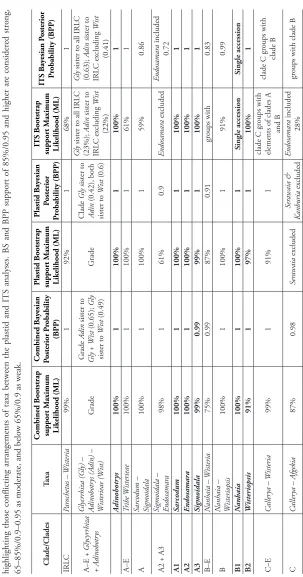
eak. Clade/Clades Taxa Combined B ootstrap suppor t M aximum Likelihood (ML) Combined B ay esian Posterior P robability (BPP) Plastid B ootstrap suppor t M aximum Likelihood (ML) Plastid B ay esian Posterior Pr obability (BPP) IT S B ootstrap suppor t M aximum Likelihood (ML) IT S B ay esian P osterior Pr obability (BPP) IRL C Par ochetus – W isteria 99% 1 92% 1 68% 1 A–E + G lycyrr hiza + Adinobotr ys G lycrr hiza (G ly) – Adinobotr ys (A din) – W isterieae (W ist) G rade G rade Adin sister to Gl y + W ist (0.65); Gl y sister to W ist (0.49) G rade Clade Gl y sister to Adin (0.42), both sister to W ist (0.6) G ly
sister to all IRL
C (23%); Adin sister to IRL C ex cluding W ist (22%) G ly
sister to all IRL
C (0.63); Adin sister to IRL C ex cluding W ist (0.41) Adinobotr ys 100% 1 100% 1 100% 1 A–E Tribe W isterieae 100% 1 100% 1 61% 1 A Sar codum – Sigmoidala 100% 1 100% 1 59% 0.86
A2 + A3
Sigmoidala – Endosamar
a 98% 1 61% 0.9 Endosamar a ex cluded Endosamar a included 0.72 A1 Sar codum 100% 1 100% 1 100% 1 A2 Endosamar a 100% 1 100% 1 100% 1 A3 Sigmoidala 99% 0.99 99% 1 100% 1 B–E N anhaia – W isteria 75% 0.99 87% 0.91 gr oups with 0.83 B N anhaia – W isteriopsis 100% 1 100% 1 91% 0.99 B1 N anhaia 100% 1 100% 1 Single accession Single accession B2 W isteriopsis 91% 1 97% 1 100% 1 C–E C aller ya – W isteria 99% 1 91% 1
clade C gr
oups with
elements of clades A
and B
clade C gr
oups with
clade B
C
C
aller
ya – Afgekia
87% 0.98 Ser awaia ex cluded Ser awaia & Kanburia ex cluded Endosamar a included 28% gr
Clade/Clades Taxa Combined B ootstrap suppor t M aximum Likelihood (ML) Combined B ay esian Posterior P robability (BPP) Plastid B ootstrap suppor t M aximum Likelihood (ML) Plastid B ay esian Posterior Pr obability (BPP) IT S B ootstrap suppor t M aximum Likelihood (ML) IT S B ay esian P osterior Pr obability (BPP) C1 C aller ya
64% (100% abo
ve C. bonatiana including C. bonatiana 0.95
48% (74% abo
ve C. bonatiana including C. bonatiana 0.96 C. bonatiana C. bonatiana ex cluded; gr oups, with no suppor
t, in Clade B
C2 + C3 + C4
Whitfor diodendr on – Afgekia 72% 0.99 Ser awaia Ser awaia & Kanburia ex cluded 53% 0.8 C2 Whitfor diodendr on 100% 1 99% 1 100% 0.99 C2/C3 Ser awaia Single accession; gr
oups with C2, with no suppor
t (13%)
Single accession;
gr
oups with C2, with moderate suppor
t
(0.93)
Single accession; unresolv
ed position
relativ
e to Clades C, D & E Single accession; no suppor
t
in Clade C, unr
esolv
ed
position r
elativ
e
to Clades D & E
Single accession;
gr
oups with C3 65%
Single accession;
gr
oups with C3 0.72
C3 Kanburia 100% 1 100% 1 85% 0.99 C4 Afgekia 100% 1 100% 1 100% 1
D + E
Padbruggea dasyphylla W103
Padbruggea dasyphylla W103
Glycyrrhiza glabra
Glycyrrhiza glabra
Serawaia strobilifera W3
Serawaia strobilifera W3
Glycyrrhiza uralensis
Glycyrrhiza uralensis
Austrocallerya megasperma W068
Austrocallerya megasperma W068
Padbruggea filipes W105
Padbruggea filipes W105
Sarcodum scandens W108
Sarcodum scandens W108
Whitfordiodendron erianthum W106
Whitfordiodendron erianthum W106
Sigmoidala kityana W5
Sigmoidala kityana W5
Wisteria macrostachya W037
Wisteria macrostachya W037
Padbruggea filipes W104
Padbruggea filipes W104
Afgekia sericea W071
Afgekia sericea W071
Sarcodum scandens W112
Sarcodum scandens W112
Adinobotrys vastus
Adinobotrys vastus
Austrocallerya megasperma W084
Austrocallerya megasperma W084
Wisteriopsis japonica W088
Wisteriopsis japonica W088
Glycyrrhiza lepidota
Glycyrrhiza lepidota
Whitfordiodendron nieuwenhuisii
Whitfordiodendron nieuwenhuisii
Wisteria floribunda W020
Wisteria floribunda W020
Wisteria sinensis W025
Wisteria sinensis W025
Wisteria brachybotrys W009
Wisteria brachybotrys W009
Glycyrrhiza pallidiflora
Glycyrrhiza pallidiflora
Adinobotrys atropurpureus
Adinobotrys atropurpureus
Wisteria sinensis W024
Wisteria sinensis W024
Callerya bonatiana W10
Callerya bonatiana W10
Endosamara racemosa W075
Endosamara racemosa W075
Nanhaia fordii W2
Nanhaia fordii W2
Astragalus mongholicus
Astragalus mongholicus
Schefflerodendron usambarense W095
Schefflerodendron usambarense W095
Callerya nitida W101
Callerya nitida W101
Astragalus eremiticus
Astragalus eremiticus
Adinobotrys atropurpureus W061
Adinobotrys atropurpureus W061
Endosamara racemosa W107
Endosamara racemosa W107
Padbruggea dasyphylla
Padbruggea dasyphylla
Padbruggea filipes W036
Padbruggea filipes W036
Callerya oosperma
Callerya oosperma
Austrocallerya australis W087
Austrocallerya australis W087
Callerya nitida W099
Callerya nitida W099
Kanburia chlorantha W074
Kanburia chlorantha W074
Wisteria brachybotrys W043
Wisteria brachybotrys W043
Parochetus africanus
Parochetus africanus
Austrocallerya pilipes W6
Austrocallerya pilipes W6
Wisteria floribunda W022
Wisteria floribunda W022
Wisteria sinensis W002
Wisteria sinensis W002
Wisteriopsis eurybotrya
Wisteriopsis eurybotrya
Schefflerodendron usambarense
Schefflerodendron usambarense
Kanburia tenasserimensis W066
Kanburia tenasserimensis W066
Sigmoidala kityana
Sigmoidala kityana
Austrocallerya pilipes W092
Austrocallerya pilipes W092
Wisteria frutescens W012
Wisteria frutescens W012
Callerya cochinchinensis
Callerya cochinchinensis
Padbruggea filipes W102
Padbruggea filipes W102
Wisteriopsis reticulata W109
Wisteriopsis reticulata W109
Wisteria sinensis W111
Wisteria sinensis W111
Whitfordiodendron scandens W098
Whitfordiodendron scandens W098
Austrocallerya australis
Austrocallerya australis
Callerya cinerea W063
Callerya cinerea W063
Alhagi maurorum
Alhagi maurorum
Nanhaia speciosa W114
Nanhaia speciosa W114
Wisteriopsis japonica W045
Wisteriopsis japonica W045
Wisteriopsis japonica W1
Wisteriopsis japonica W1
Wisteria floribunda W044
Wisteria floribunda W044
Sigmoidala kityana W064
Sigmoidala kityana W064
Wisteria floribunda W019
Wisteria floribunda W019
Wisteria floribunda W017
Wisteria floribunda W017
Wisteriopsis championii W8
Wisteriopsis championii W8
Wisteria sinensis W110
Wisteria sinensis W110
Endosamara racemosa W097
Endosamara racemosa W097
Wisteria macrostachya W038
Wisteria macrostachya W038
Alhagi graecorum
Alhagi graecorum
Wisteria brachybotrys W021
Wisteria brachybotrys W021
Afgekia mahidoliae W073
Afgekia mahidoliae W073
Afgekia sericea W096
Afgekia sericea W096
Callerya cinerea W080
Callerya cinerea W080
Callerya dielsiana W029
Callerya dielsiana W029
Afgekia mahidoliae W069
Afgekia mahidoliae W069
Wisteria floribunda W046
Wisteria floribunda W046
Parochetus communis
Parochetus communis
Wisteriopsis japonica W032
Wisteriopsis japonica W032
The Callerya group sensu Schot (1994); Lôc and Vidal (2001); Wei and Pedley (2010) and Sirichamorn et al. (2016) is not supported in its entirety in our analyses but rather, what emerges are four elements comprising the IRLC, each fully supported
here (Fig. 1; Table 3), i.e. Tribe Wisterieae, Glycyrrhiza, Adinobotrys and a clade
con-taining the Galegeae s.l., Hedysareae, Cicereae, Fabeae and Trifolieae s.l. (henceforth
the “Temperate Tribe block”). Glycyrrhiza (Bootstrap or BS 100%; Bayesian Posterior
Probability or BPP 1) is not supported as sister to Tribe Wisterieae and neither is
Adinobotrys (BS 100%; BPP 1), which, in addition, is not supported to have a
posi-tion within Tribe Wisterieae either. Adinobotrys is thus reinstated as a genus here and
removed from the Callerya group. The positions of Tribe Wisterieae, Glycyrrhiza and
Adinobotrys remain equivocal as regards their sister group relationships to the rest of the Temperate Tribe block of the IRLC.
The Callerya group i.e. Tribe Wisterieae without the genus Adinobotrys comprises five strongly supported clades with the first two in a basal grade leading to Clades C + D + E. The crown node of the tribe is fully supported in both the combined and plastid analyses (BS 100%; BPP 1) and in the ITS BI analysis (BPP 1), although only weakly so in the ITS ML analysis (Fig. 1, Table 3, BS 61%). Clade A (fully supported in the combined and plastid analyses but weakly so in the ITS analyses [BS 59%, BPP 0.86])
contains the genus Sarcodum (BS 100%; BPP 1), sequenced and analysed for the first
time here, which is sister to Endosamara (BS 100%; BPP 1) and the new monospecific
genus Sigmoidala (BS 99%; BPP 0.99) described in this paper. Clade B comprises two
new genera described here, Nanhaia (BS 100%; BPP 1) and Wisteriopsis (BS 91%;
BPP 1) and both are fully supported as Clade B (Fig. 1; Table 3). Our results confirm
that the incorrectly attributed Millettia japonica is strongly supported within our new
genus Wisteriopsis.
Figure 1. Combined Maximum Liklihood (ML) and Bayesian Inference (BI) Phylogenetic tree of Tribe Wisterieae. The tree is derived from the combined plastid and ITS, RAxML bipartitions analysis
represent-ing 77 (36) represent-ingroup samples (taxa) and 59 (40) outgroup samples (taxa). The outgroup Schefflerodendron
is used to root the trees. Lines in bold on the phylogeny incorporate results from the combined Bayesian Inference analysis, demarcating clades with BPP (0.95) support and above. Nodes are marked up with bootstrap values as percentages derived from the combined ML analysis with values of 50% or less marked
in red. The collapsed portion of the tree, below the IRLC and above Schefflerodendron, represents the
following genera (see Suppl. material 1: Figs S1–S6): Tribe Robinieae (Coursetia, Gliricidia, Poissonia &
Poitea); Tribe Sesbanieae (Sesbania), Tribe Loteae (Coronilla, Lotus & Securigera); Tribe Millettieae (
Mil-lettia), Tribe Abreae (Abrus); Tribe Phaseoleae (Clitoria & Ophrestia); Tribe Indigofereae (Phylloxylon) and
basal millettioids (Austrosteenisia, Disynstemon, Xeroderris & Platycyamus). Tribe Wisterieae is treated within five clades (Clades A–E), colour coded green for Clade A (Sarcodum, Endosamara & Sigmoidala); cyan for Clade B (Nanhaia & Wisteriopsis), red for Clade C (Callerya, Serawaia, Whitfordiodendron, Kanburia &
Afgekia); orange for Clade D (Padbruggea & Austrocallerya) and yellow for Clade E (Wisteria). Each clade is
further subdivided to represent the genera (except for the single accession of Serawaia which is incorporated
with Whitfordiodendron in Clade C2) and E1 and E2 represent the geographical disjunction of species in
Wisteria. Outgroups within the IRLC in purple include Glycyrrhiza, Adinobotrys and representatives of the
Clade C is strongly supported (BS 87%; BPP 0.98) in the combined analyses but is more labile with some genera excluded and others included in the plastid and ITS
analy-ses (Fig. 1; Table 3). A much reduced Callerya s.str. together with C. bonatiana is strongly
supported in the combined and plastid BI analyses (BPP 0.95; 0.96), but only weakly
so in the ML analyses. The single accession of C. bonatiana has no support for grouping
with Callerya in the ITS analyses. Callerya above C. bonatiana is strongly supported in
the combined ML and BI analyses (BS 100%; BPP 0.95). The grouping of Afgekia (BS
100%; BPP 1), the resurrected genus Whitfordiodendron (BS 100%; BPP 1) and the two
new genera described here, Kanburia (BS 100%; BPP 1) and Serawaia (single accession),
is moderately supported in the combined ML (BS 72%) and well supported in the com-bined BI (BPP 0.99) analyses. This grouping breaks down in the plastid analyses and is
weakly supported in the ITS analyses (Table 3). Serawaia is strongly supported within
Clade C in the combined analyses (BS 87%; BPP 0.98) in a position (Fig. 1, Table 3),
with no support, as sister to Whitfordiodendron. It is in an unresolved position in the
plas-tid analyses and is weakly supported as sister to Kanburia in the ITS analyses (Table 3).
Clade D comprises two genera, Padbruggea (BS 91%; BPP 1) which is reinstated
as a genus here and Austrocallerya (BS 98%; BPP 1), a new genus described here. Our
results reveal that Afgekia filipes belongs in our reinstated genus Padbruggea and the
transfer back is made in this paper. The two genera are also strongly supported together as Clade D (BS 98%; BPP 1). Clades D + E are strongly supported in all analyses (com-bined ML [98%] & BPP [1]; plastid BPP [0.97] and ITS ML [90%] & BPP [1]), but
in the plastid ML analysis support is weak (BS 68%). Finally Clade E comprises
Wis-teria (BS 100%; BPP 1), with two North American taxa fully supported as sister to the
three Asian species of the genus (BS 100%; BPP 1). The relationship of W. brachybotrys
as sister to W. floribunda and W. sinensis is also fully supported (BS 100%; BPP 1).
Discussion
Morphology of the Callerya Group
Schot (1994) segregated her species of Callerya into two groups based on the presence
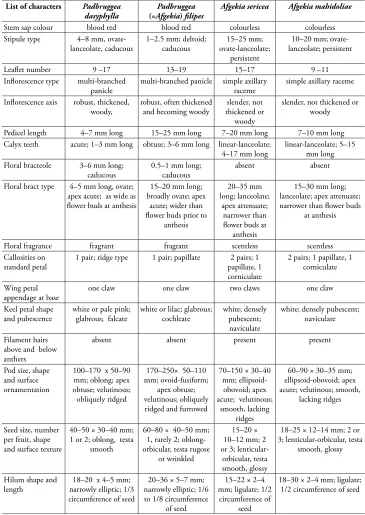
or absence of stipels and, when present, whether they were persistent or caducous. We have found no evidence that stipel presence or absence has any taxonomic significance in Calleya s.l. Lôc (1996) and Wei and Pedley (2010) segregated species on the basis of the presence or absence of an indumentum on the dorsal surface of standard petals. We concur with Lôc (1996) and Wei and Pedley (2010) but in addition regard the inflores-cence type and various floral, fruit and seed types to be equally significant in delimiting taxa (see the Key to the Genera and Table 4 for a list of significant characters). The key
to fruiting specimens of Callerya s.l. (Lôc 1996: 56) emphasised stipellae characters as