PhD Dissertation
International Doctorate School in Information and Communication Technologies
DISI - University of Trento
Towards the Application of
Interaction-oriented Frameworks to
Information Sharing in
Emergency Contexts
Gaia Trecarichi
Advisor:
Prof. Maurizio Marchese
Universit`a degli Studi di Trento
Abstract
In distributed, open evironments, possibly heterogeneous computational
entities need to engage in complex interactions in order to complete tasks
and often have to face sudden changes; it therefore becomes essential for
modern information systems to adopt coordination technologies which
sup-port dynamic and flexible interactions among processes, whether reactive
(e.g., web services) or proactive (e.g., autonomous agents). Substantial
ef-forts are being put forward to devise suitable mechanisms for process
coor-dination. In the past few years, interaction-oriented frameworks have been
proposed, which enable distributed and heterogeneus agents to engage in
coordination activities by sharing interaction models specified in executable
protocol languages. Software systems have started to be developed to apply
such frameworks to concrete use. In particular, the OpenKnowledge
frame-work has been proposed as such an interaction-oriented frameframe-work, and the
OpenKnowledge (OK) system has been developed for its realization. Such
system provides a distributed infrastructure which allows a-priori unknown
peers to gather together and coordinate with each other by publishing,
dis-covering and executing interaction models specified in the Lightweight
Co-ordination Calculus (LCC) protocol language. Although the realization of
the OpenKnowledge approach is promising, its application in realistic,
com-plex scenarios is not fully exploited.
This thesis aims at applying the OpenKnowledge framework to realistic
contexts such as emergency response (e-Response). Its main contribution
is in the design and simulation of emergency response scenarios which are
expressed in terms of LCC specifications, and are enacted by means of a
envi-(2) test the capability of the OK system to support such scenarios, and (3)
provide a preliminary evaluation of the efficacy of different information
gathering strategies (i.e., centralized or distributed) in emergency response
settings. The results obtained show that the OK system is able to support
complex coordination tasks; however, some limitations have emerged in
re-lation to the discovery mechanism. Furthermore, simure-lations have shown
to adhere with realistic scenarios, and that - under ideal conditions -
cen-tralized and decencen-tralized information-gathering strategies are comparable.
Keywords
Publications
This work has been developed in collaboration with various people (as the publications indicate) and in particular with: Maurizio March-ese, Lorenzino Vaccari, Veronica Rizzi, Juan Pane, Paolo Besana, Fiona McNeill, Nardine Osman.
Part of the material of the thesis has been published as articles in various conferences and journals and as technical reports in the EU FP6 OpenKnowledge1 Specific European Targeted Research Project (STREP) project IST-FP11V341. In what follows, journal articles, conference pa-pers, and technical reports are listed.
Journal articles (in order of appearance):
• [111]: Gaia Trecarichi, Veronica Rizzi, Maurizio Marchese, Lorenzino Vaccari, Paolo Besana. Enabling information gathering patterns for emergency response with the OpenKnowledge system, Special Issue on Pervasive Computing and Application, Computing and Informatics
Journal, Vol. 29, N. 4, 2010, pp. 537-554.
• [70]: Maurizio Marchese, Lorenzino Vaccari, Gaia Trecarichi, Nardine Osman, Fiona McNeill, and Paolo Besana. An Interaction-Centric Approach to Support Peer Coordination in Distributed Emergency Response Management, Intelligent Decision Technologies (IDT), Spe-cial Issue on Incident Management, Vol. 3, N. 1, 2009, pp. 19-34. Conference papers (in order of appearance):
• [112]: Gaia Trecarichi, Veronica Rizzi, Lorenzino Vaccari, Maurizio Marchese, and Paolo Besana. OpenKnowledge at work: exploring 1
http://www.openk.org/
texts. In Proceeding of the 6th International Conference on Informa-tion Systems for Crisis Response and Management (ISCRAM), 2009.
• [69]: Maurizio Marchese, Lorenzino Vaccari, Gaia Trecarichi, Nar-dine Osman, and Fiona McNeill. Interaction models to support peer coordination in crisis management. In Proceedings of the 5th Inter-national Conference on Information Systems for Crisis Response and
Management (ISCRAM), pages 230-241, 2008. Technical reports (in order of appearance):
• [113]: Gaia Trecarichi, Veronica Rizzi, Lorenzino Vaccari, Juan Pane, and Maurizio Marchese. OpenKnowledge deliverable 6.8: Summative report on use of OpenKnowledge approach in eResponse: integration and evaluation results. Technical report, OpenKnowledge, 2008.
• [21]: Paolo Besana, Fiona McNeill, Fausto Giunchiglia, Lorenzino Vaccari, Gaia Trecarichi, and Juan Pane. Web service integration via matching of interaction specifications. Technical report, Univer-sity of Trento, Dipartimento di Ingegneria e Scienza dell’Informazione
(DISI), 2008.
• [71]: Maurizio Marchese, Lorenzino Vaccari, Gaia Trecarichi, Pavel
Shvaiko, Juan Pane, Nardine Osman, and Fiona McNeill.
Open-Knowledge deliverable 6.7: Interaction models for eResponse. Tech-nical report, OpenKnowledge, 2008.
Contents
1 Introduction 1
1.1 The problem . . . 3
1.2 The proposed approach . . . 5
1.3 Thesis structure . . . 8
I State of the Art 11 2 Service Coordination 13 2.1 Composition techniques . . . 15
2.1.1 Workflow-based composition . . . 15
2.1.2 Dynamic composition . . . 16
2.2 Collaboration techniques . . . 17
2.2.1 WSCI . . . 18
2.2.2 WS-CDL . . . 18
2.2.3 Let’s Dance . . . 19
2.2.4 BPEL4Chor . . . 20
3 Agent-Oriented Coordination 21 3.1 Agent communication languages . . . 22
3.2 Conversation policies . . . 24
3.3 Social agency . . . 26
3.3.1 Commitment protocols . . . 26
3.3.3 Dialogue-game protocols . . . 27
3.3.4 Electronic Institutions . . . 28
3.3.5 Lightweight Coordination Calculus (LCC) . . . 29
II An Interaction-Oriented Approach to Knowledge Sharing: OpenKnowledge 37 4 The Framework 39 5 The OpenKnowledge System 43 5.1 LCC interaction models . . . 43
5.2 The OpenKnowledge Kernel . . . 45
5.2.1 OKC components . . . 46
5.2.2 Kernel modules . . . 49
5.2.3 Kernel services . . . 51
5.3 Interaction lifecycle . . . 53
5.3.1 Subscription to an interaction model . . . 53
5.3.2 Interaction bootstrap . . . 54
5.3.3 Interaction run . . . 55
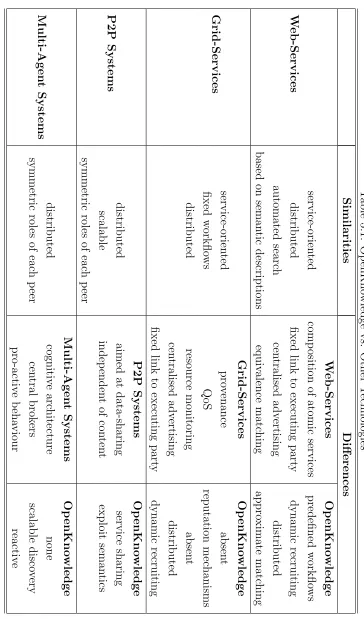
5.4 OpenKnowledge vs. other technologies . . . 56
5.4.1 Web services . . . 57
5.4.2 Grid services . . . 58
5.4.3 P2P systems . . . 59
5.4.4 Multi-Agent Systems (MAS) . . . 59
III Design and Simulation of LCC e-Response Scenarios 61
6.1 The general context . . . 64
6.2 Flooding in Trentino: the e-response case study . . . 67
6.2.1 Prealarm scenario . . . 69
6.2.2 Evacuation scenario . . . 71
6.3 Conclusion . . . 74
7 LCC Protocol Design 77 7.1 Initial design . . . 78
7.2 Final design . . . 82
7.3 Conclusion . . . 85
8 The Simulation Environment 87 8.1 LCC protocols: an overview . . . 88
8.2 Simulation architecture . . . 89
8.2.1 The peer network . . . 90
8.2.2 The e-Response simulator . . . 97
8.3 OK component reuse . . . 108
8.3.1 Reuse of LCC interaction models . . . 109
8.3.2 Reuse of OKC methods . . . 110
8.4 Conclusion . . . 111
IV Experimental Evaluation 113 9 Experimental Testbed 115 9.1 Testbed overview . . . 115
9.2 Experimental hypotheses . . . 117
9.3 Experimental design . . . 118
9.3.1 Performance measures . . . 118
9.3.2 Experimental variables . . . 118
9.3.4 Experiment configuration . . . 121
9.3.5 Experiment execution . . . 122
9.4 Results . . . 122
9.4.1 Information gathering strategies . . . 123
9.4.2 The OK infrastructure . . . 125
9.5 Conclusion . . . 128
V Final Discussions 131 10 Related Work 133 11 Conclusions 137 12 Future Work 141 Bibliography 145 A Peer Network Interaction Models 165 A.1 Evacuation.lcc . . . 165
A.2 Find-Route.lcc . . . 169
A.3 Check-Route-State.lcc . . . 170
A.4 Querier-Reporter.lcc . . . 173
B Simulator Interaction Models 177 B.1 Simulation Cycles.lcc . . . 177
B.2 Flood Sub-Simulator Connection.lcc . . . 182
B.3 Peer Connection.lcc . . . 183
B.4 Flood.lcc . . . 187
B.5 Sensory Info.lcc . . . 189
B.7 Perform Action.lcc . . . 193
List of Tables
2.1 Collaboration vs. Composition . . . 14 5.1 OpenKnowledge vs. Other Technologies . . . 60 9.1 Experiments configuration . . . 122
List of Figures
3.1 LCC formal syntax . . . 30
3.2 LCC example: double arrows (⇒,⇐) indicate message pass-ing, single arrow (←) indicates constraint satisfaction. . . . 31
5.1 Simple LCC interaction. . . 45
5.2 OK Kernel Architecture [34] . . . 46
5.3 Annotated peer’s methods . . . 48
5.4 Peer’s methods required by an OKC . . . 49
5.5 OKC: access to peer’s local knowledge . . . 49
5.6 Peer Modules [34] . . . 50
5.7 Interaction Subscription . . . 54
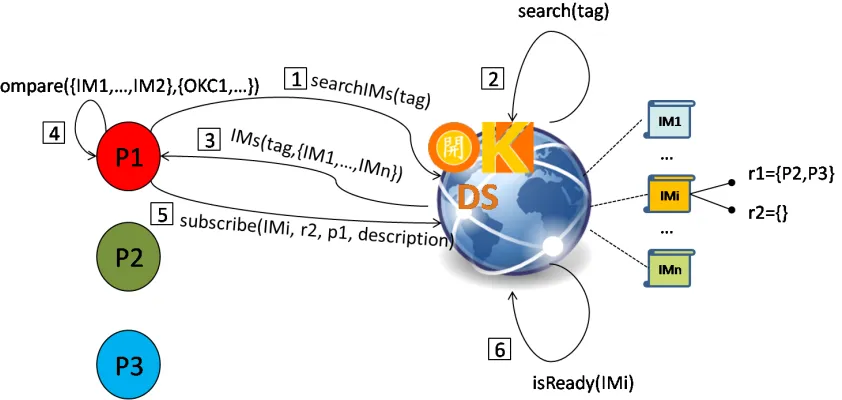
5.8 OK network at subscription time [111] . . . 55
5.9 Interaction Bootstrap . . . 56
5.10 Interaction Run . . . 57
6.1 Integrated Emergency Response Framework (iERF) proposed by NIST . . . 66
6.2 The overall e-Response use case . . . 68
6.3 The implemented e-Response scenarios . . . 69
6.4 Evacuation phase: moving peer behaviour . . . 75
7.1 UML activity diagram: baseline scenario . . . 78
7.2 UML sequence diagram: baseline scenario . . . 79
7.3 LCC fragment: ES initial role . . . 80
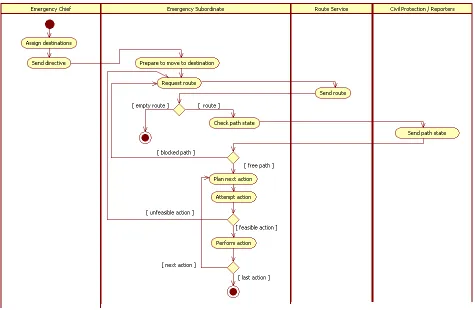
7.5 UML activity diagram: evacuation scenario . . . 83
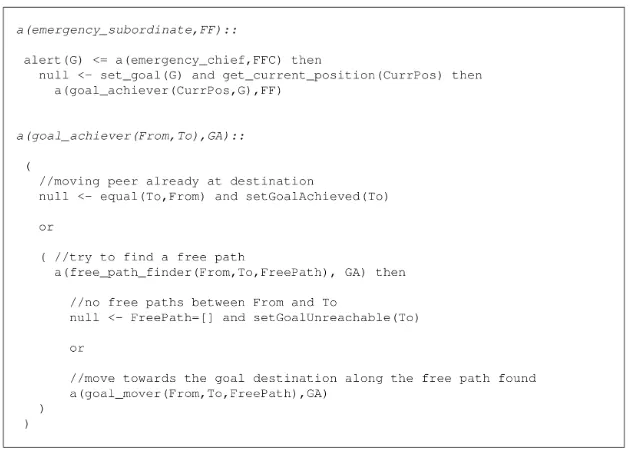
7.6 LCC fragment for the “goal-achiever” role . . . 84
7.7 LCC fragment for the “free-path-finder” role . . . 84
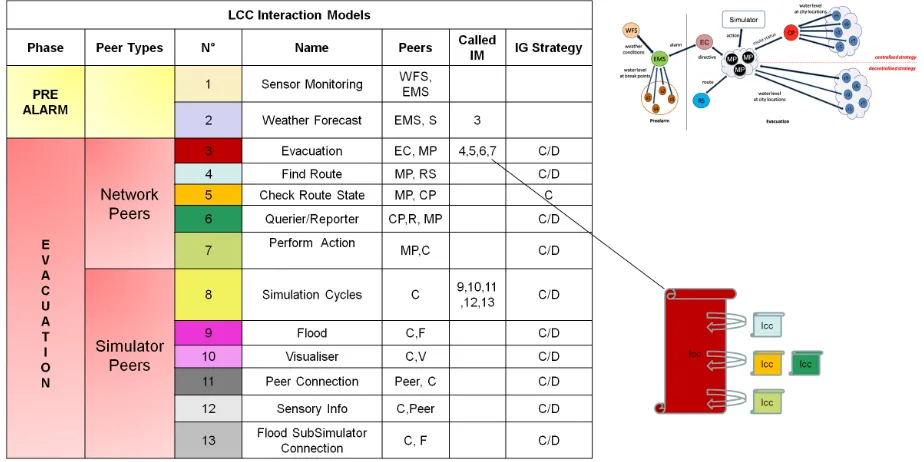
8.1 e-Response Interaction Models . . . 89
8.2 The e-Response system’s architecture . . . 90
8.3 Evacuation phase: network peer’s interactions . . . 91
8.4 LCC fragment for the “free-path-finder” role . . . 93
8.5 Java code for OKC method “request path state”: interaction model enaction . . . 94
8.6 Information Gathering: centralized interactions . . . 96
8.7 Decentralized Information Gathering: selection of reporters 98 8.8 LCC fragment for the “info-handler” role taken by the con-troller . . . 100
8.9 Maximum Water Level [2] . . . 101
8.10 Maximum Flow Velocity [2] . . . 101
8.11 Maximum impulse [2] . . . 102
8.12 Maximum water level rising speed [2] . . . 102
8.13 Arrival time of first water [2] . . . 102
8.14 Maximum water level in Trento Nord . . . 103
8.15 Arrival time of maximum water level . . . 103
8.16 Flooding Law . . . 104
8.17 Emergency GUI . . . 106
8.18 Flood Evolution . . . 107
8.19 GUI: Centralized information gathering . . . 108
8.20 GUI: Decentralized information gathering . . . 108
8.21 The “Querier-Reporter” IM Reuse . . . 109
9.2 Outcome Distribution (centralized/decentralized scenario) 124
9.3 Time-steps vs. Path Length . . . 125
9.4 Successful vs. Failed Experiment Runs . . . 126
9.5 Failed experiment runs . . . 127
9.6 Subscription failures by simulation run phase . . . 128
9.7 Subscription failures by IMs . . . 129
Chapter 1
Introduction
The need for effective process coordination has long been recognized in diverse research fields, such as service-oriented computing and agent sys-tems. In open and distributed environments, possibly heterogeneous pro-cesses (whether web services or autonomous agents) must interact with each other in a way that allows the execution of complex coordination tasks. Two different realistic scenarios are briefly outlined below, to show the kind of issues involved in such settings.
In a possible e-tourism scenario, a customer wants to book a journey and forwards a request to a travel company able to deliver e-tickets. The companys information system supports process automation and integration with airline, car rental and hotel partners. When a request is received, the process coordinates different activities involved in the reservation proce-dure; for instance, it invokes services provided by the partner companies, stores information properly and handles new and unexpected situations (e.g., a partner service changes its interface; the customer changes its re-quest, cancels reservations, asks for refunds; the company itself adds new services).
In a possible e-response scenario, a large number of actors (e.g., local governments, emergency coordination centres, fire brigades, the police and
health agencies, volunteers, citizens) are involved in the emergency activi-ties. For instance, people in a coordination center may need to retrieve and integrate data and services from different geographical information systems in order to plan activities, make decisions and forward directives to their subordinates; geographically dispersed agents have to collaborate and co-ordinate in the disaster scenes by exchanging and reporting information with each other and with the people in the control room; moreover, the information distribution system has to cope with unexpected situations (e.g., actors changing roles, taking new and interrupting old activities).
In the e-tourism scenario, the Web is the scene where all the involved activities will take place. Here, the role of services is essential: they must be coordinated in order to provide more complex services and to respond to business requirement changes (e.g., partner and customer changes). The e-response scenario is much more complex and dynamic: beside the crucial problem of coordinating services (e.g., the problem of geo-service chain-ing), coordination mechanisms must support mobile agents located in ar-eas prone to sudden changes. However, in both situations, the following key issues need to be addressed:
• Design of large-scale information systems (e.g., both scenarios involve many parties which are geographically dispersed);
• Dynamic and flexible interaction patterns (e.g., a customer may enter-tain long-lived interactions, emergency agents may engage in complex interactions or suddenly change the progress of their coordinated ac-tivities);
1.1. THE PROBLEM
The above issues are recognized as top priorities among research com-munities. For example, Singh et al. [106] highlight the importance of adopting suitable software paradigms for “programming in the large”, i.e., the need for approaches able to model systems where large software com-ponents - built by different organizations over a long period of time, and having their local state - hold interactions which are subject to unforeseen events. Kang et al. [63] distinguish orchestration from choreography ap-proaches: the former oriented in describing how composite processes are implemented and the latter focused on the interactions enacted by the processes without any central entity. Buhler et al. [25] make a distinc-tion between the internal behaviour of the software components and their interactions: “a software system is viewed as an ensemble of coordinables and their orchestrated interactions. Coordinables are entities that function
as independent units of computation. The coordinated interaction of the
computational units produces the desired behavior of the system”.
All the above mentioned works put in evidence the role played by coordi-nation mechanisms in software system design. Coordicoordi-nation technologies are, therefore, fundamental for supporting effective interactions between heterogeneous and distributed computational entities.
1.1
The problem
The issue of devising suitable coordination technologies is being tackled by several research communities: works on service-oriented computing and agent systems are converging to enable dynamic interaction among au-tonomous components in large, open systems.
On the one hand, the paradigm of Service-Oriented Architecture (SOA) and, as a consequence, that of Web services, is rapidly being accepted as the standard for coordinating distributed processes across networks, like
Internet.
On the other hand, agent technologies allow proactive entities to oper-ate autonomously and to interact with each other in order to accomplish a task. In particular, protocol languages such as the Lightweight Coordina-tion Calculus (LCC) [94], MAP [119] and RASA [81] have been specified to express executable models of interactions within multi-agent systems. However, to put them into practical use, research needs to be carried out along the following directions:
• the establishment of frameworks that allows heterogeneous agents1 to coordinate via interaction protocols;
• the development of software systems that implement the aforemen-tioned frameworks;
• the exploitation and the evaluation of such systems, to assess their ca-pability to support coordination tasks in complex, dynamic scenarios such as those briefly outlined earlier.
In respect to the first point, the OpenKnowledge (OK) framework [96] has been proposed in the past few years; it is an interaction-oriented ap-proach according to which interaction models specified in a protocol lan-guage (e.g, LCC) are shared first-class entities which enable a priori un-known agents to engage in complex coordination patterns.
In respect to the second point, the OpenKnowledge system [34] has been developed within the European project OpenKnowledge2 as a distributed peer-to-peer3 infrastructure which realizes the OK framework. In particu-lar, such system is adopted as the underlying communication infrastructure 1In the rest of this thesis, the terms “computational entity”, “process”, “agent”, and “peer” will be
used interchangeably.
2
http://www.openk.org/
1.2. THE PROPOSED APPROACH
that enables peers to find and coordinate with each other by publishing, discovering and executing multi party conversational protocols specified in the LCC language.
The work of this thesis has indirectly contributed to the second direc-tion; and has mainly contributed to the third direction by means of the approach described in the next section.
1.2
The proposed approach
With the aim to apply the above mentioned interaction-oriented frame-works in realistic contexts, the approach taken has been to: (1) first de-sign LCC interaction protocols to model coordination tasks in a complex domain such as emergency response; (2) then, provide a simulation en-vironment, where to validate such interaction-based scenarios; (3) finally, conduct an experimental evaluation, to test the functionality of the OK system, and to start exploring the efficacy of different information gather-ing strategies in emergency response contexts.
The research has thus been carried out along three main lines: (1) LCC protocol engineering; (2) simulation environment development; (3) experimental evaluation.
LCC protocol engineering the effective design of interaction models is cru-cial to the application in realistic contexts. Since interaction models shape coordination patterns occurring in well defined settings (e.g., e-response, e-health, etc.), it is essential to study the functional requirements of the specific domain. This helps to identify some common interaction patterns occurring in emergency situations. Such interaction patterns in fact form the basis for identifying basic protocols which in turn constitute reusable interaction units needed to compose larger protocols in a modular way. We
designed interaction models starting from analyzing documents related to the current flood emergency plan foreseen by the Trentino region and from interviews with experts. Our analysis resulted in the modeling of the pre-alarm and the evacuation phases foreseen by the emergency plan in terms of LCC specifications.
It is worth to mention here that, such analysis affected the design of interaction models and provided requirements and feedbacks for the devel-opment of the OK system. Under this aspect, this thesis also contributes (though in an indirect way) to the development of the OK system itself.
Simulation environment development the developed simulation
environ-ment is composed of an agent network and a simulation engine. The first component models a hierarchy of e-response agents, which plan activities and coordinate with each other through predefined LCC interaction mod-els; the second module simulates the environment where all the involved actors operate.
The developed simulator is used to: (1) informally validate interac-tion models, and investigate how appropriate LCC protocols are to reflect dynamic emergency coordination tasks; (2) evaluate the capability of the whole OK infrastructure to support different models of information sharing ; (3) assess, under specific assumptions, the efficacy of different information gathering strategies during e-response situations.
Experimental evaluation an experimental testeb has been designed, to test
the OK infrastructure in a realistic and demanding case study, and to provide a preliminary evaluation on how different information gathering strategies (i.e., centralized and decentralized) impact emergency response tasks.
1.2. THE PROPOSED APPROACH
in which stage of the coordination mechanism the OK infrastructure failed in enacting the multiple interleaved interactions; this was done without entering in the details of the underlying communication infrastructure, thus, by considering the OK infrastructure as a black-box.
To get insights into the domain under study, and in particular, to eval-uate how the above mentioned information-gathering strategies impact emergency response activities, we designed and conducted experiments. The result obtained show that our simulations adhere to realistic scenarios and that - under ideal conditions - such strategies are comparable.
In summary, this thesis contributes in the following four aspects:
1. The design of a set of interaction models written in the LCC protocol language to model complex coordination tasks in a realistic scenario such as a flood disaster;
2. The development of a simulation environment - built on top of the OK platform - to informally validate the just mentioned suite of interaction models;
3. A functional testing of the OK platform by means of the same simu-lator;
4. A preliminary evaluation on how different information gathering strate-gies impact emergency response tasks.
To the best of our knowledge, there is no prior work on the design and testing of complex interaction protocols in realistic contexts such as disaster situations. Also, while the OK platform has been exploited and tested only with a small number of simple interaction models involving mainly reactive web services [1], this thesis work focused on the exploita-tion and testing of the OK platform with multiple interleaved interacexploita-tions between more proactive agents [111]. Finally, by providing a simulation
environment, this thesis takes a first step towards the assessment of how different information gathering strategies (e.g., centralized or distributed) affect emergency response efficiency.
1.3
Thesis structure
This thesis is divided in five parts.
Part I overviews state-of-the-art research in coordination techniques, in two different fields. In particular, Chapter 2 describes the dominant composition and collaboration techniques in the Web service area; Chapter 3 deals with the key concepts related to multi-agent interaction techniques and protocols, with an emphasis on the LCC protocol language.
Part II presents OpenKnowledge as a suitable framework to enact choreography-based interaction models. Chapter 4 introduces the core principles upon
which the framework is based; Chapter 5 describes the main components of the OpenKnowledge system, and compares it with the dominant tech-nologies.
Part III describes the design of LCC interaction models in specific emer-gency response scenarios and presents the environment realized to simulate them. In particular, Chapter 6 first introduces “crisis response” as the ap-plication domain of the proposed approach, and then presents the specific case study of a flood disaster; Chapter 7 describes the process that lead from the analysis of the scenarios to the design of LCC protocols and, con-sequently, to the requirements suggested for the development of the OK system. Finally, Chapter 8 describes the architecture of the simulation environment.
1.3. THESIS STRUCTURE
overall functioning of the underlying supporting infrastructure, i.e., the OK system. Specifically, Chapter 9 first gives an overview of the experimental testbed; then it describes the hypothesis to be tested and the design of the experiments conducted to evaluate the information-gathering strategies; fi-nally, it presents the results from the conducted experiments for both the evaluation of the strategies and the testing of the OK infrastructure.
Finally, Part V concludes the thesis with final discussions: Chapter 10 gives a summary of related work in the area of emergency response systems; finally, Chapters 11 and 12 draws conclusions and outline future work directions, respectively.
Part I
Chapter 2
Service-Oriented Coordination
While the Service-Oriented Architecture paradigm is being commonly ac-cepted as a means to build distributed systems that deliver application functionalities as services, web services are emerging as suitable standards that provide an implementation of such paradigm. They can be composed, discovered and invoked thus allowing different organizations to provide and use service functionalities.
Since they are self-contained and self-describing XML-based compo-nents which enable interoperability of heterogeneous applications, they constitute the starting point for coordinating distributed processes. Web services are, in fact, sufficient for basic interaction needs but, by them-selves, inadequate to integrate processes involving multiple participants. For this reason, languages and models are needed to provide coordination mechanisms fulfilling the execution of more complex interactions. Many proposals are available and some became already standards. The most important ones are: BPEL4WS (or BPEL) [4], WSCI [5], BPML [110], WS-CDL [99], OWL-S [72], WSMO [97]. There is no common agreement on the classification model for such languages but generally they are associ-ated to orchestration and choreography languages [98, 87], or to web service composition techniques, which in turn are divided in static (e.g., BPEL,
WS-CDL) and dynamic (e.g., OWL-S) techniques [23]. Moreover, Kang et al. [63] distinguish between composition and collaboration techniques which adopt web services as basic and reusable software components. Table 2.1, taken from [63], shows the distinctive characteristics of both techniques taking WS-CDL and BPEL as examples of collaboration and composition techniques, respectively.
WS-CDL BPEL4WS
The Collaboration layer specification The Composition layer specification
Information driven Explicitly invoking
Among participants Within one single participant Distributed controlling Centralized controlling Distributed controlling Centralized controlling
Description language Process execution language
Peer-to-peer Centralized executor
Dynamic topology support
-Candidate recommendation Officially published
No commercial implementation Websphere, ActiveBPEL, etc
Table 2.1: Collaboration vs. Composition
2.1. COMPOSITION TECHNIQUES
and collaboration techniques1 .
2.1
Composition techniques
The aim of composition techniques is to provide an extension of the Web service technology in order to support the creation of composite services out of simpler ones. The main methods are classified into two broad cate-gories: workflow-based methods (e.g., BPEL, BPML ) and methods based on Semantic Web techniques and AI planning for dynamic composition [90].
2.1.1 Workflow-based composition
In this kind of composition, the flow of the information and the invocation between services is known in advance. BPEL4WS [4] can be employed to define either abstract or executable business processes. BPEL abstract processes are not executable per se, but they can indirectly impose behavior compliance upon private processes executed by the BPEL orchestration controller. How? By defining sequencing rules on invoked operations upon the BPEL private process. In this way the BPEL orchestration engine can use the abstract process to validate and assure public protocol conformance of executing processes. BPEL is also employed to describe executable business processes. In this case, the process models the internal, actual behaviour of one participant; it does so by encoding a precise sequence of messages that are exchanged between partners and described by their WSDL definitions. Moreover, an executable business process is said to be “compositionally complete”, that is, exportable as a Web service eligible to participate in other compositions.
1In the rest of this thesis, the terms “composition” and “collaboration” will be used interchangeably
with the terms “orchestration” and “choreography” respectively.
2.1.2 Dynamic composition
The technique described in the previous section requires human activities since services have to be directly specified and protocols (or models) have to be manually defined at design time. This prevents complex services to be created dynamically, at runtime. Methods based on Artificial Intelligence aim at either generating the process model automatically or locate the correct services if an abstract process model is given.
Such an abstract process model can be provided by an OWL-S service. OWL-S [72] is one of the two most prominent frameworks for enabling automated Web service composition. It provides a service ontology that supplements the WSDL description of a Web service with semantics. An OWL-S service is defined by three parts:
• Profile: describes what the service does;
• Process Model: tells how the service works;
• Grounding: contains details on how to access the service
The idea is that automatic composition can be achieved by reasoning on these components. WSMO is the alternative framework to OWL -S: it goes beyond the definition of a service ontology and provides a complete methodology for constructing Semantic Web applications.
2.2. COLLABORATION TECHNIQUES
general architecture for service delivery and coordination and describe a composition component which provides flexible semantic service compo-sition by exploiting OWL-S descriptions and Xplan, a planner partially based on HTN. In these works, the key idea is to sequentially compose the available web services, which are regarded as black boxes. In [89], a differ-ent technique based on “planning as model checking” is described to auto-matically compose BPEL web services: the code representing an internal business process is synthesized automatically starting from abstract BPEL specifications and a given business goal. This last method, in contrast to the others, has the advantage to deal with situations where external part-ner services are unpredictable and opaque in their internal status; however, the process of creating the plan is time-consuming. Althought many other AI planning techniques exist for automating web service composition, it is not our aim to provide a complete list in the framework of this thesis.
2.2
Collaboration techniques
As previously mentioned, the aim of collaboration techniques is that of providing a global view of how the participants interact in order to achieve a common goal. Here, the perspective is switched, from the “viewpoint” of the single actor (orchestration) to that of all the involved actors, which, in this case, are treated equally (choreography). A choreography model does not describe any internal action (e.g., internal computation, data transformation) occurring within a participating service that is not directly related to an externally visible effect. In short, choreography foresees all the interactions between the participating services that are relevant with respect to the choreography’s goal.
Compared to composition techniques, collaboration techniques are less investigated and choreography languages are defined at a preliminary stage.
In the next section we give an overview of the main choreography languages.
2.2.1 WSCI
The Web Service Choreography Interface (WSCI) [5] was the first XML-based language attempting to provide a standard for describing message exchange among collaborating parties. However, WSCI is classified as a behavioural interface rather than a choreography language, since it de-scribes the flow of messages exchanged by a web service participating in choreographed interactions with other services. WSCI specifies an ab-stract business process that is observable by external services. Therefore, like orchestration, focuses on the perspective of the single participant. Like choreographies, it does not describe internal tasks (e.g., internal data trans-formations).
2.2.2 WS-CDL
The Web Services Choreography Description Language (WS-CDL) [99] is the standard proposed by W3C in December 2004. It is an XML-based, ab-stract business process specification which defines interoperable, long-lived, p2p collaborations between web services. It introduces, among others, en-tities such as:
• Role: describes the external behavior that must be exhibited by a party to collaborate with other parties;
• Relationship: represents the mutual commitments needed between two parties to interact effectively;
• Choreography: defines the collaborations between interacting parties;
2.2. COLLABORATION TECHNIQUES
WS-CDL defines multi-party contracts that can be used in two ways:
(1) to generate the behavioural interfaces needed by peers to participate at the collaboration and (2) to check whether a specific service - provided with its behavioural interface - is able to play a given role in that contract. Criticisms directed to the language regard, among the others: the lack of a comprehensive formal grounding, the lack of direct support for multi-transmission interactions, the lack of separation between the meta-model and syntax [12]. Moreover, there is no graphical support and only few im-plementations are available [38]. In this last respect, Kang et al. proposed WS-CLD+ as an extension of the WS-CDL language [62] and a first execu-tion engine [63] for its enactment. Other implementaexecu-tions include pi4soa2, a partial implementation presented in [49] and an agent-oriented solution [126].
2.2.3 Let’s Dance
Let’s Dance is a visual language introduced by Zaha and colleagues to model behavioral dependencies between service interactions [125]. The language is meant to be used during the design phase of a system, it sup-ports the specification of both global and local models, allows to specify interaction models at different levels of abstraction, and to compose them. It has proven to be compliant with all the Service Interaction Patterns (SIP) [13], a set of 13 recurrent interaction scenarios used as a benchmark to assess the languages for service behavior modeling. Maestro has been developed as a tool to support the static analysis of global models, the generation of local models from global ones, and the interactive simulation of both local and global models [36].
2http://sourceforge.net/projects/pi4soa/ [01/11/2010]
2.2.4 BPEL4Chor
BPEL4Chor [37] is a language built on top of BPEL, to extend orchestra-tion models with choreographies. In BPEL4Chor, the core elements are: (i)
Participant behavior descriptions define the control flow dependencies be-tween activities, in particular bebe-tween communication activities, at a given participant; (ii) A participant topology determines the structural aspects of a choreography by specifying participant types, participant references, and message links; (iii) Participant groundings describe the technical configura-tion of the choreography by pointing to actual links to WSDL definiconfigura-tions, and establishing XSD types. It complies with almost all service interaction patterns, promotes reusability since technical details are confined to the groundings layer, and directly supports multi-party interactions. Regard-ing the supportRegard-ing tools, a web-based editor3 exists that enables designers to create choreography models in a graphical way.
Chapter 3
Agent-Oriented Coordination
As presented in the previous chapter, the SOA framework has the goal to provide loose coupling among interacting software agents which are dis-tributed over a network and created by different organizations, with differ-ent platforms. The similarity with Multi-Agdiffer-ent Systems (MASs) becomes apparent: a MAS is, in fact, a loosely coupled network of intelligent agents that interact to solve problems that are unsolvable by the individual ca-pacities or knowledge of the single entity. However, there is a fundamental difference between SOA and MAS that lies in the definition of an agent. A “SOA agent” is a software agent, that is, a program that implements and accesses a web service. In a MAS, the agent is an intelligent agent, that is, an independent entity which is able to make decisions autonomously. While software agents are involved in stateless communications, intelligent agents can engage in complex interactions by means of sophisticated communica-tion and coordinacommunica-tion mechanisms and can easily adapt to changes in the environment they inhabit. This makes agent techniques suitable to com-plement and enhance the more inflexible nature of Web service technology. In the next sections, we give an overview of the main agent communication and coordination techniques and sketch some approaches which use these techniques to strength web service technology.
3.1
Agent communication languages
An Agent Communication Language (ACL) is a mechanism allowing agents to exchange information and knowledge. Existing ACLs for MASs are KQML[45] and FIPA-ACL [47]. Even though the latter has superseded the former, the principles underlying the two are similar. They are based on the speech act theory [8, 102], according to which verbalizing certain utterances (performative speech acts) means to “do things” or “perform”; a message therefore specifies a performative (or communicative act) which tells whether it is an assertion, a command, a query or any other element of a predefined set of performatives. A KQML message is organized in three layers:
• Content Layer: it represents the actual content of the message encoded in a given representation language. Different representation languages are allowed, including languages expressed as ASCII strings and those expressed using binary notation;
• Communication Layer: it specifies lower-level communication param-eters, such as the identity of the sender and the receiver, and a unique identifier for the communication;
• Message Layer: it is the fundamental layer which determines the type of performative; it also specifies the content language, the ontology used and some type of description of the content.
3.1. AGENT COMMUNICATION LANGUAGES
after the message delivery; usually they also specify the conditions that must be satisfied in the recipient agent.
For what concerns the integration of FIPA’s technologies with service-oriented ones, [18] sketches an agent-based approach where FIPA-ACL standards adopted in JADE are combined with Semantic Web Services (OWL-S) to realize a flexible coordination infrastructure, able to operate in highly dynamic settings. P. A. Buhler et al. [25] recognize the benefit of using MAS techniques for flexible enactment of enterprise workflows and, starting from a comparison between BPEL and the FIPA-IP standard, suggest the use of a BPEL specification to express the initial social order of a MAS.
In [67], the authors analyse the two ACLs, compare them and explain their limitations: it is up to the agent programmer to conform to the semantics defined in the specification. As a consequence, the problem is to pass from the theory (formal semantics) to the code and the process is left to the intuition of the designer. This clearly leads to problems when coordinating groups of heterogeneous computational entities. However, since compliance with the formal model is not enforced, ACL standards are adopted in some multi-agent platforms such as JADE [17].
Besides the problem of relying on agent designers to avoid messages being misinterpreted, a crucial issue of ACLs is that while they guaran-tee knowledge sharing, effective coordination is not ensured. Cost et al. [31] well identify these two distinct and separate problems which interact-ing agents face when actinteract-ing in open and dynamic environments: while the knowledge sharing problem between agents is solved with shared ontologies and translation of their respective representation languages, coordination requires agents to reason about the next action to perform (e.g., the mes-sage to send), the anticipated actions of others and the environment; in this way, coherent interactions aimed at completing a common task can take
place. In short, agents usually engage in complex interactions which use ACL performatives as building blocks. Another perspective of this problem is provided by Greaves et al. [54] which identify the Basic Problem:
“Modern ACLs, especially those based on logic, are frequently
power-ful enough to encompass several different semantically coherent ways to
achieve the same communicative goal, and inversely, also powerful enough
to achieve several different communicative goals with the same ACL
mes-sage”.
Basically, it is unfeasible for an agent, whose aim is to select the next action to take in an interaction, to reliably deduce the intentions and goals implied in the use of an ACL performative by another agent; therefore, since it lacks the more rich context of the interaction, it comes to search in a vast space of possible actions. As Maudet et al. [75] observe, the complexity of this task is made worse by the difficulty of accessing an agent’s mental-state (especially in open environments) and by the fact that not always agents are “sincere”, hence trustable.
3.2
Conversation policies
3.2. CONVERSATION POLICIES
Conversation policies as defined by Greaves et al. [54] are conceived as abstract sets of fine-grained constraints, each handlying a certain aspect of the conversation (i.e., uptake acknowledgment, synchrony, exception handling, etc.). They should be shared among the agents and enforced by the computational models adopted by each of them.
In order to model conversation policies on an abstract level, extensions of the Unified Modelling Language (UML) have been proposed, such as the AUML formalism [84, 85]. It allows to represent agent interactions by means of collaboration, sequence and activity diagrams. These kind of protocol diagrams are used by FIPA to provide an Interaction Protocol (IP) standard, i.e., a set of high-level interaction protocols (e.g., auction, contract-net, negotiation) [46]. Tools have been proposed for mapping high-level AUML diagrams into Petri nets, thus to generate code structures from the drawings [26].
Computational models used to implement conversation protocols range from Finite State Automata (FSM), to Pushdown Automata (PDA), to Petri Nets and Colored Petri Nets. For example, Iwao et al. [59] specify conversation policies by means of FSM: so called policy packages separat-ing the agent’s inner state from the state transitions and the rules for state transitions are dynamically exchanged among agents which are required to adopt the same architecture in order to interpret a policy package. Martin et al. [73] also use an automata (specifically a PDA) for protocol represen-tation; however, they provide mechanisms to statically and dynamically upgrade it. Petri Nets are preferred by de Silva et al. [35] since they allow to parallelize conversation (e.g., messages sent in multicast). The advan-tages of using Colored Petri Nets (CPNs) to model conversational proto-cols are presented in detail by Nowostawski et al. [83] which underline the ability of such computational models to model, beside concurrency, the dif-ferent participants’ roles; and to allow the reuse of conversation structures.
Further research (among many others) on the use of CPNs for protocol representation has been conducted by Cost et al. [29, 30, 31] and Lin et al. [68].
3.3
Social agency
Alternative approaches to conversation policies have emerged which con-sider agents as members of an artificial society. Such society-based ap-proaches underline the importance to explicitly define societal norms in an interaction among agents [105, 104]. Societal norms represent constraints, that is, restrictions an agent may choose to adhere to, in order to be part of a society and thus gain benefit from it (e.g., from services, knowledge pro-vided by other agents). In particular, concepts as “commitments”, “obli-gations”, “power” (meaning hierarchical relations) have been introduced to model such artificial social systems. The following sections present briefly, and not exhaustively, some of the most relevant approaches. More com-prehensive surveys tackle the issue of specifying agent coordination under different perspectives: Artikis et al. [6] provide a definition of Open Agent Systems (OAS) through the review and comparison of four frameworks (i.e., normative systems, enterprise modeling, commitment protocols and Electronic Institutions) highlighting their ability to model normative re-lations; McGinnis et al. [76] discuss only those approaches that can be ascribed to “first-class protocols” by stressing the feature of being dynam-ically composable.
3.3.1 Commitment protocols
3.3. SOCIAL AGENCY
the debtor x is committed to the creditor y to bring about the condition p
when the condition q is satisfied. There can be non-conditional (or base-level) commitments (i.e.,q is true ) and meta-commitments (i.e., p involves other commitments ). Commitments provide meaning to a protocol and have operations defined on them (e.g., create, discharge, cancel, etc.) which are executed as a result of a message sent or received. Agents are supplied with inference mechanisms that allow them to reason about the action to be taken. The works in [124, 39, 28, 40] present and describe the use of commitment protocols.
3.3.2 Normative systems
In normative systems, the approach is similar to that of commitment ma-chines but social norms are represented by legal and illegal actions instead of commitments. As before, agents have the proper machinery to create and manipulate norms when messages are sent or received. The work in [7] presents this kind of framework.
3.3.3 Dialogue-game protocols
The approaches that lead to these kind of protocols were inspired by the theory of Walton and Krabbe [122], according to which dialogues can be categorized into six types (e.g., persuasion, information-seeking, negotia-tion, etc.) depending on the individual and joint goals of the participants, and on the information and the aptitude (e.g., being cooperative, compet-itive) they initially have. Research has been carried out to formalize the theory and to apply it to enable inter-agent communication [91].
Maudet et al. [75] offer a broad survey of both commitment-based and dialogue-game protocols.
3.3.4 Electronic Institutions
Electronic Institutions (EI) [44, 42, 43, 50] provide a framework to specify artifical social systems where agents are supposed to follow social norms to engage in interactions. The core components of an EI are [42]:
• Roles: they represent the agent capabilities, that is, the actions al-lowed when an agent takes a given role, and are organized in hier-archies to specify, for example, subsumption and exclusivity between roles;
• Dialogic framework: it determines the message format of communica-tive acts, i.e., the ontology, the content language, a list of illocutions (type of performatives), roles and their relationships. The dialogic framework hence permits agents to interact meaningfully.
• Scenes: a scene defines a specific task, i.e. a structured exchange of messages between roles, within the whole interaction (e.g., negotia-tion). Scenes are defined as finite state machines and are connected together, thus forming a so called performative structure. Agents only interact directly within a scene, move simultaneously between states, can take different roles, and can pass from one scene to another de-pending on normative rules (e.g., obligations and commitments), these being defined and administered externally by a central process.
• Performative structure: a network of scenes describing how agents can move between scenes, provided that they satisfy certain rules which are dependent on the roles they occupy and the performative they execute.
3.3. SOCIAL AGENCY
scene-illocution pairs) and a consequent (the predicates that must hold if the antecedent illocutions have taken place).
Tools assisting the design of EIs exist: ISLANDER is such an exam-ple [44]. It provides a graphical user interface that allows users to edit performative structures, scenes and illocutions. Another tool offering com-putational support for EI specifications is the one presented in [50]; it is a rule-based system for executing a set of normative rules which are used to derive the permissions and obligations of the agents in each state.
EIs offer the advantage that agents involved in interactions will actually conform to the estabilished norms, this resulting in reliable coordination mechanisms. However, some drawbacks cannot be avoided: (1) since a finite-state model is adopted, all the possible conversations are shaped be-fore they actually occurr, thus limiting interaction flexibility; (2) since an administrative agent syncronizes the agents, the objective to build decen-tralized systems is not fulfilled.
3.3.5 Lightweight Coordination Calculus (LCC)
Alternative approaches exist that overcome the limitations of the EI frame-work. These are based on the use of protocol languages: executable spec-ifications which are used directly to build real multiagent systems [119]. The feature of being inspectable/executable protocols avoid to translate abstract specifications into computational models.
The Lightweight Coordination Calculus (LCC) is a protocol language according to the above definition. It is based on logic programming [94] and is used to describe interactions among distributed processes, e.g., agents, web services [92, 93]. LCC was designed specifically for expressing p2p style interactions within multi-agent systems, i.e., without any central control; henceforth, it is well suited for modeling coordination of software
nents running in an open environment. Its main characteristics are the flexibility, the modularity and the neutrality to the underlying commu-nication infrastructure. It supports, on one side, the independence and autonomy of the peers and, on the other side, the collaborative process es-sential to achieve a common goal in a distributed-knowledge and dynamic environment.
LCC syntax and semantics
The formal syntax of LCC is presented in Figure 3.1.
Framework := {Clause, . . .}
Clause := Role::Dn Agent := a(T ype, Id)
Dn := Agent | M essage |Dn then Dn | Dn or Dn| Dn par Dn | null ←C M essage := M ⇒Agent |M ⇒Agent←C | M ⇐Agent |C ←M ⇐Agent
C := T erm| C∧C |C∨C T ype := T erm
M := T erm
Where null denotes an event which does not involve message passing; T erm is a structured term and Id is either a variable or a unique identifier for the agent.
Figure 3.1: LCC formal syntax
3.3. SOCIAL AGENCY
choice operator (“or”) to connect messages and changes of role. Messages are either outgoing to (⇒) or incoming from (⇐) another participant in a given role. During an interaction, a participant can take on more than one role, and can recursively take the same role (for example when processing a list). Message input/output or change of role is controlled by constraints defined using the normal logical operators for conjunction and disjunction.
LCC example
A basic LCC interaction is shown in Figure 3.2.
a(r1, A1) ::
ask(X)⇒a(r2, A2)←need(X) then update(X)←return(X)⇐a(r2, A2)
a(r2, A2) ::
ask(X)⇐a(r1, A1)then
return(X)⇒a(r1, A1)←get(X)
Figure 3.2: LCC example: double arrows (⇒,⇐) indicate message passing, single arrow (←) indicates constraint satisfaction.
The peer identified by the value of the variable A1 playing the role
r1 verifies if it needs the info X (pre-condition need(X)); if it does, A1
asks the peer identified by the value of the variable A2 for X by sending the message ask(X). A2 receives the message ask(X) from A1 and then obtains the info X (pre-condition get(X)) before sending back a reply to
A1 through the message return(X). After having received the message
return(X), A1 updates its knowledge (post-condition update(X)).
The constraints embedded into the protocol express its semantics and
could be written as first-order logic predicates (e.g., in Prolog) as well as methods in an object-oriented language (e.g., in Java). Furthermore, these constraints could hide simple functionalities (i.e., provided by web services) as well as very complex AI algorithm. This is the characteristic of modularity previously mentioned that allows to separate the protocol from the agent or service engineering.
While performing the protocol, peers can therefore exchange messages, satisfy constraints before/after messages are sent/received and jump from one role to another so that a flexible interaction mechanism is enabled still following a structured policy, which is absolutely necessary for team-execution of coordinated tasks.
Coordination in LCC
An agent willing to coordinate via LCC protocols must have a way to receive the protocol, unpack it, interpret what are the actions to perform next and upgrade the state of the conversation. This is done through a
protocol expansion mechanism which consists of:
• Extracting the protocol embedded in the message received;
• Extracting from the protocol the clause pertaining to its role and identifying its part of the conversation;
• Applying rewriting rules to compute a new clause (that will be sub-stituted to the old one in order to produce a new protocol), a set of outgoing messages, and a set of unprocessed messages;
• Sending the outgoing messages, each containing a copy of the new protocol.
compo-3.3. SOCIAL AGENCY
nents need to be present in an agent process: (i) a message encoder/decoder for sending and receiving messages through the communication infrastruc-ture chosen to transmit messages on the wire; (ii) a protocol expander performing the just mentioned steps; and (iii) a constraint solver used to satisfy the pre- and post-conditions specified in the protocol.
The fact that the protocol can be exchanged between agents while the conversation evolves, allows for flexibility and adaptivity. On one hand, LCC protocols can be designed in a way that confine agents to be mere executors of decision procedures; in this case, the protocol is fully con-strained and imposes strict “social norms” which limit the autonomy of the agent; on the other hand, they can be very flexible, for example by just declaring the messages allowed to be exchanged; in this second case, agents are required to apply reasoning techniques in order to compute the next actions to be taken. They could even modify the protocol so that the one sent next differs from the one received. McGinnis et al. [77, 78, 79] conducted research on how to make protocol transformation in a way that still guarantees the continuation of meaningful dialogues.
Although the LCC protocol provides flexible specifications, some draw-backs were discovered: Besana et al. [19] present these limitations and extend the language so to overcome them. In particular, they introduce two operators: the scene operator which allows to model abstractions of interaction models, thus to compose them in a more straightforward way; and the parallel operator that permits to create new processes performing roles at run-time.
As far as composability is concerned, the RASA executable protocol lan-guage was designed where dynamic composition is intrinsic to the lanlan-guage. RASA combines constraints and process algebra to model interaction pro-tocols as first-class entities [81]. As for LCC, the agent process is decoupled from the protocol but the ability of participants to compose protocols at
runtime to engage in more complex interactions is a built-in feature. A comparison of the two protocols by analyzing different characteristics is provided by McGinnis et al. [76].
Integration with Web service standards
The benefits of integrating multiagent techniques with web service stan-dards are pointed out in different research works [93, 119, 118, 27, 100, 55, 56].
Li Guo et al. [55, 56] apply techniques to enact business workflows ex-pressed in BPEL4WS in a distributed manner, i.e., by using a multiagent platform where agents exchange LCC protocols. In [55], an LCC interac-tion model is directly derived from a BPEL4WS specificainterac-tion and passed around the agent network; in [56], the approach of using an LCC protocol to interpret a BPEL4WS model is preferred.
A protocol language similar to LCC, MAP, has proven to be effective in building multiagent systems within a Web service architecture, thus allowing complex communication patterns: Walton [119] describes a service approach, the key idea being that of building a MAS service composed by proxies in charge of communicating via interaction models. An agent is represented by one or more proxies and an external web service, which embodies its decision procedures (defined as constraints in the interaction models). The approach is substantiated in the MagentA agent system [120]. Here, the agent technique is adopted to enable web service composition by defining pre-prepared plans written in MAP. The same protocol is used for web service invocation [117]: it specifies the correct order in which the operations should be invoked as well as inter-argument dependencies, thus enhancing industry-standard WSDL specifications.
3.3. SOCIAL AGENCY
contextual information in order to facilitate semantic matching at run-time, this being crucial for enabling automatic service composition; although interaction protocols are predefined workflows, the advantage is that web services are not assumed to be semantically annotated.
In relation to web service composition, other agent-oriented methods exist: for instance, Casella et al. [27] propose a tool for translating AUML visual diagrams into WS-BPEL and WSDL definitions. Also, a protocol-based approach is advocated by Singh et al. [106] to model and enact business processes. Here, the emphasis is on how the modular nature of protocols can be exploited to enable their abstraction, thus allowing protocols to be composed and reasoned about.
Recently, protocol languages such as LCC and MAP have been regarded more as executable choreography languages rather than logic-based work-flows enabling service composition [22, 19, 9, 10, 11]. Barker et al. [10, 11] used them to enact e-science experiments where the transmission of huge amount of data benefits from a choreography model in terms of decreased data transfer and bottleneck likelihood. In particular, in [10]/[11], Open-Knowledge/MagentA is presented as the framework for the enactment of distributed LCC/MAP choreographies which are then compared with ex-isting languages such as WS-CDL, Let’s Dance and BPEL4Chor.
Finally, Miller et al. [82] propose the RASA language as a viable solution to coordinate web service and agent processes in e-science workflows.
Part II
An Interaction-Oriented Approach
to Knowledge Sharing:
Chapter 4
The Framework
In the previous two chapters, we have given an overview of state-of-the-art research in coordination techniques in two different (but combinable) fields, namely the web service and the multiagent fields. In this chapter, we restrict our attention to OpenKnowledge, the framework developed within the European project OpenKnowledge [95], and around which our work revolves; we describe here its underlying principles.
As emerged from our state-of-the-art analysis, effective knowledge shar-ing and coordination between (reactive/proactive) processes across open environments, is made possible, respectively, by achieving semantic inter-operability and by permitting computational entities to engage in complex interaction patterns. The OpenKnowledge framework we introduce in this chapter addresses both issues with few general principles.
The basic intuition is that by promoting interaction specifications as the currency of knowledge sharing, it is possible to have a context in which the knowledge that is to be exchanged may be interpreted [96]. In this way, semantic heterogeneity problems can be reduced; in addition, they can be solved with techniques which prevent different parties to agree on
a common conceptualization of the world a priori, i.e., before the actual interaction. Instead, semantic agreement applies only for the purpose of the interaction and within its scope.
According to the just described vision, it is fundamental to have inter-action specifications fulfilling certain criteria.
The first criteria consists of specifications which guarantee the separa-tion between the interacsepara-tion protocol and the processes that will take part in it. For example, if the protocol is being used to compose a set of services, it should not specify which atomic services will be involved. This is crucial to allow reuse of interaction specifications, hence, to permit heterogeneous peers to make use of them.
The second criteria requires to devise specifications which are indepen-dent on the computational model adopted to run them. For example, a peer could run the interaction model locally and contact partner peers only when needed; or, it could opt for a distributed computation where each party is separately running its piece of model; or, finally, interactions could be passed around as scripts thus to produce complex interactions [96].
It is therefore crucial to ensure neutrality towards the computational strategy adopted for executing the specifications.
are described.
Once an interaction model is specified, coordination between peers has to take place. In order to form teams for the purpose of completing a task effectively, three principles must be put in action [96]:
1. In open environments, peers should interact in a meaningful way, i.e., the knowledge exchanged should be understood within the context of a given interaction. This is accomplished by adopting dynamic ontology matching techniques that, at run-time, map terms in the interaction models and help to select peers which are not known in advance but are suitable to take part in a given interaction;
2. Interaction models should be searchable and peers should be able to select suitable partners to interact with. This is accomplished by re-lying on some distributed discovery service(s) which could use simple keyword-based techniques to retrieve appropriate interaction models; also, peers may select partners according to different strategies, one of which could be relying on their past experiences;
3. Full automation is not a prerogative: humans might need to be on the loop. The provision of visualization components is thus required. This is accomplished by allowing default visualization modules and/or modules fully customizable by both interaction models and peer de-signers.
In the next chapter we present the OpenKnowledge system, i.e., the infrastructure which has been developed to implement the framework de-scribed here.
Chapter 5
The OpenKnowledge System
The OpenKnowledge system has been developed to translate the princi-ples previously described into a concrete piece of software. It provides the underlying p2p communication infrastructure needed to execute coor-dinated tasks between peers. As already mentioned, the key concepts in OpenKnowledge are [95]:
• The interactions between agents, defined by interaction models writ-ten in LCC and published by the authors on a peer-to-peer infrastruc-ture with a keyword-based description;
• A distributed infrastructure, denoted as OpenKnowledge Kernel, that supports the publishing, discovery, execution, monitoring and man-agement of the various interaction models.
In Section 5.1 we recall some LCC basics and, in Section 5.2, we de-scribe the core ideas behind the OpenKnowledge Kernel, which allows the execution of models of interactions among agents.
5.1
LCC interaction models
Interaction models are specified in the LCC language [92], an executable choreography language based on process calculus, and published by the
authors on a distributed discovery service (DDS) with a keyword-based description [66]. LCC is designed [92] to model coordination of software components running in an open peer-to-peer environment (without a cen-tral management): it supports, on one side, the independence and auton-omy of the peers and, on the other side, the collaborative process essential to achieve a common goal in a distributed-knowledge and dynamic envi-ronment.
As described in Section 3.3.5, an interaction model in LCC is a set of clauses, each of which describes the behaviour of an agent role. This is defined by structuring message exchanges with other roles and role changes; and by applying constraints defined using the normal logical operators for conjunction and disjunction. During an interaction, a participant can take on more than one role and can take on the same role recursively.
In OK, constraints have a key role in that they are bridges between the interaction and the peers’ knowledge: they are used to query values or to update the local knowledge of a peer. The LCC specification does not enforce any particular constraint solver, hence, different engineers might choose different techniques: web services, object oriented language meth-ods, first order logic predicates, human intervention, etc. The OK frame-work suggests to solve constraints by means of Java methods defined in so called OpenKnowledge Components. These components are described in more detail in Section 5.2.1.
5.2. THE OPENKNOWLEDGE KERNEL
a message with the changes (flood info(Changes)) to the controller. The controller, after having received the flood info(Changes) message, updates its local knowledge about the flood with the postcondition constraint up-dateFlood(Changes). At the end of the controller role definition, we also have an example of recursion (a(controller,C)).
a(controller, C) ::
request inf o(T ime)⇒a(f lood simulator, F S)←getT ime(T ime)then
updateF lood(Changes)←f lood inf o(Changes)⇐a(f lood simulator, F S) then a(controller, C)
a(f lood simulator, F S) ::
request inf o(T ime)⇐a(controller, C)then
f lood inf o(Changes)⇒a(controller, C)←f loodChanges(T ime, Changes) Figure 5.1: Simple LCC interaction.
5.2
The OpenKnowledge Kernel
The OpenKnowledge Kernel [34] uses p2p technology to provide a dis-tributed infrastructure which enables assorted services and applications to interact according to predefined taskflows; it permits peers to publish, search and run interaction models as well as to share and download so called OpenKnowledge Components (OKCs), i.e., the software code pro-viding the services needed to execute the taskflows.
Each peer willing to participate in an “OK-enabled” interaction has to install the OK Kernel whose architecture is sketched in Figure 5.2 [34].
A peer can manage OKCs and store interaction models1 (IMs), i.e., for-mal specifications written in a suitable language (e.g., LCC). Each IM
de-1In the rest of this thesis, we will give to “interaction model” the short name “IM”.
Figure 5.2: OK Kernel Architecture [34]
fines roles and the interactions between them. OKCs are able to fulfill one or more roles in a given IM, and are coordinated by means of a peer acting as a coordinator in the network. In order to be selected as a coordinator, a peer needs to include an interpreter able to parse the IM specification at hand. Notice that the OK Kernel infrastructure is not strictly tied to the language used to specify workflows. Consequently, different languages will require different interpreters.
The next sections describe in more detail the OpenKnowledge compo-nents (Section 5.2.1), the core modules of the kernel (Section 5.2.2) and the services it provides (Section 5.2.3).
5.2.1 OKC components
5.2. THE OPENKNOWLEDGE KERNEL
• Providing the bridge between IM’s constraints and the peer’s knowl-edge;
• Allowing a peer to play different roles in different IMs;
• Allowing modularity and reuse of code.
A peer willing to play a role in a given interaction, must be capable of solving the constraints defined for that role. For this purpose, it needs to add OKCs in its repository. An OKC is a Java class containing methods which can be used to solve constraints defined in IMs. When a constraint in an IM has to be solved, a Java method declared in an OKC “associated” to the peer, that plays the role containing this constraint, is called [20]. A peer knows whether it is capable of playing a given role by applying a matching algorithm during the subscription phase, which is described in more detail in Section 5.3.1.
When a peer takes part in an IM, new instances of the related OKCs are created and stored in a local repository. An OKC, indeed, can be used in more than one interaction but a sin
![Figure 5.2: OK Kernel Architecture [34]](https://thumb-us.123doks.com/thumbv2/123dok_us/844365.2079018/64.612.161.406.106.313/figure-ok-kernel-architecture.webp)
![Figure 5.8: OK network at subscription time [111]](https://thumb-us.123doks.com/thumbv2/123dok_us/844365.2079018/73.612.177.452.100.324/figure-ok-network-at-subscription-time.webp)