P-ISSN.2089-1180, E-ISSN.2302-2914
CrossMark Published by DiscoverSys
ABSTRACT
Background: Sepsis is a life-threatening organ dysfunction, caused by the dysregulation of the body’s response to infection. Sepsis remains one of the major causes of hospitalization and mortality in hospitals with large medical expenses. Sequential (sepsis-related) organ failure assessment/SOFA is a score that describes the presence of organ dysfunctions. Lactate is a metabolite formed anaerobic respiration due to hypoperfusion. This study was conducted to determine the role of SOFA score as a predictor of sepsis mortality and its association with capillary lactate levels.
Method: This was an observational study with a cohort design. A sample of 68 subjects with sepsis was taken using consecutive sampling. Calculation of the SOFA score was performed at the beginning of sepsis diagnosis whilst capillary lactate examination was performed in the first 3 hours after diagnosis.
Result: The most frequent cases of organ dysfunction based on SOFA score was respiration system (83.8%), kidney (58.8%), central nervous system (55.9%), cardiovascular (41.2%), coagulation
(36.8%), hepatobiliary (23.5%). The mean score of SOFA and the initial capillary lactate level of the living group compared with the deceased group was 4.89±2.06 vs. 7.64±2.67 (p <0.05); 3.28±1.39 vs 3.60±1.43 (p 0.116). The best cut-off values of the SOFA score for mortality were ≥ 5.5 (area under curve/AUC 0.788, sensitivity 74.2% and specificity 62.2%, positive predictive value/ PPV 62.2%, and negative predictive value/NPV 74.2%). The log-rank test of the Kaplan-Meier curve was statistically significant (p <0.05). Multivariate Cox regression analysis showed that the SOFA score with cut-off ≥5.5 could be used as a predictor of mortality in sepsis patients with a hazard ratio of 2.475 (p <0.05). Spearman correlation test between SOFA score with initial capillary lactate level was statistically significant (p <0.05) with correlation coefficient 0.319 (weak correlation)
Conclusion: The SOFA score with cut-off ≥5.5 can be used as a predictor of mortality in sepsis. The SOFA score correlated weakly with capillary lactate levels.
Keywords: Sepsis, Sequential (sepsis-related) organ failure assessment, capillary lactate level, mortality
Cite This Article: Utama, M.S., Lasmono, C., Merati, T.P. 2018. Sequential (Sepsis-Related) Organ Failure Assessment (SOFA) as a predictor of mortality and its correlation with capillary lactate levels in sepsis patients. Bali Medical Journal. 7(2): 499-504. DOI:10.15562/bmj.v7i2.1109
Sequential (Sepsis-Related) Organ Failure Assessment
(SOFA) as a predictor of mortality and its correlation
with capillary lactate levels in sepsis patients
Made Susila Utama,* Candra Lasmono, Tuti Parwati Merati
INTRODUCTION
Sepsis, severe sepsis and septic shock are of the major health issues with increasing incidence, high mortality, and high health care costs. The incidence of sepsis is approximately 1 million people world-wide each year, with mortality rates reaching 25%.1
Data in the United States show that the incidence of severe sepsis was found to be about 2% of all hospitalized patients. Of all the patients with severe sepsis, nearly half were admitted to intensive care units (ICU) and accounted for 10% of all patients treated in the ICU.2
Despite improvement in the management of severe sepsis and septic shock, the mortality rate remains high, about 50% for septic shock.3
Evaluation of organ dysfunction in septic patients helps the diagnosis, management, and outcomes prediction. Various assessment systems were developed to assess the severity of sepsis and predict mortality such as Acute Physiology and Chronic Health Evaluation (APACHE), Simplified
Acute Physiology Score (SAPS), Mortality Probability Models (MPM), Sequential Organ Failure Assessment SOFA), and Logistic Organ Dysfunction Score (LODS). All of the assessment systems calculated during the first 24 hours of admission to the ICU.
SOFA score is developed to predict mortality in septic patients. It is an objective and simple assess-ment system consisting of clinical and laboratory assessments of the function of six organ systems (respiration, coagulation, liver, cardiovascular, renal and neurological) with score of 0-4 for each organ corresponding to the degree of organ dysfunction.4,5
Research on lactate in severe sepsis is becoming more popular recently. Increased lactate in sepsis conditions is thought to be associated with anaer-obic cell metabolism due to the imbalance between the demand and supply of ATP and oxygen in the body in conditions such as hypoperfusion or organ dysfunction in sepsis patients. Studies showed that
Internal Medicine Department, Sanglah Hospital, Udayana University
*Correspondence to:
Made Susila Utama, Internal Medicine Department, Sanglah Hospital, Udayana University [email protected]
hyperlactatemia in patients with severe sepsis and septic shock is associated with higher mortality. A study conducted by Poeze et al found that lactate is the only predictive parameter against mortality compared with 20 hemodynamic and regional vari-ables of organ dysfunction in sepsis conditions.6
Studies by Sinkovic et al in patients with severe sepsis or septic shock showed that initial lactate levels were independent predictors of 30-day mortality in severe sepsis or sepsis shock (OR 1.36, CI 1.04-1.79, p = 0.025).7
A correlation study of SOFA score with lactate levels has not been widely performed. Most stud-ies examined the role of SOFA scores and lactate levels as a predictor of mortality in hospital. A study by Wilujeng H discussed the association of blood lactate concentration with SOFA score in 13 patients obtained correlation coefficient value (r = 0.565; p = 0.044).8
This study was designed to determine the role of SOFA scores as a predictor of mortality in septic
patients and their correlations with capillary lactate levels in septic patients.
METHOD
This study was an observational study with prospec-tive cohort design of sepsis patients treated at Sanglah Hospital from February to May 2017. The sampling method was consecutive sampling with a sample size of 68 subjects. The diagnosis of sepsis based on SEPSIS-3 criteria: the presence of life-threatening organ dysfunction due to immune system dysreg-ulation due to infection characterized by increased SOFA score ≥2.4
Inclusion criteria included sepsis patients at least 12-years-old and willing to partici-pate in the study by signing informed consent. The exclusion criteria are liver cirrhosis, stage V chronic kidney disease, cancer, diabetes mellitus, carbon monoxide intoxication, cyanide intoxication, meth-anol intoxication, and pregnancy.
The SOFA score was calculated on the basis of clinical and laboratory assessment of the function of six organ systems (respiration, coagulation, liver, cardiovascular, renal and neurological) with a degree of 0-4 for each organ corresponding to the degree of organ dysfunction.4
Lactate levels were examined by Accutrend® Plus lactate tools. Letter of ethical clearance was obtained from Research and Development Unit of Faculty of Medicine Udayana University while the research permit was obtained from the Director of Sanglah Hospital Denpasar. Patients who were willing to follow the research signed the informed consent.
1. The collected data were analyzed using SPSS 16.0 program. P value was considered signifi-cant if p <0.05 with 95% confidence interval. 2. The descriptive test was performed to know the
characteristics of data. The normality test of the data was done using Kolmogorov Smirnov test. 3. ROC analysis followed by Kaplan-Meier and
Cox regression analysis was performed to find out whether the SOFA score can be used as a predictor of mortality in septic patients 4. In order to assess the correlation of SOFA score
with capillary lactate level, Spearman nonpara-metric test was performed because the data did not have a normal distribution.
RESULT
The study involved 68 septic patients treated at Sanglah Hospital that met inclusion and exclusion criteria. Age and white blood cells are normally distributed. Other variables like consciousness, Table 1 Demographic characteristic of the subjects
Variable
Total (68) Mean±SD or frequency (percentage)
Age (years old) 60.78 ± 18.42
Sex
Male 36 (52.9%)
Female 32 (47.1%)
Source of Sepsis
Respiratory tract infection 51 (75%)
Urinary tract infection 9 (13.2%)
Digestive tract infection 4 (5.9%)
Musculoskeletal infection 3 (4.4%)
Other sources of infection
(infective endocarditis)
1 (1.5%)
Organ Dysfunction based on SOFA score
Respiration 57 (83.8%)
Coagulation 25 (36.8%)
Hepatobiliary 16 (23.5%)
Cardiovascular 28 (41.2%)
Central Nervous System 38 (55.9%)
Kidney 40 (58.8%)
Severity of sepsis
Sepsis 47 (69.1%)
Septic shock 21 (30.9%)
Outcome
Survive 37 (54.4%)
pulse, MAP, respiration, axillary temperature, neutrophil, initial lactate level, SOFA score, and length of stay had abnormal data distribution. The
characteristics of research subject data are listed in
tables 1, 2, and 3.
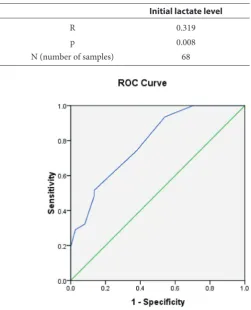
The ROC Curve Analysis of SOFA score The ROC curve analysis of SOFA score in this study was conducted to determine the cut-off of SOFA score associated with patient mortality during treat-ment. The result of the area under curve (AUC) of ROC curve for SOFA score was obtained at 0.788 with p-value 0.000 (p <0.05). The optimal point for SOFA score for mortality was ≥ 5.5 with sensitivity 74.2% and specificity 62.2%, positive predictive value (PPV) 62.2%, and negative predictive value (NPV) 74.2%. (table 4)
Kaplan-Meier Curve and Cox Regression Analysis of SOFA score
The Kaplan-Meier survival curve in Figure 2 shows that in general, a high SOFA score (≥5.5) has a lower life expectancy than a lower SOFA score (<5.5). The Log-rank test obtained result 5.320 with p 0.021 (p <0.05). Hazard ratio calculation obtained result 2.579 with p <0.05.
Table 2 Characteristic of subject based on mortality
Variable
Survive group (37) mean ± SD, (median; minimum-maximum)
Death group (31) mean ± SD, (median; minimum-maximum)
Total (68) mean ± SD, (median; minimum-maximum)
Age (years old) 60.89 ± 16.46 (63; 26-83) 60.65 ± 20.81 (64; 15-93) 60.78 ± 18.42 (63; 15-93)
Level of Consciousness (GCS) 13.8 ± 1.83 (15; 8-15) 12.7 ± 2.74 (14; 3-15) 13.32 ± 2.34 (14; 3-15) MAP (mean arterial pressure) 82.10 ± 11.6 (80.0; 50.0-106.6) 76.49 ± 15.19 (73.3; 43.3-106.6) 79.54 ± 13.59 (80; 43.30-106.66)
Pulse rate 101.62 ± 13.68 (100; 70-150) 108.81 ± 18.65 (105; 70-150) 104.1 ± 16.41(101.5; 70-150)
Respiration 25.18 ± 2.92 (24; 20-34) 26.38 ± 4.04 (24; 20-36) 25.73 ± 3.50 (24; 20-36)
Axilla temperature (°C) 37.43 ± 0.97 (37; 36-39.6) 37.33 ± 0.84 (37; 36-39) 37.38 ± 0.91 (37; 36-39.6)
WBC (white blood count) 16.36 ± 10.89 (13,06; 3.89-46.19) 15.58 ± 8.22 (15.74; 0.66-33.78) 16.01 ± 9.70 (13.89; 0.66-46.19) Neutrophil 13.94 ± 10.29 (10.68; 2.61-42.9) 13.25 ± 7.47 (11.97; 0.06-30.7) 13.63 ± 9.06 (11.37; 0.06-42.90)
Septic shock (%) 24,3% 38.7% 30.9%
Length of stay (day) 12.08 ± 8.51 (9; 4-46) 9.09 ± 7.20 (7; 2-29) 10.72 ± 8.02 (9.0; 2-46)
Table 3 Initial lactate level and SOFA score in subject
Variable
Survive group (37) mean ± SD, (median; minimum-maximum)
Death group (31) mean ± SD, (median; minimum-maximum)
Total (68) mean ± SD, (median; minimum-maximum)
P
Initial lactate level (mmol/L) 3.28 ± 1.39 (2.9; 1.3-7.4) 3.60 ± 1.43 (3.4; 1.3-9.2) 3.43 ± 1.40 (3; 1.30-9.20) 0.116
Total SOFA score 4.89 ± 2.06 (5.0; 2-10) 7.64 ± 2.67 (7; 4-13) 6.14 ± 2.72 (6.0; 2-13) 0.000
SOFA respiration 1.32± 1.00 (1; 0-3) 2.41± 1.17 (3; 0-4) 1.82±1.20 (2; 0-4) 0.000
SOFA coagulation 0.64±0.97 (0; 0-3) 0.58±0.95 (0; 0-4) 0.61±0.96 (0; 0-4) 0.78
SOFA hepatobiliary 0.40±0.86 (0; 0-4) 0.35±0.75 (0; 0-3) 0.38±0.81 (0; 0-4) 0.862
SOFA cardiovascular 0.81±1.35 (0; 0-4) 1.70±1.71 (1; 0-4) 1.22±1.58 (0; 0-4) 0.018
SOFA CNS 0.62±0.89 (0; 0-3) 1.32±1.04 (1; 0-4) 0.94±1.02 (0; 0-4) 0.003
SOFA Renal 1.08±1.21 (1; 0-4) 1.29±1.34 (1; 0-4) 1.17±1.26 (0; 0-4) 0.557
Table 4 ROC curve coordinate of SOFA score on mortality Positive if Greater Than
or Equal To Sensitivity 1 – Specificity
1.0000 1.000 1.000
2.5000 1.000 .892
3.5000 1.000 .703
4.5000 .935 .541
5.5000 .742 .378
6.5000 .516 .135
7.5000 .484 .135
8.5000 .323 .081
9.5000 .290 .027
10.5000 .194 .000
11.5000 .129 .000
12.5000 .032 .000
The next stage of analysis is to conduct a multi-variate Cox regression analysis to control the effect of controlled variables associated with mortal-ity during treatment. The controlled variables included in this analysis were age (geriatrics vs. non-geriatrics), sepsis severity (sepsis vs. sepsis), and comorbidities (Coronary heart disease/CHD, chronic obstructive pulmonary disease/COPD,
Human Immunodeficiency Virus/HIV infection, autoimmune disease).
CHD: Coronary heart disease, COPD: Chronic obstructive pulmonary disease, HIV: Human Deficiency Virus
Cox regression multivariate analysis result showed that SOFA score with cut-off ≥5.5 could be used as a predictor of mortality in sepsis patients during treatment with hazard ratio 2.512 (p<0.05). The complete multivariate Cox regression analysis is presented in Table 5.
Correlation between SOFA score with initial capillary lactate levels
In this study, bivariate analysis was performed to determine the correlation between SOFA score vari-ables with initial capillary lactate levels. Since the data is not normally distributed, Spearman correla-tion test was done. The resulting correlacorrela-tion coeffi-cient was 0.319 (weak correlation) and significance value was 0.008. (table 6) The correlation was also illustrated in the scatter plot as shown in Figure 3.
DISCUSSION
This study used 68 research subjects consisting of 36 (52.9%) men and 32 (47.1%) women. The mean age of this study was 60.78 ± 18.42 years, where geriatric patients were 52.9% (36 of 68 patients). A meta-analysis study of 14.418 patients with sepsis showed similar demographic characteristic where 40% of patients with severe sepsis were female with mean age was 61-year-old.9 The most common
cause of sepsis in this study was respiratory infec-tion, which amounted to 51 subjects (75%), while the rest included urinary tract infections (13.2%), gastrointestinal tract, musculoskeletal infection Table 5 Multivariate Cox regression analysis of SOFA score
associated with mortality in sepsis patients
Variable Hazard Ratio (95% CI) P score
SOFA score 2.512 (1.044-6.045) 0.040
Age 1.201 (0.496-2.905) 0.709
Severity of sepsis 1.030 (0.465-2.279) 0.942
CHD 0.000 (0.000) 0.982
COPD 1.115 (0.310-4.002) 0.868
HIV 2.988 (0.860-10.384) 0.085
Autoimmune disease 1.257 (0.242-6.520) 0.785
Table 6 Results of Spearman correlation analysis between SOFA score and initial lactate levels
Initial lactate level
SOFA score R 0.319
p 0.008
N (number of samples) 68
Figure 2 Kaplan Meier’s curve based on SOFA score. Log-rank analysis showed significant result (p <0.05)
and other infections. Previous study by Utama et al. on 91 sepsis patients in 2007 also showed that the most common cause of infection was pneumonia followed by urinary tract infection.10,11
The study by Jones et al. showed that serial SOFA score measurements provide significant prognostic information in predicting mortality in patients with severe sepsis admitted to hospi-tal. The initial SOFA score (AUROC 0.75; 95% CI 0.68-0.83) and SOFA 72 hours (AUROC 0.84; 95% CI 0.77-0.90) have a good enough accuracy in predicting mortality. The overall mortality rate was 21% with a significant association with ΔSOFA and mortality. Groups with ΔSOFA ≥2 had 42% mortality whereas the group with ΔSOFA ≤2 had a mortality of 9%.12
Ferreira et al. performed a serial SOFA score evaluation every 48 hours in 31 surgical ICU patients Belgium. That study found that baseline score and a maximum score of more than 11 or a mean score greater than 5 were associated with a mortality of over 80%. Mean SOFA (OR 3.06) and highest score (OR 1.59) had the highest correla-tion with mortality, followed by ΔSOFA (OR 1.52) and the initial value of SOFA (OR 1.45). (AUROC 0.9; p <0.01 compared with baseline score). Analysis of 96-hour SOFA evaluation showed mortality> 50% in increased SOFA score, 27-35% mortality at unchanged score, and mortality <27% in reduced score. From that study, there was no significant difference in length of stay of the group.13
Data from the University of Pittsburgh Medical Center found that in ICU patients with suspected infection, the SOFA score (AUROC = 0.74; 95% CI 0.73-0.76) had more superior predictive validity for hospital mortality compared with SIRS (AUROC = 0.64; 95% CI 0.62-0.66). For patients outside the ICU and with suspected infections, the predictive validity of SOFA score (AUROC = 0.79; 95% CI 0.78-0.80) and SOFA score change (AUROC = 0.79; 95% CI 0.78-0.79 ) is as good as SIRS (AUROC = 0.76; 95% CI 0.75-0.77).5
The study of SOFA score in septic patients in Indonesia alone has not been sufficient. The study by Halim et al. compared SOFA and APACHE II as a predictor of mortality of surgical patients in intensive care hospitals dr. Hasan Sadikin pointed out that the SOFA score (AuROC 0.73; p ≤0.05) was better than APACHE II (AuROC 0.69) in predicting the death of surgical patients in the ICU.14
Sunaryo et al. compared validation of APACHE II and SOFA score to predict mortality of 132 patients treated in intensive care. The study showed that the SOFA score (AuROC 0.951; p ≤ 0.05) was better than
APACHE II (AuROC 0.912) in predicts the death of patients treated in the ICU of Hasan Sadikin Hospital Bandung.15
Another study by Isnaini and Harahap showed that there was no correlation between SOFA score and length of hospitaliza-tion of septic patients in ICU dr. Kariadi Hospital Semarang (p = 0.158 and r = 0.214).16
CONCLUSION
The SOFA score with cut-off ≥5.5 can be used as a predictor of mortality in sepsis patients with hazard ratio of 2.475 (1.031-5.940; p <0.05). The SOFA score correlated weakly with capillary lactate levels (r = 0.319; p <0.05)
REFERENCES
1. Dellinger RP, Levy MM, Rhodes A, Annane D, Gerlach H, Opal SM, dkk. Surviving sepsis campaign: international guidelines for management of severe sepsis and septic shock: 2012. Critical care medicine. 2013;41(2):580-637. 2. Angus DC, Linde-Zwirble WT, Lidicker J, Clermont G,
Carcillo J, Pinsky MR. Epidemiology of severe sepsis in the United States: analysis of incidence, outcome, and associated costs of care. Critical care medicine. 2001;29(7):1303-10.
3. Mayr FB, Yende S, Angus DC. Epidemiology of severe sep-sis. Virulence. 2014;5(1):4-11.
4. Singer M, Deutschman CS, Seymour CW, Shankar-Hari M, Annane D, Bauer M, dkk. The Third International Consensus Definitions for Sepsis and Septic Shock (Sepsis-3). Jama. 2016;315(8):801-10.
5. Seymour CW, Liu VX, Iwashyna TJ, Brunkhorst FM, Rea TD, Scherag A, dkk. Assessment of Clinical Criteria for Sepsis: For the Third International Consensus Definitions for Sepsis and Septic Shock (Sepsis-3). Jama. 2016;315(8):762-74. 6. Poeze M, Solberg BC, Greve JW, Ramsay G. Monitoring
global volume-related hemodynamic or regional variables after initial resuscitation: What is a better predictor of out-come in critically ill septic patients? Critical care medicine. 2005;33(11):2494-500.
7. Sinkovic A, Markota A, Fluher J, Rehar D. Predictor of 30-day Mortality in medical patients with severe sepsis or septic shock. Signa Vitae. 2014;9:47-52.
8. Wilujeng H. HUBUNGAN KONSENTRASI LAKTAT DARAH DENGAN DISFUNGSI-GAGAL ORGAN MULTIPEL PADA PASIEN SEPSIS YANG DIUKUR DENGAN SKOR SOFA ( SEPSIS RELATED ORGAN FAILURE ASSESSMENT ). Surakarta: Universitas Sebelas Maret; 2009.
9. Stevenson EK, Rubenstein AR, Radin GT, Wiener RS, Walkey AJ. Two decades of mortality trends among patients with severe sepsis: a comparative meta-analysis*. Critical care medicine. 2014;42(3):625-31.
10. Utama S, Somia A, Merati TP. Characteristic of Sepsis in Internal Medicine Departement of Sanglah Hospital Denpasar. 2008.
11. Filho RR, Rocha LL, Correa TD, Pessoa CM, Colombo G, Assuncao MS. Blood Lactate Levels Cutoff and Mortality Prediction in Sepsis-Time for a Reappraisal? a Retrospective Cohort Study. Shock. 2016;46(5):480-5. 12. Jones AE, Trzeciak S, Kline JA. The Sequential Organ
13. Ferreira FL, Bota DP, Bross A, Melot C, Vincent JL. Serial evaluation of the SOFA score to predict outcome in criti-cally ill patients. Jama. 2001;286(14):1754-8.
14. Halim DA, Murni TW, Redjeki IS. Comparison of Apache II, SOFA, and Modified SOFA Scores in Predicting Mortality of Surgical Patients in Intensive Care Unit at Dr. Hasan Sadikin General Hospital. Critical Care & Shock. 2009;12(4):157-69. 15. Sunaryo A, Redjeki IS, Bisri T. Perbandingan Validasi
APACHE II dan SOFA Score untuk Memperkirakan Mortalitas Pasien yang Dirawat di Ruang Perawatan Intensif. Majalah Kedokteran Terapi Intensif. 2012;2(1):11-20.
16. Isnaini NA, Harahap S. KORELASI ANTARA SKOR SOFA DENGAN LAMA RAWAT INAP PASIEN SEPSIS DI ICU RSUP DR.KARIADI SEMARANG. Semarang: Diponegoro University; 2014.