http://ijessr.com Page 213 THE DIFFERENCE OF ELEMENTARY SCHOOL STUDENTS’ KNOWLEDGE LEVEL
AND ATTITUDE TO PHYSICAL ACTIVITY AND HEALTHY FOOD IN SNAKES LADDERS MEDIA
Marpati, Zahroh Shaluhiyah and Sulistiyani Sulistiyani
Faculty of Public Health, Magister Health Promotion, Universitas Diponegoro– Semarang Indonesia
ABSTRACT
Health promotion in elementary school is expected to improve knowledge and attitude to physical activity, eating vegetable and fruit. Health promotion is an educative approach that can result in community or individual behavior in improving health degree. The problem of research was how is the difference of students’ knowledge level and attitude to physical activity & healthy food in health promotion media. The objective of research was to find out the effect of health promotion media on knowledge and attitude to physical activity and healthy food in elementary school students. This research employed a quasi-experimental pretest-posttest control group design. The total sample of research consisted of 90 students divided into two groups: 44 students in intervention group and 46 in control group, each of which held 4 meetings for a month. The result of research showed that there was a difference of mean knowledge and attitude in the two groups before and after treatment (p < 0.05). There was a difference of knowledge and attitude increases between intervention and control groups, in which the increase in the group using snakes and ladders media was higher than that in the group using lecturing media.
KEYWORDS: Snakes and ladders pictured physical activity, vegetable and fruit consumption, health promotion
INTRODUCTION
About two millions deaths occur in the world due to inadequate physical activity and vegetable and fruit deficiency annually. WHO estimates that in 2020 non-communicable diseases (NCDs) about a quarter deaths occurs in developed countries with lower and middle income due to inadequate physical activity and vegetable and fruit deficiency. Routine activity can lower the risk of death due to all cause of cardiovascular and cancer diseases (Arem et al, 2015). Regular physical activity and eating vegetables and fruit routinely are a part of healthy lifestyle and one of important factors in maintaining health and preventing a variety of non-infectious disease (Reunamo et. al., 2012).
http://ijessr.com Page 214 and adolescents aged 5-19 years.
An individual’s behavior can affect health behavior due to inadequate knowledge, thereby leading to the high non-communicable disease incidence rate including cardiac disease, diabetes mellitus, stroke, obesity, and cancer. An attempt of improving knowledge among elementary school students can be taken through health promotion. Health promotion is an attempt given to students in order to get self-confidence and self concept, to be utilized individually in improving behavior in the future (Grob et al. 2008; Weare et al. 2011; Langford et al. 2014)
Health promotion among elementary school children can be conducted in various methods and media in order to deliver the material joyfully and to enable the children to learn while playing. Many attempts have been taken in giving the elementary school children the knowledge on physical activity, and vegetable and fruit consumption, but only very few are conducted with health promotion media in the form of game. Health promotion using snakes and ladders effectively improves knowledge and attitude, so do the others with other health promotion media like lecturing (Grob et al. 2008; Notoadmodjo, 2012).
Well-known enough traditional game in Indonesia is, among others, snakes and ladders game that is simple, playable, educating, amusing, and interactive when played collectively. This game can be modified if necessary (Zulfa, 2019).
Snakes and Ladders game can improve health knowledge, so that this snakes and ladders game media is very desirable in the attempt of health promotion concerning physical activity, and vegetable and fruit consumption (Nikmawati S, 2018).
This research on snakes and ladders media was selected because this game is well-known throughout country among various age groups; in addition, this game can be modified according to the health material to be informed, as it is simpler and does not take too wide space, and can be played by more than one person. In addition, although snakes and ladders can be found, there has been no measurement on the improved health knowledge and attitude among elementary school students in Palu Indonesia concerning physical activity and healthy food.
The utilization of health promotion can generate motivation, desire, and new interest and can stimulate learning activity, and can affect the children’s psychology. Utilizing health promotion media, the children are expected to interact directly with their environment, and to improve their learning motivation (AzharArsyad, 2006).
http://ijessr.com Page 215 objective of research was to find out the effect of health promotion on knowledge and attitude to physical activity, and healthy food in elementary school students in Palu Indonesia.
RESEARCH METHOD
This research was conducted on the 5th graders in primary school Inpres 8 Mamboro and primery school Inpres 1 Tanamodindi in academic year of 2018/2019. The sample of research consisted of 90 students divided into two groups: 44 students from primary school Inpres 8 Mamboro in intervention group using snakes and ladders and lecturing media, and 46 students from primary school Inpres 1 Tanamodindi in control group using lecturing media.
This study was a quantitative research using quasi-experiment research design with non-equivalent control group design in which sampling technique employed was total sampling one that fulfilled inclusion and exclusion criteria. The selected samples have gotten informed consent from their parents and follow all activities (pretest, treatment, and posttest).
The questionnaires used to measure knowledge and attitude have undertaken validit y and reliability test respectively containing 20 items for attitude and 18 items for knowledge, while 25 items have not undertaken validity test. Pretest and posttest measurement contains 18 items of question related physical activity, and fruit and vegetables consumption. Control group consisting of students coming from primary school Inpres 1 Tanamodindi employed lecturing media once a week for a month with time allotment about 30 minutes during teaching-learning process, while experiment group consisting of students coming from primary school Inpres 8 Mamboro employed snakes and ladders media in four meetings for a month during teaching-learning process. Techniques of analyzing data used were univariate and bivariate analyses, in which univariate analysis was conducted using frequency table, while bivariate analysis using wilcoxon and Mann Whitney.
Health promotion using snakes and ladders media has been modified into a checkerboard containing figures 1-25, each box of which contains different pictures related to physical activity and vegetable and fruit consumption.
http://ijessr.com Page 216 Snakes and ladders game consists of a set of games, a checkerboard in 30 x 30 cm dimension, four chess pieces with different colors, a pawn, 16 cards contains physical activity and healthy food, 17 question items and answer sheets.
This rule of snakes and ladders game is as follows: before playing, the players do hompipa to determine their turn in the game, each of players have different-color chess piece, and each of them shakes the dice and pays attention to the number of point revealed by the dice. Each of players run their piece based on the number of dice point shaken. When the piece stops on the box with non-ladder and snake tail picture, the player should take the card sheet available and then read it and other players listen to it. When the piece of player stops on the box with snake tail (box number 8, 22, and 24) or ladder (box number 5, 6, 10, and 14), the players take the quest ion item and should answer it.
In box numbers 5, 6, 10 and 14, when the player answers correctly, his/her piece is entitled to go up to the box in the end of ladder, but it cannot go up to the box in the end of ladder if she/she answer the question incorrectly. Similarly, on the box numbers 8, 22, and 24 with snake tail picture one piece should go down to the snake head when the answer is incorrect, but it can remain to be on the snake tail box when the answer is correct.
The sample questions contained in snakes and ladders game are: (1) how much should vegetable and fruit be consumed a day? The correct answer is 250 gram of vegetables/day and 150 gram of fruit/day; (2) mention what diseases will occur when we perform physical activities lazily! The correct answer is cardiac disease, hypertension, blood vessel obstruction, diabetes mellitus and cancer. The winner in the game is the one arrives at the box number 25 first.
RESULTS
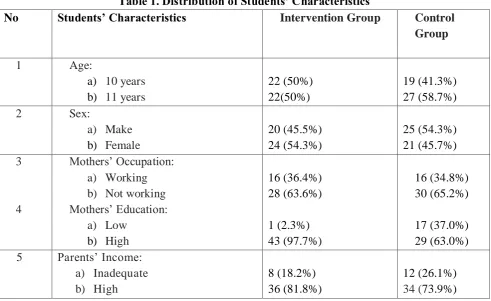
The subject of research consisted of the 5th graders of primary school Inpres 8 Mamboro and primary school Inpres I Tanamodindi. The characteristics of respective groups can be seen by age, sex, mother’s occupation, mother’s education, and parents’ income. The distribution of age in both groups by age shows that in the 10-11 age group, the largest number of students age 11 years occurs in control group, 27 students (58.7%), while in intervention group only 22 students (50%) aged 11 year, and in 10 year group the largest number is found in intervention group, 22 (50%) students while in control group there are 19 students (41.3%).
http://ijessr.com Page 217 The distribution of mother’s occupation in both groups shows that 16 (34.8%) working mothers are found in control group and 16 (36.4%) in intervention group, while 30 (65.2%) not-working mothers in control group and 28 (63.6%).
The distribution of mother’s education shows that most (17 or 37.0%) mothers have low education in control group and 1 in intervention group, and 43 (97.7%) mothers have high education in intervention group and 29 (63.0%) in control group.
The distribution of parents’ income in both groups shows most parents (12 or 26.1%) have inadequate income in control group and 8 (18.2%) have high income, while 36 (81.8%) parents have high income in intervention group and 34 (73.9%) in control group.
Table 1. Distribution of Students’ Characteristics
No Students’ Characteristics Intervention Group Control
Group
1 Age:
a) 10 years b) 11 years
22 (50%) 22(50%)
19 (41.3%) 27 (58.7%)
2 Sex:
a) Make b) Female
20 (45.5%) 24 (54.3%)
25 (54.3%) 21 (45.7%) 3
4
Mothers’ Occupation: a) Working b) Not working Mothers’ Education:
a) Low b) High
16 (36.4%) 28 (63.6%)
1 (2.3%) 43 (97.7%)
16 (34.8%) 30 (65.2%)
17 (37.0%) 29 (63.0%) 5 Parents’ Income:
a) Inadequate b) High
8 (18.2%) 36 (81.8%)
12 (26.1%) 34 (73.9%)
Table 2. Comparison of knowledge and attitude mean values between intervention and control groups
Variable Intervention Group Control Group p-Value
Knowledge
http://ijessr.com Page 218
posttest 17,16 16,26 0,000
Attitude Pretest Posttest
16,73 18,93
15,91 17,41
0,105 0,000 Uji Mann-Whitney signifikan p<0,05
Table 2 shows the comparison of knowledge and attitude mean values between snakes and ladders and lecturing group and lecturing group during pretest and posttest. The result of pretest shows that the mean value of knowledge is 14.52 for lecturing group and 13.93 for snakes and ladders and lecturing group, so that it can be concluded that the knowledge of lecturing group before intervention is higher than that of snakes and ladders and lecturing group. Nevertheless, the pretest value of knowledge on physical activity, and vegetable and fruit consumption in respective groups shows no significant difference.
The comparison of posttest value for knowledge between snakes and ladders and lecturing group shows mean value of 17.16 for snakes and ladders group and 16.26 in lecturing group, so that it can be concluded that the knowledge value of snakes and ladders group after intervention is higher than that of lecturing group. The posttest value for knowledge on physical activity, and vegetable and fruit consumption in respective groups shows a significant difference between snakes and ladders and lecturing group.
The result of pretest shows that the mean value of attitude is 16.73 for snakes and ladders and 15.91 for lecturing group, so that it can be concluded that the attitude value of snakes and ladders group before intervention is higher than that of lecturing group. Nevertheless, the pretest value of attitude to physical activity, and vegetable and fruit consumption in respective groups shows no significant difference.
The comparison of posttest value for attitude between the two groups shows mean value of 18.93 for snakes and ladders group and 17.41 in lecturing group, so that it can be concluded that the attitude value of snakes and ladders group after intervention is higher than that of lecturing group, indicating a significant difference between snakes and ladders and lecturing group.
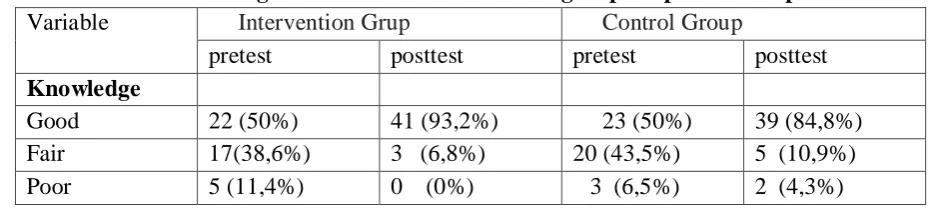
Table 3. Knowledge Level and Attitude of both groups in pretest and posttest
Variable Intervention Grup Control Group
pretest posttest pretest posttest
Knowledge
Good 22 (50%) 41 (93,2%) 23 (50%) 39 (84,8%)
Fair 17(38,6%) 3 (6,8%) 20 (43,5%) 5 (10,9%)
http://ijessr.com Page 219 Attitude
Good 28 (63,6%) 41 (93,2%) 20 (43,5%) 35 (76,1%)
Fair 14 (31,8%) 2 (4,5%) 22 (47,8%) 7 (15,2%)
poor 2 (4,5%) 1 (2,3%) 4 (8,7%) 4 (8,7%)
Table 3 shows that considering the result of early analysis on knowledge data in snakes and ladder group before intervention, out of 44 respondents, 22 (50%) have good knowledge, 17 (38.6%) have fair knowledge and 5 (11.4%) have poor (inadequate) knowledge. After the implementation of health promotion using snakes and ladders and lecturing media in intervention group, the assessment on knowledge conducted two months following pretest found that 41 (93.2%) respondents have good knowledge and 3 (6.8%) have fair knowledge in intervention group. No students (0%) have poor knowledge during posttest. The result of early analysis on data of attitude before intervention shows that out of 44 respondents, 28 (63.6%) have good attitude, 14 (31.8%) respondents have fair attitude, and 2 (4.5%) have poor attitude in intervention group. After the implementation of health promotion using snakes and ladders and lecturing media in intervention group, the assessment on attitude conducted two months following the pretest or a month following the treatment in intervention group found that 41 (93.2%) respondents have good attitude, 2 (4.5%) have fair attitude, and 1 (2.3%) have poor in intervention group.
The result of early analysis on data of knowledge during pretest in control group shows that out of 46 students, 23 (50%) have good knowledge, 20 (43.5%) have fair knowledge, and 3 (6.5%) have poor knowledge. After the implementation of health promotion using lecturing media in control group, the assessment on knowledge conducted two months following pretest or a month after the treatment with lecturing method found that 35 (76.1%) respondents have good knowledge, 7 (15.2%) have fair knowledge, and 4 (8.7%) have poor knowledge during posttest in control group. The result of early analysis on data of attitude before intervention in control group shows that out of 46 students, 28 (63%) have good attitude, 14 (31.8%) have fair attitude, and 2 (4.5%) have poor attitude. After the implementation of health promotion using lecturing media in control group, the assessment on attitude conducted two months following pretest or a month after the treatment with lecturing method found that 35 (76.1%) respondents have good attitude, 7 (15.2%) have fair attitude, and 4 (8.7%) have poor attitude during posttest in control group.
Knowledge level and attitude to physical activity, and vegetable and fruit consumption in this research are categorized into: 1) Good: score of correct answer more than 80%, 2) Fair: score of correct answer 60-80%, and 3) Poor: score of correct answer less than 60%.
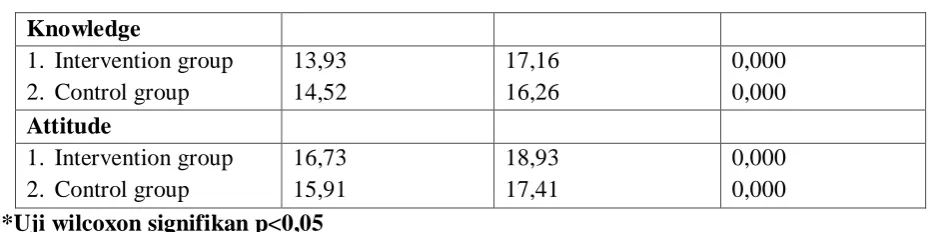
Table 4. The comparison of knowledge and attitude mean values between two groups during pretest and posttest
http://ijessr.com Page 220 Knowledge
1. Intervention group 2. Control group
13,93 14,52
17,16 16,26
0,000 0,000 Attitude
1. Intervention group 2. Control group
16,73 15,91
18,93 17,41
0,000 0,000 *Uji wilcoxon signifikan p<0,05
Table 4 indicates that the result of data analysis using wilcoxon test on snakes and ladders & lecturing group shows mean value of knowledge on physical activity, and vegetable and fruit consumption is 13.93 in pretest and 17.16 in posttest, increasing by 3.23. The result of variance test on pretest and posttest in snakes and ladders group shows p value = 0.000 with p < 0.05, so that it can be stated that there is a significant difference of knowledge level between before and before health promotion. The result of analysis on pretest and posttest result in lecturing group shows that the mean value of knowledge on physical activity, and vegetable and fruit consumption is 14.52 in pretest and 16.26 in posttest, increasing by 1.74. The result of variance test on pretest and posttest in lecturing group shows p value = 0.000 with p < 0.05, so that it can be said that there is a significant difference of knowledge level between before and after health promotion.
The result of analysis using wilcoxon test on snakes and ladders & lecturing group shows that the mean value of attitude to physical activity, and vegetable and fruit consumption is 16.73 in pretest and 18.93 in posttest, increasing by 2.2. The result of variance test on pretest and posttest in snakes and ladders group shows p value = 0.000 with p < 0.05, so that it can be stated that there is a significant difference of attitude between before and before health promotion. The analysis on pretest and posttest result in lecturing group shows that the mean value of attitude to physical activity, and vegetable and fruit consumption is 15.91 in pretest and 17.41 in posttest, increasing by 1.5. The result of variance test on pretest and posttest in lecturing group shows p value = 0.000 with p < 0.05, so that it can be said that there is a significant difference of attitude between before and after health promotion.
The result of analysis as shown in table 2 indicates the difference of students’ knowledge level and attitude to physical activity and vegetables and fruit consumption in intervention and control groups in posttest with p value = 0.000 (p < 0.05). It can be concluded that health promotion using snakes and ladders media improves the students’ knowledge and attitude to physical activities and vegetables and fruit consumption more effectively than that using lecturing media does.
DISCUSSION
http://ijessr.com Page 221 with lecturing media only. The difference of knowledge level between two groups is due to health promotion give using snakes and ladders game and lecturing media in intervention group, and only lecturing media without game in control group. Intervention group can absorb and remember material better because the health promotion with auditory media has successful rate of about 20%, health promotion with auditory and visual media about 30%, and health promotion with direct participation in game about 90% (Dawson, 2004).
The result of research shows that health promotion concerning physical activity, and vegetable and fruit consumption through media contributes to improving knowledge and attitude. The advantage of media use in health promotion is, among others, serving as visual aid in delivering information about health (Grob et al. 2008;Notoatmodjo. 2012).
Health promotion using snakes and ladders game make the learning circumstance attractive and joyful to children, thereby enabling the students to receive easily the material delivered.
This finding is in line with Hamdalah’s (2013) study finding that snakes and ladders game and pictorial story book can affect the improvement of knowledge, attitude, and practice before and after the illumination (education) about tooth and mouth health. Similarly, (Dita et.al. 2015) study found that there is a difference of knowledge and attitude between intervention group using snakes and ladders media and control group using lecturing media after the treatment concerning diarrhea disease.
CONCLUSION
Students’ knowledge and attitude improve after the treatment of health promotion with snakes and ladders and lecturing media. There is a difference of knowledge between two groups after the treatment with p-value 0.000 (p< 0.05). There is no difference of attitude between two groups after treatment with p-value 0.000 (p < 0.05). Snakes and ladders and lecturing media improves knowledge and attitude to physical activities, and vegetable and fruit consumption more effectively than lecturing media does.
REFERENCES
Arem H, Moore Moore SC, Patel A, et al. (2015). Leisure Time Physical Activity and Mortality: Adetailed Pooled Analysis of the Dose-respnse Relationship. JAMA Intern Med. 175 (6):959-967 Azhar A. (2006). Media Pembelajaran. Jakarta: PT Raja Grafindo Persada
Daly CM, Wadsworth DD, Foote SJ. (2017). Physical Activity, Sedantary Behavior, Fruit and Vegetable Consumption and Access: What Influences Obesity in Rural Children. Jcommun Health. https://doi.org/10.1007/s10900-017-0343-6
http://ijessr.com Page 222 Grob C, Meier S, Eschenbeck H, Haas T, Kohmann C-W. (2008). Praxis Der Gesundheitsforderung an Schulen in Ostwurttemberg [School-based Health Promoting in the East Wurttemberg Region of Germany]. Pravention Und Gesundheitsforderung. 3:103-12. http://doi.org/10.1007/s11553-008-0114-4.
Hamdalah A. (2013). Efektivitas Media Cerita Bergambar dan Ular Tangga dalam Pendidikan Kesehatan Gigi dan Mulut Siswa SDN Patrang Kab. Jember
Langford R, Bonell CP, Jones HE, Pouliou T, Murphy SM, Water E, et al. (2014). The WHO Health Promoting School Framework for Improving the Health and Well-Being of Students and Their
Academic Achievement. Cochrane Database Syst Rev. 4.
https://doi.org/10.1002/14651858.CD008958.pub2.
Maulana,Heri D.J. (2012). Promosi Kesehatan Jakarta EGC
Ng M, Robinson M, Fleming T, Graetz N, Margonio C, et al. (2014). Global, Regional, amd National Prevalence of Overweight and Obesity in Children and Adults During 1980-2013. A Systematic Analysis for the Global Burden of Disease Study 2013 Lancet. https://doi.org/10/1016/S01406736(14)60460-8
Nikmawati S. (2018). Taking Snake and Ladder Game to Build the Students Vocabulary in Indonesia Junior High School. Proceeding of the 65 TEFLIN International Conference 65:1
Pratiwi DA, Yuniar N, Erawan. (2015). Pengaruh Metode Permainan Edukatif dan Metode Ceramah Terhadap Pengetahuan, Sikap dan Tindakan tentang Pencegahan Penyakit Diare pada Murid SD di Kecamatan Poasia Kota Kendari. J Ilm mhs Kesehat Masy Unsyiah. 2017;0-9
Reunamo J, Ruismaki H, Saros L. (2012). The Amount of Physical Activity in Finnish Day Care. Procedia-Social and Behavioral Sciences. 45:501-6
Soekidjo N. (2012) Promosi Kesehatan dan Perilaku Kesehatan. Revisi Jakarta: Rineka Cipta
Weare K, Nind M. (2011). Mental Health Promoting and Problem Prevention in Schoos: What does the Evidence Say? Health Promot Int. 26(suppl1): i29-69. https://doi.org/10.1093/heapro/dar075. WHO. (2008). 2008-2013 Action Plan for The Global Strategy for The Prevention and Control of Noncommunicable Diseases.In Genewa
WHO. (2008) Overweight and Obesity. http://www.who.int/mediacentre/factsheets/fs31