S T U D Y P R O T O C O L
Open Access
Developing stepped care treatment for
depression (STEPS): study protocol for a pilot
randomised controlled trial
Jacqueline J Hill
1*, Willem Kuyken
1and David A Richards
2Abstract
Background:Stepped care is recommended and implemented as a means to organise depression treatment. Compared with alternative systems, it is assumed to achieve equivalent clinical effects and greater efficiency. However, no trials have examined these assumptions. A fully powered trial of stepped care compared with intensive psychological therapy is required but a number of methodological and procedural uncertainties associated with the conduct of a large trial need to be addressed first.
Methods/Design:STEPS (Developing stepped care treatment for depression) is a mixed methods study to address uncertainties associated with a large-scale evaluation of stepped care compared with high-intensity psychological therapy alone for the treatment of depression. We will conduct a pilot randomised controlled trial with an embedded process study. Quantitative trial data on recruitment, retention and the pathway of patients through treatment will be used to assess feasibility. Outcome data on the effects of stepped care compared with high-intensity therapy alone will inform a sample size calculation for a definitive trial. Qualitative interviews will be undertaken to explore what people think of our trial methods and procedures and the stepped care intervention. A minimum of 60 patients with Major Depressive Disorder will be recruited from an Improving Access to Psychological Therapies service and randomly allocated to receive stepped care or intensive psychological therapy alone. All treatments will be delivered at clinic facilities within the University of Exeter. Quantitative patient-related data on depressive symptoms, worry and anxiety and quality of life will be collected at baseline and 6 months. The pilot trial and interviews will be undertaken concurrently. Quantitative and qualitative data will be analysed separately and then integrated.
Discussion:The outcomes of this study will inform the design of a fully powered randomised controlled trial to evaluate the effectiveness and efficiency of stepped care. Qualitative data on stepped care will be of immediate interest to patients, clinicians, service managers, policy makers and guideline developers. A more informed understanding of the feasibility of a large trial will be obtained than would be possible from a purely quantitative (or qualitative) design.
Trial registration:Current Controlled Trials ISRCTN66346646 registered on 2 July 2014.
Keywords:Stepped care, Major Depressive Disorder, Mixed methods, Feasibility study
Background
Prevalence, impact and access
Depression is a long-term and relapsing condition and set to become the third biggest cause of the global burden of disease by 2030 [1]. Over three-quarters of all people who recover from one episode will go on to have at least one
more [2]. Lifetime prevalence has been estimated at 16.2% and rates of co-morbidity are high [3-5]. In the UK, de-pression and anxiety are estimated to cost the economy £17 billion in lost output and direct healthcare costs annu-ally, with a £9 billion impact on the Exchequer through benefit payments and lost tax receipts [6].
Whilst there is a clear need for effective depression treatment, access to treatment is poor: results from the Adult Psychiatric Morbidity Survey 2007 indicate only 24% of people with common mental health problems * Correspondence:[email protected]
1
Mood Disorders Centre, School of Psychology, University of Exeter, Queen’s Drive, Exeter, UK
Full list of author information is available at the end of the article
receive treatment; of those, 42% receive an evidence-based psychological therapy [7]. For people with a severe mental disorder, 35 to 50% of people in high-income countries receive no treatment [8].
Stepped care
To maximise access, many clinical guidelines worldwide recommend evidence-based psychological therapies for depression to be delivered at low- and high-intensity levels using a system called‘stepped care’[9-12]. Stepped care requires that almost all patients start with an evidence-based treatment of low-intensity as a first step [13]. Progress is monitored systematically and patients who do not respond adequately step up to a subsequent treatment of higher intensity [14]. Low-intensity treat-ments are usually defined as those treattreat-ments that require less time from a healthcare professional than a conven-tional treatment [15], although intensity may also mean the time required of patients, cost and therapists’level of expertise. In England, stepped care has been adopted by ‘Improving Access to Psychological Therapies’ (IAPT) services (www.iapt.nhs.uk) which have treated 500,000 patients annually since 2008. The majority of patients re-ceive low-intensity treatment; around 30% are either allo-cated directly or‘stepped up’to high-intensity psychological therapy [16].
Uncertainties
Although stepped care is widely implemented in England, based on their narrative review Bower and Gilbody caution that the equivalence and efficiency of stepped care are untested [14]. The central tenet of stepped care is that, for most patients, low-intensity treatment is sufficient and relatively few patients need to step up. If this holds, com-pared with alternatives, stepped care may achieve equiva-lent clinical outcomes at reduced cost and increase access to treatment. However, there is insufficient evidence to support this. In a systematic review and meta-analysis of randomised controlled trials (RCTs) of stepped care, we found a moderate effect of stepped care compared with care-as-usual (n = 4580 patients,d= 0.34, 95% CI 0.20 to 0.48) [17] yet care-as-usual may not be the best trial com-parator. To test equivalence and efficiency, a fully powered clinical trial of stepped care compared with an alternative system which has the potential to be as clinically effective is required [14,17].
The National Institute for Health and Care Excellence has made a specific recommendation to conduct a fully powered trial of stepped care versus matched care for depression [10]. Although the two systems may be as clinically effective, there are no prognostic indicators, in-cluding severity of depression itself, with sufficient power to predict response to treatment and therefore the specific treatment required for matched care [18]. In
terms of severity, a recent individual patient data meta-analysis of 2,470 patients with depression receiving low-intensity treatment has shown that patients with severe symptoms show at least as good clinical benefit from low-intensity interventions as less severely ill ones [19]. Conversely, if cognitive behaviour therapy (CBT) as an example of an intensive psychological therapy is pres-ently considered the ‘gold standard’ treatment for de-pression (effective against a number of comparators, in patients with a range of severity of depressive symptoms, in group and individual settings, and for both relapse prevention and treatment of a current episode [10]), the key question to test equivalence and efficiency becomes “can CBT be ‘re-structured’ (as in stepped care) and achieve equivalent patient outcomes at less cost, com-pared with offering almost all patients high-intensity CBT alone?”Compared with matched care, there are fewer un-certainties associated with high-intensity CBT. Therefore, in our opinion, the most appropriate and robust test of the equivalence and efficiency of stepped care would be a fully powered RCT against high-intensity (intensive) psy-chological therapy alone.
The need for a mixed methods feasibility study
Whilst a fully powered RCT of stepped care compared with intensive therapy is needed, a number of metho-dological and procedural uncertainties currently prevent such a trial: the appropriateness of potential trial methods and procedures; recruitment and retention rates; the pro-portion of patients who step up from low- to high-intensity psychological therapy; an estimate of treatment effects to inform a sample size calculation for the large trial; and the acceptability of stepped care.
National IAPT data confirm that, despite the average results cited above, rates of stepping up from low- to high-intensity treatments varied from 0 to 50% of pa-tients seen across services in the first year of their oper-ation [20]. Services use different criteria to make clinical decisions on initial stratification and stepping up [21]. This may reflect a lack of guidance on how stepped care should be delivered; as yet, the optimal configuration of system elements is unknown [14,17]. Data on current practice will not reliably inform rates of stepping in a fully powered trial.
the development of a stepped care clinical protocol for use in a large clinical trial.
Commensurate with the Medical Research Council framework for the development and evaluation of com-plex interventions [22], all of the above uncertainties are appropriate to address through piloting and in a feasibility study [23]. An issue that arises is that quantitative data alone will be inadequate. To understand what people think of potential trial methods and procedures, qualitative data will be important. Integrated with numeric data, they will provide a richer understanding of the appropriateness of those procedures. Moreover, to understand the acceptabil-ity of stepped care, qualitative data are required. Merged with quantitative data on treatment adherence, they may help explain variability in patients’ therapeutic engage-ment. Ultimately, the outcome of a feasibility study that encompasses the collection and integration of quantitative and qualitative data will be the information needed to de-sign a large RCT of stepped care.
Study purpose
The purpose of this study will be to prepare the ground for undertaking a fully powered RCT of stepped care com-pared with high-intensity psychological therapy alone for the treatment of depression in adults.
Objectives
Our specific objectives will be to: (1) gather enough infor-mation on recruitment, retention, step ups and treatment effects to design a fully powered clinical trial or to deter-mine that such a trial is not feasible; and (2) explore pa-tients’and therapists’views of stepped care and the ways in which patients’views relate to how much they engage in therapy to inform a stepped care clinical protocol for a proposed randomised trial.
Research questions
1. What is the quantifiable performance of recruitment and retention methods which may be used in a fully powered trial? (Objective 1)
2. What proportion of people who receive stepped care step up from low-intensity to high-intensity treatment or are discharged following low-intensity psychological therapy? (Objective 1)
3. What is the variability in patient-related outcomes following stepped care or intensive psychological therapy alone and how do they correlate with
pa-tients’baseline scores? (Objective 1)
4. To what extent are potential recruitment methods considered appropriate by trial participants (patients), study therapists and other health professionals and administrators and how do
people’s views combine with numeric data on the
performance of trial recruitment methods? (Objective 1)
5. How acceptable is stepped care to patients and
therapists and how do patients’views explain
variability in the number of treatment sessions they attend? (Objective 2)
Methods/Design
STEPS (Developing stepped care treatment for depression) uses a mixed methods embedded design [24] in which semi-structured interviews with patients, therapists and other health professionals will be embedded within a pilot RCT of stepped care versus intensive psychological the-rapy alone for people with depression. Quantitative data will be used to assess the feasibility of trial recruitment, re-tention and clinical procedures and to inform the sample size calculation that is required for a full-scale evaluation. Semi-structured interviews will be embedded in the pilot trial and undertaken concurrently to explore what trial participants (patients) and others (for example, study therapists) think of (i) trial methods and procedures and (ii) the acceptability of the stepped care intervention. By merging qualitative and quantitative data on trial methods and procedures, we will develop a richer understanding of their feasibility and appropriateness; through the integra-tion of qualitative and quantitative data on the accepta-bility of stepped care we will aim to explain variaaccepta-bility in patients’treatment adherence.
Philosophical assumptions
By advocating a mixed methods design where the deci-sion to incorporate qualitative and quantitative methods is guided by the set of uncertainties (unanswered re-search questions) that must first be addressed to inform a full-powered RCT, we are guided by a pragmatic phil-osophy: we give primary importance to the problem to be addressed and how the information we collect will be used [25]. We will also combine deductive and inductive thinking; we will allow for a singular view and multiple views of reality in how we come to understand and in-terpret our findings; the motivation for the research is to inform‘real-world’practice in the care of adults with de-pression. In these respects, our views are consistent with a pragmatic worldview [24].
Pilot randomised controlled trial
Setting and participants
of this trial (and the fully powered evaluation) we will identify and exclude people at interview who are alcohol or drug dependent, acutely suicidal or cognitively im-paired, have bipolar disorder or psychosis/psychotic symptoms. Participants will be eligible whether they are in receipt of antidepressant medication or not. Patients will subsequently be treated at the Mood Disorders Centre Accessing Evidence-Based Psychological Therapies (AccEPT) clinic facilities (see Trial Interventions section below).
Randomisation, allocation concealment and blinding Participants will be allocated in a 1:1 ratio to either the stepped care or intensive psychological therapy arms stratified according to their symptom severity on the Beck Depression Inventory version I (BDI-I) [27] (BDI-I minimal (0 to 9), mild (10 to 18), moderate (19 to 29), severe (30 to 63)). Allocation will be minimised to maxi-mise the likelihood of balance in stratification variables across the two study arms. Concealment will be ensured by use of an externally administered, password-protected randomisation website and retaining a stochastic element to the minimisation algorithm. The computer-based allo-cation and website will be developed and maintained by the accredited Peninsula Clinical Trials Unit, independent of the trial. Participants’details will be sent to the clinic administrator to alert them to assign the patient a study therapist and contact the patient to arrange treatment.
All research measures will be applied equally to both groups of participants. At baseline, the study researcher (JJH) will be blind to group allocation which will occur after this assessment. At follow-up, the researcher will be unblinded to allow her to interview patients (who have been allocated to receive stepped care) on end-treatment; interviews will occur prior to follow-up. Follow-up (and baseline) data will be self-reported. In our opinion, the risk of bias related to unblinding will be both minimal and tolerable.
Recruitment
Patients will be recruited via an IAPT service serving a city population. The service will write to all patients who are offered an initial assessment appointment to invite them to take part. A study summary sheet and permission for researcher to contact form will accompany each letter. Patients who complete and return their permission-to-contact form will be telephoned by the study researcher who will use a standard two-question case-finding instru-ment for depression [28] to assess possible eligibility. Base-line interviews will be arranged with potentially eligible and willing participants. Interviewees will be sent a full study information sheet and flow-chart. At interview, the study will be explained in full and we will assess eli-gibility using the Mini-Cog [29] to screen for cognitive
impairment and the Clinical Interview Schedule (Revised) [26]. If eligible, fully informed and consenting, patients will enter into the study. Ineligible and/or unwilling patients will continue with usual care at the IAPT service. We estimate from our recent experience managing other National Institute for Health Research mental health trials [30-32] that we will need to send out 1,500 recruitment letters to achieve the upper limit of our sample size (see below and Figure 1).
Trial interventions
Clinical procedures in both arms of the feasibility trial are CBT in both low- and high-intensity variants. All treat-ments will be delivered at the Mood Disorders Centre AccEPT Clinic facilities (http://www.exeter.ac.uk/moood-disorders/acceptclinic/). The AccEPT Clinic is part of the School of Psychology at the University of Exeter. It provides psychological therapies as part of the Mood Disorders Centre’s mission to develop, test and make ac-cessible effective treatments for depression and other mood disorders. Although the AccEPT Clinic has been commissioned by the National Health Service, it is separ-ate to and not an IAPT service; it has not previously deliv-ered stepped care treatment for depression.
Stepped care
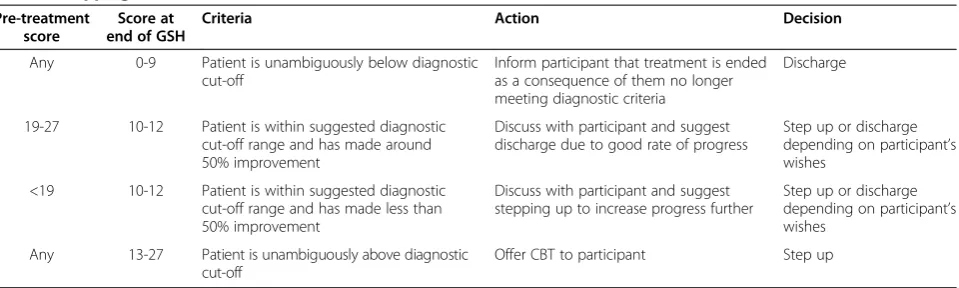
Additional resources will be optional reading; they will provide further information on specific topics which may help patients (for example, sleep, communication skills). Patients will be supported by weekly contact with their therapist involving up to five, 30-minute consultations. The first consultation will be face-to-face; the remainder will be by phone although we may accommodate patients’ specific requests for some or all of these to be face-to-face. Stepped care participants’ progress will be monitored using the Patient Health Questionnaire 9 (PHQ-9) [36]. At a sixth 30-minute consultation and following clinical assessment and discussion with the participant, people who show insufficient progress and/or who do not fall below the accepted PHQ-9 threshold for recovery (≤9) [37] will be offered high-intensity psychological therapy. Participants who recover at this stage will only receive low-intensity therapy (see Table 1).
High-intensity psychological therapy will be CBT de-livered by therapists following a treatment protocol based on the standard manuals published by Beck and colleagues [38] and used in two of our other recent trials [30,32]. Early sessions will focus on agreeing problems to be addressed, therapeutic goals and learning about the CBT model and techniques for behaviour change. Patients will subsequently work on negative automatic thoughts, maladaptive beliefs and, where indicated, under-lying core beliefs. Later sessions will help patients anti-cipate and practice managing their response to stressors which could lead to future relapse. Specific CBT tech-niques that may be used will include scheduling activity
and mastery behaviours and the use of thought records. All sessions will be face-to-face and consistent with National Institute for Health and Care Excellence recom-mendations for duration and frequency (that is, between 8 and 20, 50-minute consultations over a maximum of 16 weeks [10]).
Intensive psychological therapy alone
High-intensity psychological therapy for participants in the control arm of the trial will be identical to the high-intensity treatment for patients in stepped care except that patients will only have intensive CBT; they will not be offered GSH first.
Outcomes
Given this is a feasibility study with a range of different aims to inform a fully powered evaluation of stepped care, there is no single primary outcome measure. Rather a var-iety of patient-related data will be collected at baseline and 8 months’ post-randomisation: severity of depressive symptoms (BDI-I) [27], health-related quality of life (Short Form Health Survey-36; SF-36) [39] and worry and anx-iety (Generalised Anxanx-iety Disorder-7; GAD-7) [40]. At 6 months’ post-randomisation we anticipate that treat-ment for patients, including those who are randomised to stepped care and step up to CBT, will be complete. We will also collect data on the flow of participants through the trial (that is, numbers of participants at each step) and the number and proportion of people who step up and are discharged from stepped care following low-intensity Invited to participate (n=1500)
Assessed for eligibility (n=150)
Randomised (n=75)
Stepped Care (n=37) Cognitive Behaviour Therapy (n=38)
Lost to follow up (n=7) Lost to follow up (n=8)
[image:5.595.59.539.90.339.2]Analysed (n=30) Analysed (n=30)
psychological therapy. Therapists will collect data on treat-ment adherence and content; they will log all patient con-tacts and record key themes covered at each treatment session using an agreed, semi-structured form.
Sample size
A conventional power calculation is inappropriate for the purpose of a pilot RCT [23,41]. Instead, we have cal-culated the sample size required based on the margins of error associated with the key parameters of interest, specifically: recruitment and follow-up rates; the stand-ard deviation of the primary outcome (and other con-tinuous outcomes); and the correlation between baseline and 6 month follow-up outcome scores, which can be used to refine the sample size calculation for the fully powered evaluation to take into account the added pre-cision gained from adjusting for baseline scores when comparing the follow-up outcome scores between the trial arms.
We expect to approach a total of 1,500 patients to par-ticipate in the feasibility trial. This is large enough to es-timate a participation rate (as percentage of subjects approached) of 5% with a margin of error of ±1.1% or to estimate a participation rate of 10% with a margin of error of ±1.5% based on 95% confidence intervals. How-ever, if we need to approach a higher number of poten-tial participants (2,000) and achieve a lower participation rate of 2%, the associated margin of error will be ±0.7% based on 95% confidence intervals.
If we assume the participation rate will be 5% of 1,500 people approached, then the feasibility trial would re-cruit 75 participants. This is sufficient to: (i) estimate a follow-up rate (as percentage of participants recruited) of 80% with a margin of error of ±9%; (ii) estimate the standard deviation of the continuous primary outcome to within 22% of its true value based on the upper limit of the 95% confidence interval; (iii) estimate the correl-ation between the baseline and follow-up outcome scores with a margin of error of 0.12 (based on the lower
limit of the 95% confidence interval) if the true corre-lation is 0.8. If we assume the participation rate will be 2% of 2,000 people approached, this is sufficient to: (i) estimate a follow-up rate of 80% with a margin of error of ±10.1%; and (ii) estimate the correlation between the baseline and follow-up outcome scores with a margin of error no greater than 0.13 (based on the lower limit of the 95% confidence interval).
We consider the margins of error associated with the recruitment of 75/1,500 people and 60/2,000 approached to be acceptable and have, therefore, selected a range of between 60 and 75 as our target sample size.
Semi-structured interviews
Sample and setting
We will aim to interview all of the trial participants (pa-tients) who are allocated to stepped care and to achieve a minimum sample size of 24 patients with varied re-ceipt of and adherence to low- and high-intensity ther-apy within the stepped care protocol. All three of the study therapists who will deliver trial treatments, the AccEPT Clinic administrator, the IAPT team manager, lead psychological wellbeing practitioner and administra-tor will also be interviewed. Patient interviews will be undertaken at AccEPT Clinic facilities, by phone or at the participant’s home depending on interviewees’ pref-erence. Therapist and other staff interviews will be held at AccEPT or IAPT facilities.
Recruitment
[image:6.595.60.540.98.242.2]Patients’informed consent to be interviewed will be de-termined at trial participants’ baseline interview. On completion of stepped care treatment, we will telephone patients to establish that they are still willing to be inter-viewed, remind them what will be involved and answer any questions. For patients who remain willing, an inter-view will be arranged no sooner than 48 hours later. Confirmation of arrangements will be sent in writing.
Table 1 Stepping criteria
Pre-treatment score
Score at end of GSH
Criteria Action Decision
Any 0-9 Patient is unambiguously below diagnostic cut-off
Inform participant that treatment is ended as a consequence of them no longer meeting diagnostic criteria
Discharge
19-27 10-12 Patient is within suggested diagnostic cut-off range and has made around 50% improvement
Discuss with participant and suggest discharge due to good rate of progress
Step up or discharge depending on participant’s wishes
<19 10-12 Patient is within suggested diagnostic cut-off range and has made less than 50% improvement
Discuss with participant and suggest stepping up to increase progress further
Step up or discharge depending on participant’s wishes
Any 13-27 Patient is unambiguously above diagnostic cut-off
Offer CBT to participant Step up
We will explain the opportunity to rearrange or cancel the interview in our letter.
We will provide study therapists and the AccEPT ad-ministrator with details of the interviews at a trial orien-tation day at the start of the study at which we will also establish their willingness to be interviewed. Interviews will be arranged shortly before the end of their involve-ment in the pilot RCT. IAPT staff will be invited to be interviewed shortly before the end of the trial recruit-ment period and interviews will be arranged on end-recruitment.
Interview process and questions
Semi-structured interviews will be used to allow partici-pants to describe their views in confidence. This approach will enable us to explore the meaning of participants’ re-sponses and to elicit more detail on themes which arise during the interviews as well as to explore participants’ views on our pre-defined topics of interest [42].
Interview schedules will be adapted for patients, clini-cians, the AccEPT administrator and IAPT staff. In this way, we will ask people for their views and experience of stepped care and our trial methods and procedures in relation to their specific role or study involvement. To find out about the acceptability of stepped care we will invite people to describe what they understand by the term‘stepped care’. We will also explore their views and experiences of its underpinning principles and imple-mentation. For example, we will ask people what they think about face-to-face versus telephone consultations, starting with low-intensity treatment, monitoring and (dependent on treatment response) progression to high-intensity therapy. With respect to exploring the feasibility and appropriateness of our trial procedures, we will ask participants for their views and opinions of recruitment, study management and data collection. We will aim to identify procedures that facilitate the efficient running of the trial but also any that are perceived to be problematic.
Interviews are expected to last up to 45 minutes and will be audio-recorded with participants’permission.
Analysis
First, we will analyse the quantitative trial data and the qualitative data from the semi-structured interviews sep-arately. Next, we will integrate both types of information and conduct a mixed methods analysis [24].
Quantitative analysis
To address our first research question,“what is the quanti-fiable performance of recruitment and retention methods which may be used in a fully powered trial?”, we will use count data to enumerate the flow of the participants through the trial. We will express count data both as a percentage of the total number of participants approached
and in relation to the preceding step in recruitment. We will estimate margins of error for these parameters. For each of the interventions, we will quantify the number of participants who withdrew, could not be contacted or did not provide 6 month follow-up data for another reason. We will express numbers as a percentage of the total number of participants in each of the stepped care or high-intensity group. We will follow Consolidated Stan-dards of Reporting Trials (CONSORT) guidelines [43] on reporting the number of participants who exit the trial at each step of recruitment and from whom we are unable to collect follow-up data. We will quantify the number and proportion of people who receive stepped care and step up from low- to high-intensity treatment or are discharged following low-intensity therapy (Question 2). To measure the variability in patient-related outcomes following stepped care or intensive psychological therapy and their correlation with patients’baseline scores (Question 3) we will estimate the standard deviation around mean BDI-I, GAD-7 and SF-36 scores at baseline and 6 months for both groups. We will then estimate the correlation be-tween participants’scores on the BDI-I, GAD-7 and SF-36 at baseline and at 6 months. Quantitative data on the ac-ceptability of stepped care (Question 5) will be analysed as follows. For each of the interventions we will generate de-scriptive statistics to describe the number of sessions attended. We will quantify the number and proportion of participants who declined any treatment, dropped out early or completed treatment. For stepped care partici-pants, we will quantify the number and proportion who drop out prior to low-intensity therapy, before high-intensity therapy having been stepped up, and during each treatment step. Therapists’ thematic description of the content of high-intensity CBT that is received by patients in each of the intervention groups will be quantified and compared. We will analyse session content data to assess the extent to which GSH material and CBT are delivered in line with our clinical protocol for CBT and guidance on GSH.
All analyses will be on an intention to treat basis (that is, we will analyse participants in their original assigned groups). Emphasis will be on quantification and estima-tion rather than hypothesis testing. We will not impute missing data although we will report outcome data that are missing in both intervention groups and, to the extent that we are able, reasons for missing outcomes. We will conduct all analyses using STATA v.11 (STATA, StataCorp LP, College Station, TX, USA).
Qualitative analysis
analysed using a framework analysis [44] combining in-ductive and dein-ductive approaches. The analysis of the patient interviews will be iterative, moving between data collection and analysis to test emerging theories. Ana-lysis will therefore commence prior to the anaAna-lysis of the quantitative data from the pilot RCT. Transcripts will be coded at the level of individual participants but analysed thematically across the whole dataset as well as in the context of each participant’s interview, using a constant comparison approach [45]. Thematic frameworks will be developed from a combination of interview topics and data collected from participants. The data will be indexed (applied to the thematic framework), charted, mapped and interpreted to distil, structure and make sense of what people say [46], the original transcripts being frequently revisited to check and clarify contextual meaning . We will identify and follow-up ‘deviant’cases that do not fit into emerging theories.
We will use NVivo version 9.0 (www.qsrinternational. com/products_nvivo.aspx) to organise the data and en-sure its systematic analysis. Preliminary findings will be sent to interviewees for confirmation and correction.
Mixed methods data analysis and interpretation
Our mixed methods analysis will be guided by both the nature of the quantitative and qualitative data that we ul-timately obtain and the inferences that arise from our sep-arate analysis of both. Consequently, the mixed methods data analysis we eventually undertake may differ to the analysis we propose. Analytical techniques have been pro-posed based on methods summarised by Cresswell and Plano Clark [24] and draw on examples of their use cited therein [47-50].
For an improved understanding of the feasibility and appropriateness of our trial procedures (research Question 4), we will merge qualitative data on appropriateness with numeric data on the performance of recruitment methods by presenting the qualitative and quantitative results to-gether, side-by-side, in a summary table so that they can be easily compared. We will also consider the use of a joint display where qualitative themes are summarised in relation to themes that arise from the quantitative data (for example, on recruitment difficulties).
To investigate how patients’views on the acceptability of stepped care explain variability in the number of treatment sessions they attend (research Question 5), we will merge the quantitative and qualitative data we col-lect from patients by developing typologies of their dif-ferent views on acceptability. For each typology we will present data on treatment adherence for patients for whom the typology applies. We will also identify cat-egories of patients defined by their treatment adherence and explore similar and different views on acceptability within and between categories. Finally, we will integrate
data on acceptability and treatment adherence in a case-oriented merged analysis display that will position cases (patients) on a scale of treatment adherence along with their qualitative data on acceptability.
Ethical issues
We will conduct the trial in such a way to protect the human rights and dignity of the participants as reflected in the Helsinki Declaration [51]. Participants will not be paid to participate. The study has been approved by the National Research Ethics Service South West–Frenchay (reference 13/SW/0140). National Health Service Re-search and Development permission has been obtained from Devon Partnership Trust (reference DPT 0258) to identify and recruit patients. The School of Psychology Ethics Committee at the University of Exeter has ap-proved the study (reference 2012/500). To conform to data protection and freedom of information acts, all data will be stored securely and anonymised wherever pos-sible. No published material will contain identifiable pa-tient information.
Obtaining informed consent from patients
recording systems will be set up to enable the study team to monitor and act on participants’wishes to withdraw.
Anticipated risks and benefits
No treatment will be withheld from participants taking part in this study. Interventions comprise active psycho-logical treatments with previously demonstrated efficacy and no known iatrogenic effects. By participating in the study, participants will also receive an intensive level of monitoring such that any participants worsening or at suicidal risk will be identified and directed to appropri-ate care. The participant information leaflet will provide potential participants with information about the pos-sible benefits and risks of taking part in the trial. Partici-pants will be given the opportunity to discuss this issue with the study researcher prior to consenting. The study researcher will inform the participants if new informa-tion comes to light that may affect the person's willing-ness to participate.
Managing risk of suicide
Inherent in the nature of the population under scrutiny is the risk of suicide. We will follow good clinical practice in monitoring for suicide risk during all clinical and research appointments with study participants (patients). Where any risk to participants due to expressed thoughts of sui-cide is encountered, we will report these directly to the general practitioner (with the participant’s expressed per-mission), or if an acute risk is present will seek advice from the general practitioner immediately and/or follow locally established suicide management plans. All of the study therapists and members of the research team will be familiar with established protocols if a participant indi-cates that they are having thoughts of self-harm or suicide. Clinicians and researchers will be specifically trained in risk assessment and management and supervised by expe-rienced clinicians. Systems will be put in place to ensure that senior academic and clinically qualified members of the study team are notified should there be any risk to pa-tients’safety.
Patient and public involvement
The proposal for this study has arisen from a research prioritisation process in the National Institute for Health Research Collaboration for Leadership in Applied Health Research and Care (CLAHRC) South West Peninsula (PenCLAHRC, http://clahrc-peninsula.nihr.ac.uk/). Pen-CLAHRC has a well-developed patient and public involve-ment process through a funded group of representatives, the Peninsula Public Involvement Group (PenPIG). Pen-PIG members are involved in research topic identification and prioritisation. The University of Exeter Mood Dis-order Centre’s Lived Experience Group (LEG) advises on all research activity in the centre. Patient and public
representatives from both PenPIG and the LEG have been involved at all stages in identification and preparation of the proposal for this study and in the early work we have conducted to underpin it.
Two members of the LEG will be involved in the de-sign and conduct of the semi-structured interviews, spe-cifically the development of the patient topic guide and the analysis and interpretation of qualitative data, including its implications for understanding both the ac-ceptability of stepped care and the feasibility and appro-priateness of trial procedures. We will follow national good practice guidance for researchers on public in-volvement in research and the paying of Patient and Public Involvement (PPI) representatives at www.invo. org.uk. We will also work with our PPI representatives to ensure that our dissemination strategies are inclusive and accessible to other people who use services.
Study oversight
An external advisor (academic psychiatrist) will be appointed to provide the study team with independent advice and guidance. The role of this person will include reviewing serious adverse events which are thought to be treatment related. This research forms part of the first author’s (JJH) PhD programme of studies for which she is supervised by DAR and WK.
Forecast execution dates
The preparatory period started in April 2013. Recruit-ment is running from September 2013 for approximately 1 year. Follow-up and qualitative data will be collected from April 2014 to March 2015. Data analysis and reporting are forecast to take another 6 months. The total duration of the study will be 24 months.
Discussion
This study will provide important information towards the development and subsequent evaluation of stepped care treatment for depression. Study outcomes will in-form the design of a large clinical trial that will provide much needed guidance on the effectiveness and effi-ciency of stepped care to help policy makers, clinicians and guideline developers decide on its merits as a sys-tem for the organisation of depression treatment. We anticipate that data on acceptability will be of immediate interest to patients and those with responsibility for the design, implementation and recommendation of systems for the organisation of depression treatment.
Arain and colleagues [41]. We have calculated the pilot RCT sample size based on the key parameters of inter-est: recruitment and retention. We will calculate the variability of patient outcomes and their correlation with baseline scores to inform a sample size calculation for a fully powered RCT but we will not evaluate the out-comes of interest. Indeed, we do not identify a primary outcome measure. Rather, we have designed an RCT and semi-structured interviews that will allow us to test un-certainties associated with the conduct of a large stepped care trial.
At a time when mixed methods are gaining ground in health services research but can still be considered to be under development [53,54], a further strength is that we have made our commitment to this approach explicit and clear. We have described our proposal in line with recommendations for Good Reporting of a Mixed Methods Study [55]. We have reached key decisions on the level of interaction, priority, timing and mixing of the quantitative and qualitative strands. This will be reflected in our implementation of an embedded mixed methods design [24]: quantitative and qualitative data will be integrated (interact) prior to when we discuss the results at the end of the study; we will collect and ana-lyse qualitative data within a traditional quantitative framework; we will undertake the pilot RCT and inter-views concurrently; we will ‘mix’ the quantitative and qualitative strands at the design level (that is, embed the qualitative interviews within a pilot RCT for a more complete understanding of trial methods and procedures and to help explain variability in treatment attendance), and also at the level of analysis. Ultimately, by implement-ing an embedded mixed methods design, this study will better prepare for a large clinical trial than would be pos-sible from a purely quantitative (or qualitative) approach.
A potential weakness in our study design may be the specific form of stepped care that we propose to deliver. In the absence of specific guidance on how to imple-ment stepped care or evidence on the optimal configur-ation of system elements, we have developed a clinical protocol that is true to stepped care principles (almost all patients begin with low-intensity therapy, progress is monitored systematically, only those who do not respond ‘step up’). Key components have been defined (for ex-ample, stepping criteria). However, we do not know how the effectiveness, efficiency or acceptability of stepped care in this study compare with stepped care implemented in other ways. This may have implications for a fully powered evaluation of stepped care but also how data on the ac-ceptability of stepped care are received. In our systematic review of stepped care, we found considerable variety in the implementation of stepped care but only one signifi-cant difference between sub-groups of studies requiring further investigation [17]. It is reasonable to conclude that
differences in the implementation of stepped care are not necessarily associated with (statistically significant) differ-ences in effectiveness; commonalities may be more im-portant. Whilst patients’ views on the underpinning principles of stepped care and how it is implemented will be intertwined, we anticipate that data from the qualitative interviews will inform our understanding of both. Patients, therapists and others who are involved in deciding to rec-ommend or implement stepped care may interpret data on acceptability alongside the description of the interven-tion received and consider how findings relate to their own experience of stepped care implemented in similar or different ways. Ultimately, the results of the current study based on one form of stepped care will usefully inform the design of a large clinical trial to compare stepped care with high-intensity therapy alone for the treatment of depression.
Trial status
Recruitment commenced in September 2013 and is ongoing.
Abbreviations
AccEPT:Accessing Evidence-Based Psychological Therapies; BDI-I: Beck Depression Inventory version I; CBT: cognitive behaviour therapy; CLAHRC: Collaboration for Leadership in Applied Health Research and Care; CONSORT: Consolidated Standards of Reporting Trials; DIY: Do-It-Yourself; DSM:Diagnostic and Statistical Manual of Mental Disorders; GAD-7: Generalised Anxiety Disorder-7; GSH: guided self-help; IAPT: Improving Access to Psychological Therapies; LEG: Lived Experience Group; PenPIG: Peninsula Public Involvement Group; PHQ-9: Patient Health Questionnaire 9; PPI: Patient and Public Involvement; RCT: randomised controlled trial; SF-36: Short Form Health Survey-36.
Competing interests
The authors declare that they have no competing interests.
Authors’contributions
JJH as chief investigator and study researcher co-conceived and designed the study with the involvement of DAR; WK provided additional related guidance and support. JJH drafted the study protocol and materials and obtained ethics and National Health Service research and development approvals; she is responsible for project management, data collection and analysis. DAR and WK designed the high-intensity CBT intervention and supervise study therapists; JJH adapted the low-intensity intervention. JJH drafted the manuscript. All other authors contributed to editing of the final manuscript. All authors read and approved the final manuscript.
Acknowledgements
Author details
1
Mood Disorders Centre, School of Psychology, University of Exeter, Queen’s Drive, Exeter, UK.2University of Exeter Medical School, University of Exeter, Exeter, UK.
Received: 16 June 2014 Accepted: 30 October 2014 Published: 20 November 2014
References
1. Mathers C, Boerma T, Ma Fat D:The Global Burden of Disease: 2004 Update. Geneva, Switzerland: World Health Organization; 2008.
2. Keller MB:Long-term treatment of recurrent and chronic depression. J Clin Psychiatr2001,62:3–5.
3. Andrews G, Henderson S, Hall W:Prevalence, comorbidity, disability and service utilisation: overview of the Australian National Mental Health Survey.Br J Psychiatr2001,178:145–153.
4. Kessler RC, Berglund P, Demler O, Jin R, Koretz D, Merikangas KR, Rush AJ, Walters EE, Wang PS:The epidemiology of major depressive disorder: results from the National Comorbidity Survey Replication (NCS-R).JAMA 2003,289:3095–3105.
5. Singleton N, Bumpstead R, O’Brien M, Lee A, Meltzer H:Psychiatric Morbidity among Adults Living In Private Households, 2000.London: Office for National Statistics; 2001.
6. The Centre for Economic Performance Mental Health Policy Group:The Depresssion Report. A New Deal for Depression and Anxiety Disorders.London: School of Economics and Political Science Centre for Economic
Performance; 2006.
7. McManus S, Meltzer H, Brugha T, Bebbington P, Jenkins R:Adult Psychiatric Morbidity in England, 2007: Results Of A Household Survey.London: The NHS Information Centre for Health & Social Care; 2009.
8. World Health Organization:Mental Health Action Plan: 2013–2020.Geneva, Switzerland: World Health Organization; 2013.
9. Andrews G:Tolkien Ii - A Needs-Based, Costed, Stepped-Care Model for Mental Health Services: Recommendations, Executive Summaries, Clinical Pathways, Treatment Flowcharts, Costing Structures.Sydney, NSW: World Health Organization, Collaborating Centre for Classification in Mental Health; 2006. 10. National Institute for Health and Care Excellence:Depression in Adults: The
Treatment and Management of Depression in Adults. NICE Clinical Guideline 90.London: National Institute for Health and Care Excellence; 2009. 11. Spijker J, van Vliet IM, Meeuwissen JAC, van Balkom AJLM:Update of the
multidisciplinary guidelines for anxiety and depression.Tijdschr Psychiatr 2010,52:715–718.
12. National Institute for Health and Care Excellence:Anxiety (Amended): Management of Anxiety (Panic Disorder, With or Without Agoraphobia, and Generalised Anxiety Disorder) in Adults in Primary, Secondary and Community Care.London: National Institute for Health and Care Excellence; 2007. 13. Davison GC:Stepped care: doing more with less?J Consult Clin Psychol
2000,68:580–585.
14. Bower P, Gilbody S:Stepped care in psychological therapies: access, effectiveness and efficiency: narrative literature review.Br J Psychiatr 2005,186:11–17.
15. Bennett-Levy J, Richards D, Farrand P:Low intensity CBT interventions: a revolution in mental health care.InLow Intensity CBT Interventions.Edited by Bennett-Levy J, Richards D, Farrand P, Christensen H, Griffiths KM, Kavanagh DJ, Klein B, Lau MA, Proudfoot J, Ritterband L, White J, Williams C. Oxford: Oxford University Press; 2010:3–18.
16. Gyani A, Shafran R, Layard R, Clark DM:Enhancing recovery rates: Lessons from year one of IAPT.Behav Res Ther2013,51(9):597–606.
17. Van Straten A, Hill JJ, Richards DA, Cuipjers P:A systematic review of stepped care for depression.Psychol Med2014,26:1–16 [E-pub ahead of print]. 18. Fournier JC, DeRubeis RJ, Shelton RC, Hollon SD, Amsterdam JD, Gallop R:
Prediction of response to medication and cognitive therapy in the treatment of moderate to severe depression.J Consult Clin Psychol2009,77:775–787. 19. Bower P, Kontopantelis E, Sutton A, Kendrick T, Richards DA, Gilbody S, Knowles
S, Cuijpers P, Andersson G, Christensen H, Meyer B, Huibers M, Smit F, van Straten A, Warmerdam L, Barkham M, Birch L, Lovell K, Liu ET-H:Influence of initial severity of depression on effectiveness of low intensity interventions: meta-analysis of individual patient data.Br Med J2013,346:f540. 20. Glover G, Webb M, Evison F:Improving Access to Psychological Therapies: a
Review of the Progress Made by Sites in The First Roll-Out Year.Durham, UK: North East Public Health Observatory; 2010.
21. Richards DA, Bower P, Pagel C, Weaver A, Utley M, Cape J, Pilling S, Lovell K, Gilbody S, Leibowitz J, Owens L, Paxton R, Hennessy S, Simpson A, Gallivan S, Tomson D, Vasilakis C:Delivering stepped care: an analysis of implementation in routine practice.Implement Sci2012,3:7. 22. Craig P, Dieppe P, MacIntyre S, Michie S, Nazareth I, Petticrew M:
Developing and evaluating complex interventions: the new Medical Research Council guidance.Brit Med J2008,337:a1655.
23. Thabane L, Ma J, Chu R, Cheng J, Ismaila A, Rios LP, Robson R, Thabane M, Giangregorio L, Goldsmith CH:A tutorial on pilot studies: the what, why and how.BMC Med Res Methodol2010,10:1.
24. Cresswell JW, Plano Clark VL:Designing and Conducting Mixed Methods Research. Secondthth edition. Thousand Oaks, California: Sage Publications, Inc; 2011. 25. Tashakkori A, Teddlie C:Handbook of Mixed Methods in Social and
Behaviuoral Research.Thousand Oaks, California: Sage Publications, Inc; 2003. 26. Lewis G, Pelosi AJ, Araya R, Dunn G:Measuring psychiatric disorder in the
community: a standardized assessment for use by lay interviewers. Psychol Med1992,22:465–486.
27. Beck XX, Ward CH, Mendelson M, Mock J, Erbaugh J:An inventory for measuring depression.Arch Gen Psychiatry1961,4:561–571.
28. Whooley MA, Avins AL, Miranda J, Browner WS:Case-finding instruments for depression: two questions are as good as many.J Gen Intern Med 1997,12:439–445.
29. Borson S, Scanlan J, Brush M, Vitaliano P, Dokmak A:The Mini-Cog: a cognitive ‘vital signs’measure for dementia screening in multi-lingual elderly.Int J Geriatr Psychiatry2000,15:1021–1027.
30. Rhodes S, Richards DA, Ekers D, McMillan D, SByford S, Farrand PA, Gilbody S, Hollon SD, Kuyken W, Martell C, O’Mahen HA, O’Neill E, Reed N, Taylor RS, Watkins ER, Wright KA:Cost and outcome of behavioural activation versus cognitive behaviour therapy for depression (COBRA): study protocol for a randomised controlled trial.Trials2014,15:29. 31. Richards DA, Hill JJ, Gask L, Lovell K, Chew-Graham C, Bower P, Cape J,
Pilling S, Araya R, Kessler D, Bland JM, Green C, Gilbody S, Lewis G, Manning C, Hughes-Morley A, Barkham M:Clinical effectiveness of collaborative care for depression in UK primary care (CADET): cluster randomised controlled trial.Br Med J2013,347:f4913.
32. Wiles N, Thomas L, Abel A, Ridgway N, Turner N, Campbell J, Garland A, Hollinghurst S, Jerrom B, Kessler D, Kuyken W, Morrison J, Turner K, Williams C, Peters T, Lewis G:Cognitive behavioural therapy as an adjunct to pharmacotherapy for primary care based patients with treatment resistant depression: results of the CoBalT randomised controlled trial.Lancet2013, 381:375–384.
33. Titov N, Dear BF, Johnston L, Lorian C, Zou J, Wootton B, Spence J, McEvoy PM, Rapee RM:Improving adherence and clinical outcomes in self-guided internet treatment for anxiety and depression: randomised con-trolled trial.PLoS One2013,8:e62873.
34. Titov N, Dear BF, Johnston L, McEvoy PM, Wootton B, Terides MD, Gandy M, Fogliati V, Kayrouz R, Rapee RM:Improving adherence and clinical outcomes in self-guided internet treatment for anxiety and depression: a 12-month follow-up of a randomised controlled trial.PLoS One2014,9:e89591. 35. Titov N, Dear BF, Johnston L, Terides M:Transdiagnostic internet treatment
for anxiety and depression.Spanish J Clin Psychol2012,17:237–260. 36. Kroenke K, Spitzer RL, Williams JBW:The PHQ-9: validity of a brief depression
severity measure.J Gen Intern Med2001,16:606–613.
37. McMillan D, Gilbody S, Richards D:Defining successful treatment outcome in depression using the PHQ-9: a comparison of methods.J Affect Disord 2010,127:122–129.
38. Beck AT, Rush AJ, Shaw B, Emery G:Cognitive Therapy of Depression: a Treatment Manual.New York: Guilford Press; 1979.
39. Ware JE, Snow KK, Kosinski M, Gandek B:SF-36 Health Survey: Manual and Interpretation Guide.Boston MA: The Health Institute, New England Medical Centre; 1993.
40. Spitzer RL, Kroenke K, Williams JBW, Lowe B:A brief measure for assessing generalized anxiety disorder: the GAD-7.Arch Intern Med2006,166:1092–1097. 41. Arain M, Campbell MJ, Cooper CL, Lancaster GA:What is a pilot or
feasibility study? A review of current practice and editorial policy.BMC Med Res Methodol2010,10:67.
42. Taylor M:Interviewing.InQualitative Research in Health Care.Edited by Holloway I. Maidenhead: Open University Press; 2011:29–55. 43. Schulz KF, Altman DG, Moher D:CONSORT 2010 statement: updated
44. Pope C, Ziebland S, Mays N:Qualitative research in health care: analysing qualitative data.Br Med J2000,320:114–116.
45. Miles MB, Huberman AM:Qualitative Data Analysis: an Expanded Sourcebook. 2nd edition. London: Sage; 1994.
46. Spencer L, Ritchie J, O’Connor W, Morrell G, Ormston R:Analysis in Practice.InQualitative Research Practice.Edited by Ritchie J, Lewis J, McNaughton Nicholls C, Ormston R. Los Angeles, London, New Delhi, Singapore, Washington DC: Sage; 2014.
47. Li S, Marquart JM, Zercher C:Conceptual issues and analytic strategies in mixed-methods studies of preschool inclusion.J Early Intervention2000, 23:116–132.
48. Wittink MN, Barg FK, Gallo JJ:Unwritten rules of talking to doctors about depression: integrating qualitative and quantitative methods.Ann Fam Med2006,4:302–309.
49. McEntarffer R:Strengths Based Mentoring in Teacher Education: a Mixed Methods Study, Masters Thesis. Lincoln, US: University of Nebraska-Lincoln; 2003. 50. Mendlinger S, Cwikel J:Spiraling between qualitative and quantitative
data on women’s health behaviours: a double helix model for mixed methods.Qual Health Res2008,18:280–293.
51. World Medical Association General Assembly:World Medical Association Declaration of Helsinki: Ethical Principles for Medical Research Involving Human Subjects - Seoul Amendment.Ferney-Voltaire: The World Medical Association; 2008.
52. The National Institute for Health Research Evaluation Trials and Studies Coordinating Centre (NETSCC) glossary:The National Institute for Health Research Evaluation Trials and Studies Coordinating Centre (NETSCC) glossary.[http://www.nets.nihr.ac.uk/glossary]
53. Collins KMT, O’Cathain A:Ten points about mixed methods research to be considered by the novice researcher.Int J Multiple Res Approaches 2009,3:2–7.
54. Johnson RB, Onwuegbuzie AJ, Turner LA:Towards a definition of mixed method research.J Mix Meth Res2007,1:112–133.
55. O’Cathain A, Murphy E, Nicholl J:The quality of mixed methods studies in health services research.J Health Serv Res Policy2008,13:92–98.
doi:10.1186/1745-6215-15-452
Cite this article as:Hillet al.:Developing stepped care treatment for depression (STEPS): study protocol for a pilot randomised controlled
trial.Trials201415:452.
Submit your next manuscript to BioMed Central and take full advantage of:
• Convenient online submission
• Thorough peer review
• No space constraints or color figure charges
• Immediate publication on acceptance
• Inclusion in PubMed, CAS, Scopus and Google Scholar
• Research which is freely available for redistribution