
Title: NEW INSIGHTS IN THE FIELD OF FAST DISSOLVING TABLETS Author: Shivangi Shukla*, Dinesh Kumar Mishra, Dinesh Kumar Jain Keyword: Disintegration, Dissolution, Modified tablets, Novel drug delivery system (NDDS).Page No: 213-226Abstract: Recent a
6
0
0
Full text
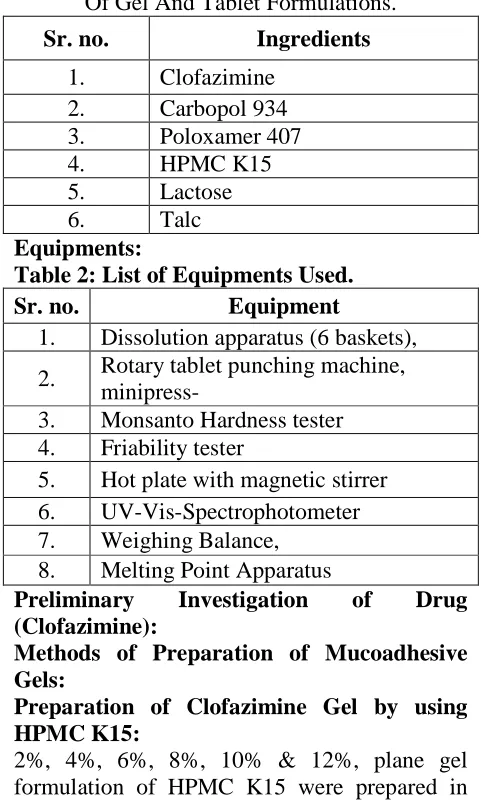
(2) Shah.K.S & Agrawal M., Jour. Harmo. Res. Pharm., 2015, 4(3), 246-251. Mucoadhesive Gel: Gel formulation was selected as it is a semisolid dosage form, has advantage of easy dispersion throughout the mucosa & easy to prepare. However, semisolid dosage forms do not show accurate drug dosing in comparison of tablets, patches, or films. Bioadhesive formulations can be used to overcome the problem of poor retention. Certain bioadhesive polymers, e.g. poloxamer 407, sodium CMC,carbopol, hyaluronic acid, and xanthan gum, shows change of state from a liquid to a semisolid. This type of changes can increases viscosity, that results in sustained & controlled release of drugs. Mucoadhesive Tablets: Tablets may be defined as solid pharmaceutical dosage forms having drug substances with or without suitable excipients & made by either compression or Molding methods. Various mucoadhesive polymers can be used in tablet manufacturing to overcome problem like poor retention time of a dosage form in the stomach (GIT), thereby improving the oral bioavailability of the drug and also provide more controlled/ sustained release drug profile. Mechanism Of Mucoadhesion: Hydration mediated adhesion: Certain hydrophilic polymers have the tendency to imbibe large amount of water and become sticky, thereby acquiring bioadhesive properties. Bonding mediated adhesion: For adhesion to occur, molecules must bond across the interface. These bond scan arise in the following way (Hassan, 1990). a) Ionic bonds b) Covalent bonds c) Hydrogen bonds d) Van-der-waals bonds e) Hydrophobic bonds Factors Affecting Mucoadhesion: A. Polymer related factors 1. Molecular weight of polymer 2. Concentration of active polymer 3. Spatial conformation 4. Hydration (swelling). 5. Charge B. Environment related factors 1. pH: 2. Applied strength 3. Contact time: 4. Swelling: C. Physiological variables 1. Mucin properties 2. Mucin turnover 3. Disease states Materials and Method Ingredients: Table 1: List of Ingredients Used In Preparation Of Gel And Tablet Formulations. Sr. no.. Ingredients. 1. Clofazimine 2. Carbopol 934 3. Poloxamer 407 4. HPMC K15 5. Lactose 6. Talc Equipments: Table 2: List of Equipments Used. Sr. no. Equipment 1. Dissolution apparatus (6 baskets), Rotary tablet punching machine, 2. minipress3. Monsanto Hardness tester 4. Friability tester 5. Hot plate with magnetic stirrer 6. UV-Vis-Spectrophotometer 7. Weighing Balance, 8. Melting Point Apparatus Preliminary Investigation of Drug (Clofazimine): Methods of Preparation of Mucoadhesive Gels: Preparation of Clofazimine Gel by using HPMC K15: 2%, 4%, 6%, 8%, 10% & 12%, plane gel formulation of HPMC K15 were prepared in distilled water by simple mixing method. 12%, formulation was selected on the bases of consistency of gel.. www.johronline.com. 247 | P a g e.
(3) Shah.K.S & Agrawal M., Jour. Harmo. Res. Pharm., 2015, 4(3), 246-251. Formulation of Mucoadhesive Tablets: Preparation of Clofazimine Gel by Using Mucoadhesive tablets of Clofazimine were Corbopol 934: 0.5, 1% & 2%, plane gel formulation of made by direct compression method. Nine Carbopol were prepared in distilled water. Out formulations (F1-F9) were formulated by using three different mucoadhesive polymers (HPMC of these, 1% gel formulation was selected on the bases of gel consistency. K15, Carbopol 934 & Poloxamer 407). Mucoadhesive polymers were used as binder, Preparation of Clofazimine gel by using lactose as diluents and talc as lubricant. poloxamer 407: The pluronic gels were prepared by modification of the “Cold dispersion” method described by Schmolka. Table 3: Formula for Different Tablet Formulations. FORMULATION Ingredents (mg) F1 F2 F3 F4 F5 F6 F7 F8 F9 Drug (Clofazimine) 150 150 150 150 150 150 150 150 150 HPMC K 15 100 150 200 Carbopol 934 20 30 40 Poloxamer 407 75 125 175 Lactose 220 170 120 250 200 150 315 305 295 Talc 20 20 20 20 20 20 20 20 20 General Appearance: General appearance was Evaluation Parameter for Mucoadhesive examined by visual inspection. All tablets Gels: General Appearance: A Visual inspection was should be of uniform size, shape, color and done to know the general appearance of gels. surface textures etc. There should be no sign of grittiness and Weight Variation: Randomly, twenty tablets were selected and individually weighed. The formulation must be of uniform texture. Mucoadhesive force: Mucoadhesive force of average weight of tablet was calculated. Then individual weight was compared with average all three gel formulation was determined by method and apparatus reported by Choi et al., weight of tablets. Thickness: Six tablets were selected randomly 1998 & koffi et al, 2006. (by using goat stomach mucosa). from each batch and thickness was measured by Drug Release Profile: Drug release profile of using vernical caliper. all three gel formulations was carried out in Friability: Twenty tablets were weighted and placed in Roche friabilator and equipment was distilled water, by using cellophane membrane. rotated at 25 rpm for 4 minute. And drug release rate kinetics of the Hardness: Hardness was determined by using formulations was determined by fitting release Monsanto Hardness tester result in models of data treatment as follows: Evaluation Methods Of Mucoadhesive Gel 1. Log cumulative percent drug remaining versus time (first order kinetic model). Texture profile analysis of pharmaceutical gels: Texture profile analysis (TPA) of 2. Cumulative percent drug release versus time pharmaceutical gels can be performed using a (zero order kinetic model). Stable Micro Systems texture analyzer (Model 3. Higuchi release kinetic model. TA-XT 2). 4. Korsmeyer- peppas model. Rheological characterization: Rheological Evaluation parameter for mucoadhesive chararacterization can be performed by using tablets: following rheolometers, such as: www.johronline.com. 248 | P a g e.
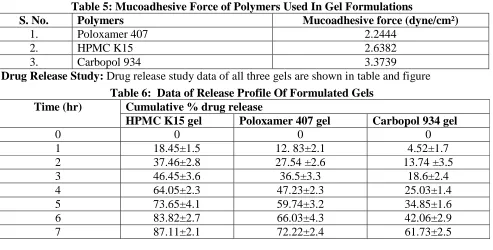
(4) Shah.K.S & Agrawal M., Jour. Harmo. Res. Pharm., 2015, 4(3), 246-251. Thermostatically controlled Brookfield apparatus 2 with the use of the Enhancer Cell™ Programmable Rheometer (Brookfield LVDV 4 cm² section. III, Brookfield Engineering Laboratories, Results and Discussion Middleboro, MA) fitted with CP-52 spindle 3.1 Preliminary Investigation of Drug with cone/ plate geometry (Majithiya et al., (Clofazimine): 2006). Physical Appearance: Clofazimine was a Measurement of mucoadhesive force: The reddish-brown powder. bioadhesive force, expressed as the detachment Melting point: Melting point of Clofazimine stress in dyne/cm2, was determined from the was found to be 210°C. minimal weights that detached the tissues from Solubility study: Solubility profile of the surface of each formulation. Clofazimine in various solvents, are given in Drug release studies: In vitro drug release tests table . are carried out on the gels by using USP XXIV Table 4 : Solubility Profile of Clofazimine In Various Solvents S. No. Solvent Solubility 1. Benzene Very Soluble 2. Chloroform Soluble 3. Methanol Sparingly soluble 4. Acetone Poorly soluble 5. Ethanol Sparingly soluble 6. Ethyl acetate Poorly soluble 7. Distilled water Practically Insoluble 8. Ether Insoluble Mucoadhesive Force: Mucoadhesive force of Evaluation Parameter For Mucoadhesive all three gel formulations were determined by Gel: using goat stomach mucosa and is given in table General Appearance: All three gel . Out of all three polymers, Carbopol showed formulations were good texture profile. the maximum mucoadhesive force. Table 5: Mucoadhesive Force of Polymers Used In Gel Formulations S. No. Polymers Mucoadhesive force (dyne/cm²) 1. Poloxamer 407 2.2444 2. HPMC K15 2.6382 3. Carbopol 934 3.3739 Drug Release Study: Drug release study data of all three gels are shown in table and figure Table 6: Data of Release Profile Of Formulated Gels Time (hr) Cumulative % drug release HPMC K15 gel Poloxamer 407 gel Carbopol 934 gel 0 0 0 0 1 18.45±1.5 12. 83±2.1 4.52±1.7 2 37.46±2.8 27.54 ±2.6 13.74 ±3.5 3 46.45±3.6 36.5±3.3 18.6±2.4 4 64.05±2.3 47.23±2.3 25.03±1.4 5 73.65±4.1 59.74±3.2 34.85±1.6 6 83.82±2.7 66.03±4.3 42.06±2.9 7 87.11±2.1 72.22±2.4 61.73±2.5 www.johronline.com. 249 | P a g e.
(5) Shah.K.S & Agrawal M., Jour. Harmo. Res. Pharm., 2015, 4(3), 246-251. Evaluation Parameter for Mucoadhesive Tablets: General Appearance: General appearance was examined by visual inspection.. Weight variation: All nine tablet batches passed the weight variation test as percentage weight variation was within the pharmacopoeia limits (±5%). Results are shown table.. Table 7 : Weight Variation BATCH CODE. WEIGHT VARIATION. F1 F2 F3 F4 F5 F6 F7 F8 F9. (mg) (N=20) 497±1.8 495±2.5 501±1.67 496±1.5 503±2.6 496±2.8 495±3.2 501±1.86 497±2.2. Thickness: The thickness of the tablets was found in the range of 5.6– 6.1 mm. Friability: Friability of tablets was observed in acceptable range of 0.34-0.84%. It was within the pharmacopeia limit i.e. less than 1%. Hardness: Hardness of the tablets was found in the range of 6.8-9.4 kg/cm2. That was satisfactory for sustained release formulations. Mucoadhesive Studies: Mucoadhesive strength of tablets was measured on the modified physical balance. The highest adhesion force and highest strength of the mucoadhesive bond was observed with the carbopol formulations. And it was increasing with increase in concentration of polymer. Acknowledgement: My sincere thanks to all my respected teacher of SSSCOP, Sehore (M.P.), and a Special thanks to Mr. Sunil Shah & Mr. Harish Pandey who at every stage of my studies have encouraged and tried to get the best of me. 4. References 1. https://en.wikipedia.org/wiki/Clofazimine 2. http://www.sciencedirect.com/science/articl e/pii/S0169409X07003092 3. http://www.sciencedirect.com/science/articl e/pii/S0169409X09003640. RESULT PASSED PASSED PASSED PASSED PASSED PASSED PASSED PASSED PASSED. 4. http://www.newdruginfo.com/pharmacopeia /usp28/v28230/usp28nf23s0_m18360.htm 5. A Pocket Guide to Adult HIV/AIDS Treatment, Department of Health and Human Services, February 2006 edition. 6. Abdul S. Althaf, Seshadri T., Sivakranth M. & Umal S. Khair (2010), “Design and Study of Lamivudine Oral Sustained Release Tablets”, Der Pharmacia Sinica; 1 (2): 6176. 7. Abrahamasson B., Alpsten M., Jonsson V.E., Lundberg P.J., Sandberg A., Sundgren T.M., Svenheden A. & Tolli J. (1996), “Gastrointestinal transit of a multiple unit formulation (Metoprolol CR/ZOK) and a non-disintegrating tablet with the emphasis on the colon”, Int J Pharm; 140: 229-235. 8. Alexander P. (1986), Organic Rheological Additives, Mfg. Chem, 57(10): 81-84. 9. Alonso M.J. & Sanchez A. (2003), “The potential of chitosan in ocular drug delivery”, J Pharm Pharmacol; 55:1451– 1463. 10. Alur H.H., Pather S.I., Mitra A.K. & Johnston T.P. (1999), “Transmucosal Sustained–Delivery of Chlorpheniramine Maleate in Rabbits using a Novel, Natural Mucoadhesive gum as an Excipient in Buccal Tablets”, Int J Pharm; 88: 1-10.. www.johronline.com. 250 | P a g e.
(6) Shah.K.S & Agrawal M., Jour. Harmo. Res. Pharm., 2015, 4(3), 246-251. 11. Annick L. (2005), “The use of mucoadhesive polymers in ocular drug delivery”, Adv Drug Deliv Rev; 57: 1595– 1639. 12. Asane Govind S., Rao Yamsani Madhusudan, Bhatt Jaykrishna H. & Haikh Karimunnisa S. (2011), “Optimization, “Characterisation and Pharmacokinetic. Studies of Mucoadhesive Oral Multiple Unit Systems of Ornidazole”, Sci Pharm.; 79: 181–196. 13. Attwood D., Collett J.H. & Tait C.J. (1983), J. Pharm. Pharrnacol; 35(suppl.): 54. 14. Baier R.E.S., Zisman E.G. & William A. (1968), “Adhesion: mechanisms that assist or impede it”, Science 162: 1360–1368. www.johronline.com. 251 | P a g e.
(7)
Figure
Related documents
A cross-sectional study was conducted among second and third year Medical students of Bangalore Medical College and Research Institute (BMCRI), Bengaluru,
fir:;t defecation ( retention time ). Retention times as long as four to five hours resulted in only about 60% of the dose being absorbed. In our judgment the use of aspirin in
In order to quantify the effect of RAP content on PCC properties, mixes F0, F20, F40, F60, F80, and F100 were tested for their compressive strength, indirect tensile and
The results showed that treatments of high concentrations of bacterial cells and their free cells had a significant effect on the mortality of all treated ootheca for four times
Patient with tumors that showed Ki-67 overexpression (our definition: SI ≥ 11.5) and histone H3 overexpression (our definition: SI ≥ 8.2) tended to have poor prognosis but
b The HD trial tracked four compliance measures as defined by the study protocol: app-based medication reporting of the investigational drug, daily smartwatch data streaming
Acute MI stage (Figure 6 A1-A5): 48 hours after reperfused MI, the infarcted region appeared almost isointense on T1WI, but hyperintense to a larger extent at the lateral and
42 To assess the mechanism(s) of solute release from calcein-HPPH liposomes upon phototriggering, we evaluated 1) amounts of liposome- encapsulated calcein and HPPH per µ
