Summary
Several studies have highlighted many metacognitive deficits in patients with schizophrenia.
The concept of metacognition refers to all those abilities that are needed to understand one’s own or someone else’s thoughts and affections, and refers also to the process of reflection on mental states that allows to use such information to solve psychological or interpersonal conflicts. Thus, metacognition includes a series of semi-independent abilities that could be damaged separately or in combination. Due to the multi-dimensional nature of the construct, in this survey we suggest a battery of tests, each test analyses different metacognitive functions. Furthermore, we propose an implementation of such battery through the
pres-entation of results of two groups of patients with schizophrenia (characterized by different levels of inveteracy), and the com-parison with a control group composed of healthy subjects. The implementation of this battery has highlighted the presence of metacognitive impairments from the early onset of the disease, while the comparison between chronic patients and patients at the early onset of the disease shows a gradual impairment of such abilities.
Key words
Schizophrenia • Assessment • Hinting Test • Brüne Picture Sequencing Task • Reading the Mind in the Eyes test • Irony Task • Beck Cognitive Insight Scale
The metacognitive functioning in schizophrenia: a proposal for assessment
Il funzionamento metacognitivo della schizofrenia: proposta di valutazione
R. Popolo1,2, G. Vinci3, F. D’Amato4, L. Buonocore1, A. Balbi3, G. Dimaggio1, G. Salvatore1
1 Centro di Terapia Metacognitiva Interpersonale, Roma; 2 Studi Cognitivi, Modena; 3 DSM ASL Roma D; 4 DSM ASL Verbania
Correspondence
Raffaele Popolo • Centro di Terapia Metacognitiva Interpersonale, piazza dei Martiri di Belfiore 4, 00195 Roma, Italy • Tel./Fax +390644233878 • E-mail: [email protected]
Metacognition in schizophrenia
During the last decades several studies have highlighted the presence of an impairment about specific abilities defined “metacognitive” 1-5. In literature, the term “meta-cognition” coincides with other terms such as Theory of Mind (ToM) 6-10, social cognition 11, emotional awareness deficit or alexithymia 12-15, mentalization 16 17 and affec-tive awareness 18. The “metacognition” concept refers to the general ability of each individual to infer one’s own and others’ thoughts and affections and to the process of reflection on mental states that allows to use such representation in order to solve psychological and inter-personal conflicts 19-21. Thus, metacognition includes a series of semi-independent abilities that could be dam-aged separately or in combination; for example, we can infer others’ emotions through their facial expressions, but we have less sensitivity towards our own emotions. These metacognitive skills, not only can be activated separately but they also interact among them function-ing like a system able to allow social adaptation and problem solving.
Patients with schizophrenia have strong metacognitive impairments: they have difficulty in distinguishing the origin of their inner experience; in perceiving themselves
as able to actively affect what is happening around them; when they are involved in relationships they can-not understand others’ implied intentions and emotions through visual and verbal signals, they are not able to build elaborate descriptions of themselves and others, as well as understanding their irony; and normally their speeches are characterized by poverty of contents and confusion 1 4 5 22-26. Metacognitive impairments are a con-stitutive part of the disease 1 and they play a fundamental role for the onset and the maintenance of the disease 27 28; they have a direct effect on social functioning, because they affect the abilities to engage in relationships and in social skills, in taking care of oneself and in keeping a working activity 29-34; in general they agree to undertake the treatment 35.
ability to understand one’s own and others’ mental state, among these there are the simplest skills, like the one that allows to understand the others’ emotional expres-sions, or some others more elaborate, like the one that allows to keep a continuous representation of oneself in an integrated way. Therefore it is better to introduce multiple tasks to assess metacognitive abilities. Thus, during the assessment, it is necessary to use a series of tools that take into account the complexity of the meta-cognition construct.
Starting from these premises we have chosen some as-sessment tools, that were selected to answer to patient’s needs as well as to the examiner’s, within a clinic con-text like the schizophrenic one. Indeed, tests should not be onerous in terms of time and commitment, both for the patient (burdened by symptoms and by cognitive impairments during the performance) and for the exam-iner (normally a Services operator with heavy burden of work). We believe it is necessary to use a battery of tests and not only a single test, just because of the multi-di-mensional nature of the metacognitive functioning; also to limit the methodological error due to the patients’ heterogeneity of function: many of them shows different abilities in answering to verbal tests rather than iconic tests. Therefore, it is important to have the possibility to diversify the stimulus proposed with the test, in order to obtain a more complex evaluation, closer to that of the actual functioning. We suggest a battery of tests to as-sess the different metacognitive functions, that could be also easy to administrate, and that could be used with other tools, in order to observe how such functions in-teract with aspects that are closely correlated, like the social functioning, the subjectively perceived quality of life and the symptomatology aspects; so to have a “cus-tomized” definition of the complex treatment course of the schizophrenic patient.
The selected tests are the following. Two social-cogni-tive tasks have been selected to assess ToM abilities and the understanding of others’ mental states, these tasks solicit such functions using different stimuli: The
Hint-ing Task (pragmatic language comprehension) and the Theory of Mind Picture Sequencing Task (stories with
picture sequencing). A social-perceptive task like the
Reading the Mind in the Eyes test to assess the ability to
understand others’ emotions. We have also added a test like the Irony Task, to assess the abilities to infer others’ intentions, and a self-report scale like the Beck
Cogni-tive Insight Scale, to assess the self-reflection.
The tests
The Hinting Task 41 is a test that consists of 10 brief sto-ries describing an interaction between two characters. Each story ends with one character giving a hint and the
Assessment of the metacognitive functioning
Despite the growing interest in the metacognition role during the last years, there is no agreement so far about which test can be considered the most suitable to evalu-ate such abilities. In schizophrenia metacognition is mainly studied in terms of ToM, showing a relevant corre-lation between ToM impairments and specific symptoms, for example the persecutory delusion 2 40-44.
Due to the multi-dimensional nature of metacognition, during its assessment it is better to include multiple tasks or tests to analyse the different functions. Some of these tests require that the subject makes some reason-ing about others’ mental states. Such tests are called “social-cognitive” and require the assimilation of con-textual aspects about individuals (for example what some specific characters know and what they did, in order to infer their mental state) and they interact with other complex cognitive functions, like the language. Some of these tasks assess the comprehension of oth-ers’ mental states using vignettes or pictures sequenc-ing 45 46. These tests assess the subject’s ability to infer the false beliefs of one of the characters of the story, or the false beliefs that a character of the story has about another character’s mental state. In order to succeed in such tasks it is necessary for the subject to distin-guish mental states and mental representations from the real world. Other similar tools demand the subject to complete stories where he has to infer the charac-ters’ intentions (AIT) 47. Among the social-cognition tools, there are those that assess the subject’s ability to understand the pragmatic language, in other words the ability to infer the meaning of others’ speeches (for example tests that assess irony or the ability to under-stand metaphors). A good pragmatic skill implies the ability of going beyond the literal meaning of words to infer and evaluate the speaker’s beliefs and intentions. Schizophrenic patients have problems in understand-ing both irony and metaphor use.
A second category of ToM tasks is the social-perception one; these tests investigate the patient’s ability to in-fer mental states through implicit signals (for example by facial expressions or by the observation of bodily movements), and also using one’s own automatic af-fective system. Probably the best know among these, is the Eyes Test 7 48 with which subjects are requested to choose which mental state best describes the pho-tographs of the eye region they have been shown; schizophrenic subjects perform worse than healthy subjects 49.
6 stories, each one consists of 4 pictures to be put in or-der by the patient in a logical sequence as fast as possi-ble. Two stories describe a scenario were two characters cooperate, other two stories describe a scenario where one character deceives a second character; the last two stories describe a scenario where two characters coop-erate to deceive a third. For example in the story of the apple tree, there is a boy who is trying to get an apple from a tree, while another boy is reading, the first boy cannot get the apple and asks the second to help him, they manage to get the apple and in the last picture they eat it together. Then the examiner makes some questions to evaluate the patient’s ability to infer the mental states of each character of the stories; questions will concern levels of understanding, levels of growing complexity, first and second order false belief; tasks about cheat-ing detection and questions about reality. For example, about the apple tree story, it is asked “What does the person with the red shirt believe the one in blue shirt intends to do?” to evaluate the second order beliefs, or “ What does the person with the red shirt expect from the person in the blue shirt?” to evaluate the patient’s ability to understand the reciprocity in the scene. If subjects fail to put in the right order the stories, the examiner will put the pictures into the correct order before making other questions. For the correct order of the pictures and for the answers, will be given a score whose maximum value is 59 points.
The Irony task 51 is a test that consists of 63 vignettes: 31 pictures where it is necessary to ascribe ignorance, false belief or deception to one of the character, thus analysing his/her mental state in order to understand participants have to infer the intention hidden behind
the speeches; they are brief stories, in order to reduce the interference of memory or verbal comprehension problems. For example, story 10 is the following: Pa-tricia is getting off the train with three heavy suitcases. John is standing behind her. Patricia says to John “Wow, these suitcases are a bother!”. Each story is read aloud by the evaluator to the patient and they can be read as many times as needed to assure a correct understanding of them. At the end of each story the evaluator drops an easy and clear comment about the main character of the story. This is a useful hint for the subject who has to answer to the evaluator’s question about the charac-ter’s intentions. Regarding the story above for example, the evaluator will ask: “What does Patricia really want to say when she says this?”. If the subject answers cor-rectly 2 points are given, otherwise the evaluator makes a second comment to make the scenario clearer for the subject, and makes again the question; for example he could suggest “Patricia continues to say – I don’t know if I can manage all 3 of them” and then he asks “What does Patricia want John to do?”. If the subject answers correctly 1 point is given, if the answer is incorrect or he/she cannot answer, the score is 0. The task has a max-imum score of 20 points and healthy adults normally reach the maximum score. The test administration nor-mally takes from 5 to 15 minutes.
The Theory of Mind Picture Sequencing Task (PST) is a test developed by Brüne 46 to assess the relation be-tween intelligence and ToM abilities in schizophrenia. During this test the patient is asked to put in the right sequence some vignettes that describe a story. There are
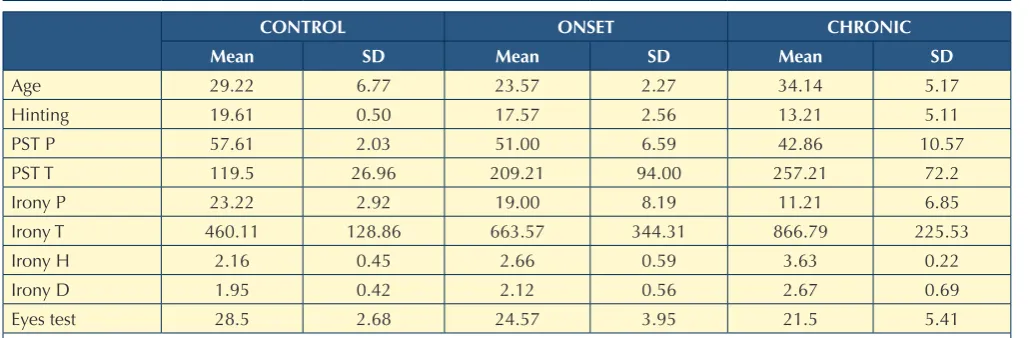
TAble I.
Mean and standard deviation of the three groups. Media e deviazione standard dei tre gruppi.
CONTROl ONSeT CHRONIC
Mean SD Mean SD Mean SD
Age 29.22 6.77 23.57 2.27 34.14 5.17
Hinting 19.61 0.50 17.57 2.56 13.21 5.11
PST P 57.61 2.03 51.00 6.59 42.86 10.57
PST T 119.5 26.96 209.21 94.00 257.21 72.2
Irony P 23.22 2.92 19.00 8.19 11.21 6.85
Irony T 460.11 128.86 663.57 344.31 866.79 225.53
Irony H 2.16 0.45 2.66 0.59 3.63 0.22
Irony D 1.95 0.42 2.12 0.56 2.67 0.69
Eyes test 28.5 2.68 24.57 3.95 21.5 5.41
agnosed within the schizophrenia spectrum, diagnosis made according to DSM IV-TR criteria by psychiatrists specialized in the treatment of such diseases. The first group was composed of young patients at their first cri-sis, with less than 3-5 years of disease (mean age: 23 years old); the second group of chronic patients with more than 5 years of disease (mean age: 34 years old). Such partition was made according to Birchwood’s hy-pothesis, who identified in the first 3-5 years of disease the so called “critical period”, when the main social and personal impairments are developed, with the resulting loss of self-esteem, relationships and competence at school and at work. The tested patients are all males, except for one girl of the first group. All of them, at the moment of the test, were in stable clinical conditions and benefited of the same services offered by the ASL RMD, including pharmacological, clinical, and reha-bilitative treatment. Patients with mental retard, cranial trauma, neurological disorders, epilepsy, substance mis-use at the moment and for more than 6 months, were excluded. The outcomes for both the clinical groups were compared to those of a control group composed of 15 healthy male subjects, all the selected tests were administered to them.
The aim is to evaluate the quality of the battery, to un-derstand the differences in ToM ability according to a heterogeneous population like the schizophrenic one, that shows an impairment in such skill. These ToM im-pairments indeed are already present in the subjects at their very first episode and tend to become more serious and pervasive during the years, damaging in this way the social functioning.
At a first examination of the mean and standard devia-tions of the scores resulting from the several tests it ap-pears clear the general tendency to impairment for both the samples; if we compare them with the results ob-tained from the test previously administered to a sam-ple of healthy subjects with an age that ranges from 20 to 40, we can see that the clinical samples have worse scores compared to the healthy ones, and at the same time, they need more time to carry out the tasks, if we consider for example the time measurement for Brüne’s and Irony tests. It seems that patients try to balance their performance (that is still problematic) taking more time to give an answer.
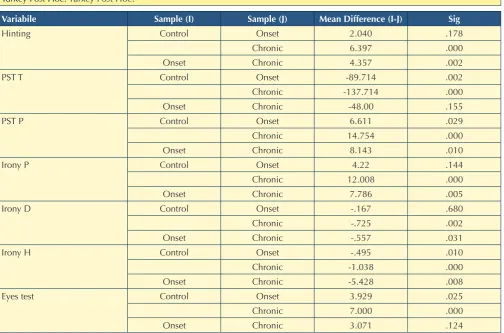
Later on, we have evaluated the significance of differ-ences between the performance made by the subjects of the clinical samples using the one way ANOVA with the Tukey Post hoc test and with significance < 0.05 (Tab. II). From the data obtained it appears as the worst function-ing in chronic patients compared to the control group, is more significant in all the tests that have been adminis-tered, contrary to what happens in the early onset group, where there were no significant differences in the Hint-irony (ToM vignettes). The remaining 32 vignettes
de-scribe physical events or behaviours that do not need ToM abilities to be correctly understood. Subjects are requested to observe each vignette and to indicate to the examiner its meaning as soon as they will understand it. Later the subjects give their own brief explanation of the meaning of the vignette itself. The examiner records with a timer the time the subject needs to explain the vignette. If the explanation is correct 1 point is given, 0 points if is incorrect. The explanation is considered correct only if a suitable mental state is ascribed to one or more characters. An objective score is obtained from the total of the correct answers. It is also requested to give a subjective score (from 1 to 5) about the degree of fun and the degree of difficulty to understand each vignette. We chose 30 of the 63 humorous vignettes (15 ToM + 15 Physical) in order to shorten the times of test administration.
The Reading the Mind in the Eyes or Adult Eyes Test 48 is a test that considers the eyes as the part of the face mainly involved in expressing complex emotions. In this test are shown 36 pictures with different set of eyes, to each set of eyes are ascribed 4 adjectives and the sub-ject has to choose the one that best describes what the person in the picture is thinking or feeling. This test was useful to understand and evaluate the subject ability to put himself in the other’s mind, tuning in with his/her mental state.
The Beck Cognitive Insight Scale 52 evaluates patients’ self-reflectiveness according to their experiences, the self-certainty and the ability to self-correct their own wrong judgements. It consists of a 15-item self-report questionnaire, divided into two sub-scales. The first subscale consists of 9 items about self-reflectiveness, it evaluates subject’s objectivity, reflectiveness and open-ness to feedback. The second sub-scale instead consists of 6 items measuring decision making, high degree of certainty in one’s interpretations: for example it as-sesses the “Jumping to conclusions”, certainty of being right and resistance to corrections. The subject is asked to give an answer to each question on a 4-point scale, from 0 (do not agree at all) to 3 (agree completely). The test had no time limit. Detracting the second sub-scale from the first one, we have a composite index, the BCIS, that reflects the degree of the cognitive insight, in other words the introspective ability and the capacity to un-derstand one’s own errors.
An example of clinic application
di-perspective; only the use of different tools allows to un-derstand and measure the multi dimensional complex-ity of such functions 58.
The implementation of this battery have highlighted the presence of metacognition impairments since the early years of the disease, the comparison between the chronic patients and others at the early onset, showed a gradual impairment of such abilities. The differences between the group of chronic and the subjects at the early onset of the disease, are indeed significant, except for the Eye test and for the times obtained in the Irony test. The outcomes can be surely generalized, because of the small number of subjects of the different groups, but they allow us to make some hypothesis for this pilot study:
• it is necessary to evaluate the metacognitive functions through a wide battery of tests, contrary to what many studies carried out until now; tasks that consider the different aspects of metacognition, not only the spe-cific ToM ability;
ing and in the Irony test. The different seriousness of ToM abilities impairment for the two clinical samples appears even if we compare them; effectively there were statisti-cally significant differences in Brüne, Irony (except for the time) and Hinting tests.
Discussion
There is widespread agreement in literature, about the central role played by the metacognitive deficit in caus-ing the social functioncaus-ing impairment in serious psychi-atric disorders particularly in schizophrenia 34. Patients diagnosed within the schizophrenia spectrum show an overall deficit of metacognitive functions 1 2 5. These ob-servations call for the need to integrate in the assess-ment routine of such patients a specific protocol of evaluation for this area. In this study we have presented a battery of tests that has to evaluate the metacognitive functioning of these patients using a multi dimensional
TAble II.
Turkey Post Hoc. Turkey Post Hoc.
Variabile Sample (I) Sample (J) Mean Difference (I-J) Sig
Hinting Control Onset 2.040 .178
Chronic 6.397 .000
Onset Chronic 4.357 .002
PST T Control Onset -89.714 .002
Chronic -137.714 .000
Onset Chronic -48.00 .155
PST P Control Onset 6.611 .029
Chronic 14.754 .000
Onset Chronic 8.143 .010
Irony P Control Onset 4.22 .144
Chronic 12.008 .000
Onset Chronic 7.786 .005
Irony D Control Onset -.167 .680
Chronic -.725 .002
Onset Chronic -.557 .031
Irony H Control Onset -.495 .010
Chronic -1.038 .000
Onset Chronic -5.428 .008
Eyes test Control Onset 3.929 .025
Chronic 7.000 .000
Onset Chronic 3.071 .124
2 Harrington L, Siegert RJ, McClure J. Theory of mind in
schizophrenia: a critical review. Cogn Neuropsychiatry 2005,10:249-86.
3 Van der Meer L, Costafreda S, Aleman A, et al. Self-reflection
and the brain: a theoretical review and meta-analysis of neu-roimaging studies with implications for schizophrenia. Neu-rosci Biobehav R 2010;34:935-46.
4 Stratta P, Riccardi I, Mirabilio D, et al. Exploration of irony
appreciation in schizophrenia: a replication study on a Ital-ian sample. Eur Arch Psy Clin N 2007;257:337-9.
5 Popolo R, Salvatore G, Lysaker PH. Schizofrenia e terapia
cognitiva. Psicopatologia, metacognizione e trattamento. Roma: Alpes 2012.
6 Leslie AM. How to acquire a “representational theory of
mind”. In: Sperber D, editor. Metarepresentations: a multi-disciplinary perspective. New York: Oxford University Press 2000.
7 Baron-Cohen S, Leslie A, Frith U. Does the autistic child
have a “theory of mind”? Cognition 1985;21:37-46.
8 Baron-Cohen S, Tager-Flusberg H, Cohen DJ.
Understand-ing other minds: perspectives from autism. New York: Ox-ford University Press 1993.
9 Fodor JA. Modularity of mind: an essay on Faculty
Psychol-ogy. Cambridge, MA: MIT Press 1983.
10 Premack D. Woodruff G. Does the chimpanzee have a
‘the-ory of mind’? Behav Brain Sci 1978;4:515-26.
11 Brüne M, Abdel-Hamid M, Lehmkamper C. et al. Mental
state attribution, neurocognitive functioning, and psychopa-thology: what predicts poor social competence in schizo-phrenia best? Schizophr Res 2007;92:151-9.
12 Helmes E, McNeill PD, Holden RR, et al. The construct of
alexithymia: associations with defense mechanisms. J Clin Psychol 2008;64:318-31.
13 Taylor GJ, Bagby RM Parker JDA. Disorders of affect
regu-lation. Alexithymia in medical and psychiatric illness. Cam-bridge: Cambridge University Press 1997.
14 Vanheule S, Desmet M, Rosseel Y, et al. Relationship patterns
in alexithymia: a study using the Core Conflictual Relationship Theme (CCRT) method. Psychopathology 2007;40:14-21.
15 Vanheule S. Challenges for alexithymia research: a
com-mentary to “The Construct of Alexithymia: associations with defence mechanisms. J Clin Psychol 2008;64:332-7.
16 Allen JG, Fonagy P, Bateman AW. La mentalizzazione nella
pratica clinica. Milano: Raffaello Cortina 2010.
17 Fonagy P, Gergely G, Jurist EL, et al. Affect regulation,
men-talization, and the development of the self. New York: Other Press 2002.
18 Heberlein AS, Saxe R. Dissociation between emotion and
personality judgements: Convergent evidence from func-tional neuroimaging. Neuroimage 2005;28:770-7.
19 Dimaggio G, Semerari A. I disturbi di personalità. Modelli e
trattamento. Stati mentali, metarappresentazione, cicli inter-personali. Roma-Bari: Laterza 2003.
20 Carcione A, Semerari A, Nicolò G, et al. Metacognitive
• instead of classifying metacognitive dysfunctions simply as present or absent, as state or trait mark-ers, it could be more interesting and therapeutically significant to evaluate the gradual impairment, keep-ing in mind that some metacognitive areas could be impaired at the beginning but not yet significantly altered.
The proposed battery, besides showing a good sensitivity in noticing the presence of an impairment, it also answers to the need to evaluate metacognition under a multidi-mensional perspective. Both the social cognitive tasks (that analyse the ability to understand the mental states of others) and the social perceptual tasks (that evaluate the implicit mental states decoding) were adopted; and a classic test “paper and pencil” has been added as a self-report questionnaire.
With the Theory of Mind Picture Sequencing Task (that is a task about false belief and deception) some vignettes are used to infer false beliefs belonging to one of the char-acter of the story and the false beliefs of one charchar-acter about the mental state of another. Tests like the Irony task and the Hinting Task, instead assess the pragmatic skill of the patient, in other words the ability of going beyond the literal meaning of words to infer and evaluate the speak-er’s beliefs and communicative intentions, even in a con-versational context. Among the “social perceptual” tests there is the Reading the Mind in the Eyes that allows to infer mental states from the visual expression, using both the theory of mind abilities and the identification of the most basic emotions. We considered only a self-report tool, the Beck Cognitive Insight Scale, that evaluates the subjects’ self-reflectiveness.
The decision to use tests that assess the different func-tions, using different types of tasks, allow to reduce, at least in part, what we consider to be the main limit of the battery, in other words these are evaluations carried out in “clinic”, in an environment that is not emotionally stimulating. In a future perspective we would like to in-tegrate tools that can give suggestions about the patients’ capacity to “mentalize in the field”; even patients that seem to be capable, when they are evaluated with specif-ic testing assessment, can show diffspecif-iculties in metacogni-tive functioning, such difficulties make them less efficient and less fast when they have to interact in the dynamic structure of everyday life.
Conflict of interests
The authors declare that there are no conflicts of interest. The authors have not received grants.
References
1 Brüne M. Theory of mind in schizophrenia: a review of the
37 Dimaggio G, Semerari A, Carcione A, et al. Psychotherapy
of personality disorders. London: Routledge 2007.
38 Semerari A, Carcione A, Dimaggio G, et al. How to evaluate
metacognitive function in psychotherapy? The metacogni-tion assessment scale its applicametacogni-tions. Clin Psychol Psychot 2003;10:238-61.
39 Perris C. Psicoterapia del paziente difficile. Guida pratica
all’approccio cognitivo nei servizi di salute mentale. Lancia-no: Métis Editrice 1993.
40 Frith CD. The cognitive neuropsychology of schizophrenia.
Hove, Laurence Erlbaum Associates 1992.
41 Corcoran R. Mercer G. Frith C.D. Schizophrenia,
symptoma-tology and social influence: investigating “theory of mind” in people with schizophrenia. Schizophr Res 1995;17:5-13.
42 Corcoran R., Cahill C, Frith CD. The appreciation of visual
jokes in people with schizophrenia: a study of ‘‘mentalizing’’ ability. Schizophr Res 1997;24:319-27.
43 Frith CD. Corcoran R. Exploring ‘theory of mind’ in people
with schizophrenia. Psychol Med 1996;26:3:521-30.
44 Randall F, Corcoran R, Day JC, et al. Attention, theory of
mind, and causal attributions in people with persecutory de-lusions: a preliminary investigation. Cogn Neuropsychiatry 2003;8 287-294.
45 Langdon R, Michie PT, Ward PB, et al. Defective self
and/or other mentalizing in schizophrenia: a cognitive neuropsychological approach. Cogn Neuropsychiatry 1997;2:167-93.
46 Brüne M. Theory of mind and role of IQ in chronic
disorgan-ized schizophrenia. Schizophr Res 2003;60:57-64.
47 Brunet E, Sarfati Y, Hardy-Baylé MC. Reasoning about
physi-cal causality and other’s intentions in schizophrenia. Cogn Neuropsychiatry 2003;8:129-39.
48 Baron-Cohen S, Wheelwright S, Hill J, et al. The
Read-ing The Mind in the Eyes. Test Revised Version: A study with normal adults, and adults with Asperger Syn-drome or High-functionig Autism. J Child Psychol Psych 2001;42:241-51.
49 Craig JS, Hatton C, Craig FB, et al. Persecutory beliefs,
at-tributions and theory of mind: comparison of patients with paranoid delusions, Asperger’s syndrome and healthy con-trols. Schizophr Res 2004;69:29-33.
50 Lysaker PH. La metacognizione nei disturbi dello spettro
schizofrenico. Metodi di valutazione della metacognizione nelle narrazioni e legami con la neurocognizione. In Dimag-gio G, Lysaker P, editors. Metacognizione e psicopatologia. Valutazione e trattamento. Milano: Raffaello Cortina Editore 2013.
51 Gallagher HL., Happé F, Brunswick N, et al. Reading the
mind in cartoons and stories: an fMRI study of ‘theory of mind’ in verbal and nonverbal tasks. Neuropsychologia 2000;38:11-21.
52 Beck AT, Baruch E, Balter JM, et al. A new instrument for
measuring insight: the Beck Cognitive Insight Scale. Schizo-phr Res 2004;68:319-29.
mastery dysfunctions in personality disorder psychotherapy. Psychiat Res 2010;190:60-71.
21 Dimaggio G Lysaker PH. Metacognizione e
psicopato-logia: valutazione e trattamento. Milano: Cortina 2011 [Edizione inglese: Metacognition and severe adult men-tal disorders: From basic research to treatment. London: Routledge 2010].
22 Blakemore SJ, Smith J, Steel R, et al. The perception of
self- produced sensory stimuli in patients with auditory hal-lucinations and passivity experiences: evidence for a break-down in self-monitoring. Psychol Med 2000;30:1131-9.
23 Franck N, Farrer C, Georgieff N, et al. Defective recognition
of one’s own actions in patients with schizophrenia. Am J Psychiat American 2001;158:454-9.
24 Langdon R., Davies M. Coltheart M. Understanding minds
and understanding communicated meanings in schizophre-nia. Mind Lang 2002;17:68-104.
25 Lysaker PH, Carcione A, Dimaggio G, et al. Metacognition
amidst narratives of self and illness in schizophrenia: Asso-ciation with neurocognition, symptoms, insight and quality of life. Acta Psychiat Scand 2005;112:64-71.
26 Lysaker PH, Lysaker JY. Schizophrenia and the Fate of Self.
New York: Oxford University Press 2008.
27 Crow TJ, Done DJ, Sacker A. Childhood precursors of
psy-chosis as clues to its evolutionary origins. Eur Arch Psy Clin N 1995;245:61-9.
28 Hekkanen ST, McEvoy C. False memories and
source-mon-itoring problems: Criterion differences. Appl Cogn Psychol 2002;16:73-85.
29 Corrigan PW. Toomey R. Interpersonal problem solving and
information processing deficits in schizophrenia. Schizophr Bull 1995;21:395-403.
30 Penn DL, Spaulding W, Reed D, et al. The relationship of
social cognition to ward behavior in chronic schizophrenia. Schizophr Res 1996;20:327-35.
31 Lysaker PH, Shea AM, Buck KD, et al. Metacognition as a
mediator of the effects of impairments in neurocognition on social function in schizophrenia spectrum disorders. Acta Psychiat Scand 2010;122:405-13.
32 Abdel-Hamid M, Lehmkämper C, Sonntag C, et al. Theory
of mind in schizophrenia: the role of clinical symptomatol-ogy and neurocognition in understanding other people’s thoughts and intentions. Psychiat Res 2009;165:19-26.
33 Wykes T. Dunn G. Cognitive deficit and the prediction of
re-habilitation success in a chronic psychiatric group. Psychol Med 1992;22:389-98.
34 Green MF. What are the functional consequences of
neurocognitive deficits in schizophrenia? Am J Psych 1996;153:321-30.
35 Mueser KT, Bond GR. Psychosocial treatment approaches
for schizophrenia. Curr Opin Psychiatr 2000;13:27-35.
36 Bora E, Yücel, Pantelis C. Cognitive impairment in
56 Koelkebeck K, Pedersen A, Suslow T, et al. Theory of
Mind in first-episode schizophrenia patients: correla-tions with cognition and personality traits. Schizophr Res 2010;119:115-23.
57 Montreuil T, Bodnar M, Bertrand MC, et al. Social
cog-nitive markers of short-term clinical outcome in first-episode psychosis. Clin Schizophr Relat Psychoses 2010;4:105-14.
58 Repacholi B. Slaughter V. Individual Differences in
Theo-ry of Mind, Implications for Typical and Atypical Devel-opment. Stratford-upon-Avon, UK: Stratford Books 2003.
53 Bertrand MC, Sutton H, Achim AM, et al. Social
cogni-tive impairments in first episode psychosis. Schizophr Res 2007;95:124-33.
54 Inoue Y, Yamada K, Hirano M, et al. Impairment in theory of
mind in patients in remission following first episode schizo-phrenia. Eur Arch Psy Clin N 2006;256:326-8.
55 Pinkham AE, Penn DL, Perkins DO, et al. Emotion