SHIV SHAKTI
International Journal in Multidisciplinary and
Academic Research (SSIJMAR)
Vol. 3, No. 3, May-June (ISSN 2278 – 5973)
A NEW CLUSTER HEAD ELECTION ALGORITHM FOR WIRELESS
MESH NETWORKS
Pushpender
1Research Scholar, CSE, Shri Venkateshwara University , Amroha(UP), India
Dr. Sohan Garg
2CSE, C.C.S. University, Meerut(UP), India
Impact Factor = 3.133 (Scientific Journal Impact Factor Value for 2012 by Inno Space Scientific Journal Impact Factor)
Indexing:
ABSTRACT --In the typical Wireless Mesh Networks application, the network hosts usually perform the given task according to groups, e.g. the command and control over staff and accruement in military affairs, traffic management, etc. In wireless mesh network, multicast protocols must consider control overhead for maintenance, energy efficiency of nodes and routing trees managements to frequent changes of network topology. Now-a days Multicast protocols extended with Cluster based approach.. The mobility of nodes will always increase the communication delay because of re-clustering and cluster head selections. For this issue we evaluate a new cluster head election algorithm for wireless mesh networks. Our simulation result implemented in MATLab 7.0 shows the effectiveness and efficiency of our proposed algorithm.
Keywords --Fuzzy Clustering, ,FIS, Fuzzy rules, Kalman Filter and Location Management.
I.INTRODUCTION
Wireless mesh networks (WMNs) are a very popular technology for scenarios where the installation of cables is not possible or too expensive. Possible application scenarios are open community networks, provider networks or wireless campus networks. Because of their flat hierarchy wireless mesh networks have the same problems as MANETs where scalability is a big challenge when the number of nodes becomes large. Therefore, clustering is a widely accepted approach for MANETs to achieve scalability by dynamically grouping the network into sub-groups called clusters. Each cluster consists of one cluster head, a number of cluster members and gateway nodes which connect two clusters. Currently, there are a number of clustering schemes which are optimized for a certain type of wireless network and scenario. Clustering schemes for MANETs are based on mobility aspects and are thus not suited well for wireless mesh networks with a static backbone. A clustering scheme for wireless mesh networks should take into account the heterogeneity of node types and most importantly identify a stable structure, i.e. reliable links and nodes. As this requirement cannot be achieved in one communication round, it is clear that such a clustering scheme can only increase its performance by a longer runtime. In this paper, we propose a new multi-hop clustering scheme “a new cluster head election algorithm for wireless mesh networks which takes into account the long-term stability of links and neighbor nodes.
II.TYPES OF CLUSTERING
Clustering can be classified in to following types, distributed and hybrid clustering
entire network will collapse and hence there is no guarantee for reliability in centralized clustering mechanism.
2. Distributed Clustering - It is one in which, there is no fixed central CH and this keeps on changing from node to node based on some parameters, for instance residual energy. Distributed architecture is used in MANETs for some specific reasons like mobile nodes prone to failure, better collection of data and provide backup in case of failure of the central node. Also, nodes sensing and forwarding the redundant information can be minimized. Since there in no centralized body to allocate the resources, they have to be self-organized.
3. Hybrid Clustering - It is formed as the resulting combination of both the above mentioned mechanisms.
III.LITERATURE SURVEY
S. Muthuramalingam et al proposed a modified algorithm that uses Weighted Clustering Algorithm (WCA) for cluster formation and Mobility Prediction for cluster maintenance. In a MANET node management is done by Clustering. Cluster formation: At first, a beacon message is send by each node to notify its presence to its neighbors. A beacon message contains the state of the node. A neighbor list is built by each node based on the received beacon messages. The cluster head is elected based on the weight values of the nodes. The node with the lowest weight is chosen as the CH. Maintenance: It has two distinct types of operations like the battery power threshold property and the node movement to the outside of its cluster boundary. Mobility prediction: The improvement in the weighted clustering algorithm is due to the use of mobility prediction in the cluster maintenance phase. Arash Dana et al presented a new clustering-based routing protocol named Cross-CBRP. In the proposed approach the interaction between Physical, MAC and Routing layers are exploited. Hence it better adapt the clustering algorithm to varying link and network condition due to mobility. The proposed Cross-CBRP algorithm uses signal power information at the physical layer for routing layer so that the stability of the formed clusters can be maximized. Routing layers are exploited. Hence it better adapt the clustering algorithm to varying link and network condition due to mobility. The proposed Cross-CBRP algorithm uses signal power information at the physical layer for routing layer so that the stability of the formed clusters can be maximized.
IV. PRPOSED WORK
The proposed fuzzy logic system based algorithmis solve reclustering delay in WMNss. Our proposed algorithm is three phases;
Phase I: Cluster based multicast tree formation, Phase II: Localized clustering and
Phase III:Data transfer.
The cluster formation is by the calculating the weighted factor of each node has to become the cluster-head by considering two fuzzy memberships like its remaining battery capacity, and its degree of mobility node with respect to the entire cluster. The nodes send data to the respective cluster -heads, which in turn compresses the aggregated data and transmits it to the group members. For wireless mesh network, we make the following assumptions:
• Due to node mobility cluster tree formation and cluster head selection is consider heavy control overhead.
• Location based cluster evaluation is considering for future multicast routing.
In our protocol approach, considering wireless mesh networks are meant to be deployed over a geographical area with the main purpose of sensing and gathering information, we assume that nodes have minimal mobility, thus sending the location information during the initial setup phase is sufficient
A. Fuzzy System based Cluster Formation
We evaluate the cluster formation is based on the following two fuzzy membership functions:
Fig.2:Input Variable ‘Energy’
• Node Remaining Energy - energy level available in each node, designated by the fuzzy variable energy
Fig.3:Input Variable ‘Mobility’
• Node Mobility - a value which classifies the nodes based on how central the node is to the cluster, designated by the fuzzy variable mobility.
The linguistic variables used to represent the node energy: low, medium and high
Fig4.
The output linguistic variables used to represent the node cluster-head election chance: Very Small, Small, Rather Medium, Medium, Large, Very Large
The fuzzy rule base currently includes rules like the following:
Table1. Fuzzy Rules
Rule No. Energy Mobility CH chance Rule No.1 LOW CLOSE SMALL
Rule No.2 LOW ADEQUATE RATHER MEDIUM Rule No.3 LOW FAR VERY SMALL Rule No.4 MEDIUM CLOSE MEDIUM Rule No.5 MEDIUM ADEQUATE MEDIUM Rule No.6 MEDIUM FAR SMALL
Rule No.7 HIGH CLOSE VERY LARGE Rule No.8 HIGH ADEQUATE LARGE
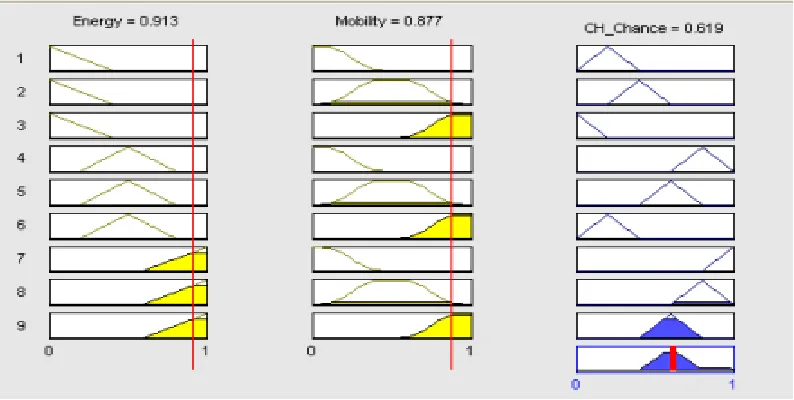
Fig.5:Fuzzy Rules in MATLab
1. If energy is low and mobility is close then cluster head election chance is small.
2. If energy is low and mobility is adequate then cluster head election chance is rather medium.
3. If energy is low and mobility is far then cluster head election chance is very small. 4. If energy is medium and mobility is close then cluster head election chance is medium. 5. If energy is medium and mobility is adequate then cluster head election chance is medium.
6. If energy is medium and mobility is far then cluster head election chance is small. 7. If energy is high and mobility is close then cluster head election chance is very large. 8. If energy is high and mobility is adequate then cluster head election chance is large. 9. If energy is high and mobility is far then cluster head election chance is medium.
All the nodes are compared on the basis of chances and the node with the maximum chance is then elected as the cluster-head. Each node in the cluster associates itself to the cluster-head and starts transmitting data.
B. Location Updates by Kalman Filter
joint use of Kalman filter at the cluster head and members sides enables reducing the number of necessary location updates. In fact, the filter is used to estimate the position at the actor based on measurements, which is a common practice in robotics, and to predict the position of the CH (i) at the members, thus, reducing the message exchange. The position of CH can be estimated and predicted at the members in its Voronoi cell, based on the measurements ziK taken at the actor and broadcast by the actor. At step k, each member‟s m in i‟s Voronoi cell updates the state (that represents position and velocity of the ch) based on the equations.
C. Location Updates in Clustered Groups By using kalman filter we can predict the location updates within clustered groups, each CH gets their neighbors locations.CH also exchange their position to members.CH keeps tracks of nodes position it will leads to predicts the new cluster head based on mobility.CH also predict neighbors‟ future directions. It will leads to fuzzy membership function, here it reduces re-clustering timing. 3.3.4 CH to CH Groups Cluster head to cluster head scenario location management scheme updating position of neighbors‟ nodes will exchange each other. Like if any node moving out of clustered groups.CH will predict the future direction and exchange to direction based CH. While applying the new CH selection this information will leads efficient fuzzy membership formation. In networks with mobile nodes and multiple recipients, however, it depends on the ability of location management schemes to efficiently provide relevant nodes with the position of mobile nodes at any time. Each member will thus expect to receive location updates from the actor it is dominated by. With respect to delay, the energy consumption for location updates is drastically reduced.
V. SIMULATION AND RESULT DISCUSSION
Fig.6: ‘CH Chance’ O/P w.r.t. High ‘Energy’, far ‘Mobility’
Figure 6.0 represents (rule viewer) that when value of the input parameter remaining energy is high and the value of the another input parameter „Moblity‟ of the node is also far then as a result the value of the output variable „CH Chance‟ is large i.e. cluster head election chances is large.
In the figure 7.0 , the 3 D decision surface illustrate the output variable cluster head election chance with respect to the input variable named „Energy‟ and another input variable named „Mobility‟
Fig.8: ‘CH Chance’ O/P w.r.t. ‘Mobility’ and ‘Energy’
As shown in figure 8.0, the 3 D decision surface illustrate output variable CH Chance with respect to the input variable named „Mobility‟ and another input variable named „Energy‟.
A number of test cases were conducted in simulation work using MATLab 7.0. Some test cases description is explained here:
Table 2.: Test Cases
Test Case no. Energy
Mobility
CH
Chance
Test Case No.9 0.867(high) 0.35(close) 0.802
The simulation results indicate that when node remaining energy is high and node mobility is close the cluster head election chance is more. But when node remaining energy is low and node mobility is far then as a result the status of the cluster head election chance is less. Also when node remaining energy is medium and node mobility is adequate then cluster head lection chance is also medium. At last simulation results indicate that at high rate of node‟s mobility degrade the performance of our proposed fuzzy system based algorithm. But in some other conditions our proposed algorithm works well.
VI. CONCLUSIONS
Due to the unprecedented growth in the scale and diversity of mobile computing devices, new horizons for wireless connectivity have come into view. In this paper, we address the problem of reliable multicast data delivery in wireless mesh networks. Constantly changing network topology makes conventional ad hoc routing protocols incapable of providing satisfactory performance. We reported on simulation-based experiments evaluating our proposed approaches fuzzy clustering to multicast communication in wireless mesh networks (WMNs). We present a cluster head election scheme using fuzzy logic system for wireless mesh networks. Two descriptors are used its remaining battery capacity, and its degree of mobility. In this approach nodes can dynamically switch routing mechanisms based on their perception of the network conditions. Kalman filter used to predict the future clusters and cluster heads, its increasing the performance of clustering phases and reduce the re clustering delay and control packets. The efficiency of the involvement of future cluster head prediction against node mobility, as well as the overhead due to fuzzy clustering is analyzed. Through simulation, we further confirm the effectiveness and efficiency of our proposed work:
VI. REFERENCES
[1] Byung-Jae Kwak, Nah-Oak Song and Leonard E. Miller,(2003)” A Mobility Measure for Mobile Ad-Hoc Networks” Communications Letters, IEEE Issue Date: Aug. 2003
[2] Dewan Tanvir Ahmed, (2005) “Multicasting in Ad Hoc Networks” CSI5140F Wireless Ad Hoc Networking Professor Ivan Stojmenovic Ottawa, Ontario, Canada, Fall 2005
[4] ZHAO Chun-Xiao and WANG Guang-Xing, (2004) “Fuzzy-Control-Based Clustering Strategy in MANET” Proceedings of the 5th World Congress on Intelligent Control and Automation, June 15-19, 2004,
[5] K. Venkata Subbaiah and Dr. M.M. Naidu, (2010) “Cluster head Election for CGSR Routing Protocol Using Fuzzy Logic Controller for Mobile Ad Hoc Network” Int. J. of Advanced Networking and Applications 246 Volume: 01, Issue: 04, Pages: 246-251 (2010)
[6] Hongbo Zhou, (2003),” A Survey on Routing Protocols in MANETs” on MSU-CSE-03-08, Mar 28, 2003
[7] B.G.Obula Reddy, Maligela Ussenaiah, (2012) “An Adaptive Fuzzy System in Large Scale Mobile Ad Hoc Networks” IJCSMS International Journal of Computer Science and Management Studies, Vol. 12, Issue 02, April 2012.
[8] B.G.Obulla Reddy, Maligela Ussenaiah, “An Adaptive Fuzzy Clustering and Location Management in Mobile Ad Hoc Networks”, International Journal of Computer Applications & Information Technology Vol. I, Issue III, November 2012 (ISSN: 2278-7720),pp. 99-106.
[9] M. Anupama and Bachala Sathyanarayana,” Survey of Cluster Based Routing Protocols in
Mobile Ad-hoc Networks”, International Journal of Computer Theory and Engineering, Vol. 3, No. 6, December 2011,pp. 806-815.
ABOUT THE AUTHORS
1. Er. Pushpender Sarao received the B.Tech degree in Information Technology from DAV
College of Engineering & Technology Kanina, Haryana affiliated to MD University Rohtak and M.Tech degree in Computer Science and Engineering from M.D. University, Rohtak (India). He has been in teaching profession more than four years. Beside he has the good industrial exposure in the field of computer technology and network. He is a research scholar pursuing his Ph.D from Shri Venkateshwara University, Gajraula,Amroha (UP), India in Wireless Mesh Network specializing Routing Protocols.
2. Dr. Sohan Garg: Presently working as Director, Sir Chhotu Ram Institute of Engineering and