PILOT TESTING OF THE CZECH VERSIONS OF THE COACHING BEHAVIOR
ASSESSMENT QUESTIONNAIRE STRUCTURE
Veronika Baláková, Martin Musálek
Faculty of Physical Education and Sport, Charles University, Prague, Czech Republic
Submitted in January, 2012
BACKGROUND: In the sports environment, the opinion that the leadership style of the coach plays an essential role in achieving team success is generally accepted (Amorose & Horn, 2001). Scott Martin and Kelly Barnes in 1999 created Coaching Behavior Assessment Questionnaire, based on CBAS (Smith et al., 1977) and LSS (Chelladurai & Saleh, 1978, 1980). Currently in the Czech Republic, there is no diagnostic tool that would address the eff ectiveness of the coach.
OBJECTIVE: The purpose of this pilot study was to translate and evaluate the structure of CBAQ by method of structural equation modeling for population of children in age 10–16.
METHODS: For translation of the questionnaire we utilized a modifi ed direct translation method (Behling & Law, 2000). A total of 100 participants age 10 to 16, female 63 (mean age 13.02, SD = 2.10), male 37 (mean age 13.27, SD = 1.37) completed the CBAQ. For data analysis we applied both exploratory and confi rmation factor analysis approaches.
RESULTS: The original model was tested to verify the structural theory and diagnosis quality of this tool. Results of the original CBAQ 12 factor model showed poor fi t of the underaverage values RMSEA on the level 0.082, CFI on the level 0.600 and lack coeffi cients of generic reliability. After reanalyzing the data we established a modifi ed 5 factor structure of CBAQ. This 5 factor model with restricted numbers of items gave the best values of fi t RMSEA = 0.056, CFI = 0.964 and acceptable values of generic reliability.
CONCLUSIONS: This study had pilot character and we were aware of problems with loosing information due to very restricted numbers of items in modifi ed version, however it is suggested that fi nal 5 factor version with 15 items could made basis for future full standardized Czech version of CBAQ.
Keywords: Behavior of coach, cross cultural validation, face-validity, content validity, structural equation modeling, reliability.
Vallerand, Amoura, & Balds, 2010; Martin, Jackson, Richardson, & Weiller, 1999).
Probably the best known diagnostic tools in this area are Meditational model of leadership that was creat ed by the authors Smith, Smoll, and Hunt (1978) and Multidimensional model of leadership, Chelladurai and Saleh (1978). Although these two models are gener-ally ac cepted by experts, each of them has a fundamen-tally diff erent approach in the evaluation of the work of coaches. Smith et al. created the Coaching Behavior Assessment System (CBAS; Smith et al., 1977), which evaluates the coachʼs behavior based on participative structured observations. In addition, in order to obtain more data sources, the athlete can be asked for verbal description of a situation and can be also asked how of ten a coach uses this type of behavior. Athlete eva-luates on 7 point Likert scale from never (1) to almost always (7).
Based on this multi-dimensional model, created later Chelladurai and Saleh Leadership Scale for Sport (LSS, Chelladurai & Saleh, 1980), which evaluates the coachʼs behavior based on results of questionnaires for coaches INTRODUCTION
In the sports environment, the opinion that the leader ship style of the coach plays an essential role in achieving team success is generally accepted (Amo-rose & Horn, 2001).
and their athletes. The authors argued that the input (antecedent) characteristics (i.e. situational, leader, and member) in combination with the characteristics of leadership (coach) behaviors (i.e., required, actual, and preferred) determine the athlete/team performance and satisfaction (consequences). There are three ver-sions of the LSS, (a) version for a coach, where he tries to describe his own behavior, (b) version for athletes, where they try to describe the coachʼs behavior, (c) the preferred version, where athletes try to describe behav-ior that they would prefer in their trainer.
The Multidimensional model of leadership (Chel-ladurai & Saleh, 1978, 1980) was subsequently slightly modifi ed by Martin et al. (1999). They included parents in the model for the fi rst time, creating a version of the questionnaire, which deals with the preferred style of coaching behavior on the part of parents.
Scott Martin and Kelly Barnes then in 1999 at the University of North Texas in the U. S. created Coaching Behavior Assessment Questionnaire, based on CBAS (Smith et al., 1977) and LSS (Chelladurai & Saleh, 1978, 1980). The authors speculated whether connect-ing these two approaches would result in better conclu-sions for the evaluation of coaches.
Coaching Behavior Assessment Questionnaire
The CBAQ was originally created and is used for the population aged 10 to 23 years. Like LSS, CBAQ was also designed to detect three variants of the coachʼs leadership: a) required, b) actual, c) preferred.
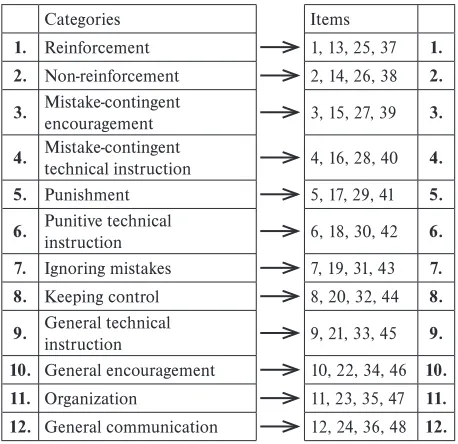
Coaching Behavior Assessment Questionnaire is com posed of two parts. The fi rst part contains 12 demo-graphic items, then the second part 48 items related to elements of the coachʼs behavior. The 12 demographic items talk not only about the athleteʼs age, gender, race or sport performed but also the preference of gender and age of coach. The 48 items measure perception of se lected elements of the coachʼs behavior and is di-vided into 12 categories, each category is expressed by four items. Twelve categories, which are divided into 48 items, correspond with the 12 categories of the coachʼs behavior represented in CBAS (Smith et al., 1977). Responses to all 48 items are recorded on 5 point Likert scale ranging from strongly disagree (1) to strong-ly agree (5). All 48 items are always equalstrong-ly applied to all variants of the questionnaire, only an introduction to each item varies. The required version begins with “Coach...” (Coach says statements like “way to go” when athlete is doing well). The current version starts with “My coach...” (My coach says statements like “way to go” when athlete is doing well). The preferred version then begins, “I prefer coach...” (I prefer a coach who says statements like “way to go” when athlete is doing well). Altogether CBAQ has 8 versions – three versions of the desired behavior (option for athletes, the coach or the parents), three of the actual behavior (option
for athle tes, the coach or the parents) and two versions of the preferred behavior (option for athletes and for parents). The reason for the creation of these various options is ability to determine what the coach should have done (how he should have behaved) at a specifi c level, how he actually behaves and also what is required of him. That is why CBAQ combines categories of be-havior from CBAS (Smith et al., 1977) and multidimen-sionality resulting from the LSS (Chelladurai & Saleh, 1978, 1980).
Studies by Martin et al. (2001), in which a question-naire CBAQ was used shows that athletes prefer such coachʼs behavior, which falls into the category of rein-forcement, general encouragement, and general tech-nical instruction. Further studies examined the eff ect of gender and type of sport on the coachs preferred be havior (Kravig, 2003).
RESEARCH PROBLEMS
Currently in the Czech Republic, there is no diagnos-tic tool that would address the eff ectiveness of the coach. For this reason it was decided to translate and evaluate the structure of CBAQ by method of structural equation modeling for population of children in age 10–16. Given the complexity of the process of the validation study, we have decided only to execute the pilot verifi cation of CBAQ structure. Results and conclusions of this pilot investigation subsequently served as a basis for creating a modifi ed version of the questionnaire CBAQ.
METHODS
Fig. 1
Original structure of CBAQ questionnaire
Categories Items
1. Reinforcement 1, 13, 25, 37 1.
2. Non-reinforcement 2, 14, 26, 38 2. 3. Mistake-contingent
encouragement 3, 15, 27, 39 3.
4. Mistake-contingent
technical instruction 4, 16, 28, 40 4.
5. Punishment 5, 17, 29, 41 5.
6. Punitive technical
instruction 6, 18, 30, 42 6.
7. Ignoring mistakes 7, 19, 31, 43 7.
8. Keeping control 8, 20, 32, 44 8.
9. General technical
instruction 9, 21, 33, 45 9.
10. General encouragement 10, 22, 34, 46 10.
11. Organization 11, 23, 35, 47 11.
Participants
In the study 100 players of a youth volleyball from Prague and Pilsen aged 10 to 16 years, female 63 (mean age 13.02, SD = 2.10), male 37 (mean age 13.27, SD = 1.37) participated. For research, we used the meth-od of intended selection. The fi rst criterion was the age of athletes, which had to be 10–16 because CBAQ is de termined for this population. Second criterion was the skill level of athletes. Athletes had to play a regional championship or Czech Cup.
The informative agreements of children parents and confi rmation from ethic committee were obtained.
Translation of the questionnaire
The questionnaire was translated by three experts in the fi eld of physical education and sport. For this purpose were used the modifi ed direct translation pro-cedure (Behling & Law, 2000) in combination with the protocol analysis (Hines & Snowden, 1993).
In phase 1, three experts worked independently. Pro fessionals were presented with the instructions to translate the text based on the meaning rather than word by word.
In phase 2, translations from all three translators were reviewed by the researcher who added additional notes. The entire content was then returned back to the translators for clarifi cations.
In phase 3, all three experts met with the main re-searcher. Individual items were then discussed in rela-tion to meaning and grammar. The result of this meeting was the fi rst Czech version of the questionnaire.
In phase 4, was the fi rst Czech version of the ques-tionnaire given to language professionals to review. The second version was then created on the basis of their proposals.
Because of the identifi ed shortcomings of the con-tent and face validity, we did not include the next phase i.e. the distribution and administration of the second version of the questionnaire, relating to the clarity of items.
Factorial validity and reliability
The factor structure was tested by means of struc-tural equation modeling. We applied the confi rmato-ry approach for categorical data. We used statistical program M-plus version 6.0 which represents a suit-able statistical tool for modeling with latent varisuit-ables (Muthen & Muthen, 2010). The main idea is to verify re-lationship between the unobserved latent variable called mathematically factor and observed variables – items. This relationship is expressed by regression coeffi cients called factor validity (Lawley & Maxwell, 1971; Rao & Sinharay, 2007).
The original model was tested to verify the structural theory and diagnosis quality of this tool which assess coaching behavior. Since our data are categorical
ordi-nal, Muthen (1984) we recommend using for param-eters of estimation, the method of Weighted least square parameter estimates using a diagonal weight matrix with standard errors and mean and variance adjusted chi-square test statistic that use a full weight matrix. Fit of the model was expressed by several fi t indices, Sat-tora-Bentler chi-square, Comparative Fit Index (CFI), (Bentler, 1990) and Root Mean Square of Approxima-tion (RMSEA) (Steiger, 1990). Authors Browne and Cu deck (1993) describe index CFI as coeffi cient with value between 0–1, value 0.90 and higher indicate good fi t of model. Values of RMSEA lower than 0.05 show a very good fi t, 0.05–0.08 good fi t, 0.08–0.10 average fi t and higher than 0.10 indicate bad fi t of the model. Other indices we used were SRMR, Standardized Root Mean Residual for exploratory approach (recommended value ≤ 0.07) (Jöreskog & Sörbom, 1988). The SRMR is an absolute measure of fi t and a value of zero indicates per-fect fi t. The SRMR has no penalty for model complexity. A value less than .08 is generally considered a good fi t (Hu & Bentler, 1999).
Another fi t indices which were recommended by Keith (1997) were used, TLI Tucker-Lewis index also called the non-normed fi t index and WRMR Weighted Root Mean Square Residual (recommended value ≤ 1) (Keith & Witta, 1997).
Approximation of generic reliability of each con-struct was performed by computing of coeffi cient Mc-Donalds omega (McDonald, 1991).
The process of testing
The translated questionnaires were gradually distrib-uted to players from 10 volleyball clubs at the end of the training unit.
During the administration of the test, our assump-tions were confi rmed regarding the inadequate content validity, and there were three main categories of prob-lems:
1. Items no. 2, 7, 14, 19, 31, 38, 43 contained negatives, causing many players not to be able to adequately respond on the Likertʼs scale (instead of 5 checked 1, instead of 4 checked 2, etc.);
2. Items no. 25, 31, 42, 46 contained expressions, which especially the younger athletes did not understand (no. 25, 46 – that the appraisement is not a material gift, but the expression of praise or recognition) or did not know them at all; no. 31 – emotions; no. 42 – sarcasm);
3. Content and meaning of items no.11, 20, 23, 32, 40, 43, 47 especially younger athletes did not under-stand;
inter-views with selected players by the administrator, when he asked them controlling questions (e.g. no. 2 – “Does not say encouraging remarks during the game”, a player scored a 4 – “I agree” the administrator asked – “Does the coach encourage you during a game?” the player re plied “yes” in the questionnaire should therefore be scored 2 – “I do not agree”).
Given the assumption that not always and not all athle tes who needed help asked for it, it is likely that the above problems could aff ect the results of analysis of the original version CBAQ.
RESULTS
Factorial validity and fi t of the model of original version CBAQ
The outcomes from structural equation modeling (Appendix 1) suggested that a twelve dimensional struc-ture with the original 48 items indicated lack values of fi t of the model. Additionally comparing our results with data provided by authors of CBAQ there are a lot of diff erences. In our study the index of fi t RMSEA on the level 0.082 express only average fi t. This value was much lower in comparing of RMSEA = 0.052 in original study. Other index of fi t, CFI = 0.600 TLI = 0.555 and WRMR = 1.225. CFI were even very under average and showed that there are some problems in structure in our study. As well as chi-square = 1248.386. These results may imply from sample size N = 100 as well as from problems with content and face validity of several items, its diffi culty and understanding by participants which we suggested in the Methods section – process of testing.
From Appendix 1 is also evident that there is 13 indi-cators which have poor factor validity, lower than 0.40. Furthermore in our structural model we discovered a lot of strong correlations between latent variables (factors) (Appendix 2). This fi nding indicates that each pair of constructs is indicating similar or even the same latent areas.
Reliability
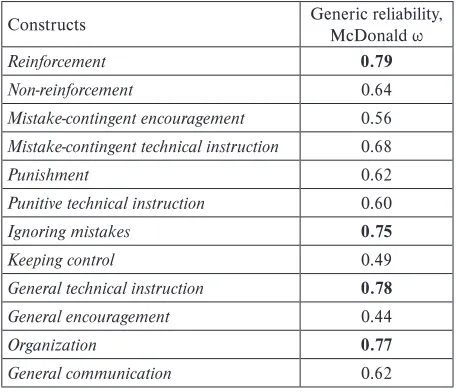
In this study it was generally found that lower coef-fi cients of generic reliability ranged from 0.44 to 0.79 in comparison with the original CBAQ from 0.62 to
0.95. The poorest generic reliability on the level 0.44 was found at the tenth dimension called General En-couragement (Ge-en).
TABLE 2
Generic reliability of latent variables
Constructs Generic reliability,
McDonald ω
Reinforcement 0.79
Non-reinforcement 0.64
Mistake-contingent encouragement 0.56 Mistake-contingent technical instruction 0.68
Punishment 0.62
Punitive technical instruction 0.60
Ignoring mistakes 0.75
Keeping control 0.49
General technical instruction 0.78
General encouragement 0.44
Organization 0.77
General communication 0.62
Modifi cation of original CBAQ diagnostics tool
Based on the results of structural modeling of the original version of CBAQ potential problems were con-fi rmed with content validity, face validity and problems of clarity and complexity of some items that players had when fi lling in CBAQ. After fi nding the unacceptable values fi t indices, the original model structure of CBAQ was dismissed and it was proceeded to the modifi cation of the tool CBAQ, which was comprised of the follow-ing steps:
1. The selected expressions in items no. 25, 31, 42, 46 the athletes did not understand; items no. 25, 46 were retained in the questionnaire, for the reason that the behavior of a coach who shows praise, the athletes of the age mentioned above are able to identify very well and has for them and their learning process a very crucial meaning (Black & Weiss, 1992); item no. 42 remained in the questionnaire as well, although children often fail to identify this type of behavior, it means that TABLE 1
CFA 12 factor model of original version of CBAQ
Model Chi-square Df CFI TLI RMSEA WRMR
12 factors 1248.386 1014 0.600 0.555 0.082 1.225
Appendix 1
Structural model of CBAQ, squares represent individual items, ovals latent factors, the arrows represent relationships between items and latent variables
Non-reinforcement Mistake-contingent encouragement Mistake-contingent technical instruction Punishment Punitive technical instruction 2 14 38 26 3 15 39 27 4 16 40 28 5 17 41 29 6 18 42 30 Reinforcement 1 13 37 25 0.483 0.483 0.536 0.536 0.590 0.590 0.783 0.783 0.853 0.853 0.486 0.486 0.646 0.646 0.544 0.544 0.487 0.487 0.549 0.549 0.579 0.579 0.344 0.344 0.321 0.321 0.676 0.676 0.826 0.826 0.092 0.092 0.487 0.487 0.653 0.653 0.908 0.908 0.369 0.369 -0.369 –0.369 0.334 0.334 0.732 0.732 0.556
0.556 Keeping control
children may be confused, lost in meanings and subse-quently in the organization and cease to be interested in the activity; in order to ensure proper understanding of the two verbal expressions, a word commentary during test administration is suitable; item no. 31 was excluded from the questionnaire (see also section 4);
2. Items no. 11, 20, 23, 32, 43, 47 players very often did not understand, did not know what the content of individual questions meant; it is not possible to further verbally explain each item, as well as an adult who has a problem with their understanding; for this reason all items were excluded from the questionnaire; item no. 40 is not properly formulated so as to correspond with the respective category, and thus was eliminated from the questionnaire;
3. Items no. 9, 16, 22, 23, 26, 28, 30, 34, 44, 46 did not fall clearly into the category of the original structure; after a consultation with the principal methodologist and also with the coordinator of youth of the Czech Volley ball Association it was decided on the rearrange-ment or exclusion of some items:
x no. 9, category 9 → ?; the item is talking about tac-tics, strategy, which is not in the fi eld of sports train-ing considered as a synonym of the word technique, therefore, this item should not be included in the cate gory general technical instruction; it is likely that the author of this questionnaire does not distinguish between these two words; this item was excluded from the questionnaire;
x no. 16 – according to the original structure belongs to a category 4, based on our opinion it rather falls into category 3;
x no. 22, category 10 → 1; the coachʼs behavior is a re-action to the playerʼs previous performance, the item should not fall into the category of general encour-agement;
x no. 23, category 11 → ?; the author uses the word of strategy of game for an item from the category organ-ization, the item should not belong in this category; the item should be removed from the questionnaire; x no. 26, category 2 → 4; the behavior of the coach is
a reaction to the playerʼs mistake, it should therefore belong to category 4; the item was removed from the questionnaire;
x no. 28, category 4 → 9; the description of the be ha-vior is not given, that it is a reaction to the behaha-vior of a player, so item should belong to the spontaneous behavior of the coach;
x no. 30, category 6 → 5; the physical intimidation of players by a coach can be regarded as a punishment rather than just rebuke (punitive instruction); x no. 34, category 10 → 1; the coachʼs behavior is a
re-action to the playerʼs previous performance, the item Appendix 2
Correlation matrix of latent variables (factors) with highlighted strong correlations between factors
Rei Non re Mi-co-e Mi-co-t-i Pun Pun-t-i Ig-mi Kee-co Ge-te-i Ge-en Org Ge-com
Rei 1
Non re –0.999 1
Mi-co-e 0.542 0.542 1
Mi-co-t-i 0.921 –0.927 0.102 1
Pun –0.520 0.238 –0.654 0.150 1
Pun-t-i 0.998 0.979 0.369 –0.849 0.996 1
Ig-mi –0.727 0.998 0.272 –0.552 0.000 0.545 1
Kee-co 0.977 –0.867 0.483 0.996 –0.856 –0.999 –0.320 1
Ge-te-i 0.597 –0.461 0.171 0.891 0.257 –0.567 –0.494 0.570 1
Ge-en 0.774 –0.553 0.401 0.997 0.058 –0.837 –0.629 0.903 0.970 1
Org 0.388 –0.197 0.356 0.387 0.660 0.132 –0.308 –0.111 0.617 0.771 1
Ge-com 0.293 –0.119 0.601 0.080 –0.261 –0.515 0.129 –0.082 0.353 0.364 0.474 1
Appendix 3
Acronyms of latent variables (factors)
Reinforcement Rei
Non-reinforcement Non rei
Mistake-contingent encouragement Mi-co-e Mistake-contingent technical instruction Mi-co-t-i
Punishment Pun
Punitive technical instruction Pun-t-i
Ignoring mistakes Ig-mi
Keeping control Kee-co
General technical instruction Ge-te-i
General encouragement Ge-en
Organization Org
should not fall into the category of general encour-agement;
x no. 44, category 8 → ?; item deals with coachʼs fair-ness, which does not correspond with the skill of organizing training; the item was removed from the questionnaire;
x no. 46, category 10 → 1; if a coach “praises” player, the item should fall into the category of Reinforce-ment;
4. Items no. 2, 7, 14, 19, 31, 38 and 43 contained ne gative, all of these items were excluded from the ques-tionnaire;
5. Categories no. 2, 4, 7, 8, 10 and 11 were comple-tely excluded from the questionnaire. After selection of items, remained always only one item in these catego-ries, which is suffi cient to identify the factor:
x category no. 2 (Non-reinforcement) – included 3 items (no. 2, 14, 38) with negative and 1 item (no. 26) did not fall into this category; this category is the opposite of category 1 and therefore we con-clude that there is no need to incon-clude both of them, categories 1 and 2 highly correlated;
x category no. 4 (Mistake-contingent technical instruc-tion) – 2 items (no. 16 and 28) did not fall into this category, 1 item (no. 40) was not properly formu-lated due to the category;
x category no. 7 (Ignoring mistakes) – contained all negative items; we believe also that children are not able to adequately assess this speech of the coach; x category no. 8 (Keeping control) – 2 items (no. 20
and 32) from this category have been incomprehen-sible for children; 1 item (no. 44) did not fall into this category; we believe that even here children are not able to assess what the coach is doing or not doing in order to maintain control;
x category no. 10 (General encouragement) – 3 items (no. 22, 34 and 46) according to our fi ndings did not fall in this category;
x category no. 11 (Organization) – 3 items (no. 11, 23 and 47) were incomprehensible to the respondents;
this trainerʼs skill is particularly important in order to keep children motivated and excited for the sport; we believe that not even here younger children are able to adequately respond.
Finally we used 28 items and 6 factor structure which we evaluated through procedure of exploratory factor analysis to confirm general picture of modify CBAQ – used items: 1, 3, 5, 6, 12, 13, 15, 16, 17, 18, 21, 22, 24, 25, 27, 28, 29, 30, 33, 34, 36, 37, 39, 41, 42, 45, 46, 48.
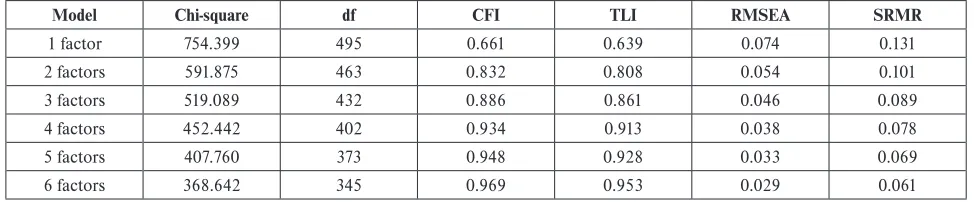
An examination of the goodness of fi t information for the EFA results produces relatively clear results. Us-ing the recommended cut off values of fi t indices 6 fac-tor solution is supported. We decided to use 6 facfac-tor EFA model as basic also due to transparent dividing of items to factors. What is clear from TABLE 4 is that the 1–5 factor solution is not supported by the pattern of all fi t indices.
Furthermore, the 6 factor solutions presented in TABLE 4 produce general meaningful solutions, thus we fi nally decided to take 6 factor EFA model as a basic model for CFA.
However, this model had of lack fi t for the model and moreover, we also had to reject this 6 factor model due to the Heywood case. Correlation between Punish-ment and Punitive technical instruction was higher than value 1 (1.132). Furthermore, we found poor construct validity lower than 0.40 of items 5, 12, 15, 16, 18, 21, 22, 27, 33, 34, 46. This fact showed that 6 factor model with 28 items is not suffi cient. Therefore, we suggested to assess content of each of poor item and tried to re-move them to other constructs. However, the meaning of indicators was so specifi c that fi nally it was decided to delete poor items from 6 factor model and suggest a new structure.
Based on the above mentioned steps, modifi ed ver-sion of the CBAQ questionnaire was created, it consists of 6 constructs containing a total of 17 items.
TABLE 3
Exploratory factor analysis models of modifi ed version of CBAQ with 28 items
Model Chi-square df CFI TLI RMSEA SRMR
1 factor 754.399 495 0.661 0.639 0.074 0.131
2 factors 591.875 463 0.832 0.808 0.054 0.101
3 factors 519.089 432 0.886 0.861 0.046 0.089
4 factors 452.442 402 0.934 0.913 0.038 0.078
5 factors 407.760 373 0.948 0.928 0.033 0.069
6 factors 368.642 345 0.969 0.953 0.029 0.061
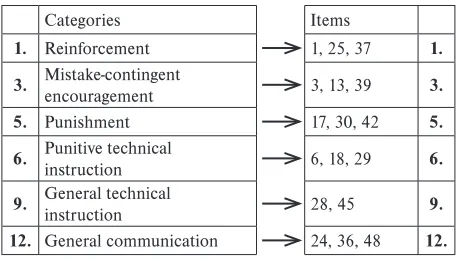
Despite deleting poor items, this 6 factor model also showed poor fi t values at index CFI and TLI, which was caused due to problem with latent variable General tech-nical instruction factor which contained only two indica-tors 28, 45. This fact can be problematic in identi fying the model, because for identifi cation of latent variables in sample size N = 100 it is needed to have at least three observed variables (Kline, 2011).
Therefore, we decided to reject this model. For our next analysis we deleted this factor with two items and repeat CFA with remaining fi ve factors structure.
With regard to an important characteristic of Ge ne-ral technical instruction factor we suggest that this fac-tor should be in further study re-modeled along with reformulated items that contain negatives about which we discussed above.
TABLE 4
CFA 6 factor model of modifi ed version of CBAQ with 28 items
Model Chi-square df CFI TLI RMSEA WRMR
6 factors 469.282 362 0.828 0.808 0.085 0.981
Legend: CFI = Comparative fi t index (recommended value ≥ 0.95), TLI = Tucker-Lewis index (recommended value ≥ 0.95), RMSEA = Root Mean Square of Approximation (recommended value ≤ 0.08), WRMR = Weighted Root Mean Square Residual (recommended value ≤ 1.00)
TABLE 5
CFA 6 factor model of modifi ed version of CBAQ with 17 items
Model Chi-square Df CFI TLI RMSEA WRMR
6 factors 206.679 137 0.897 0.872 0.072 0.937
Legend: CFI = Comparative fi t index (recommended value ≥ 0.95), TLI = Tucker-Lewis index (recommended value ≥ 0.95), RMSEA = Root Mean Square of Approximation (recommended value ≤ 0.08), WRMR = Weighted Root Mean Square Residual (recommended value ≤ 1.00)
TABLE 6
CFA 5 factor model of modifi ed version of CBAQ without factor “General technical instruction”
Model Chi-square df CFI TLI RMSEA WRMR
5 factors 104.193 109 0.964 0.953 0.056 0.712
Legend: CFI = Comparative fi t index (recommended value ≥ 0.95), TLI = Tucker-Lewis index (recommended value ≥ 0.95), RMSEA = Root Mean Square of Approximation (recommended value ≤ 0.08), WRMR = Weighted Root Mean Square Residual (recommended value ≤ 1.00)
Fig. 2
Modifi ed 6 factor model structure of CBAQ question-naire with 17 items
Categories Items
1. Reinforcement 1, 25, 37 1.
3. Mistake-contingent
encouragement 3, 13, 39 3.
5. Punishment 17, 30, 42 5.
6. Punitive technical
instruction 6, 18, 29 6.
9. General technical
instruction 28, 45 9.
12. General communication 24, 36, 48 12.
Fig. 3
Modifi ed 5 factor model structure of CBAQ question-naire
Categories Items
1. Reinforcement 1, 25, 37 1.
3. Mistake-contingent
encouragement 3, 13, 39 3.
5. Punishment 17, 30, 42 5.
6. Punitive technical
instruction 6, 29, 41 6.
Fig. 4
Structural model of modifi ed version of CBAQ with fi ve factors, squares represent individual items, ovals latent factors, the arrows represent relationship between items and latent variables
Reinforcement 1
25
37
0.629 0.929 0.723
Punishment 17
30
42
0.799 0.767 0.756
General communication 24
36
48
0.612 0.775 0.601
Mistake-contingent encouragement 3
13
39
0.741 0.498
0.688
6
29
41
Punitive technical instruction 0.654
0.848 0.768
TABLE 7
Correlation matrix of latent variables (factors) with high lighted stronger correlations between factors in modifi ed version
Rei Rei Mi-co-e Pun Pun-t-i Ge-com
Rei 1
Mi-co-e 0.702 1
Pun –0.344 –0.337 1
Pun-t-i –0.459 –0.569 0.682 1
Ge-com 0.189 0.569 0.157 –0.049 1
From the results of this model is seen that the 5 fac-tor model with 15 items showed signifi cant improve-ment of all fi t indices with values at acceptable or even very good levels. The 5 factor model shows conceptually clear factor loading patterns that are mostly consistent.
DISCUSSION
Factorial validity and fi t of the model of modify version CBAQ
The outcomes from structural equation modeling (Fig. 4) of modifi ed version of CBAQ suggested that a fi ve dimensional structure with the 15 items fi t the data best and indicated good fi t of the model. In the modifi ed version of CBAQ which contains fi ve factors and 18 items the index RMSEA was on the level 0.056 which expresses good fi t of the model. This value was much closer in comparing of RMSEA = 0.052 in the original study Martin and Barnes (1999). Value of CFI index of fi t was also increased from 0.600 to accept-able the value 0.964. As well as chi-square = 104.193, TLI = 0.953 and WRMR = 0.712 showed rather strong improvement for fi t of the model.
These results were achieved despite of sample size N = 100 which was not entirely satisfactory. From Fig. 4 is also evident that there is one indicator which has factor validity, on relatively poor level 0.50, item no. 3 at latent variable Mistake-contingent encourage-ment. We tried to analyze 5 factor model with inter-changed item no. 16 for item no. 3 for its similar con tent, but after that we found a much worse fi t of the model. Therefore we decided to leave this indicator in structure for its important uniqueness. Additionally, in the modifi ed structural model we discovered only two stronger correlations between latent variables which are measuring similar but not the same latent areas.
Reliability
In approximation of generic reliability by coeffi-cient McDonald ω in modifi ed version of CBAQ we found a narrowing of reliability coeffi cients range values
TABLE 8
Generic reliability of latent variables in modifi ed ver-sion of CBAQ
Constructs Generic reliability, McDonald ω
Reinforcement 0.82
Mistake-contingent encouragement 0.69
Punishment 0.83
Punitive technical instruction 0.80
0.69–0.83. These results showed improvement in com-parison with results from the Czech version of original CBAQ. Coeffi cients of approximation of generic reli-ability were acceptable at factors Reinforcement ω = 0.82, Punishment ω = 0.83, Punitive technical instruction ω = 0.80, General communication ω = 0.71. Latent vari-able Mistake-contin gent encouragement ω = 0.69 was only one subscale which showed reliability lower than 0.70.
CONCLUSION
We can conclude that structural equation modeling did not confirm similar coefficients of diagnostics quality of the Czech version of CBAQ in the original twelve factors and 48 items model. We found a lot of problems with understanding and the meaning of some of items which were unsuitable for participants (e.g. item number 11, 20, 23, 25, 31, 32, 40, 42, 43, 46, 47). Furthermore, we found problems with items not cor-responding to related factors (e.g. 9, 16, 22, 23, 26, 28, 30, 34, 44, 46). Results from original model completely indicated under average fi t of the model. Due to aver-age value RMSEA on the level 0.082, under averaver-age value of CFI = 0.600, TLI = 0.555 and high correla-tions between. We decided to re-evaluate our data with a restricted number of factors and items in modifi ed version of CBAQ. After the procedure of confi rmatory factor analysis we fi nally de termined fi ve factor struc-ture with 15 items which contribute to an improving of psychometric properties of this modifi ed version of CBAQ. Results of this modifi ed version of CBAQ indi-cated a good fi t of the model at index RMSEA = 0.056 and acceptable fi t value of CFI = 0.964, WRMR = 0.712 despite of that size of re search sample (N = 100) was not satisfactory.
This study had a pilot character and we realize prob-lems with loosing information due to very restricted numbers of items in the modifi ed version. However, we suggest that the fi nal 5 factor 15 items version could be made as the basis for a future full standardized Czech version of CBAQ. We assume that for suffi cient stan-dardization would be necessary to repeat process of con-tent validity reformulated items (no. 2, 5, 7, 9, 11, 14, 19, 20, 21, 22, 23, 26, 31, 32, 33, 34, 38, 40, 43, 47), so that, you remove negatives from them and problematic words as well and that certain items will be reformulated so that they will describe more clearly the category, they fall into.
After that, we suggest re-evaluation of the Czech ver-sion of CBAQ by means of structural equation modeling with a bigger research sample at least (N = 600) from de-sign selected population of volleyball athletes age 10–16 played regional championship or Czech Cup and create a fi nal version of CBAQ for the Czech population.
ACKNOWLEDGEMENTS
This project is supported by the programs SVV265 602 and 261105.
REFERENCES
Amorose, A. J. (2007). Coaching effectiveness. In M. S. Hag ger & N. L. D. Chatzisarantis (Eds.), In-trinsic motivation and self-determination in exercise and sport (pp. 209–227). Leeds: Human Kinetics. Amorose, A. J., & Horn, T. S. (2011). Pre to post-season
changes in intrinsic motivation of the fi rst year col-lege athletes: Relationships with coaching behavior and scholarship status. Journal of Applied Sport Psy-chology, 13, 355–373.
Baker, J., Yardley, J., & Côté, J. (2003). Coach be-haviors and athlete satisfaction in team and indivi-dual sports. International Journal of Sport Psychology, 34, 226–239.
Behling, O., & Law, K. S. (2000). Translating question-naires and other research instruments: Problems and solutions. Thousand Oaks, CA: Sage.
Bentler, P. M. (1990). Comparative fi t indexes in struc-tural models. Psychological Bulletin, 107, 238–246. Black, S. J., & Weiss, M. R. (1992). The relationship
among perceived coaching behaviors, perceptions of ability, and motivation in competitive age group swimmers. Journal of Sport & Exercise Psychology, 14, 309–325.
Browne, M. W., & Cudeck, R. (1993). Alternative ways of assessing model fi t. In K. A. Bollen & S. J. Long (Eds.), Testing structural equation models (pp. 136–162). New-bury Park: Sage.
Chelladurai, P. (1990). Leadership in sports: A review. International Journal of Sport Psychology, 21(4), 328–354.
Chelladurai, P. (1993). Leadership. In R. N. Singer, M. Murphy, & L. Tennant (Eds.), Handbook of Re-search on Sport Psychology (pp. 647–671). New York: Macmillan.
Chelladurai, P., & Saleh, S. D. (1978). Preferred leader-ship in sports. Canadian Journal of Applied Sport Sci-ences, 3(2), 85–92.
Chelladurai, P., & Saleh, S. D. (1980). Dimensions of leader behavior in sports: Development of a leader-ship scale. Journal of Sport Psychology, 2, 34–45. Gillet, N., Vallerand, R. J., Amoura, S., & Baldes, B.
(2010). Infl uence of coaches’ autonomy support on athletes’ motivation and sport performance: A test of the hierarchical model of intrinsic and extrinsic moti-vation. Psychology of Sport and Exercise, 11, 155–116. Hines, A. M., & Snowden, L. R. (1993). Survey and
and the use of protocol analysis. In J. E. Trimble, C. S. Bolek, & S. Niemcryk (Eds.), Conducting cross-cultural substance abuse research: Emerging strategies and methods (pp. 25–45). Newbury Park, CA: Sage. Hu, L., & Bentler, P. M. (1999). Cut off criteria for fi t in-dices in covariance structure analysis: Conventional criteria versus new alternatives. Structural equation modeling, 6, 1–55.
Jöreskog, K. G., & Sörbom, D. (1988). LISREL 7 – A guide to the program and applications (2nd ed.). Chi cago: SPSS.
Keith, T. A., & Witta, E. L. (1997). Hierarchical and cross-age confi rmatory factor analysis of the WISC-III: What does it measure? School Psychology Quarterly, 12, 89–107.
Kline, R. B. (2011). Principles and practice of structural equation (3rd ed.). New York: Guildford Press. Kravig, S. D. (2003). Coaching behavior preferences of
interscholastic athletes. Master thesis, University of North Texas, College of Education, Denton. Lawley, D. N., & Maxwell, A. E. (1971). Factor analysis
as a statistical method (2nd ed.). London: Butter-worths.
Martin, S. B., & Barnes, K. (1999). Coaching beha vior questionnaire. Unpublished manual, University of North Texas, Denton.
Martin, S. B., Barnes, K., Kravig, S. D., & Johnson, M. S. (2005). Coaching behavior preferences of in-ter scholastic and inin-tercollegiate athletes. Unpublished manual, University of North Texas, College of Edu-cation, Denton.
Martin, S. B., Dale, G. A., & Jackson, A. W. (2001). Youth coaching preferences of adolescent athletes and their parents. Journal of Sport Behavior, 24, 197–212.
Martin, S. B., Jackson, A. W., Richardson, P. A., & Weil-ler, K. H. (1999). Coaching preferences of adoles-cent youths and their parents. Journal of Applied Sport Psychology, 11, 247–262.
McDonald, R. P. (1991). Faktorová analýza a příbuzné Metody v psychologii (P. Blahuš, Trans.) (1. ed.). Pra-ha: Academia.
Mondello, M. J., & Janelle, C. M. (2001). A comparison of leadership styles of head coaches and assistant coaches at a successful division I athletic program. International Sports Journal, 5, 40–49.
Muthén, B. (1984). A general structural equation model with dichotomous, ordered categorical and con-tinuous latent variable indicators. Psychometrika, 49, 115–132.
Muthén, L. K., & Muthén, B. O. (2010). Mplus userʼs guide (6th ed.). Los Angeles, CA: Muthén & Muthén. Rao, C. R., & Sinharay, S. (2007). Handbook of statistics
26 psychometrics. North Holland: Elsevier.
Smith, R. E., Smoll, F. L., & Hunt, E. B (1977). A sys-tem for the behavioral assessment of coaches. Re-search Quarterly, 48, 40–47.
Steiger, J. H. (1990). Structural model evaluation and modifi cation: An internal estimation approach. Mul-tivariate Behavioral Research, 25, 173–180.
Trucker, L. R., & Lewis, C. (1973). The reliability coef-fi cient for maximum likelihood factor analysis, Psy-chometrika, 38, 1–10.
PILOTNÍ TESTOVÁNÍ STRUKTURY ČESKÉ VERZE DOTAZNÍKU COACHING BEHAVIOR ASSESSMENT QUESTIONNAIRE
(Souhrn anglického textu)
VÝCHODISKA: Ve sportovním prostředí je obecně uznáván názor, že trenér hraje důležitou roli při dosaho-vání týmového úspěchu (Amorose & Horn, 2011). Scott Martin a Kelly Barnes vytvořili v roce 1999 dotazník Coa-ching Behavior Assessment Questionnaire, který vychází z CBAS (Smith a kol., 1977) a LSS (Chelladurai & Saleh, 1978, 1980). V současné době není v České republice po-dobný diagnostický nástroj pro hodnocení chování trenéra.
CÍLE: Cílem této pilotní studie bylo přeložit a ohod-notit strukturu dotazníku CBAQ metodou strukturál-ního modelování pro populaci dětí ve věku 10–16 let.
METODIKA: Pro účel překladu dotazníku byla pou-žita modifi kovaná metoda přímého překladu (Behling & Law, 2000). Dotazník vyplnilo 100 účastníků ve věku 10–16 let, 63 dívek (průměrný věk 13,02, SD = 2,10), 37 chlapců (průměrný věk 13,27, SD = 1,37). Pro analý-zu dat byla použita exploratorní a konfi rmační faktorová analýza.
VÝSLEDKY: Původní model byl testován za účelem ověření struktury a diagnostické kvality tohoto nástroje. Výsledky původního 12faktorového modelu CBAQ uká-zaly slabou shodu modelu s podprůměrnými hodnotami indexů shody RMSEA = 0,082, CFI = 0,600 a také nízké koefi cienty generické reliability. Z tohoto důvodu jsme se rozhodli pro re-analýzu dat, ze které byla vytvořena modifi kovaná 5faktorová struktura CBAQ. Tento 5fakto-rový model s omezeným počtem položek ukázal nejlepší hodnoty indexů shody RMSEA = 0,056, CFI = 0.964 a také akceptovatelné hodnoty generické reliability.
ZÁVĚRY: Tato studie měla pilotní charakter, uvědo-mujeme si proto, že snížení velkého počtu položek u této modifi kované verze vedlo ke ztrátě informace. Přesto se domníváme, že by tato fi nální 5faktorová verze s 15 po-ložkami mohla tvořit základ pro budoucí připravovanou plně standardizovanou českou verzi CBAQ.
Mgr. Veronika Baláková
Education and previous work experience
2003–2008 – Faculty of Physical Education and Sport, Charles University in Prague – Master degree in Peda-gogy for secondary school with specialization in Physi-cal education and Psychology.
Since 2008 – Faculty of Arts, Charles University in Pra-gue – Ph.D. student.
2009 – Faculty of Humanities and Social Sciences, Uni-versity of Glamorgan – Pontypridd, Wales, United King-dom (educational stay).
Since 2012 – Faculty of Education, Charles University in Prague (lecturer).
Since 2010 – Faculty of Science, Charles University in Prague (lecturer).
Since 2008 – Czech Association of Sport Psychologists (sport psychologist).
First-line publication
Baláková, V. (2008). Komunikační dovednosti trenéra vo lejbalu. Diplomová práce, Univerzita Karlova, Fa-kulta tělesné výchovy a sportu, Praha.
Baláková, V. (2010). Videotrénink interakcí – metoda na podporu a rozvoj sociálních dovedností trenérů. In V. Baláková & J. Kirchner (Eds.), Sborník příspěvků z konference Psychologie sportu v praxi aneb Cesty ke sportovnímu úspěchu (pp. 127–139). Praha: Filozo-fi cká fakulta UK v Praze.
Baláková, V. (2011). Rozvoj sociálních dovedností spor tovního trenéra pomocí VTI. In D. Heller & P. Mi chálek (Eds.), Sborník příspěvků z konference Psychologické dny 2010: Cesty psychologie a psycholo-gie cest (pp. 475–487). Praha: Provozně ekonomická fakulta ČZU v Praze a Českomoravská psycholo-gická společnost.
Baláková, V. (2011). Youth volleyball trainerʼs social skills and their development by video interac-tion gui dance [Abstract]. In S. Serpa, N. Teixeira, M. J. Al meida, & A. Rosado (Eds.), Sport and exer-cise psychology: Human performance, well-being and health (p. 399). Funchal: Institute of Sport of the Autonomous Region of Madeira, IP-RAM.
Baláková, V. (in press). Jak ovlivnit motivaci sportovce. In Sborník příspěvků z konference Hry 2012.
Baláková, V. (in press). Případová studie – práce s tre-nérem volejbalu pomocí metody VTI. In Sborník pří spěvků z konference Psychologické dny 2012: Prostor v nás a mezi námi – respekt, vzájemnost, sdílení. Charles University
Faculty of Physical Education and Sport