625
C
H
A
P
T
E
R
Electromagnetic Waves
CONTENTS
22–1 Changing Electric Fields Produce Magnetic Fields; Maxwell’s Equations
22–2 Production of
Electromagnetic Waves
22–3 Light as an Electromagnetic Wave and the Electromagnetic Spectrum
22–4 Measuring the Speed of Light
22–5 Energy in EM Waves
22–6 Momentum Transfer and Radiation Pressure
22–7 Radio and Television; Wireless Communication
22
CHAPTER-OPENING QUESTION—Guess now!Which of the following best describes the difference between radio waves and X-rays?
(a) X-rays are radiation whereas radio waves are electromagnetic waves. (b) Both can be thought of as electromagnetic waves. They differ only in
wave-length and frequency.
(c) X-rays are pure energy. Radio waves are made of fields, not energy. (d) Radio waves come from electric currents in an antenna. X-rays are not related
to electric charge.
(e) X-rays are made up of particles called photons whereas radio waves are oscillations in space.
T
he culmination of electromagnetic theory in the nineteenth century was the prediction, and the experimental verification, that waves of electromagnetic fields could travel through space. This achievement opened a whole new world of communication: first the wireless telegraph, then radio and television, and more recently cell phones, remote-control devices, wi-fi, and Bluetooth. Most important was the spectacular prediction that light is an electromagnetic wave.The theoretical prediction of electromagnetic waves was the work of the Scottish physicist James Clerk Maxwell (1831–1879; Fig. 22–1), who unified, in one magnificent theory, all the phenomena of electricity and magnetism.
FIGURE 22–1 James Clerk Maxwell. Wireless technology is all around us: radio and television, cell phones, wi-fi, Bluetooth, and all wireless communication. These devices work by electromagnetic waves traveling through space. Wireless devices are applications of Marconi’s development of long-distance transmission of information a century ago.
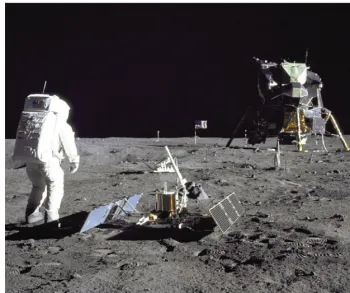
In this photo we see the first humans to land on the Moon. In the background is a television camera that sent live moving images through empty space to Earth where it was shown live.
626
CHAPTER 22 Electromagnetic Waves22–1
Changing Electric Fields Produce
Magnetic Fields; Maxwell’s Equations
The development of electromagnetic theory in the early part of the nineteenth century by Oersted, Ampère, and others was not actually done in terms of electric and magnetic fields. The idea of the field was introduced somewhat later by Faraday, and was not generally used until Maxwell showed that all electric and magnetic phenomena could be described using only four equations involving elec-tric and magnetic fields. These equations, known as Maxwell’s equations, are the basic equations for all electromagnetism. They are fundamental in the same sense that Newton’s three laws of motion and the law of universal gravitation are for mechanics. In a sense, they are even more fundamental, because they are consistent with the theory of relativity (Chapter 26), whereas Newton’s laws are not. Because all of electromagnetism is contained in this set of four equations, Maxwell’s equa-tions are considered one of the great triumphs of the human intellect.
Although we will not present Maxwell’s equations in mathematical form since they involve calculus, we will summarize them here in words. They are: (1) a generalized form of Coulomb’s law that relates electric field to its source,
electric charge ( Gauss’s law, Section 16–12);
(2) a similar law for the magnetic field, except that magnetic field lines are always continuous—they do not begin or end (as electric field lines do, on charges); (3) an electric field is produced by a changing magnetic field (Faraday’s law); (4) a magnetic field is produced by an electric current (Ampère’s law), or by a
changing electric field.
Law (3) is Faraday’s law (see Chapter 21, especially Section 21–4). The first part of law (4), that a magnetic field is produced by an electric current, was discovered by Oersted, and the mathematical relation is given by Ampère’s law (Section 20–8). But the second part of law (4) is an entirely new aspect predicted by Maxwell: Maxwell argued that if a changing magnetic field produces an electric field, as given by Faraday’s law, then the reverse might be true as well:a changing electric field will produce a magnetic field. This was an hypothesisby Maxwell. It is based on the idea of symmetryin nature. Indeed, the size of the effect in most cases is so small that Maxwell recognized it would be difficult to detect it experimentally.
Maxwell’s Fourth Equation (Ampère’s Law Extended)
To back up the idea that a changing electric field might produce a magnetic field, we use an indirect argument that goes something like this. According to Ampère’s law (Section 20–8), That is, divide any closed path you choose into short segments multiply each segment by the parallel component of the mag-netic field Bat that segment, and then sum all these products over the complete closed path. That sum will then equal times the total current I that passes through a surface bounded by the path. When we applied Ampère’s law to the field around a straight wire (Section 20–8), we imagined the current as passing through the circular area enclosed by our circular loop. That area is the flat surface 1 shown in Fig. 22–2. However, we could just as well use the sack-shaped surface 2 in Fig. 22–2 as the surface for Ampère’s law because the same current I
passes through it.
m0 ¢l,
©B||¢l = m0I.
*
⫽
Closed path Surface 2
Surface 1
I I
SECTION 22–2 Production of Electromagnetic Waves
627
Now consider the closed path for the situation of Fig. 22–3 where a capacitoris being discharged. Ampère’s law works for surface 1 (current Ipasses through surface 1), but it does not work for surface 2 because no current passes through surface 2. There is a magnetic field around the wire, so the left side of Ampère’s law
is not zero around the circular closed path; yet no current flows through sur-face 2, so the right side iszero for surface 2. We seem to have a contradiction of Ampère’s law. There is a magnetic field present in Fig. 22–3, however, only if charge is flowing to or away from the capacitor plates. The changing charge on the plates means that the electric field between the plates is changing in time. Maxwell resolved the problem of no current through surface 2 in Fig. 22–3 by proposing that the changing electric field between the plates is equivalent toan electric current. He called it adisplacement current, An ordinary current Iis then called a “conduction current,” and Ampère’s law, as generalized by Maxwell, becomes
Ampère’s law will now apply also for surface 2 in Fig. 22–3, where refers to the changing electric field.
Combining Eq. 17–7 for the charge on a capacitor, with Eq. 17–8, and with the magnitudes in Eq. 17–4a, we can write
Then the current becomes
where is the electric flux, defined in analogy to magnetic flux (Section 21–2). Then, Ampère’s law becomes
(22;1) This equation embodies Maxwell’s idea that a magnetic field can be caused not only by a normal electric current, but also by a changing electric field or changing electric flux.
22–2
Production of
Electromagnetic Waves
According to Maxwell, a magnetic field will be produced in empty space if there is a changing electric field. From this, Maxwell derived another startling conclusion. If a changing magnetic field produces an electric field, that electric field is itself changing. This changing electric field will, in turn, produce a magnetic field, which will be changing, and so it too will produce a changing electric field; and so on. When Maxwell worked with his equations, he found that the net result of these interacting changing fields was awaveof electric and magnetic fields that can propagate (travel) through space! We now examine, in a simplified way, how such electromagnetic wavescan be produced.
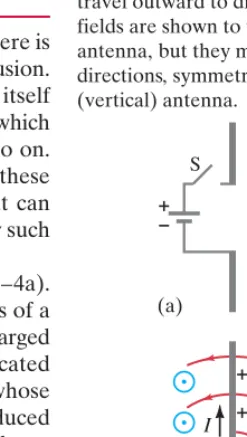
Consider two conducting rods that will serve as an “antenna” (Fig. 22–4a). Suppose these two rods are connected by a switch to the opposite terminals of a battery. When the switch is closed, the upper rod quickly becomes positively charged and the lower one negatively charged. Electric field lines are formed as indicated by the lines in Fig. 22–4b. While the charges are flowing, a current exists whose direction is indicated by the black arrows. A magnetic field is therefore produced near the antenna. The magnetic field lines encircle the rod-like antenna and there-fore, in Fig. 22–4, points into the page on the right and out of the page on the left. Now we ask, how far out do these electric and magnetic fields extend? In the static case, the fields would extend outward indefinitely far. However, when the switch in Fig. 22–4 is closed, the fields quickly appear nearby, but it takes time for them to reach distant points. Both electric and magnetic fields store energy, and this energy cannot be transferred to distant points at infinite speed.
(䉺) (z)
BB
©B||¢l = m0I + m0⑀0 ¢£E
¢t . £E = EA
ID = ¢
Q
¢t = ⑀0 ¢£E
¢t ,
ID
Q =CV = (⑀0A兾d)(Ed)= ⑀0AE.
V= Ed,
C = ⑀0A兾d,
Q = CV,
ID
©B||¢l = m0AI + IDB.
ID.
©B||¢l = m0I
Ampère’s law (general form) Closed path Surface 2 Surface 1 I – – – – – – – – – – – –– – –– – – – – – – + + + + + + + + + + + + + + + + + + + + + + + + + EB I S I I (a) (b) + – + – + + – – + – is in is out EB EB EB BB BB FIGURE 22–4 Fields produced by charge flowing into conductors. It takes time for the and fields to travel outward to distant points. The fields are shown to the right of the antenna, but they move out in all directions, symmetrically about the (vertical) antenna.
BB EB
628
CHAPTER 22 Electromagnetic Waves (a)(b)
+ + + +
–
– – –
I
I
–
I
I
+
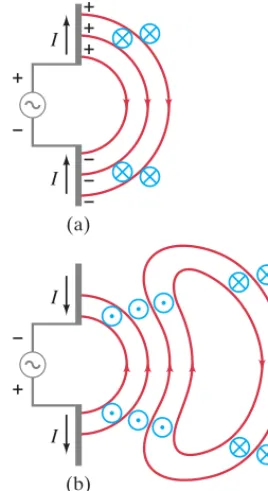
FIGURE 22–5 Sequence showing electric and magnetic fields that spread outward from oscillating charges on two conductors (the antenna) connected to an ac source (see the text).
Now we look at the situation of Fig. 22–5, where our antenna is connected to an ac generator. In Fig. 22–5a, the connection has just been completed. Charge starts building up, and fields form just as in Fig. 22–4b. The and signs in Fig. 22–5a indicate the net charge on each rod at a given instant. The black arrows indicate the direction of the current. The electric field is represented by red lines in the plane of the page; and the magnetic field, according to the right-hand rule, is into or out of the page in blue. In Fig. 22–5b, the voltage of the ac generator has reversed in direction; the current is reversed and the new magnetic field is in the opposite direction. Because the new fields have changed direction, the old lines fold back to connect up to some of the new lines and form closed loops as shown.† The old fields, however, don’t suddenly disappear; they are on their way to distant points. Indeed, because a changing magnetic field produces an electric field, and a changing electric field produces a magnetic field, this combination of changing electric and magnetic fields moving outward is self-supporting, no longer depending on the antenna charges.
The fields not far from the antenna, referred to as the near field, become quite complicated, but we are not so interested in them. We are mainly interested in the fields far from the antenna (they are generally what we detect), which we refer to as the radiation field. The electric field lines form loops, as shown in Fig. 22–6a, and continue moving outward. The magnetic field lines also form closed loops, but are not shown because they are perpendicular to the page. Although the lines are shown only on the right of the source, fields also travel in other directions. The field strengths are greatest in directions perpendicular to the oscillating charges; and they drop to zero along the direction of oscillation—above and below the antenna in Fig. 22–6a.
(䉺) (z)
– ±
†We are considering waves traveling through empty space. There are no charges for lines of to start
or stop on, so they form closed loops. Magnetic field lines always form closed loops.
EB
(a) (b)
Antenna
Direction of wave travel
FIGURE 22–6 (a) The radiation fields (far from the antenna) produced by a sinusoidal signal on the antenna. The red closed loops represent electric field lines. The magnetic field lines, perpendicular to the page and represented by blue and also form closed loops. (b) Very far from the antenna, the wave fronts (field lines) are essentially flat over a fairly large area, and are referred to as planewaves.
䉺,
z
The magnitudes of both and in the radiation field are found to decrease with distance as (Compare this to the static electric field given by Coulomb’s law where decreases as ) The energy carried by the electromagnetic wave is proportional (as for any wave, Chapter 11) to the square of the amplitude, or as will be discussed further in Section 22–7, so the intensity of the wave decreases as Thus the energy carried by EM waves follows the inverse square lawjust as for sound waves (Eqs. 11–16).
Several things about the radiation field can be noted from Fig. 22–6. First,the electric and magnetic fields at any point are perpendicular to each other, and to the direction ofwave travel. Second, we can see that the fields alternate in direction ( is into the page at some points and out of the page at others; points up at some points and down at others). Thus, the field strengths vary from a maximum in one direction, to zero, to a maximum in the other direction. The electric and magnetic fields are “in phase”: that is, they each are zero at the same points and reach their maxima at the same points in space. Finally, very far from the antenna (Fig. 22–6b) the field lines are quite flat over a reasonably large area, and the waves are referred to as plane waves.
EB BB
1兾r2. B2,
E2
1兾r2. EB
1兾r.
y
x
z
Direction of motion of wave
EB EB
BB
BB
SECTION 22–3
629
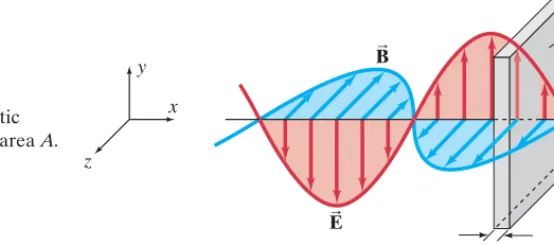
If the source voltage varies sinusoidally, then the electric and magnetic fieldstrengths in the radiation field will also vary sinusoidally. The sinusoidal character of the waves is shown in Fig. 22–7, which displays the field directions and magni-tudes plotted as a function of position along the direction of wave travel. Notice that and are perpendicular to each other and to the direction of wave travel.
We call these waves electromagnetic (EM) waves. They are transversewaves because the amplitude is perpendicular to the direction of wave travel. However, EM waves are always waves of fields, not of matter (like waves on water or a rope). Because they are fields, EM waves can propagate in empty space.
As we have seen, EM waves are produced by electric charges that are oscil-lating, and hence are undergoing acceleration. In fact, we can say in general that
accelerating electric charges give rise to electromagnetic waves.
Maxwell derived a formula for the speed of EM waves:
(22;2) wherecis the special symbol for the speed of electromagnetic waves in empty space, and EandBare the magnitudes of electric and magnetic fields at the same point in space. More specifically, it was also shown that
(22;3)
When Maxwell put in the values for ⑀0and m0, he found
[speed of EM waves]
c = 1
2⑀0m0
.
v = c = EB,
EB BB
FIGURE 22–7 Electric and magnetic field strengths in an electromagnetic wave. and are at right angles to each other. The entire pattern moves in a direction perpendicular to both EBand BB.
BB EB
= 3.00 * 108m兾s, c = 1
2⑀0m0
= 1
3A8.85 * 10–12C2兾N⭈m2BA4p * 10–7N⭈s2兾C2B
which is exactly equal to the measured speed of light in vacuum (Section 22–4).
EXERCISE A At a particular instant in time, a wave has its electric field pointing north and its magnetic field pointing up. In which direction is the wave traveling? (a) South, (b) west, (c) east, (d) down, (e) not enough information. [See Fig. 22–7.]
22–3
Light as an Electromagnetic Wave
and the Electromagnetic Spectrum
Maxwell’s prediction that EM waves should exist was startling. Equally remarkable was the speed at which EM waves were predicted to travel—
the same as the measured speed of light.
Light had been shown some 60 years before Maxwell’s work to behave like a wave (we’ll discuss this in Chapter 24). But nobody knew what kind of wave it was. What is it that is oscillating in a light wave? Maxwell, on the basis of the calculated speed of EM waves, argued that light must be an electromagnetic wave. This idea soon came to be generally accepted by scientists, but not fully until after EM waves were experimentally detected. EM waves were first generated and detected experimentally by Heinrich Hertz (1857–1894) in 1887, eight years after Maxwell’s death. Hertz used a spark-gap apparatus in which charge was made to rush back and forth for a short time, generating waves whose frequency was about He detected them some distance away using a loop of wire in which an emf was induced when a changing magnetic field passed through.
109 Hz.
630
CHAPTER 22These waves were later shown to travel at the speed of light,
and to exhibit all the characteristics of light such as reflection, refraction, and interference. The only difference was that they were not visible. Hertz’s experiment was a strong confirmation of Maxwell’s theory.
The wavelengths of visible light were measured in the first decade of the nine-teenth century, long before anyone imagined that light was an electromagnetic wave. The wavelengths were found to lie between and
or to The frequencies of visible light can be found using Eq. 11–12, which we rewrite here:
(22;4) wherefand are the frequency and wavelength, respectively, of the wave. Here,
cis the speed of light, it gets the special symbol cbecause of its universality for all EM waves in free space. Equation 22–4 tells us that the frequencies of visible light are between and (Recall
that )
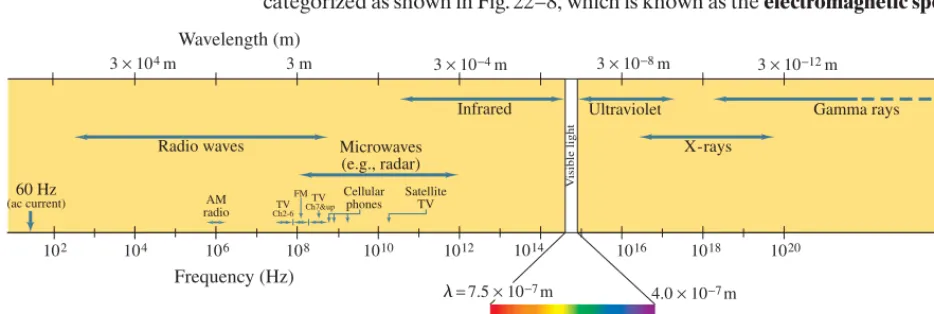
But visible light is only one kind of EM wave. As we have seen, Hertz produced EM waves of much lower frequency, about These are now called radio waves, because frequencies in this range are used to transmit radio and TV signals. Electromagnetic waves, or EM radiation as we sometimes call it, have been produced or detected over a wide range of frequencies. They are usually categorized as shown in Fig. 22–8, which is known as the electromagnetic spectrum.
109Hz.
1Hz = 1 cycle per second = 1s–1.
7.5 * 1014Hz.
4.0 * 1014Hz
3.00 * 108m兾s;
l
c = lf,
A1nm = 10–9mB.
750nm
400nm
7.5 * 10–7m,
4.0 * 10–7m
3.00 * 108m兾s,
Radio waves and microwaves can be produced in the laboratory using elec-tronic equipment (Fig. 22–5). Higher-frequency waves are very difficult to produce electronically. These and other types of EM waves are produced in natural processes, as emission from atoms, molecules, and nuclei (more on this later). EM waves can be produced by the acceleration of electrons or other charged particles, such as electrons in the antenna of Fig. 22–5. X-rays have very short wavelengths (and very high frequencies), and they are produced (Chapters 25 and 28) when fast-moving electrons are rapidly decelerated upon striking a metal target. Even the visible light emitted by an ordinary incandescent bulb is due to electrons undergoing acceleration within the hot filament.
EXERCISE B Return to the Chapter-Opening Question, page 625, and answer it again now. Try to explain why you may have answered differently the first time.
3× 10⁴m 3 m 3× 10⁻⁴m 3× 10⁻⁸m 3× 10⁻¹²m
Wavelength (m)
104
102
Frequency (Hz)
106 108 1010 1012 1014 1016 1018 1020
Visible light
V
isible light
Infrared Ultraviolet Gamma rays
Radio waves
60 Hz
(ac current)
X-rays Microwaves
(e.g., radar)
TV
Ch2-6
AM radio
FMTV Ch7&up
Cellular phones
Satellite TV
f=4× 10¹⁴Hz
4.0× 10⁻⁷m
7.5× 10¹⁴Hz l=7.5× 10⁻⁷m
FIGURE 22–8
Electromagnetic spectrum.
We will meet various types of EM waves later. However, it is worth mentioning here that infrared (IR) radiation (EM waves whose frequency is just less than that of visible light) is mainly responsible for the heating effect of the Sun. The Sun emits not only visible light but substantial amounts of IR and UV (ultraviolet) as well. The molecules of our skin tend to “resonate” at infrared frequencies, so it is these that are preferentially absorbed and thus warm us. We humans experience EM waves differently depending on their wavelengths: Our eyes detect wavelengths between about and (visible light), whereas our skin detects longer wavelengths (IR). Many EM wavelengths we don’t detect directly at all.
SECTION 22–3 Light as an Electromagnetic Wave and the Electromagnetic Spectrum
631
Light and other electromagnetic waves travel at a speed ofCompare this to sound, which travels (see Chapter 12) at a speed of about in air, a million times slower; or to typical freeway speeds of a car, (
or ), 10 million times slower than light. EM waves differ from sound waves in another big way: sound waves travel in a medium such as air, and involve motion of air molecules; EM waves do not involve any material—only fields, and they can travel in empty space.
60mi兾h
100km兾h, 30m兾s
300m兾s
3 * 108m兾s. C A U T I O N Sound and EM waves are different
Wavelengths of EM waves. Calculate the wavelength (a) of a 60-Hz EM wave, (b) of a 93.3-MHz FM radio wave, and (c) of a beam of visible red light from a laser at frequency
APPROACH All of these waves are electromagnetic waves, so their speed is We solve for in Eq. 22–4:
SOLUTION (a)
or 5000 km. 60 Hz is the frequency of ac current in the United States, and, as we see here, one wavelength stretches all the way across the continental USA. (b)
The length of an FM radio antenna is often about half this or (c)
l = 3.00 * 108m兾s
4.74 * 1014 s–1 = 6.33 * 10
–7 m(= 633 nm).
112m.
A1 2lB,
l = 3.00 * 108m兾s
93.3 * 106 s–1 = 3.22 m.
l = c f =
3.00 * 108m兾s
60 s–1 = 5.0 * 10
6 m,
l = c兾f.
l
c = 3.00 * 108m兾s.
4.74 * 1014 Hz. EXAMPLE 22;1
EXERCISE C What are the frequencies of (a) an 80-m-wavelength radio wave, and (b) an X-ray of wavelength 5.5 * 10–11m?
Cell phone antenna. The antenna of a cell phone is often wavelength long. A particular cell phone has an 8.5-cm-long straight rod for its antenna. Estimate the operating frequency of this phone. APPROACH The basic equation relating wave speed, wavelength, and frequency is the wavelength equals four times the antenna’s length.
SOLUTION The antenna is long, so Then
NOTE Radio antennas are not always straight conductors. The conductor may be a round loop to save space. See Fig. 22–18b.
f = c兾l = A3.0 * 108m兾sB兾(0.34m) =l8.8= * 108Hz = 880MHz.
4(8.5cm) = 34cm = 0.34m.
1 4l
l
c = lf;
1 4
EXAMPLE 22;2 ESTIMATE
EXERCISE D How long should a antenna be for an aircraft radio operating at 165 MHz?
1 4-l
FIGURE 22–9 Coaxial cable. Electromagnetic waves can travel along transmission lines as well as in empty
space. When a source of emf is connected to a transmission line—be it two parallel wires or a coaxial cable (Fig. 22–9)—the electric field within the wire is not set up immediately at all points along the wires. This is based on the same argument we used in Section 22–2 with reference to Fig. 22–5. Indeed, it can be shown that if the wires are separated by empty space or air, the electrical signal travels along the wires at the speed For example, when you flip a light switch, the light actually goes on a tiny fraction of a second later. If the wires are in a medium whose electric permittivity is and magnetic permeability is (Sections 17–8 and 20–12, respectively), the speed is not given by Eq. 22–3, but by
instead.
v = 1
1⑀m
m
⑀
632
CHAPTER 22 Electromagnetic WavesPhone call time lag. You make a telephone call from New York to a friend in London. Estimate how long it will take the electrical signal generated by your voice to reach London, assuming the signal is (a) carried on a telephone cable under the Atlantic Ocean, and (b) sent via satellite 36,000 km above the ocean. Would there be a noticeable delay in either case?
APPROACH The signal is carried on a telephone wire or in the air via satellite. In either case it is an electromagnetic wave. Electronics as well as the wire or cable slow things down, but as a rough estimate we take the speed to be
SOLUTION The distance from New York to London is about 5000 km. (a) The time delay via the cable is
(b) Via satellite the time would be longer because communications satellites, which are usually geosynchronous (Example 5–12), move at a height of 36,000 km. The signal would have to go up to the satellite and back down, or about 72,000 km. The actual distance the signal would travel would be a little more than this as the signal would go up and down on a diagonal (5000 km New York to London, small compared to the distance up to the satellite). Thus
, one way. Both directions NOTE When the signal travels via the underwater cable, there is only a hint of a delay and conversations are fairly normal. When the signal is sent via satellite, the delayisnoticeable. The length of time between the end of when you speak and your friend receives it and replies, and then you hear the reply, would be about a half second beyond the normal time in a conversation, as we just calculated. This is enough to be noticeable, and you have to adjust for it so you don’t start talking again while your friend’s reply is on the way back to you.
L1 2 s. t = d兾c L A7.2*107 mB
兾
A3* 108 m兾sB L 0.24 s0.017 s. t = d兾c L A
5 * 106 mB兾A3.0 * 108 m兾sB = c = 3.0 * 108m兾s.
EXAMPLE 22;3 ESTIMATE
EXERCISE E If you are on the phone via satellite to someone only 100 km away, would you notice the same effect discussed in the NOTE above?
EXERCISE F If your voice traveled as a sound wave, how long would it take to go from New York to London?
22–4
Measuring the Speed of Light
Galileo attempted to measure the speed of light by trying to measure the time required for light to travel a known distance between two hilltops. He stationed an assistant on one hilltop and himself on another, and ordered the assistant to lift the cover from a lamp the instant he saw a flash from Galileo’s lamp. Galileo measured the time between the flash of his lamp and when he received the light from his assistant’s lamp. The time was so short that Galileo concluded it merely represented human reaction time, and that the speed of light must be extremely high.
The first successful determination that the speed of light is finite was made by the Danish astronomer Ole Roemer (1644–1710). Roemer had noted that the carefully measured orbital period of Io, a moon of Jupiter with an average period of 42.5 h, varied slightly, depending on the relative position of Earth and Jupiter. He attributed this variation in the apparent period to the change in distance between the Earth and Jupiter during one of Io’s periods, and the time it took light to travel the extra distance. Roemer concluded that the speed of light— though great—is finite.
SECTION 22–5 Energy in EM Waves
633
in Fig. 22–10 for a series of high-precision experiments carried out from 1880 tothe 1920s. Light from a source would hit one face of a rotating eight-sided mirror. The reflected light traveled to a stationary mirror a large distance away and back again as shown. If the rotating mirror was turning at just the right rate, the return-ing beam of light would reflect from one face of the mirror into a small telescope through which the observer looked. If the speed of rotation was only slightly different, the beam would be deflected to one side and would not be seen by the observer. From the required speed of the rotating mirror and the known distance to the stationary mirror, the speed of light could be calculated. In the 1920s, Michelson set up the rotating mirror on the top of Mt. Wilson in southern California and the stationary mirror on Mt. Baldy (Mt. San Antonio) 35 km away. He later measured the speed of light in vacuum using a long evacuated tube.
Today the speed of light,c, in vacuum is taken as
and is definedto be this value. This means that the standard for length, the meter, is no longer defined separately. Instead, as we noted in Section 1–5, the meter is now formally defined as the distance light travels in vacuum in 1 299,792,458 of a second.
We usually round off cto
when extremely precise results are not required. In air, the speed is only slightly less.
22–5
Energy in EM Waves
Electromagnetic waves carry energy from one region of space to another. This energy is associated with the moving electric and magnetic fields. In Section 17–9, we saw that the energy density stored in an electric field Eis
(Eq. 17–11). The energy density stored in a magnetic field B, as we discussed in Section 21–11, is given by (Eq. 21–10). Thus, the total energy stored per unit volume in a region of space where there is an electromagnetic wave is
(22;5) In this equation, EandBrepresent the electric and magnetic field strengths of the wave at any instant in a small region of space. We can write Eq. 22–5 in terms of the Efield only using Eqs. 22–2 and 22–3 to obtain
(22;6a) Note here that the energy density associated with the Bfield equals that due to theEfield, and each contributes half to the total energy. We can also write the energy density in terms of the Bfield only:
(22;6b) or in one term containing both EandB,
or
(22;6c)
Equations 22–6 give the energy density of EM waves in any region of space at any instant.
u = Bm⑀0 0
EB.
u = ⑀0E2 = ⑀0EcB =
⑀0EB
2⑀0m0
u = ⑀0E2 = ⑀0c2B2 = B2
m0
,
u = 1
2⑀0E
2 + 1
2
⑀0m0E2
m0 = ⑀0E 2.
(c = 1兾1⑀0m0) (B = E兾c)
u = uE + uB =
1 2⑀0E
2 + 1
2
B2
m0
.
uB = 12B2兾m0
uE = 12⑀0E2 uEAJ兾m3B
c = 3.00 * 108m兾s
兾
c = 2.99792458 * 108 m兾s,
35 km
Stationary mirror Eight-sided
rotating mirror
Light source (Mt. Wilson)
(Mt. Baldy) Observer
634
CHAPTER 22 Electromagnetic Waves†The intensity Ifor EM waves is often called the Poynting vectorand given the symbol Its direction
is that in which the energy is being transported, which is the direction the wave is traveling, and its magnitude is the intensity (S= I).
S
B
.
The energy a wave transports per unit time per unit area is the intensityI, as defined in Sections 11–9 and 12–2.† The units of Iare The energy is the energy density (Eq. 22–6a) times the volume V. Hence the energy passing through an area Ain a time (see Fig. 22–11) is
because Therefore, the magnitude of the intensity (energy per unit area per time or power per unit area) is
From Eqs. 22–2 and 22–3, this can also be written
(22;7) We can also find the average intensityover an extended period of time, if EandB
are sinusoidal. Then , just as for electric currents and voltages, Section 18–7, Eqs. 18–8. Thus
(22;8) Here and are the maximum values of EandB. We can also write
where and are the rms values and
Brms = 3¿ = B0兾22B.
AErms = 3y = E0兾22 , Brms
Erms
I = ErmsmBrms 0
,
B0 E0
I = 1
2⑀0cE0
2 = 1
2
c
m0B0
2 = E0B0
2m0
.
y = E02兾2 I = ⑀0cE2 = c
m0
B2 = EB
m0
.
I = ¢U A¢t =
A⑀0E2B(Ac¢t)
A¢t = ⑀0cE2. ¢t,
¢x = c¢t.
¢U = u¢V = (u)(A¢x) = A⑀0E2B(Ac¢t) ¢t
¢U
W兾m2.
Δx = cΔt y
x
z
x
EB BB
A
FIGURE 22–11 Electromagnetic wave carrying energy through areaA.
EandBfrom the Sun. Radiation from the Sun reaches the Earth (above the atmosphere) with an intensity of about
Assume that this is a single EM wave, and calculate the maximum values of EandB.
APPROACH We solve Eq. 22–8 for in terms of and use
SOLUTION
From Eq. 22–2, so
NOTE AlthoughBhas a small numerical value compared to E(because of the way the different units for EandBare defined),Bcontributes the same energy to the wave as Edoes, as we saw earlier.
B0 = E0
c =
1.01 * 103 V兾m
3.00 * 108m兾s = 3.37 * 10
–6T. B = E兾c,
= 1.01 * 103V兾m. E0 = C
2I
⑀0c = C
2A1350 J兾s⭈m2B
A8.85 * 10–12C2兾N⭈m2BA3.00 * 108m兾sB
I = 1350 J兾s⭈m2. AI = E0 I
1 2⑀0cE02B
1350J兾s⭈m2.
1350W兾m2 = EXAMPLE 22;4
C A U T I O N
E and B havevery different values (due to howunits are defined),
SECTION 22–6
635
22–6
Momentum Transfer and
Radiation Pressure
If electromagnetic waves carry energy, then we would expect them to also carry linear momentum. When an electromagnetic wave encounters the surface of an object, a force will be exerted on the surface as a result of the momentum trans-fer just as when a moving object strikes a surface. The force per unit area exerted by the waves is called radiation pressure, and its existence was predicted by Maxwell. He showed that if a beam of EM radiation (light, for example) is completely absorbed by an object, then the momentum transferred is
c
d
(22;9a)where is the energy absorbed by the object in a time and cis the speed of light. If, instead, the radiation is fully reflected (suppose the object is a mirror), then the momentum transferred is twice as great, just as when a ball bounces elastically off a surface:
c
d
(22;9b)If a surface absorbs some of the energy, and reflects some of it, then whereahas a value between 1 and 2.
Using Newton’s second law we can calculate the force and the pressure exerted by EM radiation on an object. The force Fis given by
The radiation pressure P(assuming full absorption) is given by (see Eq. 22–9a)
We discussed in Section 22–5 that the average intensity is defined as energy per unit time per unit area:
Hence the radiation pressure is
(22;10a) If the light is fully reflected, the radiation pressure is twice as great (Eq. 22–9b):
(22;10b) cfullyreflectedd
P = 2cI.
cfullyabsorbedd P = Ic.
I = A¢U¢t.
I P = AF = A1 ¢¢pt = 1
Ac
¢U
¢t . F = ¢¢pt .
¢p = a¢U兾c, radiation
fully reflected
¢p = 2¢U
c .
¢t ¢U
radiation fully absorbed
¢p = ¢U
c , (F = ¢p兾¢t)
Solar pressure. Radiation from the Sun that reaches the Earth’s surface (after passing through the atmosphere) transports energy at a rate of about Estimate the pressure and force exerted by the Sun on your outstretched hand.
APPROACH The radiation is partially reflected and partially absorbed, so let us estimate simply
SOLUTION
An estimate of the area of your outstretched hand might be about 10 cm by 20 cm, so Then the force is
NOTE These numbers are tiny. The force of gravity on your hand, for compari-son, is maybe a half pound, or with
The radiation pressure on your hand is imperceptible compared to gravity.
2N.
mg L (0.2kg)A9.8m兾s2B L m = 0.2kg,
F = PA L A3 * 10–6N兾m2BA0.02m2B L 6 * 10–8N. A L 0.02m2.
P L Ic = 1000W兾m2
3 * 108 m兾s L 3 * 10
–6 N兾m2. P = I兾c.
636
CHAPTER 22 Electromagnetic WavesP H Y S I C S A P P L I E D
Optical tweezers (move cell parts, DNA elasticity)
A solar sail. Proposals have been made to use the radiation pressure from the Sun to help propel spacecraft around the solar system. (a) About how much force would be applied on a highly reflective sail when about the same distance from the Sun as the Earth is? (b) By how much would this increase the speed of a 5000-kg spacecraft in one year? (c) If the spacecraft started from rest, about how far would it travel in a year? APPROACH (a) Pressure Pis force per unit area, so We use the estimate of Example 22–5, doubling it for a reflecting surface (b) We find the acceleration from Newton’s second law, and assume it is constant, and then find the speed from (c) The distance traveled is given by
SOLUTION (a) Doubling the result of Example 22–5, we get a solar pressure that is about rounding off. Then the force is
(b) The acceleration is One
year has The speed increase is
(c) Starting from rest, this acceleration would result in a distance traveled of
about in a year, about seven
times the Sun–Earth distance. This result would apply if the spacecraft was far from the Earth so the Earth’s gravitational force is small compared to 10 N. NOTE A large sail providing a small force over a long time could result in a lot of motion. [Gravity due to the Sun and planets has been ignored, but in reality would have to be considered.]
d = 1 2at2 L
1
2A2 * 10–3 m兾s2BA3 * 107 sB2 L 1012 m
A2 * 10–3 m兾s2BA3 * 107 sB L 6 * 104 m兾s (L 200,000 km兾h!). v - v0 = at L
(365 days)(24 h兾day)(3600 s兾h) L 3 * 107 s.
2 * 10–3 m兾s2. (10 N)兾(5000 kg) L
a L F兾m L
A10–5 N兾m2BA103 mBA103 mB L 10 N. F L PA =
2I兾c L 10–5 N兾m2,
x = 1 2at2. v = v0 + at.
P = 2I兾c.
F = PA.
1 km * 1 km
EXAMPLE 22;6 ESTIMATE
Although you cannot directly feel the effects of radiation pressure, the phenomenon is quite dramatic when applied to atoms irradiated by a finely focused laser beam. An atom has a mass on the order of and a laser beam can deliver energy at a rate of This is the same intensity used in Example 22–5, but here a radiation pressure of would be very signif-icant on a molecule whose mass might be to It is possible to move atoms and molecules around by steering them with a laser beam, in a device called optical tweezers. Optical tweezers have some remarkable applications. They are of great interest to biologists, especially since optical tweezers can manip-ulate live microorganisms, and components within a cell, without damaging them. Optical tweezers have been used to measure the elastic properties of DNA by pulling each end of the molecule with such a laser “tweezers.”
10–26kg.
10–23
10–6N兾m2
1000W兾m2.
10–27kg,
P H Y S I C S A P P L I E D
Wireless transmission
FIGURE 22–12 Guglielmo Marconi (1874–1937), on the left, receiving signals in Cornwall, 1901.
22–7
Radio and Television;
Wireless Communication
SECTION 22–7 Radio and Television; Wireless Communication
637
AF amplifier
RF amplifier
RF oscillator
Mixer Sound
waves
Microphone
Audio signal (amplified)
Modulated signal
Transmitting antenna
RF signal = carrier Audio
signal (electrical)
FIGURE 22–13 Block diagram of a radio transmitter.
The next decade saw the development of vacuum tubes. Out of this early work radio and television were born. We now discuss briefly (1) how radio and TV signals are transmitted, and (2) how they are received at home.
The process by which a radio station transmits information (words and music) is outlined in Fig. 22–13. The audio (sound) information is changed into an elec-trical signal of the same frequencies by, say, a microphone, a laser, or a magnetic read write head. This electrical signal is called an audiofrequency (AF) signal, because the frequencies are in the audio range (20 to 20,000 Hz). The signal is ampli-fied electronically and is then mixed with a radio-frequency (RF) signal called its carrier frequency, which represents that station. AM radio stations have carrier frequencies from about 530 kHz to 1700 kHz. For example, “710 on your dial” means a station whose carrier frequency is 710 kHz. FM radio stations have much higher carrier frequencies, between 88 MHz and 108 MHz. The carrier frequencies for broadcast TV stations in the United States lie between 54 MHz and 72 MHz, between 76 MHz and 88 MHz, between 174 MHz and 216 MHz, and between 470 MHz and 698 MHz. Today’s digital broadcasting (see Sections 17–10 and 17–11) uses the same frequencies as the pre-2009 analog transmission.
兾
Program (audio)
Carrier
Total signal (AM)
FIGURE 22–14 In amplitude modulation (AM), the amplitude of the carrier signal is made to vary in proportion to the audio signal’s amplitude.
P H Y S I C S A P P L I E D
AM and FM
Program (audio)
Carrier
Total signal (FM)
FIGURE 22–15 In frequency modulation (FM), the frequency of the carrier signal is made to change in proportion to the audio signal’s amplitude. This method is used by FM radio and television.
The mixing of the audio and carrier frequencies is done in two ways. In amplitude modulation(AM), the amplitude of the high-frequency carrier wave is made to vary in proportion to the amplitude of the audio signal, as shown in Fig. 22–14. It is called “amplitude modulation” because the amplitudeof the car-rier is altered (“modulate” means to change or alter). In frequency modulation(FM), thefrequencyof the carrier wave is made to change in proportion to the audio signal’s amplitude, as shown in Fig. 22–15. The mixed signal is amplified further and sent to the transmitting antenna (Fig. 22–13), where the complex mixture of frequencies is sent out in the form of EM waves. In digital communication, the signal is put into digital form (Section 17–10) which modulates the carrier.
638
CHAPTER 22 Electromagnetic Waves†For FM stereo broadcasting, two signals are carried by the carrier wave. One signal contains frequencies
up to about 15 kHz, which includes most audio frequencies. The other signal includes the same range of frequencies, but 19 kHz is added to it. A stereo receiver subtracts this 19,000-Hz signal and distributes the two signals to the left and right channels. The first signal consists of the sum of left and right channels so monophonic radios (one speaker) detect all the sound. The second signal is the difference between left and right Hence a stereo receiver must add and subtract the two signals to get pure left and right signals for each channel.
(L -R).
(L+ R),
RF tuner and amplifier Receiving
antenna
AF amplifier RF
signal
Audio signal Demodulator
Loudspeaker
FIGURE 22–16 Block diagram of a simple radio receiver.
Now let us look at the other end of the process, the reception of radio and TV programs at home. A simple radio receiver is diagrammed in Fig. 22–16. The EM waves sent out by all stations are received by the antenna. The signals the antenna detects and sends to the receiver are very small and contain frequencies from many different stations. The receiver uses a resonant LCcircuit (Section 21–15) to select out a particular RF frequency (actually a narrow range of frequencies) correspond-ing to a particular station. A simple way of tuncorrespond-ing a station is shown in Fig. 22–17. A particular station is “tuned in” by adjusting Cand or Lso that the resonant frequency of the circuit ( Eq. 21–19) equals that of the station’s carrier frequency. The signal, containing both audio and carrier frequencies, next goes to the demodulator, or detector(Fig. 22–16), where “demodulation” takes place—that is, the audio signal is separated from the RF carrier frequency. The audio signal is amplified and sent to a loudspeaker or headphones.
Modern receivers have more stages than those shown. Various means are used to increase the sensitivity and selectivity (ability to detect weak signals and dis-tinguish them from other stations), and to minimize distortion of the original signal.†
A television receiver does similar things to both the audio and the video signals. The audio signal goes finally to the loudspeaker, and the video signal to the monitor screen, such as an LCD (Sections 17–11 and 24–11).
f0 = 1兾A2p1LCB,
兾
P H Y S I C S A P P L I E D
Radio and TV receivers
C
Antenna
Tuning circuit
Transistor amplifier
FIGURE 22–17 Simple tuning stage of a radio.
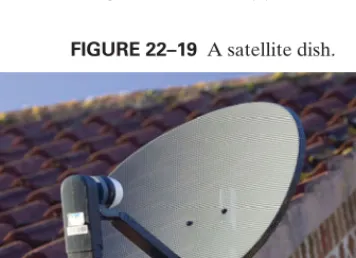
FIGURE 22–19 A satellite dish. One kind of antenna consists of one or more conducting rods; the electric field in the EM waves exerts a force on the electrons in the conductor, causing them to move back and forth at the frequencies of the waves (Fig. 22–18a). A second type of antenna consists of a tubular coil of wire which detects the magnetic field of the wave: the changing Bfield induces an emf in the coil (Fig. 22–18b). A satellite dish (Fig. 22–19) consists of a parabolic reflector that focuses the EM waves onto a “horn,” similar to a concave mirror telescope (Fig. 25–22).
EB
EB
EB
EB B
B B
B
BB BB
Antenna rod
Current produced by electric field
I
To receiver
To receiver (TV set) Induced
current Loop antenna
(a) (b)
EM wave direction
Summary
639
P H Y S I C S A P P L I E D
Cell phones, remote controls, cable TV, satellite TV and radio Tuning a station. Calculate the transmitting wavelength of
an FM radio station that transmits at 100.1 MHz.
APPROACH Radio is transmitted as an EM wave, so the speed is The wavelength is found from Eq. 22–4,
SOLUTION The carrier frequency is so
NOTE The wavelengths of other FM signals (88 MHz to 108 MHz) are close to the 3.0-m wavelength of this station. FM antennas are typically 1.5 m long, or about a half wavelength. This length is chosen so that the antenna reacts in a resonant fashion and thus is more sensitive to FM frequencies. AM radio antennas would have to be very long and impractical to be either or14l.
1 2l
l = c f =
A3.0 * 108 m兾sB
A1.0 * 108 s–1B = 3.0 m.
f = 100.1 MHz L 1.0 * 108 s–1,
l = c兾f.
c = 3.0 * 108m兾s. EXAMPLE 22;7
Other EM Wave Communications
The various regions of the radio-wave spectrum are assigned by governmental agencies for various purposes. Besides those mentioned above, there are “bands” assigned for use by ships, airplanes, police, military, amateurs, satellites and space, and radar. Cell phones, for example, are complete radio transmitters and receivers. In the U.S., CDMA cell phones function on two different bands: 800 MHz and 1900 MHz Europe, Asia, and much of the rest of the world use a dif-ferent system: the international standard called GSM (Global System for Mobile Communication), on 900-MHz and 1800-MHz bands. The U.S. now also has the GSM option (at 850 MHz and 1.9 GHz), as does much of the rest of the Americas. A 700-MHz band is being made available for cell phones (it used to carry TV broadcast channels, no longer used). Radio-controlled toys (cars, sailboats, robotic animals, etc.) can use various frequencies from 27 MHz to 75 MHz. Automobile remote entry (keyless) may operate around 300 MHz or 400 MHz.
Cable TV channels are carried as electromagnetic waves along a coaxial cable (Fig. 22–9) rather than being broadcast and received through the “air.” The channels are in the same part of the EM spectrum, hundreds of MHz, but some are at frequencies not available for TV broadcast. Digital satellite TV and radio are carried in the microwave portion of the spectrum (12 to 14 GHz and 2.3 GHz, respectively).
Wireless from the Moon
In 1969, astronauts first landed on the Moon. It was shown live on television (Fig. 22–20). The transmitting TV camera can be seen in the Chapter-Opening photo, page 625. At that time, someone pointed out that Columbus and other early navigators could have imagined that humans might one day reach the Moon. But they would never have believed possible that moving images could be sent from the Moon to the Earth through empty space.
(= 1.9GHz).
James Clerk Maxwell synthesized an elegant theory in which all electric and magnetic phenomena could be described using four equations, now called Maxwell’s equations. They are based on earlier ideas, but Maxwell added one more—that a changing electric field produces a magnetic field.
Maxwell’s theory predicted that transverse electromagnetic
(EM)waveswould be produced by accelerating electric charges, and these waves would propagate (move) through space at the speed of light:
(22;3)
The oscillating electric and magnetic fields in an EM wave are perpendicular to each other and to the direction of propa-gation. These EM waves are waves of fields, not matter, and can propagate in empty space.
The wavelength and frequency fof EM waves are related to their speed cby
(22;4)
just as for other waves. c = lf
l
c = 1
2⑀0m0
= 3.00* 108m兾s.
Summary
640
CHAPTER 22 Electromagnetic Waves1. The electric field in an EM wave traveling north oscillates in an east–west plane. Describe the direction of the magnetic field vector in this wave. Explain.
2. Is sound an EM wave? If not, what kind of wave is it?
3. Can EM waves travel through a perfect vacuum? Can sound waves?
4. When you flip a light switch on, does the light go on imme-diately? Explain.
5. Are the wavelengths of radio and television signals longer or shorter than those detectable by the human eye?
6. When you connect two loudspeakers to the output of a stereo amplifier, should you be sure the lead-in wires are equal in length to avoid a time lag between speakers? Explain.
7. In the electromagnetic spectrum, what type of EM wave would have a wavelength of 103km?1 km? 1 m? 1 cm? 1 mm?1mm?
8. Can radio waves have the same frequencies as sound waves (20 Hz–20,000 Hz)?
9. If a radio transmitter has a vertical antenna, should a receiver’s antenna (rod type) be vertical or horizontal to obtain best reception?
10. The carrier frequencies of FM broadcasts are much higher than for AM broadcasts. On the basis of what you learned about diffraction in Chapter 11, explain why AM signals can be detected more readily than FM signals behind low hills or buildings.
11. Discuss how cordless telephones make use of EM waves. What about cell phones?
12. A lost person may signal by switching a flashlight on and off using Morse code. This is actually a modulated EM wave. Is it AM or FM? What is the frequency of the carrier, approximately?
Questions
1. In a vacuum, what is the difference between a radio wave and an X-ray?
(a) Wavelength. (b) Frequency. (c) Speed.
2. The radius of an atom is on the order of In com-parison, the wavelength of visible light is
(a) much smaller. (b) about the same size. (c) much larger.
3. Which of the following travel at the same speed as light? (Choose all that apply.)
10–10m.
8. An electromagnetic wave is traveling straight down toward the center of the Earth. At a certain moment in time the electric field points west. In which direction does the mag-netic field point at this moment?
(a) North. (d) West. (g) Either (a) or (b). (b) South. (e) Up. (h) Either (c) or (d). (c) East. (f) Down. (i) Either (e) or (f).
9. If the intensity of an electromagnetic wave doubles, (a) the electric field must also double.
(b) the magnetic field must also double.
(c) both the magnetic field and the electric field must increase by a factor of
(d) Any of the above.
10. If all else is the same, for which surface would the radiation pressure from light be the greatest?
(a) A black surface. (b) A gray surface. (c) A yellow surface. (d) A white surface.
(e) All experience the same radiation pressure, because they are exposed to the same light.
11. Starting in 2009, TV stations in the U.S. switched to digital signals. [See Sections 22–7, 17–10, and 17–11.] To watch today’s digital broadcast TV, could you use a pre-2009 TV antenna meant for analog? Explain.
(a) No; analog antennas do not receive digital signals. (b) No; digital signals are broadcast at different
frequencies, so you need a different antenna.
(c) Yes; digital signals are broadcast with the same carrier frequencies, so your old antenna will be fine.
(d) No; you cannot receive digital signals through an antenna and need to switch to cable or satellite.
12 .
MisConceptual Questions
(a) Radio waves. (d) Ultrasonic waves. (g) Gamma rays. (b) Microwaves. (e) Infrared radiation. (h) X-rays. (c) Radar. (f) Cell phone signals.
4. Which of the following types of electromagnetic radiation travels the fastest?
(a) Radio waves. (b) Visible light waves. (c) X-rays.
(d) Gamma rays.
(e) All the above travel at the same speed.
5. In empty space, which quantity is always larger for X-ray radiation than for a radio wave?
(a) Amplitude. (c) Frequency. (b) Wavelength. (d) Speed.
6. If electrons in a wire vibrate up and down 1000 times per second, they will create an electromagnetic wave having (a) a wavelength of 1000 m. (c) a speed of
(b) a frequency of 1000 Hz. (d) an amplitude of 1000 m.
7. If the Earth–Sun distance were doubled, the intensity of radi-ation from the Sun that reaches the Earth’s surface would (a) quadruple. (b) double. (c) drop to (d) drop to 1
4. 1
2.
1000m兾s. After EM waves were experimentally detected, it became generally accepted that light is an EM wave. The electromagnetic spectrumincludes EM waves of a wide variety of wavelengths, from microwaves and radio waves to visible light to X-rays and gamma rays, all of which travel through space at a speed
The average intensity of an EM wave is
(22;8)
where and are the peak values of the electric and magnetic fields, respectively, in the wave.
EM waves carry momentum and exert aradiation pressure
proportional to the intensity Iof the wave.
Radio, TV, cell phone, and other wireless signals are trans-mitted through space in the radio-wave or microwave part of the EM spectrum.
B0 E0
I = 12⑀0cE02 = 1 2
c
m0B0 2 = 1
2
E0B0
m0
,
AW兾m2B
Problems
641
22–1 Produced by Changing*1.(II) Determine the rate at which the electric field changes between the round plates of a capacitor, 8.0 cm in diameter, if the plates are spaced 1.1 mm apart and the voltage across them is changing at a rate of
*2.(II) Calculate the displacement current between the square plates, 5.8 cm on a side, of a capacitor if the electric field is changing at a rate of
*3.(II) At a given instant, a 3.8-A current flows in the wires connected to a parallel-plate capacitor. What is the rate at which the electric field is changing between the plates if the square plates are 1.60 cm on a side?
*4.(III) A 1500-nF capacitor with circular parallel plates 2.0 cm in diameter is accumulating charge at the rate of
at some instant in time. What will be the induced magnetic field strength 10.0 cm radially outward from the center of the plates? What will be the value of the field strength after the capacitor is fully charged?
22–2 EM Waves
5. (I) If the electric field in an EM wave has a peak magnitude of what is the peak magnitude of the magnetic field strength?
6. (I) If the magnetic field in a traveling EM wave has a peak magnitude of 10.5 nT, what is the peak magnitude of the electric field?
7. (I) In an EM wave traveling west, the Bfield oscillates up and down vertically and has a frequency of 90.0 kHz and an rms strength of Determine the frequency and rms strength of the electric field. What is the direction of its oscillations?
8. (I) How long does it take light to reach us from the Sun, away?
9. (II) How long should it take the voices of astronauts on the Moon to reach the Earth? Explain in detail.
22–3 Electromagnetic Spectrum
10.(I) An EM wave has a wavelength of 720 nm. What is its frequency, and how would we classify it?
11.(I) An EM wave has frequency What is its wavelength, and how would we classify it?
12.(I) A widely used “short-wave” radio broadcast band is referred to as the 49-m band. What is the frequency of a 49-m radio signal?
13.(I) What is the frequency of a microwave whose wavelength is 1.50 cm?
14.(II) Electromagnetic waves and sound waves can have the same frequency. (a) What is the wavelength of a 1.00-kHz electromagnetic wave? (b) What is the wavelength of a 1.00-kHz sound wave? (The speed of sound in air is ) (c) Can you hear a 1.00-kHz electromagnetic wave?
15.(II) (a) What is the wavelength of a radar signal? (b) What is the frequency of an X-ray with wave-length 0.12 nm?
22.75 * 109Hz 341m兾s. 7.14 * 1014Hz.
1.50 * 108km
7.75 * 10–9T. 0.72 * 10–4V兾m,
32.0mC兾s 1.6 * 106V兾m⭈s.
ID
120V兾s.
EB BB
Problems
16. (II) How long would it take a message sent as radio waves from Earth to reach Mars when Mars is (a) nearest Earth, (b) farthest from Earth? Assume that Mars and Earth are in the same plane and that their orbits around the Sun are circles (Mars is from the Sun).
17. (II) Our nearest star (other than the Sun) is 4.2 light-years away. That is, it takes 4.2 years for the light it emits to reach Earth. How far away is it in meters?
18. (II) A light-year is a measure of distance (not time). How many meters does light travel in a year?
19. (II) Pulsed lasers used for science and medicine produce very brief bursts of electromagnetic energy. If the laser light wavelength is 1062 nm (Neodymium–YAG laser), and the pulse lasts for 34 picoseconds, how many wavelengths are found within the laser pulse? How brief would the pulse need to be to fit only one wavelength?
22–4 Measuring the Speed of Light
20. (II) What is the minimum angular speed at which Michel-son’s eight-sided mirror would have had to rotate to reflect light into an observer’s eye by succeeding mirror faces (1 8 of a revolution, Fig. 22–10)?
21. (II) A student wants to scale down Michelson’s light-speed experiment to a size that will fit in one room. An eight-sided mirror is available, and the stationary mirror can be mounted 12 m from the rotating mirror. If the arrangement is otherwise as shown in Fig. 22–10, at what minimum rate must the mirror rotate?
22–5 Energy in EM Wave
22. (I) The field in an EM wave has a peak of
What is the average rate at which this wave carries energy across unit area per unit time?
23. (II) The magnetic field in a traveling EM wave has an rms strength of 22.5 nT. How long does it take to deliver 365 J of energy to of a wall that it hits perpendicularly?
24. (II) How much energy is transported across a area per hour by an EM wave whose Efield has an rms strength of
25. (II) A spherically spreading EM wave comes from an 1800-W source. At a distance of 5.0 m, what is the intensity, and what is the rms value of the electric field?
26. (II) If the amplitude of the B field of an EM wave is (a) what is the amplitude of the E field? (b) What is the average power transported across unit area by the EM wave?
27. (II) What is the average energy contained in a volume near the Earth’s surface due to radiant energy from the Sun? See Example 22–4.
28. (II) A 15.8-mW laser puts out a narrow beam 2.40 mm in diameter. What are the rms values of EandBin the beam?
29. (II) Estimate the average power output of the Sun, given that about reaches the upper atmosphere of the Earth.
30. (II) A high-energy pulsed laser emits a 1.0-ns-long pulse of average power The beam is nearly a cylinder in radius. Determine (a) the energy deliv-ered in each pulse, and (b) the rms value of the electric field. 2.2* 10–3m
1.5 * 1011W. 1350W兾m2
1.00-m3 2.2* 10–7T,
30.8mV兾m?
1.00-cm2 1.00cm2
22.5mV兾m.
EB 兾
L 230 * 106km
642
CHAPTER 22 Electromagnetic Waves38. (I) The variable capacitor in the tuner of an AM radio has a capacitance of 2500 pF when the radio is tuned to a station at 550 kHz. What must the capacitance be for a station near the other end of the dial, 1610 kHz?
39. (I) The oscillator of a 98.3-MHz FM station has an induc-tance of What value must the capacitance be?
40. (II) A certain FM radio tuning circuit has a fixed capacitor Tuning is done by a variable inductance. What range of values must the inductance have to tune stations from 88 MHz to 108 MHz?
41. (II) An amateur radio operator wishes to build a receiver that can tune a range from 14.0 MHz to 15.0 MHz. A variable capacitor has a minimum capacitance of 86 pF. (a) What is the required value of the inductance? (b) What is the maximum capacitance used on the variable capacitor?
42. (II) A satellite beams microwave radiation with a power of 13 kW toward the Earth’s surface, 550 km away. When the beam strikes Earth, its circular diameter is about 1500 m. Find the rms electric field strength of the beam.
43. (III) A 1.60-m-long FM antenna is oriented parallel to the electric field of an EM wave. How large must the electric field be to produce a 1.00-mV (rms) voltage between the ends of the antenna? What is the rate of energy transport per m2? C= 810pF.
1.8mH. 22–6 Radiation Pressure
31.(II) Estimate the radiation pressure due to a bulb that emits 25 W of EM radiation at a distance of 9.5 cm from the center of the bulb. Estimate the force exerted on your fingertip if you place it at this point.
32.(II) What size should the solar panel on a satellite orbiting Jupiter be if it is to collect the same amount of radiation from the Sun as a solar panel on a satellite orbiting Earth? [Hint: Assume the inverse square law (Eq. 11–16b).]
33.(III) Suppose you have a car with a 100-hp engine. How large a solar panel would you need to replace the engine with solar power? Assume that the solar panels can utilize 20%of the maximum solar energy that reaches the Earth’s surface (1000 W m2).
22–7 Radio, TV
34.(I) What is the range of wavelengths for (a) FM radio (88 MHz to 108 MHz) and (b) AM radio (535 kHz to 1700 kHz)?
35.(I) Estimate the wavelength for a 1.9-GHz cell phone transmitter.
36.(I) Compare 980 on the AM dial to 98.1 on FM. Which has the longer wavelength, and by what factor is it larger?
37.(I) What are the wavelengths for two TV channels that broad-cast at 54.0 MHz (Channel 2) and 692 MHz (Channel 51)?
兾
1.0-m2
44.Who will hear the voice of a singer first: a person in the balcony 50.0 m away from the stage (see Fig. 22–21), or a person 1200 km away at home whose ear is next to the radio listening to a live broadcast? Roughly how much sooner? Assume the microphone is a few centimeters from the singer and the temperature is 20°C.
General Problems
50.0 m
FIGURE 22–21 Problem 44.
45.A global positioning system (GPS) functions by determining the travel times for EM waves from various satellites to a land-based GPS receiver. If the receiver is to detect a change in travel distance on the order of 3 m, what is the associated change in travel time (in ns) that must be measured?
46.Light is emitted from an ordinary lightbulb filament in wave-train bursts about in duration. What is the length in space of such wave trains?
47.The voice from an astronaut on the Moon (Fig. 22–22) was beamed to a listening crowd on Earth. If you were standing 28 m from the loudspeaker on Earth, what was the total time lag between when
you heard the sound and when the sound entered a microphone on the Moon? Explain whether the microphone was inside the space helmet, or outside, and why.
10–8s
48. Radio-controlled clocks throughout the United States receive a radio signal from a transmitter in Fort Collins, Colorado, that accurately (within a microsecond) marks the beginning of each minute. A slight delay, however, is introduced because this signal must travel from the transmitter to the clocks. Assuming Fort Collins is no more than 3000 km from any point in the U.S., what is the longest travel-time delay?
49. If the Sun were to disappear or radically change its output, how long would it take for us on Earth to learn about it?
50. Cosmic microwave background radiation fills space with an average energy density of about (a) Find the rms value of the electric field associated with this radiation. (b) How far from a 7.5-kW radio transmitter emitting uni-formly in all directions would you find a comparable value?
51. What are and at a point 2.50 m from a light source whose output is 18 W? Assume the bulb emits radiation of a single frequency uniformly in all directions.
52. Estimate the rms electric field in the sunlight that hits Mars, knowing that the Earth receives about and that Mars is 1.52 times farther from the Sun (on average) than is the Earth.
53. The average intensity of a particular TV station’s signal is when it arrives at a 33-cm-diameter satellite TV antenna. (a) Calculate the total energy received by the antenna during 4.0 hours of viewing this station’s programs. (b) Estimate the amplitudes of the EandBfields of the EM wave.
54. What length antenna would be appropriate for a portable device that could receive satellite TV?
55. A radio station is allowed to broadcast at an average power not to exceed 25 kW. If an electric field amplitude of is considered to be acceptable for receiving the radio transmission, estimate how many kilometers away you might be able to detect this station.
0.020V兾m 1.0 * 10–13W兾m2
1350W兾m2 B0
E0
4 * 10–14J兾m3.
56.The radiation pressure (Section 22–6) created by
electro-magnetic waves might someday be used to power spacecraft through the use of a “solar sail,” Example 22–6. (a) Assuming total reflection, what would be the pressure on a solar sail located at the same distance from the Sun as t