Modern Journal of Language Teaching Methods ISSN: 2251-6204
Vol. 6, Issue 7, October 2016
Page 1
Modern Journal of Language Teaching Methods (MJLTM)
ISSN: 2251 - 6204
www.mjltm.com
Editor – in – Chief
Hamed Ghaemi, Assistant Professor in TEFL, Islamic Azad University (IAU)
Editorial Board:
1.
Abednia Arman, PhD in TEFL, Allameh Tabataba’i University, Tehran, Iran
2.
Afraz Shahram, PhD in TEFL, Islamic Azad University, Qeshm Branch, Iran
3.
Amiri Mehrdad, PhD in TEFL, Islamic Azad University, Science and research
Branch, Iran
4.
Azizi Masoud, PhD in Applied Linguistics, University of Tehran, Iran
5.
Basiroo Reza, PhD in TEFL, Islamic Azad University, Bushehr Branch, Iran
6.
Dlayedwa Ntombizodwa, Lecturer, University of the Western Cape, South Africa
7.
Doro Katalin, PhD in Applied Linguistics, Department of English Language
Teacher Education and Applied Linguistics, University of Szeged, Hungary
8.
Dutta Hemanga, Assistant Professor of Linguistics, The English and Foreign
Languages University (EFLU), India
9.
Elahi Shirvan Majid, PhD in TEFL, Ferdowsi University of Mashhad, Iran
10.
Fernández Miguel, PhD, Chicago State University, USA
11.
Ghaemi Hamide, PhD in Speech and Language Pathology, Mashhad University
of Medical Sciences, Iran
12.
Ghafournia Narjes, PhD in TEFL, Islamic Azad University, Neyshabur Branch,
Iran
13.
Grim Frédérique M. A., Associate Professor of French, Colorado State University,
USA
14.
Izadi Dariush, PhD in Applied Linguistics, Macquarie University, Sydney,
Australia
15.
Kargozari Hamid Reza, PhD in TEFL, Payame Noor University of Tehran, Iran
16.
Kaviani Amir, Assistant Professor at Zayed University, UAE
Modern Journal of Language Teaching Methods ISSN: 2251-6204
Vol. 6, Issue 7, October 2016
Page 2
17.
Kirkpatrick Robert, Assistant Professor of Applied Linguistics, Shinawatra
International University, Thailand
18.
Mehrani Mehdi, PhD in TEFL, University of Neyshabur, Neyshabur, Iran
19.
Morady Moghaddam Mostafa, PhD in TEFL, University of Tabriz, Iran
20.
Mouton Nelda, PhD in Education Management, North-West University
(NWU), South Africa
21.
Najafi Sarem Saeid, PhD Candidate in TEFL, Islamic Azad University, Science
and Research Branch, Tehran, Iran
22.
Naicker Suren, Department of Linguistics and Translation, University of South
Africa
23.
Ndhlovu Finex, PhD, Linguistics Programme, University of New England,
Australia
24.
Raddaoui Ali Hechemi, PhD, Associate Professor of Applied Linguistics,
University of Wyoming in Laramie, USA
25.
Rezaei Saeed, PhD in TEFL, Sharif University of Technology, Tehran, Iran
26.
Rolstad Kellie, PhD, Associate Professor of Education, University of Maryland,
USA
27.
Roohbakhshfar Hamid, PhD in TESOL, Islamic Azad University, Neyshabur
Branch, Iran
28.
Sanatifar Mohammad Saleh, PhD in Translation Studies, Tabaran Institute of
Higher Education, Mashhad, Iran.
29.
Shafiee Sajad, Department of English, Shahrekord Branch, Islamic Azad
University, Shahrekord, Iran
30.
Stobart Simon, PhD, Dean of Computing, Teesside University, UK
31.
Suszczynska Malgorzata, Senior Assistant Professor, University of Szeged,
Hungary
32.
Tabeifard Sayed Javad, PhD in ELT, University of Tehran, Kish International
Campus, Iran
33.
Weir George R. S., PhD in Philosophy of Psychology, University of Strathclyde,
Glasgow, UK
34.
Zabihi Reza, PhD in TEFL, University of Neyshabur, Neyshabur, Iran
35.
Zegarac Vladimir, PhD, University of Bedfordshire, UK
Modern Journal of Language Teaching Methods ISSN: 2251-6204
Vol. 6, Issue 7, October 2016
Page 3
Abstracting/Indexing
Index
Copernicus 2011
Modern Journal of Language Teaching Methods ISSN: 2251-6204
Vol. 6, Issue 7, October 2016
Page 4
Linguistics Abstract
EBSCO Publication
Lulu Publication
Modern Journal of Language Teaching Methods ISSN: 2251-6204
Vol. 6, Issue 7, October 2016
Page 5
Directory of Open Access Journals
ProQuest
Modern Language Association
Modern Journal of Language Teaching Methods ISSN: 2251-6204
Vol. 6, Issue 7, October 2016
Page 6
Cabell's Directories
COPE
Directory of Research Journal Indexing (DRJI)
Modern Journal of Language Teaching Methods ISSN: 2251-6204
Vol. 6, Issue 7, October 2016
Page 7
Indian Citation Index
International Society of Universal Research in Sciences
Ulrich's
Modern Journal of Language Teaching Methods ISSN: 2251-6204
Vol. 6, Issue 7, October 2016
Page 8
THE EFFECTS OF COLLABORATIVE BLOGGING ON
COMMUNICATIVE ASPECTS OF IRANIAN EFL LEARNERS’
WRITING
Bahareh Masaeli [email protected] Mohammad Ali Heidari-Shahreza
Department of ELT, Shahreza Branch, Islamic Azad University, Shahreza, Iran
ABSTRACT
THE PRESENT STUDY WAS AN ATTEMPT TO INVESTIGATE HOW COLLABORATIVE BLOGGING AFFECTED THE COMMUNICATIVE ASPECTS OF IRANIAN EFL LEARNERS' WRITING PERFORMANCE. 21 IRANIAN MALE AND FEMALE INTERMEDIATE EFL LEARNERS WERE CHOSEN THROUGH THE OXFORD QUICK PLACEMENT TEST (OQPT). AT FIRST, THE PARTICIPANTS WERE INTRODUCED TO THE BLOGGING PROJECT BY THE COURSE TEACHER AND BLOGGER WAS INTRODUCED TO THE PARTICIPANTS IN CLASS. PARTICIPANTS WERE SHOWN HOW TO SET UP THEIR BLOGS AND HOW TO ADD OTHER BLOGS TO THEIR OWN BLOG. THE PARTICIPANTS WROTE A TOTAL OF EIGHT BLOG ASSIGNMENTS. AFTER 10 WEEKS, THE ATTITUDE QUESTIONNAIRE WAS ADMINISTERED AMONG THE PARTICIPANTS TO SEE IF THEIR ATTITUDE HAD CHANGED. AS PART OF THE BLOG ASSIGNMENTS, THE PARTICIPANTS WROTE ABOUT THEIR IDEAS ON THEIR OWN BLOG AND, ALSO THEY POSTED THE COMMENTS FOR THE OTHER PARTICIPANTS ON THEIR BLOGS. THE RESEARCHER ALSO POSTED COMMENTS ON THE PARTICIPANTS’ BLOGS. THE PARTICIPANTS WROTE A TOTAL OF FIVE BLOG ASSIGNMENTS. RESULT SHOWED THAT , A LOW DEGREE OF THE COMMUNICATIVE SKILLS OF WRITING WERE OBSERVED IN THE WRITING ASSIGNMENTS IN BLOGS BY THE PARTICIPANTS. A CHI-SQUARE TEST WAS RUN AMONG THE FOUR SUBCATEGORIES OF COMMUNICATIVE SKILLS, THE RESULTS SHOWED THAT THAT THERE IS NO STATISTICALLY SIGNIFICANT DIFFERENCE BETWEEN DIFFERENT SUBCATEGORIES OF COMMUNICATIVE SKILLS.
1.Introduction
Huffaker (2004) stated that the Internet continues to generate new applications that not only foster individual expression, but also cohesive community development. Current research in computer– mediated communication (CMC) environments such as chat rooms, newsgroups, and multi–user domains (MUDs) have revealed interesting trends in the way individual identity is presented, language is used .and interactions have transpired (Calvert, et al., 2003 ;Crystal, 2001; Greenfield and Subrahmanyam, 2003). One of the latest developments in computer–mediated communication( CMC ) is the weblog, or "blog." Blogs are personal journals made up of chronological entries, not unlike a paper diary. The features of a blog include instant publishing of text or graphics to the Web without
Modern Journal of Language Teaching Methods ISSN: 2251-6204
Vol. 6, Issue 7, October 2016
Page 9
sophisticated technical knowledge, ways for people to provide comments or feedback to each blog post, the opportunity to archive past blog posts by date, and hyperlinks to other bloggers. These features not only distinguish blogs from other forms of CMC, they provide new opportunities for people to present and express themselves online.
According to Huffaker (2004), adolescents make up a large part of the community of bloggers, often referred to as the blogosphere. This article discusses the application of one of the latest Information and Communication Technology( ICT) tools, which is known as weblog. Information and Communication Technology (ICT) and Computer Mediated Communication (CMC) in teaching and learning have offered many ways of improving the learner's writing skills such as using online forum, wikis, and weblogs.
The ability to write well can have a profound impact on our lives. In discussing the importance of writing to learning, Suleiman (2000) asserts that "writing is a central element of language, any reading and language arts program must consider the multidimensional nature of writing in instructional practices, assessment procedures, and language development." (p. 155). Writing classes in academic schools have never stopped. Without the stability of written records, a lot of knowledge concerning human civilization becomes impossible. The ability to write well can have a profound impact on our lives. These days many students use social networking sites such as Facebook, my space, Weblogs, Whats app. and hi5. With English being used as a global language for communication in education, business and technology, it is essential that students need to be able to communicate in English. Good writing skills are, therefore, important in today's world of technology where people want to share ideas and communicate over the internet. However, it should be mentioned that even at post-graduate level some Iranian EFL learners have problem with writing properly. Electronic and on-line applications and soft-wares can enhance the situation to be more rewarding and easier to handle. This is what seems to be ignored in Iranian context, and there is a missing link between writing instruction and the new technologies. Blogging, posting homework assignments using PowerPoint, YouTube and so on can help to provide these links. Previous research on blogging has held similar aspirations, that "...the capabilities of blogging for self-presentation and social interactivity would assist students to forge a stronger sense of personal empowerment and expressive entitlement, on the one hand, and increased connection to a shared learning community, on the other." (Farmer, Yue & Brooks, 2008, p.2). according to the existing literature, a gap is felt within the area of teaching writing.
This study tried to find out whether this electronic media could be an appropriate tool toward mastering communicative aspects writing or not. Therefore, it focused on how collaborative blogging could affect the communicative aspects of Iranian EFL learners' writing .
2. Literature Review
Of the four skills in English, writing is considered to be the most complex and difficult skill to master. This difficulty, according to Richards and Renandya (2002, p. 303)," lies not only in generating and organizing of ideas but also in translating these ideas into readable texts."
According to Boyd and Ellison (2007), SNSs are web-based services that allow individuals to construct a public or semi-public profile within a bounded system, articulate a list of other users with whom they share a connection, and view the pages and details provided by other users within the system.
Research on using Facebook and blogs in educational settings, especially in developing writing is a new concept (Wan, 2011).Yet, there are some studies that have investigated their use in the educational field generally and in the writing classroom particularly. Facebook and blogs are only examples of many technology tools (Wikis, Myspace and Linkedin) to mention a few that are used by educators to empower learners by granting them an opportunity to express their opinions. They help assist students with their reading and writing skills as well as their collaboration in learning (Leight, 2008).
Modern Journal of Language Teaching Methods ISSN: 2251-6204
Vol. 6, Issue 7, October 2016
Page 10
2.1Communicative Skills in Writing through Collaborative Blogging
According to Iyer (2013), "communication skills are skills that enable a person to convey information so it is received and understood" (P 21). Communication skills in writing are shown in the way a person is able to express his/her thoughts clearly. This study focused on four communicative skills in writing, namely, critical thinking, creativity, voice and comments. According to Thompson (2000) any kind of writing brings about communication, and writing on blogs is a powerful tool for communication. Blogs can be viewed as a platform for students to improve fluency by writing new posts and also commenting on their peers' work. The following items are considered as four writing communicative skills.
2.2.1Creativity
As far as creativity is concerned, this form of online collaboration can be used to create powerful connections among students, collaborations and give students opportunities to display their creativity (Johnson, 2010). Creativity in writing is defined as the ability of the writer to express their thoughts, feelings and emotions rather than simply stating facts and information (Hale, 2008). Iyer (2013), claims that "I see collaboration as the natural first step of the creative process (P.21). In addition, Iyer (2013) not all projects can accommodate, a phase of creative exploration and exchange" (P.21). Collaboration is good for creativity, but smart choices about the characteristics of the partners should be made .
2.2.2Critical Thinking
Following creativity, critical thinking is another important communicative skill in writing. "Critical thinking is a form of realistic and perceptive thinking that focuses on deciding what to do and how to do it" (Iyer, 2013, P. 22). According to Pohl (2000), critical thinking has been categorized into creating, evaluating, analyzing, applying, understanding and remembering, where creating, evaluating, and analyzing are the higher order thinking skills. Critical thinking, as such, has been defined as the process of analyzing and evaluating thinking with the goal of trying to improve on it (Paul & Elder, 2008).
Pohl (2000) believes that critical thinking can be seen as having two components: 1) a set of information and belief generating and processing skills, and 2) the habit, based on intellectual commitment, of using those skills to guide behavior
According to Mc Guinness (2013), a lot of clarification in thinking happens as a result of writing blog posts and commenting on feedback received from others. When writing on blogs, students must carefully monitor what they write, as it will be available to the public. This process of writing carefully leads to the development of critical thinking skills. (Iyer, 2013, P 23)
2.2.3Voice
This process involves not only expressing one's own views but also observing feedback from others since blogs involve a two way communication and comments are exchanged back and forth. The different types of blogging voices usually found on the internet are informative, friendly, humorous, inspirational and dreamy (Cutmore, 2012). Freese (2013) believes that finding a writing voice can be a struggle, whether you're writing a novel, short story, flash fiction or a blog post. Some may even wonder, what is voice in writing? A writer's voice is something uniquely their own. It makes their work pop, plus readers recognize the familiarity .
2.2.4Comments
According to Ferdig and Trammell "the comment function allows others to communicate relevant feedback thereby facilitating the scaffolding of new ideas" (2004, P. 1). In addition, Ferdig and Trammell (2004) believe that the blog has a single author, there are some group blogs where contributors post and
Modern Journal of Language Teaching Methods ISSN: 2251-6204
Vol. 6, Issue 7, October 2016
Page 11
debate short essays and opinion pieces. The comments represent the opinions of the author(s) and their interpretations of an event, content or context."
As far as creativity is concerned, this form of online collaboration can be used to create powerful connections among students, collaborations and give students opportunities to display their creativity (Johnson, 2010).
Blogs can be looked upon as a medium to promote critical thinking skills among students. According to Mc Guinness (2013), a lot of clarification in thinking happens as a result of writing blog posts and commenting on feedback received from others. When writing on blogs, students must carefully monitor what they write, as it will be available to the public. This process of writing carefully leads to the development of critical thinking skills. (Iyer, 2013, P 23).
As a result of writing on blogs, students can try and find their blogging voice by communicating with a wider audience. A good and consistent blogging voice leads to effective communication, more appeal and more fans, and also influences the readership on the blog. Freese (2013) believes that finding a writing voice can be a struggle, whether you're writing a novel, short story, flash fiction or a blog post.
Iyer (2013) explored the effects of collaborative blogging on communicative skills in writing of Thai EFL students. The participants were 12 fourth year university students studying English as their major field of study. The participants wrote a total of eight blog assignments, completed two questionnaires, one before the start of the study, and the second after writing all the blog assignments. An interview was also carried out at the end of the study. The results revealed that most participants had not written blogs before, and were relatively new to the concept of blogging. The findings brought to light the fact that the communicative skills in writing, based on the four codes chosen for the study, namely creativity, critical thinking, voice, comments and contributions, Drexler, Dawson and Ferdig (2007) carried out a study between pre-service teachers and third-grade students to help the students complete a five-paragraph essay as part of an assignment. The study used collaborative blogging in which each student posted their assignments on their respective blogs. The assignment involved each student to write a paragraph contributing towards an essay. The students were given instructions on how to use the blogs before starting the study. improved as a result of collaborative blogging. This study was a success in that it not only improved the writing skills of the students but other skills they learned through the collaboration process were transferred to other subjects and other facets of their life.
A study conducted by Kavaliauskiene and Vaiciuniene (2006) indicated that the experience of writing on blogs (for an audience) provides opportunities to help students improve their knowledge of English. Nadzrah (2007) also found that blogs let students compose writing with specific purposes that can encourage them to enhance their writing in the language constructively.
3. Methodology
As said in introduction This study tried to find out whether this electronic media could be an appropriate tool toward mastering communicative aspects writing or not. Therefore, it focused on how collaborative blogging could affect the communicative aspects of Iranian EFL learners' writing.
3.1Research Questions
-Does collaborative blogging contribute to the communicative aspects of Iranian EFL learners' writing ?
3.2Research Hypothesis
Base on the aforementioned research question the following hypothesis was formulated.
H0: Collaborative blogging does not contribute to the communicative aspects of Iranian EFL learners' writing.
Modern Journal of Language Teaching Methods ISSN: 2251-6204
Vol. 6, Issue 7, October 2016
Page 12
3.3 Participants
The sample of the study consisted of 21 EFL learners including six male and fifteen female learners. The participants' age ranged from 15 to 22. The setting of the current study was a language institute in Isfahan. The general proficiency level of the participants was set to be intermediate according to an Oxford Quick Placement Test (OQPT) and the background of the participants. The participants had already taken Basic Writing, Paragraph Writing as necessary credit courses for students of Teaching English as Foreign language (TEFL). The participants created their own blogs on Blogfa and did all the five blog assignments collaborating with the researcher. The sampling method for this research was non-probability sampling (selective methods) and the type of sampling was purposive sampling. Purposive sampling is non-probability and hence can be subject to bias and error.
3.2 Research Instruments& Materials
The instruments used to collect data were Oxford Quick Placement test (OQPT), blogs, interviews, and multiple instruments were chosen to bring about a triangulation of data.
The Oxford Quick Placement Test (OQPT) was used to measure the participants' language proficiency .The test consisted of sixty items with different question formats comprising of two parts. There were multiple choice, item matching, and cloze test type items in the test. In each item, there was a missing word for which there were four options. Students were supposed to find the correct item among these options. All of the chosen participants for the present study were able to pass the test with a score between 30 and 46. Based on the test scoring level chart of OQPT, those whose scores in the test were between 30 and 46 were considered as the intermediate-level and categorized to be at the same level according to the OQPT results. The reason why the researcher of the study decided to utilize OQPT as the students' measure of proficiency was due to the fact that the test is a standard test of proficiency, and its validity and reliability were assumed to be satisfactory.
Blogs were the instrument chosen for the study, in which the participants wrote their assignments. The participants were given explicit instructions on how to set up their blogs on Blogfa and also how to add other blogs to their reading list. Blogfa is a world-class weblog service for Persian language speakers. It is designed to enable Persian people to rapidly configure and deploy weblogs for personal, as well as for marketing purposes.
Blogfa is a wholly-owned product of Ravand Cybertech Inc developed by Alireza Shirazi. Blogfa, being used for blogging and hence it was chosen as the blogging software for this study. The following figures are snapshots that display the steps in creating a blog on Blogfa.
3.3 Procedures
At the onset of the study, the OQPT was run among a group of EFL learners studying at a language institute in Isfahan. Then, based on the results, 21 whose scores fell one standard deviation above or below the mean score of the OQPT were chosen. At first, the participants were introduced to the blogging project by the course teacher and Blogfa was introduced to the participants in class. The email notification feature was also shown to the students and the attitude questionnaire was run among participants. Participants were shown how to set up their blogs and how to add other blogs to their own blog.
The blog assignments were used to investigate how collaborative blogging contributed on students' communicative skills in writing. As part of the blog assignments, the participants wrote about their ideas on their own blog and, also they posted the comments for the other participants on their blogs. The researcher also posted comments on the participants’ blogs. The participants wrote a total of five blog assignments. The topic for the first blog assignment was 'behind the beautiful frozen waterfall'. In week two, blog assignment 1 was posted on the researcher blog and participants started writing in their own blogs and posted two comments on two other participants’ blogs.
Modern Journal of Language Teaching Methods ISSN: 2251-6204
Vol. 6, Issue 7, October 2016
Page 13
Following this, the topic for the second week was 'a lovely beach with white round table besides two white chairs' which the participants were required to look at Blogfa and then write about what they thought of the picture. After the first two blog assignments, the selection of topics for the remaining three blog assignments was open to the students. This was carried out in order to give them an opportunity to become independent in their learning and take control of decisions they needed to make while they communicated through their blogs. The students could write the blog assignments at their homes if they had internet or write them in the computer lab in the university or wherever they had convenient access to the internet. In week three, the participants as well as the researcher gave feedback on the participant blogs in the comments section on Blogfa. The same process was repeated for blog assignments 2 to 8. Then the course instructor and researcher printed out and collected the blog assignments for analysis. After 10 weeks, the attitude questionnaire was administered among the participants to see if their attitude has changed.
3.4 Scoring
The participants’ blogs were scored based on the rubric designed for this study. (see Appendix B). The points for each type of communicative skill: creativity, critical thinking, voice and comments ranged from 0 to 3 where 0 = Unsatisfactory, 1 = Partially proficient, 2 = Proficient and 3 = Exemplary.
3.5 Data Analysis
The rubric coding schemes were three blog rubrics (Franker, 2011; ELT Blog Evaluation, 2009; Blogging Evaluation2007.) which were retrieved online by the researcher. The codes had been used for evaluating student blogs in other studies, in order to assess the effectiveness of the learners’’ written work on the blogs. The performance of the participants was scored in terms of creativity, critical thinking, voice and comments based on the rubrics.
4. Results
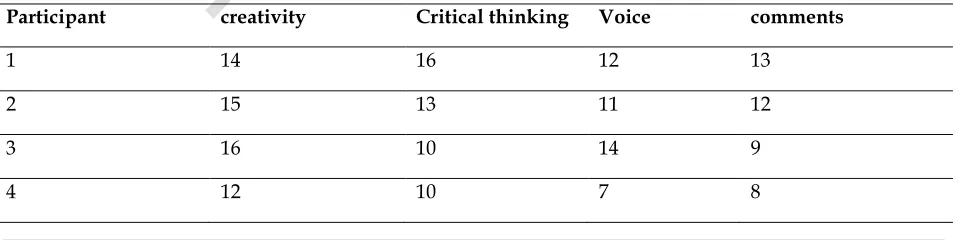
The research question was The effects of collaborative blogging on communicative aspects of writing . in order to measure the effects of blogging collaboratively on communicative aspects of EFL learners' writing, it was needed to code the communicative aspects of writing. According to Saldana, (2009) "a code in qualitative research is a short word or phrase that characteristically assigns a collective, noticeable, essence-capturing, and/or suggestive attribute for a portion of language-based or visual data (P.56). The codes which were used in the present research, were taken directly from blog rubric-coding schemes online that were appropriate for the present research. The rubric coding schemes were three blog rubrics (Franker, 2011; ELT Blog Evaluation, 2009; Blogging Evaluation, 2007) which were retrieved online by the researcher and checked by the supervisor. The blog assignments were classified into the following codes: creativity, critical thinking, voice, and comments. The scores allotted to the participants are show in Table 4.1 below
Table 1
Communicative Skills in Writing Performance of the Participants
Participant creativity Critical thinking Voice comments
1 14 16 12 13
2 15 13 11 12
3 16 10 14 9
4 12 10 7 8
Modern Journal of Language Teaching Methods ISSN: 2251-6204
Vol. 6, Issue 7, October 2016
Page 14
5 14 13 11 8
6 15 10 13 9
7 14 12 10 8
8 14 11 8 12
9 17 12 13 10
10 16 14 15 7
11 18 11 10 10
12 14 12 8 9
13 17 13 11 10
14 18 11 9 12
15 13 10 11 13
16 17 15 12 9
17 17 14 15 8
18 13 11 10 10
19 18 12 10 8
20 15 10 9 10
21 14 9 11 13
Total 321 249 230 208
Mean 15.28 11.85 10.95 9.90
Percentage 31.84% 24.70% 22.81% 20.63%
Table 4.1 shows the frequency and percentage of the scores obtained by the whole participants in the eight blog assignments. In fact, the scores gained by the participants in the four communicative aspects of writing are given. For example participant number one scored 14 in creativity, 16 in critical thinking, 12 in voice and 13 in comments. As shown, creativity with 31.84% was the criteria which scored the first among the four scoring criteria. Differently stated, 31.84% of the blog assignments were scored to be creative. Accordingly, a low degree of creativity was observed among the participants performance in their blog assignment. As the next criterion, critical thinking accounted for 24.70% which still is low in degree. In other words, only 24.70% of the blog assignments were identified to include some critical thinking activities. The third criterion which still scored lower than the two previous criteria was voice with a percentage of 22.81%. Finally, comments with a percentage of 20.63% accounted for the least criterion as applied by the participants in their blog assignments. Therefore, as displayed a low degree of the communicative skills of writing were observed in the writing assignments in blogs by the participants. In fact, less than 50% of the communicative criterion was seen in the blog assignments of the participants.
Modern Journal of Language Teaching Methods ISSN: 2251-6204
Vol. 6, Issue 7, October 2016
Page 15
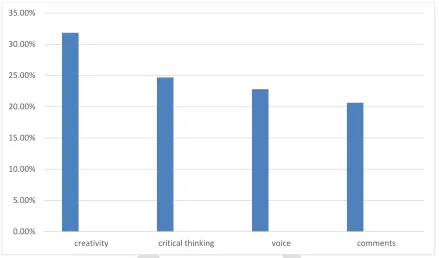
Thus, the participants showed a low degree of communicative skills in writing, with a higher degree of creativity and critical thinking, compared to voice and comments. Figure 4.1 depicts different criteria of communicative aspects of writing.
Figure 4.1 Communicative Skills in Writing Performance of Participants
Based on Figure 4.1, all the four criteria of communicative skills in writing were found to be less than 50% showing that the communicative skill of the participants has no improved due to assignments in blogs. However, from among the four criteria of communicative skills, creativity and critical thinking were found to be more than voice and comments among the four criteria.
A Chi-square test was run among the four subcategories of communicative skills, the results are presented in Table 4.1.
Table 4.2
Results of Chi-square test between subcategories of communicative skills
frequency Communicative skills
Chi-Square 000 a. 000 a .
df 3 3
Asymp. Sig. 1.000 1.000
According to the figures given in Table 4.2 the significance level is 1.000, which is higher than the observed level of significance (.05<.1.000). This tells us that there is no statistically significant difference between different subcategories of communicative skills.
5. Discussions
The current study intended to compare the effects of using collaborative blogging on communicative aspects of Iranian EFL learners' writing. In a quest for finding the answer for this question, after
0.00% 5.00% 10.00% 15.00% 20.00% 25.00% 30.00% 35.00%
creativity critical thinking voice comments
Modern Journal of Language Teaching Methods ISSN: 2251-6204
Vol. 6, Issue 7, October 2016
Page 16
gathering the required data using writing tasks, and analyzing the gathered data, it was made clear that less than 50% of the communicative criterion was seen in the blog assignments of the participants. Thus, the participants showed a low degree of communicative skills in writing, with a higher degree of creativity and critical thinking, compared to voice and comments.
In justifying the findings it should be noted that even though, the participants displayed low scores, the process of commenting on the blogs made the participants get to know each other and their blog writing styles outside of the classroom. These writing styles gave the participants ideas on what to write and how to write in their own blogs. Using creativity and humor, some participants managed to keep a conversation going on the blogs. The response to this creativity and humor motivated them to continue writing on the blog. The participants did not seem to be shy about voicing their opinion on the blogs. They communicated with others, by putting questions across to them in the form of a blog post or comments. The participants were seen as communicating on Blogger from time to time during the course of the study.
Based on the results in the area of critical thinking, the participants displayed a certain degree of critical thinking, depending upon their topics of their interest and possibly their background knowledge and experiences on that topic. The topics such as money and Valentine's Day seemed to bring about more interest and more discussion was generated from these blog assignments. This showed that if the participants were given topics that related their own lives, they felt motivated to carry on communicating through blogs.
Regarding the display of participants' voice in their blog assignments, there was a varying degree in the participants’ contribution, and a reason for this might have been anxiety while writing on the blogs.. Overall, it was found that writing the blog assignments in their own time encouraged the participants to feel less anxious and contribute to the study. The results of this study lend support to the study by Iyer (2013) who revealed that the students displayed a low degree of communicative skills in writing: (26%-32%) for creativity, critical thinking, voice and comments. They showed a positive attitude towards collaborative blogging and found the process of blogging and commenting helped in their writing skills and developing good relationships with each other.
6. Conclusion
The study was in fact an attempt to shed more light on the point whether using the ICT tools can enhance writing performance of Iranian EFL learners or not As it was illuminated in the preceding section of the study, the findings of the study revealed that in spite of the positive contributions of blogging, using collaborative blogging cannot enhance the communicative aspects of writing ability of Iranian EFL students. All in all, more attention should be given to new technology of different types in teaching the complicated task of writing.
The findings may well suggest that the incorporating blogging practices as a type of ICT tool in EFL writing classes in Iran may be fruitful for both the teachers and learners.
The findings of the study can also provide insights for university language professors by demonstrating the role of one of the instruments to be used in writing classes, namely, blogging. This way the Iranian professors may come to know how to teach the instructional materials relating writing, and how to improve writing ability of students.
The findings of the study will, therefore, be helpful for teachers, so as to enable them to decide whether learners should be given some opportunity to use new technology in their writings.
Even though, investigating the role of using new technology in writing performance of EFL learners can be of importance in foreign language writing skill, like any other study, this study also has a number of
Modern Journal of Language Teaching Methods ISSN: 2251-6204
Vol. 6, Issue 7, October 2016
Page 17
limitations, some of which could influence the findings and restrict the generalization of the results. Here are some of the limitations of the research at hand.
Firstly, the study was restricted to pre intermediate EFL students who were Iranian, and the results may be different with students of other levels. Furthermore, in a different environment which may include non-Iranian participants, different results may be obtained.
Secondly, the participants of this study, included 21 EFL students. However, the same study can be conducted with a higher number of students .
finally, in the present study only one of the ICT tools, namely weblog was considered. Other studies can broaden the literature with other ICT tools.
This study focused on the effect of using collaborative blogging on enhancing writing ability of Iranian EFL learners. Other studies can examine the effect of other types of ICT tools like the new applications installed on cellphone on writing performance of the EFL students.
REFERENCE
Boyd, D., & Ellison N. (2007). Social network sites: Definition, history and scholarship Journal of Computer-Mediated Communication, 13(1), 210-230.
http://dx.doi.org/10.1111/j.1083-6101.2007.00393.x
Blood, R. (2000). Weblogs: A History and Perspective. Retrieved from Rebecca’s Pocket Blog
Drexler, W., Dawson, K., & Ferdig, R. (2007). Collaborative Blogging as a Means to Develop Elementary Expository Writing Skills, Electronic Journal of Technology in Education, 6, 140-160.
ELT Blog evaluation. (2009).In British Council Online. Retrieved from
http:// www. britishcouncil.org/russia-english-blogathon-evaluation-criteria.pdf
Farmer, B., Yue, A. & Brooks, C. (2008). Using blogging for higher order learning in larg cohort university teaching: A case study. Australasian Journal of Educational Technology, 24(2), 123-136.
Ferdig, R.E. & Trammell, K.D. (2004). Content delivery in the blogosphere. T.H.E. Journal , 31(7), 12-20. Iyer, P., (2013). Effects of collaborative blogging on communicative skills in writing of Thai
University EFL students. English for Specific Purposes World, 14(39), 54-63.
Kavaliauskien, G., & Vaičiūnien, V. (2006). Communication Interaction Using Information and Communication Technology. Studies about Languages (Kalbų Studijos), 8, 8894-8899.
Nadzrah A. B. (2007). English Language Activities in Computer-based Learning Environment: A Case Study in ESL Malaysian Classroom, GEMA Online Journal of Language Studies, 7(1), 33-49.
Pohl, K. (2000). Learning to Think, Thinking to Learn , p.8. Retrieved from http:// www .
kurwongbss.qld.edu.au/thinking/Bloom/blooms.htm
Saldana, J. (2009). The Coding Manual for Qualitative Researchers. SAGE Publication.
Modern Journal of Language Teaching Methods ISSN: 2251-6204
Vol. 6, Issue 7, October 2016
Page 18
AN ANALYSIS OF CLUTIRE SPECIFIC ITEMS IN
ENGLISH TRANSLATION OF PERSIAN TOURIST
GUIDE BOARDS OF PERSEPOLIS
Fatemeh Keshtkar
Department of English, Marvdasht Branch, Islamic Azad University, Iran Amin Karimnia
Department of English, Fasa Branch, Islamic Azad University, Iran [email protected]
ABSTRACT
THE PRESENT STUDY AIMED AT INVESTIGATING THE CULTURE SPECIFIC ITEMS OF TOURIST GUIDE BOARDS OF PERSEPOLIS SITE BY STUDYING THE TYPE OF EACH CULTURE SPECIFIC ITEM AND THE STRATEGIES APPLIED BY THE TRANSLATOR IN TRANSLATING THOSE ITEMS BY FOCUSING ON THE PERSIAN BOARDS AND THEIR ENGLISH TRANSLATED BOARDS, BASED ON NEWMARK’S TAXONOMY FOR CULTURE SPECIFIC ITEMS (1988). IN SO DOING THE RESEARCHER EXTRACTED ALL THE CULTURE SPECIFIC ITEMS FROM PERSIAN BOARDS THEN IDENTIFIED THEIR TYPES AND FREQUENCIES. THE TRANSLATED ITEMS FOR EACH CULTURAL ITEM WERE EXTRACTED FROM ENGLISH BOARD AND THE TYPE OF STRATEGIES AND THEIR FREQUENCIES WERE ALSO STUDIED BASED ON NEWMARK 2012. THE RESULTS SHOWED THAT THERE WERE145 CULTURE SPECIFIC ITEMS IN TOURIST GUIDE BOARDS OF PERSEPOLIS THAT MATERIAL CULTURE WAS THE MOST FREQUENT AND ECOLOGY WAS THE LEAST FREQUENT ONES; THE RESULTS ALSO INDICATED THAT THE TRANSLATOR TRANSLATED 100 ITEMS OF THOSE CULTURAL ITEMS AND FROM AMONG THE TRANSLATION PROCEDURES TRANSONYM WAS THE MOST FREQUENT ONES, OTHER 45 ITEMS THAT WERE REMAINED UNTRANSLATED BY THE TRANSLATOR WERE ALSO TRANSLATED IN THIS STUDY.
KEYWORDS: TRANSLATION, CULTURE, CULTURE SPECIFIC ITEM, CULTURAL TRANSLATION
1. Introduction
Language and culture are means of communication and their relationship with culture is undeniable. Each community often with specific language has its own culture, which refers to the way of life, sets of beliefs, traditions, attitudes, values and behavior of that community. Today translation is regarded as a process and science beyond the linguistic form of a language. “The 1970s and 1980s saw a move away from the statistic linguistic typologies of translation shifts and the emergence and flourishing of a functionalist and communicative approach to the analysis of translation” Munday declared (Munday, 2001, p.73).
Culture is the characteristics of a particular group of people, defined by everything from language, religion, music, arts, etc. Preserving culture helps society members of that culture to remain alive by introducing their culture to others. Studies about cultural and traditional heritages have gained significance especially in recent years. This place gains much attention from different national and international tourists. Administrators of Persepolis put different tourist guide boards in different parts of Persepolis in both Persian and English for both national and international visitors, with the aim of
Modern Journal of Language Teaching Methods ISSN: 2251-6204
Vol. 6, Issue 7, October 2016
Page 19
introducing different parts of the site and giving the visitors necessary information. Texts of these boards are kinds of tourist texts so their function is to give the readers information about culture, custom and history of this site. But, whether these English boards are successful in introducing and transferring cultural issues in the English boards or not is the subject which needs more study.. A good translator should be able to deal with the translation of different CSI and use appropriate and suitable methods for their translation.
World heritage sites must provide a clear translation of these items for international tourists; in spite of this, the fact is that somewhere in English boards of Persepolis these items were omitted and there is not any equivalence for them in its vicinal board. Inadequacy in transferring the message from one language to another language is the source of different problems and misunderstandings. These problems and misunderstandings become more crucial when the focus of the translation is culture and specially culture items. Absence of cultural items of one language in another one is a barrier in introducing and transferring culture of source language and society to the target ones. This is the subject that has gained much attention in translation studies and different scholars and translators have proposed different ways and strategies for dealing with translation of cultural items. For the importance of CSI’s translation and their roles in representing each language culture, this research tried to study them and their translation. In this study the focus was on the culture specific items in Persian and especially English tourist guide boards of Persepolis. The first purpose was to introduce the concept of CSI, its definition and various categories according to Newmark’s (1998) model. Then different strategies for translating CSIs were introduced and elaborated. The next step was extracting CSIs from Persian boards and putting them under related categories, after finding equivalences of each Persian CSI in the English boards the main purpose was analyzing translation of each CSI to see what kind of strategy was used by the translator for each item and then the frequency of translation procedures applied by the translator were shown, then where CSIs was omitted the researchers suggested an appropriate equivalence. More specifically, the present research addressed the following research questions:
1. What are the most and the least frequent culture specific items in tourist guide boards of Persepolis? 2. What are the most and the least frequent translation strategies for translating CSIs in tourist guide boards of Persepolis?
3. What is the best equivalence for those CSIs which are omitted in English board in the process of translation CSIs from Persian into English?
2. Literature Review
Language and culture are two structures which can be helpful in understanding a country and society. Akbari in a paper ‘The role of culture in translation’ explained that “language is an expression of culture and individuality of its speakers” (Akbari, 2013, p.13). One might even claim that cultural contact as such presupposes translation and that the exchange of goods of material and spiritual culture is not possible without translation. The concept of translation and culture is a matter of controversy and attracts many enthusiastic researchers to research in this filed.
Larson defined culture as “a complex of beliefs, attitudes, values and rules which a group of people share” (Larson, 1984, p.431). Each individual language can be considered as a means of expression for its own culture. Vermeer (2000) considered language as a part of culture. Each language presents a specific culture and each culture has in itself a specific language. Different cultures influence the way its members view the world. Zare-Behtash and Firoozkoohi (2010) said that the concept of culture is important for understanding the implication of culture specific items, so many translation theorists deal with this issue and provide definitions for this concept.
Modern Journal of Language Teaching Methods ISSN: 2251-6204
Vol. 6, Issue 7, October 2016
Page 20
Newmark as one of them considered culture as “the way of life and its manifestations that are peculiar to a community that uses a particular language as its means of expression” (Newmark, 1998, p.94). CSIs are those items which can make problems in translation process. CSIs with their cultural roots and meanings which lie behind them and are strongly related to the specific cultural context can provide a clear definition of each culture. Translating CSIs is one of the problematic and challengeable issues in translation studies. In translating CSIs by considering the purpose of the source text, a translator main attempt should be to make the source items clear for target readers by choosing the best and the most appropriate strategy.
According to Nida “differences between cultures may cause more severe complications for the translator than do differences in language structures” (Nida, 1964, p.130).This statement emphasizes the importance and significance of the research about translation and culture and CSIs in specific. Preserving culture in world heritage cites like Persepolis, is very important as those places belong to people all around the world with different languages and cultures, and translators have the duty to provide the most understandable, representative and clear texts, and should be aware of this important issue. Representing correct and clear information of each part of this site is the duty of its administrators. While each year about 8000 (non-native) tourists visit this site, those tourist guide boards (in English as an international language) are the most important tools for introducing Persepolis and its ancient culture to its visitors, these boards should be in a way to be able to introduce the nature, culture, history and customs of the site to the visitors through their texts.
Tourist texts have been designed with the purpose of introducing a place or a spot to its viewers by providing related information for them to enjoy their visit. These texts offer expressive, informative and vocative functions. The writer or the originator of a text type produces a text irrespective of any response, so expressive function works as the mind of the originator. The informative function of these texts relates to the information and external aspect of the spot, its vocative function is in a way to appeal and persuade readers to think about the spot and appeal them (Sanning, 2010).
Before visiting a place the visitors may want to gain some information about the history, culture and importance of that place, then a detailed explanation about that place will strengthen their decision for visiting the spot and even make them enthusiastic. So till now the vocative and informative function are crucial. As Newmark (1988) declares the informative and vocative texts belong to communicative translation. This kind of translation tried to render the exact contextual meaning of the original text in such a way that both content and language are acceptable and comprehensible to the readership. But the expressive side has its own importance, as a well translated text and the aesthetic dimensions of language is used by the translator because the visitors “can sense national pride and a warm welcome emanating from the host country” (Sanning, 2010, p.125). An expressive tourist text is often well organized, concise, and short and it concerns the cultural values of the object.
Newmark distinguished six categories for CSIs as follow: ecology, public life, social life, personal life, customs and pursuits, and private passions (Newmark, 2010, p. 173-177).
1.Ecology: encompasses CSIs referring to geological and geographical environment, e.g., Naples, Lyon. 2. Public life: refer to politics, law and government, e.g., the House of Commons, Prime Minister .
3. Social life: includes economy, occupations, social welfare, health and education, e.g., the patients are admitted or discharged from the hospital and not accepted or rejected.
4. Personal life: encompasses food, clothing and housing, e.g., pasta, paella, espresso, mocha.
5. Custom and pursuits: refer to various body language signs that are specific to particular culture, e.g., slow hand clapping means applause, and various means of entertainment, e.g., cricket and football with their national idioms such as sticky wicket.
Modern Journal of Language Teaching Methods ISSN: 2251-6204
Vol. 6, Issue 7, October 2016
Page 21
6. Private passions: include religion, music, poetry and their different social organizations, e.g., Methodism, Shakespeare, the Arts Councils.
3. Methodology
3.1. Materials
Text of TGBs of Persepolis was the material for this study. CSIs of these boards were regarded as the content. All the procedures of the study were done according to the CSIs from TGBs, and the results of the research were in the way to prepare appropriate answers to the research questions.
3.1.1. Value of the Materials
Outstanding interaction between people and their environment in a place is the key concept of a world heritage cultural landscape. According to Jukka Johileto who is a UNESCO consultant, in order to understand the values of a place there are some steps as follow:
1. Recognizing the themes characteristics of that place: 2. Chronological-regional context is also important. 3. Type of property
4. World heritage criteria 5. Authenticity and integrity
6. Management, the development of a management system relevant to the defined area.
Value can be understood as the social association of qualities to things. The value of a thing is because of its characteristics. So in the process of defining the value of a thing or a place we should at first define its characteristics, rank and importance, and a point should be considered that value is relative not absolute. The value of a cultural heritage like Persepolis is related to the value discipline of its own culture. Conservation of cultural heritage in all its form is rooted in the values attributed to the heritage. Our ability to understand these values depends on the degree to which information sources about these values may be understood as credible of truthful. Knowledge and understanding of these sources of information in relation to original and subsequent characteristics of cultural heritage and their meaning is a requite basis for assessing all aspects of authenticity. Providing authentic information about cultural landscape for the visitors of such places is a useful way for transferring and introducing its values to others. The value of Persepolis as a cultural landscape and world heritage site is obvious for everybody.
3.2. Data Collection Procedures
Data for the present study were selected from the boards which are used in the Persepolis site in order to prepare brief information for the national and international visitors. These boards are written documents of a popular culture. They are representative of the ancient culture and era of Persia. The researchers tried to study all these public documents in order to answer the research questions.
3.3. Data Analysis
In order to analyzing the data, all the Persian boards were studied carefully. The unit of analysis was word. The gathered items, those that had the characteristics of a CSI according to Newmark’s model, are different kinds of CSIs. Then each word was reviewed and coded into different organized categories. The researchers then counted the frequencies of the items. Each English item’s equivalence was founded from each English TGB near its Persia TGB. The types of translation strategies were counted and the quantitative data provided a description for the main research questions.
Modern Journal of Language Teaching Methods ISSN: 2251-6204
Vol. 6, Issue 7, October 2016
Page 22
4. Findings and Results
In the following, one of the Persian TGBs from Persepolis is presented as a sample. All the research procedures were conducted one-by-one and step-by-step for all boards.
Board of Terrace Stairway
یدورو ناکلپ
یاراد اعومجم ناکلپ فیدر ره .دنهد یم لیکشت ار دیشمج تخت هب دورو یلصا هار هنیرق ناکلپ فیدر ود ۱۱۱
لوط هب هلپ ۶.۹۰
ضرع رتم
۳۸ عافترا و رتم یتناس ۱۰
ناس شش ای جنپ ای راهچ ره وتسا هدیدرگ روظنم یصاخ یاه هورگ روبع یارب لاامتحا فرط ره یاه ناکلپ.تسا رتم یت
رزب .تسا هدرک یم یریگولج نانامهیم یلامتحا طوقس زا ناکلپ دازآ تهج رد هانپ ناج یاه هرگنک فیدر .تسا هدش هتخاس گنس هتخت کی زا هلپ ناگ
نانامهم نینچمه وروشک نارس و رظن فلاخ رب ناکلپ یهاتوک تلع .دنا هتفر یم لااب اه هلپ زا یهورگ تروص هب و هدایپ نشج رد هدننک تکرش
تسا هتشاد یزاون نامهم و یتافیرشت هبنج زا یوریپ هکلب هدوبن خاک لخاد هب بسا اب راوس نتفر هماع. هب تسا هداد یم هزاجا هاتوک یاه هلپ هچ ن و نارومام هب یناریا ناگرزب هناهاش ینامهم و ماعراب روخ رد یراقو اب ودنلب و رخاف یاه سابل رد همه نانک وگتفگ و هتسد هتسد عبات للم ناگدنیام
.دنور تخت یلااب هب نییاپ زا هتسهآ هتسهآ
Table 1. CSI Analysis of Terrace Stairway Board
Col. CSI type Extracted CSIs
1 Ecology 0
2 Material culture تخت هفص روظنم(تخت -هانپ ناج یاه هرگنک
)تسا دیشمج 2
3 Social culture ماعراب 1
4 Organization,… -روشک نارس-دیشمج تخت 2
5 Gestures and
habits
یهورگ تروص هب 1
Total 6
CSI analysis of this board showed that there were 6 CSIs of four kinds: material culture, social culture, organization and gesture. ‘تخت’, ‘هانپ ناج یاه هرگنک’ are the items related to the ancient buildings and are the items that are culture based. The cultural items which are related to house terms are under the material culture of Newmark’s taxonomy. ‘ماعراب’ in Farsi means ‘صاخ ای ماع ییاریذپ’, therefore it was considered as a social culture term which included work and leisure.
‘دیشمج تخت’is an international and historical term, ‘یروشک نارس’in the text is a culture term which, like ‘ تخت دیشمج’, is in the organization group.
cultural gestures are those gestures that occur in some cultures and are specific for that culture; ‘ تروص هب یهورگ’ is a kind of gesture that shows respect.
Table 2. Strategies Applied in Translation of CSIs in Terrace Stairway Board
Col. Source Text Target Text Translation Strategies
1 دیشمج تخت Platform Componential A
2 هانپ ناج یاه هرگنک Parapets Marginal T(S)
Modern Journal of Language Teaching Methods ISSN: 2251-6204
Vol. 6, Issue 7, October 2016
Page 23
3 روشک نارس Nobles of the empire Cultural E
4 یهورگ تروص هب ..with one another Marginal T (modulation)
5 ماعراب
6 تخت platform Componential A
The translator was successful in translating cultural items presented in this board. He/She had used different strategies in translating these items. The translator had used platform for ‘تخت و دیشمج تخت’ in which he/she had tried to split the term into generic components. Platform is one of the characteristics of this universal place.
‘Parapets’ which means: a low protective wall along the edge of a roof, bridge, or balcony is a synonym for ‘هانپ ناج یاه هرگنک’ and the translation strategy which had been applied here is Marginal translation (synonym).
The following section summarizes the findings of the research in relation to each research question. The research showed that the total number of CSIs in all the available TGBs of Persepolis was 145.
From these CSIs, ‘material culture’ category had the most frequency with 61 items that allocated 42.06% to itself. Then organization with 58 items had the second rank, social culture with 21 items, gesture and habit with 4 items and finally ecology with just one item occupied other ranks (in decreasing order). From among these 145 CSIs, the translator translated only 100 items and 45 other CSIs were left without any translation and were absent on the English boards. For translating other 100 items, Transonym with 31 items or 17.6% was the most frequent strategy, and then cultural equivalents, marginal translation strategies, descriptive equivalent, componential analysis and transference were the other strategies that the translator applied in translating CSIs.
‘Organization’, with 58 items, had the second rank. It means that the frequency of the items related to this part is 40%. ‘Social culture’, with 21 items, had 14.48% frequency, ‘gesture and habit’ ,with 4 items, had the frequency of 2.7%, and finally ‘ecology’ ,with just one item, had the frequency of 0.68% and occupied other ranks (in decreasing order).
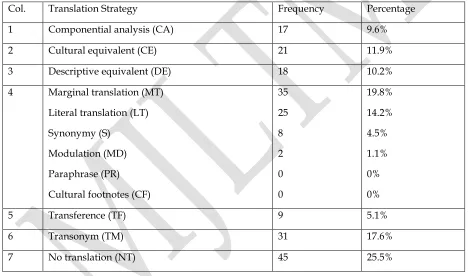
From among these 145 CSIs, the translator translated only 100 items and 45 other CSIs were left without any translation and were absent on the English boards. For translating other 100 items the translator used all kinds of proposed strategies for translating CSIs by Newmark (2010). Transonym with 31 items or 17.6% was the most frequent strategy which is mostly related to the translation of names of places and proper names. ‘cultural equivalent’ was the strategy which was used 21 times with the frequency of 11.9%, ‘marginal translation’ strategies was the third mostly used strategy which itself consists of five subcategories as follow; literal translation, synonymy, modulation, paraphrase and cultural footnotes. Among these subcategories, literal translation allocated 14.2% of the total frequency of the marginal translation. ‘Descriptive equivalent’ was used 18 times and had the frequency of 10.2%. ‘Componential analysis’ and ‘transference’ were other strategies that the translator applied for translating CSIs. The first one was used 17 times and transference was used nine times in the process of translation. All the above mentioned frequencies occurred in a decreasing order. The following tables provide an overview of the research findings. The first table shows the frequency of CSIs and each item’s percentage, and the second one shows the frequency and percentage of each translation strategy.
Modern Journal of Language Teaching Methods ISSN: 2251-6204
Vol. 6, Issue 7, October 2016
Page 24
Table 3. Frequency of CSIs in TGBs of Persepolis
Col. CSI type Frequency Percentage
1 Ecology(E) 1 0.68%
2 Material culture (MC) 61 42.06%
3 Social culture (SC) 21 14.48%
4 Organization,… (O) 58 40%
5 Gesture and Habits (G) 4 2.7%
Table 4. Frequency of Applied Strategies for Translating CSIs in all the TGBs of Persepolis
Col. Translation Strategy Frequency Percentage
1 Componential analysis (CA) 17 9.6%
2 Cultural equivalent (CE) 21 11.9%
3 Descriptive equivalent (DE) 18 10.2%
4 Marginal translation (MT)
Literal translation (LT) Synonymy (S)
Modulation (MD) Paraphrase (PR) Cultural footnotes (CF)
35 25 8 2 0 0
19.8% 14.2% 4.5% 1.1% 0% 0%
5 Transference (TF) 9 5.1%
6 Transonym (TM) 31 17.6%
7 No translation (NT) 45 25.5%
5. Discussion and Conclusion
As it was mentioned earlier, Newmark’s (1988) category of CSIs and his translation strategies (2010) were employed in this study in order to answer the first two research questions with respect to “What are the culture specific items in tourist guide boards of Persepolis?” and “What kind of strategy is used by the translator in the translation of each CSI?”. He proposed 5 categories for CSIs and 6 kinds of translation strategies. Some examples for each category are presented here.
Shokri and Ketabi (2015) studied the translation of CSIs of the book ‘ShahzadehEhtejab’ that is a Persian literary masterpiece. They extracted the CSIs from the text according to Newmark's categorization (1988)
Modern Journal of Language Teaching Methods ISSN: 2251-6204
Vol. 6, Issue 7, October 2016
Page 25
of culture specific items. Then the CSIs were examined according to Aixela’s model of translating culture specific items. In their research ‘Synonym’ with 39percent was the most frequent strategy.
Rezaei and Kuhi (2014) dealt with CSIs and their translation in the article “Strategies Employed in Translation of Tourist Guidebooks Culture-specific Items from Persian into English”. They studied the translation of two tourist guidebooks from Persian to English to analyze the kind of strategies used by translators to translate each CSI according to Newmark (1998) and to explore whether most of these CSIs are domesticated or foreignized. In their view, Tourist guidebooks usually include details about a country geographic location and provide some information about its tourist sites, accommodations and sometimes the costumes and culture of its people (p. 750). In translating these kinds of tourist texts, the translator needs to know the source language and the target language well and should also get familiar with both cultures and know a wide range of possible strategies for dealing with the translation of CSIs. This descriptive research studied the rendering choices in translation of CSIs in two tourist guide book ‘Travel Guide to Fars’ and ‘Iran Tourist Guide’ translated by Beheshti and Hakimian from Persian into English and did not intend to judge the correctness of translations or appropriateness of the application of translators’ ideological presuppositions. At first they explained about the concept of culture and define CSIs according to different viewpoints. Then, the translation strategies for CSIs were explained. And finally the result and findings were reported. CSIs were divided into the following groups in the mentioned corpus: Geographical items, Ethnographic items, Ethic items, and artistic and cultural items. Then for each group, they studied the translation strategies which were used by the translators.
Finally the result revealed that transference with the addition of some notes is the mostly used strategy used by translators and the most common strategy in the translation of these two tourist guidebook is foreignization. It was obvious that the translators tended to foreignize the cultural items and tried to preserve the meaning of the SL cultural norms and their foreignness to the TL text and a number of SL cultural words were borrowed and introduced into the TL culture.
REFERENCES
Akbari, M. (2013). The role of culture in translation. Journal of Academic and Applied Studies, 3 (8), 13-21. Larson, M. (1984). Meaning-based translation. London: Bradford Publishing House.
Munday, J. (2001). Introducing translation studies. London: Routledge Newmark, P. (1988). Textbook of translation. Oxford: Pergamon Press.
Newmark, P. (2010). Translation and culture. In B. Lewandowska-Tomaszczyk (Eds),Meaning in translation (pp. 171-182). Frankfurt: Peter Long GmbH.
Nida, E. (1964). Principles of correspondence. In L. Venuti (Ed.),The translation studies reader (pp. 153-167). London: Routledge.
Rezaei, M., &Kuhi, D. (2014). Strategies employed in translation of tourist guidebooks culture-specific items from Persian into English. Theory and Practice in Language studies, 4(4).
Sanning, H. (2010). Lost and found in translating tourist texts domesticating, foreignising or neutralising approach. The Journal of Specialized Translation. Retrieved from www.jostrans.org
Shokri, S., &Ketabi, S., (2015). Translating culture-specific items in ShahzadehEhtejab: Examining foreignization and domestication. International Journal of Research Studies in Education, 4(3), 3-16.
Vermeer, H. J. (2000). Skopos and commission in translational action. In L. Venuti (Ed.), The Translation Studies Reader (pp. 221-232). London: Routledge.
Zare-Behtash, E., & Firoozkoohi, S. (2010). Culture specific items in literary translation. Translation journal, 14 (1). Retrieved from http://translationjournal.net/journal/51culture.htm
Modern Journal of Language Teaching Methods ISSN: 2251-6204
Vol. 6, Issue 7, October 2016
Page 26
Appendix
CSI analysis of All the Boards and Their Applied Strategies
Col. Source Text CSI
type
Target Text Translation Strategy
1 رلاات
MC
hall NT
2 ناویا MC Veranda NT
3 دیشمج تخت O Persepolis1
(Takht-e Jamshid)2
1.TM 2.TF
4 سراپ ییاورنامرف O Pars (Persian)reign NT
5 لوا شویراد O Darius1 the Great2 1.TM
2.CE
6 )هاگ تخت( هفص MC Platform1(Takht)2 1.CA
2.TF
7 )رهم( تمحر هوک E Mount Mithra1 (Mehr)
Kooh-e Rahmat2 (“Mount Mercy”)3
1.MT (S) 2.TF 3.MT (LT)
8 اناداپآ خاک O A large audience hall1 (The
Apadana)2 1.DE
2.TM
9 هسراپ O Parsa TM
10 رهش( سیلوپسرپ
)هسراپ O The city of Persians DE
11 راصح MC Enclosure, retaining wall NT
12 یناسربآ یاه هکبش MC Water hammer NT
13 رباقم MC Sepulchers NT
14 یاه هتسجرب شقن
یگنس O Bas-relief NT
Modern Journal of Language Teaching Methods ISSN: 2251-6204
Vol. 6, Issue 7, October 2016
Page 27
15 ینودقم ردنکسا O Alexander III of Macedon NT
16 راد باعل یاه رجآ MC Coated bricks NT
17 یسراف نابز O Persian language NT
18 موس شویراد O Darius III NT
19 دیشمج تخت O Platform CA
20 هانپ ناج یاه هرگنک MC Parapets MT(LT)
21 روشک نارس O Nobles of the empire CE
22 یهورگ تروص هب G ..with one another MT (M)
23 ماعراب SC audience NT
24 تخت MC platform CA
25 ماع راب SC Audience CE
26 اشرایاشخ O The Great King1( Xerxes2) 1.CE
2.TM
27 هتسشن تخت رب MC Enthroned CE
28 یهاش یاصع G A scepter of royalty CE
29 ناگجاوخ SC A eunuch chamberlain CE
30 زوس دوع MC Incense burner CE
31 رداچ( ناورداش
)یتنطلس MC Royal tent NT
32 )سوتول( یبآ رفولین O Lotus flower MT (LT)
33 دهعیلو O Crown prince CE
34 ار دوخ تسار تسد
دنلب مارتحا ی هناشن هب تسا هدرک
G (He) reverentially rises his hand NT
35 راد هحلسا SC Weapon- bearer MT(LT)
36 تافیرشت سییر SC Senior official (the chiliarch) MT (S)
37 شرف MC NT
38 هبیتک MC Inscription NT
39 ناراد هزین SC Lance-bearers MT(LT)
Modern Journal of Language Teaching Methods ISSN: 2251-6204
Vol. 6, Issue 7, October 2016
Page 28
40 یتنطلس ی هیاپاهچ SC Stool CA
41 رتهم SC Grooms CE
42 لاماک هک ار یبسا
تسا هدش هتسارآ SC A well-groomed horse NT
43 یتنطلس ی هنودرگ SC Royal chariot NT
44 دنلب هلاک(یسراپ سابل
)دنلب سابل و راد کرت MC (Persian1 attire)2 (consisting of a tall fluted hat3, pleated tunic and skirt4 1.TM
2.MT (LT) 3.CA 4.DE
45 هلاک( یدام سابل
سابل اب درگ یدمن )راولش و هاتوک
MC (Median1 Costumes)2 (consisting of a round flat hat3, tight-fitting jacket and trousers and the candy, a long robe worn on the shoulder but with empty sleeves4
1.TM 2.MT (LT) 3.CA 4.DE
46 ای و تسد رد تسد
مه ی هناش رب تسد G Holding hands MT(LT)
47 ندرگ قوط MC Torque MT(ئ)
48 هراوشوگ MC Ear rings MT(S)
49 دنبتسد MC Armlet CA
50 دنلب شیر MC Fairly long beard DE
51 زورون SC Nowruz (the first day of the new
year)
NT
52 ناروخآ ریم SC Head of ostlers NT
53 ارسمرح MC Harem1 (seraglio)2 1.MT (LT)
2.MT (S)
54 هاگرد MC Hall’s entrances MT(LT)
55 شوقن O Figures MT (S)
56 صوصخم همدخ SC Attendant MT (CA)
57 و ریش اب هاش گنج
لاویه SC A hero1 in Persian dress fighting monstrous anima