Surface Roughness and Surface Damage Analysis of
Titanium Alloy (Ti6al4v) in High Speed Turning Process
Using Refrigerated Air as Coolant
Saad Shaikh
1, Kishor Patil
2, Pradeep Panga
2, Kaif Dakhwe
2, Gayatri Tangadi
21 Faculty of Mechanical Engineering, Anjuman-I-Islam Kalsekar Technical Campus School of Engineering, New Panvel, Mumbai University, Maharashtra(India).
2B.E.Mech.(Students), Anjuman-I-Islam Kalsekar Technical Campus School of Engineering, New Panvel, Mumbai University, Maharashtra(India).
*Corresponding author Tel.: 9967602802; Email: [email protected]
Manuscript Submitted: April 23, 2016; accepted: Sep 2, 2016 doi: ???
Abstract: Recent developments and chaos on climate change has led to researchers and scientists world over to rethink and bring impactful changes to the current manufacturing processes. Current manufacturing trends require large usage of cutting fluids for lubrication during machining. This leads to increase the cost of production in industries. Also due to some harmful additives present in cutting fluids for better lubrication effects, they are polluting the environment and leading to affect the health of operator during machining. With the aim to reduce the effect of cutting on environment, Refrigerated Air as Coolant has been adopted by various machining and grinding applications. In this work, the high speed turning of Titanium alloy (Ti6Al4V) is carried out using refrigerated air as a coolant. In order to maintain a good surface integrity and to improve the machinability of Ti6Al4V experiments were conducted by varying different machinability variables. The machinability variables such as speed and feed rate were varied and its influence on surface damage and surface roughness were measured and analyzed.
Key words: ANOVA, Coolant, Refrigerated air, Taguchi.
1. Introduction
Titanium alloys have recently been more widely used in the aerospace, bio-medical and petroleum industries because of their good strength-to-weight ratio and superior corrosion resistance. The increasing use of titanium alloys magnifies the need for optimizing high-performance titanium machining. It is very difficult to machine them due to their poor machinability. Among all titanium alloys, Ti6Al4V is most widely used, which is selected as the work material in this study. Low thermal conductivity of Ti6Al4V causes the cutting heat to remain at the tool/chip interface .which is particularly problematic due to the fact that titanium has high chemical re-activity at elevated temperatures .Maximum available spindle speed is limited by cutting temperature in titanium machining.
High speed turning operation is generally performed on order of 5-10 times as that of conventional cutting speed. It has several advantage such as reduction in cutting forces and temperature ,low power consumption , improvement in surface finish, low stress component burr-free surface , better dimensional accuracy.
and dimensional accuracy, decrease cutting temperatures, surface roughness and the amount of power consumed in a metal cutting process and thus improve the productivity. The machining of metals has traditionally involved the use of large quantities of water and oils for dissipating the cutting tool temperature , improving the surface finish of parts and increasing tool life. The use of cutting fluids has caused some problems such as high cost, pollution, and hazards to operator’s health. All the problems related to the use of cutting fluids have urged researchers to search for some alternatives to minimize or even avoid the use of cutting fluids in machining operations.
To avoid hazards to operator’s health and to reduce pollution, we are proposing refrigerated air as coolant. In this project, we are analyzing surface roughness and surface damage of Ti-alloy to see contribution each machining parameter also which is best combination is giving satisfactory result by use of refrigerated air. we are seeing the effectiveness of our coolant in comparison with other conventional coolant.
2. Design of Experiment by Taguchi Method
Dr. Genichi Taguchi is regarded as the foremost proponent of robust parameter design, which is an engineering method for product or process design that focuses on minimizing variation and/or sensitivity to noise. When used properly, Taguchi designs provide a powerful and efficient method for designing products that operate consistently and optimally over a variety of conditions.
In robust parameter design, the primary goal is to find factor settings that minimize response variation, while adjusting (or keeping) the process on target. After you determine which factors affect variation, you can try to find settings for controllable factors that will either reduce the variation, make the product insensitive to changes in uncontrollable (noise) factors, or both. A process designed with this goal will produce more consistent output. A product designed with this goal will deliver more consistent performance regardless of the environment in which it is used.
Engineering knowledge should guide the selection of factors and responses. Robust parameter design is particularly suited for energy transfer processes; for example, a car's steering wheel is designed to transfer energy from the steering wheel to the wheels of the car. You should also scale control factors and responses so that interactions are unlikely. When interactions among control factors are likely or not well understood, you should choose a design that is capable of estimating those interactions. Minitab can help you select a Taguchi design that does not confound interactions of interest with each other or with main effects.
Noise factors for the outer array should also be carefully selected and may require preliminary experimentation. The noise levels selected should reflect the range of conditions under which the response variable should remain robust. Robust parameter design uses Taguchi designs (orthogonal arrays), which allow you to analyze many factors with few runs. Taguchi designs are balanced, that is, no factor is weighted more or less in an experiment, thus allowing factors to be analyzed independently of each other.
Minitab provides both static and dynamic response experiments.
In a static response experiment, the quality characteristic of interest has a fixed level.
In a dynamic response experiment, the quality characteristic operates over a range of values and the goal is to improve the relationship between an input signal and an output response.
An example of a dynamic response experiment is an automotive acceleration experiment where the input signal is the amount of pressure on the gas pedal and the output response is vehicle speed. You can create a dynamic response experiment by adding a signal factor to a design.
The goal of robust experimentation is to find an optimal combination of control factor settings that achieve robustness against (insensitivity to) noise factors. Minitab calculates response tables, linear model results, and generates main effects and interaction plots for:
signal-to-noise ratios (S/N ratios, which provide a measure of robustness) vs. the control factors
standard deviations vs. the control factors
natural log of the standard deviations vs. the control factors
Use the results and plots to determine what factors and interactions are important and evaluate how they affect responses. To get a complete understanding of factor effects it is advisable to evaluate S/N ratios, means (static design), slopes (dynamic design), and standard deviations. Make sure that you choose an S/N ratio that is appropriate for the type of data you have and your goal for optimizing the response. In our project, we are analyzing surface roughness and surface damage of titanium alloy in high speed turning process. In turning there are three factors contributes surface roughness: 1. Cutting speed (m/min), 2. Feed rate (mm/rev), 3. Depth of cut (mm).
In our experimentation the factor cutting speed & feed rate are considered on three different level. By taguchi approach:
Number of experiment = {Number of stages} Number of factors = 32 = 9 Experiments
Table 1. Experimental Combinations
3. Observations
3.1. Preparation of Fixture for Taking Observation
1. We took wooden block of length: 118 mm and cross section: 1216 mm2 (square). 2. We marked point on the face of wooden block to drill approximately 14 mm hole.
3. With the help of jack planner we exposed the some portion of drilled hole so that at time of taking reading will facilitated to take reading with help of roughness tester on horizontal axis.
3.2. Observation Table for Ra Value:
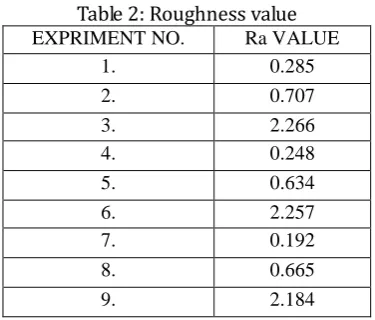
Table 2: Roughness value
EXPRIMENT NO. Ra VALUE
1. 0.285
2. 0.707
3. 2.266
4. 0.248
5. 0.634
6. 2.257
7. 0.192
8. 0.665
9. 2.184
4. Experimental Result
4.1. Parametric optimization of surface roughness (Ra)
The term signal represents desirable value and noise being undesirable and response considering high S/N ratio is close to optimal. The mean S/N ratio of surface roughness for cutting speed at level 1, 2 and 3 can be calculated by averaging the S/N ratio for the experiments 1-3, 4-, and 7-9 respectively. Similarly, the mean S/N ratio for the other levels of the process parameters can be computed. The mean S/N response table for surface roughness Is shown in table.
Table 3: Calculation of SN ratio
Speed Feed Ra value S/N RATIO
60 0.08 0.283 10.9643
60 0.16 0.707 3.0116
60 0.32 2.226 -6.9505
120 0.08 0.248 12.1110
120 0.16 0.634 3.9582
120 0.32 2.257 -7.0706
180 0.08 0.192 14.3340
180 0.16 0.665 3.5436
180 0.32 2.184 -6.7851
Response Table for Signal to Noise Ratios : Smaller is better
Level Speed Feed
1 2.342 12.470
2 3.000 3.504
3 3.697 -6.935
Delta 1.356 19.405
Rank 2 1
Fig. 2. Main effect plot of SN Ratios
4.2. ANOVA
The Analyses of variance (ANOVA) for the adequacy of the models are then performed in the subsequent steps. The F ratio is calculated for 95% level of confidence for each response. The values which are less than 0.05 are considered significant and the values greater than 0.05 are not significant and the models are adequate to represent the relationship between machining response and the machining parameters.
Table present the ANOVA result of machining parameters as main effect on Surface roughness using refrigerated air as a coolant. Table—indicates that the feed rate is highly significant with 99.8533% contribution and spindle speed is less significant with 0.077853% contribution.
Table 4: Percentage Contribution of Various Factors
Source DF Adj SS Adj MS F-Value P-Value % Contribution
Cutting Speed 2 0.00513 0.00256 2.30 0.216 0.0778535955 Feed rate 2 6.52246 3.26123 2928.37 0.000 99.85333831
Error 4 0.00445 0.00111 0 0 0.068125731
Total 6 6.53204 0 0 100
4.3. Model Summary
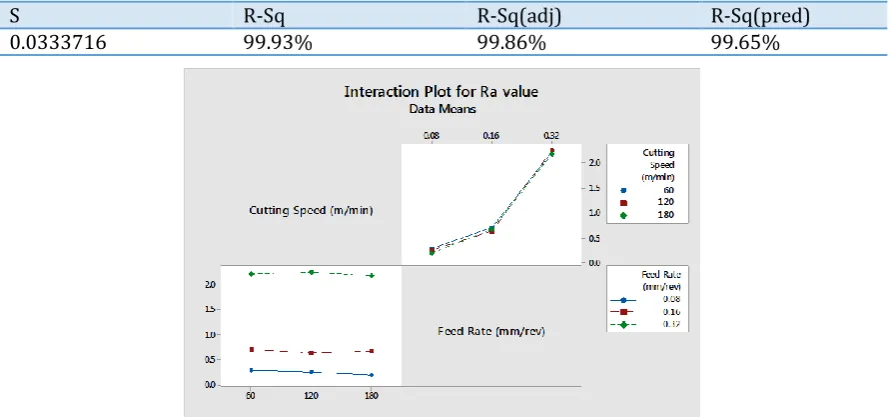
S R-Sq R-Sq(adj) R-Sq(pred)
0.0333716 99.93% 99.86% 99.65%
From the above figure, it is concluded that interaction in feed is more than interaction in cutting speed, as the graph in cutting speed are widely spreaded unlike graph in feed rate i.e. they are closely related to each other.
5. Conclusion
The most influencing parameter on surface roughness is feed rate which is followed by cutting speed. Feed rate contributes 99.583 % while cutting speed contributes 0.077853%.
The optimal combination to reduce surface roughness is (Cutting speed=180 m/min and feed rate-= 0.08 mm/rev) were obtained through this study and the confirmation experiments produced low values of surface roughness.
As feed rate increases, the value of surface roughness increases. Hence lower feed rate gives better surface finish.
References
[1] Jamadar A. M., & Shinde V. B. (2012). Study of Machinability of Titanium Alloy (Ti-6Al-4V) in High Speed Turning Process Using Steam As A Coolant. IJERT, 1(9), November-.
[2] Sutter, G., & List, G.. (2012). Very high speed cutting of Ti–6Al–4V titanium alloy–change in morphology and mechanism of chip formation.
[3] Rosemar, B. da S., Álisson R. M., Emmanuel, O. E., John, Bonney., Wisley. F. (2013). Sales tool life and wear mechanisms in high speed machining of Ti–6Al–4V alloy with PCD tools under various coolant pressures.
[4] Marya. S., & Garay A. (2008). Machinability of Titanium Alloys (Ti6Al4V and Ti5553). Elsevier. [5] Su, Y., He, N., & Xiao, M. H. (2006). Refrigerated cooling air cutting of difficult to cut materials.
[6] Patil, N. G., Ameer A., Pawade, R. S., Thakur, D.G., Brahmankar, P. K. (2014). Comparative study of high speed machining of Inconel 718 in dry conditionand by using compressed cold carbon dioxide gas as coolant. Elsevier.