REAL UNDERSTANDING OF LPN-PROBLEM-BASED LIGHTWEIGHT
AUTHENTICATION PROTOCOLS
Ya-Fen Chang
Department of Computer Science and Information Engineering National Taichung Institute of Technology, Taichung 404, Taiwan
e-mail: [email protected]
Abstract. A family of lightweight authentication protocols, HB-family, has been proposed for low-computation-load-required applications such as radio frequency identification (RFID). Security of this family is based on the learning parity with noise (LPN) problem which has been proven to be an NP-complete problem. But, we find that se-curity of these LPN-problem-based protocols is doubted. We will demonstrate how to cheat the verifier without solving the secret keys with high probability.
Keywords: RFID, the LPN problem, wireless communications, NP-completeness.
1. Introduction
RFID is a popular technology to be utilized in
plenty of applications.An RFID system is composed
of tags, a reader, and a back-end application system. Data stored in tags will be transmitted to a reader by wireless technologies, and a reader is connected to the back-end system [5]. In such a way, the back-end ap-plication system can further use the received informa-tion. There are two types of RFID tags: passive tags and active tags. Passive tags receive energy sent by the reader and transfer it to operation power. Passive
tags need no batteries and therefore they possess the
following advantages: small size, low cost, and low power consumption. Active tags need batteries plug-ged, and they can send signals to the reader actively and further than passive ones. With RFID, automatic monitoring facilities can be provided by combining database management systems, computer networks and firewall technologies.
Like most wireless technologies, RFID needs to overcome some security problems. As a result, some cryptographic algorithms and protocols for RFID
sys-tems were proposed [11, 13-15]. In these protocols,
only the legal reader can get information stored in tags so the reader needs to be authenticated by tags. In 2001, Hopper and Blum proposed a light-weight authentication protocol, HB protocol [7]. Unlike pre-vious protocols, HB protocol requires only dot product operation of binary vectors. The computation load of HB protocol is light, and it suits devices with low computation ability such as passive RFID tags. In 2005, Juels and Weis showed that HB protocol could not resist active attacks and proposed a modified
version, HB+ protocol [8]. Later, Katz and Shin [9] and Gilbert et al. [6] successfully mounted attacks on HB and HB+ protocols. In 2006, Bringer et al. [4] and Piramuthu [12] proposed modified HB+ protocol to resist previous mentioned attacks. In 2007, Munilla
and Peinado proposed HB-MP′ and HB-MP protocols
to improve the computation performance of HB+ pro-tocol and to withstand active attacks [10]. They
claimed that HB-MP′ protocol was still vulnerable to
man-in-the-middle attacks but HB-MP protocol could defend against active attacks.
With deep insight into HB-family, only dot product operation of binary vectors is needed so the compu-tation load is light. Security of HB-family is based on the computational hardness of the learning parity with noise (LPN) problem [2], which has been proven to be an NP-complete problem [1]. However, we find that security of these LPN-problem-based protocols is doubted. We will demonstrate how to cheat the veri-fier without solving the secret keys with high probabi-lity by mounting active attacks on HB-MP protocol.
The remainder of this paper is organized as
fol-lows. Section 2 reviews the LPN problem, HB-MP′
protocol, and HB-MP protocol. Section 3 shows the security of HB-family and further discussions. At last, some conclusions are drawn in Section 4.
2. Reviews of related works
The LPN problem, HB-MP′ protocol, and HB-MP
2.1. The LPN problem
In this section, the concept of learning parity with-out noise and how to find the secret share are first introduced. Then the condition with noise taken into consideration and the LPN problem are presented. For clarity, the used notations are listed as follows:
i: the length of the shared secret;
x: the shared secret, wherex is a binary vector of
length i;
gk: binary vectors of length i, where k∈[1, n];
y, z: binary vectors of length n;
ν: random noise, where vis a 1-bit value and ν=
1 with probability p∈[0, 1/2];
⊕: XOR operation.
yk denotes the dot product ofx · gk(mod 2), and
shorthand x · gk for x · gk(mod 2) is used throughout
this paper for simplicity. A linear system with binary
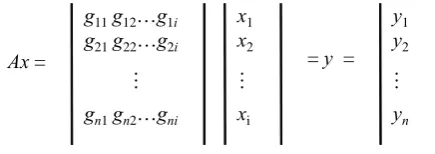
matrices A,xandyis illustrated in Figure 1, where A
is composed of g1, g2, …, gn. When A and y are
available and there is no noise, we can solve x by
Gaussian elimination.
= y =
x1 x2
xi Ax =
g11g12…g1i g21g22…g2i
gn1gn2…gni
y1 y2
yn
# # #
Figure 1. A linear system with binary matrices A,xandy
When noise is taken into consideration, this prob-lem of learning parity is known as the LPN probprob-lem, which is an NP-complete problem [1]. In [3], it takes 2O(n/logn) to getx.For given A, x, y and z, we can re-formulate these parameters as follows:
yk= x · gk, (1)
zk= yk⊕ν. (2)
According to Equations (1) and (2), we can define the LPN problem as follows:
The LPN problem: for given gk, zk and the
prob-ability p, recover x.
2.2. A review of HB-MP′ protocol
Munilla and Peinado proposed HB-MP′ protocol
composed of q rounds [10]. For clarity, the i-th round
is illustrated in Figure 2, where only two messages are exchanged between the reader and a tag. The used no-tations are listed as follows:
x: the secret key shared between the reader and a
tag;
k: the length of x;
a, b: random binary vectors of length k;
ν: noise, where vis a 1-bit value and ν= 1 with
probability p∈[0, 1/2];
⊕: XOR operation;
a · x: the dot product of vectors a and x, which is the shorthand for a · x(mod 2).
Reader Tag
x = xk, xk-1, ..., x1 x = xk, xk-1, ..., x1
a
z = a · x⊕v
choose b, where b · x = z
b
check a · x = ? b · x
q*p failures are accepted
Figure 2. The i-th round of HB-MP′ protocol
The details of HB-MP′ protocol are described as
follows:
Step 1: The reader chooses onerandom binary vector
a of lengthk and sends it to the tag.
Step 2: After receiving a, the tag computes z= a ·
x⊕ν and chooses one k-bit vector b such that b · x = z.
Then, the tag sends b to the reader.
Step 3: The reader checks if b · x= a · x.
After q rounds, the reader accepts the tag if q*p or
less rounds to verify b are failed. It can be proven that
the problem of finding x by given a and b is at least as
difficult as solving the LPN problem [1, 2].
2.3. A review of HB-MP protocol
Although HB-MP′ protocol can resist passive
HB+ protocol. Thus, Munilla and Peinado proposed
HB-MP protocol by modifying HB-MP′ protocol to
withstand man-in-the-middle attack [10]. In HB-MP protocol, there are two secret keys shared between the tag and the reader while the length of these shared
secret keysdoes not coincide with that of exchanged
messages. The notations used in HB-MP protocol are listed as follows:
x, y: secret keys shared between the reader and the
tag;
k: the length of shared secret keys;
m: the length of messages exchanged between the
reader and the tag;
xm: an m-bit binary vector, which is the m least
significant bits of x;
a, b: random binary vectors of length m;
ν: noise, where v is a 1-bit value and ν= 1 with
probability p∈[0, 1/2];
⊕: XOR operation;
a · x: the dot product of vectors a and x, which is the shorthand for a · x(mod 2);
rotate(x, yk) : a bitwise left rotate operator, which
denotes x is left rotated with yk positions.
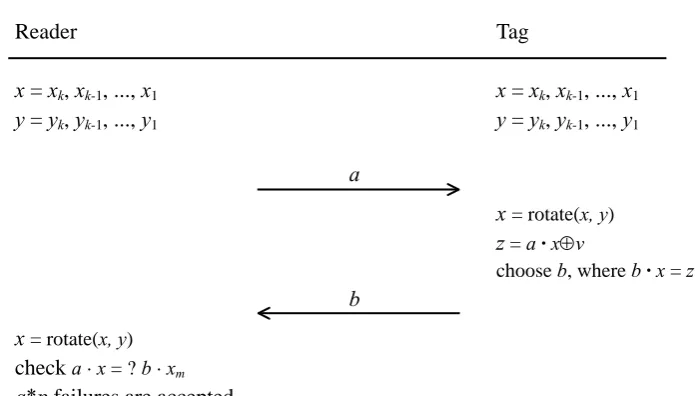
HB-MP protocol is also composed of q rounds. For
simplicity, the i-th round is illustrated in Figure 3, and
the details are showed as follows:
Step 1: The reader first choosesonerandom binary
vector a of length m and sends it to the tag.
Step 2: After receiving a, the tag computes x=
rotate(x, yi), where yi is the i-th bit of y and computes
z= a · xm⊕ν. Then, the tag selects an m-bit binary
vector b such that b · xm = z and sendsb to the reader.
Step 3: The reader computes x = rotate(x, yi),
where yi is the i-th bit of y, and checks if a · xm= b · xm.
Note that the computation result of x = rotate(x, yi)
is only for the i-th round and will not be stored to
replace the original x. After q rounds, the reader
accepts the tag if q*p or less rounds to verify b are
failed.
Reader Tag
x = xk, xk-1, ..., x1 x = xk, xk-1, ..., x1
y = yk, yk-1, ..., y1 y = yk, yk-1, ..., y1
a
x = rotate(x, y)
z = a · x⊕v
choose b, where b · x = z
b x = rotate(x, y)
check a · x = ? b · xm
q*p failures are accepted
Figure 3. The i-th round of HB-MP protocol
3. Security of HB-family and further discussions
In HB-family, it has been proven that HB, HB+
and HB-MP′ protocols suffer from active attacks or
man-in-the-middle attacks. Only HB-MP protocol is claimed to be secure. Unfortunately, we find that
HB-MP protocol is still vulnerable to active attackseven if
two secret keys are used. In the following, we are
going to demonstrate how an attacker cheats the reader with a high probability without knowing what two secret keys are.
In HB-MP protocol, two secret keys x and y are
shared between the reader and the tag. In the i-th
round, a tag and the reader need to compute
x=rotate(x, yi), where yidenotes the i-th bit of secret keyy. Because y is a binary vector, yimust be 1 or 0. If
yi=1, it denotes thatxm=xm-1xm-2…x1xkwhile xm=xmxm
-1…x1 if yi=0. Obviously, only xmxm-1…x1xk are
involved for authentication though x is of length k. If
an attacker tends to cheat the reader, he only needs to
get partial information of x by figuring out where two
consecutive zeros appear. Attack procedure is as follows:
Step 1: The attacker impersonates a RFID tag and guesses the j-th and (j-1)-th bits are zero, where j-1 = k if j =1.
Step 2: After getting binary vector a sent from the
RFID reader, the attacker executes
binary-vector-modification algorithm to get b and sends b to the
Step 3: If the attacker is authenticated successfully,
xjxj-1=00 occurs with high probability. The attacker
regards xjxj-1=00.
From now on, the attacker may simply adopt bi-nary-vector-modification algorithm to modify binary
vector a to cheat the RFID reader.
Binary-vector-modification algorithm
Input: binary vector a= amam-1…a1 of length m and
position (j, j-1), where j-1 = k if j =1
Output: binary vector b of length m
Step 1: Modify ajaj-1 to be aj′aj-1′. Case 1: If ajaj-1=00, aj′aj-1′=10.
Case 2: If ajaj-1=01,aj′aj-1′=11. Case 3: If ajaj-1=10, aj′aj-1′=00. Case 4: If ajaj-1=11, aj′aj-1′=01. Step 2: b = a.
For clarity, we are going to demonstrate the spirit of vector-modification algorithm. In
binary-vector-modification algorithm, ajaj-1 are modified to
be aj′aj-1′according to ajaj-1. One of the following two cases will hold.
Case 1: If yi=0, dot product operation over ajaj-1
will be executed with xjxj-1, respectively. That is, the
difference between the dot product of xm and binary
vector a and that with modified binary vector, b, will
be xj.
Case 2: If yi=1, dot product operation over ajaj-1
will be executed with xj-1xj-2., respectively. That is, the
difference between the dot product of xm and binary
vector a and that with modified binary vector, b, will
be xj-1.
After q rounds, if the attacker is authenticated
successfully, xjxj-1=00 occurs with high probability.
The attacker may regard xjxj-1=00. Later, the attacker
may cheat the RFID reader by simply using
binary-vector-modification algorithm to modify binary vector
a.
Every bit of x may be 0 or 1 with probability 1/2.
One interesting question occurs: whether there are no two consecutive zeros appearing? For this interesting question, we need to further analyze HB-MP protocol. Note that it is determined that two consecutive zeros appear if the last and the first bits are zero. The used symbols are listed as follows:
Sj: the set of all binary vectors of length j which
contain no two consecutive zeros;
Sj,01: the set of all binary vectors of length j which
contain no two consecutive zeros while MSB (most significant bit, MSB) is 0 and LSB (least significant bit, LSB) is 1;
Sj,10: the set of all binary vectors of length j which
contain no two consecutive zeros while MSB is 1 and LSB is 0;
Sj,11: the set of all binary vectors of length j which
contain no two consecutive zeros while MSB is 1 and LSB is 1;
We have Sj= Sj,01∪Sj,10∪Sj,11.
Sj,01 = {A1}∪{B01}, where A∈Sj-1,01 and B∈Sj-2,01.
Sj,10 = {A0}, where A∈ Sj-1,11 ={B10}∪{C10}, where B∈Sj-2,10 and C∈Sj-2,11.
Sj,11 = {A1}∪{B1}, where A∈Sj-1,11 and B∈Sj-1,10. That is,
|Sj,01| = |Sj-1,01| + |Sj-2,01|. |Sj,10| = |Sj-2,10| + |Sj-2,11|. |Sj,11| = |Sj-1,11| + |Sj-1,10|.
|Sj| = |Sj,01| + |Sj,10| + |Sj,11| = |Sj-1,01| + |Sj-2,01| + |Sj-2,10| + |Sj-2,11| + |Sj-1,11| + |Sj-1,10| = |Sj-1| + |Sj-2|.
Let F(n) = |Sj|, we have F(n)=F(n-1)+F(n-2),
where F(2)=3 and F(3)=4. Munilla and Peinado
suggest that the length of x may be 64-bit. According
to the above equation, the number of 64-bit binary vectors containing no two consecutive zeros is
2.372515*1013, and the probability will be
1.286143*10-6. As a result, the probability to find two
consecutive zeros is high. According to the above ana-lyses, HB-MP protocol is still vulnerable to active
attacks even two secret keys x and y are shared
bet-ween the reader and the tag.
Why these LPN-problem-based authentication pro-tocols are insecure even though the LPN problem is an NP-complete problem? It is because the dot product of two binary vectors will be either 0 or 1. All the attacker has to do is finding the position of zero in
HB, HB+ and HB-MP′ protocols and the position of
two consecutive zeros in HB-MP protocol.
4. Conclusions
Though the LPN problemhas been proven to be an
NP-complete problem, these LPN-problem-based au-thentication protocols are insecure. It is because the computation results for authentication will be either 0 or 1. All the attacker has to do is finding the position of one zero or two consecutive zeros. In our opinion, the concept of HB-MP protocol may be adopted in
such a way that the RFID reader and a tag still share
two secrets x and y. But, x for the i-th round should
not be computed by x=rotate(x, yi). We may use
different operations to have x vary in differentrounds
-- Pi =
∑
=
i
j j
y
1
and x=rotate(x,Pi) in thei-th round for
Acknowledgement
This work was supported in part by National Science Council under the grant NSC 98-2221-E-025-007-.
References
[1] E.R. Berlekamp, R.J. McEliece, H.C.A. van Tillborg. On the inherent intractability of certain co-ding problems. IEEE Transactions on Information
Theory, Vol. 24, 1978, 384-386.
[2] A. Blum, M.L. Furst, M.J. Kearns, R.J. Lipton. Cryptographic primitives based on hard learning prob-lems. Advances in Cryptology – CRYPTO’93, Lecture
Notes in Computer Science,Vol. 773, Springer, 1994,
278-291.
[3] A. Blum, A. Kalai, H. Wasserman. Noise-tolerant learning, the parity problem, and the statistical query model. Journal of the ACM, Vol. 50, No. 4, July 2003, 506-519.
[4] J. Bringer, H. Chabanne, E. Dottax. HB++: a lightweight authentication protocol secure against some attacks. Proceedings of IEEE International
Con-ference on Pervasive Services, Workshop on Security, Privacy and Trust in Pervasive and Ubiquitous
Computing- SecPerU’06, 2006, 28-33.
[5] K. Finkenzeller. RFID Handbook. Second edition,
Wiley & Sons, UK, 2002.
[6] H. Gilbert, M. Robshaw, H. Silbert. An active attack against HB+- a provable secure lightweight authenti-cation protocol. Cryptology ePrint Archive, Report 2005/237, 2005, http://eprint.iacr.org.
[7] N.J. Hopper, M. Blum. Secure human identification protocols. Advances in Cryptology - ASYACRYPT’
2001, Lecture Notes in Computer Science, Vol. 2248,
Springer, 2001, 52-66.
[8] A. Juels, S. Weis. Authenticating pervasive devices with human protocols. Advances in Cryptology –
Crypto2005, Lecture Notes in Computer Science, Vol.
3621, Springer, 2005, 293-308.
[9] J. Katz, J.S. Shin. Parallel and concurrent security of the HB and HB+ protocols. Cryptology ePrint archive,
Report 2005/461, 2005,http://eprint.iacr.org.
[10] J. Munilla, A. Peinado. HB-MP: a further step in the HB-family of lightweight authentication protocols.
Computer Networks, Vol. 51, 2007, 2262-2267.
[11] M. Ohkubo, K. Suzuki, S. Kinoshita. Efficient hash-chain based RFID privacy protection scheme.
Procee-dings of Ubiquitous Computing, September 2004.
[12] S. Piramuthu. HB and related lightweight tion protocols for secure RFID tag/reader authentica-tion. Proceedings of CollECTeR Europe Conference,
Basel, Switzerland, June 2006.
[13] S.E. Sarma, S.A. Weis, D.W. Engels. RFID systems and security and privacy implications. Workshop on Cryptographic Hardware and Embedded Systems,
Lecture Notes in Computer Science, Vol. 2523,
Springer, 2002, 454-469.
[14] I. Vajda, L. Buttyan. Lightweight authentication pro-tocols for low-cost RFID tags. Proceedings of
Ubi-quitous Computing, 2003.
[15] S.A. Weis, S.E. Sarma, R.L. Rivest, D.W. Engels. Security and privacy aspects of low-cost radio frequency identification systems. Security in Pervasive
Computing, Lecture Notes in Computer Science, Vol.
2802, Springer, 2004, 201-212.