Habib Cakir
1, a–f, Hasan Uncu
2, a–C, Ozcan Gur
3, b–f, Demet Ozkaramanli Gur
4, C–E,
Ismail Yurekli
1, C–f, Ozsoyler Ibrahim
2, a–ERisk Factors for Intraaortic Balloon Pump Use
in Coronary Artery Bypass Surgery
1 Department of Cardiovascular Surgery, Katip Celebi University ataturk Education and Training Hospital, Izmir, Turkey
2 Department of Cardiovascular Surgery, adana Numune Education and Training Hospital, Turkey 3 Department of Cardiovascular Surgery, Namik Kemal University Medicine faculty, Tekirdag, Turkey 4 Department of Cardiology, Tekirdag State Hospital, Turkey
A – research concept and design; B – collection and/or assembly of data; C – data analysis and interpretation;
D – writing the article; E – critical revision of the article; F – final approval of article; G – other
Abstract
Objectives. The study was aimed at investigating the risk factors of using an intraaortic balloon pump (IabP) in coronary artery bypass surgery and presenting the authors’ clinical experience of IabP use.
Material and Methods. The study included 1094 patients who underwent coronary artery bypass surgery at the authors’ clinic between January 2009 and December 2011. a comparison was made between 17 patients in whom an IabP was used and 1077 patients in whom it was not used.
Results. an intraaortic balloon pump was used in 17 patients (1.55%) out of 1094 patients who underwent isolated coronary artery bypass surgery. The ratio of patients who had had preoperative myocardial infarction within the preceding 30 days, left main coronary artery stenosis of more than 50% and emergency surgery in Group 1 were higher than in Group 2 (p < 0.05). The total cardiopulmonary bypass time of Group 1 was found to be longer than that of Group 2 (p < 0.05). The demand for inotropics after weaning from cardiopulmonary bypass was greater in Group 1 than in Group 2 (p < 0.05). The need for reoperation (because of bleeding) was higher in Group 1 than in Group 2 (p < 0.05). The patients’ stay on the intensive care unit was longer in Group 1 than in Group 2 (p < 0.05). Mortality rates were 29.4% in Group 1 and 1.2% in Group 2 (p < 0.05).
Conclusions. Preoperative myocardial infarction within the preceding 30 days, left main coronary artery stenosis of more than 50%, emergency surgery and long cardiopulmonary bypass time are important risk factors for IabP use in coronary artery bypass surgery (Adv Clin Exp Med 2014, 23, 2, 253–257).
Key words: intraaortic balloon pump, coronary artery bypass surgery, mortality.
adv Clin Exp Med 2014, 23, 2, 253–257 ISSN 1899–5276
ORIGINaL PaPERS
© Copyright by Wroclaw Medical University
In contemporary medical practice, the intraaor-tic balloon pump (IabP) is the most common me-chanical support device used to treat low cardiac output syndrome when medical therapy fails [1]. The IabP reduces afterload and increases coro-nary arterial perfusion pressure by increasing dia-stolic pressure in the aortic root. Thus, the myocar-dial work load and oxygen consumption decrease. IabPs are most commonly used in cardiovascular surgery clinics, in coronary artery bypass graft sur-gery patients during the perioperative period when low cardiac output syndrome develops or when weaning from cardiopulmonary bypass fails.
The aim of this study was to investigate the risk factors of using an IabP in coronary artery bypass surgery and to present the authors’ clinical experience in IabP use.
Material and Methods
made between 17 patients in whom an IabP was used and 1077 patients in whom it was not used. Routine transthoracic echocardiography was car-ried out in all patients before surgery and the ejec-tion fracejec-tion was calculated by Simpson’s method. for induction of anesthesia, fentanyl citrate (fen-tanyl Citrate, abbott) and midazolame (Dormi-cum, Roche) were used; sevoflurane (Sevorane, abott) and vecuronium bromide (Norcuron, Or-ganon) were used for maintenance. Coronary ar-tery bypass grafting was performed either on the beating heart or under cardiopulmonary bypass (CPb). In beating heart operations 2 mg/kg heparin (Nevparin, Mustafa Nevzat) was used, and 4 mg/ /kg heparin was used in operations under CPb. In operations under CPb, mild systemic hypothermia was applied and cardiac arrest was maintained by antegrade warm blood cardioplegia through the aortic root. Cardioplegia given through the aor-tic root was repeated in every 20 min throughout the cross-clamp period. antegrade cardioplegia was given through the proximal end of the sa-phenous vein grafts after each distal anastomosis. Proximal anastomoses were done with side-biting clamps. Neutralization of the heparin was main-tained by protamine hydrochloride (Protamine ICN, Onko) in a ratio of 1:1. an intraaortic bal-loon pump (Datascope CS300, Maquet Datascope Corp., USa) was used in low cardiac output syn-drome when medical therapy failed or in failures of weaning from cardiopulmonary bypass. The use of the IabP was randomized for all patients. The IabP was not used preoperatively. IabP catheters were placed percutaneously via the femoral artery in all patients. The intraaortic balloon pump was placed by surgical exploration of the femoral ar-tery in one patient. Low molecular weight heparin therapy was used in patients after IabP placement until its removal. When the need for inotropic sup-port decreased, patients were weaned from IabP
support and then the catheter was removed. The demographic data of the patients, their opera-tional data and postoperative complications were registered.
Statistical Analysis
SPSS 18.0 software was used for the statisti-cal analysis. Qualitative data were summarized as numbers and percentage; quantitative data were summarized as mean and standard devia-tion (if necessary, as mean, minimum and maxi-mum). The chi square test was used to compare the qualitative data from the two groups. In com-paring quantitative data from two groups, the t-test was used in groups with normal data distri-bution and the Mann-Whitney U test was used for groups with non-normal distribution of data. In comparing numerical measurements of more than two groups, one way variance analysis was used for groups with normal data distribution and the Kruskal-Wallis test was used for groups with non-normal distribution of data. Logistic regres-sion analysis was used to determine mortality risk factors. a p value of less than 0.05 was regarded as statistically significant.
Results
an intraaortic balloon pump was used in 17 patients (1.55%) out of 1094 patients who un-derwent isolated coronary artery bypass surgery. The patients in whom an IabP was inserted con-stituted Group 1 and those in whom it was not used constituted Group 2. The preoperative demo-graphic features of the patients are listed in Table 1. The mean age of Group 1 was 60.7 ± 9.2 years, and the mean age of Group 2 was 59 ± 9.7 years. There was no statistically significant difference
Table 1. Preoperative demographic findings
Group 1 (n = 17) Group 2 (n = 1077) P
age Male female DM HT COPD Ef (%) MI LMCaD Emergency Surgery
60.7 ± 9.2 14 3 4 8 1
40.8 ± 17.3 9
5 8
59 ± 9.7 767 310 346 457 67 46.8 ± 18.8 254 87 31 > 0.05 > 0.05 > 0.05 > 0.05 > 0.05 > 0.05 > 0.05 < 0.05 < 0.05 < 0.05
between two groups in terms of sex, cardiovascular risk factors like diabetes mellitus (DM), hyperten-sion (HT), chronic obstructive pulmonary disease (COPD) or ejection fraction. The ratio of patients with preoperative myocardial infarction within the preceding 30 days, left main coronary artery ste-nosis of more than 50% and emergency surgery in Group 1 was higher than in Group 2, and the dif-ference was statistically significant (p < 0.05). Cor-onary artery bypass surgery was carried out on the beating heart in two patients in Group 1 and 71 pa-tients in Group 2 (p = 0.315). although the mean cross clamping time in Group 1 was longer than that in Group 2, the difference was not statistical-ly significant (p = 0.282). The total cardiopulmo-nary bypass time for Group 1 was longer than for Group 2 (p = 0.012). The demand for inotropics after weaning from cardiopulmonary bypass was greater in Group 1 than Group 2 (p = 0.003). The Intraoperative findings and data are listed in Table 2. Thrombocytopenia was seen in 6 patients and
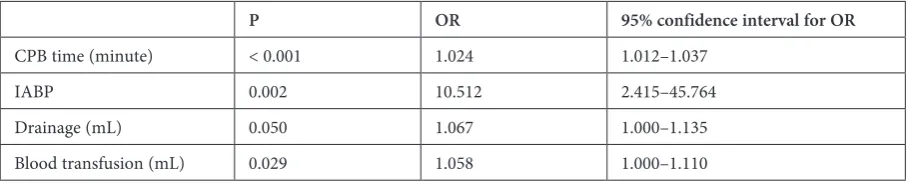
leg ischemia was noted in one patient in Group 1. The need for reoperation (because of bleeding) was higher in Group 1 than in Group 2 (p = 0.013). It was found that drainage and the need for blood transfusion were higher in Group 1 than in Group 2 (p > 0.05). When compared in terms of the inci-dence of postoperative atrial fibrillation, the du-ration of the hospital stay and the use of levosi-mendan, the two groups showed no statistically significant differences (p > 0.05). The patients’ stay in the intensive care unit was longer in Group 1 than in Group 2 (p < 0.001). Mortality rates were 29.4% in Group 1 and 1.2% in Group 2 (p < 0.001). all the mortalities in Group 1 were due to multio-rgan failure after low cardiac output. The compli-cations of the cases are listed in Table 3. Multivari-ant analyses showed that cardiopulmonary bypass time, the use of an intraaortic balloon pump, the amount of drainage and transfused blood were the most important parameters that affected mortal-ity (Table 4).
Table 2. Intraoperative findings
Group 1 (n = 17) Group 2 (n = 1077) P
Cross Clamp Time (min) 47.4 ± 38.2 47.4 ± 38.2 > 0.05 Cardiopulmonary bypass Time (min) 105.8 ± 68 67.1 ± 29.2 < 0.05
beating Heart (n) 2 71 > 0.05
Need for inotropic support (n) 12 361 < 0.05
Table 3. Complications
Group 1 (n = 17) Group 2 (n = 1077) P
amount of blood transfusion (mL) 588.2 ± 545.3 428.9 ± 387.1 > 0.05 Drainage (mL) 755.9 ± 841.1 621.6 ± 421.4 > 0.05
Reoperation (n) 3 30 < 0.05
CVa 0 2 > 0.05
Exitus 5 14 < 0.05
CVa – cerebrovascular accident.
Table 4. Multi-variant analyses for mortality
P OR 95% confidence interval for OR
CPb time (minute) < 0.001 1.024 1.012–1.037
IabP 0.002 10.512 2.415–45.764
Drainage (mL) 0.050 1.067 1.000–1.135
Discussion
Low cardiac output syndrome, which develops after coronary artery bypass surgery, is a serious com-plication with high mortality [2]. Low cardiac output is seen more frequently in patients who have preop-erative left ventricular dysfunction, inadequate pro-tection of the myocardium, long cross clamp and car-diopulmonary bypass time, perioperative myocardial infarction and incomplete revascularization [3]. The intraaortic balloon pump is the most commonly used mechanical support device to treat low cardiac out-put syndrome when medical therapy fails [1]. Miceli et al. reported the rate of IabP use after coronary artery bypass surgery to be 2.1% [4]. In the current study, the rate of IabP use was calculated as 1.55% in isolated coronary artery bypass surgery.
In coronary artery bypass surgery, identifying high risk patients preoperatively is of critical im-portance for the surgeon’s operation plan and for postoperative management. Preoperative prophy-lactic usage of an IabP is still controversial in pa-tients who have stable hemodynamic parameters but are at high risk [5]. In some studies, it has been found that preoperative use of an IabP in patients who have stable hemodynamic parameters but are at high risk has reduced the incidence of postoper-ative myocardial infarction, low cardiac output and mortality [5, 6]. There is no consensus on deter-mining which high risk patients will benefit from IabP in coronary artery bypass surgery [4]. In the study conducted by Miceli et al., it was detected that preoperative myocardial infarction within the preceding 30 days, left main coronary artery steno-sis of more than 50%, emergency operation, pre-vious cardiac surgery, age older than 70 years and poor left ventricular function were important risk factors for the need for IabP use [4]. In the present study, it was found that preoperative myocardial infarction within the preceding 30 days, left main coronary artery stenosis of more than 50%, emer-gency operation and a long cardiopulmonary by-pass time were important risk factors necessitating IabP in isolated coronary artery bypass graft sur-gery. On the other hand, the present study did not demonstrate any effect of age, sex, diabetes melli-tus, hypertension, chronic obstructive pulmonary disease or ejection fraction on the need for IabP.
Despite the positive hemodynamic effects of IabP, the complication rates related to IabPs are
not low. In a study which reviewed the recent lit-erature, the complication rates related to IabPs were reported to be between 32.6% and 50% [7]. IabPs may lead to complications like thrombocy-topenia, bleeding, injury to the aorta and iliac ar-teries, dissection, thromboembolism and leg isch-emia. Thrombocytopenia and bleeding are the most commons complications [8]. additionally, complications related to malpositioning of the bal-loon catheter can be observed [9]. In the current study, the most common complication was throm-bocytopenia (35.2%). Mild leg ischemia developed in one patient, which diminished in the course of the hospital stay. although it was speculated that open surgical insertion of IabP via the femoral ar-tery can decrease the vascular complication rates, Iverson et al. reported decreasing vascular compli-cation rates with IabP catheters placed into fem-oral artery percutaneously [10, 11]. In the present study, all IabP catheters except one were placed percutaneously via the femoral artery and no seri-ous vascular complications were seen.
In this study, it was found that the patients in whom an IabP was placed had more bleeding; the need for reoperation (because of bleeding) was more common; and their stay in the intensive care unit was longer than for patients who did not re-ceive IabP therapy. Mortality rates in patients that undergo CabG surgery and have IabP placement are reported to be between 27% and 52.6% [1, 6, 12, 13]. In the present study, it was found that the mortality rate of patients that were treated with an IabP was 29.4% and the mortality rate of patients that were not treated with an IabP was 1.2%.
The authors concluded that the mortality rates of patients that undergo coronary artery bypass sur-gery and receive an IabP are still high. Preopera-tive myocardial infarction within the preceding 30 days, left main coronary artery disease greater than 50%, emergency surgery and long cardiopulmonary bypass time are important risk factors for IabP us-age in coronary artery bypass surgery. although the number of cases in Group 1 was small, the results of this study may contribute to the formulation of a consensus statement that preoperative prophylac-tic IabP insertion might be beneficial in patients with a high risk for coronary bypass surgery. fur-ther research with larger populations is needed to determine the effectiveness of preoperative prophy-lactic IabP insertion in high risk patients.
References
Baskett RJF, Ghali WA, Maitland A, Hirsh GM:
[1] The intraaortic balloon pump in cardiac surgery. ann Thorac Surg 2002, 74, 1276–1287.
Rao V:
Richenbacher WE, Pierce WS:
[3] Treatment of heart failure: assisted circulation. In: Heart disease. a textbook of cardiovascular medicine. Eds.: braunwald E, Zipes DP, Libby P. Saunders, Philadelphia 2001, 6th ed., 600–614.
Miceli A, Duggan JMS, Capoun R, Romeo F, Caputo MAngelini GD:
[4] a Clinical Score to Predict the Need for
Intraaortic balloon Pump in Patients Undergoing Coronary artery bypass Grafting. ann Thorac Surg 2010, 90, 522–526.
Miceli A, Fiorani B, Danesi TH, Melina G, Sinatra R:
[5] Prophylactic intra-aortic balloon pump in high-risk patients undergoing coronary artery bypass grafting: a propensity score analysis. Interact Cardiovasc Thorac Surg 2009, 9, 291–294.
Creswell LL, Rosenbloom M, Cox JL, Ferguson TB Sr, Kouchoukos NT, Spray TL:
[6] Intraaortic balloon
counter-pulsation: patterns of usage and outcome in cardiac surgery patients. ann Thorac Surg 1992, 54, 11–20.
Parissis H, Soo A, Alao B:
[7] Intra-aortic balloon pump: literature review of risk factors related to complications of the intraaortic balloon pump. J Cardiothorac Surg 2011, 6, 147.
Vales L, Kanei Y, Ephrem G, Misra D:
[8] Intra-aortic balloon pump use and outcomes with current therapies. J Invasive Cardiol 2011, 23, 116–119.
Rastan AJ, Tillmann E, Subramanian S, Lehmkuhl L, Funkat AK, Leontyev S:
[9] Visceral arterial compromise
dur-ing intra-aortic balloon counterpulsation therapy. Circulation 2010, 14, 122, 92–99.
Colyer W R, Moore JA, Burket MW, Cooper CJ:
[10] Intraaortic balloon pump insertion after percutaneous revascu-larization in patients with severe peripheral vascular disease. Cathet Cardiovasc Diagn 1997, 42, l–6.
Iverson LI, Herfindahl G, Ecker RR, Young JN, Ennix CL, Lee J:
[11] Vascular complications of intraaortic balloon counterpulsation. am J Surg 1987, 154, 99–103.
Arafa OE, Pedersen TH, Svennevig JL, Fosse E, Geiran OR:
[12] Intraaortic balloon pump in open heart operations: 10-year follow-up with risk analysis. ann Thorac Surg 1998, 65, 741–747.
Torchiana DF, Hirsh G, Buckley MJ, Hahn C, Allyn JW, Akins CW:
[13] Intraaortic balloon pumping for cardiac
support: trends in practice and outcome, 1968 to 1995. J Thorac Cardiovasc Surg 1997, 113, 758–764.
Address for correspondence:
Habib Cakir
Department of Cardiovascular Surgery
Katip Celebi Universitesi ataturk Education and Training Hospital Yeşilyurt, Izmir
Turkey
Tel.: + 90 532 485 9051
E-mail: [email protected]
Conflict of interest: None declared