−
Effect of Submerged Multi-pass Friction Stir Process on
the Mechanical and Microstructural Properties of Al7075
Alloy
S.H. Nourbakhsh
a,∗, A. Atrian
baMechanical Engineering Department, Shahrekord University, Shahrekord, Iran.
bMechanical Engineering Department, Najafabad Branch, Islamic Azad University, Najafabad, Iran.
Article info
Article history: Received 24 Jane 2017 Received in revised form 10 August 2017Accepted 05 September 2017
Keywords:
Friction stir process (FSP) Submerged
Overlap Al 7075
Characterization
Abstract
The friction stir process (FSP) is a solid-state process which is used for severe plastic deformation of materials and modification in microstructure. The microstructure evolution, which iscaused by dynamic recrystallization, changes the mechanical properties of the material. In this study, the FSP of the surface of Al7075 alloy is carried out using 0% overlapping of passes. The FSP caused the non-uniform structure of the raw material with an average grain size of 18 micrometers to change into a uniform structure. This process refined the structure to the grain size of about 8.2 and 12.1 micrometersfor overlapped regions in water and air respectively. In order to study the mechanical properties, the tensile specimens were preparedin both parallel and perpendicular directions to the pin motion. Results showed an improvement in the yield stress, ultimate stress, and elongation of the specimens after FSP. Furtheremore, Vickers hardness of the overlapping specimens decreased compared to the raw materials after applying the FSP.
1. Introduction
Aluminum alloy 7075 is one of the most high-strength aluminum alloys which is well-suited for applications in automotive, military, and aerospace industries.This al-loy has high specific strength, good fracture toughness, and proper cracking resistance [1,2]. Recent research has focused on the improvement of the alloy structure in order to enhance the mechanical strength using se-vere deformation processes such as the FSP. FSP is a solid-state process in which a rotating tool containing a shoulder and a pin is inserted into the specimen and moves in the desired direction with constant traverse and rotational velocities. In the process according to the traverse and rotational velocities, there are two sides; advancing and retreating. When the linear
direc-tion of rotadirec-tional velocity is in direcdirec-tion of the linear velocity, the side is called the advancing and when the linear direction of rotational velocity is opposite to the linear velocity, it is called the retreating. FSP can be applied in single pass or multipass conditions; Region affected by single pass FSP is approximately equal to the size of a pin. By the use of a pin with a diameter of 8mm, a region of 10-14mm is affected and refined after the single-pass FSP. This small region may not be appropriate for engineering applications [3]. Many studies have been conducted on single-pass FSP[4-10]. In the multipass FSP the refined region of each pass overlaps with the refined region of the next pass to a certain extent in order to create a surface with the desired width.
Hitherto, few researches have been conducted on
∗Corresponding author: S.H. Nourbakhsh (Assistant Professor) E-mail address: [email protected]
http://dx.doi.org/10.22084/jrstan.2017.14013.1022 ISSN: 2588-2597
the Al7075 alloy overlapping processes [6,11-13] . Dutta et al. [11] developed an overlapping region with a width of 80mm and Johannes and Mishra [12] devel-oped a region by the use of 4 overlapping passes. Both studies only examined the super-plasticity properties of the regions. Dutta et al. [11] obtained an elongation of 378% at a strain rate of 0.01s−1 and atemperature
of 723◦K. In both studies, the overlapping process was performed at the ambient temperature and tensile specimens were prepared in the direction of pin mo-tion. Using rapid cooling during the process of over-lapping, SU et al. [13] observed grains with the size of about 250nm in Al7075 alloy; however, there were no studies on the mechanical properties. Nakata et al. [14] studied the aluminum cast ADC12, Ma et al. [3] studied the aluminum cast A356 and Nascimento et al. [15] studied the Aluminum 5083 and 7072 in terms of the overlapping of passes in FSP and exam-ined the microstructure and mechanical properties of the affected region at ambient temperature. The me-chanical properties were studied in both parallel and perpendicular directions to the process. Nakata et al. [14] found that the mechanical strength and ductility of the region in parallel and perpendicular directions to the process are almost similar and are more than those of the base metal.
The overlapping of passes can be performed in two ways, by the use of advancing side or retreating side. The effects of each one were studied by Gandra et al. [16] on the microstructure and bending strength of Al5083 alloy. It was concluded that the overlapping process with the advancing side forms a more uniform layer and the overlapping process with the retreating side forms a layer with higher strength, while the hard-ness distribution of both sides remainedthe same. The way the next pass develops is another issue to be con-sidered in the overlapping of passes, i.e. whether the next pass should immediately follow the previous one or the workpiece must have time to rest, so its temper-ature drops to the level of ambient tempertemper-ature before the next pass starts. The issue was studied by Ramesh et al. [17] on Al5086 alloy. It was observed that in both cases, the mechanical properties were degraded compared to the single pass and even the raw material, and the results were less desirable in the perpendicular direction to the process compared to the parallel direc-tion. Generally, the results of the process in which the specimens were allowed to rest in order to reach the room temperature were more positive. Pradeep and Pancholi [18] performed the overlapping of passes on the Al5086 alloy in two different states of rotational and linear velocities and studied the super-plasticity properties. Better results wereobtained from the state in which the specimen temperature did not increase because of lower rotational velocity and higher linear velocity.
As it is mentioned above, for producing surfaces
op-erational in engineering applications, single pass FSP is not suitable and overlapping FSP must be used. Hither to, few researches have been conducted on the overlap-ping FSP of Al7075, which their results are different and their focus is on the superplasticity properties. In this paper, a comprehensive research on the mechan-ical and microstructural properties of the overlapped region was conducted. Moreover, no researches have been investigated the effect of submerged multipass FSP on the mechanical and microstructural properties of Al7075. The current study performs the overlapping process on the surface of Al7075 in both air and wa-ter. The microstructure and mechanical properties of the overlapping regions were examined in both parallel and perpendicular directions to the pin motion, which is the other advantages of this paper.
2. Experimental Work
Samples of Al7075 were cut and prepared with the di-mensions of 10×10cm and the thickness of 10mm. A die was prepared in order to conduct the FSP in the water as shown in Fig. 1. Water with the dis-charge rate of 0.5 liter per minute flowed into and out of the container. A thermocouple was used to record water temperature. Given the water discharge, wa-ter temperature remained stable at 30◦C. The size of shoulder diameter, pindiameter, and pin length were considered to 18, 5 and 8mm respectively. The single-pass friction stir processed specimens were considered with 40 and 63mm/min for traverse speed and 800 and 1250rev/min for rotational velocity in the water and at the ambient temperature (8 different conditions).
The mechanical strength of the single-pass regions was calculated. The best condition were for the pro-cess with the traverse and rotational velocities of 1250 and 63 for the ambient temperature and with the ro-tational and traverse velocities of 1250 and 43 for the submerged FSP. These velocities were determined for performing overlap processing. The overlapping pro-cess of passes was performed at 0 percent according to equation (1) [15,16]:
OR= 1− [
l dpin
]
(1)
Wherel,dpin, andOR(overlap ratio) are the distance
Fig. 1. The die used for submerged friction stir pro-cess.
Fig. 2. a) Overlapped region, b) Dimensions of the tensile specimen.
According to Fig. 2b, the tensile specimens were separated using an electro discharge machine in both the parallel and perpendicular directions to the pro-cess. To remove the surface effects, samples were pol-ished. Tensile tests were conducted with the strain rate of 0.01s−1 according to ASTM E8 standard. The
micro-hardness of specimens was calculated under the condition of 100 grf and 30 seconds. The microstruc-ture of specimens was observed using an optical micro-scope after etching the specimen surface with Kellers solution (2mL HF, 3mL HCL, 20mL HNO3, 175mL)
for 10 seconds. For determining the grain size mean linear intercept method was used.
3. Results and Discussion
3.1. Macro and Micro Structure
Fig. 3 shows the macrostructure of specimens after the overlap. A sit can be seen, the transition zones are generated between the passes. It is due to the 0%
overlapping. Ni et al. [19] also mentioned that if the overlapping is other than 0%, these zones will not exist. These zones exist because the transition zones are not processed twice. Ramesh et al. [17] observed this case in an overlapping process in which the temperature of the specimen is reduced to ambient temperature prior to the next pass.
Fig. 3. Macro structure of the overlapped region.
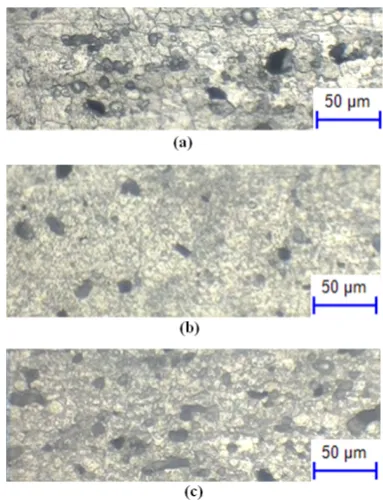
Fig. 4 shows the microstructure of the overlapped regions. Fig. 4a shows the raw material structure with non-uniformity with grain size of 18±5.2 micrometers. Moreover, Fig. 4b and 4c show the overlapping region structure overlapped in water 8.2±1.6 and 12.1±2.3 air with the grain size of and micrometers respectively.
Fig. 4. Microstructure of different regions, a) Base Material, b) Submerged friction stir process, c) In air friction stir process.
by consecutive passes had no significant effect on the grain size and the growth of previous passes. This find-ing is consistent with that of other studies [12,13,17]. SU et al. [13] explained that the recrystallized grains in high temperature processes have greater stability. Moreover, because of the rapid cooling, the tempera-ture drops quickly and there is not enough time for the grains to regrow. The grains had greater uniformity with the overlapping process in the water; however, in the air, the grain size had more changes and the size decreased from the surface to the depth. SU et al. [13] reported the reduction of the grain size from the sur-face of the specimen to the depth during the friction stir process. Ni et al. [19] explained that it is due to the difference in material flow above and below the overlapping region. The grain size obtained from the overlapping process was similar to the grain size ob-tained from the single-pass friction stir process. The similarity between the grain sizes obtained in the over-lapping region with that of the single-pass FSP was also observed in other studies [13,19].
3.2. Micro-hardness
The hardness was measured at 2mm thickness of the top surface of specimens. The Vickers hardness of raw material was equal to 156HV. The average hardness of the overlapping region was also 148HV in the water and 131HV in the air. The hardness of overlapping region dropped in comparison with the raw material; however, the hardness of overlapping region in the wa-ter increased in comparison with that in the air. Other studies also confirm an increase in the hardness of the region affected by the FSP in water compared with that in the air [20]. As observed in the microstructure section, the grain size decreased in the overlapping re-gion, according to Hall-Petch equationHv=Ho+kd12,
which is expected to havea greater hardness. How-ever, the hardness of regions affected by the FSP is decreased. In aluminum alloys, especially Al-Zn-Mg alloys, the heat treatment conditions creating age hard-ening in material also affect the hardness and mechan-ical strength. Hardness reduction while the grain size has decreased can be attributed to the dissolution of alloy deposits. Locally increased temperature in the regions affected by the FSP results in the dissolution of deposits in the materials [21]. Tadivaka et al. [22] also examined the reduction in hardness of a region
affected by the FSP in the Al7075 and explained the phenomenon according to the dissolution of deposits. The hardness in the transition zones of the overlapping regions was slightly higher than that of other regions, which can be due to finer grain size in those zones. Ramesh et al. [17] also reported an increase in the hardness of the transition zones. The hardness of the specimens with overlapping regions deposited in water was similar to the single-pass FSP; however, the hard-ness was lower in the overlapping regions deposited in air in comparison with the single-pass FSP. Ni et al. [19] also reported the similarity between the hardness of the overlapping regions inthe single-pass state; how-ever, Ramesh et al. [17] reported that the hardness of overlapping region was less than that in the single-pass state.
3.3. Mechanical Properties
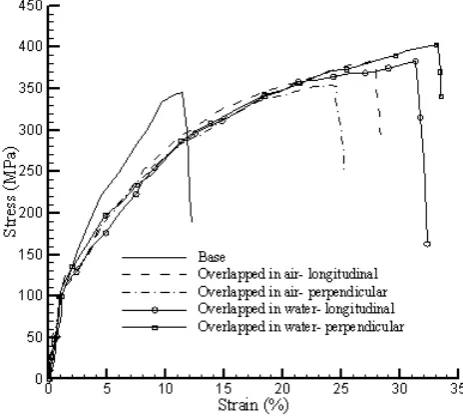
The tensile test specimens were prepared from the FSP region in parallel and perpendicular directions of the pin movement. Fig. 5 shows the tensile specimens af-ter the test. Fig. 6 shows the stress-strain curve for all samples; the numerical values of the yield stress, ulti-mate stress, and elongation of different states are given in Table 1. Based on Table 1, in the overlapping regions deposited in the air, the yield stress and elongation in-creased in all states. Also, ultimate stress inin-creased in all states except in the perpendicular direction to the process, which can be due to the uniformity and the reduction of the grain size.
Fig. 5. Tensile specimens after the test, a) Submerged in water, b) In ambient temperature.
Table 1
Yield stress, ultimate stress, and elongation for overlapping FSP samples. Yield Stress
(MPa)
Changes (%)
Ultimate Stress (MPa)
Changes (%)
Elongation (%)
Base 100±2.5 - 350±3.2 - 10.5
Fig. 6. Stress-strain curve for all samples.
Venkateswarlu et al. [23] reported that 0% over-lapping coating on AZ31 alloy creates a region more uniform than that created by any other percentage. According to Table 1, the improvement of mechani-cal properties was greater in the submerged specimens. This case is justified while considering a further reduc-tion in grain size and uniformity of grains in the over-lapped regions in water. An increase in the ultimate stress and elongation is more noticeable in the speci-mens in perpendicular direction to the pin motion in the overlapped regions in water than in air. Rapid cool-ing results in very small thermomechanical and heat affected zones which are not identifiable; however, the influence on the results of the tensile strength of the material is noticeable. SU et al. [13] have also exam-ined this issue.
As mentioned before, the mechanical properties of Al7075 is dependent on the changes in grain size and its distribution as well as the heat treatment applied during the FSP. The alloy consists of up to 6% Zinc, up to 3% Magnesium, up to 2% Copper and up to 0.4% Chromium, of which the elements, Chromium and Copper, prevent any failure during the process, and lead to an improvement in the mechanical proper-ties and resistance to stress-corrosion cracking. More-over, Magnesium controls the growth of the grain and promotes the grain refinement. It prevents the growth of grains during the process and increases the strength. Chromium and Manganese combine with some of the main alloying elements, form the com-pounds of Al12Mg2Cr and Al20Cu2Mn3 and separate
the elements used in the solid solution. Generally, it can be concluded that the improvement in mechan-ical properties can be dependent on the removal of the pores and cracks, and the promotion of the refine-ment, homogeneity and uniformity of the
microstruc-tures [15].
4. Conclusions
In this study, the FSP of overlapping regions of Al7075 was conducted. The process was performed in both water and air. Microstructure and mechanical prop-erties of the overlapping regions were investigated and the following results were obtained:
1. By conducting the process under the water, the overlapping process can be performed consecu-tively while preventing any increase in the tem-perature of the workpiece, which helps reduce the required time to apply the overlapping process over the entire surface of the workpiece.
2. The uniformity of grain size across and in the thickness of the region overlapped in water was more thanthe others. The formation of transition zones was observed in overlapped regions, both in water and air.
3. The mechanical properties of overlapping regions in both the parallel and perpendicular directions to the process improved in comparison with the raw materials.
4. The mechanical properties and hardness of Al7075 are dependent on the microstructural evo-lutionas well as the changes in the deposits aris-ing from the heat treatment applied duraris-ing FSP.
References
[1] A. Atrian, G.H. Majzoobi, S.H. Nourbakhsh, S.A. Galehdari, R. Masoudi Nejad, Evaluation of ten-sile strength of Al7075-SiC nanocomposite com-pacted by gas gun using spherical indentation test and neural networks, Adv. Powder. Technol., 27(4) (2016) 1821-1827.
[2] V.V. Patel, V. Badheka, A. Kumar, Effect of polygonal pin profiles on friction stir processed su-perplasticity of AA7075 alloy, J. Mater. Process. Technol., 240 (2017) 68-76.
[3] Z.Y. Ma, S.R. Sharma, R.S. Mishra, Effect of multiple-pass friction stir processing on mi-crostructure and tensile properties of a cast aluminumsilicon alloy, Scripta Materialia, 54(9) (2006) 1623-1626.
[5] M. Navaser, M. Atapour, Effect of Friction Stir Processing on Pitting Corrosion and Intergranu-lar Attack of 7075 Aluminum Alloy, J. Mater. Sci. Tech., 33(2) (2017) 155-165.
[6] A. Orozco-Caballero, M. lvarez-Leal, D. Verdera, P. Rey, O.A. Ruano, F. Carreo, Evaluation of the mechanical anisotropy and the deformation mech-anism in a multi-pass friction stir processed Al-Zn-Mg-Cu alloy, Mater. Design., 125 (2017) 116-125.
[7] H.G. Rana, V.J. Badheka, A. Kumar, Fabrication of Al7075 / B4C Surface Composite by Novel Fric-tion Stir Processing (FSP) and InvestigaFric-tion on Wear Properties, Procedia. Tech., 23 (2016) 519-528.
[8] Y. Wang, R.S. Mishra, Finite element simula-tion of selective superplastic forming of fricsimula-tion stir processed 7075 Al alloy, Mater. Sci. Eng. A., 463(1) (2007) 245-248.
[9] A. Azizi, Influence of friction stir welding pro-cess and tool parameters on strength properties of AA7075-T6 aluminum alloy joints, Modares Mech. Eng., 13(12) (2013) 56-66.
[10] A. Lotfi, S. nourouzi, The microstructure and me-chanical properties of friction stir welded 7075-T6 aluminum alloy by the use of design of experiment, Modares Mech. Eng., 14(3) (2014) 17-26.
[11] A. Dutta, I. Charit, L.B. Johannes, R.S. Mishra, Deep cup forming by superplastic punch stretch-ing of friction stir processed 7075 Al alloy, Mater. Sci. Eng. A., 395(1) (2005) 173-179.
[12] L.B. Johannes, R.S. Mishra, Multiple passes of friction stir processing for the creation of su-perplastic 7075 aluminum, Mater. Sci. Eng. A., 464(1) (2007) 255-260.
[13] J.Q. Su, T.W. Nelson, C.J. Sterling, Friction stir processing of large-area bulk UFG aluminum al-loys, Scripta Materialia, 52(2) (2005) 135-140.
[14] K. Nakata, Y.G. Kim, H. Fujii, T. Tsumura, T. Komazaki, Improvement of mechanical properties of aluminum die casting alloy by multi-pass fric-tion stir processing, Mater. Sci. Eng. A., 437(2) (2006) 274-280.
[15] F. Nascimento, T. Santos, P. Vila¸ca, R.M. Mi-randa, L. Quintino, Microstructural modification and ductility enhancement of surfaces modified by FSP in aluminium alloys, Mater. Sci. Eng. A., 506(1) (2009) 16-22.
[16] J. Gandra, R.M. Miranda, P. Vila¸ca, Effect of overlapping direction in multipass friction stir pro-cessing, Mater. Sci. Eng. A., 528(16) (2011) 5592-5599.
[17] K.N. Ramesh, S. Pradeep, V. Pancholi, Multipass friction-stir processing and its effect on mechanical properties of aluminum alloy 5086, Metall. Mater. Trans. A., 43(11) (2012) 4311-4319.
[18] S. Pradeep, V. Pancholi, Effect of microstruc-tural inhomogeneity on superplastic behaviour of multipass friction stir processed aluminium alloy, Mater. Sci. Eng. A., 561 (2013) 78-87.
[19] D.R. Ni, P. Xue, Z.Y. Ma, Effect of multiple-pass friction stir processing overlapping on microstruc-ture and mechanical properties of as-Cast NiAl Bronze, Metall. Mater. Trans. A., 42(8) (2011) 2125-2135.
[20] J.H. Cho, S.H. Han, C.G. Lee, Cooling effect on microstructure and mechanical properties during friction stir welding of Al-Mg-Si aluminum alloys, Mater. Lett., 180 (2016) 157-161.
[21] S. Rajakumar, C. Muralidharan, V. Balasubrama-nian, Influence of friction stir welding process and tool parameters on strength properties of AA7075-T6 aluminium alloy joints, Mater. Design., 32(2) (2011) 535-549.
[22] T.S. Rao, G.M. Reddy, S.R.K. Rao, Investigation on variations in hardness and microstructure of in-process cooled 7075 aluminum alloy friction stir welds, Mater. Test., 59(2) (2017) 155-160.