P
age
1
Employment Oriented Development Strategy: Evaluation of
MGNREGA in Haryana
Dr. Sunil* and Ms. Anupriya**
*Lecturer ( Economics ), Govt. Sr. Sec. School, Gubhana, Jhajjar.
**Assistant professorKamrah Institute of Information Technology ( KIIT), Gurgaon
ABSTRACT:
MGNREGA not only provide employment to the poor people in the rural areas but also generate employment opportunities outside MGNREGA by generating useful and long term assets. We are looking MGNREGA as an alternative development strategy. To remove poverty, the employment should be the right of the people. It will not only provide empowerment to the poor people but also enhance the growth rate of the economy. Present study examines the Impact of MGNREGA at both the individual level and community level.
INTRODUCTION
Development strategy embedding high growth rate of GDP with social justice has been given high priority in India since independence. It was believed by the policy makers that a high growth rate was essential to sustain the burden of full employment but high growth rate has failed to create sufficient jobs for the poor people and alleviate poverty (Bhaduri, 2005). Even after six decades of India‟s independence, the country still fails to arrest abject poverty, illiteracy, malnutrition, social inequality and so on. Also the employment generated was of poor quality. This is more valid for rural areas where employment grew at the rate of 0.58%, which was far below 1.7%, the population growth rate (Patnaik, 2005). Poverty rate estimated by NSSO 61st round was 25.7% for urban areas and 28.3%for rural areas in 2004-05 and unemployment rate was 8% at current daily status (CDS) for rural and urban areas (Economic Survey, 2011-12). Employment in both organized and unorganized sectors has been growing at a miserably low rate. The organized public and private sectors provide employment to less than 10% people of the Indian labour force and employment growth steadily went down over the last two decade of liberalization and it turned negative since 1994 and the growth between 1994-1998 was -0.38% (Singh, 2008). What is worse, unorganized sector provides employment to more than 90% people, where work hours and wage rates are not fixed like in the formal sector. For example, poor people might work very long hours but earn so little that they could be considered time-disposition-wise employed and income-wise unemployed (Bhaduri, 2005).
P
age
2
economic development. Thus for the full employment and all over development, policy makers must reverse the strategy of „growth first‟ and „full employment‟ second „to „employment first; with growth as an outcome‟ (Bhaduri, 2005).
The Mahatma Gandhi National Rural Employment Guarantee Programme (MGNREGP) can thus be interpreted as a timely intervention. Employment Guarantee Bill 2004, which was a part of Common Minimum Programme (CMP) was introduced in parliament by UPA government in December 2004. After having an intense debate on its desirability and feasibility, it was passed by the government on 23rd August 2005 and was launched on 2nd February 2006 in 200 hundred most backward districts and was to be extended to all over the country within five year in a phased manner. From April 2008 the scheme has been extended to all the districts across the country.
MGNREGA not only provide employment to the poor people in the rural areas but also generate employment opportunities outside MGNREGA by generating useful and long term assets. Successful implementation of the MGNREGA can achieve the twin objective of employment generation in rural India, and at the same time address the issue of falling agricultural productivity through creation of durable assets (Banerjee and Partha Sahu, 2010). Construction of the well under MGNREGA in Ranchi district of Jharkhand would not only boost confidence in the Act, but also lead to the creation of much needed productive assets in rural areas (Aggerwal and et al). The study conducted in the Chhattisgarh, Jharkhand and Orissa showed that the net household income increased in the range of 16% to 23% in 2008-09 as compared to that in 2005-06 in Chhattisgarh. In Jharkhand was in the range of 60-70%, while it was in the range of 30- 40% in Orissa where it was implemented in the first phase (Banerjee and Partha Sahu, 2010).
The paper is divided into three sections. Section I describes the status of the employment and poverty in the rural areas. Second section explain the methodology used in the study. Individual and community level impact of MGNREGS has been describes in the section III.
METHODOLOGY USED IN THE STUDY
P
age
3
IMPACT OF MGNREGA ON INCOME LEVEL OF HOUSEHOLDS
One of the important aspects of impact assessment of the scheme is to measure the increase in income levels of the beneficiaries. Annual increase in income of the beneficiaries was categorized into three groups such as (a) less than Rs. 2,000, (b) between Rs. 2,000 and 4,000, (c) above Rs. 4,000. The categorization was done on the basis of the information got from the survey about increase in the income of beneficiaries
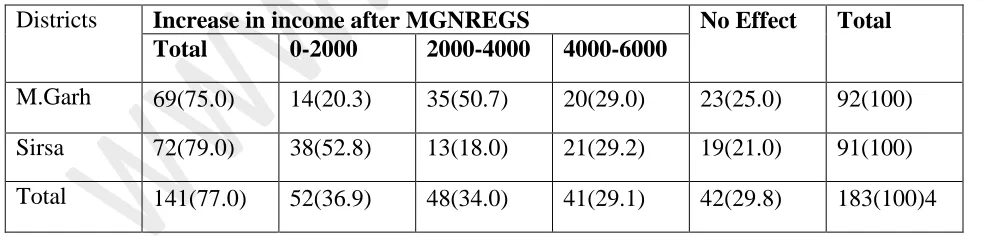
Table 1 brings out that out of the total 183 households, 77% beneficiaries i.e. 141 households reported an increase in the income after the implementation of MGNREGS. Out of the households whose income has increased, 73% households reported of income increased between“2,000 to 6,000”. Out of the total households, 23 percent of households reported no effect on income. These were those households who get less number of work days under MGNREGS. No doubt the income of the respondents has increased due to MGNREGS. Some respondents reported that had they not worked with MGNREGS, they would have left with no work. They visualize MGNREGS as a great opportunity for uplifting the life of rural poor. As against this, some households who had worked less number of work days were unhappy with the scheme. They reported that work is not provided regularly under MGNREGS and wage rate was also low that is why they don‟t want to work under it. Regular employment leads to high levels of employment demand, while low levels may create a “discouraged worker effect”, whereby potential workers stop showing interest in the scheme. They also revealed that if work is provided regularly in the off season than the MGNREGS was helpful in enhancing the standard of living in the rural areas. The MGNREGS is great scheme if implemented well in the villages. One thing also comes out from the survey that the respondents from Sirsa districts were more happy to work under MGNREGA than the Mahandergarh district. The reason is that the work opportunities in the surveyed villages are low than in the Mahandergarh district.
Table 1 Impacts of NREGA on Income in both district
Districts Increase in income after MGNREGS No Effect Total
Total 0-2000 2000-4000 4000-6000
M.Garh 69(75.0) 14(20.3) 35(50.7) 20(29.0) 23(25.0) 92(100) Sirsa 72(79.0) 38(52.8) 13(18.0) 21(29.2) 19(21.0) 91(100) Total 141(77.0) 52(36.9) 48(34.0) 41(29.1) 42(29.8) 183(100)4
MULTIPLIER EFFECTS ON THE ECONOMY
P
age
4
services like food and food items. Therefore, the demand for basic goods like food and non-food items would increase. Thus to balance the supply with the demand, the output of the basic goods would increase consequently in the economy. In the next round the producers who supply food and clothing would generate more employment to produce more goods. This process consequently increases the income of the workers employed in the basic goods industries. This process goes on in many rounds and creates a “multiplier effect” in the economy.
IMPACT OF MGNREGS ON WOMEN EMPOWERMENT
The MGNREGS stipulates: “The priority should be given to women in such a way that at least one-third of the beneficiaries shall be women who have registered and requested to work under the Act” (MGNREG Act, 2005, Guidelines, 2008). Impact of MGNREGS on women empowerment is very crucial issue and very difficult to measure since it is very wide and qualitative concept. To measure the effect of MGNREGS on women empowerment, we have taken some broad concept of women empowerment like, employment opportunity under MGNREGS, increase in self income, increase in decision making power, and participation in GS meeting after MGNREGS. Table shows that in Mahendergarh district, out of the total respondents, 89% respondents reported that after implementation of MGNREGS, employment opportunity and income has increased. The problem of unemployment in the lean season is mainly faced by the women. Since, men could go to nearby places for work but women have to stay in their own village. The reason is that women perform all households work and look after children and elders in the home. In the spare time if the work is available in the village, they do some earning by working there. After the implementation of the scheme, out of the total 183 respondents, 142 i.e. 77.6% respondents reported that the decision making power has been increased after the implementation of the scheme. But only 19% respondents said that the women were going in the GS meeting. It is also revealed from the survey that the women were only participating in the GS meeting on the request of the Sarpanch, they were not speaking in the meeting. Their actual participation in the GS meeting seems to be zero if we take in to account the willingness of the women.
IMPACT OF MGNREGS ON VILLAGE ECONOMY
P age
5
some crucial gaps in rural infrastructure. Both the districts are backward having low irrigated areas, low density of roads, and plenty of land available for development. For example, most of the villages of Mahendergarh district face the problem of water conservation as the ground water density is low in these areas, a number of villages in Mahendergarh districts have given preference to works of digging ponds.
To assess the impact of the scheme on village economy, the study has questioned about the assets created and usefulness of it in the villages. The table 1.2 provides the impact of MGNREGS in both the districts. It was found that the assets generated were not long term assets. Digging pond, earth filling, Plantation and land development type of works were given highest priority in both the districts. All the respondents reported that water conservation facility has been increased by digging of pond.
Table 1.2: Impact on Village Economy in both the districts
C ategor y of R esponde nts Ir riga ti on fa cil it y W ater conser va ti on La nd De ve lopm ent Agr icultura l
output Roa
d const ruc ti on P lanta ti on Dr inki ng wa ter C lea nne ss P eople unity
M.garhl 16(17) 92(100) 67(72) 28(30) 92(100) 92(100) 60(65) 46(50) 47(51) Sirsal 62(68) 91(100) 91(100) 47(51) 76(83) 47(51) 47(51) 61(67) 27(29) Total 78(42) 183(100) 158(86) 75(41) 168(9) 139(76) 117(63) 107(5) 74(40)
As stated above the level of implementation was not equal in all the villages. In some villages the scheme was working well and work undertaken were according to the need of village but in other villages the Sarpanch has not taken any useful work. For example, in Mahendergarh districts Work for irrigation facilities has been done in Bargaon village only. The pucha roads were not constructed in any of the villages. The earth filling works were taken up in most of the villages and it has solved the problem of collection of dirty water in some villages. But the respondents from the villages reported that the earth filling work didn‟t make any difference in the collection of dirty water in their village. There was a big problem of standing water in the rainy season in the middle of Kanti villages. The Sarpanch of Kanti village reported that this work require large amount of fund but the block sanction work up to certain limit of amount.
P
age
6
Consequently, the agricultural output has been increased in the Bochriya village. As far as the irrigation facility is concerned, has not been increased by the MGNREGS significantly. Only, 17% households reported that irrigation facility has been increased due to digging of ponds they were all from Bargaon village. They reported that the irrigation facility has been increased by digging pond in the Village and it was filled with water from the canal water. The irrigation facility in the land near to pond has been increased. The villagers use the pond water in their field for irrigation. Some people also reported that they also use the pond for fishing.
Although concrete statistical evidence in terms of the contribution of these assets is not available at this stage, yet what is learnt through observation was that the schemes undertaken were proving useful in some villages. The selection of the works largely follows the comfort level of the implementing agencies. The sarpanch includes those works in the list that would be approved easily by the block office. It was found that in most of the villages, only short term assets have been generated under the scheme.
IMPACT ON WAGE RATES OUTSIDE MGNREGS
In Mahandergarh district, the wage rate outside MGNREGS was more than MGNREGS wage. Most of the respondents didn‟t want to work under MGNREGS because wage rate under it low and work didn‟t get regularly or continuously. In Mahendrgarh, the average wage rate outside MGNREGS in different occupations was lie between “Rs.200-300”, more than the prescribed minimum wages under the MGNREGS and sometimes they were also offered tea, biri and food at the work sites. The respondents opined that market wage rate was higher and considerable amount employment opportunities in farm and non-farm sector were available in the district. The table 1.3 shows that 15% households reported that the wage rate outside MGNREGS has been increased after the implementation of the scheme. Out of them 85% reported that the wage has increased only Rs. 30 which is very insignificant. Only 15% households reported that the wage rate has been increased between Rs. 30-50 after the implementation of the scheme in Mahandergarh districts. But it is not clear that the increase in wage rate was due to MGNREGS or other factors. In Sirsa district, 47% respondents reported that wage rate has increase after the implementation of the scheme, out of them 87% households reported that the wage rate increase between Rs 30-50. Out of the total households 51% respondents reported increase in employment opportunity outside NREGA due to the scheme.
Table 1.3: Impact of MGNREGS on outside wage and employment in Sirsa
Category Of Respondents
Impact of MGNREGS on Outside Wage and Employment Opportunities
Increase wage Increase
employment opportunity
Total Total 0-30 31-50
P
age
7
CONCLUSION:
MGNREGS not only provide income security, but also aims to create community assets, reduce distress migration from rural areas, and stimulate village and community life by strengthening local democracy. These multiple objectives of the Act make it different from the „cash transfer scheme. Though, the increase in income was not satisfactory even it somehow increased the standard of living of the rural poor as the beneficiaries didn‟t get regular work under MGNREGS. In most of the surveyed villages, the utility of this scheme was not up to the maximum permissible limit of 100 days employment. Very few percentage of household did utilized 100 days of wage employment under the scheme. Due to all this reason, all the important variables which contribute towards betterment of quality of life did not give much output for further analysis since the scheme is not fully and uniformly implemented in all the surveyed villages. The scheme was implemented successfully in some villages at the great effort of the sarpanches. In these villages i.e. Khore, Bochria and Mohmadpur in Mahendergarh district and Jhiri, Thiraj and Bhangu in Sirsa, the scheme has significantly increased the income of the respondents. The respondents spent MGNREGS earning on food items, non-items, purchased durable assets, paid debt etc. The assets generated under the MGNREGS were not proved of immense use. However, in some villages the scheme has increased the irrigation facilities. The quality of the assets was generally found to be poor, though not necessarily because of the material-labour component. In most of the cases, enough technical supervision was lacking and workers were left to execute the works in whatever manner they could. In most of the cases particularly, the responsibility of the construction of ponds and wells was left entirely to the workers. In such cases, technical support, advice and knowledge were not provided for the proper utilization of the works. But whatever the quality, the scheme has filled up some gap of rural infrastructure. The impact of the scheme on the economy was not equally. In some areas the scheme has been implemented in efficient ways. But in many areas there were found many cases of wastage of government money. The success of the MGNREGP depends largely on people‟s participation and creation of employment as an entitlement among the rural poor (Dreze, 2008; Roy et al, 2008).
Endnotes:
i
A snowball sample is a non-probability sampling technique that is appropriate to use in research when the members of a population are difficult to locate. Obtaining a sample from such a population we can’t use the traditional random sampling. Snowball sampling employ the presumed social networks that exist between members of a target population to build a sample
ii National Rural Employment Guarantee Act 2005, Operational Guidelines,2008, 3rd edition, Ministry of Rural
Development, Department of Rural Development, Government of India, New Delhi
BIBLIOGRAPHY :
P
age
8
ii. Ambasta, Pramathesh Shanker, P.S. Vijay and Mihir Shah (2008), “Two Year of NREGA: The Road Ahead,” Economic & Political Weekly, February 23 Vol. XLIII, No. 8, pp. 41-50.
iii. Bagchee, Aruna(2005): “Political and Administrative Realities of Employment Guarantee Scheme”, Economic & Political Weekly, October 15 Vol. XL, No. 42, pp. 4531-4537. iv. Bagchi, K.K, ed. (2011): Mahatama Gandhi National rural Employment Guarantee Act
(MGNREGA) As Right to Employment: Assessment of Impact and Effectiveness, Abhijit Publications, New Delhi
v. Banergee, Kaustav and Partha Saha(2010): “The NREGA, The Maoist and the Development woes of Indian State”, Economic & Political Weekly, July 10, VOL. XLV, No. 28 pp. 42-47.
vi. Bhaduri, Amit (2005): Development with Dignity: A Case For Full Employment, National Book Trust of India; New Delhi.
vii. Burange, L.G. (2002): Growth of Employment and Output of Organized Manufacturing Sector in India: An Interstate Analysis, CAS Working Paper, (Department of Economics, Center for Advanced Study, University of Mumbai), http://www.mu.ac.in/arts/social_science/eco/pdfs/depart/dwp23.pdf accessed on 20 Aug. 2011.
viii. Census of India (2001): General Population Tables, Population census 2001, Office of the Registrar General, India.
ix. Dey, Dreze and Reetika (2006): Employment Guarantee Act: A Primer, National Book Trust of India, New Delhi.
x. Dreze, Jean (2008): “NREGA: Ship without Rudder?”, The Hindu, December 19.
xi. Dutta and et al (2012): “Does India‟s Employment Guarantee Scheme Guarantee
Employment?”, Economic & Political Weekly, April 21, Vol. XLVII, No, 16, pp. 55-64. xii. Gguman, Ranjit and Parminder Kaur Dua 2008): NREGA and Rural Employment in
Punjab: An Evaluative Study of Hoshiyarpur District, (Paper prepared for Conference on Employments Opportunities and Public Employment Policy in Globalizing World). xiii. Ghose, Ajit (2004): “The Employment Challenge in India,” Economic & Political
Weekly, November 27, Vol. 39, No. 48, pp. 5106-5116.
xiv. Ghosh, Jayati (2006): “The Right to Work” and Recent Legislation in India”, Social Scientist, Jan- Feb 2006, Vol. 34, No. 1/2, pp. 88-102.
xv. Government of India (2001): State of Human Development- Concept, Methodology and Core Indices, in National Human Development report, New Delhi.
xvi. Government of India (2008): National Rural Employment Guarantee Act 2005 (NREGA), Operational Guidelines, 2008 3rd Edition, (New Delhi: Ministry of Rural Development, Department of Rural Development).
xvii. Government of India (2010): Report on Employment and Unemployment Survey (2009-10), (New Delhi: Labour Bureau, Ministry of Labourand Employment).
xviii. Government of India (2011): Economic Survey of India (2011-2012), (New Delhi: Ministry of Finance).
P
age
9
Development),http://nrega.nic.in/netnrega/WriteReaddata/Circulars/Draft_MGNREGA_o perational_Guidelines_29_10_2012_CommentsSuggestion.pdf, accessed on 15 August 2012.
xx. Harway, Indira, Saluja, M.R. And Bhupesh Yadav (2008): “Assessing Impact of NREGA Works in a Village Based on Village SAM” published in Dr. Niley Ranjan, Coordinator in NREGA Knowledge Network, 2008, The National Rural Employment Guarantee Act (NREGA): Design, Process and Impact, NREGA Net Series, [email protected], United Nations Development Programme, New Delhi, pp. 31-51.
xxi. Hirvey, Saluja M.R. and Bhupesh Yadav (2010): Employment Guarantee Programme and Pro- Poor Growth: The Study of a village in Gujarat, Academic Foundation, New Delhi.
xxii. Hirway, Indira (2006): Concurrent Monitoring of National Rural Employment Guarantee Act Feedback from the Field, (New Delhi: Centre for Development Alternatives, Ahmadabad, Report Submitted to Ministry of Rural Development, Government of India and UND).
xxiii. Jacob, Arun and Richard Varghese (2006): “Reasonable Beginning in Palakkad, Kerala,” Economic & Political Weekly, December 2, Vol. XLI, No. 53, pp. 4943-4945.
xxiv. Jha, Gaiha & Shankar (2008): “Reviewing the National Rural Employment Guarantee Programme”, Economic & Political Weekly, March 15, Vol. 43, No. 43 No. 11, pp. xxv. Jha, Gaiha & Shankar (2008): National Rural Guarantee Programme in Andhra Pradesh:
Some Recent Evidence, Working Paper Submitted to ASARC.
xxvi. Jha, Raghbendra and et al, (2009): “Capture‟ of Anti-Poverty Programs: An Analysis of the National Rural Employment Guarantee Program in India”, Journal of Asian Economics, Vol.20, No. 4, PP. 456-64.
xxvii. K Datta and et al (2009): A Quick Appraisal of NREGS and Strategies for next level, Report Submitted to Center for Management in Agriculture Indian Institute of Management, Ahmadabad.
xxviii. Nair K.N.,Sreedharan T.P., and M. Anoopkumar (2009): A study of National Rural Employment Guarantee Programme in Three Grama Panchayats of Kasaragod District working Paper, August 2009.
xxix. NSSO.(2001) Employment and Unemployment Situation in India 1999-2001, NSS 55TH Round( July 1999-June 2000) Report No. 458 Government of India.