
International Journal of Advances in Engineering Research http://www.ijaer.com
(IJAER) 2012, Vol. No. 3, Issue No. II, February ISSN: 2231-5152
CLOUD COMPUTING SECURITY CHALLENGES AND
SOLUTION
*Deepak Chopra, ** Dishant Khurana, *** K. Govinda
*,**,***SCSE VIT University Vellore, Tamilnade, 632014
India
______________________________________________________________________________________________________________
ABSTRACT
Cloud computing is another name used to describe “intergalactic computer network” in which the variety of services are offered, including storage, computers over the network of interconnected computers. As cloud computing involves storage and computation of data over the network, so it involves the issues of network security. Network security has become a major issue in these days because more and more people get involved with cloud applications which have sensitive information. Some of the applications of cloud computing like dropbox, private cloud of the firm has to send, receive and store the sensitive data over the network. The security of cloud and communication systems becomes a major issue as society becomes increasingly dependent on the cloud computing technology. Cloud computing represents is the new evolution in the field of technology which has many demanding security concerns at every level, e.g., network, host, application, and data levels. Breaches of confidentiality, data corruption, man-in-the-middle attack are some of the risk issues related to cloud security. This paper describes about the different security algorithms, security issues and security attacks in cloud computing. Finally, as a result of this research, we propose a security model as a combination of the security algorithms.
Keywords- Cloud computing, Infrastructure, Security Algorithms, Security Attacks, Security Issues.
INTRODUCTION
International Journal of Advances in Engineering Research http://www.ijaer.com
(IJAER) 2012, Vol. No. 3, Issue No. II, February ISSN: 2231-5152
LITERATURE REVIEW
Cloud computing has become the latest topic in the field of Information & Technology and resear ch today. It is often provided “as a service” over the Internet. In this computing model, resources are combined to provide service, infrastructure and platform to as many as possible users by sharing the resources. The services are mainly provided in the form of infrastructure as a service (IaaS), platform as a service (PaaS), or software as a service (SaaS)
Service Models
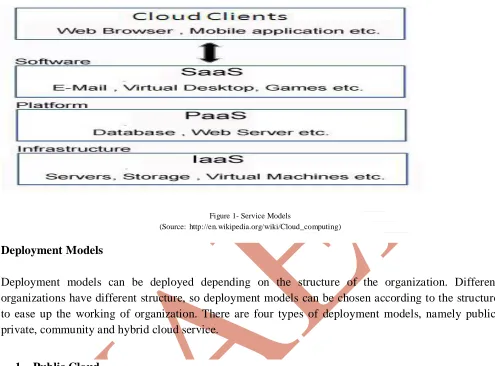
Service models of cloud computing are deployed depending on requirements of business models. The primary service models being deployed (see Figure 1) are commonly known as:
1. Software as a Service (SaaS) — the applications or services are hosted in the cloud. Consumers have to buy the ability to access the hosted cloud services. A benchmark example of this is Salesforce.com, as discussed previously, where necessary information for the interaction between the consumer and the service is hosted as part of the service in the cloud [1]. Also, Microsoft is expanding its involvement in this area, and as part of the cloud computing option for Microsoft®Office 2010, its Office Web Apps are available to Office volume licensing customers and Office Web App subscriptions through its cloud-based Online Services.
2. Platform as a Service (PaaS) — Consumers purchase access to the platforms [2], enabling them to deploy their own software and applications in the cloud. The operating systems and network access are not managed by the consumer, and there might be constraints as to which applications can be deployed.
International Journal of Advances in Engineering Research http://www.ijaer.com
(IJAER) 2012, Vol. No. 3, Issue No. II, February ISSN: 2231-5152
Figure 1- Service Models
(Source:http://en.wikipedia.org/wiki/Cloud_computing)
Deployment Models
Deployment models can be deployed depending on the structure of the organization. Different organizations have different structure, so deployment models can be chosen according to the structure to ease up the working of organization. There are four types of deployment models, namely public, private, community and hybrid cloud service.
1. Public Cloud
The resources like cloud applications and storage is being made as open source. General public can access these services by buying them from cloud service providers [5]. These services are free or payable depends upon situation. Examples of public cloud systems are Amazon Web Services (AWS) and the Google App Engine [7].
2. Private Cloud
The infrastructure consisting of the resources of cloud application and storage is operated and managed either by organization or a third party. It may exist on site or at remote place of the organization. It is difficult to manage, make and assemble alone for a single user [7].
3. Community Cloud
The infrastructure supports a specific community that has common concerns (example: policy, security requirements, mission, and compliance considerations). This type of infrastructure can be managed either by the organisation or by a third party and may exist on-site or at remote location [7].
4. Hybrid Cloud
International Journal of Advances in Engineering Research http://www.ijaer.com
(IJAER) 2012, Vol. No. 3, Issue No. II, February ISSN: 2231-5152
SECURITY ISSUES IN CLOUD COMPUTING
Cloud computing involves communication between client and server through a network. Large amount of time has been consumed to transfer big volumes of data through the network. This becomes a major concern for data-sensitive applications in cloud computing. The communication delay between client and server is responsible to add delay to response time. As the time taken by the traffic is sufficient to intercept the data between the client and server, so it is a major concern of security to secure the channel of network between the client and server. There are various security issues arises when data has been intercepted over the channel between client and server. Some of them are listed below:
Breaches of confidentiality
Potential loss of control/ownership of data Account hijacking
Data Security
Unauthorized secondary usage Network security
SECURITY ALGORITHMS
There are various security algorithms available to provide secure communication over the network, out of them cryptographic algorithms play an important role. Cryptographic algorithms involve encryption and decryption of the data using key. Encryption algorithm encodes the data using key such that it is not vulnerable to third party attack. Decryption algorithm decodes the encoded data in the original form before encryption. There are two types of cryptography algorithms:
a) Symmetric key algorithm: Only one key is used to both encrypt and decrypt the message. b) Asymmetric key algorithm: Two different keys (namely: public and private) are used to encrypt
and decrypt the message. Public key is used to encrypt the message while private key is used to decrypt the message. Public key is known to everyone while Private key is known to only user who is going to decrypt the message.
Cryptography algorithms which are used in cloud computing are as follows:
RSA (Rivest-Shamir-Adleman)
International Journal of Advances in Engineering Research http://www.ijaer.com
(IJAER) 2012, Vol. No. 3, Issue No. II, February ISSN: 2231-5152
signature. The signature is then returned to the client. Then it verifies using the server’s known public key [10].
MD5- (Message-Digest algorithm 5)
A widely used cryptographic hash function algorithm with a 128-bit hash value and processes a variable length message into a fixed-length output of 128 bits. First the input message is broken up into chunks of 512- bit blocks then the message is padded so that its total length is divisible by 512. [9] In this, the sender of the data use the public key to encrypt the message and the receiver uses its private key to decrypt the message [10].
AES- Advanced Encryption Standard
It is a symmetric-key encryption standard. It uses 10, 12, or 14 rounds. Each of the ciphers has a 128-bit block size, with the key sizes of 128, 192 and 256 128-bits, respectively. It ensures that the hash code is encrypted in a highly secure manner [10]. Its algorithm steps are as follows:
1. Key Expansion 2. Initial round 3. Add Round Key 4. Rounds
5. Sub Bytes 6. Shift Rows 7. Mix Columns 8. Add Round Key 9. Final Round 10. Sub Bytes 11. Shift Rows 12. Add Round Key.
DES- Data Encryption Standard
International Journal of Advances in Engineering Research http://www.ijaer.com
(IJAER) 2012, Vol. No. 3, Issue No. II, February ISSN: 2231-5152
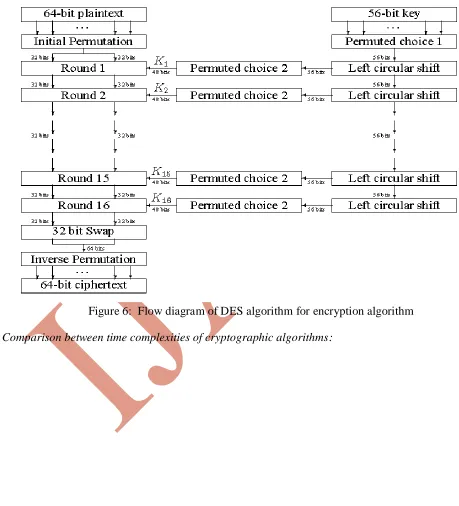
quantities are swapped to create what is known as the pre-output. This [R16, L16] concatenation is permuted using a function which is the exact inverse of the initial permutation. The output of this final permutation is the 64 bit cipher text [11].
Figure 6: Flow diagram of DES algorithm for encryption algorithm
International Journal of Advances in Engineering Research http://www.ijaer.com
(IJAER) 2012, Vol. No. 3, Issue No. II, February ISSN: 2231-5152
Figure 7: Comparison of time taken to encrypt the data by DES, Bloefish-256, AES-128 and AES-256 [12]
PROPOSED SOLUTION FOR CLOUD SECURITY
Using the above discussed security algorithms; we proposed a simple way to tackle the threats from the hackers to stop them from intercepting the data. We know that data has been transferred in the form of packets through the network.
Steps to send the data from client side:
1. The cryptography algorithms have been stored on client side in particular order. For example: first is RSA, second is MD5 and third is AES and fourth is DES.
2. The encryption algorithm has been selected randomly at client site. It could either be achieved by the use of rand () function or by linear congruently method i.e.
r= (((a*r) +b)) %m)%z
Where: a,b are large prime numbers.
z = number of cryptography algorithms used in the model
m = 232 or 264.
Initial value of r = 32.
If you get over the same seed you get the same sequence of random variables. The choice of numbers being generated by rand () provides pseudo-random numbers while the latter technique is the most suitable way of generating random numbers.
International Journal of Advances in Engineering Research http://www.ijaer.com
(IJAER) 2012, Vol. No. 3, Issue No. II, February ISSN: 2231-5152
4. The packet has been sent to the server and get stored over there.
Now reverse of the above mechanism takes place in the retrieval of the data from server.
1. The attached r value has been detected.
2. Corresponding cryptographic decryption algorithm starts decrypting the packet. 3. User can avail the information in simple format.
Advantages of the above proposed model for cloud computing security:
1. The channel of communication can be unsecured. No need to spend money on securing the channel because we are using randomly generated encryption algorithms for sending packets through the network channel. No one we get to know that which packet is encrypted by which algorithm.
2. This model uses less computer resources as compared to complex security algorithms 3. It is a cost effective model. It doesn’t require much cost to implement this method.
CONCLUSION
Although cloud computing plays a vital role in today’s IT world. It revolutionizes the working structure of the companies. Cloud computing made easier to store and compute data over the network, but the revolution always comes with new problem. Cloud computing has their own security issues which risks user data privacy.
In this paper, we have discussed many security issues and their effects. The security issues faced by the users/providers over the communication channel have been discussed. To remove the data interception over the communication channel, encryption and decryption plays a vital role. As a result of this research, we proposed a new model to provide security to the data over the network. Cloud security has been provided by our model, because nobody knows at what time which encryption algorithm has been chosen up for encryption. As hacker don’t know about the encryption algorithm, so it will not be easy for him to decrypt the data. For the time being, we have used only three cryptographic algorithms. In future, we will extend this research by testing the efficiency of different cryptographic algorithms over the network and try to put more cryptography algorithms.
REFERENCES
[1] Mr. D. Kishore Kumar, Dr.G.Venkatewara Rao, Dr.G.Srinivasa Rao, “Cloud Computing: An
Analysis of Its Challenges & Security Issues”, IJCSN Volume 1, 2012.
[2] Kuyoro S. O., Ibikunle F. & Awodele O., “Cloud Computing Security Issues and
International Journal of Advances in Engineering Research http://www.ijaer.com
(IJAER) 2012, Vol. No. 3, Issue No. II, February ISSN: 2231-5152
[3] Dr. L. Arockiam, S. Monikandan, “Data Security and Privacy in Cloud Storage using Hybrid
Symmetric Encryption Algorithm”, International Journal of Advanced Research in Computer and
Communication Engineering Vol. 2, Issue 8, 2013.
[4] Satveer Kaur, Amanpreet Singh, “The Concept of Cloud Computing and Issues Regarding its
Privacy and Security”, International Journal of Engineering Research & Technology, Vol.1 - Issue
3, 2012.
[5] Florin OGIGAU-NEAMTIU, “Cloud Computing Security Issues”, JoDRM Volume 3, Issue no. 2
(5), 2012.
[6] K.Valli Madhavi, R.Tamilkodi , K.Jaya Sudha, “Cloud Computing: Security Threats and Counter
Measures”, International Journal of Research in Computer and Communication Technology
Advance Technology, Vol 1, No 4, 2012.
[7] http://www.cloud-competence-center.com/understanding/cloud-computing-deployment-models
[8] K.S.Suresh, Prof K.V.Prasad, “Security Issues and Security Algorithms in Cloud Computing”,
International Journal of Advanced Research in Computer Science and Software Engineering,
Volume 2, 2012.
[9] Gurpreet Kaur,Manish Mahajan, “Analyzing Data Security for Cloud Computing Using Cryptographic Algorithms”, IJERA : Volume 3 Issue 5, 2013.
[10] M. Vijayapriya M. Phil. Research Scholar, “Security Algorithm In Cloud Computing: Overview”
International Journal of Computer Science & Engineering Technology (IJCSET), Vol. 4, 2013.
[11] http://www.facweb.iitkgp.ernet.in/~sourav/DES.pdf
![Figure 7: Comparison of time taken to encrypt the data by DES, Bloefish-256, AES-128 and AES-256 [12]](https://thumb-us.123doks.com/thumbv2/123dok_us/8848207.1799201/7.612.125.562.84.348/figure-comparison-time-taken-encrypt-data-des-bloefish.webp)
