IJPAR |Vol.8 | Issue 4 | Oct - Dec - 2019
Journal Home page: www.ijpar.com
Research article Open Access
Knowledge, attitude and practice of pharmacy professionals towards PVPI
programme
Aleena Alex*
a, Suja Abraham
b, Heera George
cAbc
Department of Pharmacy Practice, Nirmala college of Pharmacy, Muvattupuzha, Kerala, India
(Affiliated to Kerala University of Health Science).
*Corresponding Author: Aleena Alex
Email: [email protected]
ABSTRACT
Pharmacovigilance is the pharmacological science relating to the detection, assessment, understanding and prevention of adverse effects, particularly long term and short term side effects of medicines. By giving importance for patient safety, India setup a surveillance system “Pharmacovigilance Programme of India” (PvPI). This work was done mainly to highlight the role of pharmacist in detecting, assessing and documenting adverse drug reactions and also to assess the knowledge, attitude and practice of working pharmacist towards pharmacovigilance programme. A survey was done among 20 working pharmacists and found that 90% of pharmacists were aware of pharmacovigilance and 55% had knowledge about the procedures for reporting ADR. Moreover 95% of them felt that ADR reporting is the responsibility of pharmacist. There are many discouraging factor for ADR reporting, the major barrier was lack of time (40%) and the lack of knowledge about the procedure for reporting (20%). So it is the high time to provide sufficient training and conduct workshop on pharmacovigilance for those working in community or hospital pharmacy in order to uplift the profession of pharmacy into great heights.
Keywords:
Pharmacovigilance, Side effects, Pharmacist, ADRINTRODUCTION
Pharmacovigilance is an vital and integral part of clinical research. Both clinical trials safety and post marketing pharmacovigilance are important
throughout the product lifecycle.‟
Pharmacovigilance is the pharmacological science relating to the detection, assessment, understanding and prevention of adverse effects, mainly long term and short term side effects of medicines. According to WHO an adverse drug reaction (ADR) is „‟any
reaction to a drug that is noxious and unintended, and occurs at doses used for prophylaxis, diagnosis or therapy, excluding failure to achieve the intended response. [1]
In1960s, the tragedy of the thalidomide disaster has encouraged many countries for establishing screening systems for early inspection and detection of ADRs. These systems are named as pharmacovigilance (PV) systems. PV is considered the interior element for any medication
safety study. PV is also named as post marketing surveillance as it plays a vital role in detecting any known and unknown ADRs of drugs accessible in the market. The discovery and development process plays vital role for ensuring drug safety and its efficacy eventhough following the marketing of these drugs put amrk on safety approval in human being. [2]
Establishing PV centre program is one of the greatest strategies for monitoring ADRs which in turn help in encouraging health care professionals to report suspected ADRs they may encounter in their clinical practice. Participation of all health care professional in reporting ADRs is the corner stone for a successful PV program.
Pharmacovigilance Programme of India
(PvPI)
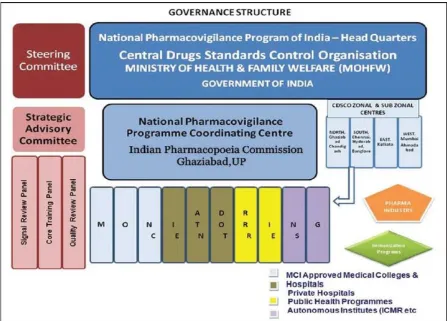
The Pharmacovigilance attempt in the India is coordinated by The Indian Pharmacopoeia
Commission (IPC) and conducted by means of the Central Drugs Standard Control Organization (CDSCO). They have a separate format to report suspected ADRs. The main responsibility of the IPC is to maintain and develop the Pharmacovigilance database consisting of all suspected serious adverse reactions to medicines observed. Indian Pharmacopoeia Commission (IPC) is functioning as a National Coordination Centre (NCC) for Pharmacovigilance Programme of India (PvPI). The main responsibility of NCC is to detect all the adverse reactions of medicines being observed in the Indian population and to develop and maintain its own pharmacovigilance database. The aim of the commission that acts like the National Coordinating Centre (NCC) for PvPI is for safety of the patient, safety of the population with respect to use of the Drug.
Fig 1: National Pharmacovigilance Program of India
The Central Drugs Standard Control Organization (CDSCO), Directorate General of Health Services under the guidance of Ministry of
Pharmacovigilance Programme for protecting the health of the patients by assuring drug safety. The Programme shall be coordinated by the Indian Pharmacopeia commission, Ghaziabad as a National Coordinating Centre (NCC). The Pharmacovigilance Programme of India (PvPI) was initiated by the Government of India on 14th July 2010 by means of the All India Institute of Medical Sciences (AIIMS), New Delhi as the National Coordination Centre for monitoring Adverse Drug Reactions (ADRs) in the country for safe-guarding Public wellbeing. In the year 2010, 22 ADR monitoring centre‟s including AIIMS, New Delhi was set up under this Programme. To ensure implementation of this programme in a more effective way, the National Coordination Centre was shifted from the All India Institute of Medical Sciences (AIIMS), New Delhi to the Indian Pharmacopoeia Commission, Ghaziabad, and Uttar Pradesh on 15th April 2011.
The Medical Colleges (both Indian Pharmacopoeia commission Pharmacovigilance Programme of India (PvPI) Government & Private) are the corner stone of the Pharmacovigilance Programme of India. They work as peripheral Adverse Drug Reaction Monitoring Centre‟s (AMCs) which are responsible for collecting the ADRs, performing the follow up with the patient to check fullness of the ADRs as per Standard Operating Procedures (SOPs) and to enter the Data in the prescribed software (VigiFlow) to report to NCC. [3]
METHODOLOGY
A total of 19 studies were collected which comprises of original work as well as review articles. Based on the articles reviews a study was conducted in a small population of 20 subjects working as community and hospital pharmacist.
This was a prospective observational study to assess the knowledge, attitude and practice of hospital/community pharmacist towards pharmacovigilance programme. A
self-administered 12 item questionnaire was prepared in order to understand their awareness regarding the programme and to assess their practice regarding the same. The questionnaire comprised of four sections. The first section consisted of the demographics of pharmacist including-qualification, working site, experience etc. The second part consisted of four questions to document the knowledge of adverse reactions and pharmacovigilance. The four questions of second part assessed the pharmacists‟ perception and attitude towards ADR reporting. The three questions of the third part of the questionnaire had identified practices regarding the reporting of an identified ADR. The last question of the third part of the questionnaire focused on the barriers that exist toward having a PV.
We conducted a survey by randomly selecting 20 number of pharmacist employed in hospital and community pharmacy across Muvattupuzha.
RESULT
A total of 20 pharmacists working in different pharmacies, community or hospital were selected and their role in pharmacovigilance was assessed. From our study we found that about 40% of subjects had D Pharm, 45% B Pharm and 15% M Pharm qualification and 40% of subjects working as hospital pharmacist and 60% were community pharmacist. When KAP was analyzed, it showed that even though all the subjects heard about ADR, only 90% of subjects were aware of PV and 55% had knowledge about the procedures for reporting ADR. The demographic details were listed in table 1.
Even though 100% of subjects knew that PV is necessary for better patient care, only 95% subject felt that ADR reporting is the responsibility of pharmacist.
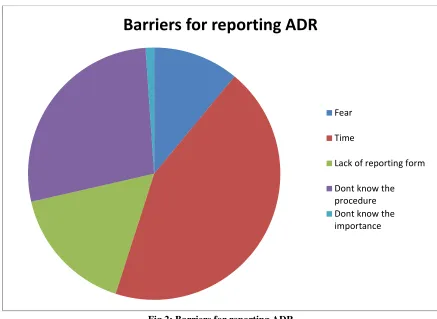
There were many discouraging factor for ADR reporting, the major barrier was lack of time (40%) and the lack knowledge about the procedure for reporting (20%). Details were given in table 2.
Table 1-Demographic details
Demographics Percentage of pharmacist
1. Qualification
D Pharm 40%
B Pharm 45%
2. Age
21-40 75%
41-60 25%
˃60 0%
3. Working site
Hospital 40%
Community 60%
4. Experience
˂2 25%
2-10 40%
˃10 35%
Table 2- Knowledge, attitude and practice of working pharmacist
Questions
Response (%) Yes No Don’t
know KNOWLEDGE
1. Have you heard about Adverse Drug Reaction?
100% 0% 0%
2. Are you aware of pharmacovigilanceprogramme? 90% 10% 0%
3. Do you know the reporting process of ADR? 55% 45% 0%
4. Do you attend any workshop/training on pharmacovigilance? 35% 65% 0%
ATTITUDE
1. Do you think that ADR is essential for all adverse reactions?
80% 20% 0%
2. Do you feel that each pharmacist is responsible for assessing and monitoring adverse drug reactions?
95% 5% 0%
3. Do you think that the pharmacovigilance program will help in better patient care? 100% 0% 0% 4. Do you think pharmacovigilance program will help to identify the predisposing factor
and reduce the Risk of further incidence?
85% 0% 15%
PRACTICE
1. Have you reported any ADR?
15% 85% 0%
2. Do you motivate your colleagues in reporting adverse drug reactions? 80% 20% 0% 3. Do you feel that pharmacovigilance training is essential for all working pharmacist? 100% 0% 0% 4. What are the barriers for reporting an adverse drug reaction?
Lack an access to reporting form
Don‟t know the procedure of reporting
Don‟t know the importance of ADR reporting
Time
Fear
Fig 2: Barriers for reporting ADR
DISCUSSION
This study was focused on a particular community peoples spread on community and
hospital pharmacy.Literatures on
pharmacovigilance were reviewed and found a questionnaire survey to done evaluate the attitudes and knowledge of hospital pharmacists to adverse drug reaction reporting by Green et.al .The aim of that study was to assess the attitudes and knowledge of hospital pharmacists to spontaneous ADR reporting in the UK. The response rate was 51%, and found that pharmacists reported a higher proportion of serious reactions and a lower proportion of reactions to newly marketed drugs in comparison to hospital doctors. In our study the qualification of subjects ranged between D pharm to M pharm. About 45% of respondents were the groups who have completed B pharm. Apart from this 60 % of the subjects were community pharmacist while considering the experience of subjects the maximum response is between 2-10 years. [5]
An evaluation of knowledge, attitude and practice of Indian pharmacists towards adverse drug reaction reporting by Ahmad et.al was also a
questionnaire based study which included pharmacist from all over India. This was one of the first studies in India that evaluated the KAP of pharmacists regarding ADR reporting and the functioning of the National Pharmacovigilance Program (NPP). Overall, the KAP scores of the pharmacists were very low. Our KAP study shows that among the participants 100% have heard about ADRs and 90 % are aware of PV programme and only 35% participants had ever been trained on reporting ADR. [6]
Another study about Pharmacist‟s knowledge, practice and attitudes toward pharmacovigilance and adverse drug reactions reporting process by Suyagha et.al, was a cross-sectional survey in Jordan. The results of their study firstly demonstrated that the majority of pharmacists have insufficient knowledge and lack of awareness about pharmacovigilance and ADRs reporting systems. This was consistent with a previous report by Toklu and Uysal in which they showed that82.5% of the pharmacists were not aware of the concept of pharmacovigilance. Despite the lack of knowledge in the majority of pharmacists, the study showed that the awareness of hospital pharmacists was
Barriers for reporting ADR
Fear
Time
Lack of reporting form
better compared to community pharmacists which may be related to the fact that hospital pharmacists were indirect contact with other health care professionals such as physicians and nurses who were more often involved in the identification of potential ADRs, thus they were more exposed to situations where there is a need to manage or to report such adverse effects. In our study only 15% of the study population reported ADR .Even though 100% of the subjects were of the view that PV should be taught in detail for better ADRs were lack of access of reporting form (15%) , lack of time to report ADR(40%),don‟t know the procedures(25%),don‟t know the importance (10%) and fear(10%). [4]
In a study by Herdeiro et al., it was shown that hospital pharmacists report 20 times more frequently than community pharmacists, this was due to the fact that the hospital pharmacist was better educated and informed about pharmacovigilance practice. [7]
CONCLUSION
Pharmacovigilance has not well established in India, when compared with other countries India rates below 1% against the world rate of 5%. This is due to ignorance of the subject and also lack of training. Therefore, there is a need for an active pharmacovigilance system in the country to protect the population from the potential harm of drugs. The study about the knowledge, attitude and practice of pharmacist towards pharmacovigilance showed that majority of pharmacist had good knowledge about PV and understand the need for reporting ADR. But the reporting rate of ADRs is very low. The fact that majority of respondents agreed that reporting of ADR is necessary and PV workshop/training is essential. Even though clinical pharmacy activities in hospitals are more focused on patient care; it is not much developed in the community pharmacy.
REFERENCES
[1]. World Health Organization. Safety of Medicines. A Guide to Detecting and Reporting Adverse Drug Reactions. Geneva, Switzerland: 2002. Available from: http://www.WHO/EDM/QSM/2002.2 29, 2017.
[2]. Beri B, Estella F, Jose M, Ngo V and Ntungwen C. Pharmacovigilance: Knowledge Attitude and Practice within the Public Health actors in Yaounde, Cameroon. Current Trends in Pharmacology and Clinical Trials. 2(2), 2019, 180017.
[3]. Qassin S, Metwali Z and Hariri Y A. Why there is a need for drug post marketing surveillance.European Journal of Pharmaceutical and Medical Research. 3, 2016, 45-50.
[4]. H.Z. Toklu, M.K. Uysal.The knowledge and attitude of the Turkish community pharmacists toward pharmacovigilance in the Kadikoy district of Istanbul.Pharm. World Science. 30(5), 2008, 556-562.
[5]. Green C F, Mottram D R, Rowe P H,and Pirmohamed M.Attitudes and knowledge of hospital pharmacists to adverse drug reaction reporting. British Journal of Clinical Pharmacology. 51(1), 2001, 81–86.
[6]. Ahmad A, Patel I, Balkrishnan R, Mohanta GP, Manna PK .An evaluation of knowledge, attitude and practice of Indian pharmacists towards adverse drug reaction reporting: A pilot study. Perspect Clinical Research. 4, 2013, 204-10