
International Journal of Advances in Engineering Research
STUDIES ON COMPRESSION IGNITION ENGINE TO
ESTABLISH EFFECTS OF INJECTION PRESSURE,
COMPRESSION RATIO AND NANO ADDITIVES – A REVIEW
Melbin Jose# and R.B.Anand
Department of Mechanical Engineering, National Institute of Technology Tiruchirappalli- 620015, Tamil Nadu, India.
#
Corresponding Author, Email: [email protected]
ABSTRACT
The review is focused to throw light on the effects of the fuel injection pressure, compression ratio and nano additives in the compression ignition (CI) engines on the performance, combustion and emission characteristics. However the CI engines have good reliability and performance characteristics, they emit hazardous emissions like unburned hydrocarbons, carbon dioxide, carbon monoxide, particulate matters, nitrogen oxides, etc. with the exhaust gases. Several studies have been carried out to improve the performance and combustion characteristics while reducing the level of pollutants in the exhaust gases and developed mainly three techniques. They are engine hardware modification, improvement in the fuel injection system and the exhaust gas treatment. Recently some studies were reported regarding the application of nanoparticles in the improvement of thermophysical properties of diesel fuel. The type and size of the nanoparticle added with fuel play a significant role in the engine/combustion characteristics. The review reveals that various techniques are available for improving the working characteristics, but not a single method which suits in all working conditions.
Keywords: CI engines, injection pressure, compression ratio, biodiesel, nanoparticles.
INTRODUCTION
The importance of compression ignition (CI) engine is due to its higher thermal efficiency than efficiency of a diesel engine depends upon the conversion rate of the chemical energy of the fuel into heat release. The rate of heat release depends on the amount of fuel injected, ignition at an adequate time and the combustion process. The diesel engines emit hazardous emissions such as oxides of nitrogen (NOx), particulate matter (PM), unburned hydrocarbons (UBHC), soot, smoke, carbon dioxide (CO2spark ignition (SI) engines, effective performance, reliability and engine design. The), carbon monoxide (CO), etc. Various researches have been done to reduce the exhaust gas emissions, mainly by modifying the engine design, fuel modification, varying engine operating parameters like fuel injection pressure, injection timing, working speed, compression ratio, intake pressure etc. and exhaust gas treatment.
International Journal of Advances in Engineering Research
EFFECT OF FUEL INJECTION PRESSURE
High injection pressure is an effective method to improve diesel engine performance and decrease particulate matter emission due to improved spray atomisation and fuel-air mixing, resulting in a more distributed vapour phase [1, 2]. Consequently it results in high local temperature, which affects NOx emissions adversely, which can be reduced by combining increased injection pressure with exhaust gas recirculation [3]. The injected fuel particles get smaller depending on the increasing injection pressure and the NOx formation is reduced by reducing the ignition delay [4].
Icingur and Altiparmak [5] experimentally studied the effects of injection pressure and cetane number on compression ignition engine performance and emissions. They conducted experiments in a four stroke, four cylinder DI diesel engine by varying the fuel injection pressure; from 100 – 250 bar and observed that the injected fuel particles get smaller depending on the increasing injection pressure, and NOx formation was reduced by reducing the ignition delay. By varying the fuel injection pressure from 100 to 250 bar, the smoke level was reduced from 1.2 to 0.4 for diesel with cetane number of 54, whereas for diesel fuel with cetane number of 46, smoke level decreased from 2.05 to 0.6 respectively, which was because of the smaller drop size of the injected fuel with increase in injection pressure. Although the smoke level slightly increased with fuel cetane number, in the case of changing the injection pressure, the smoke level was affected by the pressure rather than cetane number. The smoke level was found to be very high when the injection pressure was 100 bar as at lower injection pressure, premixing in combustion process was in a bad condition because of dripping of fuel particles.
International Journal of Advances in Engineering Research
pressure to 250 bar, the CO emission decreased to 1100 ppm. Higher pressures compared with standard injection pressure gave an advantage of reducing CO emission between 1500 and 2500 rpm. CO2 was reduced when injection pressure was increased. The highest value was 14 % at 100 bar for 1500 rpm, which reduced to 10.8 % at 250 bar. NOx emission was between 300 and 100 ppm at 100 bar, between 300 and 600 ppm at 250 bar. Minimum NOx values were obtained at 100 bar. Descending order for NOx was 250–150–200–100 bar with 600, 500, 450, 280 ppm respectively at 3500 rpm. SO2 emission was very high at 100 bar than the others. Maximum SO2 value of 700 ppm was obtained at 2500 rpm for 100 bar. With increase in the injection pressure, the SO2 value decreased to less than 200 ppm. For pressures except 100 bar, emission values were generally between 100 and 200 ppm. For 100 % throttle position, maximum CO emission was 4000 ppm obtained for 1500 rpm at 150 bar. Reducing the injection pressure to 100 bar slightly decreased the emission to 3900 ppm. Increasing the pressure to 200 bar decreased the emission to less than 100 ppm, the minimum CO value being almost nil in 3000 rpm at 250 bar. High value of CO2 was 14% for 1500 rpm obtained at 100 bar. While the emission was about 10 % at 250 bar, the value was between 12 and 13 % at design injection pressure. In general, CO2 reduced as injection pressure increased. NOx emission was between 280 and 450 ppm at 100 bar, between 280 and 650 ppm at 250 bar. Minimum value was 280ppm for 1500 rpm obtained at 100 bar. NOx emission reduced as injection pressure decreased. Maximum SO2 value of 300 ppm was obtained at 100 bar and 4000–4500 rpm. SO2 emission descending order was 150–200–250–100 bar . For pressures except 100 bar, emission values were generally between 100 and 250 ppm.
Ozer et al. [7] experimentally investigated the effect of injection pressure in a turbocharged indirect injection (IDI) diesel engine. Ethanol–Diesel emulsions (10 % ethanol-90 % diesel) were tested with 150, 200 and 250 bar fuel injection pressures. Ethanol had higher latent heats of vaporization than of diesel which caused low vaporization and mixing of fuel and air. Increasing the fuel injection pressure decreased the particle diameter and caused the diesel– ethanol fuel spray to vaporize quickly. But the liquid fuel cannot penetrate deeply into the combustion chamber and hence higher injection pressures initially generated faster combustion rates, resulting in higher temperatures. However, the initial combustion with the spray was restricted to a small region near the injector, and the flame spread around the chamber through slow propagation and caused an inefficient conversion process of heat to work. NOx emission was about 300 ppm at 150 bar and 1500 rpm, which increased to a maximum of 700 ppm at 2500 rpm with an increase in injection pressure to 200 bar and with further increase in injection pressure to 250 bar, the emission decreased to a maximum of 500 ppm at 2500 rpm due to the effects of active combustion caused by smaller particles of atomized fuel. Thus higher NOx emissions were observed with increase in injection pressure due to the effects of active combustion. An injection pressure of 150 bar at 1500 rpm gave a high CO value of 2600 ppm. Increasing the injection pressure to 200 and 250 bar caused fairly low CO (less than 100 ppm) in all engine speeds, especially between 1500 and 2500 rpm due to the good fuel–air mixing and easy and complete combustion of the smaller droplets.
high-International Journal of Advances in Engineering Research
pressure, high-temperature constant volume combustion vessel at injection pressures of 100, 200 and 300 MPa. They ascertained that the highest injection pressure (300 MPa) gave better engine performance and decreased particulate matter emission due to improved spray atomization, fuel–air mixing and larger flame length. The flame length increased more rapidly and achieved quasi-steady length earlier for high injection pressure. The advance of quasi-steady stage for high injection pressure indicated an enhancement of soot oxidation. The wide dispersion of impinging spray was responsible for large flame length and flame area at high injection pressure. With microhole nozzle (0.08 mm), impinging spray flame showed lower soot formation at injection pressure of 100 MPa. At injection pressures of 200 and 300 MPa, the two-colour optical system did not detect soot images which were due to much weak soot formation under such conditions. For 0.16 mm nozzle, high injection pressure led to slightly lower soot luminosities. Even 300 MPa, an ultra-high injection pressure; the reduction of soot luminosities was not significant which might be due to the high injection rate. The soot reduction with the increase in injection pressure was mainly due to better spray atomization. Ignition delay for impinging spray flame was shortened with the increase of injection pressure because of improved spray atomization and enhanced fuel–air mixing rate. The study indicated that micro-hole nozzle and especially the combination of micro-hole nozzle and ultrahigh injection pressure provided an effective method to reduce soot formation in combustion chamber of diesel engine.
Pandian et al. [9] experimentally investigated the effect of injection system parameters on performance and emission characteristics of a twin cylinder compression ignition direct injection engine fuelled with pongamia biodiesel–diesel blend. Increasing the injection pressure from 150 bar to 225 bar increased brake thermal efficiency (BTE) from 21.82 % at 18⁰ Before Top Dead Centre (BTDC) to 26.59 % at 27⁰ before TDC respectively, and NOx emissions from 316 ppm at 27⁰ BTDC to 420 ppm at 30⁰ BTDC respectively with reduction in CO from 0.98 % volume at 18⁰ BTDC to 0.23% volume at 30⁰ BTDC respectively, UBHC from 98 ppm at 18⁰ BTDC to 52 ppm at 30⁰ BTDC respectively and smoke opacity from 92 % at 18⁰ BTDC to 59 % at 30⁰ BTDC respectively. With increase in injection pressure, better atomization of the fuel resulted in the smaller droplet size; faster evaporation of fuel sprays; and improved reaction between fuel and air which resulted in comparatively better combustion and contributed for higher BTE and NOx emission with lesser CO, HC and smoke emissions at all injection timings. Beyond 225 bar of injection pressure, faster velocity of the fuel jets caused most fuel particles to hit the wall of combustion chamber where the fuel particles got cooled and not participated in the combustion process effectively which resulted in incomplete combustion. The experiment found that an injection pressure of 225 bar combined with advanced injection timing 27⁰ before top dead centre (TDC) produced highest BTE with maximum NOx emissions and lesser emissions of CO, HC and smoke emissions while the low injection pressure (150 bar) combined with the retarded injection timing (18⁰BTDC) resulted in the opposite trend to that of previous one.
International Journal of Advances in Engineering Research
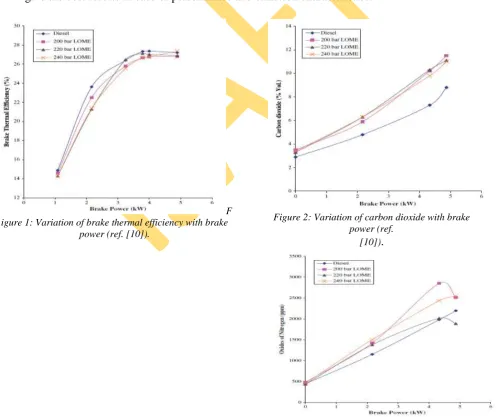
fuel consumption was higher in the case of LOME compared to diesel which was due to higher density and lower heating value of LOME compared to diesel. The efficiency at full load was closer to diesel fuel because of improved atomization and better mixing process at higher injection pressures (Fig.1). At 240 bar injection pressure the efficiency was marginally higher than diesel due to the better combustion of LOME. CO2 emissions for LOME (Fig.2) were comparatively higher than that of diesel fuel. As the heating value of LOME was low and had almost the same cetane number as diesel fuel and higher viscosity, the ignition delay was more for LOME which in turn produced more oxides of nitrogen (Fig.3). But injecting the fuel at higher pressures partly solved the problem by making the physical process to take place faster and hence the production of oxides of nitrogen reduced. The CO emissions (Fig.4) for LOME at all the injection pressures were lower than that of diesel fuel which was due to better combustion of LOME compared to diesel fuel. As the injection pressure was increased the fuel droplet travelled with a high velocity and that may hit the wall of the combustion chamber, which led to higher un-burnt hydrocarbon emissions (Fig.5).
The experimental investigation on the effect injection pressure in a direct injection diesel engine running on Jatropha methyl ester was done by Jindal et al. [11] in single cylinder, water cooled, four stroke, variable compression ratio (VCR) diesel engine. For 100% biodiesel, performance tests were carried out at three injection pressures (150, 200, 250 bar). The BSFC decreased with load significantly as the power output per unit fuel consumption increased at higher loads. It was found that the BSFC was always higher for B100 (100 % biodiesel) than B0 (100 % diesel) by about 25– 34% at standard rated engine parameters which was due to the fact that the esters of vegetable oils have lower heat value when compared to diesel and therefore more bio-diesel is needed to maintain the power output. During trials with three injection pressures, the effect of change in injection pressure on BSFC was found significant with lowest BSFC at 200 bar up to 50% load and 250 bar for higher loads. The decrease in BSFC can be attributed to the more efficient utilization of the fuel at higher injection pressures because of better atomization.
EFFECT OF COMPRESSION RATIO
International Journal of Advances in Engineering Research
performance. The compression work and thus the final compression temperature increase as the compression ratio increases [5].
Performance, emission and combustion characteristics of a variable compression ratio engine using methyl esters of waste cooking oil and diesel blends was experimented by Muralidharan and Vasudevan [12]. The performance and emission characteristics of variable compression ratio engine using various blends at compression ratios 18:1, 19:1, 20:1, 21:1 and 22:1 for 50% load and its comparison with the results of standard diesel fuel were done. The brake thermal efficiency of the blend B40 (40 % biodiesel + 60 % diesel) was slightly higher than that of the standard diesel at higher compression ratios, and was maximum for a compression ratio of 21, as for standard diesel and blend B40- 26.08 and 31.48 % respectively. The specific fuel consumption of B40 blend was lower than that of all other blends at compression ratio 20 and 21 which may be due to fuel density, viscosity and heating value of the fuels. B40 had higher energy content than B60 and B80, but lower than B20 and diesel. The specific fuel consumption of B40 blend at the compression ratio of 21 was 0.259 kg/kWh whereas for diesel it was 0.314 kg/kWh. At higher percentage of blends, the specific fuel consumption increased due to the decrease in calorific value for the higher blends. The blends B20, B40, B60 and B80 with standard diesel had a reduction in brake power. Brake power decreased at higher compression ratio due to the conversion from the chemical energy to mechanical energy. Due to the lower heating value of the blends and unstable combustion the brake power decreased. The maximum brake power obtained for B40 and diesel at a compression ratio 21 was 2.07 kW and 2.12 kW respectively. The mechanical efficiency of the blend B40 increased with the increase in compression ratio, when compared to that of standard diesel, the maximum obtained for compression ratio 21 being 52.53 %. The NOx emission for diesel and other blends increased with the increase of compression ratio, the reason being higher peak temperature. For the compression ratio of 21, NOx emission from the waste cooking oil blend B40 was higher than that of diesel, 621 ppm and 640 ppm respectively. The CO emission of the blend B40 was close to the standard diesel and it was found to be higher for compression ratio 21. The other blends B20, B60 and B80 had slightly lesser CO emission for compression ratio 21. The percentage of CO increased due to rising temperature in the combustion chamber, physical and chemical properties of the fuel, air–fuel ratio, shortage of oxygen at high speed, and lesser amount of time available for complete combustion. The blend emitted higher percentage of CO2 than diesel at lower compression ratios and vice versa. More amount of CO2 was an indication of complete combustion of fuel in the combustion chamber.
International Journal of Advances in Engineering Research
International Journal of Advances in Engineering Research
at a compression ratio of 18 with injection pressure of 150 bar and minimum smoke opacity (20.5 %) was with IP-250 for CR-18. CO2 emissions increase both with compression ratio and injection pressure indicating better combustion at higher compression ratio and higher injection pressures. The emission of NOx was more sensitive to compression ratio at lower injection pressures as compared to higher compression ratios. With low injection pressure, increase in compression ratio facilitated the combustion of larger droplets because of high temperature of compression, whereas, high injection pressure converted the fuel into smaller droplets with good combustion suppressing the effect of compression pressure. The highest emissions were observed for high compression ratio and low injection pressure which was due to greater availability of fuel inside the cylinder (as reflected by increased specific fuel consumption at low injection pressure) and higher peak pressure leading to high temperatures. Minimum value of NOx emission (165 ppm) was found for injection pressure of 250 bar with compression ratio of 17.
International Journal of Advances in Engineering Research
CO emissions by 37.09 % and reduced CR increased CO emissions by 9.67 % compared to results of ORG CR for B100. At lower CR, insufficient heat of compression delayed ignition and so CO emissions increased. The reason was that the increased CR increased the air temperature inside the cylinder thereby reduced the ignition lag and caused better and more complete burning of the fuel. For B20, the reduction in the emission of CO was 6.85 %, when the IP was increased from 18 to 22 MPa. The BSFC generally increased with the increase in biodiesel percentage in the fuel blend. The increments in BSFC are 1.94, 5.50, 8.27 and 11.04 % for B5, B20, B50 and B100 at original IT, respectively, compared to the results of diesel fuel. It was because of the decrease in the lower heating value (LHV) of the blends by adding biodiesel, which required more fuel to be injected into the cylinder to get the same power output, leading to the increase in the BSFC. Increased CR decreased the BSFC by 1.78 % and 2.79 % for B50 compared with original and reduced CR, respectively, because with an increase in CR, the maximum cylinder pressure increased due to the fuel injected in hotter combustion chamber which led to higher effective power. Therefore, fuel consumption per output power decreased. The minimum BSFC values were obtained with the increased IPs because of improved atomization and better mixing process. The increased IP decreased BSFC values by 17.26 and 19.60 % compared to the original IP and decreased IP for B20. The BTE usually increased with the increase in biodiesel percentage in the fuel blend. Thus, the primary reason for the decrease in the BTE of biodiesels was the higher BSFC in spite of lower LHV of biodiesels. The change in BTE with respect to diesel fuel is 1.99, 3.69, 5.99 and 9.06 %, respectively, at reduced CR. The effects of the variation in CR on the BTE indicated that higher CRs improve the engine efficiency was due to better combustion and higher lubricity of biodiesel. The increased CR increased the BTE by 0.55 % and 1.33 % for B5 compared to the results of ORG and reduced CR, respectively. With respect to IP, change in the BTE was obtained at increased IP which was due to better combustion due to finer atomization of fuel.
NANOTECHNOLOGY
International Journal of Advances in Engineering Research
nanoparticles in the base fluid. The improved heat transfer performance of nanofluids is due to the fact that the nanoparticles exhibit [18] properties like increase in surface area and heat transfer capacity of the fluid, improvisation in thermal conductivity, causing more collisions and interactions between the fluid particles and flow passages, causing more turbulence and mixing of the fuel.
EFFECT OF NANO ADDITIVES
Ambrozik and Chlopek [19] listed some basic requirements for catalytic fuel additives to the conventional fuel:
1. The catalyst added to the fuel should undergo decrement in particulates emission in the engine cylinder.
2. The chemical stability of the catalytic additive should be stable over long time with the fuel.
3. The use of catalytic additives in the fuel should not enhance the hazardous emissions.
The catalyst is characterised by its size and the reduced size of catalyst creates more active surfaces where the chemical reaction takes place and thus leads to improved reaction efficiency. Nanoparticles are the best choice as catalyst as they possess potential thermo-physical properties such as enhanced surface-area to volume ratio, enhanced radiative/mass transfer properties and enhanced ignition temperature characteristics. Yetter et al. [20] found that the nano catalyst presence in hydrocarbon fuels may lead to lower ignition temperature, shorter ignition delay and conversion of carbon into carbon dioxide. The experiment by Kulkarni et al. [21] on an inline-four cylinder diesel engine with turbocharger and liquid cooling concluded that by employing nanofluids in water coolant jacket, the engine will heat up faster and may result in the reduction of emission, since the higher concentration pollutants are emitted during the engine warm up. As the nanoparticles concentration was increased, the magnitude of specific heat was decreased, as the nanopaticles require less time to heat up during start up.
International Journal of Advances in Engineering Research
volatility of the fuel increases with the quantity of the fuel additive. The cerium oxide nanoparticles present in the fuel promote longer and more complete combustion, compared to the base fuel as cerium oxide acts as an oxygen buffer and thus increases the efficiency. A maximum increase of 1.5% in the brake thermal efficiency was obtained when the dosing level was varied from 20 to 80 ppm, with a maximum improvement observed at a dosing level of 80 ppm. Cerium oxide oxidizes the carbon deposits from the engine leading to efficient operation and reduced fuel consumption. Hydrocarbon emission was found to be significantly reduced on the addition of the additive; for 80ppm CeO2, 20ppm of HC at no load to 100ppm at 5kW load and 70ppm to 180ppm for biodiesel without CeO2. Cerium oxide supplies the oxygen for the reduction of the hydrocarbon as well as the soot and gets converted to cerous oxide (Ce2O3). An average reduction of 25% to 40% in the hydrocarbon emissions was obtained for additive dosing levels ranging from 40 to 80 ppm of the additive. The NOx emission was found to be generally reduced on the addition of cerium oxide nanoparticles to bio diesel, where an average reduction of around 30% was found to occur with a dosing level of 80 ppm nanoparticles.
International Journal of Advances in Engineering Research
brake thermal efficiency was higher for D2S5W50CNT compared to that of D2S5W25CNT. The CNT blended water–diesel emulsion fuels produced lower NOx emission compared to that of water–diesel emulsion fuel due to lower combustion temperature (950ppm for D2S5W50CNT at 5.3 bmep and 1050ppm for D2S5W) which was because of reduced ignition delay and the heat absorption of the vaporization of the water during the combustion in the engine cylinder. The magnitude of CO emission for the CNT blended water–diesel emulsion fuels was marginally lower compared to that of neat diesel and water–diesel emulsion fuel (0.17, 0.18 and 0.185 % vol. respectively at 5.3 bmep) which could be due to the occurrence of secondary atomization phenomenon of the encapsulated CNT water droplets in the combustion chamber. The unburnt HC emissions were also marginally lower for the CNT blended water–diesel emulsion fuels than the water– diesel emulsion fuel (75, 82 ppm respectively at 5.3 bmep) due to catalytic activity and improved combustion characteristics of CNT, which led to improved combustion.
Kao et al. [27] studied about aqueous aluminum nanofluid combustion in diesel fuel by conducting experiment in a single cylinder diesel engine, with aqueous alumina blended with diesel. At greater engine speeds the combustion with diesel fuel was more efficient than with aqueous alumina blended with diesel fuel because of the too large moisture content in aqueous alumina blended with diesel fuel, which caused the decomposing energy to become insufficient. The reduced smoke concentrations at 1200 and 1800 rpm (18 and 19% respectively) indicated that the combustion with aqueous alumina blended diesel was more complete at those speeds than with diesel fuel. At 2400 rpm the smoke concentration showed no significant difference between aqueous alumina blended diesel fuel and diesel fuel. The mean smoke concentration of aqueous alumina blended diesel fuel was lower than that from diesel fuel in all loads for engine speeds less than 2200 rpm as adding aqueous aluminum nanofluid in diesel fuel promoted more complete combustion and the aluminum nanopowder additive contained moisture that produced a microexplosion on the emulsified fuel drains and hence reduced the smoke concentration. NOx concentration for aqueous alumina blended diesel fuel was lower than that of diesel fuel at all loads at 1200 and 1800 rpm (365ppm and 410ppm respectively), because the nanopowder additive contains moisture causing micro-explosions in the emulsified fuel drains. At 1200 rpm at maximum load hydrogen burning resulted in the more complete combustion and hence the NOx concentration caused by aqueous alumina blended diesel fuel was less than that caused by diesel fuel. The latent heat of evaporation of water and its high thermal capacity also reduced the temperatures in the combustion chamber, thus retarding nitrogen oxide build-up.
International Journal of Advances in Engineering Research
International Journal of Advances in Engineering Research
biodiesel emulsion fuels, an ample fuel could have been induced in the combustion chamber prior to the ignition, leading to better combustion, air-fuel mixing, resulting in reduced smoke emissions.
SUMMARY
Nanoparticles are added to the diesel fuel as they possess potential thermo-physical properties such as enhanced surface-area to volume ratio, enhanced radiative/mass transfer properties and enhanced ignition temperature characteristics. These properties help in better combustion of diesel fuel and thus improvement in performance as well as in emission characteristics. Research on the optimum usage of nanoparticles in diesel/biodiesel fuels are still going on and are mostly in the developing stage. Also, the adding nanoparticles should not cause a new mode of air pollution. Varying the injection pressure and/or compression ratio has also led to improvement in efficiency and emission characteristics of diesel engines. The right combination of injection pressure and compression ratio varies with the fuel properties. Now-a-days, the importance of biodiesel is increasing day by day and hence addition of proper nanoparticle (as catalyst) and adjustment of the compression ratio and injection pressure will give the best results in case of performance and emission characteristics.
F igure 1: Variation of brake thermal efficiency with brake
power (ref. [10]).
Figure 2: Variation of carbon dioxide with brake power (ref.
International Journal of Advances in Engineering Research
Figure 3: Variation of oxides of nitrogen with brake power (ref. [10]).
Figure 4: Variation of carbon monoxide with brake power. (ref.
[10]).
Figure 5: Variation of UBHC with brake power. (ref. [10]).
International Journal of Advances in Engineering Research
REFERENCES
1. Su TF, Farrell PV. Characterization of high injection pressure diesel sprays with relation to particulate and NOx emissions. Atomization Spray 1998;8 :83–107.
2. G. Bruneaux, Liquid and vapour spraystructure in high-pressure common rail diesel injection, Atomization and Sprays 11 (2001) 533–556.
3. Klaus Mollenhaue, Helmut Tschoeke; Handbook of Diesel Engines –Bosch; ISBN 978-3-540-89082-9.
4. Norman C. Energy and combustion science. England: University of Sheffield; 1971. 5. Yakup Icingur, Duran Altiparmak ., The effect of fuel cetane number and injection
pressure on a DI Diesel engine performance and emissions., Energy Conversion and Management 44 (2003) 389–397.
6. Ismet Celıkten., An experimental investigation of the effect of the injection pressure on engine performance and exhaust emission in indirect injection diesel engines; Applied Thermal Engineering 23 (2003) 2051–2060.
7. Ozer Can, Ismet C elikten, Nazım Usta; The effects of ethanol addition on performance and emissions of a turbocharged indirect injection Diesel engine running at different injection pressures; Energy Conversion and Management 45 (2004) 2429– 2440.
8. Xiangang Wang, Zuohua Huang, Wu Zhang, Olawole Abiola Kuti and Keiya Nishida; Effects of ultra-high injection pressure and micro-hole nozzle on flame structure and soot formation of impinging diesel spray; Applied Energy 88 (2011) 1620–1628. 9. M. Pandian, S.P. Sivapirakasam, M. Udayakumar; Investigation on the effect of
injection system parameters on performance and emission characteristics of a twin cylinder compression ignition direct injection engine fuelled with pongamia biodiesel–diesel blend using response surface methodology; Applied Energy 88 (2011) 2663–2676.
10.Sukumar Puhan, R. Jegan, K. Balasubbramanian, and G. Nagarajan; Effect of injection pressure on performance, emission and combustion characteristics of high linolenic linseed oil methyl ester in a DI diesel engine; Renewable Energy 34 (2009) 1227–1233.
11.S. Jindal, B.P. Nandwana, N.S. Rathore and V. Vashistha; Experimental investigation of the effect of compression ratio and injection pressure in a direct injection diesel engine running on Jatropha methyl ester; Applied Thermal Engineering 30 (2010) 442–448.
12.K. Muralidharan and D. Vasudevan; Performance, emission and combustion characteristics of a variable compression ratio engine using methyl esters of waste cooking oil and diesel blends; Applied Energy 88 (2011) 3959–3968.
13.C. Sayin, M. Gumus, Impact of compression ratio and injection parameters on the performance and emissions of a DI diesel engine fuelled with biodiesel-blended diesel
fuel, Applied Thermal Engineering (2011),
doi:10.1016/j.applthermaleng.2011.05.044.
International Journal of Advances in Engineering Research
15.Rao, C.N.R. and Cheetham, A.K., Science and Technology of Nanomaterials, J. Mater. Chem., 11, 2887, 2001.
16.Rao, C.N.R., and Govindaraj, A., Nanotubes and Nanowires, Royal Soc. Chem.
(London), 2005.
17.Dae-Hwang Yoo, K.S. Hong, Ho-Soon Yang., 2007, “Study of thermal conductivity of nanofluids for the application of heat transfer fluids.” Thermochimica Acta, 455, pp. 66-69.
18.Julian Edger, Argonne National Laboratory Transportation Technology., 2008, “Nanofluids”. Autospeed, Technical Feature, 462.
19.Ambrozik A, Chlopek Z., 2001, “The catalytic limitation of PM formation in engines.”, The Sixth International Congress of the Engine Construction, Rybacie, Ukrania.
20.Richard A Yetter, Grant A Risha, Steven F Son., 2009, “Metal particle combustion and nanotechnology,” Proceedings of the combustion Institute, 32, pp 1819-1838. 21. Devadatta P Kulkarni, Ravikanth S Vajjha, Debendra K Das, Daniel Oliva., 2008,
“Application of aluminum oxide nanofluids in diesel electric generator as jacket water coolant,” Applied Thermal Engineering, 28, pp 1774-1781.
22.Himanshu Tyagi, Patrick E Phelan, Ravi Prasher, Robert Peck, Taewoo Lee, Jose R Pacheco, Paul Arentzen., 2008, “Increased hot plate ignition probability for nanoparticle laden diesel fuel.” Nano Letters, vol 8, No.5, pp. 1410-1416.
23.Bio-diesel biodegradable alternative fuel for diesel engines by Gadepalli Ravi Kiran Sastry.
24.C.Y. Lin, H.-A. Lin, Diesel engine performance and emission characteristics of biodiesel produced by the peroxidation process, Fuel 85 (2006) 298–305.
25.V. Sajith, C. B. Sobhan, and G. P. Peterson., “Experimental Investigations on the Effects of Cerium Oxide Nanoparticle Fuel Additives on Biodiesel”, Hindawi Publishing Corporation, Advances in Mechanical Engineering, Volume 2010, Article ID 581407, 6 pages doi:10.1155/2010/581407.
26.J. Sadhik Basha and and R. B. Anand., An experimental investigation in a diesel engine using carbon nanotubes blended water-diesel emulsion fuel., Proc. IMechE Vol.225 Part A:J. Power and Energy, pg. 279-288.
27.Mu-Jung Kao, Chen-Ching Ting, Bai-Fu Lin,1 and Tsing-Tshih Tsung., Aqueous Aluminum Nanofluid Combustion in Diesel Fuel., Journal of Testing and Evaluation, Vol. 36, No. 2 Paper ID JTE100579.
![Figure 3: Variation of oxides of nitrogen with brake power (ref. [10]).](https://thumb-us.123doks.com/thumbv2/123dok_us/8847666.1798880/15.595.95.539.59.755/figure-variation-oxides-nitrogen-brake-power-ref.webp)
