VOLUME 38, ARTICLE 11, PAGES 247
−
286
PUBLISHED 18 JANUARY 2018
http://www.demographic-research.org/Volumes/Vol38/11/ DOI: 10.4054/DemRes.2018.38.11
Research Article
First and second births among immigrants and
their descendants in Switzerland
Eder Andres Guarin Rojas
Laura Bernardi
Flurina Schmid
This publication is part of the Special Collection on “Childbearing among the Descendants of Immigrants in Europe,” organized by Guest Editors Hill Kulu and Tina Hannemann.
© 2018 Guarin Rojas, Bernardi & Schmid.
This open-access work is published under the terms of the Creative Commons Attribution 3.0 Germany (CC BY 3.0 DE), which permits use, reproduction, and distribution in any medium, provided the original author(s) and source are given credit.
1 Introduction 248
2 Theoretical background 250
2.1 Immigrants’ fertility: Theoretical explanations 250 2.2 The fertility of the children of immigrants 252
2.3 The compositional effects 253
2.4 First- and second-generation immigrants’ fertility in Switzerland 254
3 Hypotheses 257
4 Data and method 258
5 Results 261
5.1 Total fertility rate (TFR) by immigrant group 261 5.2 Mother’s age at first and second birth 263 5.3 Timing of first birth and multivariate analyses by origin 264 5.4 Timing of second birth and multivariate analyses by origin 268
6 Discussion and conclusion 272
7 Acknowledgements 275
References 276
First and second births among immigrants and their descendants in
Switzerland
Eder Andres Guarin Rojas1
Laura Bernardi2
Flurina Schmid2
Abstract
BACKGROUND
The fertility of immigrants and their descendants is a crucial determinant of population dynamics, particularly where migrants are numerous and ethnically diverse, as in Switzerland. This paper analyses the transition to the first and second births of immigrants and their descendants and compares them with each other and with the native population.
METHODS
Using survival analysis and drawing on data from the Family and Generation Survey (FGS-2013), we disaggregate the fertility indicators of intensity and timing by ethnic minority and by birth order, controlling for a variety of sociodemographic characteristics.
RESULTS
Our results show that while there is no substantive difference in the probability and timing of first births between immigrants, their descendants, and Swiss natives, first-generation immigrants become parents younger and more often. Quite unexpectedly, we found that for migrants a second child is less frequent and comes after a longer birth interval than for Swiss natives, independently of whether or not they are born in Switzerland.
CONCLUSIONS AND CONTRIBUTIONS
This pattern of a delayed second birth for immigrants and their descendants differs from those observed in other European countries (Kulu et al. 2017). Our paper contributes to the literature by examining the heterogeneous fertility trajectories of different groups of migrants and their children. Our results by ethnic group and generation document fertility distribution in a highly diversified migration context, where new migrant groups are joining more established groups and where integration and family policies are weak, compared with the rest of Europe.
1. Introduction
The fertility of migrants in Europe has attracted much attention in the literature, for three main reasons. Firstly, on average and in most countries, migrants’ fertility is higher than the fertility of natives (Kahn 1988; Kulu et al. 2017), thus contributing to the slowing of population ageing (Sobotka 2008). Secondly, given that migrants face worse employment and economic outcomes (Algan et al. 2010; Alba 1985; Kogan 2007; Portes 1994; Portes and Rumbaut 2005) and greater challenges in cultural adaptation (Canales and Zlolniski 2000; Kevisto 2001; Levitt 2004; Portes 1997, 1999; Vertovec 2003), migrants’ higher fertility is seen as challenging social welfare and social cohesion (Crul and Vermeulen 2003; De Valk 2011; Höhn 2005; Kulu et al. 2017). Thirdly, in the literature on migrants’ integration, differential fertility patterns between migrants and majority populations are used as indicators of the degree of migrants’ sociocultural integration (Dubuc 2015).
In the past, the literature focusing on family dynamics among immigrants has looked at high-fertility immigrant groups migrating to low-fertility countries in Europe and North America and has found patterns of gradual adaptation of migrants’ fertility (Andersson 2004; De Valk 2011; Ford 1990; Kulu 2005; Kulu and Milewski 2007). Many such studies report overall differences in fertility levels and show that age at immigration, duration of stay, reasons for migration, and labour force participation affect migrant fertility (Abbasi-Shavazi and McDonald 2000; Andersson and Scott 2005, 2007; Holland and De Valk 2013; Kulu and Milewski 2007; Toulemon 2004).
Second-generation immigrants in these groups bear children sooner and more often than natives in their home countries (Kulu et al. 2015).
We know little about the first and second birth risks of different immigrant groups in Switzerland, particularly for new migrants from Portugal, Turkey, and the Balkan regions (Fibbi et al. 2015; Wanner 2012).3 Such lack of knowledge is regrettable, given
that Switzerland has one of the highest quotas of immigrants in Europe (Marks 2005). In 2015 about 36% of the Swiss population had immigrant origins (first- and second-generation immigrants) (FSO 2017). This high proportion is the combined result of a restrictive naturalisation policy, which keeps migrants in the status of foreigners, and generally higher fertility rates compared to the native population (Fibbi and Wanner 2009; Wanner 2012).
Not only is the migrant population high, but it is also highly diversified in terms of geographic origin, socioeconomic position, and migration trajectories (Afonso 2004; Bolzman 2001; Fibbi, Lerch, and Wanner 2010; Laganà, Chevillard, and Gauthier 2013; Lerch and Wanner 2010). Four-fifths of the immigrants come from various European countries but their migration history is heterogeneous. At the beginning of the 21st century the largest immigrant group in Switzerland came from Italy, followed by
immigrants from Germany and Portugal (Federal Statistical Office 2014). Children of immigrants, commonly referred to as second-generation immigrants, have been educated and socialised in their parents’ host country for decades and constitute a substantial subgroup (Crul 2013; Crul and Mollenkopf 2012). Laganà and colleagues (2013) estimate that the proportion of children born to migrant parents in Switzerland is about 10%, of which 4% have Italian or Spanish parents and 5.4% have parents from the groups that have arrived more recently from Portugal, former Yugoslavia, and Turkey. A major challenge facing such groups is integration into Switzerland’s federal structure, which is based on 26 cantons with different official languages ‒ 65% of Switzerland’s resident population speak mainly German, 23% speak French, and 8% speak Italian (Federal Statistical Office 2014).
Until now, research on the fertility of immigrants in Switzerland has been based on nationality, without distinguishing between different immigrant groups or generations. Studies by Bolzman (2001, 2003, 2007) only take into account Spanish and Italian immigrant children; research on fertility by Fibbi et al. (2009), Haug, Compton, and Courbage (2003), and Wanner and Fei (2005) uses nationality to distinguish immigrant groups; Fibbi et al. (2015) study the second generation of immigrants from Turkey and former Yugoslavia in Zurich and Basel and do not present results on timing and quantum of fertility; and the Federal Statistical Office presents differences of fertility
according to nationality. Our paper contributes to the literature by adding to knowledge about fertility trajectories of migrants and their children in a context of highly diversified ethnic migration origins. Specifically, we study differences between first-and second-birth patterns of native Swiss, immigrants, first-and children of immigrants, examining probabilities of birth and the timing of birth for women of reproductive age and taking into account their ethnic origin. Drawing on data from the Family and Generation Survey (FGS) collected in 2013, we disaggregate the fertility indicators of intensity and timing by ethnic minority and by birth order, controlling for a variety of demographic and socioeconomic characteristics. To our surprise, we find that the comparison of second-generation migrants’ fertility with that of their native counterparts diverges from what it is observed in neighbouring countries: in Switzerland the children of migrants delay or forego second births more often than the native Swiss.
In the next section we review existing explanations of differences in childbearing trends between natives, immigrants, and their descendants. In Section 3 we give an overview of immigrants’ and their children’s fertility in Switzerland. Section 4 introduces the data and methods of our analysis. Sections 5 and 6 display the results and our interpretation of them.
2. Theoretical background
2.1 Immigrants’ fertility: Theoretical explanations
degree of migrants’ integration. The most common mechanisms investigated in the literature are socialisation, adaptation, selection, and disruption (Milewski 2007, 2010).
The socialisation mechanism suggests that immigrants’ family trajectories depend on the values, norms, and behavioural patterns that immigrants learn in childhood (Kulu and Milewski 2007; Kulu and González-Ferrer 2014). Since migrants come from contexts that differ in terms of family values and fertility practices, the socialisation hypothesis allows for variation in individuals’ fertility preferences according to their origin. The implicit assumption is that preferences are relatively stable over time, and this remains the case despite the fact that the migration experience constitutes a major adjustment in the life course (Kulu and González-Ferrer 2014). Several empirical cases illustrate the pertinence of this hypothesis, showing that migrants’ fertility is more similar to patterns found in their country of origin than to those in the host country, even after controlling for socioeconomic characteristics (Alders 2000 in the Netherlands; Andersson 2004 in Sweden; Milewski 2010 in Germany). The uncertainty associated with the migration experience and the perception that the new environment threatens such values may reinforce adhesion to them (Huschek, de Valk, and Liefbroer 2011).
The adaptation mechanism posits that the family behaviour of migrants will gradually converge with that of their host society (Andersson 2004; Andersson and Scott 2005; Kulu and González-Ferrer 2014). Immigrants create a new family life that is influenced not only by past cultural customs and earlier socialisation but also substantially by the lifestyle of the new country. The adaptation hypothesis is compatible with the socialisation hypothesis (Krapf and Wolf 2015). According to the adaptation mechanism the convergence of immigrants’ and natives’ behaviours does not occur immediately but takes more than one generation (Kulu and González-Ferrer 2014). Among current conditions that most influence the fertility preferences and behaviour of migrants are economic constraints and the resources available to them (Andersson and Scott 2005, 2007; Kulu 2006; Kulu and Milewski 2007), and sociocultural gender, fertility, and family norms in the host country (Kulu and González-Ferrer 2014). Consequently, despite coming from a context of early and high fertility, immigrants might adapt to the ideal smaller family size prevalent in the host country and enter into parenthood later.
education, occupation, social mobility, career ambitions, family proneness, or other characteristics that shape and reflect an individual’s long-term plans (Hoem 1975; Macisco, Bouvier, and Waller 1970). Depending on what kind of selectivity principle is at stake, migrants’ fertility may be more or less similar to that of the host country.
Finally, the disruption mechanism emphasises the importance of the timing of migration, differentiating between recently arrived migrants and longer-term migrants. Disruption assumes that fertility levels are particularly low immediately after migration due to the economic costs and psychological stress of migrating and the immediate and often dramatic changes resulting from it (Kulu and González-Ferrer 2014). After an adjustment phase, the length of which varies according to migration circumstances, fertility levels are expected to rise again (De Valk and Milewski 2011; Kulu and Milewski 2007; Kulu and González-Ferrer 2014).4 Yet, as a counter-hypothesis
compatible with the disruption frame, a pregnancy may follow closely after migration to fill the time during the adjustment period when employment is disrupted and social networks are broken (Brinbaum and Kieffer 2004; Foner 1997; Kulu and Milewski 2007; Santelli 2007).
2.2 The fertility of the children of immigrants
Based for the most part on the previous four theoretical mechanisms, studies of immigrants’ fertility have analysed the descendants of immigrants as a distinct population subgroup that is expected to have behaviours in between those of their parents and those of their counterparts among the native population. Most studies have suggested “that the fertility of the descendants of migrants moving from high to low-fertility countries is lower than the one of their parents” (Andersson and Persson 2015: 6), while remaining higher than that of the majority population. If socialisation, adaptation, disruption, and selection mechanisms work well for newcomers, they have been found to apply only partially to children of immigrants and their fertility. Contrary to their parents, immigrants’ children are socialised in the host country from a young age, meaning that they do not personally experience migration and its disruption potential. Adaptation is therefore strongly identified with socialisation. However, differences in the fertility patterns of the children of immigrants and native populations have mostly been interpreted as being due to modified socialisation and adaptation mechanisms.
4 For a summary of this topic, see Kulu and González-Ferrer (2014). They present an excellent state-of-the-art
Socialisation allows for specific fertility norms and values to be transmitted from the first generation to their children. For some immigrant groups, values such as the ideal number of children and age norms concerning the transition to parenthood are transmitted between first- and second-generation immigrants (De Valk and Milewski 2011; Milewski 2011). Depending on the degree to which their ethnic group is open to other cultures and intermarriage, some children of migrants may grow up under the influence of an immigrant or minority subculture, which may also be reflected in their family and fertility ideals and behaviours (De Valk and Liefbroer 2007; Milewski 2010; Milewski and Kulu 2014). However, and cohering with the adaptation hypothesis, the children of immigrants might also experience cultural adaptation via social exposure to the majority population from an early age. In addition, they participate in the institutions and labour market conditions of the host countries to a greater extent than their parents (Huschek, de Valk, and Liefbroer 2011).
Empirical research on the fertility of descendants of immigrants focuses on the comparison between first-generation migrants, their descendants, and native populations, as well as between the descendants of migrants of different origin (i.e., different migrant groups). Such research is still relatively young in Europe (De Valk and Milewski 2011). On the one hand, second-generation immigrants have in many cases not yet reached the end of their reproductive age; on the other hand, given the difficulty of identifying second-generation immigrants in the European surveys, establishing groups for meaningful comparison is challenging (Andersson and Persson 2015; Lessard-Phillips et al. 2015; Kulu and Milewski 2007). However, studying the fertility behaviour of individuals in their late 20s or early 30s is, in many cases, indicative of completed fertility (Kreyenfeld and Andersson 2014).
2.3 The compositional effects
Parental education level plays an indirect role in fertility behaviour via children’s educational orientation and preferences: parents with higher education will be able to provide help during the schooling of their children and “they also have experience with the more demanding educational pathways, and this strategic knowledge places them [their children] in an advantageous position at important educational transitions” (Kristen et al. 2011: 124) and during prolonged enrolment in the educational systems (van Hek, Kraaykamp, and Wolbers 2015). Children with highly educated parents may be socialised differently from children with less-well-educated parents. Indeed, prolonged enrolment in the educational system leads to the postponement of family formation (van Hek, Kraaykamp, and Wolbers 2015). Other important compositional effects are the motivation for immigration and age at immigration (these variables only apply to first-generation immigrants). Research has shown an elevated probability of childbearing when migration is for family reasons. If immigrants who are joining their partner in the receiving country have not previously had children, they often have a concentrated reproductive period in the years immediately following the migratory event (Mussino and Strozza 2012). On the other hand, immigrants who are motivated for employment reasons may postpone having children.
2.4 First- and second-generation immigrants’ fertility in Switzerland
and raised in Switzerland, with most of them remaining foreign nationals (Mey, Rorato, and Voll 2005).
The integration of the immigrant population in Switzerland has led to numerous studies in different fields (Bader and Fibbi 2012) regarding family formation (Bolzman, Fibbi, and Vial 2003; Fibbi, Lerch, and Wanner 2007; Wanner and Fibbi 2002), access to education (Bauer and Riphahn 2007; Fibbi, Lerch, and Wanner 2010; Laganà, Chevillard, and Gauthier 2013; Mahnig and Piguet 2003), demographic behaviour (Wanner 2001), economic status (Flückiger and Ramirez 2003), and access to the labour market (Fibbi 2010).
Total fertility rates in Switzerland, like in other European countries, declined between the mid-1960s and 2001 and then gradually increased again to reach 1.52 children per woman in 2013 (FSO 2014). Women’s average age at first birth increased from 28 to around 30 between the 1960s and the 1990s (Wanner 2004a; Wanner 2004b; Wanner and Fei 2005). In 2013 the average age was 32. Using census data, researchers (Guarin, Bernardi, and Burkimsher 2016; Burkimsher and Zeman 2017) have shown that childlessness is fairly common for Swiss natives (over 20%), though there is also variation between the country’s different linguistic areas. The Italian-speaking part of Switzerland has the highest frequency of childlessness (23% of women who have recently completed their reproductive life), followed by the Swiss-German region (22%), with the French-speaking areas having the lowest levels (19%), at least for the postwar generations (Burkimsher and Zeman 2017).
Figure 1: Average number of children per women for ‘natives’ and immigrants in Switzerland (FSO 2014)
Source: http://www.bfs.admin.ch/bfs/portal/fr/index/themen/01/06/blank/key/02/05.html
The study conducted by Bolzman, Fibbi, and Vial (2003) on children of Spanish and Italian migrants in Switzerland seems to point in the same direction. In the working and lower middle classes there are very few differences between the fertility patterns of young Spanish and Italian immigrants and the Swiss-born (Bolzman 2007). Kohler (2012) found evidence that second-generation women from the Middle East, the Maghreb, and Turkey still display the highest fertility but have also experienced the largest drop compared to Swiss natives. A new second generation has become of reproductive age in Switzerland, identified as the children of recently arrived migrants from the Balkans, Turkey, and Portugal. Little is known about the fertility or the timing of childbearing in these populations. This is particularly interesting because the global context of fertility has changed in the 21st century. Low fertility and increasing age at
generation, and norms regarding family size and age at first childbirth are changing accordingly.
3. Hypotheses
Against this long and heterogeneous migration background, we examine the fertility trajectories of immigrants and their descendants. We ask if we can identify different degrees of integration in the differing fertility patterns of Swiss women, immigrant women from different migration groups, and their daughters. We specifically focus on the occurrence and timing of first and second births.
Pursuant to theoretical explanations that show that a larger gap in fertility patterns between first and second generations could be a sign of gradual adaptation to prevailing behaviours and norms in Switzerland, we expect that
The fertility patterns of children of immigrants are more similar to those of
natives than to those of their parents(H1a).
This is because second generation immigrants have been socialised within the host country from an early age, attended its educational institutions, and experienced economic integration in young adulthood. However, because the socialisation and adaptation of children of immigrants is potentially caught between multiple contexts,
The fertility behaviour of children of immigrants may still undergo some
adaptation and differ subtly from that of natives (H1b).
We also expect that, because parental background is an important factor in explaining fertility patterns (Huschek, de Valk, and Liefbroer 2011; Kulu et al. 2017),
First-generation immigrants and their descendants from traditionally higher-fertility groups (Turks and Balkans) are more likely to have a child and to
have a child faster than natives (H2).
This would be in line with recent comparative studies on the fertility of migrants in Germany and Austria, which have immigrant groups that are comparable to those in Switzerland (Kulu et al. 2015).
The fertility patterns of ethnic groups with a longer presence in the country or who are culturally ‘closer’ to the Swiss, like Southern European migrants, migrants from bordering countries like Germany and France and Northern European countries, are more similar to the fertility pattern of natives than is the case for the recently arrived and more culturally distant
groups from the Balkans and Turkey (H3).
All of the hypotheses are tested controlling for other individual characteristics like educational level and age.
4. Data and method
We draw on data from the 2013 Survey on Families and Generations (FGS),5 which
was conducted by the Federal Statistical Office (FSO) as part of a new census of the Swiss population. Its sample includes approximately 10,000 permanent residents in Switzerland aged 15 to 79 years (the reference date being January 1, 2013). The FGS aims to provide data on the current state and evolution of families and more generally on the relationship between generations. Among other things, the survey collected information on ethnic origin, migratory status, and retrospective information on partners with whom the respondent had cohabited (married or not) in the past. The data was collected through computer-assisted telephone interviews (CATIs), followed by additional online or paper questionnaires (CAWI/ PAPI). The interviews were held in three languages, German, French, and Italian. To conduct the FGS, the Federal Statistical Office started with a randomly drawn sample of 34,818 people in the sampling frame for surveys of individuals and households. A total of 17,288 persons (50%) participated in the survey (53% women and 47% men). Eighty-two per cent of these persons have Swiss nationality and 18% are foreign nationals. The data has been weighted and calibrated to take into account the sampling plan and missing responses.6
While the FGS represents the population in Switzerland and its major linguistic regions, it does not specifically target immigrants. It does not provide researchers with an easy ‘list’ with which to contact second-generation immigrants for survey or interview (Heckathorn 2002). Furthermore, national registers provide no variables to
5https://www.bfs.admin.ch/bfs/en/home/statistics/population.gnpdetail.2014-0364.html#publication. 6 The data was weighted to correct for nonresponse, taking into account marital status (married or not),
identify second-generation immigrants, such as parents’ country of birth or age at arrival in host country. This is why studies of second-generation immigrants tend to homogenise situations that could be distinct. Recent literature has tended to construct typologies of individuals with immigrant parentage (Heath, Rothon, and Kilpi 2008; Lessard-Phillips et al. 2015). Such typologies help to understand immigrant integration within the population (Lessard-Phillips et al. 2015; Rumbaut 2005). Our dependent variables were those that identify first and second births and timing of births. We generated a variable that indicates whether a woman has had a first or second childbirth. For the transition to the first birth, the process time was the respondents’ age at first birth. This is based on the difference between the mother’s birth year and the birth year of her first child. For second births we calculated the duration since the first birth using yearly time information results in an overestimate of the Kaplan‒Meier survival estimates. To reduce this overestimation we imputed random birth months to distribute births across the year.
Our major interest is detecting differences in fertility patterns (first and second births) between natives and first- and second-generation immigrant groups. We defined immigrant origins as follows.7 We constructed the variable ‘origin’ to identify
individuals with an immigrant background that combined the dummy variable ‘born in Switzerland’ (yes/no), having moved to Switzerland before the age of 15,8 and country
of birth. We chose the age of 15 as the limit, because compulsory education in Switzerland is from age 4 to age 15, so an immigrant who enters the country after age 15 does not have to participate (and be socialised) in institutions related to the educational system.
We could then use the variable ‘origin’ to divide the population into native Swiss, immigrants (the first generation), and their descendants (the second generation). Natives are individuals who are Swiss nationals and whose parents are Swiss nationals. If at least one of their parents was not a Swiss national, the individual was considered to be a descendant of immigrants. If a descendant of immigrants had parents of different origins, priority was given to the father’s country of birth. Since we were interested in fertility by generation and immigrant group we disaggregated the variable ‘origin’ according to geographic origin of the respondent, regrouping as follows: 1) Southern European countries that have a tradition of migration to Switzerland (Greece, Italy, Portugal,9 and Spain); 2) countries that share a border with Switzerland, putting them in
7 Ethnic minorities have systematically higher dropout rates in panel surveys (see Feskens et al. 2006; 2007).
The FGS population weights constructed by the FSO allow us to reduce the bias due to dropouts.
8 Analyses were also made for children of immigrants who arrived before the ages of 10 or 6. Their results are
virtually identical.
or near Western Europe (Austria, France, Germany, Liechtenstein, and Luxembourg); 3) Eastern European countries, for which migration to Switzerland is more recent (ex-communist states including former Yugoslavia, plus Turkey); 4) north-western European countries, which include Western European countries that are not included in the preceding categories such as the United Kingdom and the Scandinavian countries; and 5) others,mainly Russia, the United States and its territories, India, Lebanon, and Sri Lanka (see Appendix A). We proceeded in two steps. First, we provided descriptive analyses of TFR by origin, mean age at first and second birth by origin, and Kaplan‒ Meier survival estimates of the chance of having a first and second birth by origin. We used the period TFR rather than completed fertility, both because we wanted to compare first and second generations and because for the latter (particularly for groups coming from Balkans and Turkey) we do not yet have information about lifetime fertility.
We applied event-history analyses (Cox models) to identify some influential determinants (age cohort, educational level of the respondents and their parents) of the transition to first and second birth by origin. The common starting age for being at risk of giving birth is 15.10 Cases were right-censored either at the last known interview date
or at age 45. We included only women. The data was in person–month format, with each person potentially contributing one entry per month.
For each transition we estimated a series of main effect models and monitored the change in the effects of the independent variable with the introduction of controls (age cohort, age at birth, and achieved education level).11 For the first birth, model M1
included the independent variable ‘origin’ (immigrant status/generation); in M2 we added the birth cohort (1949 and before, 1950–1959, 1960–1969, 1970–1979, 1980 and after), 1949 and before being the reference. In M3 we added controls for the educational attainment (low, medium, high)12 of respondents using a stepwise procedure and taking
the medium category as the reference. In M4 we added the educational levels of the father and mother.
10 We decided to start the risk age at 15 years because few women give birth before 15 (4 cases only). 11 Following the composition hypothesis, the educational differences would account for differences in fertility
patterns of immigrants and non-immigrants. We expected to find lower fertility for first-generation immigrants with higher educational levels and higher parental educational levels. On the other hand, we expected to find that differences in birth risks between second-generation immigrants and natives do not exist after accounting for the effect of educational level and parental educational level.
12 Low educational level: incomplete compulsory school, specialized school for handicapped, pre-obligatory
For the second birth we used the same M1, M2, and M3 models. In the M4 model we added as a control variable the age of the mother at first birth (15–20, 21–25, 26–30, 31 and older) and took 26–30 as the reference category. In M5 we interacted the level of education with the migrant status to test whether education has a different effect on the fertility patterns of Swiss natives and first-and second-generation immigrants. The category ‘medium’ is the reference category for educational level and the category ‘natives’ is the reference for origin. Finally, in M6 we added a control for parents’ educational level (both father and mother), with low education as the reference category.
5. Results
We have three sets of results which contrast the fertility of migrants with that of Swiss natives: the TFRs by immigrant group; the average age of the mother at first and second birth; the survival curves for first and second birth by origin, and the parametric Cox models of first and second birth risks.
5.1 Total fertility rate (TFR) by immigrant group
Figure 2: Total fertility rate for women, by origin, between 1940 and 1998 (FGS 2013)
Note: 1G means first-generation immigrants and 2G means second-generation immigrants. - - - Level of native TFR across all other ethnic groups.
reproductive life (i.e., who were over 49 years of age at the time of the survey). Our results show that none of the groups is very different from the natives. From the census returns we know that migrants from former Yugoslavia have larger families (2.3 children per woman on average in 2000) than those originating from other areas of Eastern Europe (with just 1.3), while the second generation tends toward the Swiss average when looking at completed fertility (Guarin, Bernardi, and Burkimsher 2016).13
5.2 Mother’s age at first and second birth
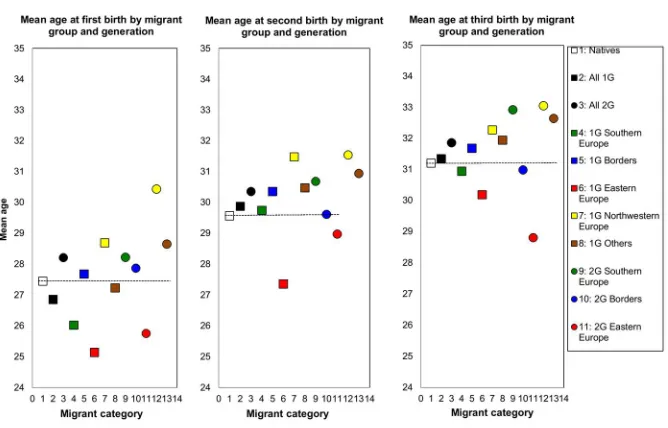
The average age of the mother at first birth has been increasing steadily over the past 40 years and has now reached above 30 years, though this age varies considerably based on the immigrant group’s country of origin. In Eastern Europe the modal age for having a first child when these countries were under a communist regime was as low as 19–20. Since the fall of communism in 1989 the age of entering motherhood has risen, often precipitously (Guarin, Bernardi, and Burkimsher 2016). The mean ages at first and second birth for women born between 1940 and 1998 appear in Figure 3; natives are represented by a white square, first-generation immigrants by a black square, and second-generation immigrants by a circle. The results show that the mean ages at first birth and second birth for first generation immigrants and their descendants tend to be similar to that of natives (27.5 for first birth and 29.6 for second birth). However, if we analyse the results by origin we observe that first- and second-generation immigrants of Eastern European origin and first-generation immigrants of Southern European origin have a lower mean age at first and second birth than natives, while the reverse is true for first- and second-generation immigrants with Northwestern European origins. Second-generation immigrants with Southern European origins tend to have first and second births later than first-generation immigrants of Southern European origin.
13 Immigrant groups in Switzerland are also heterogeneously composed according to their distribution across
Figure 3: Mean age at first, second, and third birth per women, by origin, in Switzerland (FGS 2013)
Note: 1G means first-generation immigrants and 2G means second-generation immigrants.
- - - Level of mean age at first, second, or third birth for native women compared with all other ethnic groups.
5.3 Timing of first birth and multivariate analyses by origin
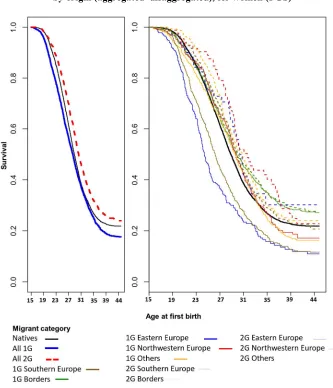
Figure 4: Kaplan‒Meier survival estimates of entering into first birth, by origin (aggregated‒disaggregated), for women (FGS)
Note: 1G means first-generation immigrants and 2G means second-generation immigrants.
descendants of immigrants have the same probability of becoming parents as Swiss natives.
We present the results of the Cox models for first birth in Table 1. Model 1 (M1) includes the effect of migrant status without controlling for other characteristics and shows that immigrants are more likely to have children than Swiss natives. However, for all second-generation immigrants this probability is lower than for Swiss natives. Controlling for birth cohort (M2) leaves the effects unchanged.
Table 1: Transition to first birth for women, by origin
Model 1 Model 2 Model 3 Model 4
Origin
Swiss 1 1 1 1
1G Borders 0.85 ** 0.87 ** 0.91 0.87 *
1G Eastern Europe 1.76 *** 2.1 *** 1.89 *** 1.78 *** 1G Northwestern Europe 1 1.13 1.21 * 1.21 *
1G Others 1.04 1.13 ** 1.21 *** 1.15 *
1G Southern Europe 1.49 *** 1.32 *** 1.35 *** 1.29 ***
2G Borders 0.82 ** 0.92 * 0.87 * 0.89
2G Eastern Europe 0.81 0.89 1.13 0.99
2G Northwestern Europe 0.75 * 0.92 0.94 0.91
2G Others 0.81 ** 0.94 0.93 0.93
2G Southern Europe 0.91 0.99 1.1 1.01
Cohort
Before 1949 1 1 1
1950‒1959 0.83 *** 0.92 *** 0.93 *
1960‒1969 0.69 *** 0.79 *** 0.8 ***
1970‒1979 0.61 *** 0.75 *** 0.78 ***
1980 and + 0.44 *** 0.53 *** 0.67 ***
Educational level
Low 1.33 *** 1.36 ***
Middle 1 1
High 0.64 *** 0.65 ***
Educational level father
Low 1
Middle 0.92 *
High 0.88 *
Educational level mother
Low 1
Middle 0.96
High 0.93
AIC 96,173.91 95,917.65 95,226.54 80,273.53
R2 0.02 0.04 0.08 0.09
Max. R2
1 1 1 1
Num. events 5,761 5,761 5,761 4,946
Num. obs. 9,002 9,002 8,976 6,760
Note:***p < 0.001, **p < 0.01, *p < 0.05. 1G means first-generation immigrants and 2G means second-generation immigrants.
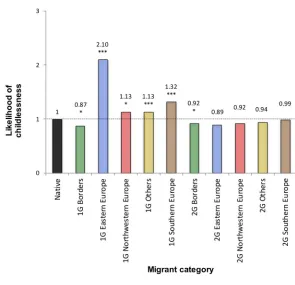
In order to better grasp the effect of education, in Figure 5 we present the coefficients of M3. Once the level of education is controlled for, the first-generation immigrants show higher first birth risks than the Swiss natives. This is particularly the case for first generation immigrants of Eastern European and Southern European origin (89% and 35% higher chance of having a first birth respectively). For second-generation immigrants the first birth risks are generally lower than for the Swiss natives, with the exception of the second-generation immigrants of Eastern European and Southern European origin (13% and 10% higher risks respectively, but coefficients are not statistically significant)
Figure 5: Relative risk of having a first birth for women aged 15‒45, by immigrant group (controlled for cohort and education)
Note: ***p < 0.001, **p < 0.01, *p < 0.05.
The comparison by cohort shows that women belonging to the older cohorts have a higher probability of first birth than those belonging to younger cohorts; yet this may be simply due to the fact that younger women have not yet reached their reproductive age limit and may be more likely to delay the transition to motherhood to their late thirties.
The introduction of the parents’ educational level (both father and mother) in M4 allows us to test whether the social origin of the individual plays a role in the choice of having a first child. The results show that the likelihood of having a first child is lower for women whose fathers have a medium or high education level than it is for women whose fathers have a low education level.
5.4 Timing of second birth and multivariate analyses by origin
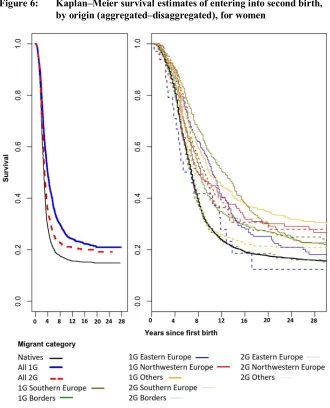
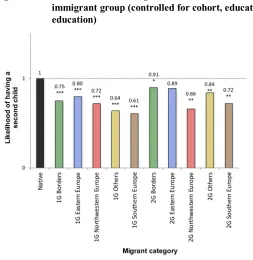
In Figure 6 we present estimated Kaplan‒Meier survival curves for second birth (origin aggregated on the left and disaggregated on the right). Here, Swiss natives have a greater chance of having a second child than immigrants and their descendants. The curves that are most distant from Swiss natives are first-generation immigrants of Southern European origin and those from ‘Other’ countries. These results show that Swiss natives are more likely to have a second child than immigrants and their descendants, and more likely to have it quickly.
Figure 6: Kaplan‒Meier survival estimates of entering into second birth, by origin (aggregated‒disaggregated), for women
Source: Family and Generation Survey 2013.
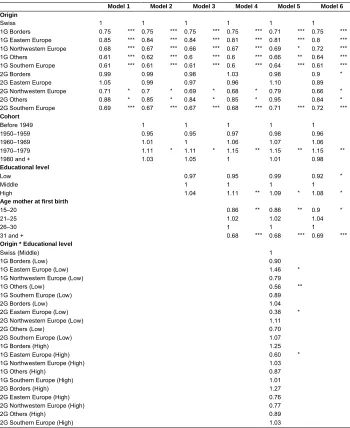
Table 2: Transition to second birth for women, by origin
Model 1 Model 2 Model 3 Model 4 Model 5 Model 6 Origin
Swiss 1 1 1 1 1 1
1G Borders 0.75 *** 0.75 *** 0.75 *** 0.75 *** 0.71 *** 0.75 *** 1G Eastern Europe 0.85 *** 0.84 *** 0.84 *** 0.81 *** 0.81 *** 0.8 *** 1G Northwestern Europe 0.68 *** 0.67 *** 0.66 *** 0.67 *** 0.69 * 0.72 *** 1G Others 0.61 *** 0.62 *** 0.6 *** 0.6 *** 0.66 ** 0.64 *** 1G Southern Europe 0.61 *** 0.61 *** 0.61 *** 0.6 *** 0.64 *** 0.61 ***
2G Borders 0.99 0.99 0.98 1.03 0.98 0.9 *
2G Eastern Europe 1.05 0.99 0.97 0.96 1.10 0.89 2G Northwestern Europe 0.71 * 0.7 * 0.69 * 0.68 * 0.79 0.66 * 2G Others 0.88 * 0.85 * 0.84 * 0.85 * 0.95 0.84 * 2G Southern Europe 0.69 *** 0.67 *** 0.67 *** 0.68 *** 0.71 *** 0.72 ***
Cohort
Before 1949 1 1 1 1 1
1950‒1959 0.95 0.95 0.97 0.98 0.96
1960‒1969 1.01 1 1.06 1.07 1.06
1970‒1979 1.11 * 1.11 * 1.15 ** 1.15 ** 1.15 **
1980 and + 1.03 1.05 1 1.01 0.98
Educational level
Low 0.97 0.95 0.99 0.92 *
Middle 1 1 1 1
High 1.04 1.11 ** 1.09 * 1.08 *
Age mother at first birth
15‒20 0.86 ** 0.86 ** 0.9 *
21‒25 1.02 1.02 1.04
26‒30 1 1 1
31 and + 0.68 *** 0.68 *** 0.69 ***
Origin * Educational level
Swiss (Middle) 1
1G Borders (Low) 0.90
1G Eastern Europe (Low) 1.46 *
1G Northwestern Europe (Low) 0.79
1G Others (Low) 0.56 **
1G Southern Europe (Low) 0.89
2G Borders (Low) 1.04
2G Eastern Europe (Low) 0.38 *
2G Northwestern Europe (Low) 1.11
2G Others (Low) 0.70
2G Southern Europe (Low) 1.07
1G Borders (High) 1.25
1G Eastern Europe (High) 0.60 *
1G Northwestern Europe (High) 1.03
1G Others (High) 0.87
1G Southern Europe (High) 1.01
2G Borders (High) 1.27
2G Eastern Europe (High) 0.76
2G Northwestern Europe (High) 0.77
2G Others (High) 0.89
Table 2: (Continued)
Model 1 Model 2 Model 3 Model 4 Model 5 Model 6 Educational level father
Low 1
Middle 0.93
High 1.02
Educational level mother
Low 1
Middle 0.99
High 0.98
AIC 69,996.99 69,992.92 69,747.38 69,646.05 69,648.75 59,148.76
R2 0.03 0.03 0.03 0.05 0.05 0.05
Max. R2 1 1 1 1 1 1
Num. events 4,394 4,394 4,394 4,394 4,394 3,795 Num. obs. 5,761 5,761 5,761 5,761 5,761 4,946
Notes:***p < 0.001, **p < 0.01, *p < 0.05. 1G means first-generation immigrants and 2G means second-generation immigrants.
Source: Family and Generation Survey 2013.
The introduction of control variables shows that the 1960–1969 and 1970–1979 cohorts have a greater chance of having a second birth than Swiss natives. In reference to maternal age at first birth, we found a lower second birth probability for women who have their first child before 25 and after 30 than for those who have the first child between 25 and 30, which is in line with other studies (Kreyenfeld and Anderson 2014). Concerning education level, to identify whether this pattern is different for respondents of immigrant origin, we specified an interaction effect (M5 in Table 2). In M5 all first-generation immigrants of Eastern European origin with a low educational level have a higher chance (46%) of having a second birth than Swiss natives with a medium educational level. All other first-generation immigrants with a low educational level have a lower likelihood of a second birth than Swiss natives with a medium educational level. First-generation immigrants with a high educational level have a lower probability of a second birth than Swiss natives with a medium educational level. For descendants of immigrants, all second-generation immigrants with a low educational level except those of Northwestern European origin have a lower likelihood of having a second child, and second-generation immigrants with a high educational level have a lower chance of having a second child. In M6 (Table 2) we introduced fathers’ educational level, but this variable provided no meaningful information.
Results also show that first-generation immigrants of Eastern and Southern Europeans origin, a population that commonly has a first child, are less likely to have a second child than Swiss natives, and the delay before having a second child is much longer (a mean interval of just over three years for native Swiss women compared to over six years for some first-generation immigrants of Southern and Eastern European origin). By contrast, second-generation immigrants of Eastern and Southern European origin show the reverse pattern and are similar to the Swiss natives. Indeed, the pattern for second-generation immigrants shows indications of integration: despite first-generation immigrants being less likely to have a second child, for second-first-generation immigrants the likelihood approaches the Swiss norm.
6. Discussion and conclusion
This paper draws a portrait of first and second births in Switzerland, differentiating quantum and tempo of first births among Swiss natives and Swiss residents of immigrant origin. In particular, we investigate the relative probability of a first and second birth for first- and second-generation immigrants compared to Swiss natives, and we distinguish immigrant populations by their geographical origin.
from Eastern and Southern Europe have a higher probability of transiting to parenthood (first birth) than second-generation immigrants and natives, and do so earlier (H1 and H3). This is comparable to what has been observed in other European countries (Kulu et al. 2017) and can be explained by a number of combined factors: younger age at immigration (for first-generation immigrants), higher average fertility levels in the country of origin (Milewski 2011), labour market performance (Scott and Stanfors 2011), aspirations, and norms concerning family formation. Second-generation immigrants have a lower likelihood of first birth than their parents and Swiss natives, with the exception of second-generation immigrants of Eastern and Southern European origin, whose chances of having a first birth lie between these two groups. Much has been written on the possible ‘normative duality’ of children of migrants, who seem to have a hard time reconciling the behavioural norms and aspirations conveyed by their parents within the family with those of the host society to which they are exposed through their participation in local institutions and networks (school, work, friends, sports, hobbies; Krapf and Wolf 2015) (H2 and H3).
This work has some limitations. We rely on the most recent dataset available, the Swiss FGS of 2013, whose large sample size allows studying recent immigrant groups and disaggregating fertility by migrant origin and generation. However, a finer distinction by country of origin, particularly for those countries whose population is ethnically, socially, and culturally very heterogeneous, could reveal important within-group differences. Similarly, our data did not allow us to distinguish natives who have a family history of naturalisation (acquisition of Swiss nationality). Last, given the young age of the second-generation migrants in recently arrived groups, we had to limit our analyses to first and second birth even though major differences in TFR depend on the transition to third birth. Our sample sizes for the analysis of third birth became too small when broken up by migrant group. Other factors such as ambition for social mobility, type of immigration, and individual family orientation could also play an important role in the fertility patterns of immigrant populations. Unfortunately, our data does not include socioeconomic information or individuals’ characteristics before migration. In particular, we do not have information on age at immigration or reason for immigration, so we could not test the influence of these variables in our analyses. This limited our results, because we could not build hypotheses based on the immigration strategies that play a key role in the decision to have a child. Ribe and Schultz (1980) argue that migrants have a clear ‘unobserved’ preference for family size and that their propensity for fertility is one of the factors that determine the destination country.
Despite these limitations, the results of this study raise important questions for future research. Examining the FGS, we found that migrants have a second child less often than natives and have longer intervals between births. This pattern has not been observed in other European countries, where migrants generally have faster and more frequent transitions to a second birth (Kulu et al. 2015). What makes migrants’ fertility different in Switzerland than in neighbouring countries? In what ways might this be related to the Swiss context, and does it have wider implications regarding social inequalities in fertility in such a context?
First, the arrival of a child is linked to additional costs. The relatively poor public support for parents and the high costs of childrearing in Switzerland may discriminate against migrants, who generally have lower economic and relational resources than the native population. Migrants from countries where welfare support for families and work-family reconciliation is more generous may possibly have higher expectations concerning public support for families. Working migrant parents from contexts where care needs are dealt with within the extended family face further constraints, because migrants generally have smaller social networks and thus less support is available to parents (Moret and Dahinden 2009).
Kieffer 2004; Fuligni and Fuligni 2007; Fuligni and Yoshikawa 2004). Therefore immigrants may want, more than natives, to invest their resources in one of their children to ensure their higher education.
Thirdly, differences in fertility behaviour may also be rooted in demographic changes in the migrants’ countries of origin. The theory of cultural continuity assumes that immigrants’ fertility behaviour will reflect that in their country of origin. This assumption would explain both the high levels of childlessness among Northwestern European immigrants and their high propensity to move on to a second birth once they are parents. It could also explain the rare childlessness but many one-child families among immigrants from Southern Europe and the Balkans.
These three interpretations of our results are not mutually exclusive, but they have different consequences depending on the explanatory mechanism. In the case of the explanation regarding lower levels of informal social support for immigrants, the issue is partially socialisation and adaptation to local preferences and norms concerning family support, and partially structural constraints (geographical distance from extended family). The second explanation, where higher educational preferences lead to higher investment, may indicate that if there is relatively easy adaptation and higher flexibility in terms of family and fertility preferences, adaptation in terms of educational investment is slower. This suggests important avenues for future research on behavioural indicators of integration: rather than considering indicators coming from separate life domains (e.g., fertility and family behaviour and educational outcomes), they need to be studied jointly in order to explore whether behavioural convergences in one domain explain divergent preferences in another. In the case of the third explanation, if the fertility behaviour of the migrant groups reflects the recent decline of second birth risks and rising age at first birth in the country of origin, then neither adaptation nor early socialisation mechanisms are at stake, but rather more complex cultural identity processes that link second-generation immigrants to their counterparts in their country of origin. All of these aspects are promising fields for future research.
7. Acknowledgements
References
Abbasi-Shavazi, M. and McDonald, P. (2000). Fertility and multiculturalism: Immigrant fertility in Australia, 1977–1991. International Migration Review
34(1): 215–242.doi:10.2307/2676018.
Afonso, A. (2004). Immigration and its impacts in Switzerland. Mediterranean
Quarterly15(4): 147–166.doi:10.1215/10474552-15-4-147.
Alba, R.D. (1985).Italian Americans: Into the twilight of ethnicity. Englewood Cliffs: Prentice-Hall.
Alders, M. (2000).Cohort fertility of migrant women in the Netherlands: Developments in fertility of women born in Turkey, Morocco, Suriname, and the Netherlands
Antilles and Aruba. Paper presented at the BSPS-NVDURU Conference,
Utrecht, the Netherlands, August 31–September 1, 2000. https://www.cbs.nl/nl-nl/publicatie/2001/49/cohort-fertility-of-migrant-woman-in-the-netherlands. Algan, Y., Dustmann, C., Glitz, A., and Manning, A. (2010). The economic situation of
first- and second-generation immigrants in France, Germany and the United Kingdom. The Economic Journal 120(542): F4–F30. doi:10.1111/j.1468-0297. 2009.02338.x.
Andersson, G. (2004). Childbearing after migration: Fertility patterns of foreign-born women in Sweden. International Migration Review 38(2): 747–774.doi:10.111 1/j.1747-7379.2004.tb00216.x.
Andersson, G. and Persson, L. (2015). Childbearing among the descendants of immigrants in Sweden. Stockholm: Stockholm University (FamiliesAndSocieties working paper series “Changing families and sustainable societies: Policy contexts and diversity over the life course and across generations” 39).
Andersson, G. and Scott, K. (2005). Labour-market status and first-time parenthood: The experience of immigrant women in Sweden, 1981–97. Population Studies
59(1): 21–38.doi:10.1080/0032472052000332683.
Andersson, G. and Scott, K. (2007). Childbearing dynamics of couples in a universalistic welfare state: The role of labor-market status, country of origin, and gender. Demographic Research 17(30): 897–938. doi:10.4054/DemRes. 2007.17.30.
Bader, D. and Fibbi, R. (2012). Les enfants de migrants: Un véritable potentiel.
Bauer, P. and Riphahn, R.T. (2007). Intergenerational transmission of educational attainment: Evidence from Switzerland on natives and second-generation immigrants.Journal of Population Economics 20(1): 121‒148.
Bolzman, C. (2001). Les immigrés sur le marché du travail: Entre discrimination et égalité de chances: Le cas de la Suisse. In: Boucher, M. (ed.). De l’égalité formelle à l’égalité réelle: La question de l’ethnicité dans les sociétés
européennes. Paris: L’Harmattan: 361–376.
Bolzman, C. (2007). Familles espagnoles et italiennes en Suisse et transition vers la vie adulte. Enfances, Familles, Générations 6: 38–53. www.efg.inrs.ca/index.php/ EFG/article/view/54.
Bolzman, C., Fibbi, R., and Vial, M. (2003). Que sont-ils devenus? Le processus d’insertion des adultes issus de la migration. In: Wicker, H.-R., Fibbi, R., and Haug, W. (eds.).Les migrations et la Suisse: Résultats du programme national
de recherche ‘Migrations et relations interculturelles.’ Zurich: Seismo: 434–
459.
Brinbaum, Y. and Kieffer, A. (2004). D’une génération à l’autre, les aspirations éducatives des familles immigrées: Ambition et persévérance. Education et
Formations 72: 53–75.
Burkimsher, M. and Zeman, K. (2017). Childlessness in Switzerland and Austria. In: Kreyenfeld, M. and Konietzka, D. (eds.). Childlessness in Europe: Contexts,
causes, and consequences. Cham: Springer Open: 115–137.
Canales, A. and Zlolniski, C. (2000).Comunidades transnacionales y migración en la
era de la globalización. Paper presented at the Simposio sobre Migración
Internacional en las Américas, San José, Costa Rica, September 4–6, 2000. Coleman, D. (1994). Trends in fertility and intermarriage among immigrant populations
in Western Europe as measures of integration. Journal of Biosocial Science
26(1): 107–136.doi:10.1017/S0021932000021106.
Coleman, D. (2006). Immigration and ethnic change in low-fertility countries: A third demographic transition. Population and Development Review 32(3): 401–446. doi:10.1111/j.1728-4457.2006.00131.x.
Crul, M. (2013). Snakes and ladders in educational systems: Access to higher education for second-generation Turks in Europe.Journal of Ethnic and Migration Studies
39(9): 1383‒1401.doi:10.1080/1369183X.2013.815388.
Crul, M. and Mollenkopf, J.H. (2012).The changing face of world cities: Young adult
children of immigrants in Europe and the United States. New York: Russell
Crul, M. and Vermeulen, H. (2003). The second generation in Europe. International
Migration Review 37(4): 965–986.doi:10.1111/j.1747-7379.2003.tb00166.x.
De Valk, H.A.G. (2010). Children of immigrants in the Netherlands: Growing up in diversity.Child Indicators Research 3(4): 503‒524.
De Valk, H.A.G. (2011). Paths to adulthood: A focus on the children of immigrants in the Netherlands. In: Wingens, M., Windzio, M., De Valk, H., and Aybek, C. (eds.). A life-course perspective on migration and integration. Dordrecht: Springer: 165–186.doi:10.1007/978-94-007-1545-5_8.
De Valk, H.A.G. and Liefbroer, A.C. (2007). Timing preferences for women’s family-life transitions: Intergenerational transmission among migrants and Dutch.
Journal of Marriage and the Family 69(1): 190–206.
doi:10.1111/j.1741-3737.2006.00353.x.
De Valk, H.A.G. and Milewski, N. (2011). Family life transitions among children of immigrants: An introduction.Advances in Life Course Research 16(4): 145–151. doi:10.1016/j.alcr.2011.10.001.
Dubuc, S. (2015). Fertility of immigrants. In: Ueda, R., Bean, F.D., and Brown, S.D. (eds.). Encyclopedia of Migration. Dordrecht: Springer: 1‒8. doi:10.1007/978-94-007-6179-7_69-1.
Federal Statistical Office (2014). Migration and integration, data indicators [electronic resource]. Neuchâtel: Federal Statistical Office. https://www.bfs.admin.ch/ bfs/en/home/statistics/population/migration-integration.html.
Federal Statistical Office (2017). Rapport statistique sur l’intégration de la population issue de la migration [electronic resource]. Neuchâtel: Federal Statistical Office. https://www.bfs.admin.ch/bfs/fr/home/statistiques/population.gnpdetail.2017-0466.html.
Feskens, R., Hox, J., Lensvelt-Mulders, G., and Schmeets, H. (2007). Nonresponse among ethnic minorities: A multivariate analysis. Journal of Official Statistics
23(3): 387–408.
Feskens, R., Hox, J., Lensvelt-Mulders, G., and Schmeets, H. (2006). Collecting data among ethnic minorities in an international perspective. Field Methods 18(3): 284–304.doi:10.1177/1525822X06288756.
Fibbi, R., Lerch, M., and Wanner, P. (2007). Naturalisation and socio-economic characteristics of youth of immigrant descent in Switzerland. Journal of Ethnic
and Migration Studies 33(7): 1121–1144.doi:10.1080/13691830701541655.
Fibbi, R., Lerch, M., and Wanner, P. (2010). School qualifications of children of immigrant descent in Switzerland. In: Alba, R. and Waters, M.C. (eds.).The next
generation: Immigrant youth in a comparative perspective. New York: New
York University Press: 110–134.
Fibbi, R., Wanner, P., Topgül, C., and Ugrina, D. (2015).The new second generation in
Switzerland: Youth of Turkish and former Yugoslav descent in Zürich and Basel.
Amsterdam: Amsterdam University Press.doi:10.5117/9789089648433.
Flückiger, Y. and Ramirez, J. (2003). Positions hiérarchiques et ségrégation par origine en Suisse. In: Wicker, H.R., Fibbi, R., and Haug, W. (eds.).Les migrations et la
Suisse. Zurich: Seismo: 290‒307.
Foner, N. (1997). The immigrant family: Cultural legacies and cultural changes.
International Migration Review31(4): 961–974.doi:10.2307/2547420.
Ford, K. (1990). Duration of residence in the United States and the fertility of U.S. immigrants. International Migration Review 24(1): 34–68. doi:10.2307/254 6671.
Fuligni, A.J. and Fuligni, A.S. (2007). Immigrant families and the educational development of their children. In: Lansford, J.E., Deater-Deckard, K., and Bornstein, M.H. (eds.).Immigrant families in contemporary society. New York: Guilford: 231‒249.
Fuligni, A.J. and Yoshikawa, H. (2004). Investments in children among immigrant families. In: Kalil, A. and DeLeire, T. (eds.). Family investments in children’s
potential: Resources and parenting behaviors that promote success. Mahwah:
Erlbaum: 139‒162. doi:10.4324/9781410610874.
Guarin, A., Bernardi, L., and Burkimsher, M. (2016). Comparing fertility patterns of migrants and Swiss natives.Demos Newsletter 1: 5–8.
Gustafsson, S. (2001). Optimal age at motherhood: Theoretical and empirical considerations on postponement of maternity in Europe. Journal of Population
Economics 14(2): 225–247.doi:10.1007/s001480000051.
Hardin, G. (2001). Carrying capacity as an ethical concept.The Social Contract12(1): 48‒57.
Haug, W. and Wanner, P. (2005). Migrants et marché du travail: Compétences et
insertion professionnelle des personnes d’origine étrangère en Suisse.
Haug, W., Compton, P., and Courbage, Y. (2003). The demographic characteristics of immigrant populations. Strasbourg: Council of Europe Publishing (Population Studies 38).
Heath, A., Rothon, C., and Kilpi, E. (2008). The second generation in Western Europe: Education, unemployment, and occupational attainment. Annual Review of
Sociology 34: 211–235.doi:10.1146/annurev.soc.34.040507.134728.
Heckathorn, D. (2002). Respondent-driven sampling II: Deriving valid population estimates from chain-referral samples of hidden populations. Social Problems
49(1): 11–34.doi:10.1525/sp.2002.49.1.11.
Hoem, J.M. (1975). Fertility and out-migration: Reflections on research approaches in empirical investigations of the association between two demographic phenomena. Copenhagen: University of Copenhagen (Working Paper 1).
Höhn, C. (2005). Demographic challenges for social cohesion: A review and analysis of the work of the European Population Committee 2001‒2004. Strasbourg: Council of Europe Publishing (Population Studies 48).
Holland, J.A. and de Valk, H.A.G. (2013). Ideal ages for family formation among immigrants in Europe. Advances in Life Course Research 18(4): 257–269. doi:10.1016/j.alcr.2013.08.002.
Huschek, D., de Valk, H.A.G., and Liefbroer, A.C. (2011). Gender-role behavior of second-generation Turks: The role of partner choice, gender ideology and societal context. Advances in Life Course Research 16(4): 164–177. doi:10.1016/j.alcr.2011.09.005.
Kahn, J.R. (1988). Immigrant selectivity and fertility adaptation in the United States.
Social Forces 67(1): 108‒128.doi:10.2307/2579102.
Kevisto, P. (2001). Theorizing transnational immigration: A critical review of current efforts. Ethnic and Racial Studies 24(4): 549‒577. doi:10.1080/0141987012 0049789.
Kogan, I. (2007). A study of immigrants’ employment careers in West Germany using the sequence analysis technique. Social Science Research 36(2): 491–511. doi:10.1016/j.ssresearch.2006.03.004.
Kohler, P. (2012). Cultural integration in Switzerland. In: Algan., Y., Bisin, A., Manning, A., and Verdier, T. (eds.). Cultural integration of immigrants in
Europe. Oxford: Oxford University Press. doi:10.1093/acprof:oso/9780199
Krapf, S. and Wolf, K. (2015). Persisting differences or adaptation to German fertility patterns? First and second birth behavior of the 1.5 and second generation Turkish migrants in Germany. Kölner Zeitschrift für Soziologie und
Sozialpsychologie 67(Suppl. 1): 137–164.doi:10.1007/s11577-015-0331-8.
Kreyenfeld, M. and Andersson, G. (2014). Socioeconomic differences in the unemployment and fertility nexus: Evidence from Denmark and Germany.
Advances in Life Course Research 21: 59–73.doi:10.1016/j.alcr.2014.01.007.
Kristen, S., Sodian, B., Thoermer, C., and Perst, H. (2011). Infants’ joint attention skills predict toddlers’ emerging mental state language. Developmental Psychology
47(5): 1207‒1219.
Kulu, H. (2005). Migration and fertility: Competing hypotheses re-examined.European
Journal of Population 21(1): 51–87.doi:10.1007/s10680-005-3581-8.
Kulu, H. (2006). Fertility of internal migrants: Comparison between Austria and Poland.Population, Space and Place 12(3): 147−170.doi:10.1002/psp.406. Kulu, H. and González-Ferrer, A. (2014). Family dynamics among immigrants and their
descendants in Europe: Current research and opportunities.European Journal of
Population 30(4): 411‒435.doi:10.1007/s10680-014-9322-0.
Kulu, H. and Hannemann, T. (2016). Introduction to research on immigrant and ethnic minority families in Europe. Demographic Research 35(2): 31–46.doi:10.4054/ DemRes.2016.35.2.
Kulu, H. and Milewski, N. (2007). Family change and migration in the life course: An introduction. Demographic Research 17(19): 567–590. doi:10.4054/DemRes. 2007.17.19.
Kulu, H., Hannemann, T., Pailhé, A., Neels, K., Krapf, S., González-Ferrer, A., and Andersson, G. (2017). Fertility by birth order among the descendants of immigrants in selected European countries.Population and Development Review
43(1): 31–60.doi:10.1111/padr.12037.
Laganà, F., Chevillard, J., and Gauthier, J.-A. (2013). Socio-economic background and early post-compulsory education pathways: A comparison between natives and second-generation immigrants in Switzerland. European Sociological Review
30(1): 18‒34.doi:10.1093/esr/jct019.
Lerch, M. and Wanner, P. (2010). Quels apports démographiques des migrations internes des étrangers pour les villes suisses?GeoRegard 3.
Lessard-Phillips, L., Galandini, S., De Valk, H., and Fibbi, R. (2015). Damned if you do, damned if you don’t: The challenges of including and comparing the children of immigrants in European survey data. Den Haag: Nederlands Interdisciplinair Demografisch Instituut (Working paper no. 2015/01). http://www.nidi.nl/shared/content/output/papers/nidi-wp-2015-01.pdf.
Levitt, P. (2004). Transnational migrants: When ‘home’ means more than one country.
Migration Information Source. Washington, D.C.: Migration Policy Institute.
www.migrationpolicy.org/article/transnational-migrants-when-home-means-more-one-country/.
Macisco, Jr., J.J., Bouvier, L.F., and Weller, R.H. (1970). Effect of labor force participation on the relation between migration status and fertility in San Juan, Puerto Rico. Milbank Memorial Fund Quarterly 48(1): 51–70. doi:10.2307/ 3349288.
Mahnig, H. and Piguet, E. (2003). La politique suisse d’immigration de 1948 à 1998: évolution et effets. In: Wicker, H., Fibbi, R., and Werner, H. (eds.). Les
Migrations et la Suisse. Zurich: Seismo: 63‒103.
Marks, G.N. (2005). Accounting for immigrant non-immigrant differences in reading and mathematics in twenty countries.Ethnic and Racial Studies 28(5): 925–946. doi:10.1080/01419870500158943.
Mayer, J. and Riphahn, R.T. (2000). Fertility assimilation of immigrants: Evidence from count data models. Journal of Population Economics 13(2): 241‒261. doi:10.1007/s001480050136.
Mens, Y. (2006). La deuxième génération bouscule l’Europe. Alternatives
Internationales3(30): 31‒32.
Mey, E., Rorato, M., and Voll, P. (2005). Die soziale Stellung der zweiten Generation: Analysen zur schulischen und beruflichen Integration der zweiten Ausländergeneration. In: Federal Statistical Office (ed.). L’intégration des populations issues de l’immigration en Suisse: Personnes naturalisées et
Milewski, N. (2007). First child of immigrant workers and their descendants in West Germany: Interrelations of events, disruption, or adaptation? Demographic
Research 17(29): 859–896.doi:10.4054/DemRes.2007.17.29.
Milewski, N. (2010). Immigrant fertility in West Germany: Is there a socialization effect in transitions to second and third births?European Journal of Population
26(3): 297–323.doi:10.1007/s10680-010-9211-0.
Milewski, N. (2011). Transition to a first birth among Turkish second-generation migrants in Western Europe.Advances in Life Course Research 16(4): 178–189. doi:10.1016/j.alcr.2011.09.002.
Milewski, N. and Kulu, H. (2014). Mixed marriages in Germany: A high risk of divorce for immigrant–native couples. European Journal of Population 30(1): 89–113. doi:10.1007/s10680-013-9298-1.
Moore, K., Manlove, J., Glei, D.A., and Morrison, D.R. (1998). Nonmarital school-age motherhood: Family, individual, and school characteristics. Journal of
Adolescent Research 13(4): 433‒457.doi:10.1177/0743554898134004.
Moret, J. and Dahinden, J. (2009). Vers une meilleure communication: Coopération
avec les réseaux des migrants. Bern: Commission fédérale pour les questions de
migration (CFM).
Mussino, E. and Strozza, S. (2012). The fertility of immigrants after arrival: The Italian case.Demographic Research 26(4): 99‒130.doi:10.4054/DemRes.2012.26.4. Pailhé, A. (2015). Partnership dynamics across generations of immigration in France:
Structural vs. cultural factors. Demographic Research 33(16): 451–498. doi:10.4054/demres.2015.33.16.
Parrado, E.A. (2011). How high is Hispanic/Mexican fertility in the United States? Immigration and tempo considerations. Demography 48(3): 1059‒1080. doi:10.1007/s13524-011-0045-0.
Portes, A. (1994). Introduction: Immigration and its aftermath.International Migration
Review 28(4): 632–639.doi:10.2307/2547151.
Portes, A. (1997). Immigration theory for a new century: Some problems and opportunities. International Migration Review 31(4): 799‒825. doi:10.2307/ 2547415.
Portes, A. (1999). La mondialisation par le bas: L’émergence des communautés transnationales.Actes de la recherche en sciences sociales129(1): 15‒25. Portes, A. and Rumbaut, R. (2005). Introduction: The second generation and the
Rahnu, L., Puur, A., Sakkeus, L., and Klesment, M. (2015). Partnership dynamics among migrants and their descendants in Estonia. Demographic Research
32(56): 1519‒1566.doi:10.4054/DemRes.2015.32.56.
Ribe, H. and Schultz, T.P. (1980). Migrant and native fertility in Colombia in 1973: Are migrants selected according to their reproductive preferences? New Haven: Yale University, Economic Growth Center (Center discussion paper no. 355). http://www.econ.yale.edu/growth_pdf/cdp355.pdf.
Rumbaut, R.G. (2005). Turning points in the transition to adulthood: Determinants of educational attainment, incarceration, and early childbearing among children of immigrants. Ethnic and Racial Studies 28(6): 1041–1086. doi:10.1080/01419 870500224349.
Santelli, E. (2007). Les jeunes de banlieue d’origine maghrébine: Entre galère et emploi stable, quel devenir? Revue Européenne des Migrations Internationales 23(2): 57–77.doi:10.4000/remi.4171.
Scott, K. and Stanfors, M. (2011). The transition to parenthood among the second generation: Evidence from Sweden, 1990–2005. Advances in Life Course
Research 16(4): 190–204.doi:10.1016/j.alcr.2011.09.003.
Sobotka, T. (2008). Overview Chapter 7: The rising importance of migrants for childbearing in Europe. Demographic Research 19(9): 225–248. doi:10.4054/ DemRes.2008.19.9.
Toulemon, L. (2004). Fertility among immigrant women: New data, a new approach.
Population et Sociétés 400: 1–4.
Tucci, I. (2017). Analyzing second-generation trajectories from a life course approach: What mixed methods can offer. In: Bolzman, C., Bernardi, L., and LeGoff, J.M. (eds.). Situating children of migrants across borders and origins: A
methodological overview. Dordrecht: Springer.
van Hek, M., Kraaykamp, G., and Wolbers, M.H.J. (2015). Family resources and male– female educational attainment: Sex specific trends for Dutch cohorts (1930– 1984).Research in Social Stratification and Mobility 40: 29–38.doi:10.1016/j. rssm.2015.02.001.
Vertovec, S. (2003). Migration and other modes of transnationalism: Towards conceptual cross-fertizilization.International Migration Review 37(3): 641‒665. doi:10.1111/j.1747-7379.2003.tb00153.x.