Digital Workers of the World Unite! A Framework for
Critically Theorising and Analysing Digital Labour
Christian Fuchs
*and Marisol Sandoval
†*
University of Westminster,
[email protected]
†
City University London,
[email protected]
Abstract: The overall task of this paper is to elaborate a typology of the forms of labour that are needed for the production, circulation, and use of digital media. First, we engage with the question what labour is, how it differs from work, which basic dimensions it has and how these dimensions can be used for defining digital labour. Second, we introduce the theoretical notion of the mode of produc-tion as analytical tool for conceptualizing digital labour. Modes of producproduc-tion are dialectical units of relations of production and productive forces. Relations of production are the basic social relations that shape the economy. Productive forces are a combination of labour power, objects and instruments of work in a work process, in which new products are created. Third, we have a deeper look at dimen-sions of the work process and the conditions under which it takes place. We present a typology that identifies dimensions of working conditions. It is a general typology that can be used for the analysis of any production process. Fourth, we apply the typology of working conditions to the realm of digital labour and identify different forms of digital labour and the basic conditions, under which they take place. Finally, we discuss political implications of our analysis and what can be done to overcome bad working conditions that digital workers are facing today.
Keywords: critical theory, critical political economy of communication and the media, social theory, digital labour, digital work, digital media, philosophy
Muhanga is an enslaved miner
in Kivu (Democratic Republic of Congo). He extracts
cas-siterite, a mineral that is needed for the manufacturing of laptops and mobile phones: “As you
crawl through the tiny hole, using your arms and fingers to scratch, there’s not enough space
to dig properly and you get badly grazed all over. And then, when you do finally come back
out with the cassiterite, the soldiers are waiting to grab it at gunpoint. Which means you have
nothing to buy food with. So we’re always hungry” (Finnwatch 2007, 20).
The Chinese engineer Lu assembles mobile phones at Foxconn Shenzhen. He reports
about overwork and exhaustion: “We produced the first generation iPad. We were busy
throughout a 6-month period and had to work on Sundays. We only had a rest day every 13
days. And there was no overtime premium for weekends. Working for 12 hours a day really
made me exhausted” (SACOM 2010, 7; for an analysis of Foxconn see also Sandoval 2013).
In Silicon Valley, the Cambodian ICT (information and communications technology)
as-sembler Bopha has been exposed to toxic substances. He highlights: “I talked to my
co-workers who felt the same way [that I did] but they never brought it up, out of fear of losing
their job” (Pellow and Park 2002, 139).
Ann, a web designer, writer, and illustrator, offers her services on the freelance market
platform People Per Hour that mediates the creation and purchase of products and services
that are not remunerated by worked hours, but by a fixed product price. She describes her
work:
My design styles are as broad as my client base, from typical hard hitting, sound, clear, and concise business branding, to more stylised and fluid hand drawn or illustrated work. I relish working to a deadline, and although I often work to very specific criteria, some cli-ents are looking for a moment of inspiration, and that's where I excel. I'm always ready for a challenge, and providing the brief is concise and well conceived. I can produce work to a very tight schedule. If you are online, you will see amendments almost immediately! (data source: peopleperhour.com).
The working lives of Muhanga, Lu, Bopha, Mohan, Bob, and Ann seem completely different.
Muhanga extracts minerals from nature. Lu and Bopha are industrial workers. Mohan, Bob
and Ann are information workers creating either software or designs. They work under
differ-ent conditions, such as slavery, wage labour, or freelancing. Yet they have in common that
their labour is in different ways related to the production and use of digital technologies and
that ICT companies profit from it. In this paper we discuss the commonalities and differences
of the working lives of workers like these by identifying different dimensions of digital labour.
Section 1 introduces a cultural-materialist perspective on theorising digital labour. Section
2 discusses the relevance of Marx’s concept of the mode of production for the analysis of
digital labour. Section 3 introduces a typology of the dimensions of working conditions.
Sec-tion 4 based on the preceding secSec-tions presents a digital labour analysis toolbox. Finally, we
draw some conclusions in section 5.
1.
(Digital) Work and Labour: A Cultural-Materialist Perspective
The digital labour debate has in a first phase focused mainly on understanding the value
cre-ation mechanisms on corporate social media such as Facebook, YouTube, and Twitter.
Au-thors have for example discussed the usefulness of Karl Marx’s labour theory of value
(Fuchs 2010, Arvidsson and Colleoni 2012, Fuchs 2012b, Scholz 2013), how the notion of
alienation shall be used in the context of digital labour (Andrejevic 2012, Fisher 2012), or if
and how Dallas Smythe’s concept of audience labour can be used for understanding digital
labour (for an overview discussion see Fuchs 2012a). The book
Social Media: A Critical
In-troduction
(Fuchs 2014b) provides a general introduction to many of these issues. The
gen-eral task has been to understand and conceptualise a situation in which users under
real-time and far-reaching conditions of commercial surveillance create a data commodity that is
sold to advertising clients. This involved a discussion of the question of who exactly creates
the value that manifests itself in social media corporations’ profits. But going beyond these
initial debates, studying digital labour requires paying attention to digital labour in all its
forms.
In approaching a definition of digital labour one can learn from debates on how to define
cultural and communication labour.
1.1.
Defining Cultural Labour
Vincent Mosco and Catherine McKercher argue for a much broader definition of
commu-nication work, including “anyone in the chain of producing and distributing knowledge
prod-ucts” (Mosco and McKercher 2009, 25). In the case of the book industry, this definition
in-cludes not only writers but, equally, librarians and also printers.
Hesmondhalgh’s definition of cultural industries and cultural work focuses on content
pro-duction. Such a definition tends to exclude digital media, ICT hardware, software, and
Inter-net phenomena such as social media and search engines. It thereby makes the judgment
that content industries are more important than digital media industries. It is idealistic in that it
focuses on the production of ideas and excludes the fact that these ideas can only be
com-municated based on the use of physical devices, computers, software, and the Internet. For
Hesmondhalgh (2013, 19) software engineers for example are no cultural workers because
he considers their work activity as “functional” and its outcomes not as text with social
mean-ing.
Software engineering is highly creative: it is not just about creating a piece of code that
serves specific purposes, but also about writing the code by devising algorithms, which
pos-es logical challengpos-es for the engineers. Robert L. Glass (2006) argupos-es that software
engi-neering is a complex form of problem solving that requires a high level of creativity that he
terms software creativity. Software is semantic in multiple ways: a) when its code is
execut-ed, each line of the code is interpreted by the computer which results in specific operations;
b) when using a software application online or offline our brains constantly interpret the
pre-sented information; c) software not only supports cognition, but also communication and
col-laboration and therefore helps humans create and reproduce social meaning. Software
engi-neers are not just digital workers. They are also cultural workers.
Hesmondhalgh opposes Mosco’s and McKercher’s broad definition of cultural work
be-cause “such a broad conception risks eliminating the specific importance of
culture,
of
medi-ated communication
, and of the
content
of communication products” (Hesmondhalgh and
Baker 2011, 60). Our view is that there are many advantages of a broad definition as:
1. it avoids “cultural idealism” (Williams 1977, 19) that ignores the materiality of culture,
2. it can take into account the connectedness of technology and content, and
3. it recognizes the importance of the global division of labour, the exploitation of labour in
developing countries, slavery and other bloody forms of labour and thereby avoids the
Western-centric parochialism of cultural idealism.
Probably most importantly, a broad conception of cultural work can inform political solidarity:
“A more heterogeneous vision of the knowledge-work category points to another type of
poli-tics, one predicated on questions about whether knowledge workers can unite across
occu-pational or national boundaries, whether they can maintain their new-found solidarity, and
what they should do with it” (Mosco and McKercher 2009, 26).
Likewise, Eli Noam opposes the separation of hardware and content producers and
ar-gues for a broad definition of the information industry: “Are the physical components of media
part of the information sector? Yes. Without transmitters and receivers a radio station is an
abstraction. Without PCs, routers, and servers there is no Internet” (Noam 2009, 46). Noam
argues for a materialist unity of content and hardware producers in the category of the
infor-mation industry.
While some definitions of creative work and creative industries are input- and
occupation-focused (Caves 2000, Cunningham 2005, Hartley 2005), the broad notion of cultural work we
are proposing focuses on industry and output. Input- and output-oriented definitions of
cul-tural work/industries reflect a distinction that already Fritz Machlup (1962) and Daniel Bell
(1974) used in their classical studies of the information economy: the one between
occupa-tional and industry definitions of knowledge work. Our approach differs both from
input-oriented definitions and narrow output-input-oriented definitions.
labourer, i.e. a combination of workers”
(Marx 1867, 644), and argues that labour is
produc-tive if it is part of the combined
labour force: “In order to work productively, it is no longer
necessary for
the individual himself to put his hand to the object; it is sufficient for him to be
an organ of the collective labourer, and to perform any one of its subordinate
functions”
(ibid.). The collective worker is an “aggregate worker” whose “combined activity results
mate-rially in an aggregate product” (ibid., 1040). The “activity of this aggregate labour-power” is
“the immediate production of surplus-value, the immediate conversion of this latter into
capi-tal” (ibid.).
The question of how to define cultural and eventually also digital labour has to do with the
more general question of how to understand culture. It therefore makes sense to pay some
attention to the works of one of the most profound cultural theorists: Raymond Williams.
1.2.
Cultural Materialism
In his early works, Raymond Williams was trying to understand working-class culture in
con-trast to bourgeois culture, which illustrates his genuinely socialist position and interest in
cul-ture. But although Williams stresses the focus on totality, i.e. culture as “the way of life as a
whole” (Williams 1958, 281) and “a general social process” (Williams 1958, 282), he in his
early works tended to categorically separate culture and the economy: “even if the economic
element is determining, it determines a whole way of life” (Williams 1958, 281). This notion of
determination implies that the two realms of the economy and culture are connected, but that
in the first instance they are also separate.
Later, in
Marxism and Literature,
Raymond Williams questioned Marxism’s historical
ten-dency to see culture as “dependent, secondary, ‘superstructural’: a realm of ‘mere’ ideas,
beliefs, arts, customs, determined by the basic material history” (Williams 1977, 19). He
dis-cusses various concepts that Marxist theories have used for conceptualising the relationship
of the economy and culture: determination, reflection, reproduction, mediation, homology. He
argues that these concepts all assume a relationship between the economy and culture that
to a varying degree is shaped by causal determination or mutual causality. But all of them
would share the assumption of “the separation of ‘culture’ from material social life” (Williams
1977, 19) that Williams (1977, 59) considers to be “idealist”. In Williams view the problem
with these approaches is not that they are too economistic and materialist but quite on the
contrary that they are not “materialist enough” (Williams 1977, 92).
Williams (1977, 78) argues that Marx opposed the “
separation
of ‘areas’ of thought and
activity”. Production would be distinct from “consumption, distribution, and exchange” as well
as from social relations (Williams 1977, 91). Productive forces would be “all and any of the
means of the production and reproduction of real life”, including the production of social
knowledge and co-operation (Williams 1977, 91). Politics and culture would be realms of
material production: ruling classes would produce castles, palaces, churches, prisons,
work-houses, schools, weapons, a controlled press, etc. (Williams 1977, 93). Therefore Williams
highlights the “material character of the production of a social and political order” and
de-scribes the concept of the superstructure an evasion (Williams 1977, 93). Here, Williams
reflects Gramsci’s insight that “popular beliefs” and “similar ideas are themselves material
forces” (Gramsci 1988, 215).
Raymond Williams (1977, 111) formulates as an important postulate of Cultural
Material-ism that “[c]ultural work and activity are not […] a superstructure” because people would use
physical resources for leisure, entertainment, and art. Combining Williams’ assumptions that
cultural work is material and economic and that the physical and ideational activities
underly-ing the existence of culture are interconnected means that culture is a totality that connects
all physical and ideational production processes that are connected and required for the
ex-istence of culture. Put in simpler terms this means that for Williams the piano maker, the
composer, and the piano player all are cultural workers.
sign system would involve the social relations that produce it, the institutions in which it is
formed and its role as a cultural technology (Williams 1977, 140). In order to avoid the “real
danger of separating human thought, imagination and concepts from ‘men’s material
life-process’” (Williams 1989, 203), one needs to focus on the “totality of human activity”
(Wil-liams 1989, 203) when discussing culture: We “have to emphasise cultural practice as from
the beginning social and material” (Williams 1989, 206). The “productive forces of ‘mental
labour’ have, in themselves, an inescapable material and thus social history” (William 1989,
211). Marx expressed the basic assumption of Cultural Materialism well by stressing that the
“production of ideas, of conceptions, of consciousness, is at first directly interwoven with the
material activity and the material intercourse of men” (Marx and Engels 1845/46, 42). The
production of ideas is therefore the “language of real life” (Marx and Engels 1845/46, 42).
“Men are the producers of their conceptions, ideas, etc., that is, real, active men, as they are
conditioned by a definite development of their productive forces and of the intercourse
corre-sponding to these, up to its furthest forms” (Marx and Engels 1845/46, 42). Thinking and
communicating for Marx are processes of production that are embedded into humans’
every-day life and work. Human beings produce their own capacities and realities of thinking and
communication in work and social relations.
In his later works, Williams stressed that it is particularly the emergence of an information
economy in which information, communication, and audiences are sold as commodities that
requires rethinking the separation of the economy and culture and to see culture as material.
“[I]nformation processes […] have become a qualitative part of economic organization”
(Wil-liams 1981, 231). “Thus a major part of the whole modern labour process must be defined in
terms which are not easily theoretically separable from the traditional ‘cultural’ activities. […]
so many more workers are involved in the direct operations and activations of these systems
that there are quite new social and social-class complexities” (Williams 1981, 232).
As information is an important aspect of economic production in information societies, the
culture concept cannot be confined to popular culture, entertainment, works of arts, and the
production of meaning through the consumption of goods, but needs to be extended to the
realm of economic production and value creation. Cultural labour is a crucial concept in this
context.
1.3.
A Materialist Notion of Cultural Labour
Inspired by Raymond Williams’ cultural materialism, it is feasible to argue for a broad
under-standing of cultural and digital labour that transcends the cultural idealism of the early digital
labour debate and some positions within the cultural industries school. On the one hand
Wil-liams refutes the separation of culture and the economy as well as base and superstructure.
On the other hand he maintains that culture, as a signifying system, is a distinct system of
society. How can we make sense of these claims that at first sight seem to be mutually
ex-clusive? If one thinks dialectically, then a concept of culture as material and necessarily
eco-nomic and at the same time distinct from the economy is feasible: culture and politics are
dialectical sublations (Aufhebung) of the economy. In Hegelian philosophy sublation means
that a system or phenomenon is preserved, eliminated, and lifted up. Culture is not the same
as the economy, it is more than the sum of various acts of labour, it has emergent qualities—
it communicates meanings in society—that cannot be found in the economy alone. But at the
same time, the economy is preserved in culture: culture is not independent from labour,
pro-duction and physicality, but requires and incorporates all of them.
qualities that are grounded in the underlying systems and levels that are preserved on the
upper level and through synergies produce new qualities of the upper level. In the language
of dialectical philosophy this means that the emergent quality of an organization level is a
sublation (Aufhebung) of the underlying level.
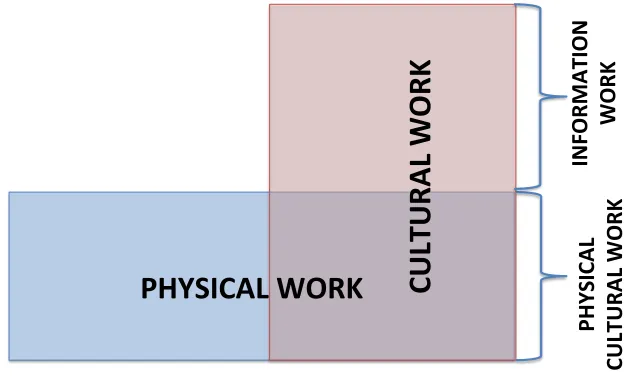
Figure 1: A stage model of cultural work
Using a stage model allows us to identify and relate different levels of cultural and digital
work (see figure 1). Cultural work is a term that encompasses organisational levels of work
that are at the same time distinct and dialectically connected: cultural work has an emergent
quality, namely information work that creates content, that is based on and grounded in
phys-ical cultural work, which creates information technologies through agricultural and industrial
work processes. Physical work takes place inside and outside of culture: it creates
infor-mation technologies and its components (cultural physical work) as well as other products
(non-cultural physical work) that do not primarily have symbolic functions in society (such as
cars, tooth brushes or cups). Cars, toothbrushes, or cups do not primarily have the role of
informing others or communicating with others, but rather help humans achieve the tasks of
transport, cleanliness and nutrition. Culture and information work however feedback on these
products and create symbolic meanings used by companies for marketing them. Cultural
work is a unity of physical cultural work and information work that interact with each other,
are connected and at the same time distinct.
The production of meaning, social norms, morals, and the communication of meanings,
norms, and morals are work processes: they create cultural use-values. Culture requires on
the one hand human creativity for creating cultural content and on the other hand specific
forms and media for storage and communication. Work that creates information and
commu-nication through language is specific for work conducted in the cultural system: informational
and communication work. For having social effects in society, information, and
communica-tion are organized (stored, processed, transported, analysed, transformed, created) with the
help of information and communication technologies, such as computers, TV, radio,
newspa-pers, books, recorded films, recorded music, language, etc. These technologies are
pro-duced by physical cultural work. Culture encompasses a) physical and informational work
that create cultural technologies (information and communication technologies) and b)
infor-mation work that creates inforinfor-mation and communication.
These two types of work act together in order to produce and reproduce culture.
Mean-ings and judgements are emergent qualities of culture that are created by informational work,
they take on relative autonomy that has effects inside but also outside the economic system.
This means that specific forms of work create culture, but culture cannot be reduced to the
economy—it has emergent qualities.
PHYSICAL)WORK)
IN
FO
RMAT
IO
N
)
W
O
RK
)
PH
YS
IC
AL
)
CU
LT
U
RAL
)W
O
RK
)
CU
LT
U
RAL
)W
O
RK
Following Williams, communication is the “passing of ideas, information, and attitudes
from person to person”, whereas communications means the “institutions and forms in which
ideas, information, and attitudes are transmitted and received” (Williams 1962, 9).
Infor-mation and communication are meaning-making activities created by inforInfor-mational work.
Physical cultural work creates communications as institutions and forms that organize the
creation and passing of information in social processes.
Marx identified two forms of information work: The first results in cultural goods that “exist
separately from the producer, i.e. they can circulate in the interval between production and
consumption as commodities, e.g. books, paintings and all products of art as distinct from the
artistic achievement of the practising artist”. In the second, “the product is not separable from
the act of producing” (Marx 1867, 1047f). The first requires a form, institution or technology
that stores and transports information, as in the case of computer-mediated communication,
the second uses language as main medium (e.g. theatre). The first requires physical cultural
work for organizing storage, organization, and transport of information; the second is
possi-ble based only on information work.
Given the notion of cultural labour and a cultural-materialist framework inspired by
Ray-mond Williams, we can next ask the question what is specific about the digital mode of
cul-tural labour.
1.4.
Digital Work and Digital Labour
The realm of digital media is a specific subsystem of the cultural industries and of cultural
labour. Digital labour is a specific form of cultural labour that has to do with the production
and productive consumption of digital media. There are other forms of cultural labour that are
non-digital. Think for example of a classical music or rock concert. But these forms of live
entertainment that are specific types of cultural labour also do not exist independently from
the digital realm: Artists publish their recordings in digital format on iTunes, Spotify, and
simi-lar online platforms. Fans bring their mobile phones for taking pictures and recording concert
excerpts that they share on social media platforms. There is little cultural labour that is fully
independent from the digital realm today. The notion of digital work and digital labour wants
to signify those forms of cultural labour that contribute to the existence of digital technologies
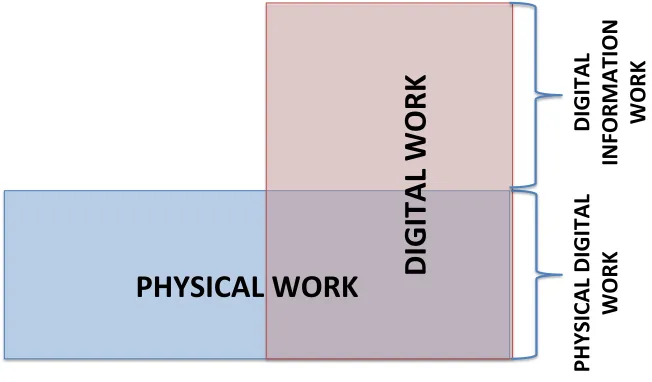
and digital content. It is a specific form of cultural labour. Figure 2 applies the stage model of
cultural work (see figure 1 above) to digital work.
Figure 2: A stage model of digital work
If culture were merely symbolic, mind, spirit, “immaterial”, superstructural, informational, a
world of ideas, then digital labour as expression of culture clearly would exclude the concrete
PHYSICAL)WORK)
D
IG
IT
AL
)
IN
FO
RMAT
IO
N
)
W
O
RK
)
PH
YS
IC
AL
)D
IG
IT
AL
)
W
O
RK
)
D
IG
IT
AL
)W
O
RK
works of mining and hardware assemblage that are required for producing digital media.
Wil-liams’ Cultural Materialism, contrary to the position of Cultural Idealism, makes it possible to
argue that digital labour includes both the creation of physical products and information that
are required for the production and usage of digital technologies. Some digital workers create
hardware, others hardware components, minerals, software or content that are all objectified
in or the outcome of the application of digital technologies. Some workers, e.g. miners, not
just contribute to the emergence of digital media, but to different products. If one knows the
mines’ sales, then it is possible to determine to which extent the performed labour is digital or
other labour.
In order to illustrate this point that culture is material, we now want return in greater detail
to a passage where Marx reflects about the work of making and playing the piano. Marx
wrote:
Productive labour is only that which produces capital. Is it not crazy, asks e.g. (or at least something similar) Mr Senior, that the piano maker is a productive worker, but not the pi-ano player, although obviously the pipi-ano would be absurd without the pipi-ano player? But this is exactly the case. The piano maker reproduces capital; the pianist only exchanges his labour for revenue. But doesn't the pianist produce music and satisfy our musical ear, does he not even to a certain extent produce the latter? He does indeed: his labour pro-duces something; but that does not make it productive labour in the economic sense; no more than the labour of the madman who produces delusions is productive. Labour be-comes productive only by producing its own opposite (Marx 1857/58, 305).
Williams remarks that today, other than in Marx’s time, “the production of music (and not just
its instruments) is an important branch of capitalist production” (Williams 1977, 93).
If the economy and culture are two separate realms, then building the piano is work and
part of the economy and playing it is not work, but culture. Marx leaves however no doubt
that playing the piano produces a use-value that satisfies human ears and is therefore a form
of work. As a consequence, the production of music must just like the production of the piano
be an economic activity. Williams (1977, 94) stresses that cultural materialism means to see
the material character of art, ideas, aesthetics and ideology and that when considering piano
making and piano playing it is important to discover and describe “relations between all these
practices” and to not assume “that only some of them are material”.
Apart from the piano maker and the piano player there is also the composer of music. All
three forms of work are needed and necessarily related in order to guarantee the existence
of piano music. Fixing one of these three productive activities categorically as culture and
excluding the others from it limits the concept of culture and does not see that one cannot
exist without the other. Along with this separation come political assessments of the
separat-ed entities. A frequent procseparat-edure is to include the work of the composer and player and to
exclude the work of the piano maker. Cultural elitists then argue that only the composer and
player are truly creative, whereas vulgar materialists hold that only the piano maker can be a
productive worker because he works with his hands and produces an artefact. Both
judg-ments are isolationist and politically problematic.
Taking the example of piano music and transferring it to digital media, we find
corre-spondences:
Just like we find piano makers, music composers and piano players in the
mu-sic industry, we find labour involved in hardware production (makers), content and software
production (composers) and productive users (prosumers, players, play labour) in the world
of digital labour. In the realm of digital labour, we have to emphasize that practices are “from
the beginning social and material” (Williams 1989, 206).
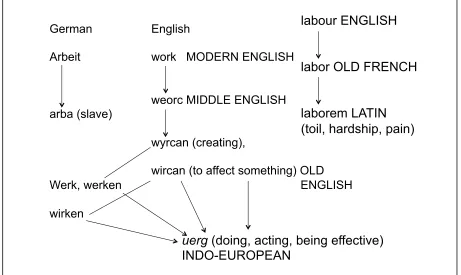
to create something that brings about some changes in society.
Weorc
is related to the
Ger-man terms
Werk
and
werken
. Both work in English and
Werk
in German were derived from
the Indo-European term
uerg
(doing, acting).
Werken
in German is a term still used today for
creating something. Its origins are quite opposed to the origins of the term
Arbeit
. The result
of the process of
werken
is called
Werk
. Both
werken
and
Werk
have the connotative
mean-ing of bemean-ing creative. Both terms have an inherent connotation of artistic creation. Arendt
(1958, 80f) confirms the etymological distinction between ergazesthai (Greek)/facere,
fabri-cari (Latin)/work (English)/werken (German)/ouvrer (French) and ponein (Greek)/laborare
(Latin)/labour (English)/arbeiten (German)/travailler (French).
Raymond Williams (1983, 176–179) argues that the word “labour” comes from the French
word
labor
and the Latin term
laborem
and appeared in the English language first around
1300. It was associated with hard work, pain and trouble. In the 18th century, it would have
attained the meaning of work under capitalist conditions that stands in a class relationship
with capital. The term “work” comes from the Old English word
weorc
and is the “most
gen-eral word for doing something” (ibid., 334). In capitalism the term on the one hand has,
ac-cording to Williams (ibid., 334–337), acquired the same meaning as labour—a paid job—but
would have in contrast also kept its original broader meaning. In order to be able to
differen-tiate the dual historical and essential character of work, it is feasible to make a semantic
dif-ferentiation between labour and work.
Figure 3: The etymology of the terms work, labour and Arbeit
The meaning and usage of words develops historically and may reflect the structures and
changes of society, culture and the economy. Given that we find an etymological distinction
between the general aspects of productive human activities and the specific characteristics
that reflect the realities of class societies, it makes sense to categorically distinguish between
the anthropological dimension of human creative and productive activities that result in
use-values that satisfy human needs and the historical dimension that describes how these
activi-ties are embedded into class relations (Fuchs 2014a). A model of the general work process
is visualized in figure 4.
German
Arbeit
arba (slave)
Werk, werken
wirken
English
work MODERN ENGLISH
weorc MIDDLE ENGLISH
wyrcan (creating),
wircan (to affect something) OLD
ENGLISH
uerg
(doing, acting, being effective)
INDO-EUROPEAN
labour ENGLISH
labor OLD FRENCH
Figure 4: The general work process
Human subjects have labour power. Their labour in the work process interacts with the
means of production (object). The means of production consist of the object of labour
(re-sources, raw materials) and the instruments of labour (technology). In the work process,
hu-mans transform an object (nature, culture) by making use of their labour power with the help
of instruments of labour. The result is a product that unites the objectified labour of the
sub-ject with the obsub-jective materials s/he works on. Work becomes obsub-jectified in a product and
the object is as a result transformed into a use value that serves human needs. The
produc-tive forces are a system, in which subjecproduc-tive producproduc-tive forces (human labour power) make
use of technical productive forces (part of the objective productive forces) in order to
trans-form parts of the nature/culture so that a product emerges.
The general work process is an anthropological model of work under all historical
condi-tions. The connection of the human subject to other subjects in figure 4 indicates that work is
normally not conducted individually, but in relations with others. A society could hardly exist
based on isolated people trying to sustain themselves independently. It requires economic
relations in the form of co-operation and a social organization of production, distribution and
consumption. This means that work takes place under specific historical social relations of
production. There are different possibilities for the organization of the relations of production.
In general the term labour points towards the organization of labour under class relations, i.e.
power relationships that determine that any or some of the elements in the work process are
not controlled by the workers themselves, but by a group of economic controllers. Labour
designates specific organization forms of work, in which the human subject does not control
his/her labour power (she is compelled to work for others) and/or there is a lack of control of
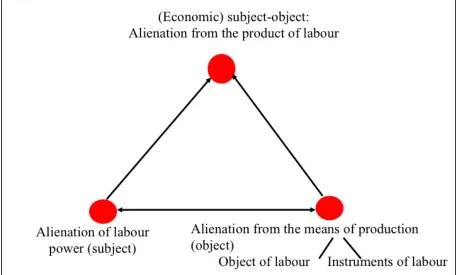
the objects of labour and/or the instruments of labour and/or the products of labour.
alien material; the instrument is likewise an alien instrument; its labour appears as a mere
accessory to their substance and hence objectifies itself in things not belonging to it. Indeed,
living labour itself appears as alien vis-à-vis living labour capacity, whose labour it is, whose
own life’s expression it is, for it has been surrendered to capital in exchange for objectified
labour, for the product of labour itself. […] labour capacity’s own labour is as alien to it – and
it really is, as regards its direction etc.—as are material and instrument. Which is why the
product then appears to it as a combination of alien material, alien instrument and alien
la-bour—as alien property” (Marx 1857/58, 462). Figure 5 visualizes potential dimensions of the
labour process as alienated work process.
Figure 5: Labour as alienated work process
Given these preliminary assumptions about the work-labour distinction and cultural
materialism, one can provide a definition of digital work and digital labour:
Digital work is a specific form of work that makes use of the body, mind or machines or a combination of all or some of these elements as an instrument of work in order to organ-ize nature, resources extracted from nature, or culture and human experiences, in such a way that digital media are produced and used. The products of digital work are depending on the type of work: minerals, components, digital media tools or digitally mediated sym-bolic representations, social relations, artefacts, social systems and communities. Digital work includes all activities that create use-values that are objectified in digital media technologies, contents and products generated by applying digital media” (Fuchs 2014a, 352).
software engineers, professional online content creators (e.g. online journalists), call cen-tre agents and social media prosumers” (Fuchs 2014a, 351f).
Work and labour are not isolated individual activities, but take place as part of social relations
and larger modes of how the economy is organised. The concepts of digital work and digital
labour need therefore to be related to a concept that can describe the organisational
struc-ture of the economy. One such concept is Marx’s notion of the mode of production.
2.
Digital Labour and Modes of Production
Michael Porter (1985) introduced the notion of the value chain that he defined as “a collection
of activities that are performed to design, produce, market, deliver and support its product”
(Porter 1985: 36). The term value chain has become a popular category for analysing the
organisation of capital, which is indicated by the circumstance that 11 682 articles indexed in
the academic database Business Source Premier use the term in their abstract (accessed on
May 21, 2013). The term has also been used in mainstream media economics for analysing
the value chains of traditional media and ICTs (see Zerdick et al. 2000: 126-135). The
prob-lem of the mainstream use of the concept of the value chain is that it focuses on the stages
in commodity production and tends to neglect aspects of working conditions and class
rela-tions. Also critical scholars have used the notion of the global value chain (see for example:
Huws 2008, Huws and Dahlmann 2010).
An alternative concept that was introduced by critical studies is the notion of the new
in-ternational division of labour (NIDL):
The development of the world economy has increasingly created conditions (forcing the development of the new international division of labour) in which the survival of more and more companies can only be assured through the relocation of production to new indus-trial sites, where labour-power is cheap to buy, abundant and well-disciplined; in short, through the transnational reorganization of production (Fröbel, Heinrichs and Kreye 1981, 15).
A further development is that “commodity production is being increasingly subdivided into
fragments which can be assigned to whichever part of the world can provide the most
profit-able combination of capital and labour” (Fröbel, Heinrichs and Kreye 1981, 14). In critical
media and cultural studies, Miller et al. (2004) have used this concept for explaining the
in-ternational division of cultural labour (NICL). The concept of the NIDL has the advantage that
it stresses the class relationship between capital and labour and how in processes of class
struggle capital tries to increase profits by decreasing its overall wage costs via the global
diffusion of the production process. It is also a concept that encompasses workers’ struggles
against the negative effects of capitalist restructuring.
The approach taken in this paper stands in the Marxist tradition that stresses class
con-tradictions in the analysis of globalisation. It explores how the notion of the mode of
produc-tion can be connected to the concept of the new internaproduc-tional division of labour. The noproduc-tion of
the mode of production stresses a dialectical interconnection of on the one hand class
rela-tionships (relations of production) and on the other hand the forms of organisation of capital,
labour and technology (productive forces). The class relationship is a social relationship that
determines who owns private property and has the power to make others produce
surplus-value that they do not own and that is appropriated by private property owners. Class
rela-tionships involve an owning class and a non-owing class: the non-owning class is compelled
to produce surplus value that is appropriated by the owning class.
Every economy produces a certain amount of goods per year. Specific resources are
in-vested and there is a specific output. If there is no contraction of the economy due to a crisis,
then a surplus product is created, i.e. an excess over the initial resources. The property
rela-tions determine who owns the economy’s initial resources and surplus. Table 2 (see further
below) distinguishes modes of production (patriarchy, slavery, feudalism, capitalism,
com-munism) based on various modes of ownership, i.e. property relations.
The
mode of allocation and distribution
defines how products are distributed and
allocat-ed: In a communist society, each person gets whatever s/he requires to survive and satisfy
human needs. In class societies, distribution is organized in the form of exchange: exchange
means that one product is exchanged for another. If you have nothing to exchange because
you own nothing, then you cannot get hold of other goods and services, except those that
are not exchanged, but provided for free. There are different forms how exchange can be
organized: general exchange, exchange for exchange-value (x commodity A = y commodity
B), exchange for maximum exchange-value, exchange for capital accumulation.
The
mode of coercion
takes on the form of physical violence (overseers, security forces,
military), structural violence (markets, institutionalised wage labour contracts, legal protection
of private property, etc) and cultural violence (ideologies that present the existing order as
the best possible or only possible order and try to defer the causes of societal problems by
scapegoating). In a free society no mode of coercion is needed.
The
division of labour
defines who conducts which activities in the household, the
econo-my, politics and culture. Historically there has been a gender division of labour, a division
between mental and physical work, a division into many different functions conducted by
specialists and an international division of labour that is due to the globalization of
produc-tion. Marx in contrast imagined a society of generalists that overcomes the divisions of labour
so that society is based on well-rounded universally active humans (Marx 1867, 334-335).
Marx (1857/58, 238) says that in class society “labour will create alien property and property
will command alien labour”. The historical alternative is a communist society and mode of
production, in which class relationships are dissolved and the surplus product and private
property are owned and controlled in common.
The relations of production are dialectically connected to the system of the productive
forces (see figure 3 in section 1 of this paper): human subjects have labour power that in the
labour process interacts with the means of production (object). The means of production
consist of the object of labour (natural resources, raw materials) and the instruments of
la-bour (technology). In the lala-bour process, humans transform the object of lala-bour (nature,
cul-ture) by making use of their labour power with the help of instruments of labour. The result is
a product of labour, which is a Hegelian subject-object, or, as Marx says, a product, in which
labour has become bound up in its object: labour is objectified in the product and the object
is as a result transformed into a use value that serves human needs. The productive forces
are a system, in which subjective productive forces (human labour power) make use of
tech-nical productive forces (part of the objective productive forces) in order to transform parts of
the natural productive forces (which are also part of the objective productive forces) so that a
labour product emerges. One goal of the development of the system of productive forces is
to increase the productivity of labour, i.e. the output (amount of products) that labour
gener-ates per unit of time. Marx (1867, 431) spoke in this context of the development of the
pro-ductive forces. Another goal of the development of the propro-ductive forces can be the
en-hancement of human self-development by reducing necessary labour time and hard work
(toil).
politi-cal, natural) environment. As a result of the interaction of subject and object, new reality is
created—Hegel terms the result of this interaction “subject-object”. Figure 5 shows that
He-gel’s notion of subject, object, and subject-object form a dialectical triangle.
Hegel (1991) characterizes the “subjective concept” as formal notion (§162), a finite
termination of understanding a general notion (§162), “altogether concrete” (§164). He
de-fines “the subject” as “the posited unseparatedness of the moments in their distinction”
(§164). Hegel characterizes objectivity as totality (§193),“external objectivity”(§208),“external
to an other” (§193),“the objective world in general” that “falls apart inwardly into [an]
unde-termined manifoldness” (§193), “immediate being” (§194), “indifference vis-à-vis the
distinc-tion” (§194), “realisation of purpose” (§194), “purposive activity” (§206) and “the means”
(§206).The Idea is “the Subject-Object” (§162), absolute Truth (§162), the unity of the
subjec-tive and the objecsubjec-tive (§212), “the absolute unity of Concept and objectivity” (§213), “the
Sub-ject-Object” understood as “the unity of the ideal and the real, of the finite and the infinite, of
the soul and the body” (§214). Hegel also says that the “Idea is essentially process” (§215).
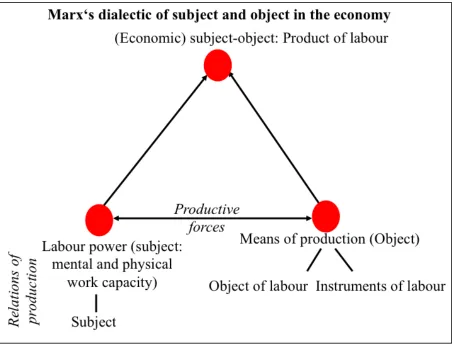
Marx applied Hegel’s dialectic of subject and object on a more concrete level to the economy
in order to explain how the process of economic production works as an interconnection of a
subject (labour power) and an object (objects and instruments) so that a subject-object
(product) emerges (see figure 6).
Figure 6: Hegel’s dialectic of subject and object
The instruments of work can be the human brain and body, mechanical tools and complex
machine systems. They also include specific organizations of space-time, i.e. locations of
production that are operated at specific time periods. The most important aspect of time is
the necessary work time that depends on the level of productivity. It is the work time that is
needed per year for guaranteeing the survival of a society. The objects and products of work
can be natural, industrial or informational resources or a combination thereof.
Mode
Instruments of work
Objects of work
Products of
work
Agricultural productive
forces
Body, brain, tools,
machines
Nature
Basic products
Industrial productive
forces
Body, brain, tools,
machines
Basic products,
in-dustrial products
Industrial
prod-ucts
Informational
produc-tive forces
Body, brain, tools,
machines
Experiences, ideas
Informational
products
Table 1. Three Modes of Organization of the Productive Forces
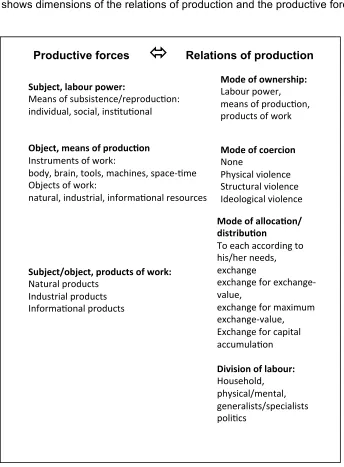
Figure 7 shows dimensions of the relations of production and the productive forces.
Figure 7: Dimensions of the Productive Forces and the Relations of Production
Productive forces
Relations of production
Mode%of%ownership:
!
Labour!power,!!
means!of!produc2on,!!
products!of!work!
Mode%of%coercion
!
None!
Physical!violence!
Structural!violence!
Ideological!violence!
Mode%of%alloca2on/
distribu2on
!
To!each!according!to!
his/her!needs,!
exchange!
exchange!for!exchangeB
value,!
exchange!for!maximum!
exchangeBvalue,!
Exchange!for!capital!
accumula2on!
!
Division%of%labour:%
Household,!
physical/mental,!
generalists/specialists!
poli2cs!
Subject,%labour%power:%
Means!of!subsistence/reproduc2on:!
individual,!social,!ins2tu2onal!
!
!
Object,%means%of%produc2on%
Instruments!of!work:!
body,!brain,!tools,!machines,!spaceB2me!
Objects!of!work:!
natural,!industrial,!informa2onal!resources!
!
!
!
!
!
Subject/object,%products%of%work:%
Natural!products!
Industrial!products!
Informa2onal!products!
!
Classical slavery, serfdom and wage labour are three important historical forms of class
rela-tions that are at the heart of specific modes of production (Engels 1884). Marx and Engels
argue that private property and slavery have their origin in the family: The first historical form
of private property can be found in the patriarchal family (Marx and Engels 1845/46, 52). The
family is a mode of production, in which labour power is no commodity, but organised by
per-sonal and emotional relationships that result in commitment that includes family work that is
unremunerated and produces affects, social relations and the reproduction of the human
mind and body. It can therefore also be called reproductive work.
A wage worker’s labour power has a price, its wage, whereas a slave’s labour power does
not have a price—it is not a commodity. However, the slave him-/herself has a price, which
means that its entire human body and mind can be sold as a commodity from one slave
owner to another, who then commands the entire life time of the slave (Marx, 1857/58: 288–
289). The slave in both ancient slavery and feudalism is treated like a thing and has the
sta-tus of a thing (Marx 1857/58, 464–465).
In the
Grundrisse
’s section “Forms which precede capitalist production“ (Marx 1857/58,
471–514) as well as in the German Ideology’s section “Feuerbach: Opposition of the
materi-alist and idemateri-alist outlooks“ (Marx and Engels 1845/46), Marx discusses the following modes
of production:
1. The tribal community based on the patriarchal family;
2. Ancient communal property in cities (Rome, Greece);
3. Feudal production in the countryside;
4. Capitalism.
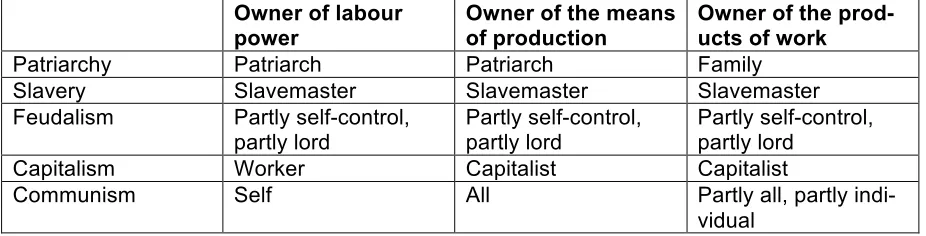
Table 2 provides a classification of modes of production based on the dominant forms of
ownership (self-control, partly self-control and partly alien control, full alien control)
Owner of labour
power
Owner of the means
of production
Owner of the
prod-ucts of work
Patriarchy
Patriarch
Patriarch
Family
Slavery
Slavemaster
Slavemaster
Slavemaster
Feudalism
Partly self-control,
partly lord
Partly self-control,
partly lord
Partly self-control,
partly lord
Capitalism
Worker
Capitalist
Capitalist
Communism
Self
All
Partly all, partly
indi-vidual
Table 2: The main forms of ownership in various modes of production
some liberals of today share in their theory elements of Stalinism. According to Banaji,
capi-talism often intensified feudal or semi feudal production relations. In parts of Europe and
out-side, feudalism would have only developed as a “commodity-producing enterprise” (Banaji
2011, 88). In the Islamic world capitalism would have developed without slavery and
feudal-ism (Banaji 2011, 6).
Banaji advances in contrast to formalist interpretations a complex reading of Marx’s
theo-ry, in which a mode of production is “capable of subsuming often much earlier forms” (Banaji
2011, 1), “similar forms of labour-use can be found in very different modes of production” (6),
capitalism is “working through a
multiplicity
of forms of exploitation” (145) and is a combined
form of development (358) that integrates “diverse forms of exploitation and ways of
organis-ing labour in its drive to produce surplus value” (359).
A mode of production is a unity of productive forces and relations of production (Marx and
Engels 1845/46, 91). If these modes are based on classes as their relations of production,
then they have specific contradictions that can via class struggles result in the sublation
(Aufhebung) of one mode of production and the emergence of a new one. The emergence of
a new mode of production does not necessarily abolish, but rather sublate (aufheben) older
modes of production. This means that history is for Marx a dialectical process precisely in
Hegel’s threefold meaning of the term Aufhebung (sublation): 1) uplifting, 2) elimination, 3)
preservation: 1) There are new qualities of the economy, 2) the dominance of an older mode
of production vanishes, 3) but this older mode continues to exist in the new mode in a
specif-ic form and relation to the new mode. The rise of e.g. capitalism however did not bring an
end to patriarchy, but the latter continued to exist in such a way that a specific household
economy emerged that fulfils the role of the reproduction of modern labour power. A
subla-tion can be more or less fundamental. A transisubla-tion from capitalism to communism requires a
fundamental elimination of capitalism, the question is however if this is immediately possible.
Elimination and preservation can take place to differing degrees. A sublation is also no linear
progression. It is always possible that relations that resemble earlier modes of organization
are created.
Capitalism is at the level of the relations of production organised around relations between
capital owners on the one side and paid/unpaid labour and the unemployed on the other
side. On the level of the productive forces, it has developed from industrial to informational
productive forces. The informational productive forces do not eliminate, but sublate
(auf-heben) other productive forces (Adorno 1968/2003, Fuchs 2014a, chapter 5): in order for
informational products to exist a lot of physical production is needed, which includes
agricul-tural production, mining and industrial production. The emergence of informational capitalism
has not virtualised production or made it weightless or immaterial, but is grounded in physical
production (Huws 1999, Maxwell and Miller 2012). Whereas capitalism is a mode of
produc-tion, the terms agricultural society, industrial society and information society characterise
specific forms of the organisation of the productive forces (Adorno 1968/2003; Fuchs 2014a,
chapter 5).
components into commodities. The different forms of digital labour are connected in an
inter-national division of digital labour (IDDL), in which all labour necessary for the existence,
us-age and application of digital media is “disconnected, isolated [
…
], carried on side by side”
and ossified “into a systematic division” (Marx 1867, 456).
Given a model of the mode of production, the question arises how one can best analyze
the working conditions in a specific company, industry or sector of the economy when
con-ducting a labour process and class analysis. Which dimensions of labour have to be taken
into account in such an analysis? The next section will address this question.
3.
A Typology of the Dimensions of Working Conditions
A suitable starting point for a systematic model of different dimensions of working conditions
is the circuit of capital accumulation as Karl Marx described it (1867, 248-253; 1885, 109).
According to Marx, capital accumulation in a first stage requires the investment of capital in
order to buy what is necessary for producing commodities, the productive forces: labour time
of workers (L or variable capital) on the one hand, and working equipment like machines and
raw materials (MoP or constant capital) on the other hand (Marx 1885/1992, 110). Thus,
money (M) is used in order to buy labour power as well as machines and resources as
com-modities (C) that then in a second stage enter the labour process and produce (P) a new
commodity (C’) (Marx 1885, 118). This new commodity (C’) contains more value than the
sum of its parts, i.e. surplus value. This surplus value needs to be realized and turned into
more money (M’) by selling the commodity in the market (Marx 1885/1992, 125). The circuit
of capital accumulation can thus be described with the following formula:
M
à
C … P … C’
à
M’ (Marx 1885, 110).
According to Marx, surplus value can only be generated due to the specific qualities of
la-bour-power as a commodity. Marx argued that labour power is the only commodity “whose
use-value possesses the peculiar property of being a source of value, whose actual
con-sumption is therefore itself an objectification of labour, hence a creation of value” (Marx
1867, 270).
Figure 8: Dimensions of working conditions
The model pictured in figure 8 identifies five areas that shape working conditions throughout
the capital accumulation process: means of production, labour, relations of production, the
production process and the outcome of production. Furthermore this model includes the
state’s impact on working conditions through labour legislation:
•
Productive Forces
—
Means of Production:
Means of production include
machines and
equipment
on the one hand and
resources
that are needed for production on the other
hand. The question whether workers operate big machines, work at the assembly line, use
mobile devices such as laptops, handle potentially hazardous substances, use high-tech
equipment, traditional tools or no technology at all etc. shapes the experience of work and
has a strong impact on work processes and working conditions.
•
Productive Forces
—
Labour:
The subjects of the labour process are workers themselves.
One dimension that impacts work in a certain sector is the question how the
workforce
is
composed in terms of gender, ethnic background, age, education levels etc. Another
ques-tion concerns worker
health and safety
and how it is affected by the means of production,
the relations of production, the labour process, and labour law. Apart from outside impacts
on the worker, an important factor is how workers themselves
experience
their working
conditions.
subject to negotiations and
struggles
. These three dimensions of the relation between
cap-ital and labour set the framework for the capcap-italist labour process.
•
Production process
: Assessing working conditions, furthermore, requires looking at the
specifics of the actual production process. A first factor in this context is its
spatial location
.
Whether it is attached to a certain place or is location independent, whether it takes place
in a factory, an office building, or outdoors etc. are important questions. A second factor
re-lates to the
temporal dimension of work
. Relevant questions concern the amount of regular
working hours and overtime, work rhythms, the flexibility or rigidness of working hours, the
relation between work time and free time etc. Finally working conditions are essentially
shaped by how the production process is executed. This includes on the one hand the
question which
types of work activity
are performed. The activities can range from
intellec-tual work, to physical work, to service work, from skilled to unskilled work, from creative
work to monotonous and standardized work tasks, etc. On the other hand another aspect
of the production process is how it is
controlled and managed
. Different management
styles can range from strict control of worker behaviour and the labour process to high
de-grees of autonomy, self-management or participatory management etc.
Space, time,
activi-ty
and
control
are essential qualities of the production process and therefore need to be
considered when studying working conditions.
•
Product
:
Throughout the production process workers put their time, effort and energy into
producing a certain
product.
This actual outcome of production and how it relates back to
the worker thus needs to be considered for understanding work in a certain sector.
•