IOT based Toll Collection System
Pramod Kumar P.M
1Assistant Professor, Department of Computer Science and Engineering,
VCET Puttur
1.
INTRODUCTION
Online toll collection system is the technology that enables the automatic electronic toll collection from the prepaid account registered on the name of vehicle owner, determining whether the vehicle is registered or not and informs the toll authorities avoiding toll violations. Over last decades, online toll collection system has been implemented in United States and many other countries with a new improvement in it. When the vehicle passes through the toll gate, the information is collected from REG reader and the amount is deducted from the owner’s wallet. This method reduces the traffic congestion problems, also reduces the travel time and reduces the fuel consumption.
2.
LITERATURE
SURVEY
Currently, most electronic toll collection (ETC) systems around the world are implemented by DSRC (dedicated short range communication) technology. However global positioning system technique is applied to ETC in recent years. It is an innovative technology for Expressway Network electronic toll collection solution. Most of the current ETC implementations are based on the vehicle positioning system using global positioning system (GPS) and mobile communication technique. In Germany: The GPS-based ETC system has been running on-line for commercial truck toll-fee collection since 2005. This system is the only officially operating GPS-based electronic payment system in the world currently [1].
An automated Vehicle monitoring system is developed by the authors using an Active Tag RFID system. The requirement for an active tag arose from the fact that vehicle applications requires a long range as well as sufficient power for the tag to ensure reliable data transfer between the two modules. Complete hardware and software solution for Vehicle Monitoring is developed to fully automate the Toll Collection System on highways. The system is equipped with sound alarm for unauthorized vehicle entry and is able to send messages to the vehicle and receive distress messages from the vehicle when vehicle is range [2].
Most of the current ETC implementations are based on the vehicle positioning system (VPS) using global positioning system (GPS) and mobile communication techniques. Hong Kong has finished VF'S-based ETC field trial project for road charging from 1997 to 2001. VPS is a category of location based service which can he applied to electronic toll collection. It combines several technologies including: vehicle positioning, wireless communication, image capture and processing, on-board computer (OBC) and the backend system. It is more difficult in the matching process between the debit and enforcement information, so the VF’S system needs more post-processing jobs in order to reduce the mismatch failure. The personal privacy problem is still there, just the same as DSRC-based ETC [3].
| Vol. 04 | Issue 02 | 2018 | 2 |
readers may be fixed, portable batch, or portable RF. Objective of the project is to Automate Toll Collection System where a Barcode will be placed on car, so when the car passes the toll booth it does not have to wait & pay the toll. Instead a Barcode reader will read the Barcode and the toll will be directly deducted from the prepaid account. Barcode has very low throughput. Also security is low. Hence it is much easier to reproduce or forged. A scanner has to see the barcode to read it, which means people usually have to orient the barcode towards the scanner for it to be read [4].3.
COMPARISON
WITH
EXISTING
SYSTEMS
Presently toll collection is done manually. It involves lot of human resources. It is time consuming. A PayToll system is capable of electronically charging a toll to an established customer account. The system can determine whether a passing vehicle is registered, automatically charging those vehicles, and alert the local highway patrol about users that are not registered. At present, customers have to wait at the tollbooth, for long time, to pay the collector.
• The PayToll system allows vehicles to pass through a toll facility without requiring any action or stopping
by the driver.
• Manual toll collection is the simplest form of toll collection, in which a collector operating from a toll booth collects the toll. Automatic coin machines allow collection of several methods of payments such as coins, tokens, smart cards, and credit cards without the need for a collector.
• PayToll is the most complex and latest method for collecting tolls.
• Typical PayToll systems can improve the traffic flow through the toll area. Manual toll collection lanes handle about 350 vehicles per hour and automatic coin machine lanes handle about 500 vehicles in the same time period.
• Most PayToll lanes are less expensive to build and operate than traditional toll collection methods
• PayToll lane usage can decrease emissions in the area.
• The reliable and relatively inexpensive technology means this is a standard element of modern toll roads.
4.
PROPOSED
SYSTEM
The proposed method is to provide a fast and safe environment for toll collection at the toll stations. The REG reader is used to read the tag of the vehicles. The Vehicle information is stored in the system based on the REG number.
To pay the road toll we need to wait at the toll plaza and time is required due to manual payment. The objective of the proposed system is to develop a system to avoid the time at tollbooth to pay the toll. We design the system which will automatically reduce the toll amount from the user’s wallet.
Advantages:
1) System will help to reduce the time required at tollbooth.
2) The system will provide secure way to pay the toll. 3) Human effort is reduced.
4) Without the interruption in the flow of traffic, this system can efficiently work all the time.
5.
IMPLEMENTATION
There are 4 modules in this project. They are User
Admin
Vehicle detection Account details
A. User module:
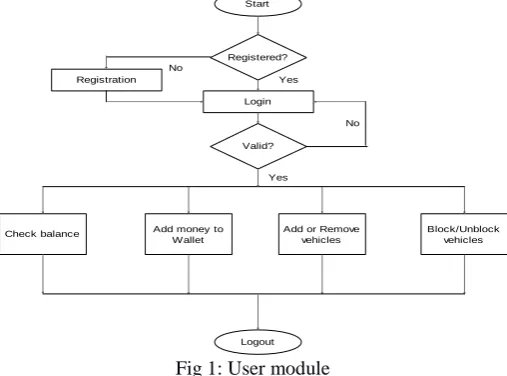
The following are the sub modules in the login module: Check balance
Add or remove vehicles Block vehicles
In this module, user need to login with given valid unique REG number and password. If it is invalid, then user needs to re-login into the system. If valid, then user performs the task such as add or remove vehicles, block or unblock vehicles, check balance, etc. After completion of his task, he needs to logout from the session. Every user will have one account corresponding to one vehicle that is owned by him.
Fig 1: User module
B. Admin module:
Admin can login to the system and recharge the user’s account with amount as required by the user. Admin provides unique REG number to each vehicle. Admin can check every user’s information which is entered during registration. It includes name, address, vehicle number, mobile number, email-id and other details about the vehicle.
C. Account details module:
Registered users can update his account information and also he can verify the balance in his wallet. Only the authorized user can access his account. On each transaction, toll amount will be deducted from the user’s wallet. Also account details,
displays the registered details about the user. It can also be viewed by the admin.
D. Vehicle Detection module:
Using a REG reader, REG number on the vehicle is detected when the vehicle passes through the toll and corresponding toll amount is deducted from user’s wallet. If it is not detected, vehicle will be sent to manual lane.
Start
Registration
Login Registered?
Check balance Add money to Wallet
Add or Remove vehicles
Block/Unblock vehicles
Logout Yes
No Valid?
No
| Vol. 04 | Issue 02 | 2018 | 4 |
Fig2: Vehicle detection module6.
FUTURE
SCOPE
This technology will be used on different toll booths in different regions so the traffic can be controlled and time required to manually payment of cash will be reduced. As of in future, we are planning to make this system more accurate. Also we can include the facility of post charging the user’s account. Also sms can be sent to user after each transaction. Apart from all these major modification we are planning to directly link the user’s toll account with his bank account. Hence the toll amount will be deducted directly from user’s bank account instead of his toll account.
7.
CONCLUSION
Times are changing and even this Manual Technique for toll tax collection at toll plaza has to change and seeing a change in mind-set of every individual. This technology would also be taken whole heartedly by and we would see that paying. Toll at the toll station won’t be that time consuming and much accurate.IOT is a powerful technology and it is likely to see world-wide deployment within the coming years. Continuous technological advancements of IOT have resulted in reduced cost of installation and maintenance of devices across different market segments comparing advantages and limitations of our system. We can conclude that our system is beneficial for daily travellers and toll station authorities to lessen the burden.On the concluding node, we can say that we have successfully implemented one of the phases of our project but still have some improvements and advancements to be done.
Start
Is vehicle detected?
Is vehicle registered?
Read REG Number.
Sufficient amount?
Deduct toll amount Send vehicle to
manual lane
Is amount paid? Detain vehicle
Send email to the user
Allow vehicle to pass Yes No
No
No
No Yes
References
:
[1]. Saijie Lu, Tiejun He, ZhaohuiGao “Electronic Toll Collection System based on Global Positioning
System Technology”, 2010 International Conference on Challenges in Environmental Science and
Computer Engineering
[2]. Atif Ali Khan, Adnan I. Elberjaoui Yakzan, Dr Maaruf Ali “Radio Frequency Identification (RFID)
Based Toll Collection System”, 2011 Third International Conference on Computational Intelligence,
Communication Systems and Networks
[3]. Wei-Hsun Lee, Bor-ShennJeng, Shian-Shyong Tseng, Ching-Hung Wang, “Electronic Toll Collection
Based on Vehicle-Positioning System Techniques”, IEEE International Conference on Networking,
Sensing & Control, Taiwan. March 21-23, 2004
[4]. DevikaMhatre, RohanKamble, Sayali Pimple, Prof. AmrutaSankhe, “Electronic Toll Collection
Using Barcode Reader”, Volume 5, Issue 2, February 2015 ISSN: 2277 128X International Journal of