Analysis of different models of Photonic Crystal
structures for sensor applications
Karthik K1, Raghunandan G2, Harshada J Patil3, Dr.Indumathi T S4
1,2
Department of Digital Electronics and Communication Systems, Visvesvaraya Institute of Advanced Technology, Muddenahalli, chikkaballapur, India
Assistant Professor, Department of ECE,VIT, Bengaluru, India
PG Co-ordinator, Visvesvaraya Institute of Advanced Technology, Muddenahalli, chikkaballapur, India
Abstract: The Photonic crystals have
become a rapidly growing area of research with their vast application areas. A Photonic crystal exhibits characteristics that depends on various parameters such as crystal lattice, dielectric used, defects dimensions, propagation of light etc. In this work, a set of four structures are taken and these structure designs are simulated using MEEP and MATLAB software tools. A report on various parameters of different crystal structures which are generally used for sensor designing applications are given along with their Q-factors and sensitivity values which helps designers to choose a better structure depending on the application requirements. The results are analysed, and discussed in terms of Q-factor and sensitivity based on transmission pattern.
In a Photonic crystal structure, there are number of geometrical and electrical parameters which can critically affect crystals characteristics. An extensive parametric study of these parameters was done through rigorous simulation on MEEP tool. During simulation, none of the parameters were varied, which helped us in understanding the influence of each geometrical difference in a structure, with the help of simulation, we obtained best possible Photonic crystal structure.
Index Terms: MEEP, Photonic crystals, structures, Q-factor, Sensitivity
I. INTRODUCTION
A photonic crystal is an optical analogue of solid state crystal, in which the atoms or molecules are replaced by macroscopic media with differing dielectric constants, and the periodic potential is replaced by a periodic dielectric function (or,
equivalently, a periodic index of refraction). If the dielectric constants of the materials in the crystal are sufficiently different, and if the absorption of light by the materials is minimal, then the refractions and reflections of light from all of the various interfaces can produce many of the same phenomena for photons (light modes) that the atomic potential produces for electrons. Bloch‘s law/theorem applies equally well for electromagnetic waves in periodic dielectric media as it does for electrons in a crystalline solid. The notion of Brillion zones and bands of allowed states are equally used in both cases.. One solution to the problem of optical control and manipulation is thus a photonic crystal, a low-loss periodic dielectric medium [1]-[3]. In particular, we can design and construct photonic crystals with photonic band gaps, preventing light from propagating in certain directions with specified frequencies.
The aim of the study of the optical properties of photonic microstructures is to understand them and how to control and manipulate light with them. If we were able to guide, store, filter, suppress and create light, then light could be put to all manner of useful purposes. For example, building integrated photonic microchips that used light for all-optical computing and telecommunications.
We can compare metallic waveguides and cavities to photonic crystals. Metallic waveguides and cavities are widely used to control microwave propagation. The walls of a metallic cavity prohibit the propagation of electromagnetic waves with frequencies below a certain threshold frequency, and a metallic waveguide allows propagation only along its axis. It would be extremely useful to have these same capabilities for electromagnetic waves with frequencies outside the microwave regime, such as visible light. However, visible light energy is quickly
dissipated within metallic components, which makes this method of optical control impossible to generalize. Photonic crystals allow the useful properties of cavities and waveguides to be generalized and scaled to encompass a wider range of frequencies. We may construct a photonic crystal of a given geometry with millimetre dimensions for microwave control, or with micron dimensions for infrared control [1].
They have the potential to replace semiconductors someday in many major applications. Defect engineering helps us to create different structures of these photonic crystals and can be considered as basic tool for designing and simulating photonic crystals in order to understand their behaviours before fabrication and also to study the properties of light such as propagation path, intensity, reflection etc. Maybe in future this may also help us to encrypt and decrypt data into light so that we can simulate real time results on these crystals.
For better sensor designing or any other applications optimum structures must be chosen. Wrong structure may not just waste time but also will result in huge loss of resources. Major goal here is finding an optimum working structure with good Q-factor, Sensitivity and efficiency.
II. DEFECT ENGINEERING
We mainly deal with the 2D photonic crystals in our discussion and for the scope of this work. These crystals have photonic band gaps for in-plane propagation. Within the band gap, no modes are allowed; the density of states (the number of possible modes per unit frequency) is zero. By perturbing a single lattice site, we can create a single localized mode or a set of closely spaced modes that have frequencies within the gap. We can remove a single column from the crystal, or replace it with another whose size, shape, or dielectric constant is different than the original. Perturbing just one site ruins the translational symmetry of the lattice. The mirror-reflection symmetry is still intact for kz = 0.
Therefore we can still restrict our attention to in-plane propagation, and the TE and TM modes still decouple. That is, we can discuss the band structures for the two polarizations independently, as before. Perturbing a single lattice site causes a defect along a line in the z direction. But because we are considering propagation only in the plane of
periodicity, and the perturbation is localized to a particular point in that plane, we refer to this perturbation as a point defect, we can remove entire line of columns and then it‘s called a line defect and similarly we can form different line of path for light to flow in the crystal lattice producing both modes of propagation [1].
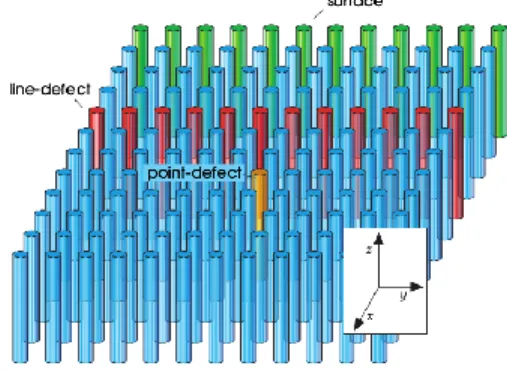
A defect (anything that breaks the periodicity) in a photonic crystal can be used to localize light modes, making it possible to confine light to a single defect plane in 1D, localize light at a linear defect in 2D, or perturb a single lattice site in 3D. Resonant cavities are created by Point defects, and line defects can be used as waveguides. In all of these cases, a defect can support modes that lay inside the band gap of the bulk crystal that are localized in the near vicinity [4]. Figure 2.1 shows different defects in a single crystal, surface is shown in green colour from where light can be fed as input. Point defect is shown in yellow colour which is in rods in air configuration. Line defect is shown in pink colour and it is constructed by removing entire row of rods in a crystal lattice and replacing with the dielectric of the required media. These two defects serve as basics to understand the propagation of light inside crystal and to understand the mathematical modelling which is explained as separate chapter.
Figure 2.1 2D crystal lattice with defects We can study this by comparing with impurities in semiconductors. In that case, atomic impurities create localized electronic states in the band gap of a semiconductor. Attractive potentials create a state at the conduction band edge, and repulsive potentials create a state at the valence band edge. In the photonic case, we can put the defect mode within the band gap with a suitable choice of Ɛdefect.
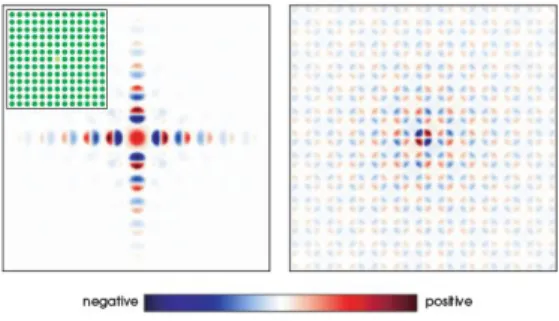
photonic crystal let‘s consider the figure 2.2, Displacement fields ( Dz ) of states localized about a
defect in a square lattice of alumina rods ( ε = 8.9) in air. The colour indicates the magnitude of the field. The defect on the left was created by reducing the dielectric constant of a single rod. This mode has a monopole pattern with a single lobe in the defect and rotational symmetry. The defect on the right was created by increasing the dielectric constant of a single rod. This mode has a quadruple pattern with two nodal planes in the defect.
Figure 2.2 Light movement in a crystal
Figure 2.3 Light propogation in top view By using point defects we can just trap light as shown above but by using line defects we can guide light to flow through the crystal as required thus creating our very own waveguides for light. Light that propagates in the waveguide with a frequency within the band gap of the crystal is confined to the defect, and can be directed along the defect. This basic idea is extended further to create new waveguides and thereby new structures for different applications. Each form of defect is different from its predecessors and this is explained clearly in terms of point and line defect next.
For a point defect, a mode can be localized whenever its frequency is in the photonic band gap. For a linear defect, we consider the mode‘s behaviour not only as
a function of frequency, but also as a function of its wave vector ky. A guided mode need only have a
combination (ky, ω0) that is disallowed in the crystal;
it is not necessary that ω0 alone is disallowed.
Electric-field ( Ez ) pattern associated with a linear
defect formed by removing a column of rods from a square lattice of rods in air. The resulting field, shown here for a wave vector ky = 0.3 (2 π/a ) along
the defect, is a waveguide mode propagating along the defect. The rods are shown as dashed green outlines as in Figure 2.3.
III. MATHEMATICAL MODELLING
A. Maxwell’s Equations
In order to study the propagation of light in photonic crystal, we start with basics of Maxwell‘s equations. After specializing to the case of a mixed dielectric medium, we make use of these Maxwell equations to form a linear Hermitian eigenvalue problem. This brings the electromagnetic problem into a close analogy with the Schrödinger equation, and allows us to take advantage of some well-established results from quantum mechanics, such as the orthogonally of modes, the variational theorem, and perturbation theory. The quantum mechanical case differs from electromagnetic case in a way that photonic crystals do not generally have a fundamental scale, in either the spatial coordinate or in the dielectric constant. This makes photonic crystals scalable in a way that traditional crystals are not.
Propagation of light in photonic crystals is governed by the following basic equations
∇ ∙ 𝐵 = 0 ∇ × 𝐸 + 𝜕𝐵 𝜕𝑡 = 0 ∇ ∙ 𝐷 = 𝜌 ∇ × 𝐻 −𝜕𝐷
𝜕𝑡 = 𝐽
----(1) Where E and H -- electric and magnetic fields respectively; D and B -- displacement and magnetic induction fields respectively; ρ and J – free charge and current densities respectively
In our work we are concentrating on propagation through mixed dielectric medium. a composite of regions of homogeneous dielectric material as a function of the (Cartesian) position vector r, in which the structure does not vary with time, and there are no free charges or currents. This composite need not be periodic. With this type of medium in mind, in which light propagates but there are no sources of light, we
can set ρ = 0 and J = 0.
Next we can relate D to E and B to H as required for our problem and get the following equation of displacement vector Di in relation with electric vector
Ei[10]
𝐷𝑖
𝜀0 = 𝜀𝑗 𝑖𝑗𝐸𝑗 + 𝑗 ,𝑘χ𝑖𝑗𝑘𝐸𝑗𝐸𝑘+ 𝑂(𝐸 3)
----(2) Where ε0≈8.854×10⁻¹² Farad/m is the vacuum
permittivity.
For many dielectric materials we make following approximations to ease the calculations as,
1. We assume the field strengths are small enough so that we are in the linear regime, so that χijk (and all
higher-order terms) can be neglected.
2. We assume the material is macroscopic and isotropic, so that E (r,ω) and D(r,ω) are related by ε0
multiplied by a scalar dielectric function ε(r,ω) , also called relative permittivity.
3. We ignore any explicit frequency dependence (material dispersion) of the dielectric constant. Instead, we simply choose the value of the dielectric constant appropriate to the frequency range of the physical system we are considering.
4. We focus primarily on transparent materials, which means we can treat ε ( r ) as purely real and positive. From all the above approximations we have D(r)= ε0ε(r)E(r) and similarly B(r)=µ0 µ(r)H(r)
Where µ0=4π×10-7 Henry /m
μ(r) is called vaccum permeability but for most dielectric materials μ(r) is unity and hence the equation gets reduced to B= µH
In that case, ε is the square of the refractive index n that may be familiar from Snell‘s law and other formulas of classical optics. (In general, √n = εμ.) Now Maxwell‘s equations will become
∇ ∙ 𝐻 𝑟, 𝑡 = 0 ∇ × 𝐸 𝑟, 𝑡 + 𝜇0 𝜕𝐻 𝑟, 𝑡 𝜕𝑡 = 0 ∇ ∙ 𝜀 𝑟 𝐸 𝑟, 𝑡 = 0 ∇ × 𝐻 𝑟, 𝑡 − 𝜀0𝜀 𝑟 𝜕𝐸 𝑟, 𝑡 𝜕𝑡 = 0 ---(3) both E and H are complicated functions of both time and space. Because the Maxwell equations are linear, however, we can separate the time dependence from the spatial dependence by expanding the fields into a set of harmonic modes.[1]
We can also express harmonic mode as a spatial
pattern as
𝐻 𝑟, 𝑡 = 𝐻 𝑟 𝑒−𝑖𝜔𝑡
𝐸 𝑟, 𝑡 = 𝐸(𝑟)𝑒−𝑖𝜔𝑡
----(4) Substituting in equation (3) we get
∇ ∙ 𝐻 𝑟 = 0, ∇ ∙ 𝜀 𝑟 𝐸 𝑟 = 0
----(5) these are called divergence equations which show us that there are no point sources or sinksof displacement and magnetic fields in the medium. The two curl equations relate E(r) to H(r) are
∇ × 𝐸 𝑟 − 𝑖𝜔𝜇0𝐻 𝑟 = 0
∇ × 𝐻 𝑟 + 𝑖𝜔𝜀0𝜀 𝑟 𝐸 𝑟 = 0
----(6) now divide the bottom equation of (6) by ε ( r ) , and then take the curl. Then use the first equation to eliminate E(r) . Moreover, the constants ε0 and µ0 can
be combined to yield the vacuum speed of light, c = 1/√ ε0µ0.
The result is an equation entirely in H(r) as : ∇ × 1 𝜀 𝑟 ∇ × 𝐻(𝑟) = 𝜔 𝑐 2 𝐻(𝑟) ----(7) This is the master equation. Together with the divergence equation (5), it tells us everything we need to know about H(r). Our strategy will be as follows: for a given structure ε(r), solve the master equation to find the modes H(r) and the corresponding frequencies, subject to the transversality requirement. Then use the second equation of (6) to recover E(r) as
𝐸 𝑟 = 𝑖
𝜔 𝜀0𝜀(𝑟)∇ × 𝐻 𝑟 ----(8)
Using this procedure guarantees that E satisfies the transversality requirement ∇ ·εE = 0, because the divergence of a curl is always zero. Thus, we need only impose one transversality constraint, rather than two. The reason why we chose to formulate the problem in terms of H(r) and not E(r) is merely one of mathematical convenience, as will be discussed in the section Magnetic vs. Electric Fields . For now, we note that we can also find H from E via the first equation of (6):
𝐻 𝑟 = − 𝑖 𝜔𝜇0
----(9) By using the master equation we can perform a series of operations on a function H(r)and if H(r) is really an allowable electromagnetic mode, the result will be a constant times the original function H(r) . This is what we call as eigenvalue problem in mathematical physics. But with the help of master equation (7) defined and linear and Hermitian operators we can normalize the result to get flux values to be implemented as graphs. Further understanding of Maxwell‘s equations used in Finite Difference Time Domain method is explained next.
B. Finite difference time domain (FDTD): The YEE algorithm:
The FDTD algorithm as first proposed by Kane Yee in 1966 employs second-order central differences. The algorithm can be summarized as follows: 1. Replace all the derivatives in Ampere‘s and Faraday‘s laws with finite differences. Discretize space and time so that the electric and magnetic fields are staggered in both space and time.
2. Solve the resulting difference equations to obtain ―update equations‖ that express the (unknown) future fields in terms of (known) past fields.
3. Evaluate the magnetic fields one time-step into the future so they are now known (effectively they become past fields).
4. Evaluate the electric fields one time-step into the future so they are now known (effectively they become past fields).
5. Repeat the previous two steps until the fields have been obtained over the desired duration[5].
This was implemented for photonic crystals computational part starting from Maxwell‘s equations. We can represent Maxwell‘s equations from equation (3) in differential form time domain as
∇ × 𝐸 = −𝜇𝜕𝐻 𝜕𝑡 ∇ × 𝐻 = 𝜎𝐸 + 𝜀𝜕𝐸
𝜕𝑡
----(10) When the above equation is equated for vector components we get 𝜕𝐸𝑥 𝜕𝑡 = 1 𝜀 𝜕𝐻𝑧 𝜕𝑦 − 𝜕𝐻𝑦 𝜕𝑧 − 𝜎𝐸𝑥 𝜕𝐸𝑦 𝜕𝑡 𝑎𝑛𝑑 𝜕𝐸𝑧 𝜕𝑡 𝑠𝑖𝑚𝑖𝑙𝑎𝑟 𝜕𝐻𝑥 𝜕𝑡 = 1 𝜇 𝜕𝐸𝑦 𝜕𝑧 − 𝜕𝐸𝑧 𝜕𝑦 𝜕𝐻𝑦 𝜕𝑡 𝑎𝑛𝑑 𝜕𝐻𝑧 𝜕𝑡 𝑠𝑖𝑚𝑖𝑙𝑎𝑟 ----(11) Discretizing space (dx)
Based on above YEEs algorithm a 3D cell is developed which is known as YEE-cell as in Figure 3.2. Note that the E, H components are all located at different locations, 1⁄2 cell apart. This is called ―leap-frogging‖ and is very useful when taking the central differences.
Figure 3 Yee Cell Discretize time (∆t):
Again, the E and H components will be at different times (Ex, Ey, Ez are defined at times n∆t, and Hx, Hy,
Hz are defined at times (n+1/2) ∆t). This is ―leap
frogging in time‖ and is useful for defining the central differences in time (d/dt)
𝐻𝑥𝑛+ 1 2 𝐼, 𝐽, 𝐾 − 𝐻 𝑥 𝑛−12 𝐼, 𝐽, 𝐾 ∆𝑡 =1 𝜇 𝐸𝑦𝑛 𝐼, 𝐽, 𝐾 + 1 − 𝐸𝑦𝑛 𝐼, 𝐽, 𝐾 ∆𝑧 −𝐸𝑧 𝑛 𝐼, 𝐽 + 1, 𝐾 − 𝐸 𝑧𝑛 𝐼, 𝐽, 𝐾 ∆𝑦 ----(12) This equation is defined at time n∆t and the location of Hx on the Yee cell
The leapfrog schemes in space and time are critical to the central differences giving the derivatives at the space and time where the equation is defined.
Now, assume you know the field at the present and past times, find the field at the future time:
𝐻𝑥𝑛+ 1 2 𝐼, 𝐽, 𝐾 = 𝐻𝑥𝑛− 1 2 𝐼, 𝐽, 𝐾 + ∆𝑡 𝜇 𝐸𝑦𝑛 𝐼, 𝐽, 𝐾 + 1 − 𝐸𝑦𝑛 𝐼, 𝐽, 𝐾 ∆𝑧 − 𝐸𝑧 𝑛 𝐼, 𝐽 + 1, 𝐾 − 𝐸 𝑧𝑛 𝐼, 𝐽, 𝐾 ∆𝑦 ----(13) This form of solving differential equations is referred to as an ―initial value problem. From our understanding of Maxwell‘s equations, we know that we must solve simultaneous for E and H.Convert E field equation to difference form.This equation is a little trickier. It is defined at time (n+1/2)∆t and the location of Ex: 𝐸𝑥𝑛+1 𝐼, 𝐽, 𝐾 − 𝐸𝑥𝑛 𝐼, 𝐽, 𝐾 ∆𝑡 =1 𝜀 𝐻𝑧𝑛+ 1 2 𝐼, 𝐽, 𝐾 − 𝐻 𝑧 𝑛+1 2 𝐼, 𝐽 − 1, 𝐾 ∆𝑦 −𝐻𝑦𝑧 𝑛+12 𝐼, 𝐽, 𝐾 − 𝐻𝑦𝑛+ 1 2 𝐼, 𝐽, 𝐾 − 1 ∆𝑧 −𝜎 𝜀 𝐸𝑥 𝑛+1/2 𝐼, 𝐽, 𝐾 ----(14) The trouble is, we don‘t have Exn+1/2
𝐸𝑥𝑛 +1 𝐼,𝐽,𝐾 −𝐸𝑥𝑛 𝐼,𝐽,𝐾 ∆𝑡 = 1 𝜀 𝐻𝑧𝑛 + 1 2 𝐼,𝐽,𝐾 −𝐻 𝑧 𝑛 +12 𝐼,𝐽−1,𝐾 ∆𝑦 − 𝐻𝑦𝑧𝑛 + 1 2 𝐼,𝐽 ,𝐾 −𝐻 𝑦 𝑛 +12 𝐼,𝐽 ,𝐾−1 ∆𝑧 − 𝜎 𝜀 𝐸𝑥𝑛 +1 𝐼,𝐽 ,𝐾 +𝐸𝑥𝑛 𝐼,𝐽 ,𝐾 2 ----(15) To get it, average 𝐸𝑥𝑛 and 𝐸𝑥𝑛+1:
Now, assume we know all fields at present and past times, solve for future time:
𝐸𝑥𝑛+1 𝐼, 𝐽, 𝐾 1 + 𝜎∆𝑡 2𝜀 = 𝐸𝑥𝑛 𝐼, 𝐽, 𝐾 1 − 𝜎∆𝑡 2𝜀 +∆𝑡 𝜀 𝐻𝑧𝑛+ 1 2 𝐼, 𝐽, 𝐾 − 𝐻 𝑧 𝑛+12 𝐼, 𝐽 − 1, 𝐾 ∆𝑦 −𝐻𝑦𝑧 𝑛+1 2 𝐼, 𝐽, 𝐾 − 𝐻 𝑦 𝑛+1 2 𝐼, 𝐽, 𝐾 − 1 ∆𝑧 𝐸𝑥𝑛+1 𝐼, 𝐽, 𝐾 = 𝐸𝑥𝑛 𝐼, 𝐽, 𝐾 1 − 𝜎∆𝑡 2𝜀 / 1 − 𝜎∆𝑡 2𝜀 + ∆𝑡 𝜀 1 −𝜎 ∆𝑡 2𝜀 𝐻𝑧𝑛+ 1 2 𝐼, 𝐽, 𝐾 − 𝐻 𝑧 𝑛+12 𝐼, 𝐽 − 1, 𝐾 ∆𝑦 −𝐻𝑦𝑧 𝑛+12 𝐼, 𝐽, 𝐾 − 𝐻𝑦𝑛+ 1 2 𝐼, 𝐽, 𝐾 − 1 ∆𝑧 ----(16) This might seem like we are magically predicting the future from the past. Maxwell‘s equations are physical laws that describe the motion of waves. E and H waves obey these laws, so we can use them to predict what E and H fields will be generated by the source fields.
Now we can see a formal flow chart for this algorithm based on all these laws as,
FDTD algorithm Process:
1. Store arrays of Ex, Ey, Ez, Hx, Hy, Hz at every
location in the model.
2. Store physical parameters ε,μ,σ at every location in the model.
3. FOR loop is used to iterate fields as function of time (n).
4. Each iteration computes field values that are correct (to order (∆x) 2 ) for each iteration.
5. Frame-by-frame ―movie‖ of the fields being scattered by an object are seen and these values are noted to plot graphs for the studies of photonic crystals and to measure various characteristics of a crystal based on these values[6].
C. Q-factor and sensitivity:
Two parameters, i.e., the quality factor (Q-factor) and the wavelength sensitivity Sλ, have to be considered
for appreciating Photonic Crystal sensor performances. The Q-factor defines the shape of resonant peaks and consequently the value of the Full Width at Half Maximum (FWHM) and it is expressed as follows:
𝑄 =𝜔0𝑈(𝑡)
𝑃(𝑡) , 𝑜𝑟 𝑄 = 𝑓0
∆𝑓
Where ω0 is the angular resonant frequency, U(t) is
the energy stored in the cavity mode, P(t) is the energy dissipated per cycle (i.e., a single round-trip in the resonant cavity), f0 is the resonant frequency and
∆𝑓 is the peak bandwidth.
In particular, Photonic Crystal sensors can be explained in two distinct modes. The first one is the wavelength interrogation mode and the second one is the intensity interrogation mode. In the first method, the optical readout consists in monitoring the wavelength of the optical signal through an optical spectrum analyser (OSA), while in the latter one, it is possible to monitor the intensity changes of the output signal by using a photo detector (PD). In this context, the wavelength sensitivity Sλ represents a
fundamental parameter for quantifying the sensor performance in case of wavelength interrogation scheme. Sλ is defined as the ratio between the shift of
resonant wavelength ( ∆λ ) induced by the change of the background refractive index ( ∆n ). Moreover, it is given in units of nm/RIU (refractive index unit), as:
𝑆𝜆 =
∆𝜆 ∆𝑛
IV. SIMULATION AND RESULTS
A. MEEP (MIT Electromagnetic Equation Propagation):
This is a MIT developed free software package to model electromagnetic systems using finite-difference time-domain (FDTD) simulation. It can simulate in 1D, 2D, 3D and cylindrical coordinates. This is distributed memory parallelism on any system supporting the MPI standard. It exploits symmetries to reduce the computation size — even/odd mirror symmetries and 90°/180° rotations. Its script is simple and can be written in
scheme scripting front-end or as a C++ library callable function; also a Python interface is available. Field analyses including flux spectra, Maxwell stress tensor, frequency extraction, local density of states and energy integrals, near to far field transformations can be programmed completely. A time-domain electromagnetic simulation is usually done by taking Maxwell‘s equations and evolving them over time within some finite computational region, performing a numerical experiment [7].The main use of FDTD method is computation of transmission spectrum. The transmitted flux can be computed at each frequency ω. For fields at a given frequency ω, this is the integral of the Poynting vector, over a plane on the far side of the photonic crystal structure.
B. Analysis:
Various parameters are used for analysing a structure of a Photonic Crystal. These are,
1. Transmission and loss 2. Execution time 3. Reflection 4. Absorption 5. Scattering
Each crystal is designed with basic common parameters and di-electric values of air and respective output values are noted. The goal of this work is to record the comparisons and document. Transmitted and received information in the form of light must be identical else it means there has been a loss due to bad structural arrangement and crystal lattice.
Execution time is another important parameter. The time taken by each structure for executing the code and generate flux values for each holes in a crystal is noted at the end of the execution and stored in the output file. If a structure is taking more time than it means it‘s probably slow and not recommended for applications which needs quick responses upon feeding information or sensors which can‘t afford time lapse like bio-sensors, sensors used to detect hazardous chemical in the atmosphere or surroundings etc.
Reflection is another parameter which should be thought during the selection of element for the designing of a Photonic Crystal. Some elements like quartz are found to reflect light when used as fabricating materials for Photonic Crystals and this may result in light interfering with its own transmission path and also undergo multiple total
internal reflections. This is not acceptable in applications like satellite, telecommunications etc. So materials which might reflect the incident light should be avoided for better designing of Optical Crystals.
Absorption is another important parameter to be taken care of. Some materials which are dark in colour might absorb some part of the light passing alongside them. Also in sensor designing the elements which are to be sensed by these crystals might absorb some part of the incident light which again results in loss of information. Also on other side we may use this absorption as a major parameter for detecting some materials [8].
Scattering is another parameter which is often neglected while designing the optical crystal based sensors. Some already proposed structures which implement electromagnetics principles neglect the fact that light undergoes scattering when it passes through elements which have similar wavelengths along its path.
For this work mainly four structures are considered. They are
1. Linear waveguide 2. Ring resonator 3. Mixed-model 4. Hybrid model
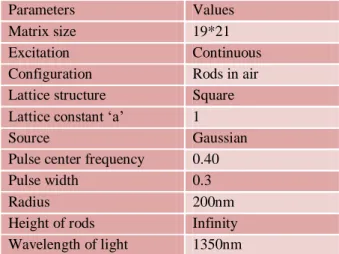
These structures are designed for the following parameters and specifications to get a common platform for comparison.
Table 1: design parameters
Parameters Values
Matrix size 19*21
Excitation Continuous
Configuration Rods in air Lattice structure Square Lattice constant ‗a‘ 1
Source Gaussian
Pulse center frequency 0.40
Pulse width 0.3
Radius 200nm
Height of rods Infinity Wavelength of light 1350nm
1. Linear waveguide:
A 2D structure of a photonic crystal is obtained as shown below and to design sensors based on this structure one has to simple replace dielectric value of air with the required material and re-run the code. The flux values are generally favourable near to the centre of the crystal and give better Q-factor values.
Figure 4.1 a- Simulated Structures
Figure 4.1 b- Transmission Spectrum
The transmission spectrum is obtained from these flux values by plotting in MATLAB (Figure 7.3 b), this plot shows us that the flux values around the crystals vary constantly without giving a common ground till the light is passed out of the crystal. When we calculate the sensitivity for this kind of structure we get a good value along with a good Q-factor. Time taken by this structure is also less making it a easy option to be considered for sensor designing applications. Light will get reflected and absorbed due to the impurities in the crystal and this structure is recommended for all simple sensor designs but not for sensors requiring very accurate results.
2.Ring resonator:
Figure 4.2 a- Simulated Structures
A ring waveguide with two linear waveguides are created here by removing rods and replacing them with air. Many sensors have been designed using this as model [9][10].Some variations of this ring resonator are also used i.e. instead of circular ring at the centre hexagonal ring can be used for designing sensor.
Figure 4.2 b- Transmission Spectrum The flux values are extracted from the output file and the transmission and reflection spectrum is plotted for both wavelength and frequency spectrum.
This structure is one of the most widely used structures in this field but many won‘t recognize the fact that this will take more time and Q-factor obtained here is less when compared to a linear waveguide and a hybrid model. Also sensitivity is less for this since light has to travel long path which might result in better absorption loss scattering losses. Distance travelled by light is very much high in this structure and hence may not be suitable for applications which requires accurate results.
3. Mixed model:
This structure is a combination of a ring
resonator with two straight waveguides is used to carve out a structure in designing of sensor to detect toxic gases in atmosphere [11]. It has one input across which light source is kept and two outputs where results are measured.
Figure 4.3 a- Simulated Structures
There are two different configurations in it such as all pass configuration and add drop configuration.In all pass configuration there is only a mono waveguide and a ring that act as cavity.This structure gives lesser Q-factor and lower sensitivity than ring resonator and hence not suitable for any kind of detection or sensor applications. Instead we may take resonator structure of previous configuration for our designs.
Figure 4.3 b- Transmission Spectrum 4.Hybrid Model:
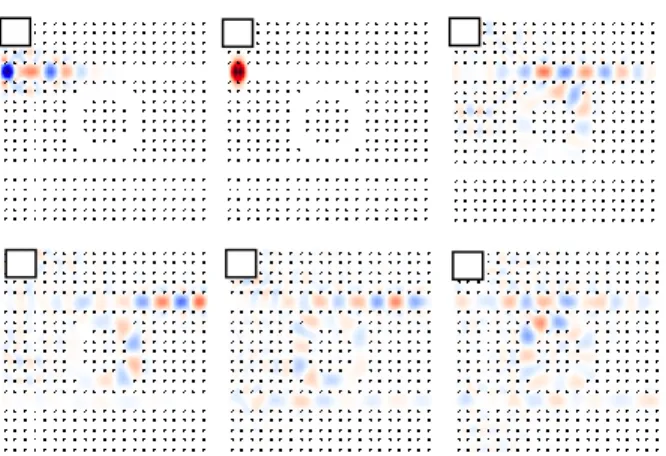
This is created by incorporating a ring resonator into a line defect and then keeping light source at the beginning of the line defect but measuring the flux values near the ring resonator. A careful design of this has a potential to give the best results. Some sensors are designed based on this structure [12].
a
b
c
d
e
f
a
b
c
Figure 4.4 a- Simulated Structures
Figure 4.4 b- Transmission Spectrum Based on above simulations a comparison table is formed as shown below,
Table 2: Comparisons
From above table we may note that the hybrid model is more efficient due to its Q-factor compared to other structures. The distance which light travels inside the crystal can be calculated by measuring the number of rods removed along the path and the length of the crystal. Hybrid model may be used in sensors where the light has to travel for longer distances inside the structure to give detailed and more accurate results. For example in detecting industrial toxins where there is a need for sensor which won‘t just give quick results but also accurate
results without getting confused similar chemicals to that which was to be detected. Normalized flux values give more clear and accurate transmission spectrum.
The structures were designed for standard design parameters taking air as dielectric but these structures can be used for various design models. It is apparent from the structures that reflection, scattering are major problems which needs to be addressed still while designing a sensor. Better Q-factor is the answer for choosing a structure but also if suitable materials are used for the fabrication of these structures then one can reduce the negative effects of these parameters.
There is a trade off between two hybrid model and a linear waveguide. Linear waveguide gives us the maximum sensitivity value where as hybrid model gives us better Q-factor. Based on the requirements of the application any structure can be chosen for sensor designing.
In design where a structure has more edges and sharp points there is less coupling as the scattering angles possessed is less and thus the coupling efficiency drops thereby reducing the efficiency. In those occasions scattering rods can be inserted and thereby reduce the sharp edges and the coupling losses and hence the efficiency can be increased.
When there is a requirement to design a sensor then this work can be used as a reference for structures and decision can be taken as to which structure to choose to get better results. Also this work makes the work of the designer more simple because to design any sensor one simply has to change refractive index and source values and re-run the code.
V. REFERENCES
[1] J. D. Joannopoulos, R. D. Meade, J. N. Winn, Photonic Crystals Modeling the Flow of Light, pp. 3-77, 1995.
[2]J. D. Joannopoulos, P. R. Villeneuve, and S. Fan. Photonic crystals: putting a new
twist on light. Nature 386 143–149, 1997.
[3] J. Pendry. Playing tricks with light. Science 285 1687–1688, 1999.
[4] S. G. Johnson, J. D. Joannopoulos, Photonic crystals — The Road from Theory to Practice, pp. 1143, 2002.
[5] John B Schneider, Understanding the
Finite-Parameters Structures Q-factor Execution time (seconds) Sensitivity (nm/RIU) Linear waveguide 3859.33 21.38 476.12 Ring resonator 125.68 24.44 261.89 Mixed model 889.75 23.05 256.5 Hybrid model 273305 21.00 186.26
a
b
c
Difference Time-Domain method. www.eecs.wsu.edu/~schneidj/ufdtd, 2010
[6] Dr. Cynthia Furse, Finite Difference Time Domain (FDTD) Introduction, University of Utah, www.ece.utah.edu
[7] http://ab-initio.mit.edu/wiki/index.php/Meep [8] Chakravarty, S.; Lai, W.-C.; Zou, Y.; Lin, C.; Wang, X. & Chen, R.T. (2011a). Silicon-nanomembrane-based photonic crystal nanostructures for chip-integrated open sensor systems. Proceeding of SPIE, (November 2011), art. 819802, 8198. [9] poonam Sharma, PreetaSharan, Photonic Crystal based ring resonator sensor for detection of glucose concentration for biomedical applications, IJETAE, Vol 4, issue 3, March 2014
[10] SaeedOlyaee, Ahmad Mohebzadeh-Bahabady, Designing a novel photonic crystal nano-ring resonator for bio sensor application,Optical and quantum electronics, Springer US, Nov 2014
[11] Photonic crystal based chip for detection of toxic gases in air, Ashwini N, PreetaSharan, Dr.SrinivasaTalabattula; www.accsindia.org
[12] Robinson, S. &Nakkeeran, R. (2012). Photonic Crystal based sensor for sensing the salinity of seawater. IEEE – International Conference On Advances In Engineering, Science and Management (ICAESM), 978-81-909042-2-3, (March 2012), 495-499.