Policy Research Working Paper
5538
Small and Medium Enterprises
A Cross-Country Analysis with a New Data Set
Oya Pinar Ardic
Nataliya Mylenko
Valentina Saltane
The World Bank
Financial and Private Sector Development
Consultative Group to Assist the Poor
January 2011
WPS5538
Public Disclosure Authorized
Public Disclosure Authorized
Public Disclosure Authorized
Abstract
The Policy Research Working Paper Series disseminates the findings of work in progress to encourage the exchange of ideas about development issues. An objective of the series is to get the findings out quickly, even if the presentations are less than fully polished. The papers carry the names of the authors and should be cited accordingly. The findings, interpretations, and conclusions expressed in this paper are entirely those of the authors. They do not necessarily represent the views of the International Bank for Reconstruction and Development/World Bank and its affiliated organizations, or those of the Executive Directors of the World Bank or the governments they represent.
Policy Research Working Paper 5538
In the aftermath of the global financial crisis of 2008–2009, there has been an increased interest in the role of small and medium enterprises in job creation and economic growth. However the lack of consistent indicators at the country level restricts extensive cross-country analyses of lending to small and medium
enterprises. This paper introduces a new dataset to fill this gap in the small and medium enterprise data landscape. In addition, it provides the first set of results of analyses with this new dataset, predicting the global small and
This paper is a product of the Financial Access Team in Consultative Group to Assist the Poor, Financial and Private Sector Development. It is part of a larger effort by the World Bank to provide open access to its research and make a contribution to development policy discussions around the world. Policy Research Working Papers are also posted on the Web at http:// econ.worldbank.org. The author may be contacted at [email protected].
medium enterprise lending volume to be $10 trillion. The bulk of this volume, 70 percent, is in high-income countries. On average, small and medium enterprise loans constitute 13 percent of gross domestic product in developed countries and 3 percent in developing countries. Note that although a unique small and medium enterprise definition does not exist, differences in definitions across countries are not statistically significant in explaining the differences in small and medium enterprise lending volumes.
Small and Medium Enterprises:
A Cross-Country Analysis with a New Data Set
*Oya Pinar Ardic Nataliya Mylenko Valentina Saltane
Keywords: Small and Medium Enterprises (SMEs); Financial access; Credit constraints; Regulation
JEL Classification: G21, G28, O16
*
The World Bank / CGAP. We are grateful to Maximilien Heimann, Joyce Antone Ibrahim, and Kristine Cronin for research assistance. This paper’s findings, interpretations, and conclusions are entirely those of the authors and do not necessarily represent the views of CGAP, CGAP’s Council of Governors or Executive Committee, the World Bank, its Board of Executive Directors, or the countries they represent. Data available at:
1. Introduction
Recent studies show that SME development is closely linked with growth. For example, Beck et al. (2005a) find a robust, positive relationship between the relative size of the SME sector and economic growth, even when controlling for other growth determinants. According to Ayyagari
et al. (2007), in high-income countries formal SMEs contribute to 50 percent of GDP on average. Furthermore, in many economies the majority of jobs are provided by SMEs. In OECD countries, for example, SMEs with less than 250 employees employ two-thirds of the formal work force (Beck et al., 2008b; Dietrich, 2010). Using country-level data, Ayyagari et al.
estimate that, on average, SMEs account for close to 60 percent of employment in the manufacturing sector. According to SME Performance Review (EC, 2009), between 2002 and 2008, the number of jobs in SMEs increased at an average annual rate of 1.9 percent while the number of jobs in large enterprises increased by only 0.8 percent. In absolute numbers, 9.4 million jobs were created in the SME sector in EU-27 between 2002 and 2008. Also, it is often
argued that SMEs are more innovative than larger firms. In developed countries, SMEs commonly follow “niche strategies,” using high product quality, flexibility, and responsiveness to customer needs as a means of competing with large-scale mass producers (see, for example, Hallberg, 2000, and Snodgrass and Biggs, 1996).
As the world economies are recovering from the financial crisis of 2008-9, many economies urgently need to create employment opportunities for their citizens. In this respect, creation and growth of SMEs is an important item on the policy agenda due to evidence that points to significant contributions by SMEs to employment. In addition, regulatory measures are necessary to ease access to formal financial services by SMEs. Historically, SMEs have been more likely than larger firms to be denied new loans during a financial crisis. For example, Hallberg (2000) argues thatthe events of the 1990s in Latin America and East Asia confirm this proposition. More recently, in the aftermath of the global financial crisis, SME Performance Review (EC, 2009) reports anecdotal evidence pointing to insufficient market demand as the prime obstacle faced by SMEs, followed by difficulties in accessing finance.
Given the importance of SMEs in supporting sustainable, diversified, long-term economic growth, they have, indeed, attracted renewed attention in the wake of the 2008-9 financial crisis.
Recently, at the Pittsburgh G-20 summit, the G-20 has committed to identifying lessons learned from the innovative approaches to the provision of financial services to SMEs and to promoting successful regulatory and policy approaches.1 SME development is high on the reform agenda of many governments. A broad range of policies and programs target improvements in SME business environments, as well as financial support to SMEs.
Despite the importance of SMEs for job creation and production, most of the SME literature points to the fact that small and medium firms face higher barriers to external financing than large firms, which limits their growth and development.2 Numerous studies that use firm-level survey data demonstrate that access to finance and the cost of credit do not only pose barriers to SME financing, but also constrain SMEs more than large firms. Small firms find it difficult to obtain commercial bank financing, especially long-term loans, for a number of reasons, including lack of collateral, difficulties in proving creditworthiness, small cash flows, inadequate credit history, high risk premiums, underdeveloped bank-borrower relationships and high transaction costs (IFC, 2009). This is evidenced in the works of Scholtens (1999), Schiffer and Weder (2001), Galindo and Schiantarelli (2003), IADB (2004), Beck et al. (2006), and Beck and Demirgüç-Kunt (2006).3 In particular, Beck et al. (2008a) conclude that smaller firms and firms in countries with underdeveloped financial and legal systems use less external finance, based on data from a firm-level survey in 48 countries.4
A broad range of business environment factors are linked to SME performance. For example, Ayyagari et al. (2007) find that lower costs of entry and better credit information sharing are associated with a larger size of the SME sector, while higher exit costs are associated with a larger informal economy. The overall banking structure is another important factor. Shen et al.
1
See the Pittsburgh G-20 Summit “Leaders’ Statement” at http://www.pittsburghsummit.gov.
2
Enterprise Analysis survey data at http://www.enterprisesurveys.org/; IFC (2009); Beck et al (2008b). 3
For earlier research, see Hartwell (1947) who reports a negative correlation between loan size and interest rates, and Murphy (1983) who argues that small loans to small firms are more costly for the lenders.
4
Studies that focus on a specific country report similar results. Stephanou and Rodriguez (2008) find that access to credit is one of the biggest constraints for SMEs in Colombia; Binks and Ennew (1997) find that the main
constraints to growth of SMEs in the UK include management, labor skills, regulation and lack of access to finance; Hutchinson (2006) compares the cases of a leading transition country, Slovenia and an established market economy, Belgium, and finds that the SME sector in Slovenia remains underdeveloped, mainly due to the inability to raise external finance. Studies by Anderson and Kegels (1997), Budina et al. (2000), Gros and Suhrcke (2000), Konings et al. (2003) all indicate that this appears to be the case in most of Central and Eastern Europe.
(2009), using Chinese data, find that total bank assets are not significant for banks’ decision to lend to SMEs. Yet, more local lending authority, more competition, carefully designed incentive schemes, and stronger law enforcement encourage commercial banks to lend to SMEs. Macroeconomic instability in developing countries and competition in developed countries are perceived as the biggest obstacles to SME finance. Rocha et al. (2010) provide supportive evidence from banks in Middle East and North Africa, noting lack of SME transparency and underdeveloped financial systems as the main obstacles.5,6 At the same time, a recent study by Beck et al. (2008b) indicates that most commercial banks perceive the SME sector as profitable.
The lack of consistent indicators restricts extensive cross-country analyses of SME lending. Most countries either do not collect data on SME lending or do so on an ad hoc basis. Even when SME data are available, it is extremely difficult to perform a cross-country analysis in the absence of a standard definition as to what constitutes an SME. Though SMEs are commonly defined as registered businesses with less than 250 employees (IFC, 2009), the definition still varies from country to country and even from bank to bank. In this respect, an OECD conference on SMEs in 2004 made two key policy recommendations to both member and non-member economies: (i) develop greater international comparability of SME statistics, and (ii) develop a common definition of an SME.7 Without reliable SME data, it is difficult for policy makers to implement programs aimed at expanding and strengthening the SME sector.
5
One strand of the literature on SME financing indicates that SMEs pay higher interest rates on formal bank credit. For example, Cressy and Toivanen (2001) find that collateral provisions and loan size reduce the interest rate paid and that better borrowers get larger loans and lower interest rates. Hernandez-Canovas and Martinez-Solano (2007), using firm-level data from Spain, argue that close relationships with financial institutions may generate advantages such as improved conditions of financing and increased credit availability. Furthermore, Dietrich (2010) argues that the lack of negotiating power of small enterprises has significant explanatory power in explaining differences in lending rates between small and large enterprises.
6
There is still an ongoing debate regarding bank size and/or ownership and SME lending. Until recently, a large strand of literature argued that small banks are more likely to finance SMEs as they are better suited to engage in “relationship lending,” (see Keeton, 1995; Berger and Udell, 1995; and Strahan and Weston, 1996). The strength of bank-borrower relationship is argued to be positively related to various credit terms (Blackwell and Winters, 1997; Harhoff and Korting, 1998; Degryse and Van Cayseele, 2000; Bodenhorn, 2003; Peltoniemi, 2007). However, some recent studies, including Berger and Udell (2006), Berger et al. (2007), de la Torre et al. (2010) and Beck et al. (2008b), have disputed this conviction by arguing that large banks, relative to other institutions, can have a comparative advantage in financing SMEs through arms-length lending technologies, such as asset-based lending, factoring, leasing, fixed-asset lending and credit scoring, as opposed to relationship lending.
7
Second OECD Conference of Ministers Responsible for Small and Medium-Sized Enterprises (SMEs), Istanbul, 2004.
This paper introduces a new cross-country data set collected through a survey of regulators at the country level, and expands on the existing literature to analyze access to finance by SMEs. The paper draws on the report and database of Financial Access 2010 (CGAP and WBG, 2010), the second in a series of annual reports by CGAP and the World Bank Group (WBG) on the financial inclusion agenda based on survey data collected from financial regulators around the world. More specifically, this new data set collects information on the level of lending to SMEs, the definition of SMEs, and country-level initiatives through which lending to SMEs is monitored. It is also the first attempt at collecting global comparable SME statistics.
This new database collects data from financial regulators, mostly central banks and bank superintendents, around the world. Although regulators collect a wide array of portfolio data from regulated financial institutions, SME lending data are not necessarily among the regularly collected statistics, and some parts of SME lending are done through unregulated institutions. Nevertheless, according to Financial Access 2010, the experience of some countries shows that collection of data on lending to SMEs is possible on a monthly basis with a clear SME definition and sound reporting requirements.
The analysis of the new data indicates two main findings. First, many regulators collect data on SME financing; however, there is no unique definition of an SME. At the same time, the results indicate that differences in definitions across countries are not statistically significant in explaining the differences in SME lending volumes. Second, given this, the paper goes on to estimate the global SME lending volume at $10 trillion, roughly two-thirds of the current size of the US economy. The bulk of this volume, 70 percent, is in high-income OECD countries. On average, SME loans constitute 13 percent of GDP in developed countries and 3 percent in developing countries.
The rest of the paper is organized as follows. Section 2 introduces the dataset. Econometric analyses are reported in section 3, and predictions of global SME lending volume are discussed in section 4. Section 5 concludes.
2. Data
A new and unique data set on SME financing volumes across the world is collected through the
Financial Access 2010 survey in January-April of 2010 by CGAP/World Bank Group.8 The survey annually collects data from the main financial regulators such as central banks or bank supervisory agencies in 140+ countries. One of the objectives of the 2010 survey was to identify the feasibility of collecting consistent cross-country data on SMEs from financial regulators. To achieve this objective, the survey asked about existing institutional arrangements for collecting SME data and about SME definitions used by the authorities. It also requested the most recent statistics on the volume and number of SME loans, as well as the number of SMEs with outstanding loans. The data collected is as of the end of 2009.
As is the case with most data collection endeavors, the survey methodology has some limitations. First, the survey collects information only on regulated financial institutions, leaving out non-regulated providers of financial services. This practice is likely to understate the scale of SME financing, as lending to SMEs is often done by non-regulated credit providers. Second, even though the main financial regulator was asked to provide data on all regulated financial institutions, in cases where some financial institutions are regulated by secondary regulators, the data are rarely available. As a result, the data understate the true scale of overall SME lending.
The survey asks regulators if they monitor the level of lending to SMEs by regulated financial institutions through regular or irregular reporting, through periodic surveys of financial institutions, through collecting estimates from credit registries and/or by using any other method. In addition, in the cases where a different institution than the financial regulator is responsible for monitoring SME lending, regulators were asked to identify this institution.
Out of 74 countries that reported that they collect data on SME finance, nearly 80 percent – 59 countries – stated they collected information on a regular basis. Financial regulators in middle and low-income countries are more likely to require regular reporting of SME statistics. Out of
8
the 59 countries that collect SME lending data on a regular basis, 86 percent are low and middle-income countries. Table 1 provides detailed information from the survey.
In a number of countries where data are not collected through regular reporting, they are collected through surveys of financial institutions or by estimating lending volume in credit registries. Credit registries contain loan level data and allow estimation of a variety of SME statistics using loan size as a proxy for an SME definition. In 13 countries, including Argentina, Tunisia and Brazil, regulators use public credit registries to estimate the volume of SME lending. In 23 countries regulators conduct periodic surveys of financial institutions to monitor SME lending. The frequency of surveys varies across countries. For example, Estonia, Singapore and Armenia conduct such surveys annually, Algeria and Tunisia monthly, while Uganda does it on an ad hoc basis. Financial institution surveys can be an important tool for a regulator to collect information not only on SME lending volumes, but on other aspects of SME finance such as fees and number of applications received and rejected, all of which are essential for the implementation of SME finance reforms and programs. In 10 countries, 8 of which are in the Western African Monetary Union, regulators combine information from the credit registries and periodic surveys from financial institutions.
There is a clear regional pattern in reporting SME data. More than half of the countries in Asia and Africa report that they collect information on SME finance on a regular basis. These are also regions where regulators tend to identify access to finance as a priority. Financial regulators in high-income countries and in Latin America and the Caribbean are the least likely to collect data on SME finance, as some other agency is usually assigned this task. Most importantly, the survey was able to collect data on the volume of SME financing from 50 countries, which enables us to assess cross-country variation in the levels of SME financing.
2.1 SME definitions
One of the main challenges in performing a cross-country analysis of SME data is the absence of a universal definition of what constitutes an SME. A number of efforts aim to streamline and harmonize SME definitions (OECD, 2004), although the heterogeneity of SMEs themselves and the nature of the economy they operate in might mean that establishing a global definition is not
feasible. We discuss the existing definitions of SMEs below and explore to what extent the difference in definitions is associated with observed variation in the level of SME financing. In addition, we supplement the information on SME definitions available from the Financial Access 2010 survey with the information available from public sources.9
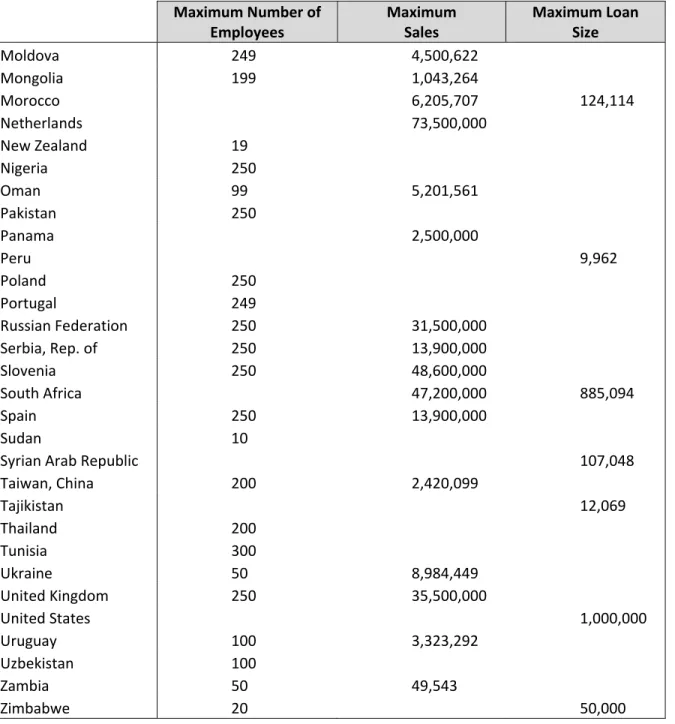
The most common definitions used by regulators are based on the number of employees, sales and/or loan size. The most common among the three is the number-of-employees criterion. Sixty-eight countries provided information on the SME definition criteria used by the financial regulator. Fifty of them use the number-of-employees criterion, and 29 out of these 50 also use the other two criteria. A total of 41 regulators use maximum sales value criteria and 15 use maximum loan value criteria to define an SME (Table 2).
Number of employees and sale volumes are probably the most accurate parameters to define SME, but these data are not always available from lenders. Banks may collect this information at the time of evaluating loan applications, but often do not keep it in their systems and as a result they are not able to report lending volumes based on these criteria. As a result, some countries choose to rely on loan size as a proxy when collecting information on SME finance from financial institutions. Extracting information on loans to firms below a certain size and loans to individual entrepreneurs can be a reasonable approximation for SME lending volume. In Financial Access 2010 only 15 countries stated that they use loan size as a proxy for defining an SME. Similar to the definitions based on the number of employees and sales, there is a substantial amount of variation among countries.
Data availability and quality for SME lending depend on the way financial institutions and credit registries handle firm level data from loan applications, as they are the primary data collectors. Financial regulators collect these data from institutions and aggregate them. In this respect, there seems to be a need to harmonize SME definitions within each country even though such a task might be unfeasible across countries. In the long run, encouraging financial institutions to collect and maintain information on the number of employees and sale volumes in their systems will
9
Additional data were used from the following sources: UNDP country studies, MSME Country Indicators (WBG/IFC), and central bank websites.
allow for more accurate monitoring of SME lending in line with the existing official definition. These data may also be useful to banks themselves for client segmentation and development of SME scoring models. In the short run, collecting data using loan size criteria as a proxy may serve as a reasonable proxy of SME volumes for regulators.
2.2 Values and numbers of outstanding loans
In the Financial Access 2010 sample, 50 out of 142 regulators were able to provide data on the total value of outstanding loans to SMEs. Out of these, 30 are middle-income and 14 are high-income countries (Table 3). Among low-high-income countries, only Afghanistan, Bangladesh, Liberia, Pakistan, Tajikistan and Uzbekistan were able to provide these data points. The ratio of SME lending to GDP ranges from less than 1 percent in Tajikistan to more than 50 percent in the Netherlands and Portugal. The median ratio of SME credit to GDP is 6.4 percent, and in 75 percent of the economies in the sample, it is below 15 percent. The value of outstanding loans to SMEs as a percentage of total loans also shows a high degree of variation reflecting the structure of the local financial market. Overall, high-income countries tend to have higher ratios of SME finance volume to GDP and total loans, suggesting a more developed SME finance market compared with developing countries.
It is less common for regulators to collect data on total numbers of outstanding loans to SMEs than on total values of outstanding loans to SMEs. Only 26 countries provided data on the number of outstanding loans to SMEs, 9 of which are in Latin America. All the 26 countries that provided data on the total number of outstanding loans to SMEs also provided data on the total value of outstanding loans to SMEs.
Only 16 countries provided data on the number of SMEs with outstanding loans, out of which four are high-income countries, eight middle-income countries, and four low-income countries. All of these countries also provided data on values of outstanding loans to SMEs, and 11 of them provided data on total number of outstanding loans to SMEs.
3. Cross-country covariates of SME financing
This section discusses macroeconomic and institutional factors that affect lending to SMEs using cross-country data from the Financial Access database introduced above, and common indicators of growth and development. We use the standard cross-country regression framework, which has both advantages and disadvantages. This framework is useful for obtaining a global picture of SME lending volumes, and for informing the policy debate from a global perspective. However, it is not necessarily the best tool to derive country-specific policy implications, as it does not consider within-country variations in SME lending.
To what extent is cross-country variation in the volume of SME financing driven by differences in the definition? This is an important first question before starting more detailed analyses of the data, since SME definitions vary greatly across countries, as evidenced in Section 2.1 above. This variation in SME definitions might in fact cause differences in levels of SME financing across countries rather than indicators of economic growth and development.
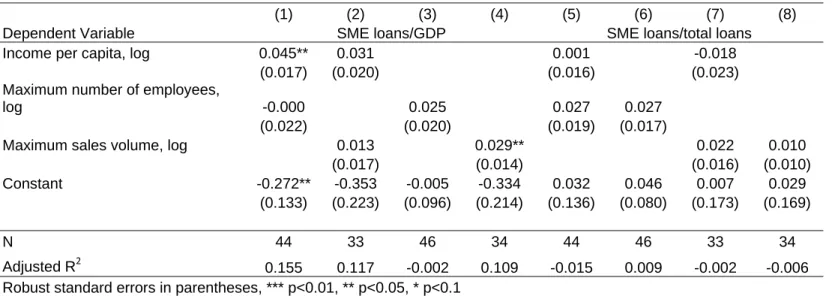
Estimation results are presented in Table 4 and show no consistent and robust correlations between the levels of SME finance and definition criteria. We do not find statistically significant correlations between the value of SME financing and the maximum number of employees used as a criterion to define SME.10 In a smaller sample the maximum sales volume criteria is positively correlated with the ratio of SME loans to GDP but not with the share of SME loans in total commercial bank loans. Moreover, the correlation between the ratio of SME loans to GDP and sales volume is not statistically significant once we control for income per capita.
These results provide a certain level of comfort and allow us to proceed in analyzing SME finance data using national definitions. Even though the definition introduces a substantial degree of heterogeneity in the data, it does not appear to influence the volume of SME financing reported by countries in a manner that would prevent cross-country comparison.
10
All regressions exclude countries where the higher cutoff for the definition of SMEs as defined by number of employees is 1,000 employees or more. In our sample, only South Korea and China fall into this category.
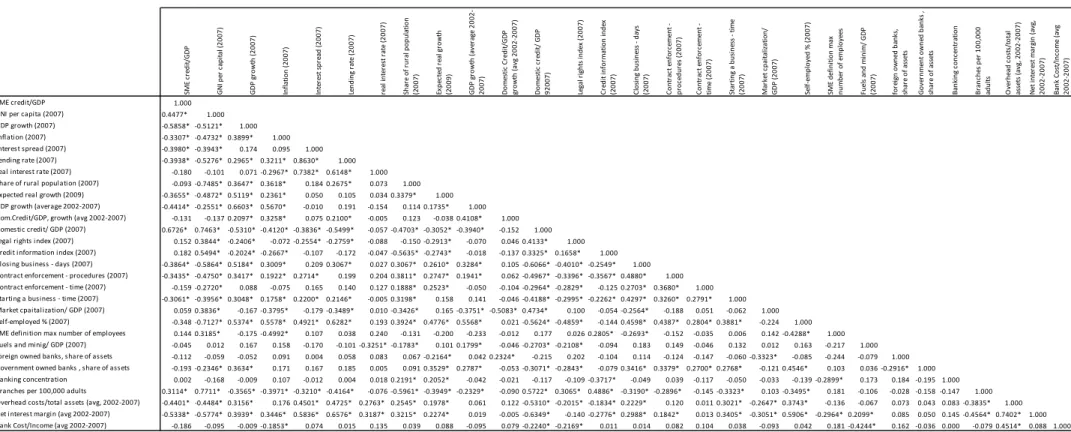
A number of macroeconomic and institutional factors are associated with greater levels of SME financing. Table 5 presents pairwise correlations of the ratio of SME loans to GDP and a number of macroeconomic and institutional factors.11 Consistent with earlier research on SME and enterprise financing, we find a positive correlation between the overall level of economic development measured by income per capita and financial development measured by the ratio of private credit to GDP with the level of SME financing. Legal frameworks and the overall business environment are also important factors affecting the level of SME financing. For example, the ability to open and close a business is found to be an important factor associated with growth. Using information from the Doing Business database, we find a negative correlation between the number of days it takes to start and close a business and the value of SME financing.
In addition, we consider a number of parameters describing financial institutions operating in a country. We do not find a statistically significant correlation between the share of foreign- or state-owned banks and levels of SME financing, which is consistent with bank level evidence in Beck et al. (2008b). Unlike firm level analysis in Beck et al. (2005b), we do not find a statistically significant level of correlation between the level of bank concentration and the ratio of SME financing to GDP. However, broader retail outlet networks measured by the number of bank branches per 100,000 adults from the Financial Access database are associated with more SME financing. Countries where banks have less efficient structures measured by a higher ratio of overhead costs to total assets, higher interest rate margin and a greater cost to income ratio, tend to have lower levels of SME financing.
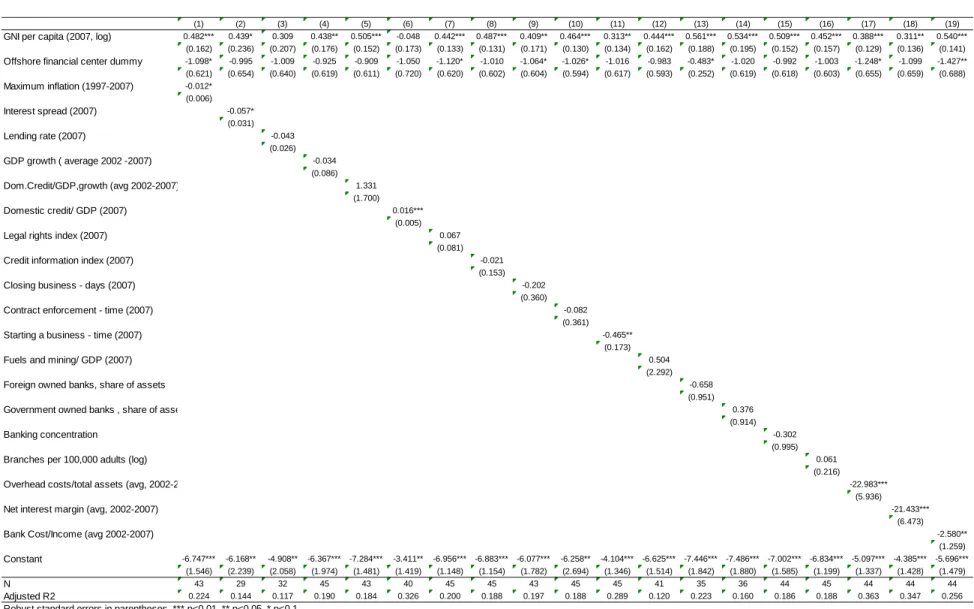
Even after controlling for the overall development using income per capita as a proxy, we find that the framework for starting businesses and the overall level of development of the financial market are significantly correlated with the levels of SME financing (Table 6). We also find that parameters characterizing efficiency of the banking system, including cost ratios and net interest margins, have statistically significant negative coefficients, even after controlling for the overall level of development.
11
We have also conducted analysis using the share of SME loans in total loans but did not find significant correlations with various macroeconomic and business environment factors, except for a negative correlation between the share of SME loans in total loans and an offshore financial sector dummy.
4. Estimating global SME lending volume
Based on data availability and the predictive power of the various factors analyzed above, we use a specification in which the overall private credit to GDP ratio, number of days to start a business and a control for offshore financial centers are explanatory variables for the regression to estimate the SME loan volume to GDP ratio. Intuitively, these variables allow us to control for the following effects: (i) the ratio of the private credit to GDP captures the overall level of financial development by proxying for all relevant business environment and macroeconomic factors affecting extension of credit in a country, (ii) the number of days to start a business captures the idea that in those countries where it is easy to start a business, there are more formal SMEs to finance and higher levels of SME lending, and (iii) the offshore financial center dummy captures the idea that such countries might have high levels of credit as a percentage of GDP but low levels of SME financing.
Estimating this model with 45 observations yields an R2 of 0.51 and coefficient estimates as follows: ln 5.27 0.87 0.900.18 ln . 1.18 0.68 0.380.15 ln _ _
These findings support earlier evidence on the importance of reforming business registration and other regulations affecting firm entry (World Bank, 2004). The longer it takes to start a business; the lower the ratio of SME loans to GDP. More developed financial markets, measured by the extent of domestic credit, imply higher levels of SME lending, and offshore financial centers have lower levels of SME lending.
Based on these estimates, the global volume of SME lending is predicted as roughly $10 trillion in 2009 (Table 7).12 The bulk of SME lending volume—70 percent—is concentrated in high income countries. The second largest market for SME loans is East Asia and Pacific, which
12
Using a logarithmic specification for the dependent variable in the regression framework creates a retransform bias in the prediction exercise due to Jensen’s inequality. We use the method by Duan (1983) to correct for the bias.
accounts for a quarter of the total SME lending volume. However, 90 percent of this amount is in China where the SME definition is broad and SMEs can employ up to 1,500 people. Excluding China, the total SME lending volume in East Asia and Pacific is comparable to Eastern Europe and Central Asia or about 3 percent of the total. Sub-Saharan Africa, Middle East and North Africa, and South Asia together account for only 1.7 percent of the total SME volume.
5. Conclusion
Expanding access to financial services by SMEs is a critical objective of the financial inclusion agenda. The G-20 has started focusing on financial inclusion in the global policy agenda since 2009 and has identified financial inclusion as a key driver of economic growth, reduced economic vulnerability for individual households, poverty alleviation, and improved quality of life for people around the world. SME access to finance is a fundamental component of this agenda. As part of the global efforts to collect data on SME financing, the Financial Access
survey by CGAP/WBG initiated data collection on SME access to finance as a first attempt to identify the feasibility of collecting consistent cross-country data on SMEs from financial regulators.
This paper presents the data set resulting from this initiative, as well as a first analysis of the data. The data set is a first attempt to form a consistent cross-country database on SME access to finance. The main message emerging from the new data is that what constitutes an SME is quite different in different parts of the world. Nevertheless, these differences in SME definitions do not drive the variation in SME lending around the world. Income per capita, private credit to GDP, the legal and business environment, and the efficiency of the banking system are among the factors that influence SME lending.
Based on this data set, the total volume of SME loans around the world is predicted as roughly $10 trillion in 2009. The bulk of SME lending volume—70 percent—is concentrated in high-income countries. The median ratio of SME loans to GDP in high-high-income countries is 13 percent, compared with only 3 percent in developing countries.
The main caveats and directions for improvement are as follows. First, the data are collected through a survey of regulators, and thus data availability and quality are based on the data collection processes of the regulators. Although SME financing data are generally not among the standard data collected by regulators, many regulators were able to provide the data. However, this indicates a potential avenue for improvement. As regulators improve their processes for collecting data, harmonizing the SME definition is crucial. Although financial institutions likely have information on the size of firms in terms of number of employees and/or sales volume at the time of loan application, they may not keep this information in their records. Thus, the only way for them to report on SME lending is based on the size of the loans. Unfortunately, in most cases, there is no unified definition of an SME, even within one country, due to this multiplicity of criteria.
Second, the data on SME lending are only based on those collected through regulated financial institutions, and in most cases, through commercial banks only. This severely underestimates SME lending volume, as one would expect that a sizeable amount of SME financing is done through unregulated and informal institutions. In some cases, even consumer loans could end up being used for commercial purposes. By going through secondary regulators, financial institutions, and firms themselves, the current data initiative could be strengthened.
References:
Anderson, Ronald and Chantal Kegels (1997). ‘Finance and Investment in Transition: Czech Enterprises, 1993–1994’, IRES-Institut de Recherches, Department of Economics, Université Catholique de Louvain, Discussion Paper 9715, Louvain-la-Neuve.
Ayyagari, Meghana, Thorsten Beck, and Aslı Demirgüç-Kunt (2007). “Small and Medium Enterprises Across the Globe,” Small Business Economics 29: 415-434.
Beck, Thorsten, and Aslı Demirgüç-Kunt (2006). “Small and Medium-Size Enterprises: Access to Finance as a Growth Constraint,” Journal of Banking & Finance 30: 2931-2943
Beck, Thorsten, Aslı Demirgüç-Kunt, and Ross Levine (2005a). “SMEs, Growth, and Poverty: Cross-Country Evidence,” Journal of Economic Growth 10: 199-229.
Beck, Thorsten, Aslı Demirgüç-Kunt, Luc Laeven, and Vojislav Maksimovic (2006). “The Determinants of Financing Obstacles,” Journal of International Money and Finance
25(6): 932-952.
Beck, Thorsten, Aslı Demirgüç-Kunt, and Vojislav Maksimovic (2005b). “Financial and Legal Constraints to Firm Growth: Does Firm Size Matter?” Journal of Finance 60: 137–7. Beck, Thorsten, Aslı Demirgüç-Kunt, and Vojislav Maksimovic (2008a). “Financing Patterns
Around the World: Are Small Firms Different?” Journal of Financial Economics 89: 467-487.
Beck, Thorsten, Aslı Demirgüç-Kunt, and Maria Soledad Martinez Peria (2008b). “Bank Financing for SMEs Around the World: Drivers, Obstacles, Business Models, and Lending Practices,” Policy Research Working Paper 4785. World Bank, Washington, DC.
Berger, Allan. N., Richard J. Rosen and Gregory. F. Udell (2007). “Does Market Size Structure Affect Competition? The Case of Small Business Lending,” Journal of Banking and Finance 31: 11-33.
Berger, Allan, and Gregory F. Udell (1995). “Relationship Lending and Lines of Credit in Small Firm Finance,” Journal of Business 68: 351-381.
Berger, Allen, and Gregory Udell (2006). “A More Complete Conceptual Framework for SME Finance,” Journal of Banking and Finance 30: 2945-2966.
Binks, Martin, and Christine Ennew (1997). “The Relationship between UK Banks and their Small Business Customers,” Small Business Economics 9: 167-178.
Blackwell, David W. and Drew B. Winters (1997). “Banking relationships and the effect of monitoring on loan pricing,” Journal of Financial Research 20: 275–289.
Bodenhorn, Howard (2003). “Short-term loans and long-term relationships: relationship lending in Early America,” Journal of Money, Credit and Banking 35: 485–505.
Budina, Nina, Harry Garretsen, and Eelke de Jong (2000). “Liquidity Constraints and Investment in Transition Economies: The Case of Bulgaria,” Economics of Transition 8: 453–475. Cressy, Robert and Otto Toivanen (2001). “Is there adverse selection in the credit market?”
Venture Capital 3: 215–238.
CGAP (Consultative Group to Assist the Poor) and WBG (The World Bank Group) (2010).
Financial Access 2010: The State of Financial Inclusion Through the Crisis, Washington, DC: CGAP and the World Bank Group.
de la Torre, Augusto, Maria Soledad Martinez Peria, and Sergio Schmukler (2010). “Bank Involvement with SMEs: Beyond Relationship Lending,” Journal of Banking and Finance 34: 2280-2293.
Degryse, Hans and Patrick Van Cayseele (2000). “Relationship lending within a bank-based system: evidence from European small business data,” Journal of Financial Intermediation 9: 90–109.
Dietrich, Andreas (2010). “Explaining Loan Rate Differentials Between Small and Large Companies: Evidence from Switzerland,” Small Business Economics, Forthcoming.
Duan, Naihua (1983). “Smearing estimate: A non-parametric retransformation method,” Journal of the American Statistical Association 78(383): 605-610.
EC (European Commission) (2009). European SMEs Under Pressure: Annual Report on EU Small and Medium-Sized Enterprises 2009, Brussels, Belgium: European Commission. Galindo, Arturo and Fabio Schiantarelli (2003). “Credit Constraints and Investment in Latin
America,” RES Working Papers 4305, Inter-American Development Bank, Washington D.C.
Gros, Daniel and Marc Suhrcke (2000). ‘Ten Years After: What is Special About Transition Countries?’ European Bank Working Paper N. 56.
Hallberg, Kristin. 2000. “A Market-Oriented Strategy for Small and Medium-Scale Enterprises,” Discussion Paper 40, International Finance Corporation.
Harhoff, Dietmar, and Timm Korting (1998). “Lending relationships in Germany - Empirical evidence from survey data,” Journal of Banking and Finance 22: 1317–1353.
Hartwell, John M. (1947). “Interest rates by loan size and geographical region,” Journal of the American Statistical Association 42: 242–245.
Hernandez-Canovas, Gines, and Pedro Martinez-Solano (2007). “Effect of the Number of Banking Relationships on Credit Availability: Evidence from Panel Data of Spanish Small Firms,” Small Business Economics 28: 37-53.
Hutchinson, John (2006). “Comparing the Impact of Credit Constraints on the Growth of SMEs in a Transition Country with an Established Market Economy,” Small Business Economics 27: 169-179.
IADB (Inter-American Development Bank) (2004). Unlocking Credit: The Quest for Deep and Stable Lending, Baltimore, MD: Johns Hopkins University Press.
IFC (International Finance Corporation) (2009). “The SME Banking Knowledge Guide,” The World Bank Group, Washington D.C.
Keeton, William R. (1995). “Multi-Office Bank Lending to Small Businesses: Some New Evidence,” Federal Reserve Bank of Kansas City Economic Review 80: 45-57.
Konings, Jozef, Marian Rizov, and Hylke Vandenbussche (2003). “Investment and Credit Constraints in Transition Economies: Micro Evidence from Poland, the Czech Republic, Bulgaria and Romania,” Economics Letters 78: 253–258.
Murphy, Neil B. (1983). “Loan rates, operating costs and size of loan: The evidence from cross- section data,” In P. Horvitz & R. Pettit (Eds.), Small Business, Connecticut: JAI Press, pp. 51–62.
OECD (Organisation for Economic Co-operation and Development) (2004). Promoting Entrepreneurship and Innovative SMEs in a Global Economy: Towards a More Responsible and Inclusive Globalisation, Second OECD Conference of Ministers Responsible for Small and Medium-Sized Enterprises (SMEs), Executive Summary of the Background Papers, Paris, France: OECD.
Peltoniemi, Janne (2007). “The benefits of relationship banking: Evidence from small business financing in Finland,” Journal of Financial Services Research 31: 153–171.
Rocha, Roberto, Subika Farazi, Rania Khouri, and Douglas Pearce (2010). “The Status of Bank Lending to SMEs in the Middle and North Africa Region: The Results of a Joint Survey of the Union of Arab Banks and the World Bank,” Mimeo, the World Bank, Washington, D.C., and the Union of Arab Banks, Beirut.
Schiffer, Mirijam, and Beatrice Weder (2001). “Firm Size and the Business Environment: Worldwide Survey Results,” Discussion Paper 43, International Finance Corporation, Washington, DC.
Scholtens, Bert (1999). “Analytical Issues in External Financing Alternatives for SMEs,” Small Business Economics 12: 137-148.
Shen, Yan, Minggao Shen, Zhong Xu, and Ying Bai (2009). “Bank Size and Small- and Medium-sized Enterprise (SME) Lending: Evidence from China,” World Development
37: 800-811.
Snodgrass, Donald, and Tyler Biggs (1996). Industrialization and the Small Firm: Patterns and Policies. San Francisco: International Center for Economic Growth.
Stephanou, Constantinos, and Camila Rodriguez (2008). “Bank Financing to Small and Medium-Sized Enterprises (SMEs) in Colombia,” Policy Research Working Paper 4481. World Bank, Washington, DC.
Strahan, Philip E. and James Weston (1996). “Small Business Lending and Bank Consolidation: Is There Cause for Concern?” Current Issues in Economics and Finance, 2:1-6.
World Bank (2004). Doing Business in 2004: Understanding Regulations, Washington, DC: World Bank.
Table 1 – Monitoring SME lending
Country
Regulator monitors SME lending
Country
Regulator monitors SME lending Yes, regularly Yes, irregularly No No, but another agency does Yes, regularly Yes, irregularly No
No, but another agency does
Afghanistan + Ecuador +
Albania + + El Salvador +
Algeria + Estonia +
Anguilla + Ethiopia +
Antigua and Barbuda + Finland +
Argentina + France + Armenia + Gambia + Australia + Georgia + Austria + Germany + Azerbaijan + + Ghana + Bangladesh + Greece + Belarus + Grenada + Belgium + + Guatemala +
Benin + Guinea Bissau +
Bosnia and Herzegovina + Honduras + +
Botswana + + Hungary +
Brazil + India +
Bulgaria + Indonesia + +
Burkina Faso + Iran +
Cambodia + Israel +
Canada + Italy +
Cape Verde + Jamaica +
Chile + + Japan +
Colombia + + Jordan +
Costa Rica + + Kazakhstan +
Cote d'Ivoire + Kenya +
Croatia + Korea +
Czech Republic + Latvia +
Denmark + Lebanon + +
Dominica + Liberia +
Dominican Republic + + Lithuania + +
Table 1 – Monitoring SME lending (continued)
Country
Regulator monitors SME lending
Country
Regulator monitors SME lending Yes, regularly Yes, irregularly No No, but another agency does Yes, regularly Yes, irregularly No No, but another agency does Macedonia + Serbia +
Madagascar + Sierra Leone +
Malawi + Singapore +
Malaysia + Slovak Republic +
Mali + Slovenia +
Mauritania + South Africa +
Mauritius + Spain +
Mexico + St. Kitts and Nevis +
Moldova + St. Lucia +
Mongolia + St. Vincent and the
Grenadines + Montserrat + Morocco + Sudan + Mozambique + Switzerland + + Namibia + + Syria + Netherlands + Taiwan + +
New Zealand + Tajikistan +
Nicaragua + + Thailand +
Niger + Togo +
Nigeria + Tunisia +
Norway + Turkey + +
Pakistan + Uganda +
Panama + United Arab Emirates +
Peru + United Kingdom +
Philippines + United States +
Poland + Uruguay +
Portugal + Uzbekistan +
Puerto Rico + Venezuela + +
Russia + Yemen +
Rwanda + Zambia + +
Senegal + Zimbabwe + +
Table 2 - SME Definitions Maximum Number of Employees Maximum Sales Maximum Loan Size Afghanistan 100 995,355 Albania 249 2,632,185 Argentina 23,900,000 Armenia 100 Australia 1,559,833 Azerbaijan 5 124,412 311,029 Bangladesh 150 Botswana 100 698,301 Canada 499 43,700,000 4,374,069 Cape Verde 51 1,889,713 Colombia 200 Costa Rica 540,000 Croatia 250 Dominican Republic 13,879 El Salvador 50 1,000,000 Estonia 50 4,340,278 1,388,889 France 69,400,000 Germany 250 73,500,000 Ghana 30 2,129,472 Greece 250 69,400,000 Guatemala 19,604
Hong Kong SAR, China 100
Hungary 250 69,400,000
Indonesia 4,812,349
Iran, Islamic Rep. 50
Ireland 249 Italy 20 Kazakhstan 250 Korea, Rep. 1,000 117,000,000 Kuwait 868,703 Lao PDR 99 117,426 Latvia 250 Lebanon 5,000,000 Liberia 16 262,500 155,000 Lithuania 249 55,600,000 Madagascar 2,555,968 Malaysia 150 7,093,199 Mexico 250 18,500,000
Table 2 – SME definitions (continued) Maximum Number of Employees Maximum Sales Maximum Loan Size Moldova 249 4,500,622 Mongolia 199 1,043,264 Morocco 6,205,707 124,114 Netherlands 73,500,000 New Zealand 19 Nigeria 250 Oman 99 5,201,561 Pakistan 250 Panama 2,500,000 Peru 9,962 Poland 250 Portugal 249 Russian Federation 250 31,500,000 Serbia, Rep. of 250 13,900,000 Slovenia 250 48,600,000 South Africa 47,200,000 885,094 Spain 250 13,900,000 Sudan 10
Syrian Arab Republic 107,048
Taiwan, China 200 2,420,099 Tajikistan 12,069 Thailand 200 Tunisia 300 Ukraine 50 8,984,449 United Kingdom 250 35,500,000 United States 1,000,000 Uruguay 100 3,323,292 Uzbekistan 100 Zambia 50 49,543 Zimbabwe 20 50,000
Table 3 - SME Lending
Total value of outstanding
loans to SMEs (usd)
Total number of outstanding loans to SMEs Total number of SMEs with outstanding loans Afghanistan 239,000,000 1,990 422,352 Albania 1,390,000,000 Argentina 4,210,000,000 761,950 60,000 Armenia 520,000,000 Australia 156,000,000,000 Bangladesh 13,700,000,000 403,181 Belgium 107,000,000,000 325,595 172,706 Botswana 54,100,000 Brazil 60,700,000,000 7,264,216 1,603,346 Cape Verde 10,300,000 242 190 China 2,110,000,000,000 Costa Rica 1,280,000,000 74,863 44,979 Ecuador 1,510,000,000 771,683 El Salvador 1,280,000,000 62,583 Estonia 7,150,000,000 46,228 France 303,000,000,000 499,493 270,475 Georgia 709,000,000 283,767 Guatemala 197,000,000 155,536
Hong Kong SAR, China 1,650,000,000 19,754
Hungary 18,400,000,000 186,452
India 52,900,000,000 4,851,082
Indonesia 3,460,000,000 2,823,027
Iran, Islamic Rep. 22,900,000,000 644,784
Italy 262,000,000,000 915,637 Japan 1,760,000,000,000 Jordan 2,040,000,000 Kazakhstan 8,480,000,000 Korea, Rep. 347,000,000,000 Latvia 14,300,000,000 56,219 Liberia 20,400,000 571 551 Malaysia 34,000,000,000 526,067 Mongolia 336,000,000 45,323 45,323 Morocco 8,970,000,000 Netherlands 463,000,000,000 Pakistan 4,260,000,000 212,387 Panama 750,000,000 5,191 Peru 1,390,000,000 1,896,923 1,334,794 Poland 41,200,000,000 127,100
Table 3 - SME Lending (continued)
Total value of outstanding
loans to SMEs (usd)
Total number of outstanding loans to SMEs Total number of SMEs with outstanding loans Portugal 126,000,000,000 671,898 214,002 Russian Federation 84,300,000,000 Singapore 27,200,000,000 South Africa 29,700,000,000 Taiwan, China 97,000,000,000 Tajikistan 18,700,000 Thailand 80,100,000,000 919,098 Turkey 58,600,000,000 1,664,254 United States 700,000,000,000 Uruguay 2,210,000,000 298,591 Uzbekistan 1,230,000,000
Table 4 – SME lending volume and SME definition
(1) (2) (3) (4) (5) (6) (7) (8) Dependent Variable SME loans/GDP SME loans/total loans
Income per capita, log 0.045** 0.031 0.001 -0.018 (0.017) (0.020) (0.016) (0.023) Maximum number of employees,
log -0.000 0.025 0.027 0.027
(0.022) (0.020) (0.019) (0.017)
Maximum sales volume, log 0.013 0.029** 0.022 0.010
(0.017) (0.014) (0.016) (0.010)
Constant -0.272** -0.353 -0.005 -0.334 0.032 0.046 0.007 0.029 (0.133) (0.223) (0.096) (0.214) (0.136) (0.080) (0.173) (0.169)
N 44 33 46 34 44 46 33 34
Adjusted R2 0.155 0.117 -0.002 0.109 -0.015 0.009 -0.002 -0.006 Robust standard errors in parentheses, *** p<0.01, ** p<0.05, * p<0.1
Table 5 – Pairwise correlations * significant at 5percent SME cre d it /G D P GNI pe r ca p it al (200 7) GD P gr o w th (2007) In fl ati o n (200 7) In te re st sp re ad (2007) Le ndi ng ra te (2007) re al in te re st ra te (2007) Sh ar e of ru ra l popul at io n (2 007) Ex p ec ted re al gr o w th (2 009) GD P gr o w th (a ve ra ge 2002 ‐ 2007 ) Do m est ic Cr ed it /G D P gr o w th (a vg 2002 ‐ 2007) Do m est ic cr ed it / GDP 9200 7) Le ga l ri gh ts in de x (2007) Cr ed it in for m at io n in de x (2 007) Cl o si n g bu si ne ss ‐ da ys (2 007) Co n tr ac t en fo rc em en t ‐ p ro ced u res (200 7) Co n tr ac t en fo rc em en t ‐ ti m e (2007) St ar ti n g a bu si ne ss ‐ ti m e (2 007) Mar ke t cp ai ta liz at io n / GD P (2007) Se lf ‐ emp lo yed % (2007) SME de fin it io n ma x num be r of emp lo yee s Fu el s an d mi n im/ GDP (2 007) fo re ig n ow ne d ba nk s, sh ar e of asse ts Go ve rn m en t ow ne d ba n ks , sh ar e of asse ts Ba n kin g co n ce n tr at io n Br an ch es pe r 100 ,0 0 0 adul ts Ov er h ea d co st s/ to ta l as se ts (a vg , 2002 ‐ 2007) Net in te re st ma rg in (a vg , 2002 ‐ 2007) Ba n k Co st /I nc o m e (a vg 2002 ‐ 2007) SME credit/GDP 1.000
GNI per capita (2007) 0.4477* 1.000
GDP growth (2007) ‐0.5858*‐0.5121* 1.000
Inflation (2007) ‐0.3307*‐0.4732* 0.3899* 1.000
Interest spread (2007) ‐0.3980*‐0.3943* 0.174 0.095 1.000
Lending rate (2007) ‐0.3938*‐0.5276* 0.2965* 0.3211* 0.8630* 1.000
real interest rate (2007) ‐0.180 ‐0.101 0.071‐0.2967* 0.7382* 0.6148* 1.000
Share of rural population (2007) ‐0.093‐0.7485* 0.3647* 0.3618* 0.184 0.2675* 0.073 1.000 Expected real growth (2009) ‐0.3655*‐0.4872* 0.5119* 0.2361* 0.050 0.105 0.034 0.3379* 1.000 GDP growth (average 2002‐2007) ‐0.4414*‐0.2551* 0.6603* 0.5670* ‐0.010 0.191 ‐0.154 0.114 0.1735* 1.000 Dom.Credit/GDP, growth (avg 2002‐2007) ‐0.131 ‐0.137 0.2097* 0.3258* 0.075 0.2100* ‐0.005 0.123 ‐0.038 0.4108* 1.000 Domestic credit/ GDP (2007) 0.6726* 0.7463* ‐0.5310*‐0.4120*‐0.3836*‐0.5499* ‐0.057‐0.4703*‐0.3052*‐0.3940* ‐0.152 1.000 Legal rights index (2007) 0.152 0.3844* ‐0.2406* ‐0.072‐0.2554*‐0.2759* ‐0.088 ‐0.150‐0.2913* ‐0.070 0.046 0.4133* 1.000 Credit information index (2007) 0.182 0.5494* ‐0.2024*‐0.2667* ‐0.107 ‐0.172 ‐0.047‐0.5635*‐0.2743* ‐0.018 ‐0.137 0.3325* 0.1658* 1.000 Closing business ‐ days (2007) ‐0.3864*‐0.5864* 0.5184* 0.3009* 0.209 0.3067* 0.027 0.3067* 0.2610* 0.3284* 0.105‐0.6066*‐0.4010*‐0.2549* 1.000 Contract enforcement ‐ procedures (2007) ‐0.3435*‐0.4750* 0.3417* 0.1922* 0.2714* 0.199 0.204 0.3811* 0.2747* 0.1941* 0.062‐0.4967*‐0.3396*‐0.3567* 0.4880* 1.000 Contract enforcement ‐ time (2007) ‐0.159‐0.2720* 0.088 ‐0.075 0.165 0.140 0.127 0.1888* 0.2523* ‐0.050 ‐0.104‐0.2964*‐0.2829* ‐0.125 0.2703* 0.3680* 1.000 Starting a business ‐ time (2007) ‐0.3061*‐0.3956* 0.3048* 0.1758* 0.2200* 0.2146* ‐0.005 0.3198* 0.158 0.141 ‐0.046‐0.4188*‐0.2995*‐0.2262* 0.4297* 0.3260* 0.2791* 1.000 Market cpaitalization/ GDP (2007) 0.059 0.3836* ‐0.167‐0.3795* ‐0.179‐0.3489* 0.010‐0.3426* 0.165‐0.3751*‐0.5083* 0.4734* 0.100 ‐0.054‐0.2564* ‐0.188 0.051 ‐0.062 1.000 Self‐employed % (2007) ‐0.348‐0.7127* 0.5374* 0.5578* 0.4921* 0.6282* 0.193 0.3924* 0.4776* 0.5568* 0.021‐0.5624*‐0.4859* ‐0.144 0.4598* 0.4387* 0.2804* 0.3881* ‐0.224 1.000 SME definition max number of employees 0.144 0.3185* ‐0.175‐0.4992* 0.107 0.038 0.240 ‐0.131 ‐0.200 ‐0.233 ‐0.012 0.177 0.026 0.2805* ‐0.2693* ‐0.152 ‐0.035 0.006 0.142‐0.4288* 1.000 Fuels and minig/ GDP (2007) ‐0.045 0.012 0.167 0.158 ‐0.170 ‐0.101‐0.3251*‐0.1783* 0.101 0.1799* ‐0.046‐0.2703*‐0.2108* ‐0.094 0.183 0.149 ‐0.046 0.132 0.012 0.163 ‐0.217 1.000 foreign owned banks, share of assets ‐0.112 ‐0.059 ‐0.052 0.091 0.004 0.058 0.083 0.067‐0.2164* 0.042 0.2324* ‐0.215 0.202 ‐0.104 0.114 ‐0.124 ‐0.147 ‐0.060‐0.3323* ‐0.085 ‐0.244 ‐0.079 1.000 Government owned banks , share of assets ‐0.193‐0.2346* 0.3634* 0.171 0.167 0.185 0.005 0.091 0.3529* 0.2787* ‐0.053‐0.3071*‐0.2843* ‐0.079 0.3416* 0.3379* 0.2700* 0.2768* ‐0.121 0.4546* 0.103 0.036‐0.2916* 1.000 Banking concentration 0.002 ‐0.168 ‐0.009 0.107 ‐0.012 0.004 0.018 0.2191* 0.2052* ‐0.042 ‐0.021 ‐0.117 ‐0.109‐0.3717* ‐0.049 0.039 ‐0.117 ‐0.050 ‐0.033 ‐0.139‐0.2899* 0.173 0.184 ‐0.195 1.000 Branches per 100,000 adults 0.3114* 0.7711* ‐0.3565*‐0.3971*‐0.3210*‐0.4164* ‐0.076‐0.5961*‐0.3949*‐0.2329* ‐0.090 0.5722* 0.3065* 0.4886* ‐0.3190*‐0.2896* ‐0.145‐0.3323* 0.103‐0.3495* 0.181 ‐0.106 ‐0.028 ‐0.158‐0.147 1.000 Overhead costs/total assets (avg, 2002‐2007) ‐0.4401*‐0.4484* 0.3156* 0.176 0.4501* 0.4725* 0.2763* 0.2545* 0.1978* 0.061 0.122‐0.5310*‐0.2015*‐0.1834* 0.2229* 0.120 0.011 0.3021* ‐0.2647* 0.3743* ‐0.136 ‐0.067 0.073 0.043 0.083‐0.3835* 1.000 Net interest margin (avg 2002‐2007) ‐0.5338*‐0.5774* 0.3939* 0.3446* 0.5836* 0.6576* 0.3187* 0.3215* 0.2274* 0.019 ‐0.005‐0.6349* ‐0.140‐0.2776* 0.2988* 0.1842* 0.013 0.3405* ‐0.3051* 0.5906* ‐0.2964* 0.2099* 0.085 0.050 0.145‐0.4564* 0.7402* 1.000 Bank Cost/Income (avg 2002‐2007) ‐0.186 ‐0.095 ‐0.009‐0.1853* 0.074 0.015 0.135 0.039 0.088 ‐0.095 0.079‐0.2240*‐0.2169* 0.011 0.014 0.082 0.104 0.038 ‐0.093 0.042 0.181‐0.4244* 0.162 ‐0.036 0.000 ‐0.079 0.4514* 0.088 1.000
Table 6 – Cross-country covariates of SME loan volume/GDP. Dependent variable: SME loans/GDP (log)
(1) (2) (3) (4) (5) (6) (7) (8) (9) (10) (11) (12) (13) (14) (15) (16) (17) (18) (19)
GNI per capita (2007, log) 0.482*** 0.439* 0.309 0.438** 0.505*** -0.048 0.442*** 0.487*** 0.409** 0.464*** 0.313** 0.444*** 0.561*** 0.534*** 0.509*** 0.452*** 0.388*** 0.311** 0.540*** (0.162) (0.236) (0.207) (0.176) (0.152) (0.173) (0.133) (0.131) (0.171) (0.130) (0.134) (0.162) (0.188) (0.195) (0.152) (0.157) (0.129) (0.136) (0.141)
Offshore financial center dummy -1.098* -0.995 -1.009 -0.925 -0.909 -1.050 -1.120* -1.010 -1.064* -1.026* -1.016 -0.983 -0.483* -1.020 -0.992 -1.003 -1.248* -1.099 -1.427** (0.621) (0.654) (0.640) (0.619) (0.611) (0.720) (0.620) (0.602) (0.604) (0.594) (0.617) (0.593) (0.252) (0.619) (0.618) (0.603) (0.655) (0.659) (0.688) Maximum inflation (1997-2007) -0.012* (0.006) Interest spread (2007) -0.057* (0.031) Lending rate (2007) -0.043 (0.026) GDP growth ( average 2002 -2007) -0.034 (0.086) Dom.Credit/GDP,growth (avg 2002-2007) 1.331 (1.700) Domestic credit/ GDP (2007) 0.016*** (0.005)
Legal rights index (2007) 0.067
(0.081)
Credit information index (2007) -0.021
(0.153)
Closing business - days (2007) -0.202
(0.360)
Contract enforcement - time (2007) -0.082
(0.361)
Starting a business - time (2007) -0.465**
(0.173)
Fuels and mining/ GDP (2007) 0.504
(2.292)
Foreign owned banks, share of assets -0.658
(0.951)
Government owned banks , share of asse 0.376
(0.914)
Banking concentration -0.302
(0.995)
Branches per 100,000 adults (log) 0.061
(0.216)
Overhead costs/total assets (avg, 2002-2 -22.983***
(5.936)
Net interest margin (avg, 2002-2007) -21.433***
(6.473)
Bank Cost/Income (avg 2002-2007) -2.580**
(1.259)
Constant -6.747*** -6.168** -4.908** -6.367*** -7.284*** -3.411** -6.956*** -6.883*** -6.077*** -6.258** -4.104*** -6.625*** -7.446*** -7.486*** -7.002*** -6.834*** -5.097*** -4.385*** -5.696*** (1.546) (2.239) (2.058) (1.974) (1.481) (1.419) (1.148) (1.154) (1.782) (2.694) (1.346) (1.514) (1.842) (1.880) (1.585) (1.199) (1.337) (1.428) (1.479)
N 43 29 32 45 43 40 45 45 43 45 45 41 35 36 44 45 44 44 44
Adjusted R2 0.224 0.144 0.117 0.190 0.184 0.326 0.200 0.188 0.197 0.188 0.289 0.120 0.223 0.160 0.186 0.188 0.363 0.347 0.256
Table 7 – Regional breakdown of SME financing (predictions)
Region
SME loans/GDP
(medians) percent
SME loans, USD,
bn.
East Asia & Pacific 6.40 2,340
Europe & Central Asia 7.00 276
High Income (OECD and non‐OECD) 15.30 7,540
Latin America & Caribbean 3.90 158
Middle East & North Africa 5.50 48
South Asia 4.30 73
Sub‐Saharan Africa 2.60 52
Appendix 1 – Variable Definitions
Variable Description Source
Adult population Adult population in 2009. When the 2009 data are not available,
we use the most recent World Development Indicators
Bank cost/income Bank Cost‐Income Ratio, 5‐year average (2002‐2007) Financial Structure Database Banking concentration Share of deposits in the five largest banks Barth, Caprio, and Levine
(2004)
Branches per adult Number of branches per 100,000 adults Financial Access Database
(2010)
Closing business ‐ days The average time to close a business, 2007 World Bank Doing Business Indicators (2008)
Contract enforcement ‐
procedures The average number of procedures to enforce a contract, 2007
World Bank Doing Business Indicators (2008)
Contract enforcement ‐ time The time to resolve a dispute, counted from the moment the plaintiff files the lawsuit in court until payment, 2007.
World Bank Doing Business Indicators (2008)
Credit information index
Getting credit, Credit Information Index, 2007. This index measures rules and practices affecting the coverage, scope and accessibility of credit information available through either a public credit registry or a private credit bureau.
World Bank Doing Business Indicators (2008)
Domestic credit/GDP Domestic credit to GDP, 2007 World Development Indicators
Expected real growth Expected real growth rate of GDP per capita, 2009 World Development Indicators Foreign owned banks, share
of assets
Percentage of banking system assets in banks 50percent + owned by foreign entities
Barth, Caprio, and Levine (2004)
Fuels and mining/GDP Exports of fuels and mining products (current USD) as percent of GDP, 2007 WTO
GDP growth Gross Domestic Product per capita in current dollars of 2007 World Development Indicators
GDP growth avg GDP growth 5 year average 2002‐2007 World Development Indicators
GNI per capita Gross National Income per capita in current dollars of 2007 World Development Indicators
Inflation Inflation, consumer prices (annual percentage) 2007 IFS
Interest spread Interest rate spread (lending rate minus deposit rate, percent) 2007 IFS Legal rights index
Getting credit, Legal Rights Index, 2007. This index measures the degree to which collateral and bankruptcy laws protect the rights of borrowers and lenders and thus facilitate lending.
World Bank Doing Business Indicators (2008)
Appendix 1 (continued)
Variable Description Source
Lending rate Lending interest rate (percent) 2007 IFS
Market capitalization/GDP Market capitalization of listed companies as percent of GDP, 2007 World Development Indicators Net interest margin Net Interest Margin, 5‐year average (2002‐2007) Financial Structure Database Number of outstanding loans
to SMEs
Regulatory agency provided the latest estimate for the total number of outstanding loans to SMEs
Financial Access Database (2010)
Number of SMEs with outstanding loans
Regulatory agency provided the latest estimate for the total number of SMEs with outstanding loans
Financial Access Database (2010)
Offshore financial center Equals one if the country was defined by the IMF as an offshore center in
2008 IMF
Overhead costs/total assets Bank Overhead Costs divided by Total Assets, 5‐year average (2002‐2007) Financial Structure Database Periodic reporting If regulatory agency monitors the level of lending to SMEs through
periodic surveys of financial institutions
Financial Access Database (2010)
Regular reporting If regulatory agency monitors the level of lending to SMEs through regular reporting
Financial Access Database (2010)
Reporting from credit registry If regulatory agency monitors the level of lending to SMEs using estimates from credit registry
Financial Access Database (2010)
Self‐employed Self‐employed as percent of total employed, 2007 World Development Indicators Share of rural population Rural population (percent of total population) 2007 World Development Indicators SME definition ‐ loan size Regulatory agency uses loan size as criteria to define SMEs Financial Access Database
(2010) SME definition ‐ max number
of employees Regulatory agency uses member of employees as criteria to define SMEs
Financial Access Database (2010)
SME definition ‐ sales Regulatory agency uses sales as criteria to define SMEs Financial Access Database (2010)
Starting a business ‐ time The total number of days required to register a firm, 2007 World Bank Doing Business Indicators (2008)
Value of outstanding loans to SMEs
Regulatory agency provided the latest estimate for the total value of outstanding loans to SMEs
Financial Access Database (2010)