Multi-Word Expression-Sensitive Word Alignment
Tsuyoshi Okita1, Alfredo Maldonado Guerra2, Yvette Graham3, Andy Way1 {CNGL1, NCLT3}/ School of Computing / Dublin City University, CNGL / School of Computer Science and Statistics / Trinity College Dublin2
{tokita,ygraham,away}@computing.dcu.ie, [email protected]
Abstract
This paper presents a new word align-ment method which incorporates knowl-edge about Bilingual Multi-Word Expres-sions (BMWEs). Our method of word alignment first extracts such BMWEs in a bidirectional way for a given corpus and then starts conventional word alignment, considering the properties of BMWEs in their grouping as well as their alignment links. We give partial annotation of align-ment links as prior knowledge to the word alignment process; by replacing the max-imum likelihood estimate in the M-step of the IBM Models with the Maximum A Posteriori (MAP) estimate, prior knowl-edge about BMWEs is embedded in the prior in this MAP estimate. In our exper-iments, we saw an improvement of 0.77 Bleu points absolute in JP–EN. Except for one case, our method gave better re-sults than the method using only BMWEs grouping. Even though this paper does not directly address the issues in Cross-Lingual Information Retrieval (CLIR), it discusses an approach of direct relevance to the field. This approach could be viewed as the opposite of current trends in CLIR on semantic space that incorpo-rate a notion of order in the bag-of-words model (e.g. co-occurences).
1 Introduction
Word alignment (Brown et al., 1993; Vogel et al., 1996; Och and Ney, 2003a; Graca et al.,
2007) remains key to providing high-quality trans-lations as all subsequent training stages rely on its performance. It alone does not effectively cap-ture many-to-many word correspondences, but in-stead relies on the ability of subsequent heuristic phrase extraction algorithms, such as grow-diag-final (Koehn et al., 2003), to resolve them.
Some aligned corpora include implicit partial alignment annotation, while for other corpora a partial alignment can be extracted by state-of-the-art techniques. For example, implicit tags such as reference number within the patent cor-pus of Fujii et al. (2010) provide (often many-to-many) correspondences between source and tar-get words, while statistical methods for extract-ing a partial annotation, like Kupiec et al. (1993), extract terminology pairs using linguistically pre-defined POS patterns. Gale and Church (1991) extract pairs of anchor words, such as num-bers, proper nouns (organization, person, title), dates, and monetary information. Resnik and Melamed (1997) automatically extract domain-specific lexica. Moore (2003) extracts named-entities. In Machine Translation, Lambert and Banchs (2006) extract BMWEs from a phrase ta-ble, which is an outcome of word alignment fol-lowed by phrase extraction; this method does not alter the word alignment process.
(McLach-lan and Krishnan, 1997; Bishop, 2006). Then, the MAP estimate allows us to incorporate the prior, a probability used to reflect the degree of prior be-lief about the occurrences of the events.
A small number of studies have been carried out that use partial alignment annotation for word alignment. Firstly, Graca et al. (2007) introduce a posterior regularization to employ the prior that cannot be easily expressed over model parameters such as stochastic constraints and agreement con-straints. These constraints are set in the E-step to discard intractable alignments contradicting these constraints. This mechanism in the E-step is in a similar spirit to that in GIZA++ for IBM Model 3 and 4 which only searches around neighbour-ing alignments around the Viterbi alignment. For this reason, this algorithm is not intended to be used combined with IBM Models 3 and 4. Al-though theoretically it is possible to incorporate partial annotation with a small change in its code, Graca et al. do not mention it. Secondly, Tal-bot (2005) introduces a constrained EM method which constrains the E-step to incorporate par-tial alignment into word alignment,1 which is in a similar manner to Graca et al. (2007). He con-ducted experiments using partial alignment anno-tation based on cognate relations, a bilingual dic-tionary, domain-specific bilingual semantic anno-tation, and numerical pattern matching. He did not incorporate BMWEs. Thirdly, Callison-Burch et al. (2004) replace the likelihood maximization in the M-step with mixed likelihood maximiza-tion, which is a convex combination of negative log likelihood of known links and unknown links. The remainder of this paper is organized as fol-lows: in Section 2 we define the anchor word alignment problem. In Section 3 we include a review of the EM algorithm with IBM Mod-els 1-5, and the HMM Model. Section 4 de-scribes our own algorithm based on the combina-tion of BMWE extraccombina-tion and the modified word alignment which incorporates the groupings of BMWEs and enforces their alignment links; we explain the EM algorithm with MAP estimation
1
Although the code may be similar in practice to our Prior Model I, his explanation to modify the E-step will not be applied to IBM Models 3 and 4. Our view is to modify the M-step due to the same reason above, i.e. GIZA++ searches only over the alignment space around the Viterbi alignment.
pair GIZA++(no prior) Ours(with prior)
EN-FR fin ini prior fin ini prior
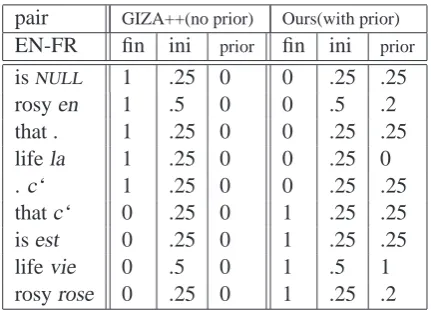
[image:2.595.305.521.69.224.2]isNULL 1 .25 0 0 .25 .25 rosyen 1 .5 0 0 .5 .2 that . 1 .25 0 0 .25 .25 lifela 1 .25 0 0 .25 0 .c‘ 1 .25 0 0 .25 .25 thatc‘ 0 .25 0 1 .25 .25 isest 0 .25 0 1 .25 .25 lifevie 0 .5 0 1 .5 1 rosyrose 0 .25 0 1 .25 .2
Table 1: The benefit of prior knowledge of anchor words.
with three kinds of priors. In Section 5 our exper-imental results are presented, and we conclude in Section 6.
2 Anchor Word Alignment Problem
The input to standard methods of word alignment is simply the sentence-aligned corpus, whereas our alignment method takes in additionally a par-tial alignment. We assume, therefore, the avail-ability of a partial alignment, for example via a MWE extraction tool. Let e˘denote an English sentence, andedenote an English word, through-out this paper. The anchor word alignment prob-lem is defined as follows:
Definition 1 (Anchor Word Alignment Problem) Let(˘e,f˘) ={(˘e1,f1˘), . . . ,(˘en,fn˘)}be a parallel corpus. By prior knowledge we additionally have knowledge of anchor words (ˆe,fˆ) =
{(senti, te1, tf1, pose1, posf1, lengthe, lengthf),
. . ., (sentk, ten, tfn, posen, posfn, lengthe,
lengthf)} where senti denotes sentence ID, posei denotes the position oftei in a sentence e˘i,
and lengthe (and lengthf) denotes the sentence length of the original sentence which includes ei. Under a given (˘e,f˘)and(ˆe,fˆ), our objective is to obtain word alignments. It is noted that an anchor word may include a phrase pair which forms n-to-m mapping objects.
Table 1 shows two example phrase pairs for French to English c’est la vie and that is life, and
la vie en rose and rosy life with the initial value
fi-Statistical MWE extraction method
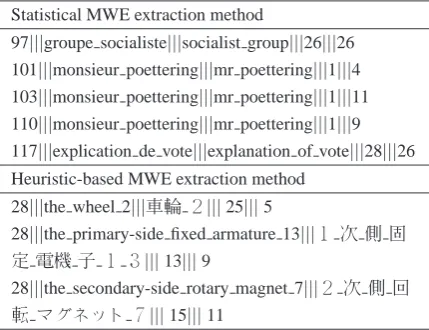
97|||groupe socialiste|||socialist group|||26|||26
101|||monsieur poettering|||mr poettering|||1|||4 103|||monsieur poettering|||mr poettering|||1|||11 110|||monsieur poettering|||mr poettering|||1|||9
117|||explication de vote|||explanation of vote|||28|||26
Heuristic-based MWE extraction method
28|||the wheel 2|||車輪2|||25|||5
28|||the primary-side fixed armature 13|||1 次側固
定 電機子 1 3|||13|||9
28|||the secondary-side rotary magnet 7|||2 次側 回
[image:3.595.76.291.71.236.2]転 マグネット7|||15|||11
Table 2: Example of MWE pairs in Europarl cor-pus (FR-EN) and NTCIR patent corcor-pus (JP-EN). There are 5 columns for each term: sentence num-ber, source term, target term, source position, and target position. The number appended to each term from the patent corpus (lower half) is a ref-erence number. In this corpus, all the important technical terms have been identified and annotated with reference numbers.
nal lexical translation probability for Giza++ IBM Model 4 and that of our modified Giza++. Our modified Giza++ achieves the correct result when anchor words ‘life’ and ‘vie’ are used to assign a value to the prior in our model.
3 Word Alignment
We review two models which address the prob-lem of word alignment. The aim of word align-ment is to obtain the model parameter t among English and French words,ei andfj respectively. We search for this model parameter under some modelMwhereMis chosen by IBM Models 1-5 and the HMM model. We introduce the latent variable a, which is an alignment function with the hypothesis that eacheandfcorrespond to this latent variable.(e, f, a)is a complete data set, and
(e, f)is an incomplete data set.
3.1 EM Algorithm
We follow the description of the EM algorithm for IBM Models of Brown et al. (1993) but introduce the parameter texplicitly. In this model, the pa-rametertrepresents the lexical translation
proba-bilitiest(ei|fj). It is noted that we usee|f rather thanf|efollowing the notation of Koehn (2010). One important remark is that the Viterbi align-ment of the sentence pair(˘e,f˘) = (eJ1, f1I), which is obtained as in (1):
Eviterbi: aˆJ1 = arg max
aJ
1
pθˆ(f, a|e) (1)
provides the best alignment for a given log-likelihood distributionpθˆ(f, a|e). Instead of sum-ming, this step simplifies the E-step. However, un-der our modification of maximum likelihood esti-mate with MAP estiesti-mate, this simplification is not a correct approximation of the summation since our surface in the E-step is greatly perturbed by the prior. There is no guarantee that the Viterbi alignment is within the proximity of the target alignment (cf. Table 1).
Letzbe the latent variable,tbe the parameters, and x be the observations. The EM algorithm is an iterative procedure repeating the E-step and the M-step as in (2):
EEXH : q(z;x) =p(z|x;θ) (2)
MMLE : t′ = arg max
t Q(t, t old)
= arg max
t
X
x,z
q(z|x) logp(x, z;t)
In the E-step, our knowledge of the values of the latent variables in a is given only by the poste-rior distributionp(a|e, f, t). Hence, the (negative log)-likelihood of complete data (e, f, a), which we denote by −logp(t|e, f, a), is obtained over all possible alignmentsa. We use the current pa-rameter values told to find the posterior distribu-tion of the latent variables given byp(a|e, f, told). We then use this posterior distribution to find the expectation of the complete data log-likelihood evaluated for parameter valuet. This expectation is given byPap(a|e, f, told) logp(e, f, a|t).
E-step, as in (3):
MMLE: t′ = arg max
t Q(t, t
old) (3)
= Pc(f|e;f, e)
ec(f|e;f, e)
where an auxiliary function c(e|f;e, f) for IBM Model 1 introduced by Brown et al. is defined as
c(f|e;f, e) =X
a
p(a|e, f)
m
X
j=1
δ(f, fj)δ(e, eaj)
and where the Kronecker-Delta functionδ(x, y)is 1 ifx =y and 0 otherwise. This auxiliary func-tion is convenient since the normalizafunc-tion factor of this count is also required. We note that if we use the MAP estimate, the E-step remains the same as in the maximum likelihood case, whereas in the M-step the quantity to be minimized is given by Q(t, told) + logp(t). Hence, we search for the value of t which maximizes the following equa-tion:
MMAP: t′= arg max
t Q(t, t
old) + logp(t)
3.2 HMM
A first-order Hidden Markov Model (Vogel et al., 1996) uses the sentence length probabilityp(J|I), the mixture alignment probability p(i|j, I), and the translation probability, as in (4):
p(f|e) =p(J|I)
J
Y
j=1
p(fj|ei) (4)
Suppose we have a training set ofR observation sequencesXr, wherer= 1,· · ·, R, each of which is labelled according to its class m, where m =
1,· · ·, M, as in (5):
p(i|j, I) = r(i−j
I J)
PI
i′=1r(i′−jJI)
(5)
The HMM alignment probabilitiesp(i|i′, I) de-pend only on the jump width(i−i′). Using a set of non-negative parameterss(i−i′), we have (6):
p(i|i′, I) = PIs(i−i′)
l=1s(l−i′)
(6)
4 Our Approach
Algorithm 1 Overall Algorithm Given: a parallel corpus,
1. Extract MWEs by Algorithm 2.
2. Based on the results of Step 1, specify a set of anchor word alignment links in the format of anchor word alignment problem (cf. Definition 1 and Table 2).
3. Group MWEs in source and target text. 4. Calculate the prior in order to embed knowl-edge about anchor words.
5. Calculate lexical translation probabilities with the prior.
6. Obtain alignment probabilities.
7. Ungroup of MWEs in source and target text.
Algorithm 1 consists of seven steps. We use the Model I prior for the case where our prior knowl-edge is sparse and evenly distributed throughout the corpus, whereas we use the Model II prior when our prior knowledge is dense in a partial corpus. A typical example of the former case is when we use partial alignment annotation ex-tracted throughout a corpus for bilingual terminol-ogy. A typical example of the latter case is when a sample of only a few hundred lines from the cor-pus have been hand-annotated.
4.1 MWE Extraction
Our algorithm of extracting MWEs is a statisti-cal method which is a bidirectional version of Ku-piec (1993). Firstly, KuKu-piec presents a method to extract bilingual MWE pairs in a unidirectional manner based on the knowledge about typical POS patterns of noun phrases, which is language-dependent but can be written down with some ease by a linguistic expert. For example in French they are N N, N prep N, and N Adj. Secondly, we take the intersection (or union) of extracted bilingual MWE pairs.2
2In word alignment, bidirectional word alignment by
Algorithm 2 MWE Extraction Algorithm
Given: a parallel corpus and a set of anchor word alignment links:
1. We use a POS tagger (Part-Of-Speech Tag-ger) to tag a sentence on the SL side.
2. Based on the typical POS patterns for the SL, extract noun phrases on the SL side.
3. Count n-gram statistics (typically n =
1,· · ·,5are used) on the TL side which jointly
occur with each source noun phrase extracted in Step 2.
4. Obtain the maximum likelihood counts of joint phrases, i.e. noun phrases on the SL side andn-gram phrases on the TL side.
5. Repeat the same procedure from Step 1 to 4 reversing the SL and TL.
6. Intersect (or union) the results in both direc-tions.
Let SL be the source language side and TL be the target language side. The procedure is shown in Algorithm 2. We informally evaluated the MWE extraction tool following Kupiec (1993) by manually inspecting the mapping of the 100 most frequent terms. For example, we found that 93 of the 100 most frequent English terms in the patent corpus were correctly mapped to their Japanese translation.
Depending on the corpus, we can use more prior knowledge about implicit alignment links. For example in some categories of patent and technical documents corpora,3we can use heuris-tics to extract the “noun phrase” + “reference number” from both sides. This is due to the fact that terminology is often labelled with a unique reference number, which is labelled on both the SL and TL sides.
4.2 Prior Model I
Prior for Exhaustive Alignment Space IBM Models 1 and 2 implement a prior for all possible
3
Unlike other language pairs, the availability of Japanese–English parallel corpora is quite limited: the NT-CIR patent corpus (Fujii et al., 2010) of 3 million sentence pairs (the latest NTCIR-8 version) for the patent domain and JENAAD corpus (Utiyama and Isahara, 2003) of 150k sen-tence pairs for the news domain. In this regard, the patent domain is particularly important for this particular language pair.
Algorithm 3 Prior Model I for IBM Model 1
Given: parallel corpus˘e,f˘, anchor wordsbiT erm initialize t(e|f) uniformly do until convergence
set count(e|f) to 0 for all e,f set total(f) to 0 for all f for all sentence pairs (es˘ ,fs˘)
prior(e|f)s= getPriorModelI(˘e,f , biT erm˘ )
for all words e in˘es totals(e) = 0 for all words f inf˘s
totals(e) += t(e|f) for all words e in˘es
for all words f inf˘s
count(e|f)+=t(e|f)/totals(e)×prior(e|f)s
total(f) +=t(e|f)/totals(e)×prior(e|f)s
for all f for all e
t(e|f) =count(e|f)/total(f)
alignments exhaustively. Such a prior requires the following two conditions. Firstly, partial knowl-edge about the prior that we use in our context is defined as follows. Let us denote a bilingual term list T = {(s1, t1), . . . ,(sm, tm)}. For example with IBM Model 1: Let us define the following priorp(e|f, e, f;T)from Equation (4):
p(e|f, e, f;T) =
1 (ei=si, fj=tj) 0 (ei=si, fj6=tj) 0 (ei6=si, fj=tj) uniform (ei6=si, fj6=tj)
Secondly, this prior should be proper for the ex-haustive case and non-proper for the sampled alignment space where by proper we mean that the probability is normalized to 1. Algorithm 3 shows the pseudo-code for Prior Model I. Note that if the prior is uniform in the MAP estimation, this is equivalent to maximum likelihood estimation.
Prior for Sampled Alignment (Function) Space Due to the exponential costs introduced by fertil-ity, null token insertion, and distortion probabilfertil-ity, IBM Models 3 and 4 do not consider all(I + 1)J
is not uniform, as it only includes the best possi-ble alignment with all its neighbouring alignments which differ from the best alignment by one word (this can be corrected by a move operation) or two words (this can be corrected by a swap operation). If we consider the neighbouring alignment via a move or a swap operation, two issues arise. Firstly, the fact that these two neighbouring align-ments are drawn from different underlying distri-butions needs to be taken into account, and sec-ondly, that the application of a move and a swap operation alters a row or column of a prior ma-trix (or indices of the prior) since either operation involves the manipulation of links.
Algorithm 4 Pseudo-code for Prior Model II Ex-haustive Alignment Space
def getPriorModelII(˘e,f˘,biTerm): for i in sentence:
for e ine˘i:
allWordsi= length of sentence˘e for f inf˘i:
if (e, f) in biTerm:
n=num of anchor words ini
uni(e|f)i = allWordsiallWordsi−n
expSum(e|f)+=uni(e|f)i×n
else:
countSum(e|f)i+= n
countSum(e|f)+= count(e|f)i for e inalle:
for f inallf:
prior(e|f)= expSum(e|f)+ countSum(e|f)
returnprior(e|f)
Prior for Jump Widthi′ One implementation of HMM is to use the forward-backward algo-rithm. A prior should be embedded within the forward-backward algorithm. From Equation (6), there are three cases which depend on whether ai and its neighbouring alignmentai−1 are deter-mined by our prior knowledge about anchor words or not. When bothai andaj are determined, this probability is expressed as in (7):
p(i−i′;I) =
0 (else) (7)
1 (ei =si, fj =tjforai)and
(e′
i =s′i, fj′ =t′jforaj)
When eitheraioraj is determined, this probabil-ity is expressed as in (8):4
p(i−i′;I) =
0 (condition 1) (8) 1 (condition 2)
1
(m−#eai−···−#eai+m) (else)
(uniform distribution)
When neitherai noraj is determined, this proba-bility is expressed as in (9): 5
p(i−i′;I) =
0 (condition 3) (9) 1 (condition 4)
m−i′
(m−#eai−···−#eai+m)2 (else)
(Pascal’s triangle distribution)
4.3 Prior Model II
Prior Model II assumes that we have prior knowl-edge only in some part of the training corpus. A typical example is when a small part of the corpus has a hand-crafted ‘gold standard’ annotation.
Prior for Exhaustive Alignment Space Prior Model II is used to obtain the prior probability p(e|f)over all possible combinations ofeand f. In contrast to Prior Model I, which computes the prior probability p(e|f) for each sentence, Prior Model II computes the prior probability globally for all sentences in the corpus. Algorithm 4 shows the pseudo-code for Prior Model II Exhaustive Alignment Space.
4
condition 1 is as follows:
((ei6=si, fj=6 tjforai)and(e′i=s′i, fj′=t′jforaj))or ((ei6=si, fj=6 tjforai)and(e′i=s′i, fj′=t′jforaj))or ((ei=si, fj=tjforai)and(e′i6=s′i, fj′=6 t′jforaj))or ((ei=si, fj=tjforai)and(ei′ 6=s′i, fj′6=t′jforaj))
‘condition 2’ is as follows:
((ei=si, fj=6 tjforai)and(e′i=s′i, fj′=t′jforaj))or ((ei6=si, fj=tjforai)and(e′i=s′i, fj′=t′jforaj))or ((ei=si, fj=tjforai)and(ei′ 6=s′i, fj′=t′jforaj))or ((ei=si, fj=tjforai)and(ei′ =s′i, fj′6=t′jforaj))
5
‘condition 3’ is as follows:
((ei6=si, fj=6 tjforai)and(e′i6=s′i, fj′6=t′jforaj))
‘condition 4’ is as follows:
Prior for Sampled Alignment (Function) Space This is identical to that of the Prior Model II ex-haustive alignment space with only a difference in the normalization process.
Prior for Jump Widthi′ This categorization of Prior Model II is the same as that of Prior Model I for for Jump Widthi′(see Section 4.2). Note that Prior Model II requires more memory compared to the Prior Model I.6
5 Experimental Settings
The baseline in our experiments is a standard log-linear phrase-based MT system based on Moses. The GIZA++ implementation (Och and Ney, 2003a) of IBM Model 4 is used as the base-line for word alignment, which we compare to our modified GIZA++. Model 4 is incrementally trained by performing 5 iterations of Model 1, 5 iterations of HMM, 5 iterations of Model 3, and 5 iterations of Model 4. For phrase extraction the grow-diag-final heuristics are used to derive the refined alignment from bidirectional alignments. We then perform MERT while a 5-gram language model is trained with SRILM. Our implementa-tion is based on a modified version of GIZA++ (Och and Ney, 2003a). This modification is on the function that reads a bilingual terminology file, the function that calculates priors, the M-step in IBM Models 1-5, and the forward-backward algo-rithm in the HMM Model. Other related software tools are written in Python and Perl: terminol-ogy concatenation, terminolterminol-ogy numbering, and so forth.
6 Experimental Results
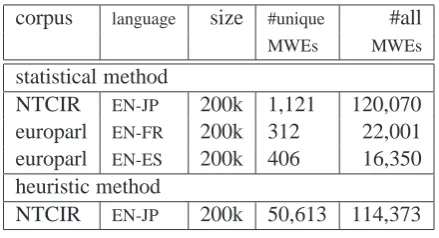
We conduct an experimental evaluation on the NTCIR-8 corpus (Fujii et al., 2010) and on Eu-roparl (Koehn, 2005). Firstly, MWEs are ex-tracted from both corpora, as shown in Table 3. In the second step, we apply our modified version of GIZA++ in which we incorporate the results of
6
This is because it needs to maintain potentially anℓ×m matrix, whereℓdenotes the number of English tokens in the corpus andmdenotes the number of foreign tokens, even if the matrix is sparse. Prior Model I only requires anℓˆ×mˆ matrix whereˆℓis the number of English tokens in a sentence andmˆ is the number of foreign tokens in a sentence, which is only needed until this information is incorporated in a pos-terior probability during the iterative process.
corpus language size #unique #all
MWEs MWEs
statistical method
NTCIR EN-JP 200k 1,121 120,070 europarl EN-FR 200k 312 22,001 europarl EN-ES 200k 406 16,350 heuristic method
[image:7.595.306.526.68.187.2]NTCIR EN-JP 200k 50,613 114,373
Table 3: Statistics of our MWE extraction method. The numbers of MWEs are from 0.08 to 0.6 MWE / sentence pair in our statistical MWE extraction methods.
MWE extraction. Secondly, in order to incorpo-rate the extracted MWEs, they are reformatted as shown in Table 2. Thirdly, we convert all MWEs into a single token, i.e. we concatenate them with an underscore character. We then run the modi-fied version of GIZA++ and obtain a phrase and reordering table. In the fourth step, we split the concatenated MWEs embedded in the third step. Finally, in the fifth step, we run MERT, and pro-ceed with decoding before automatically evaluat-ing the translations.
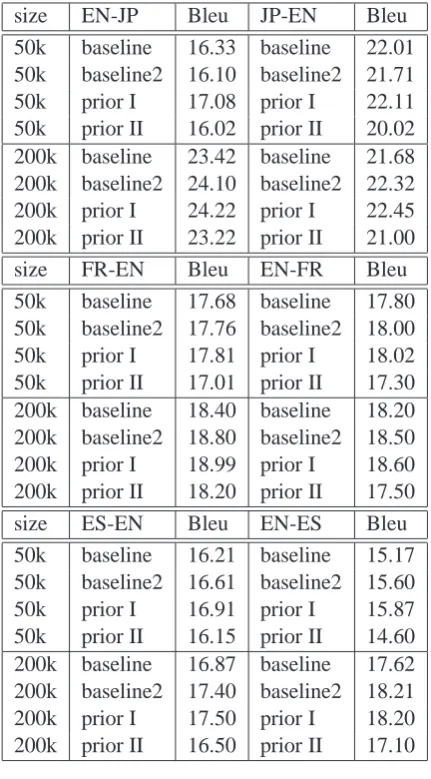
Table 4 shows the results where ‘baseline’ in-dicates no BMWE grouping nor prior, and ‘base-line2’ represents a BMWE grouping but without the prior. Although ‘baseline2’ (BMWE group-ing) shows a drop in performance in the JP–EN / EN–JP 50k sentence pair setting, Prior Model I results in an increase in performance in the same setting. Except for EN–ES 200k, our Prior Model I was better than ‘baseline2’. For EN–JP NT-CIR using 200k sentence pairs, we obtained an absolute improvement of 0.77 Bleu points com-pared to the ‘baseline’; for EN–JP using 50k sen-tence pairs, 0.75 Bleu points; and for ES–EN Eu-roparl corpus using 200k sentence pairs, 0.63 Bleu points. In contrast, Prior Model II did not work well. The possible reason for this is the misspec-ification, i.e. the modelling by IBM Model 4 was wrong in terms of the given data. One piece of ev-idence for this is that most of the enforced align-ments were found correct in a manual inspection.
ex-size EN-JP Bleu JP-EN Bleu 50k baseline 16.33 baseline 22.01 50k baseline2 16.10 baseline2 21.71 50k prior I 17.08 prior I 22.11 50k prior II 16.02 prior II 20.02 200k baseline 23.42 baseline 21.68 200k baseline2 24.10 baseline2 22.32 200k prior I 24.22 prior I 22.45 200k prior II 23.22 prior II 21.00 size FR-EN Bleu EN-FR Bleu 50k baseline 17.68 baseline 17.80 50k baseline2 17.76 baseline2 18.00 50k prior I 17.81 prior I 18.02 50k prior II 17.01 prior II 17.30 200k baseline 18.40 baseline 18.20 200k baseline2 18.80 baseline2 18.50 200k prior I 18.99 prior I 18.60 200k prior II 18.20 prior II 17.50 size ES-EN Bleu EN-ES Bleu 50k baseline 16.21 baseline 15.17 50k baseline2 16.61 baseline2 15.60 50k prior I 16.91 prior I 15.87 50k prior II 16.15 prior II 14.60 200k baseline 16.87 baseline 17.62 200k baseline2 17.40 baseline2 18.21 200k prior I 17.50 prior I 18.20 200k prior II 16.50 prior II 17.10
Table 4: Results. Baseline is plain GIZA++ / Moses (without BMWE grouping / prior), base-line2 is with BMWE grouping, prior I / II are with BMWE grouping and prior.
tracted by the statistical method and the heuris-tic method varies significantly, the total number of MWEs by each method becomes comparable. The resulting Bleu score for the heuristic method (24.24 / 22.48 Blue points for 200k EN–JP / JP– EN) is slightly better than that of the statistical method. The possible reason for this is related to the way the heuristic method groups terms in-cluding reference numbers, while the statistical method does not. As a result, the complexity of the alignment model simplifies slightly in the case of the heuristic method.
7 Conclusion
This paper presents a new method of incorporat-ing BMWEs into word alignment. We first de-tect BMWEs in a bidirectional way and then use this information to do groupings and to enforce already known alignment links. For the latter pro-cess, we replace the maximum likelihood estimate in the M-step of the EM algorithm with the MAP estimate; this replacement allows the incorpora-tion of the prior in the M-step of the EM algo-rithm. We include an experimental investigation into incorporating extracted BMWEs into a word aligner. Although there is some work which incor-porates BMWEs in groupings, they do not enforce alignment links.
There are several ways in which this work can be extended. Firstly, although we assume that our a priori partial annotation is reliable, if we extract such MWEs automatically, we cannot avoid erro-neous pairs. Secondly, we assume that the rea-son why our Prior Model II did not work was due to the misspecification (or wrong modelling). We would like to check this by discriminative mod-elling. Thirdly, although here we extract BMWEs, we can extend this to extract paraphrases and non-literal expressions.
8 Acknowledgments
This research is supported by the Science Foun-dation Ireland (Grant 07/CE/I1142) as part of the Centre for Next Generation Localisation (http://www.cngl.ie) at Dublin City Uni-versity and Trinity College Dublin. We would also like to thank the Irish Centre for High-End Com-puting.
References
Bishop, Christopher M. 2006. Pattern Recognition and Machine Learning. Springer. Cambridge, UK
Brown, Peter F., Vincent .J.D Pietra, Stephen A.D.Pietra, Robert L. Mercer. 1993. The Mathe-matics of Statistical Machine Translation: Param-eter Estimation. Computational Linguistics. 19(2), pp. 263–311.
Word- and Sentence-Aligned Parallel Corpora. Pro-ceedings of the 42nd Annual Meeting of the As-sociation for Computational Linguistics (ACL’04), Main Volume. Barcelona, Spain, pp. 175–182.
Fujii, Atsushi, Masao Utiyama, Mikio Yamamoto, Takehito Utsuro, Terumasa Ehara, Hiroshi Echizen-ya, Sayori Shimohata. 2010. Overview of the Patent Translation Task at the NTCIR-8 Workshop. Proceedings of the 8th NTCIR Workshop Meet-ing on Evaluation of Information Access Technolo-gies: Information Retrieval, Question Answering and Cross-lingual Information Access, pp. 293–302.
Graca, Joao de Almeida Varelas, Kuzman Ganchev, Ben Taskar. 2007. Expectation Maximization and Posterior Constraints. In Neural Information Processing Systems Conference (NIPS), Vancouver, BC, Canada, pp. 569–576.
Gale, William, and Ken Church. 1991. A Program for Aligning Sentences in Bilingual Corpora. In Pro-ceedings of the 29th Annual Meeting of the Associ-ation for ComputAssoci-ational Linguistics. Berkeley CA, pp. 177–184.
Koehn, Philipp, Franz Och, Daniel Marcu. 2003. Sta-tistical Phrase-Based Translation. In Proceedings of the 2003 Human Language Technology Confer-ence of the North American Chapter of the Asso-ciation for Computational Linguistics. Edmonton, Canada. pp. 115–124.
Koehn, Philipp. 2005. Europarl: A Parallel Corpus for Statistical Machine Translation. In Conference Proceedings: the tenth Machine Translation Sum-mit. Phuket, Thailand, pp.79-86.
Koehn, Philipp, H. Hoang, A. Birch, C. Callison-Burch, M. Federico, N. Bertoldi, B. Cowan, W. Shen, C. Moran, R. Zens, C. Dyer, O. Bojar, A. Constantin, and E. Herbst, 2007. Moses: Open source toolkit for Statistical Machine Translation. Proceedings of the 45th Annual Meeting of the As-sociation for Computational Linguistics Companion Volume Proceedings of the Demo and Poster Ses-sions, Prague, Czech Republic, pp. 177–180.
Koehn, Philipp. 2010. Statistical Machine Transla-tion. Cambridge University Press. Cambridge, UK.
Kupiec, Julian. 1993. An Algorithm for finding Noun Phrase Correspondences in Bilingual Corpora. In Proceedings of the 31st Annual Meeting of Associa-tion for ComputaAssocia-tional Linguistics. Columbus. OH. pp. 17–22.
Lambert, Patrik and Rafael Banchs. 2006. Group-ing Multi-word Expressions AccordGroup-ing to Part-Of-Speech in Statistical Machine Translation. In Pro-ceedings of the EACL Workshop on
Multi-Word-Expressions in a Multilingual Context. Trento, Italy, pp. 9–16.
McLachlan, Geoffrey J. and Thriyambakam Krishnan, 1997. The EM Algorithm and Extensions. Wiley Series in probability and statistics. New York, NY.
Moore, Robert C.. 2003. Learning Translations of Named-Entity Phrases from Parallel Corpora. In Proceedings of the 11th Conference of the European Chapter of the Association for Computational Lin-guistics. Budapest, Hungary. pp. 259–266.
Moore, Robert C.. 2004. On Log-Likelihood-Ratios and the Significance of Rare Events. In Proceedings of the 2004 Conference on Empirical Methods in Natural Language Processing (EMNLP). Barcelona, Spain, pp. 333–340.
Och, Franz and Herman Ney. 2003. A Systematic Comparison of Various Statistical Alignment Mod-els. Computational Linguistics. 29(1), pp. 19–51.
Resnik, Philip and I. Dan Melamed, 1997. Semi-Automatic Acquisition of Domain-Specific Transla-tion Lexicons. Proceedings of the 5th Applied Nat-ural Language Processing Conference. Washington, DC., pp. 340–347.
Talbot, David. 2005. Constrained EM for parallel text alignment, Natural Language Engineering, 11(3): pp. 263–277.
Utiyama, Masao and Hitoshi Isahara. 2003. Reliable Measures for Aligning Japanese-English News Arti-cles and Sentences, In Proceedings of the 41st An-nual Meeting of the Association for Computational Linguistics. Sapporo, Japan, pp. 72–79.