University of Bradford eThesis
This thesis is hosted in
Bradford Scholars
– The University of Bradford Open Access
repository. Visit the repository for full metadata or to contact the repository team
© University of Bradford. This work is licenced for reuse under a
Creative Commons
Licence
.
A Framework for Semantic Web Implementation based on
Context-Oriented Controlled Automatic Annotation
Muna Salman HATEM
submitted for the degree of Doctor of Philosophy
Department of Computer Science University of Bradford
Abstract
The Semantic Web is the vision of the future Web. Its aim is to enable machines to
process Web documents in a way that makes it possible for the computer software to
"understand" the meaning of the document contents. Each document on the Semantic
Web is to be enriched with meta-data that express the semantics of its contents. Many
infrastructures, technologies and standards have been developed and have proven their
theoretical use for the Semantic Web, yet very few applications have been created. Most
of the current Semantic Web applications were developed for research purposes.
This project investigates the major factors restricting the wide spread of Semantic
Web applications. We identify the two most important requirements for a successful
implementation as the automatic production of the semantically annotated document, and the creation and maintenance of semantic based knowledge base.
This research proposes a framework for Semantic Web implementation based on
context-oriented controlled automatic Annotation; for short, we called the framework
the Semantic Web Implementation Framework (SWIF) and the system that implements this framework the Semantic Web Implementation System (SWIS). The proposed architecture provides for a Semantic Web implementation of stand-alone websites that
automatically annotates Web pages before being uploaded to the Intranet or Internet,
and maintains persistent storage of Resource Description Framework (RDF) data for
both the domain memory, denoted by Control Knowledge, and the meta-data of the
Web site‟s pages. We believe that the presented implementation of the major parts of
SWIS introduce a competitive system with current state of art Annotation tools and
context in which they are created in addition to the automatic learning and verification
of knowledge using only the available computerized corporate databases.
In this work, we introduce the concept of Control Knowledge (CK) that represents the application‟s domain memory and use it to verify the extracted knowledge. Learning is based on the number of occurrences of the same piece of information in different documents. We introduce the concept of Verifiability in the context of Annotation by comparing the extracted text‟s meaning with the information in the CK
and the use of the proposed database table Verifiability_Tab.
We use the linguistic concept Thematic Role in investigating and identifying the correct meaning of words in text documents, this helps correct relation extraction. The
verb lexicon used contains the argument structure of each verb together with the
thematic structure of the arguments.
We also introduce a new method to chunk conjoined statements and identify the
missing subject of the produced clauses. We use the semantic class of verbs that relates a list of verbs to a single property in the ontology, which helps in disambiguating the
verb in the input text to enable better information extraction and Annotation.
Consequently we propose the following definition for the annotated document or
what is sometimes called the “Intelligent Document”
“The Intelligent Document is the document that clearly expresses its syntax and semantics for human use and software automation”.
This work introduces a promising improvement to the quality of the automatically
generated annotated document and the quality of the automatically extracted
technology opens new opportunities for diverse areas of applications. E-Learning
Acknowledgement
I am grateful to many people who helped me with their comments during the past four
years. I would like to especially thank my supervisor Daniel Neagu and my external
supervisor Haider Ramadan for their valuable guidance, support and encouragement.
I would also like to thank Alaa Al-Mussali, Ahmed Al-Rawi, Adel Abu-Radwan and
James Moody for their advice and comments on the linguistic concepts used in this
thesis.
Many thanks to Sultan Qaboos University for providing the external supervisor. Thanks
to my colleagues at the Department of Computer Science. Special thanks to Professor
Khaled Day, Dr. Swamy Kutti, and Professor Ali Yousif, the Dean of the College of
Science for their continuous support and encouragement.
Above all, I am grateful to God for blessing me with good health to complete this
Publications
Journal Papers
1.Hatem, M., Neagu, D., Ramadan, H.(2006) "Towards personalization and a Unique Uniform Resource Identifier for Semantic Web Users with in an Academic Environment", The Journal of Instructional Technology and Distance learning, Vol. 3. No. 6. ISSN 1550-6908 ed. by Donald G. Perrin, June 2006, USA.
2.Al-Khanjari, Z.A., Kutti, N.S., Hatem, M. (2006) “An Extended E-Learning Architecture: Integrating Software Tools Within The E-Learning Portal”, The International Arab Journal for Information Technology (IAJIT), 3(1):75-81, ISSN: 1683-3198, ed by Abuelrub, E., Alhadithi, J., Zarqa Private University, January, 2006,Amman, Jordan.
3.Hatem, M., Ramadan, H., Neagu, D. (2005) “e-Learning based on Context Oriented Semantic Web”, Journal of Computer Science, 1(4): 499-503, ISSN 1549-3636, Science Publications, 2005, New York, USA.
4.Ramadan, H., Hatem, M., Al-Khanjri, Z., Kutti, S.(2005) “A Classification of Techniques for Web Usage Analysis”, Journal of Computer Science, ISSN: 1549-3636, 1(3): 413-418, Science Publications, 2005, New York, USA
Conference Papers
5.Hatem, M., Neagu, D., Ramadan, H. (2008) “RDF Repository of Experts based on Context Oriented Automatic Annotation Framework”, Second Asia International Conference on Modelling & Simulation AMS2008. Kuala Lumpur, Malaysia 13 – 15 May 2008. Proceeding (ed. David Al-Dabass) IEEE Computer Society: ISBN: 978-0-7695-3136-6, pp. 29-34 6.Hatem, M., Neagu, D., Ramadan, H.,(2006) "Towards personalization and a Unique Uniform
Resource Identifier for Semantic Web Users", 9th International Conference on Interactive Computer aided Learning ICL2006, Villach, Austria, September 2006. Proceedings (ed. Michale E. Aure) KasseI university press: ISBN 3-89958-195-4
7.Hatem, M., Ramadan, H., Neagu, D. (2005)“ e-Learning based on Context Oriented Semantic Web”, The first International Conference on E-Business and E-Learning EBL05 , Princess Sumaya University for Technology, May 23-24 2005 Amman, Jordan. Proceedings (ed. by Chapelet. P, Awajan, A.) Princess Sumaya University for Technology: ISBN 9957-8585-0-0, pp 51-56
8.Ramadan, H., Hatem, M. (2005), “A Classification of Techniques for Web Usage Analysis”,
The first International Conference on E-Business and E-Learning, Princess Sumaya University for Technology, May 23-24, 2005 Amman, Jordan. Proceedings (ed. by Chapelet. P, Awajan, A.) Princess Sumaya University for Technology: ISBN 9957-8585-0-0, pp 210-215
9.Hatem, M., Daniel Neagu, Ramadan, H. (2005) “Context Oriented RDF Repository for Semantic Web: Application to Sultan Qaboos University Web Services”, The 6th Informatics Workshop for Research Students, University of Bradford, UK, March 2005. Proceedings (ed. by Rigas,D.) University of Bradford: ISBN 1851432205, pp 67-70
Contents
1. The Semantic Web ... 1
1.1 Introduction ... 1
1.2 What is Expected from the Semantic Web ... 3
1.3 Problems in Preparing Web Pages for the Semantic Web ... 5
1.4 Motivation and Context ... 7
1.5 Conclusions ... 9
1.6 Organization ... 10
2. Background and Related Work ... 11
2.1 Overview ... 11
2.2 Knowledge Based Management System... 11
2.3 Information Extraction ... 14
2.3.1 Types of Information Extraction ... 16
2.3.1.1 Named Entity Recognition (NE) ... 16
2.3.1.2 Coreference Resolution (CO) ... 16
2.3.1.3 Template Element construction (TE) ... 16
2.3.1.4 Template Relation construction (TR) ... 17
2.3.1.5 Scenario Template production (ST) ... 17
2.3.2 Approaches to Information Extraction ... 17
2.3.2.1 Knowledge Engineering Approach: ... 17
2.3.2.2 Automatic Training Approach ... 18
2.3.3 Evaluation of Information Extraction Systems ... 19
2.3.3.1 Standard Evaluation Measures ... 19
2.3.3.2 Evaluation Exercises ... 20
2.3.3.2.1 MUC (Message Understanding Conferences) ...21
2.3.3.2.2 ACE (Automatic Content Extraction) ...21
2.3.3.2.3 Pascal Challenge ...21
2.4 Human Language Semantic Analysis ... 22
2.4.1 Approaches to Semantic Analysis ... 23
2.4.2 Thematic Role ... 23
2.5 Knowledge Representation Languages ... 27
2.6 Ontology ... 29
2.6.1 Ontology Preparation Tools ... 31
2.7 Annotation ... 32
2.7.1 Annotation Tools ... 33
2.7.1.3 Automatic Annotation Tools... 39
2.7.1.4 Annotation and Authoring Environments ... 42
2.7.2 Measures for Evaluation of Annotation Systems ... 44
2.7.3 The Specification of Annotation Tools ... 45
2.8 Human Language Technologies and Concepts ... 46
2.8.1 Overview of GATE ... 46
2.8.2 Case Study: Information Extraction using GATE ... 48
2.8.2.1 Named Entity Recognition in GATE ... 48
2.8.2.2 Coreference Resolution in GATE ... 50
2.8.2.3 Outcome of the exercise ... 52
2.9 Semantic Web Implementation Technologies... 53
2.9.1 RDF Schema-based Repository and querying facility ... 53
2.9.2 Jena ... 54
2.10 Agents ... 56
2.11 Web Services ... 58
2.12 Conclusions ... 58
3. Framework for Semantic Web Implementation ... 61
3.1 Overview ... 61
3.2 Key Issues of the Semantic-Based Implementation ... 61
3.3 The Architecture of the Semantic Web Implementation Framework (SWIF) ... 63
3.3.1 Construction of the Initial Control Knowledge... 65
3.3.2 Pre-processing using Human Language Technology (HLT) ... 66
3.3.2.1 Unicode Tokeniser ... 66
3.3.2.2 Gazetteer lists: ... 67
3.3.2.3 Sentence Splitter ... 67
3.3.2.4 Part of Speech Tagger ... 68
3.3.2.5 Semantic Tagger ( ANNIE Transducer) ... 68
3.3.2.6 Orthographic Coreference... 69
3.3.2.7 Pronominal Coreference (Coreferencer) ... 70
3.3.2.8 The Stemmer (SnowballStemmer) ... 70
3.3.2.9 Noun Phrase Chunker (NP_Chunking) ... 71
3.3.2.10 Verb Group Chunking ... 71
3.3.3 Information Extraction and Semantic Processing ... 71
3.3.3.1 Manipulation of Individual Sentences ... 72
3.3.3.1.1 The Clause Segmenter ...72
3.3.3.1.2 The Syntactic Role Identifier ...74
3.3.3.2 Semantic Analyser ... 76
3.3.3.3 Knowledge Base Management... 78
3.3.4 Global and Local User Interface ... 78
3.4 Case Study: Development of Semantic Web Application for Academic Institution ... 79
3.4.1 Introduction ... 79
3.4.2 Sultan Qaboos University Web-based Applications ... 80
3.4.3 Our Approach to SQU Semantic Web based Implementation ... 81
3.4.4 General Implementation Plan ... 83
3.4.5 Maintenance of User Profile ... 84
3.4.6 Annotation of Arabic Documents ... 86
3.5 Conclusions ... 86
4. Semantic Web Implementation System (SWIS) ... 88
4.1 Overview ... 88
4.2 Ontology Preparation ... 89
4.2.1 Editing the Ontology File ... 89
4.2.2 Validation of Ontology File ... 89
4.3 Creating Control Knowledge ... 90
4.3.1 Selection of Implementation Framework and Persistence Storage ... 91
4.3.2 Creation of Control Knowledge as Jena Model ... 92
4.4 Pre-processing with GATE components ... 93
4.5 Creation of Knowledge Based Models and Database ... 96
4.6 Knowledge Base Management and Annotation ... 98
4.7 The Algorithm used by the Semantic Analyser ... 99
4.8 Querying the SQU’s Semantic Based Implementation ... 101
4.8.1 Querying the RDF repository... 101
4.8.2 Querying the Annotated Pages ... 101
4.9 Case Study: Walk through example ... 102
4.10 Evaluation and Conclusions ... 109
5. Conclusions and Future work ... 111
5.1.1 Introduction ... 111
5.1.2 Conclusions ... 111
Appendices ... 125
Appendix A: A Summary of the Annotation Tools Investigated in this Work 125 Appendix B: The Contents of the SWIS CD ... 126
Appendix C: Class and Property Hierarchy- Output of dumpont.java ... 129
Appendix D: Sample RDF File of Extracted Information from SQU Data Base ... 132
Appendix E: Sample Document and its Annotated Version ... 135
E1: Sample Source Document ... 135
E2: The Intelligent Version of the Document ... 135
Appendix F: Arabic Document and its Annotated Version ... 138
F1: Processing Sample Document in Arabic using OntoMat ... 138
F2: Screen Image of the Generated Annotation ... 139
F3: The Annotated Version of the document using OntoMat ... 140
Appendix G : The Contents of the Control Knowledge ... 143
G1: The contents of SquCK displayed as RDF XML output ... 143
G2: The contents of SquCK displayed as RDF Triples ( Subject, Predicate, Object) ... 146
Appendix H : The Contents of the SquRDF ... 147
H1: The contents of SquRDF displayed as RDF XML output ... 147
H2: The contents of SquRDF displayed as RDF Triples ... 149
Appendix I : Communication with The GATE Support Team ... 150
I1: The Message Sent to GATE Support Team ... 150
I2: The Message received from GATE Support Team ... 151
Appendix J: Sample of the new JAPE Rules and Gazetteer lists ... 152
J1:Sample JAPE rule: DegreeFinder.jape ... 152
J2:2Sample Gazetteer list: Degree.lst ... 152
Appendix K: Sample XML document produced by GateProcesses ... 153
K1: Sample Source Document... 153
K2: Annotated Version of the Document in XML form ... 153
Appendix L: Sample output of the Semantic Analyser-part 1 when processing the text document in Appendix E1 ... 162
List of Figures
Figure 1: Mangrove Graphical Tagger ... 34
Figure 2: HTML Version of the Document Annotated by Mangrove Graphical Tagger ... 35
Figure 3: SMORE GUI ... 36
Figure 4: OntoMat GUI window ... 37
Figure 5: OntoMat Annotation Viewer ... 38
Figure 6: The Armadillo Architecture ... 41
Figure 7: Amaya Annotation Icon and Meta-data ... 43
Figure 8: Sample Document and GATE GUI ... 49
Figure 9: Named Entity Recognition ... 49
Figure 10: Annotation Sets Produced by Name Entity Recognition ... 50
Figure 11: Coreference Anaphoric Resolution ... 51
Figure 12: Orthographic Coreference Resolution ... 52
Figure 13: The levels of the Semantic Web ... 57
Figure 14: Sample Annotation and KB contents ... 59
Figure 15: The Architecture of SWIF ... 65
Figure 16: functional category components and meaning interpretation ... 73
Figure 17: The Conceptual Architecture of SQU Semantic Web based System ... 82
Figure 18: Sample form used for manual update of user profile ... 85
Figure 19: Creation of Control Knowledge... 90
Figure 20: The Control Knowledge as Represented in the Oracle Jena Model ... 92
Figure 21: Pre-processing Using GATE Components ... 93
Figure 22: Sample Document processing Using GATE' Components ... 95
Figure 23: The Ontology as the Jena Model SquOnt... 96
Figure 24: Screen shot of the initial SquRDF model ... 97
Figure 25 : Annotation and Knowledge Base Management ... 98
List of Tables
Table 1 : Commonly-Used list of Thematic Roles ... 24To my supportive family
To my son Alameen for being such understanding and loving child. To my granddaughter Wejd for filling my life with joy and happiness again.
"Now, miraculously, we have the Web. For
the documents in our lives, everything is
simple and smooth. But for data, we are
still pre- Web."
Tim Berners-Lee, Business Model for the Semantic Web1
1.
The Semantic Web
1.1
Introduction
The success of the World Wide Web (WWW) has made it the source of choice for
information, and the entry point to business transactions. The amount of information on
the Web is growing so fast that it has become increasingly difficult to locate the
required information without having to spend a considerable amount of time searching
for the relevant pieces of information. The number of Web pages and sites on the
Internet is an important indicator of the size and the growth of the Internet. This growth
has been studied by the Online Computer Library Corporation (OCLC) [84] and
Netcraft [82]. OCLC estimated the number of websites on the Internet as 4,882,000 in
June 1999 which included nearly 300 million pages and over 500 million files, while
Netcraft estimated the number as 6,177,453 with nearly 800 million pages. This makes
it obvious that the discrepancies in the numbers are due to the different definitions and
methodologies used [71]. Netcraft estimated the number of websites in 2005 as 70.3
million website and this number increased to 158.2 million in February 2008 with
growth of 2.6 million sites compared to January 2008. These statistics mean that the
number of websites on the Internet is increasing rapidly and the Web is becoming big to
the extent that current technologies can not cope with it; the use of keyword search is
becoming inapt to cope with the users‟ demands. In response to the problems with the
current Web, new methods and techniques are required. The Semantic Web road map
was introduced by Tim Berners-Lee as the new vision of the Web [17] where
by many researchers and commercial companies as the “Future Web” or the “Third Generation Web”. Currently, the focus of Internet research and knowledge management research are targeted towards creating a global decentralized knowledge based system.
Many different definitions have been proposed to describe the Semantic Web; we prefer
the following as it is related to the objective of this work:
“The Semantic Web is a vision for a next-generation network that lets content publishers provide notations designed to express a crude meaning of the page instead of merely dumping arbitrary text onto a page. Autonomous Agent software can then use this information to organize and filter data to meet the user’s needs” [83].
Hence, one of the basic requirements of the Semantic Web is adding meta-data to Web
pages; this meta-data is the machine-understandable semantics of the Web page
contents.
Although the Semantic Web is attracting researchers‟ attention to solve the
difficulties and problems of the current Web, there is not even one Semantic Web
implementation currently available that fulfils the Semantic Web vision. The reason is
the Knowledge Acquisition problem [98].
This research is directed towards solving some Semantic Web implementation
problems. The implementation of Semantic Web application of an academic institution:
namely Sultan Qaboos University (SQU), is used as a case study to demonstrate this
1.2
What is Expected from the Semantic Web
Current search engines are based on the traditional syntactic exploration of Web
contents, there are obviously many significant problems with the current Web: search
engines seem to be ineffective in collating information that provides a high degree of
relevance, the use of different synonyms to represent the same idea excludes important
Web pages from the search results, and many words have multiple meanings that causes
an unmanageable number of irrelevant hits in search results [53, 87]. Semantic Web is
not only needed to solve the current problems with today‟s Web, it is expected to provide for new facilities that are not feasible with the current Web; some of the
expected facilities can be briefly presented as follows:
Information Retrieval
The documents retrieved with Semantic Web will not only include those documents that
are relevant to the keywords used in the search query, but will also retrieve documents
that use terms with the same meaning or that belong to a certain class, subclass of
concept.
Information Extraction and Software Agents
Software agents are expected to play a key role with semantic retrieval. Web documents
on the Semantic Web contain extra information that enables software agents to extract
relevant information from the retrieved Web pages. The user of the Semantic Web does
not browse retrieved documents searching for relevant information; extracted
Maintenance of Web Documents
One of the most demanding, tedious and time consuming activities with the current Web
is keeping Web documents updated. The current status of many websites shows clear
inabilities of website owners to keep their sites updated. The Semantic Web is expected
to enable automatic generation of updated documents independent of the methodology
used in storing and manipulating the data of the website.
At present the number of dynamically generated Web pages from databases is larger
than the number of static pages [52]; this is true for many important sites and it will
continue to be the case because data is currently handled in an efficient way in
databases. Annotation such as the deep Annotation suggested by [52] may play a role in
providing Annotation for the dynamically generated Web pages from current databases,
but we expect that future implementations will make the operational data based on
semantic representation and handling, such as the Jena [67] implementation backed by
persistent storage like Oracle data base. Such an implementation is expected to provide
for both static and dynamic Web pages and enables dynamic update for both types of
Web pages. This will include pages which start static and end dynamic.
Adaptive Websites
Currently, data about user interests and intention are collected directly from user
supplied information or from past user usage of the Internet like the user‟s previous
searches, the time spent on a site, the links visited, etc. On the Semantic Web, such data
is empowered by the fact that it is machine-processible. This data can be combined with
the other machine-processible information available on the Semantic Web to provide for
Web Services
Current Web services face many limitations and conflicting proprietary standards [7].
For example, current Web service techniques do not offer clear separation between
syntax and semantics; when applications are integrated, the grand effort is spent in
negotiating different formats [48].
Web services could benefit from the Semantic Web technologies and standards
released by the World Wide Web Consortium (W3C) to build better Semantic Web
services than the ones that are currently attempted. Semantic Web services are expected
to offer frameworks that enable agent software to make use of machine-processible data
on the Semantic Web, and to monitor and verify the Web services. This will eventually
provide better services to the users.
1.3
Problems in Preparing Web Pages for the Semantic Web
Many academic and scientific research groups are working on developing new
approaches and putting the current available approaches into practice. The World Wide
Web Consortium (W3C) focuses its activities on developing standards and technologies
for the Semantic Web. Most of the new tools, concepts and frameworks are still used as
research activities; in fact, we have not yet seen any productive application that fulfils
the complete Semantic Web vision. This has already been addressed by [8] as:
“after four years of work by the W3C (World Wide Web Consortium) and other global collaborations there are as yet no complete practical or commercial applications of the Semantic Web”
The current extensive research work on Semantic Web is directed towards creating a
global semantic-based knowledge management implementation. Semantic Web depends
on the availability of domain ontology as well as of “intelligent” Web pages annotated
with meta-data that express the syntax and semantics of the page contents in a
machine-processable way. Semantic Web services and Agents can use these annotated pages not
just for display purposes, but also for machine-processing guided by the ontology as a
model of content semantics.
In order to prepare Web pages for the Semantic Web, we can directly add Annotation
codes to a Web page using any text or HTML editing tool; this process is neither
practical nor acceptable with today‟s technology because manual Annotation is a time
consuming and expensive process [29]. The other option is to use Wrappers or
Annotators. Web Wrappers are used to convert implicitly stored information in an
HTML document into information explicitly stored as a data structure [92]. Wrappers
can also be written to convert structured data, e.g. data bases, to semantically annotated
documents that are generated on demand and guided by domain ontology. Web
Annotators, on the other hand, are used to add Annotations to Web pages. These
Annotations or meta-data are the RDF instances required for the Semantic Web
implementation; such Annotations can be statically associated and stored within the
Web document itself [97] or, for some multimedia applications that annotate video or
images over the broadband networks [94], can be externally stored on an Annotation
server.
Automatic Annotation of Web pages is vital and might be at the same level of
importance as the current indexing systems used by search engines [97]. Automatic
[104], it can also encourage users to annotate their important Web resources using
on-the–shelf software, and load them to the Web ready in machine understandable form.
Annotation is still a difficult and time consuming task. The 2002 DARPA ACE
evaluation [65] got entity extraction scores of about 80% and relation extraction scores
of around 60% which is not acceptable in real world applications. Even with the most
advanced and ambitious tools like Armadillo [27], there is still much to do to reach the
degree of accuracy and adaptability that fulfils the Semantic Web requirements. The
Annotation process then plays a key role in the successful implementation of
semantic-based applications.
1.4
Motivation and Context
Although, there are many proposed automatic Annotation tools that can ease the
knowledge acquisition problems, yet none of these tools solves the problem of
Annotation and simplifies it enough to be useful for every day production of Semantic
Web resources. The motivations behind this research are:
We believe that the idea of having each website developer annotating the site pages and/or creating the site‟s own RDF repository would give the Semantic Web the
similar chances the current Web had to succeed and expand. Semantic Web will
never become a reality unless the user is provided with tools simple enough to
encourage users‟ contributions. Unlike any other technology, big companies or
research communities are not expected to deliver an accurate ready made package
We claim that the context of Web pages influences the meaning of the text on the page; this context is better understood by the community that owns the website than
any of the available Annotation tools. The social factors in different countries play an
important role in the interpretation and semantics of a given text.
Web pages with languages like Arabic need special types of language processing resources that impose another motivation to start such research work. This will at
least clarify the processing resources needed for processing Arabic language as
compared to what is being used for English documents.
Most of the current tools for automatic Annotation have a high learning curve; too much time and energy are required before the tool can be used by the average user.
In addition, the degree of trust in the quality of Annotation produced is still not
encouraging and not accurately measured.
It is important to start contributing to creating awareness about the Semantic Web; the availability of many tools and frameworks, which are created by research
communities for Semantic Web, provide an adequate starting point.
The current extensive research aims at creating global semantic-based knowledge management implementation; many users do not have the will or motivation to wait
for such work to be available while not sure how accurate the processing of Web
semantic will be, and whether or not it will be cost effective.
The objective is to create a Stand-Alone Semantic Web implementation that can be used as a model by many academic institutions. Such implementation provides
Internet users, through the site‟s portal and Web services, with all possible services
The outcome of this work is a framework for building Semantic Web applications
based on Context-Oriented Controlled Automatic Annotation tools. The average user
will be using a simple procedure to annotate the Web pages before uploading them to
the Internet. The implementation uses the latest standard technologies available for
Semantic Web, which are currently providing the guidelines for the development of a
sound application. These standards prevent new systems from falling into the category
of the uncontrolled “let‟s build a city” way presented in Jack Schofield comment [93]:
”For Microsoft and IBM, it's like designing a giant metropolis, laying out the roads, agreeing on traffic regulations, putting in plumbing, and so on. For the hackers, it's more like "let's build a city: everybody bring a brick." This is not such a bad idea: it's basically how the PC industry and the Web succeeded. But how it will turn out in this case is anybody's guess”
1.5
Conclusions
We investigated the rapid growth of the Internet; we recognise that the Semantic Web is
the solution to the current problems of the Internet. We stated our motivations behind
this research and investigated the problems facing the rapid implementation of Semantic
Web.
In this chapter we identified the need for a framework that enables developing
stand-alone Semantic Web applications; here we recognize the importance of the Web page‟s
context and its role in analysing and inferencing the correct meaning of the page
contents especially in a multi-lingual environment. The successful implementations of
those developed stand-alone applications. Second, we identified that the unavailability
of an appropriate Annotation tools is the problem that hinders the Semantic Web from
being a reality in the near future; such a tool is needed for adding meta-data to express
the semantics of the contents of Web documents.
1.6
Organization
The rest of this thesis proceeds as follows: the next chapter covers the Semantic Web
basic concepts and tools. Chapter 3 presents the proposed Semantic Web
Implementation Framework (SWIF). It also discusses the case study used as the real
world application; that is the development of a semantic-based application for an
academic institution. Chapter 4 describes the Semantic Web Implementation System
(SWIS), the sample documents used and the algorithm developed for this
implementation. It demonstrates some experimental scenarios, and also covers the
ontology created for the institution. Conclusions and future work are highlighted in the
2.
Background and Related Work
2.1
Overview
In this chapter we briefly present the key stages of developing a Knowledge Based
Management system as it is related to our work on the Semantic Web implementation.
We distinguish between Knowledge Acquisition, Information Retrieval and Information
Extraction. We use a case study to describe the information extraction process used by
the General Architecture for Text Engineering (GATE) [46].
We present some of the evaluation measures and procedures used to evaluate
information extraction systems.
We discuss Semantic Analysis of human language and the concept of Ontology. We
briefly present several well known Annotation tools. In the last few sections of this
chapter, we investigate the current technologies that enable Semantic Web
implementation.
2.2
Knowledge Based Management System
The Semantic Web is a Web-based knowledge management application. The
architecture of such a system addresses all of the following key stages of the knowledge
Knowledge Acquisition
Knowledge acquisition is a complex and expensive process [19]. Even with a traditional
knowledge management system, knowledge acquisition has been regarded as a
bottleneck [98]. The Semantic Web has created extra challenges; information is not only
to be explicitly harvested from a page, but also mapped to the domain ontology that acts
as a semantic model. Information about the relationship between pieces of information
in a document can either be inferred, by the use of ontology, or explicitly harvested
from the document‟s text. For example, the fact that, the job title of “John Smith” is a “lecturer”, is explicitly specified in the text, but that “John Smith” is an Academic staff member and a Person are inferred by using the domain ontology. The extracted
knowledge is normally loaded in some data structure in memory or most commonly
stored as RDF triple in a database.
Knowledge can be acquired during the creation of a page by using tools like DOME
editor [72] or OntoMat annotator [51]. Automatic Annotation tools like Armadillo [27]
and systems like Artequakt [6] can also harvest knowledge from Web pages after they
are created and loaded on the Internet, hence the term “late harvesting” is used with
such systems. Ontology itself can be either built in advance or extracted from the
websites by some tools like Adaptiva [20].
Knowledge modelling
Knowledge modelling technologies provide a bridge between the acquisition of
knowledge and its use. Ontology is the essential model used in the Semantic Web to
model knowledge of a particular domain. Ontologies provide explicit meaning of the
possible sequences of messages that would allow the normal dialogue to be conducted
successfully. This enables agents to maintain their dialogues in a correct way.
Knowledge Reuse
Reuse is a major challenge in knowledge management systems. Acquired knowledge is
normally expensive; hence reuse of such knowledge is required and expected. Various
pre-existing knowledge models, repositories or services can be used. For a particular
service or resources to be reused, the user may have a large number of services for a
particular query. Brokering services are required in such cases to allow for management
of services.
Knowledge Retrieval
The prime goal of the future Web is intelligent retrieval. The current Web includes
mainly unstructured information that is found with difficulty, in addition to valuable
implicit knowledge that can not be inferred systematically. Retrieval with Semantic
Web is made using the knowledge base constructed from annotated pages, the
structured data that is converted to the knowledge base, and the dynamically collected
data from user interaction with the Web. In addition, the capabilities of architectures,
agents, Web services are expected to be integrated and directed towards intelligent
retrieval of explicit and implicit knowledge on the Web.
Knowledge Publishing
The aim is to deliver knowledge to the right user at the right time, when and where it is
requested or needed. Different users need to see knowledge presented to them
differently. Personalized presentation is important and it is one of the major goals of
Knowledge Maintenance
The successful computer application is the one that maintains its content updated as
soon as transactions that change its content are executed. The knowledge base must be
validated and verified because mistakes in such a system have a very dangerous impact
on the future of using such an expensive repository. Hence it is essential to identify the
part of knowledge that must be verified, certified, updated, or discarded. In addition, it
is equally important to specify the time at which knowledge is maintained [4].
The Semantic Web demands several foundational concepts and technologies;
information extraction tools, knowledge representation languages and tools, Semantic
Web implementation technologies, Web services and Agents. In the following sections
we shall briefly examine some of the main Semantic Web technologies and the concepts
behind them.
2.3
Information Extraction
Information Extraction, Information Retrieval and Knowledge Acquisition are three
different concepts used in the Internet domain. They can be distinguished as follows:
Information Retrieval (IR), as it is currently used, is concerned with getting a set of documents which are hopefully relevant to the user‟s query and presenting these documents to the user to analyse and look for the interested information within the
presented documents one by one.
Information Extraction (IE) [9, 30] is more difficult to perform than IR in the way that it examines the text in the documents to identify a set of pre-defined relevant items
stored in a database or spreadsheets or may be used for indexing purposes in
applications such as Internet search engine. IE has several advantages to different
applications:
Improves IR and Data Mining by examining the text within the documents to identify entities in the text and uses them for search or indexing.
Extracts data from unstructured data and converts it to structured data that can be used by application software like e-business.
Automatically adds semantics to Web pages which provides for Semantic-based processing.
Knowledge Acquisition (KA) is the science of extracting information from the environment and find mapping from the environment and its extracted information to
concepts described in the appropriate modelling formalism like Ontologies [97, 19]. KA
is an important aspect for Semantic Web, it does not only mean to acquire knowledge
from Web documents and the Web environment to populate some template or data
structure, it also involves acquiring knowledge to create or update ontologies using tools
like Adaptiva [20]. KA uses Knowledge Engineering and other Information Extraction
techniques to acquire knowledge from the environment. The acquired knowledge can be
from Web documents, Web usage, Ontologies or other modelling formalism. Acquired
knowledge might be used as knowledge base on a database or ontology that acts as a
2.3.1
Types of Information Extraction
The Message Understanding Conference (MUC-7) [78] is a competition that is
investigated with more details in 2.3.4.2. MUC-7 defined IE to be of the following five
types [30]: more details and examples can be found in Section 3.3.2.6 and 3.3.2.7
2.3.1.1
Named Entity Recognition (NE)
Extracting entities from text has been the simplest of the above five types. At MUC-7
most systems were functioning at about 95% which is an excellent performance
compared to the slowness of manual extraction that may not reach 100% accuracy. NE
recognition means identifying all the predefined entities like names of organisations,
time in different formats, dates in different formats, money, etc.
2.3.1.2
Coreference Resolution (CO)
Coreference resolution is domain dependent IE task that identifies identity relations
between entities; more details and examples can be found in Sections 3.3.2.6 and
3.3.2.7. The top performer in MUC-7 scored around 60% accuracy only which is very
low score compared to named entity recognition score.
2.3.1.3
Template Element construction (TE)
The output of NE and CO is represented in some data structure or database. Each entity
is given an identification number that is used as a reference to that entity. Based on the
scattered information in the text, TE adds descriptive information to corresponding
entities description whenever it finds new information that is related to a particular
2.3.1.4
Template Relation construction (TR)
One of the basic requirements for any information extraction is to find relations between
the entities of the document. This means that a person entity for example can be related
to an organization entity because the person works for that organization. TR identifies
such relations between TE. TR is weakly domain dependent. The top performer in
MUC-7 scored 75% accuracy for TR.
2.3.1.5
Scenario Template production (ST)
ST is restricted by the predefined scenarios specified by the user. It fits TE and TR
results into the specified event scenarios. ST is the most difficult task of all IE type. The
best MUC system performed at only 60% accuracy. ST is a domain dependent task.
2.3.2
Approaches to Information Extraction
There are two basic approaches to the design of an IE system [9]: the Knowledge
Engineering approach and the Automatic Training approach. Each of the two
approaches has its own advantages and disadvantages. The appropriate approach should
be used for a particular situation. We introduce both approaches in the sections below.
2.3.2.1
Knowledge Engineering Approach:
The Knowledge Engineering approach is characterised as being rule based. It requires
skilled knowledge engineers to write the rules needed to mark or extract the
information of interest. Knowledge Engineers usually consult other experts in the
application domain and in some cases make use of their intuition [9]. The development
modify. The system developed is modified until acceptable performance is reached, so
performance can be estimated for a particular domain during the development process
of the system.
With the Knowledge Engineering Approach, changes to the system can easily be
accommodated in the extraction procedure, by changing or adding new rules. This
approach normally requires language resources like lexicons and lists; such resources
are not difficult to get because they can be built from current digital systems; some have
already been provided by the GATE team for several languages, others are
commercially provided by companies like Basis Technology and its Rosette Linguistics
Platform [12].
2.3.2.2
Automatic Training Approach
The Automatic Training Approach uses machine learning algorithms that automatically
derive corpus statistics or rules. It requires the creation of a large amount of annotated
training data; this represents the main problem with this approach. Training data may be
difficult or sometimes impossible to prepare, for example the consistency of Annotation
by different annotators might not be controlled. In most cases, the developed systems
require user supervision to some degree, and the interaction with the user guides the
learning process. In preparing training corpus, domain relevant data entity like proper
names used in the domain, and coreference components should be included because the
quality and quantity of training data affects the measure of the learning algorithm
effectiveness.
The Automatic Training Approach is used when the extraction procedures and
lexicons are not available, the highest possible performance is not vital for the task, and
no skilled rule writers are available [9].
2.3.3
Evaluation of Information Extraction Systems
Evaluating Information Extraction systems such as language processing systems needs
special criteria, and success is not easy to measure. The system development cycle for
language processing follows the same steps needed for any other developed software
system; such a cycle includes performance evaluation that might be needed to fix some
errors and update the system until the desired performance is reached. Language
processing systems are normally domain dependent. The developer can claim that the
system is performing with certain degree of accuracy, but the actual performance of the
information extraction system might not be acceptable on unseen documents, especially
when applied in a different domain. Therefore, information extraction systems need to
be evaluated by some other procedure to verify the results. This section investigates the
procedures used.
2.3.3.1
Standard Evaluation Measures
Precision, Recall and F-measures are the standard measures normally used in evaluating
information extraction and information retrieval systems [68, 99].
Precision is a measure of exactness; perfect precision means that the system used has extracted the exact instances that should have been extracted.
FP TP
TP
precision ……… (1)
TP refers to True Positives which denotes that the fragments that should have been
fragments that were extracted and should not have been extracted. So if the text contains
100 fragments that should be found, and the system finds those exact fragments, such
system has 100% precision. If the system finds 110 for example, these extra 10
instances are the FP that will lower precision.
Recall is a measure of completeness; perfect recall means that the system has extracted all possible fragments; if instead of extracting 100 expected fragments, the system
extracted 90 for example, such a system will have 90% recall.
FN TP
TP
recall ……… (2)
FN refers to False Negative to denote fragments that should have been extracted but
were not extracted.
F-measure is a term that combines precision and recall in one term that is known as the harmonic mean. In mathematics, the harmonic mean is one of several kinds of average,
it is used to denote sub-contrary mean; in our case it denotes the trade-off between
precision and recall.
recall precision
recall precision
F 2* * ……… (3)
F refers to the F-measure where recall and precision are evenly weighted
2.3.3.2
Evaluation Exercises
The solution to the problem of evaluating language processing system became the
subject of competitions. In this section we investigate some of the well known practical
competitions organized to measure and evaluate the performance of the information
2.3.3.2.1 MUC (Message Understanding Conferences)
The most well known competitions are the MUC (Message Understanding Conferences) started in the early 90‟s; the latest is MUC-7 in 1998. The following universities were among the major competitors in MUC-7.
University of Durham University of Manitoba University of Pennsylvania University of Sheffield
The evaluation of Information Extraction systems in practical competitions involves
quantitative measurement of the outcome of the system‟s performance. Modular
answers were prepared by human analysts in advance. This practice has been used by
other competitions organized for similar purposes.
The scores of the competitions in terms of Precision, Recall and F-measure are made
public through the MUC website [78].
2.3.3.2.2 ACE (Automatic Content Extraction)
The Automatic Content Extraction program [2] succeeded MUC; the program continued
the competitive quantitative evaluation cycles of MUC. ACE implemented slightly
different information extraction tasks. Unlike MUC, ACE evaluation results are not
public.
2.3.3.2.3 Pascal Challenge
The Pascal challenge [64] on information extraction and machine learning was
organized by many universities and research institutions. The main organisers were
from the university of Sheffield namely Fabio Ciravegna and Neil Ireson. The workshop
assess Machine Learning methodologies developed by different researchers to extract
implicit relations from documents. In fact, it was only geared towards evaluation of
entity extraction; several entities were identified in a pre-prepared annotated corpus of
documents used as the challenge's dataset. The dataset was prepared by 10 different
annotators and took more than 4 months to prepare. It consisted of 250 conference
call-for-paper documents and 850 workshop call-call-for-papers, all documents were no more
than 4KB in size. Several versions of the annotated corpus were released before the
annotators agree on the final version. Part of the corpus was used as training corpus and
the rest was used in the other different testing tasks. The result of the challenge can be
found on the Pascal challenge website [86]. The results showed the variability in
performance of the different 12 information extraction systems that contributed in the
challenge and it highlighted the need for more research work to be done to improve the
current available systems.
2.4
Human Language Semantic Analysis
Semantic Analysis is defined by [68] as follows:
“Semantic analysis is the process whereby meaning representations are created and assigned to linguistic inputs”
Meaning representation is the key factor to the success of any semantic based
application. The fact that the meaning of a sentence can be represented in several
alternative ways made the inference process vulnerable to different interpretations.
Many techniques and approaches have been used to achieve this task, the key point used
that the main verb of the sentence dictates the number and type of the grammatical
arguments it takes [68]. It also dictates the location of the phrases that are expected to
accompany each grammatical category. Understanding this role of the verb in the
sentence helps in finding suitable implementations of the semantic analysis. We
introduce the concept of Thematic Role because it can be used to play key roles in the
process of information extraction needed for the Semantic Web.
2.4.1
Approaches to Semantic Analysis
There are two main approaches towards developing a human language semantic
analyser: syntax-driven approach and Information Extraction approach. Syntax analysis
is driven by syntax where the meaning of a sentence is based on the meaning of its
parts; such analysis uses static knowledge from a lexicon and the grammatical structure
of the sentence to create a context independent meaning. The information extraction
approach uses partial parsing of the sentences; this is preferred for the sort of work such
as the work presented here because it is more practical and efficient. Information
extraction is based on cascaded automata to extract pertinent information of interest by
ignoring some of the text that is irrelevant.
2.4.2
Thematic Role
Thematic roles are a set of categories that can be used to express the meaning of certain
arguments of verbs. Each verb can have its argument associated with one or more roles;
this role can be used to identify the meaning of the phrases in the sentence. Thematic
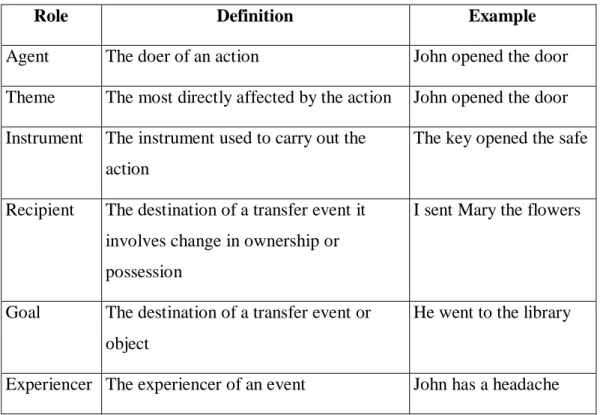
list of thematic roles. Table 1 below shows the commonly-used list of Thematic
Roles.
Table 1 : Commonly-Used list of Thematic Roles
Thematic Roles simple applications can be illustrated as in the following examples:
John opened the door. ………... (1)
Mary ate the apple. ………. (2)
The subjects in both sentences are the actor “doer” of the action. Both John and Mary are animate and according to the thematic role category they are assigned the role of
Agent. The door and the apple are inanimate objects, they are affected by the action of
the agent, the role of Theme or “Patient” is assigned to them.
Each verb has its own thematic description. Fillmore [43] stated that each verb
selects a certain number of deep cases (i.e. semantic role) which form its case frame; a
Role Definition Example
Agent The doer of an action John opened the door
Theme The most directly affected by the action John opened the door
Instrument The instrument used to carry out the action
The key opened the safe
Recipient The destination of a transfer event it involves change in ownership or possession
I sent Mary the flowers
Goal The destination of a transfer event or object
He went to the library
Experiencer The experiencer of an event John has a headache
case frame describes the important aspects of semantic valence of verbs. Fillmore also
used a thematic hierarchy to identify the subject of an active sentence as follows:
Agent Instrument Theme
This hierarchy is used to determine the thematic role of the subject of the sentence.
This means that if the case frame of a verb contains an Agent, this one is realized as the
subject; otherwise; if there is an Instrument, it is promoted to a subject else the subject
is the Theme. If the thematic description contains only Instrument and a Theme, then
the Instrument plays the role of the subject. The hierarchy is used in reverse to
determine the subject of a passive sentence. The following Example illustrates how the
thematic role of the subject is determined in active and passive sentences:
John opened the door
Agent Theme
John opened the door with the key
Agent Theme Instrument
The key opened the door
Instrument Theme
The door was opened by John ……….. Passive: run in reverse
Theme Agent
Thematic Roles can be mapped into the syntactic structure of a sentence. For
example the verb open can behave according to the number of arguments associated
The door opened. One argument - the door is subject - Theme
The key opened the door. Two arguments - the key is Subject- Instrument
the door – Object-Theme
John opened the door with the key. Three arguments - John is Subject –Agent
The door – Object-Theme
the key- Instrument
Many scholars like Levin [73] studied the semantic property and its effect on verb
alternations. An alternation is the set of different mappings of the verb‟s conceptual role
to grammatical function [68]. Levin summarised 80 alternations and associated them
with different semantic classes of verbs, she also produced a list of verbs in each
semantic class. Thematic role needs special handling for the verb unpredicted
alternations. Normally a lexicon is needed to include for each verb all possible syntactic
and thematic combinations.
The FrameNet project [10] has produced thematic roles in more specific categories
than the ones listed in Table 1 above; this is because they used the concept of Frame. A
frame is a script-like structure that instantiates a set of frame-specific semantic roles;
this means that roles in FrameNet are specific to a frame and not to an individual verb.
The FrameNet entries can be Core-Role or Non-Core Roles. FrameNet captures the
generalization among frame elements by the use of inheritance because frames can
inherit from each other. The FrameNet project aims at enabling inferences across
different verbs and also between nouns and verbs. One main goal of the FrameNet
2.5
Knowledge Representation Languages
Several languages have been successfully used on the World Wide Web to provide
information about the rendering of Web page content and its display effects [34];
examples of such languages are: the Hypertext Markup Language (HTML) and its
eXtensible version XHTML, the scripting languages Cascading Style Sheets (CSS) and
JavaScript. With the advancement in developing Web-based applications, especially
e-business and Semantic-based applications, it became obvious that a full-fledged
knowledge representation language is needed to express the structure‟s exact feature and the meaning of data. Many languages emerged; the latest is OWL announced as a
standard in January 2004 [14]. In this section, we briefly present the knowledge
representation languages that provide for the infrastructure of the future Web.
XML (Extensible Markup Language) is used only to add data format (structure) to the document, XML does not specify the data's use or semantics, even the vocabulary
and the combinations of tags allowed are not defined in XML. A Document Type
Definition (DTD) or an XML Schema might be used to specify this vocabulary. XML
document is used to act as a means to hold the data in a structured way [34]. XML
represents the basic language used by other successor languages like RDF.
RDF (Resource Description Framework) is a mechanism used to give meaning to the data. RDF consists of statements about resources, defined as subject-prdicate-object
triples. The subject are resources on the Web, and the predicates are properties defined
in RDF schema. A resource is any thing on the Web that has an identifier. RDF
provides the RDF Schema (RDFS) as a mechanism to define domain-specific properties
defined as instances of subclasses or classes. RDF is written in XML, and it became a
standard in February 2004 [106]. The following RDF document for example, describes
some information of the resource „http://computing.brad.ac.uk/people/dneagu” which is
the home page of Dr. Daniel Neagu. The <rdf:Description> element contains the
description of the resource identified by the rdf:about attribute. The elements:
<uob:Tel>, <uob:email>, <uob:name>, and <uob:WorkFor> are properties(predicate).
<?xml version="1.0"?> <rdf:RDF xmlns:rdf=“http://www.w3.org/1999/02/22-rdf-syntax-ns# > xmlns:uob="http://www.bradford.ac.uk/terms#”> < rdf:Description rdf:about="http://computing.brad.ac.uk/people/dneagu"> <uob:name>Daniel Neagu</uob:name> <uob:Tel> 01274 235704 </uob:Tel> <uob:email>[email protected]</uob:email> <uob:WorkFor rdf:resource=”http://www.bradford.ac.uk”/> </rdf:Description> </rdf>
RDF models statements as nodes and arcs in a graph. A statement is represented by a
node for the subject, a node for the object, an arc for the predicate, directed from the
subject node to the object node. Groups of statements can be represented by corresponding groups of nodes and arcs. RDF uses URI references instead of words to
name things in statements. A common namespace is normally chosen for the vocabulary
needed, for example the namespace uob in line 3 of the above example is used to prefix the vocabulary required by a domain.
OIL (Ontology Interchange Language) integrates intuitive modelling primitives, Web languages, and formal semantics into one language. One of its dialects, called
DAML+OIL [77], The main additions to RDFS is formal semantics, based on a
description logic, and more advanced modelling primitives, such as Boolean
OWL (Web Ontology Language) is built on top of RDF and RDFS. It has a larger vocabulary than RDF, formal semantics, and stronger syntax. OWL can specify exact
description of resources on the Web, and also gives high interpretation power to
software applications. The major extension in OWL over RDF is its ability to specify
restrictions on properties; for example “man” and “woman” can be declared as two
disjoint classes, the owl:cardinality can be used to specify that a “woman” can have one
“husband”, the rdfs:range axiom can be used to specify that “husband” must be an instance of class “man” [14]. OWL has three increasingly-expressive sublanguages: OWL lite, OWL DL, and OWL Full.
2.6
Ontology
Ontologies specify the vocabulary of all possible terms used in the domain of discourse
and the relationships that may exist between these terms. Ontology is simply defined by
Gruber in [50] as:
“Ontology is an explicit specification of a conceptualization”.
Several other definitions of Ontology have been presented. The Gruber‟s definition
referenced by [51] as:
“Ontology is a formal, explicit specification of a shared conceptualization of a domain of interest”.
This definition describes ontology as formal to mean that knowledge is represented in a machine-understandable language. Explicit to denote that the possible terms and the relationships between them, together with the constraints defined on them, are clearly
used by a group of people who reached consensus about common concepts, it also
means that people and software agents have common understanding of the information.
Conceptualization refers to an abstract model that identifies the concepts of some
domain [39].
Ontology plays the key role in Semantic Web applications because it provides for the
separation of domain knowledge from the operational knowledge. It also helps in
analyzing domain knowledge; formal analysis of terms is extremely valuable for reusing
or extending existing ontologies [76].
Large ontologies, such as WordNet that contains over 100,000 terms [39] was built much earlier than the introduction of Semantic Web; it uses natural language to describe
its terms. Currently, there are many standard ontologies that can be used for an
appropriate domain like SNOMED for the medicine domain [89]. The United Nations Development Program and Dun & Bradstreet developed the UNSPSC ontology for products and services [101]. The ontology ecs [100] has been developed and used by the department of Electronics and Computer Science at the University of Southampton.
Some ontologies were built for conference purposes like iswc.owl [66]. Some ontologies were developed by information and knowledge organization like the
univ.owl developed by Mondeca [62]. The most famous ontology used for ontology construction tutorial and demonstration purposes is the Wine ontology [63] that is developed by Stanford University. In short, currently there are many other ontologies
that cover a wide range of domains from a Business to Business (B2B) to Weapon of
Mass Destruction.
Current ontology research work is not only directed towards developing languages
ontologies that change over time, and combining separately developed ontologies to
answer some queries that requires merging and relating several ontologies [39].
2.6.1
Ontology Preparation Tools
Ontologies can be created and maintained by using one of the following tools:
Simple editor where the ontology is directly created using a simple editor like Notepad and saved as .xml or .owl file.
Ontology editor where editor like Protégé [60] is used. Ontology editor supports the definition of concepts hierarchies, the definition of attributes for concepts, and the
definition of axioms and constraints. They normally provide graphical interfaces.
Ontology editor enables browsing, inspecting, and modifying ontologies and thus
supports the ontology development and maintenance task.
Ontology Learners where tools like Text-To-Onto [74] and Adaptiva provide an integrated environment for learning ontology from text in a semi-automatic manner.
Ontology Reasoners where tools like the Fast Classification of Terminologies (FaCT) [61] can be used to derive concept hierarchies automatically.
Ontology Library Systems are used to store, retrieve and manipulate existing ontologies. Systems like WebOnto [41], OntoLingua, DAML library system, Ontology Server and SHOE [40] feature re-use existing ontologies; new ontology
can be constructed by assembling or modifying an existing ones.
Adapting Tools. Chimaera [76] is a good example of such adapting environment that is used for merging