W. ALLEN
WALLIS
Institute of
POLITICAL
ECONOMY
UNIVERSITY OF
ROCHESTER
Regularity of Pure Strategy Equilibrium Points in a Class of Bargaining
Games
Tasos Kalandrakis
Working Paper No. 37
April 2004
Regularity of Pure Strategy Equilibrium Points in a Class of
Bargaining Games
1by
Tasos Kalandrakis
Abstract: For a class of n-player (n ≥ 2) sequential bargaining games with probabilistic recognition and general agreement rules, we characterize pure strategy Stationary Subgame Perfect
(PSSP) equilibria via a finite number of equalities and inequalities. We use this characterization
and the degree theory of Shannon, 1994, to show that when utility over agreements has negative
definite second (contingent) derivative, there is a finite number of PSSP equilibrium points for
almost all discount factors. If in addition the space of agreements is one-dimensional, the theo-rem applies for all SSP equilibria. And for oligarchic voting rules (which include unanimity) with
agreement spaces of arbitraryfinite dimension, the number of SSP equilibria is odd and the
equi-librium correspondence is lower-hemicontinuous for almost all discount factors. Finally, we provide
a sufficient condition for uniqueness of SSP equilibrium in oligarchic games.
Keywords: Local Uniqueness of Equilibrium, Regularity, Sequential Bargaining.
Correspondence Address: W. Allen Wallis Institute of Political Economy, 107 Harkness Hall, University of Rochester, Rochester, NY 14627-0158. E-mail: [email protected].
1I thank John Duggan and participants of the 2003 annual meeting of the American Political Science Association,
Philadelphia, PA, the Political Economy Seminar at Northwestern University, and the Economic Theory seminar at the University of Rochester for helpful comments. All errors are mine.
1. INTRODUCTION
Sequential bargaining models of complete information starting with Rubinstein, 1982, have provided a fruitful environment for the study of the resolution of disagreements among agents. Unlike cooperative formulations which are silent about the underlying actions of bargaining parties, these games juxtapose equilibrium conditions based on a scrutiny of the optimality of individual
choices via which proposals emerge and agreements are crafted. In typical situations, (refined)
equilibria of these games exist allowing applications to numerous areas of social interaction. In legislative or other political environments where the non-existence of equilibrium of the cooperative genre is pervasive, such models have been welcomed in celebratory spirits.
Our goal in this paper is to study the structure of the set of equilibria for an important class of these bargaining games and analyze their stability to perturbations of the model. By stability
in what follows we mean the property that the number of equilibria of these games is finite and
each equilibrium is locally expressible as a continuous function of model parameters. Then, a slight change in the bargaining environment results in small changes in equilibrium behavior. Importantly, if we calculate equilibria using parameter values that do not exactly coincide with their true values, the equilibria we obtain are still close to the true equilibria.
Besides its obvious epistemological significance, such a property seems essential in order to build richer models of political interaction. In parliamentary systems, for example, government formation following elections requires us to append a bargaining model at the end of a game preceded by an electoral stage. In these situations, it is important to ensure conditions such that changes in the bargaining environment induced at the electoral stage, induce continuous changes in the distribution of subsequent agreements and policy outcomes.
We focus our investigation on Stationary Subgame Perfect equilibria in pure strategies (PSSP). We allow general agreement rules, although our results are stronger for a subclass of these. We
as-sume players are recognized to make proposals with some probability fixed across periods. In the
main paper we focus on the case of bargaining with discounting, although in the appendix we show
our analysis also applies in the case of fixed delay costs. With varying degrees of generality, such
models have been analyzed by, for example, Binmore, 1987, Baron and Ferejohn, 1989, Harrington, 1990, Baron, 1991, Merlo and Wilson, 1995, Banks and Duggan, 2000, Jackson and Moselle, 2002, Eraslan, 2002, Eraslan and Merlo, 2002, etc.
Except in special cases, the behavior of SSP equilibria for these games is not fully understood. Banks and Duggan, 2000, studied discounted games such as those we analyze and showed upper-hemicontinuity of SSP equilibria with respect to parameters. But they also provided an example of a majority rule game that has a continuum of PSSP and an equilibrium correspondence that fails lower-hemicontinuity.
Stronger results arise in certain types of unanimity games. For such n-player games with
discounting, Merlo and Wilson, 1995, have shown that stationary equilibria are unique when bar-gaining emulates the division of a possibly stochastic cake and a contraction condition is met. Thus, for the subset of games in Merlo and Wilson for which the upper-hemicontinuity result of Banks and Duggan holds, the equilibrium correspondence simply becomes a continuous function of the parameters.
But collective bargaining will often not emulate the division of a cake, due to the public goods aspect of agreements or the ideological nature of disagreements. For such an ideological space, in section 3 of this paper we provide an example of a four-player discounted unanimity game that
admits a continuum of PSSP equilibria.2
In view of the above, at most we can hope to show that this type of pathological behavior of the equilibrium set is not generic. Binmore, 1987, showed this is so in Rubinstein’s two player game
with delay costs, but we know of no general arguments to that effect. Our theorem specializes in
three versions of decreasing strength which guarantee that,for almost all discount factors: (a) when the agreement rule is oligarchic, a class that includes unanimity rule, the number of SSP equilibria is odd and equilibrium correspondence is lower-hemicontinuous. (b) If the space of agreements is
one-dimensional, then all SSP equilibria are locally unique and finite in number for general agreement
rules. Finally, (c) for non-oligarchic rules in multidimensional agreement spaces there is a finite
number (possibly zero) of PSSP equilibria.
Our results are weaker in the last case since PSSP equilibria may not exist in these games. Still, this theorem has been used in a majority rule application in Kalandrakis, 2003, to show that minority governments in parliamentary government formation bargaining almost always occur
2The situation is less encouraging in the case offixed delay costs. From Rubinstein’s original paper a continuum
of PSSP can emerge in such games even in the two-player unanimity case, even though SSP (and mere Subgame Perfect) equilibrium is unique in the discounted version. Rubinstein’s game involves alternating offers, but the same holds for the probabilistic recognition rules we consider.
with positive probability when utility from cabinet positions is small relative to the ideological disagreements of political parties.
Before we move to the formal arguments, we tie our analysis to two strands of related
lit-erature offering a guide to the arguments that permitted our results. The first literature sprung
from the study of general equilibrium economies and was pioneered by, Debreu, 1970. There is also a related game-theoretic literature starting with, Harsanyi, 1973, who provided an alternative
proof of the fact that almost all finite games in normal form have an odd number of Nash
equi-libria. Similarly, Kreps and Wilson, 1982, showed that the equilibrium outcome distributions of
finite games in the extensive form are finite in number. The same was shown true for a class of
cheap talk games by In-Uck Park, 1997. Haller and Lagunoff, 2000, showed genericity of behavior
in Markovian equilibria of dynamic games with finite action and state spaces.
When it comes to games with continuous action spaces, Dubey, 1986, offered a general result
for simultaneous move games. The bargaining games we analyze involve both a continuous action space for the proposer as well as multi-period dynamic interaction. Thus, these games are not covered by any existing studies. Yet, due to their particular structure, these games are amenable
to similar techniques. A key insight is that the proposer in each period chooses among a finite
number only of winning coalitions, even though she has to propose from a continuum of agreements. Exploiting this fact, our proof strategy proceeds as follows.
First, we introduce the notion of anagenda setting plan corresponding to a player/proposer
and a winning coalition: it is a mapping from the possible reservation values of players to optimal proposals by the proposer that are acceptable by members of the coalition. The role of agenda setting plans in our analysis is very akin to that of demand functions in the study of economic equilibrium. Much like demand functions shift the focus from the consumers’ optimization problem to reduce economic equilibrium to a set of equations that ensure that markets clear, agenda setting plans sidestep the proposer’s optimization problem and reduce equilibrium to a set of equations that ensure that players’ coalition choices produce reservation values that are consistent with these choices.3
PSSP equilibria emerge when each proposer chooses a unique coalition. Since there is afinite
3Kalandrakis, n.d., has used similar arguments to provide a proof of existence of SSP equilibria via Brouwer’s
number of possible combinations of coalition choices by the players, we ensure that every PSSP can
be expressed as the solution to one among a finite number of systems of equations. Thence, our
result only requires that each of these systems of equations has finitely many solutions.
Because they involve solutions to optimization problems (the agenda setting plans) our
equi-librium equations are not sufficiently smooth to allow us to apply Sard’s theorem (or the
transver-sality theorem). In the theory of general economic equilibrium this problem has been confronted early on by Rader, 1973, who was able to extend Debreu’s 1970 results to cases when the demand
functions are not differentiable but satisfy certain stability properties. More recently, Shannon,
1994, developed a degree theory for non-smooth equations. As an application, she strengthened Rader’s work to a conclusion similar to Dierker’s, 1972. Our theorem is derived by applying ho-motopy arguments based on the degree theory of Shannon, 1994, and using a theorem of Rader, 1973.
We have organized our analysis in the remainder as follows. In section 2 we present the bargaining model analyzed. In section 3, we provide an example of a unanimity game that admits a continuum of PSSP equilibria. Our analysis culminates in section 4 where we show that the example in section 3 is not generic in the space of discount factors. We conclude in section 5.
2. MODEL
Consider a set of n≥2players N ={1, ..., n}. They convene in periodst= 1,2, ... to reach
an agreementxdrawn from a setX. We assumeXa convex, compact subset ofRd,d≥1. Much of
related literature sidesteps the underlying space of agreementsX to work with the space of payoffs
generated from X. We will eventually resort to similar arguments, but we find it enlightening to
build from the primitives of the model.
An agreement requires the approval of a winning coalition, C ⊆ N. The set of winning
coalitions is determined by the underlying voting rule and is denoted by D ⊂2N\∅, D 6= ∅. For
example, if all players have one vote and the voting rule is simple majority, D consists of all
coalitions with more than n2 members.
Our strongest results concern the class ofoligarchic rules. Voting ruleDisoligarchic if there
exists coalition Co∈D such that Co =TC∈DC. One important member of the class of oligarchic
generality, we admit a much wider class of agreement rules. Hence, as in Banks and Duggan, 2000,
the only restriction onD is monotonicity: for any two coalitionsA,B with A⊆B ⊆N, we have
A∈D=⇒B ∈D.
Players bargain as follows. In each period t= 1,2, ..., one of the players is chosen by nature
(or ‘recognized’ in legislative language) to make a proposal z∈X. Having observed the proposal,
players voteyesorno. If a winning coalition voteyes, then the game ends withzbeing implemented. Otherwise, the game moves to the next period, a player is recognized anew to make a proposal,
and so on until an agreement is reached. The probability that player i∈N is recognized to make
a proposal is constant across periods and equal to πi≥0. Obviously Pi∈Nπi = 1.
Legislator i ∈ N derives von Neuman-Morgenstern stage utility ui : X −→ R from the
agreement x. We assume throughout that ui is continuously differentiable and concave, and that
the agreements are desirable so that ui(x) >0, for allx∈X, alli∈N. Our analysis will require
additional assumptions onui,i∈N, which we state in the sequel as necessary.
Players discount the future by a factorδi ∈(0,1),i∈N. Thus, the payoffof playerifrom a
decisionx∈X reached in periodt≥1is given byδit−1ui(x), and it is zero in the case of perpetual
disagreement. We denote the vector of discount factors for playersi= 1, ..., nbyδ= (δ1,..., δn)∈D,
whereD≡(0,1)n. Highlighting the fact that our genericity results are cast in terms of discounting
parameters δ, we denote specific games by Γδ. In the appendix we discuss how our arguments
extend naturally to the case players incur a delay cost ci ∈R++,i∈N instead of discounting the
future.
We shall focus our attention to pure strategy stationary subgame perfect (PSSP) equilibria.
A pure stationary proposal strategy for player i ∈N is an agreement zi ∈ X proposed wheni is
recognized. A stationary voting strategy for player i is specified by an acceptance set Ai ⊆ X.
Ai is the set of proposals on which player ivotes yes. A stationary strategy for player i is a pair
σi = (zi, Ai) that consists of a proposal strategy and an acceptance set.
Given stationary strategies σi= (zi, Ai), we calculate players’ continuation value,vi, i∈N,
which is defined as the expected utility if the game moves in the next period. Using the continuation value, we define thereservation value of playerias:
Definition 1 The reservation value of player i, i ∈ N, for continuation value vi is given by
In general, it is necessary to restrict voting strategies in order to rule out implausible equi-libria in which winning coalitions approve undesirable proposals or reject desirable proposals solely
because each of the players is not pivotal and hence is indifferent between her voting actions. In
effect, we require that for reservation valuesr∈Rn, voting strategies satisfy:
x∈Ai ⇐⇒ui(x)≥ri,i∈N (1)
i.e. players approve proposals if and only if they weakly prefer them over their reservation value.
Following Baron and Kalai, 1993, we call such voting strategies stage-undominated.
A PSSP equilibrium in stage-undominated voting strategies is ann-tuple of stationary
strate-gies σi, i∈N such thatAi are stage undominated given the corresponding reservation values, and
players are sequentially rational. It can be shown (see Banks and Duggan, 2000) that all SSP equi-libria in the class of games we consider involve no delay, i.e. all equilibrium proposals are approved
given equilibrium voting strategies. In what follows we shall omit reference to the refinement on
voting strategies and the no-delay property of equilibria for compactness. Thus, a PSSP equilibrium will be taken to imply the use of stage-undominated voting strategies and involve no delay.
3. AN EXAMPLE WITH A CONTINUUM OF PSSP
In this section we shall provide an example of a game satisfying our assumptions that has a continuum of PSSP equilibria. It involves four players bargaining under unanimity rule over agreements drawn from a one-dimensional policy space. This example illustrates the gap between the conditions that ensure uniqueness of equilibrium in the unanimity games of Merlo and Wilson, 1995, and agreement spaces typical in political environments.
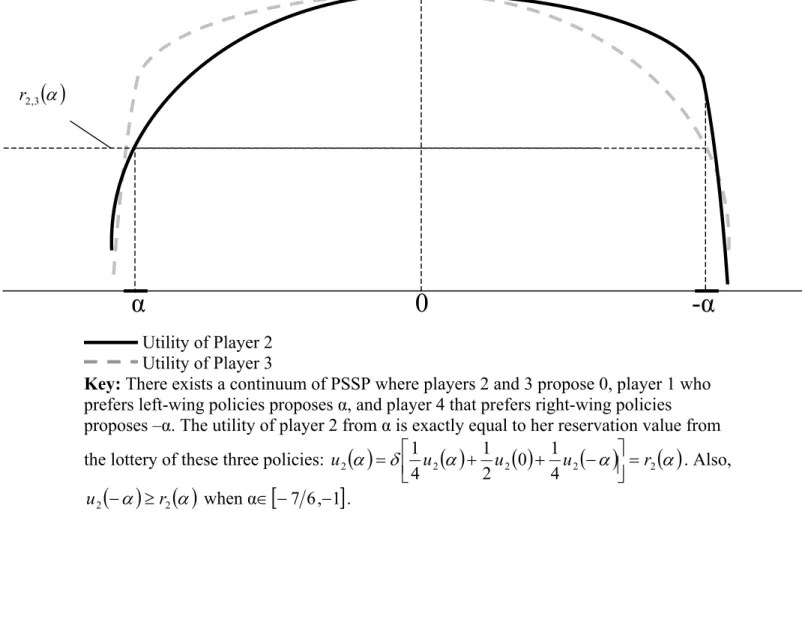
[insertfigure 1 about here] Example 1 (See Figure 1) Assume X = h−
q 7 6, q 7 6 i , N = {1,2,3,4}, D = {N}, πi = 14,
i ∈ N, δi = 15, i = 1,4, δi = 45, i = 2,3, and the following utility functions over x ∈ X:
u1(x) =−x2−3x+ 10, and u2(x) = −x2+7 2 if x∈ h − q 7 6,0 i −14x30− 1 4x2+ 7 2 if x∈[0,1] −4x2+ 7 if x∈h1, q 7 6 i
Also u4(x) =u1(−x) and u3(x) =u2(−x). Notice that ui, i= 1,2,3,4 are strictly concave and in fact C1 and that ui>0, for allx∈X.
There is a continuum of PSSP equilibria where players 2 and 3 propose 0, player 1 proposes
α ∈ h−
q
7
6,−1
i
, while player 4 proposes −α. Indeed, with these proposals, players’ reservation
values are as follows:
r1(α) = 15 ¡1 2u1(0) + 1 4u1(α) + 1 4u1(−α) ¢ = 2−101α2 r2(α) = 45 ¡1 2u2(0) + 1 4u2(−α) + 1 4u2(α) ¢ =−α2+72 =u2(α)
It is straightforward to verify that u1(z) > r1(α), for z ∈ {α,0,−α} and that u2(−α) > r2(α)
for α ∈ ³− q 7 6,−1 i , while u2 ³q 7 6 ´ = r2 ³ − q 7 6 ´
. Thus, the unanimously acceptable proposals
are [α,−α] ⊆X, when α∈ ³ − q 7 6,−1 i
. For these acceptable agreements, proposal strategies are
optimal. Hence these strategies constitute a PSSP for each α∈h−
q
7
6,−1
i
.
Note that we give an example with an oligarchic voting rule, but this example can be modified to obtain a continuum of equilibria with non-oligarchic rules, such as majority rule. Also the
example admits a number of other modifications, such as a fifth player with a ‘bliss’ point at
zero (the median), additional policy dimensions, etc. The key to the result is that the balanced
contraction of the two extreme equilibrium proposals (α and −α) produces a net change in the
reservation values of players 2 and 3 that is exactly equal to the change in utility from the one of these two proposals that renders each player exactly indifferent.
For this to occur under unanimity in the presence of discounting, utility must change at a much faster rate at the agreement which these players strictly approve as shown in Figure 1. Clearly, if players 2 and 3 are strictly indifferent between both proposals α and −α, such differential rate of change in utilities is not possible without destroying the feasibility of one of the two proposals. Thus, this type of multiplicity of equilibrium points cannot emerge under the conditions that ensure uniqueness of equilibrium in Merlo and Wilson, 1995. In their analysis, the assumption that bargaining amounts to the division of a (stochastic) cake and a contraction condition ensure that players other than the proposer receive exactly their reservation value under all equilibrium agreements.
In the next section we shall show that the pathological behavior of the equilibrium set in the above example can occur for at most a set of Lebesgue measure zero in the space of discount
factors.
4. GENERIC REGULARITY
We have divided this section into four subsections. We start with subsection (i), in which we offer a characterization of PSSP equilibria. The advantage of this characterization is that it reduces the expression of equilibrium to afinite number of equalities and inequalities. In subsection (ii), we use this characterization in order to apply the degree theory for non-smooth equations developed by Shannon, 1994, on a weaker notion of equilibrium that ignores the inequalities among equilibrium
conditions. We define regular games Γδ, and develop an index theory for the PSSP equilibria of
regular games. In subsection (iii), we establish sufficient conditions on players’ utilities that ensure that almost all such games are regular. We conclude this section in subsection (iv), where we
provide a sufficient condition for uniqueness of PSSP equilibrium in oligarchic games.
i. Agenda Setting Plans and PSSP
In order to state our characterization of PSSP equilibria, we introduce some necessary con-cepts and notation. First, we construct a space of possible continuation values by considering all
possible lotteries over proposals that may prevail in period t+ 1 if delay occurs in period t. Let
P[X]be the set of Borel probability measures overX. We obtain the space of possible continuation
values,V, as the imagev(P[X])of the mappingv:P[X]−→Rn, wherevi(µ)≡
R
Xui(x)µ(dx),
µ∈P[X].4
Next we define the set of reservation values for gameΓδ. We denote this set byRδ, since it depends on discount factors δ ∈D by the definition of the reservation values ri ≡ δivi. Thus we
have:
Rδ ≡{x∈Rn:xi=δivi, all i∈N, allv∈V}
We also define a set R ⊂Rn that contains all possible reservation values for all possible discount factorsδ∈D. Specifically,
R≡[
δ∈DRδ.
4
Even though we focus on pure proposal strategies, the need to consider lotteries over proposals arises from the fact that proposers are chosen probabilistically.
Next consider the subset of winning coalitions that include playeriand areminimum winning
in the sense that if any playerj 6=iis removed from the coalition, the coalition ceases to be a winning coalition. Denote this set of coalitions byΞi ⊂D, more formally defined as5
Ξi ≡{C ∈D:i∈C and C\ {j}∈/ D,∀j ∈C, j 6=i}
Let the number of coalitions inΞibeξi ≡|Ξi|. By non-emptiness and monotonicity of the agreement
rule, D, we are guaranteed that ξi ≥1, for all ∈N. In what follows we index the elements ofΞi,
Cω∈Ξi, byω = 1, ..., ξi.
We now introduce the concept of anagenda setting plan. Roughly speaking, an agenda setting
plan specifies optimal agreements for the proposer that meet the approval of a particular winning
coalition for all possible reservation values that members in that coalition may have. We denote the agenda setting plan of proposeriand coalitionCω∈Ξi by fωi. Formally it is a correspondence
fi
ω :R⇒X, given by
fωi (r)≡arg max
x {ui(x) :uj(x)≥rj, j ∈Cω}.
The significance of agenda setting plans becomes obvious from the following lemma:
Lemma 1 Consider any reservation values r ∈ Rδ and determine voting strategies Ai according to (1). Then, arg maxnui(x) :x∈ [ C∈D h\ h∈CAh io ⊆[ξωi=1fωi (r) (2)
Proof. It suffices to show that optimal agreementsy∈arg max©ui(x) :x∈SC∈D£Th∈CAh
¤ª
that are acceptable by any coalition C ∈ D such that C /∈ Ξi are also acceptable by some
coalition Cω ∈ Ξi, so that y∈fωi (r). Since y is optimal, ui(y) ≥ ui(x) ≥ ri, for all x ∈
Sξi
ω=1fωi (r). By the monotonicity of the agreement rule C
S
{i} ∈ D and there exists Cω ⊆
CS{i} such that Cω ∈ Ξi, by the definition of Ξi. Thus, y∈Th∈CωAh hence y∈fωi (r), since
y∈arg max©ui(x) :x∈SC∈D
£T
h∈CAh
¤ª
.
In general, an agenda setting planfωi is a multi-valued correspondence. But in certain modal cases, as we establish in lemma 3 at the end of subsection (iii), agenda setting plansfωi are functions. In those cases, we can characterize PSSP equilibria by representing the proposal strategy of player
5
Note that coalitions inΞi need not be minimum winning in the traditional sense since for coalitionC ∈Ξi it
i∈N as a choice of coalition fromΞi for given reservation values, instead of a choice of agreement
from X. Let Ω≡{1, ..., ξi} ×in=1, so thatω∈Ω represents a choice of coalition fromΞi by each of
thenplayers i∈N. We have:
Theorem 1 Consider game Γδ for which fωi is a function for all i∈ N, ω = 1, ..., ξi. Strategies
{z∗i, A∗i}ni=1 are a PSSP equilibrium of game Γδ if and only if there exists a vector of coalition
choices ω∈Ω and a vector of reservation values r∗∈Rδ,such that z∗i =fωii(r
∗),i∈N, and: r∗i =δi n X h=1 πhui ³ fωh h(r ∗)´, for all i∈N, (3) ui ¡ fωi i(r ∗)¢≥u i ¡ fωi0(r∗) ¢ , for all ω0 = 1, ..., ξi, i∈N (4)
Proof. (=⇒) Suppose strategies{zi∗, A∗i}ni=1 form a PSSP equilibrium. We shall show there existω∈Ω,r∗ ∈Rδ such thatz∗
i =fωii(r∗),i∈N, and (3) and (4) hold. Construct the reservation
values r∗ ∈Rδ according to r∗i =δi n X h=1 πhui(z∗i), for all i∈N.
For these reservation values r∗, we now obtain voting strategies A0i according to (1). Since
{z∗
i, A∗i} n
i=1 is a no-delay equilibrium (Banks and Duggan, 2000, theorem 1(ii)), we must have
A0h =A∗h and z∗i ∈arg maxnui(x) :x∈ [ C∈D h\ h∈CA 0 h io . Thus, we must have z∗i ∈
n
f1i(r∗), ..., fξi
i(r
∗)o, by lemma 1. Thence, there exists ω∗
i ∈{1, ..., ξi} such that ui ¡ fωi i∗(r ∗)¢≥u i ¡
fωi (r∗)¢, for all ω= 1, ..., ξi, alli∈N. Set ω= (ω∗1, ..., ω∗n), and this part of the proof is complete.
(⇐=) Consider ω ∈ Ω, r∗ ∈ Rδ that satisfy (3) and (4). Construct stationary
strate-gies {z0i, A0 i}
n
i=1 by setting z0i = fωii(r
∗) and A0
i = {x∈X :ui(x)≥r∗i}. We wish to show that
{z0i, A0i}ni=1 form a PSSP equilibrium. Condition (4) and lemma 1 ensure that
z0i∈arg maxnui(x) :x∈ [ C∈D h\ h∈CA 0 h io
and A0h are stage-undominated. As a result, strategies {z0i, A0i}ni=1 do not admit profitable one period deviations and constitute a PSSP equilibrium by the one-stage deviation principle.
The characterization in theorem 1 allows us to study the PSSP equilibrium set by applying
homotopy arguments on the n equations determined by (3). For that purpose we define a weaker
notion of equilibrium:
Definition 2 Consider game Γδ for which fωi is a function for all i∈N, ω= 1, ..., ξi. A
pseudo-PSSP equilibrium is a vector of reservation values r∗ ∈R and a vector of coalition choices ω∈Ω
such that, r∗i =δi n X h=1 πhui ³ fωhh(r∗) ´ , for all i∈N. (5)
Clearly, from theorem 1 and definition 2, genuine no-delay equilibria differ from pseudo-PSSP in that the latter do not necessarily satisfy the inequalities in (4). Thus, every PSSP equilibrium
is a pseudo-PSSP equilibrium but notvice-versa. In the special case of oligarchic games, we have
ξi = 1, i∈N, henceΩ is a singleton and pseudo-PSSP and PSSP equilibria coincide.
ii. Regular Games
Our analysis has permitted the expression of (pseudo)equilibria as solutions to systems of equations. In this subsection we shall use this formulation to study the behavior of (pseudo)PSSP
equilibria of game Γδ and derive an index theory for the equilibrium set.
Define the set of solutions to equations (5) for given ω ∈ Ω by Eδω ≡ {r∈Rδ: (5) holds}. Next, assuming fωi is a function for all i ∈ N, ω = 1, ..., ξi, define for each ω ∈ Ω the mapping Gω :R−→Rn as:6 Gωi (r)≡ Pn ri h=1πhui ¡ fh ωh(r) ¢,i= 1, .., n Clearly r∈Eδω if and only if Gω(r) =δ.
Following Rader, 1973, and Shannon, 1994, we say that y ∈ Y is a regular value of the
function g:X −→ Y if bothDg(x) exists and is non-singular for all x∈X such that g(x) = y.
We say thaty∈Y is acritical value if it is not a regular value. We can show the following:
Lemma 2 Consider game Γδ and assume fωi a continuous function for all i∈N, ω= 1, ..., ξi. If
δ∈D is a regular value of Gω, for some ω∈Ω, then
(i) |Eδω|<+∞, is an odd number, and
6
Recall thatui(x)>0for allx∈X,i∈N, so thatPnh=1πhui¡fωhh(r)
¢
(ii) Eδω is lower-hemicontinuous atδ.
Proof. Let ∂Rdenote the boundary ofR.7 We claim first that:
Claim: For each δ ∈ D, RδT∂R = ∅. Since Rδ ⊆ R, it suffices to show that R is an
open set. To see that R is open, notice thatR can also be expressed as the unionSv∈V Rv of the
product setsRv≡D{v},v∈V. Clearly, Rv= (0, vi)×ni=1, and sincevi >0 for all v∈V,i∈N,
Rv is open. Hence,R is open as the union of open sets.
Now defineG1 :R−→RnasG1(r)≡Gω(r)−δ. SinceXis compact andu
icontinuous,ui≡ min
x∈Xui(x) is well defined and ui >0. Let G
0 :R
−→ Rn be given byG0i (r)≡ ri
ui −δi,i= 1, ..., n. Consider the continuous function Ht = (1−t)G0+tG1. Let Ht−1(0) ≡{r∈R:Ht(r) =0}. In
order to apply homotopy arguments, we wish to show that Ht−1(0)T∂R=∅for all t∈[0,1]. Forr∈Ht−1(0)we have(1−t)G0+tG1=0=⇒r i = δiui Pn h=1πhui¡fωhh(r) ¢ (1−t)Pnh=1πhui ¡ fh ωh(r) ¢ +tui. Set δ0i ≡ δiui (1−t)Pnh=1πhui ¡ fh ωh(r) ¢ +tui, i = 1, ..., n, so that we have ri = δ 0 i Pn h=1πhui ¡ fωhh(r)¢. We must have Pnh=1πhui ¡
fωhh(r)¢≥ui for all i∈ N, hence we have δ0i ∈(0, δi] for alli∈ N and
all t ∈[0,1]. Then, δ0 ∈D and we have r∈Rδ0. ButRδ0T∂R=∅, by the claim. Hence, for all
t∈[0,1]and all r∈Ht−1(0), we haver∈/∂R.
Note that, since δis a regular value of Gω and by theorem 10, page 159, in Shannon, 1994,
thedegree ofGω is given byd(Gω, R,δ)≡Pr∈Eω
δ signdetDG
ω(r). But, by homotopy invariance, d¡G0, R,0¢=d¡G1, R,0¢, andd¡G0, R,0¢= 1. Thence, we haved¡G1, R,0¢=d(Gω, R,δ) = 1.
Since R is a bounded set, we have proven (i): Gω has an odd, finite number (at least one) of
solutions.
To show (ii) notice that, sinceδis a regular value, for everyrl∈Eδω,l= 1, ...,|Eδω|there exists
a neighborhood of rl, Nl ⊂ R, such that Eδω
T
Nl = {rl} (e.g. Shannon, 1994, theorem 1, page
150). Then, sinceδ∈/Gω(∂N
l), there exists ε >0 such that|δ−d|> εfor all d∈Gω(∂Nl). Now
the degree is constant, i.e. d¡Gω, Nl,δ0
¢
=d(Gω, Nl,δ) for every δ0 ∈Bε(δ), whereBε(δ) is the
ε-ball aroundδ. By theorem 9 of Shannon, 1994, page 158,d(Gω, N
l,δ) =signdetDGω(rl). But
signdetDGω(rl) 6= 0sinceδ is a regular value. Thusd
¡
Gω, Nl,δ0
¢
6
= 0for every δ0 ∈Bε(δ),i.e.
for everyδ0 ∈Bε(δ)there exists r0∈Nl such thatr0∈Eδω0. This establishes lower-hemicontinuity.
7Substantively, the boundary ofRis obtained by considering values of the discount factorsδ
i= 1orδi= 0. Due
to the concavity ofui, we can certainly extend the definition of continuous functionsfωi, henceGω to the domainR,
Note that lemma 2 also constitutes a proof of existence of pseudo-PSSP for all ω∈Ω. As a
consequence, it also provides a proof of existence of PSSP for oligarchic games whenξi = 1for all
i∈N. We will say that the bargaining game Γδ is regular ifδ is a regular value of Gω,for every
ω∈Ω.
We can summarize the implications of our analysis for regular gamesΓδ as follows:
Theorem 2 Consider a regular game Γδ. Then
(i) Γδ has a finite number of PSSP equilibria (possibly zero),
(ii) If X ⊂R1,Γ
δ has a finite number (at least one) of SSP equilibria, all in pure strategies,
and
(iii) if the voting rule D, is oligarchic, Γδ has an odd number of SSP equilibria and the
equilibrium correspondence is lower-hemicontinuous at δ.
Proof. Since Ωis afinite set, part (i) follows directly from lemma 2.
To show part (ii), we shall show that all SSP equilibria of game Γδ when X⊂R1 are PSSP
equilibria.8 If this is true, the result follows from part (i) since SSP equilibria for these games
exist (Banks and Duggan, 2000, theorem 1). SupposeΓδ has a no-delay SSP equilibrium in mixed
strategies to get a contradiction. Letr∈Rδ be players’ reservation values for this equilibrium. The voting strategiesA∗i,i∈N are stage-undominated and, sinceui are concave,A∗i and
T
h∈CA∗h, are
convex for every C ⊆ N. Also, SC∈D£Th∈CA∗h¤ is convex, since the average of proposals must belong inTh∈CA∗h for everyC∈D. By (2), there exists some playerithat mixes between distinct agreements fωi (r)< fωi0(r). Since £ fωi (r), fωi0(r) ¤ ⊆SC∈D £T h∈CA∗h ¤
and ui is concave, we have
ui(x) = c for all x ∈
£
fωi (r), fωi0(r)
¤
. Thus, at least one of the two agenda setting plans is a multivalued correspondence, a contradiction.
Lastly, to show part (iii) notice that by (2) and the fact that ξi = 1for all i∈N, for every
reservation values r∈Rδ there exists a unique optimal agreement for each player. Thus, all SSP
equilibria are PSSP equilibria, and the latter coincide with the pseudo-PSSP equilibria of the game.
8
The argument here is identical to the argument in theorem 2, part (ii) of Banks and Duggan, 2000, who assume strictly quasi-concave utilities. Mere concavity suffices in our case because of the added assumption that agenda setting plans are functions.
The theorem provides a sharp description of the PSSP equilibrium set for regular games. With some additional arguments, we could show that lower-hemicontinuity also applies in cases (i) and (ii) of the theorem. Lower-hemicontinuity implies that PSSP equilibria of these games
can be expressed as continuous functions of the parameters in a neighborhood ofδ. For discounted
oligarchic games, coupled with the upper-hemicontinuity result of Banks and Duggan, 2000, theorem
2 provides a complete description of the equilibrium correspondence. In effect, we have shown that
regular gamesΓδ with oligarchic rules areessential (Fort, 1950, Wu and Jiang, 1962) with respect
to the SSP equilibrium set.
iii. Sufficient Conditions for Generic Regularity
The obvious next step is to inquire how prevalent are regular gamesΓδ in the space of discount
factorsD? From the example in section 3 we cannot rule out the existence of critical values of the
mapsGω. Thus, at most we can hope to show thatalmost all gamesΓδ are regular. AssumingGω
is differentiable, we could proceed to show that the set of critical values of Gω is of measure zero
using Sard’s theorem. But the smoothness ofGω depends on the behavior of agenda setting plans,
fi
ω. Since the latter are solutions to constrained optimization problems, they will typically not be
differentiable due to changes in the set of binding constraints (or due to the non-smoothness of ui,
i∈N).
In the context of general equilibrium theory, this problem is analogous to the situation when
the excess demand function is not differentiable (e.g. Katzner, 1968). To deal with the luck of
smoothness of demand functions in that context, Rader, 1973, using a result by Sard, 1958, estab-lished the following:
Theorem 3 (Rader, 1973) Consider E ⊂ Rn, and f : E −→ Rn that is a.e. differentiable and
maps sets of measure zero into sets of measure zero. Then, the set of critical values of f has
measure zero.
Functions that are a.e. differentiable and map sets of measure zero into sets of measure
zero include Lipschitz and locally Lipschitz functions (see Federer, 1969). Rader, 1973, (lemma 3, page 918) showed that these requirements are also met by functions that are pointwise Lipschitz at every point in an open domain. The pointwise Lipschitz property is a stability to perturbations
property also known ascalmnessorlocal upper Lipschitz property in the mathematical optimization literature. It is weaker than (local) Lipschitz continuity in that one of the two points of comparison is held fixed:
Definition 3 A function f : X −→ Y is pointwise Lipschitz at x ∈ X if there exists m and a neighborhood N(x) such that|f(x)−f(z)|≤m|x−z|for all z∈N(x).
Thus we can state sufficient conditions for almost all games Γδ to be regular by imposing
conditions on the agenda setting plansfωi. In particular:
Theorem 4 Assumefωi is a pointwise Lipshcitz function at everyr∈R, for alli∈N,ω= 1, ..., ξi.
Then, for almost allδ∈Dgame Γδ is regular.
Proof. By theorem 3, it will suffice to show that Gω is pointwise Lipschitz for all ω ∈ Ω.
This is because then the set of critical values ofGω has measure zero and Ωis a finite set. Since
thefinite union of sets of measure zero has measure zero, then Γδ is a regular game for almost all
δ∈D.
Since ui is C1, the composition ui ◦fωi is pointwise Lipschitz for all i ∈ N and all fωi.
Also, the sum of pointwise Lipschitz functions, Pnh=1πhui
¡
fωh
h(r)
¢
is also pointwise Lipschitz. Define gi(r) ≡ Pnh=1πhui
¡
fωhh(r)¢, and note that gi(r) > 0 for all r ∈ R. Thus, we have
¯ ¯ ¯ ¯ 1 gi(r) − 1 gi(r0) ¯ ¯ ¯ ¯= ¯ ¯ ¯ ¯ gi(r0)−gi(r) gi(r)gi(r0) ¯ ¯ ¯ ¯ = 1 gi(r)gi(r0)| gi(r0)−gi(r)|≤ m gi(r)gi(r0)| r−r0|for allr0 ∈ N(r), for some neighborhood N(r) of r, and some m > 0 (since gi(r) is pointwise Lipschitz).
Recall that ui = min{ui(x) :x∈X} >0. Setting m0 =
m gi(r)ui
, the function 1
gi(r)
is pointwise
Lipschitz at rwith modulus m0. Then, Gω(r) = ri
gi(r)
is pointwise Lipschitz as the product of a pointwise Lipschitz function andri, and the proof is complete.
Since agenda setting plans typically do not form part of the description of the bargaining games we analyze, it is important to also establish conditions on the primitives of the model, specifically the utility functions ui, that ensure that almost all games Γδ are regular. There is a large literature on the stability of solutions to perturbed optimization problems (e.g. Robinson, 1982, Bonnans and Shapiro, 1998, Klatte and Kummar, 1999, Levy, 2000, 2001, Klatte, 2001, etc.) establishing conditions on the smoothness of the objective function and the constraints of the problem (in our caseui) that guarantee that fωi is pointwise Lipschitz or calm.
Indispensable in all existing results are (a) the Mangasarian-Fromowitz constraint qualifi
-cation (MFCQ), and (b) a second order sufficient condition that involves generalized notions of
derivatives if ui are not twice continuously differentiable. Since introducing such concepts at this
point would detain the reader from the eminent culmination of our investigation, we shall briefly
discuss these stronger results at the end of this subsection. We can now show: Lemma 3 Assume either
(A1)ui is at leastC2 with negative definite second derivative,D2ui(x) for allx∈X,i∈N,
and the Pareto set ofX, P(X)⊂intX, or
(A2) X =∆n−1 and, for all i∈N, u
i(x) =mi(xi) where mi : [0,1]−→R, withm0i(x)>0 and pointwise Lipschitz inverse m−i 1(x) for allx∈[mh(0), mh(1)].
Then, for all i∈N, ω= 1, ..., ξi, fi
ω :R⇒X is a pointwise Lipschitz function at all r∈R.
Proof. We start with assumption A1 first. Recall thatfωi solves the program:
maxui(x) s.t. (AS)
uh(x)≥rh,h∈Cω
x∈X
Consider the correspondence ACω : R ⇒ X defined by ACω ≡ {x∈X :uh(x)≥rh, h∈Cω}.
Concavity ofui,i∈N ensuresACω(r) is convex valued since it is the intersection of convex sets.
It is also non-empty for allr∈R, since for every measureµ∈P(X)that induces the continuation
value v ∈ V that corresponds to r, we have that ui
¡R
Xx(dµ)
¢
≥vi, by the concavity of ui and
the fact that RXx(dµ) ∈ X by the convexity of X. In fact, since δi < 1 for all i ∈ N, we have
vi > ri and thus ACω has non-empty interior. Since ui, i ∈ N, are continuous without “thick”
indifference contours, ACω is continuous as a correspondence. Upper-hemicontinuity of fωi then
follows by Berge’s theorem of the Maximum. By strict concavity ofui,i∈N, we have uniqueness
of the maximizer, for everyr∈R, thusfωi is a continuous function.
To show thatfωi is pointwise Lipschitz atr∈R, note thatP(X)⊂intX allows us to ignore
the constraintx∈X. For the remaining constraints in program (AS) the MFCQ amounts to Slater’s
constraint qualification (SCQ): there existsx∈X such that uh(x)> rh for all h∈Cω. But we’ve
for all r∈R. Hence, (SCQ) is satisfied for all r∈R. Let L=ui(x) +θhPh∈Cω(uh(x)−rh) be
the Lagrangian of program (AS), ignoring constraintx∈X. The second order sufficient condition:
D2xL=D2ui(x)+θhPh∈CωD2uh(x)is negative definite, holdsfor allpossible Lagrange multipliers
of program (AS), since D2ui(x) is negative definite for all i∈N, and sinceθh≥0 for all h∈Cω.
As a result, for every r ∈ R the solution mapping fωi is pointwise Lipschitz by e.g. Klatte and
Kummer, 1999, corollary 5.5, page 82, (see also Levy, 1999, corollary 5.2, page 439, Levy, 2001, proposition 3.2.1, page 21).
Now consider assumption A2. We have Pni=1m−i 1(max{mi(0), ri}) < 1, by the concavity
of ui (hencemi). Then,fωi takes the following form
fωi (r) = 0 if h /∈Cω m−h1(max{mh(0), rh}) if h∈Cω\ {i} 1−Pl∈Cω\{j}ml−1(max{ml(0), rl}) if h=i ,i∈N,ω = 1, ..., ξi (6)
which is obviously a pointwise Lipschitz function.
Note that assumption A1 covers typical spatial models assumed in political applications, while assumption A2 admits divide-the-dollar environments with private goods. In combination, the two assumptions cover most applications in the literature.
We immediately have the following corollary:
Corollary 1 Assume either (A1) or (A2). Then, for almost all δ∈D gameΓδ is regular. We have already hinted that we can weaken condition (A1). For instance, condition (A1)
does not cover example 1 in section 3, because utilities there are strictly concave and C1, but not
C2. To accommodate similar cases, we could replace (A1) with:
(A10) ui is C1,1, and for all H ∈CDu0i,H is negative definite...,
where CDu0i is the contingent derivative of the derivative of ui, u0i. This alternative assumption
(for details see Klatte and Kummer, 1999, and Klatte, 2001) would also secure thatfi
ω is pointwise
Lipschitz at r∈R.
We assumed throughout that ui is C1, and it seems doubtful whether we can further relax
this assumption in general settings. The same applies for the assumption of concavity, since it is
that P(X) ⊂ intX completely natural from casual observation of political interaction, it can
also be significantly weakened. The role of this assumption is to ensure that there are no optimal
agreements at the boundary ofX. If we permit such boundary optima, we can alternatively impose
smoothness conditions on the boundary of X.
iv. Uniqueness of PSSP
Lastly, in this subsection we establish sufficient conditions for uniqueness of equilibrium in
oligarchic games. We only focus on oligarchic games, since in the remaining cases the fact that there are multiple coalition choices available to players (|Ω|>1) creates natural possibilities for multiple
equilibria even if each combination of coalition choicesω admits a unique pseudo-equilibrium. To
illustrate our uniqueness condition, we apply it on a divide-the-dollar game with linear utilities and recover the uniqueness result of Merlo and Wilson, 1995. Their uniqueness theorem applies for a larger class of games and relies on a contraction mapping theorem, while ours is intimately related to the analysis in subsection (ii).
Since the voting ruleDis oligarchic, we have ξi= 1 and there is a single agenda setting plan
we denote byfi for each playeri∈N. For the purposes of this subsection, we work directly with
equations (5) instead of the equivalent mapping Gω. We thus define
Fi(r)≡ri−δi n X h=1 πhui ³ fh(r)´,i= 1, .., n.
SSP equilibria are now obtained as the solutions to F(r) ≡0, and our uniqueness condition can
be stated as follows (see for example Shannon, 1994, corollary 11):
Theorem 5 If 0 is a regular value of F(r), then the oligarchic game Γδ has a unique SSP
equi-librium if detDrF(r)>(<) 0 for all r∈R.
As an application, consider a divide-the-dollar unanimity game withX=∆n−1, andui(x) =
xi, for all i∈N.9 The agenda setting plans for this game are given by:
fi(r) = rh if h6=i 1−Ph6=irh if h=i 9
Hence, we formulate F(r)as Fi(r)≡ri−δi (1−πi)ri+πi 1−X h6=i rh
We now calculate the JacobianDrF(r) as:
DrF(r) = 1−δ1+δ1π1 δ1π1 · · · δ1π1 δ2π2 1−δ2+δ2π2 · · · δ2π2 .. . ... ... δnπn δnπn · · · 1−δn+δnπn
Via a series of elementary operations and making use of the properties of the determinant (or by induction) we can obtain
detDrF(r) = Yn i=1(1−δi) + n X i=1 δiπi Y h6=i(1−δh)
Hence, a sufficient condition for unique equilibrium is that(1−δi)>0 for eachi∈N. This is true
for each δ∈D. Furthermore, if we allow δi = 1 for only one i∈N, then πi >0 is also sufficient
for a unique equilibrium.
5. CONCLUSIONS
We conclude with a few remarks hinting on interesting avenues for strengthening or weakening the conclusions of our analysis under alternative assumptions. First, under the stronger condition
that the mapping Gω, is locally Lipschitz, Shannon, 1994, has shown that the equilibrium
cor-respondence is upper Lipschitzian at regular values δ. Unfortunately, as discussed by Robinson,
1982, page 218-219, solutions to rather unspectacular optimization problems may fail to be locally Lipschitz to canonical perturbations. Thus, to deduce the property we would need stronger condi-tions, such as the linear independence of the binding constraints at an optimum, which typically fail in our problem. Interestingly, this last remark implies that one environment where such stronger
results may be possible is when the dimension of the policy space X is at least as large as the size
of the (largest minimum) winning coalition minus one.
Second, there is an intimate connection between the theory we have developed in this paper and studies of the equilibrium set in the theory of general economic equilibrium. For instance,
Kleinberg, 1980, Liang, 1993, Pascoa and Ribeiro da Costa Werlang, 1999, have weakened condi-tions on individual utility to obtain (weaker) properties of the equilibrium set. It appears natural that analogous results can be established in our framework.
Extending their earlier work (Banks and Duggan, 2000), Banks and Duggan, 2003, have developed a discounted bargaining model closely related to the one we analyze that dispenses with the assumption that agreements are desirable. In their model, a status quo remains in place until it is replaced by a new agreement that is implemented in all subsequent periods. It is relevant to inquire whether analogous results can be obtained for this alternative model. A stumbling block appears to be the fact that they require a common discount factor, and our genericity result is obtained from perturbation of these individual parameters. But our analysis only requires existence of equilibrium for an open subset of discount factors, which may obtain in such games with general status quo.
Perhaps the most interesting challenge, which is the subject of our current investigation, is to extend the results of this analysis to the set of mixed strategy equilibria of non-oligarchic games and to games with history dependent recognition probabilities. It appears inescapable that this analysis requires perturbation with respect to a larger class of parameters of this game, such as some form of perturbation of the stage utilitiesui.
APPENDIX: THE CASE OF FIXED DELAY COSTS
In this appendix we show how our arguments extend naturally to the case players incur a delay cost ci ∈R++,i ∈N. In this case, we define the reservation value ri ≡vi−ci. Then, the
definition of agenda setting plans and the equilibrium characterization in theorem 1 hold. We can
then derive an analogue to lemma 2, this time setting Gωi (r)≡ n X h=1 πhui ³ fωhh(r)´−ri,i= 1, .., n. and letting G1(r) ≡ Gω(r)−c, G0
i (υ) ≡ ui(x)−ri −ci, i = 1, ..., n, for some x ∈ X, and
Ht(r) = (1−t)G0(r) +tG1(r). Now
¯
¯d¡G0, R,0¢¯¯= 1and the proof simply amounts to showing Ht−1(0)T∂R = ∅ for all t ∈ [0,1]. For r∈Ht−1(0) we have (1−t)G0 +tG1 = 0 =⇒ r
i = tPnh=1πhui ¡ fωhh(r)¢+ (1−t)ui(x)−ci. Since t ∈ [0,1], if we set vi = tPnh=1πhui ¡ fωhh(r)¢+ (1−t)ui(x) for alli∈N we have v∈V, the space of possible continuation values. Thus we also
haver∈Rc⊂Rfor allt∈[0,1]and the rest of the proof is identical to that in lemma 2. The same applies for theorem 2.
Now the sufficient conditions in subsection (iii) of section 4 apply directly to the agenda
setting plans of the game with delay costs, so that for almost allc∈Rn++ the corresponding game,
Γc, is a regular game.
REFERENCES
1. Aliprantis, Charalambos D. and Kim Border. 1999. Infinite Dimensional Analysis: a
Hitch-hiker’s Guide. 2nd edition. Springer.
2. Banks Jeffrey S., and John Duggan. 2000. “A Bargaining Model of Collective Choice,”
American Political Science Review 94(March): 73-88.
3. Banks Jeffrey S., and John Duggan. 2003. “A Bargaining Model of Policy Making,”mimeo.
University of Rochester and Caltech.
4. Baron, David P. 1991. “A Spatial Bargaining Theory of Government Formation in a
Parlia-mentary System.” American Political Science Review 85(March): 137-64.
5. Baron, David P., and John A. Ferejohn. 1989. “Bargaining in Legislatures.” American
Political Science Review 85(December): 137-64.
6. Baron, David P. and Ehud Kalai. 1993. “The Simplest Equilibrium of a Majority Rule
Game.” Journal of Economic Theory,61: 290-301.
7. Bonnans, Frederic J. and Alexander Shapiro. 1998. “Optimization Problems with Perturba-tions: A Guided Tour,” SIAM Review, 40(2): 228-64.
8. Binmore, Ken. 1987. “Perfect Equilibria in Bargaining Models,” ch. 5 in Binmore, Ken and Partha Dasgupta, eds. 1987. The Economics of Bargaining. Basil Blackwell: Oxford and New York.
9. Binmore, Ken and Partha Dasgupta, eds. 1987. The Economics of Bargaining. Basil
10. Debreu, Gerard. 1970. “Economies with a Finite Number of Equilibria,” Econometrica, 38: 387-92.
11. Dierker. 1972. “Two Remarks on the Number of Equilibria of an Economy,” Econometrica, 40(5): 951-53.
12. Dubey, Pradeep. 1986. “Inefficiency of Nash Equilibria,” Mathematics of Operations
Re-search, 11(1): 1-8.
13. Eraslan, Hulya. 2002. “Uniqueness of Stationary Equilibrium Payoffs in the Baron-Ferejohn
Model,” Journal of Economic Theory,103(1): 11-30.
14. Eraslan, Hulya and Merlo Antonio. 2002. “Majority Rule in a Stochastic Model of
Bargain-ing,”Journal of Economic Theory,103(1): 31-38.
15. Fort, M. 1950. “Essential and non-essential Fixed Points,”American Journal of Mathematics
72: 315-322.
16. Haller, Hans and Roger Lagunoff. 2000. “Genericity and Markovian Behavior in Stochastic
Games,”Econometrica, 68(5):1231-48.
17. Harsanyi, J.C. 1973. “Oddness of the Number of Equilibrium Points: A New Proof,”
Inter-national Journal of Game Theory, 2: 235-50.
18. In-Uck, Park. 1997. “Generic Finiteness of Equilibrium Outcome Distributions for Sender—
Receiver Cheap-Talk Games”. Journal of Economic Theory, 76(2): 431-448.
19. Jackson, Matthew and Boaz Moselle. 2002. “Coalition and Party Formation in a Legislative
Voting Game,” Journal of Economic Theory, 103: 49-87.
20. Kalandrakis, Tasos. 2003. “Genericity of Minority Governments: The Role of Policy and
Office,”.mimeo. Yale University.
21. ______________. n.d. “Equilibria in Sequential Bargaining Games as Solutions to
Systems of Equations,”.forthcoming, Economics Letters.
22. Klatte, Diethard and Bernd Kummer. 1999. “Generalized Kojima-Functions and Lipschitz
23. Klatte, Diethard. 2000. “Upper Lipschitz Behavior of Solutions to PerturbedC1,1programs,”
Mathematical Programming, ser. B, 88: 285-311.
24. Kleinberg, Norman L. 1980. “Continuous Economies with a Finite Set of Equilibria,”Journal
of Mathematical Economics 7: 35-49.
25. Kreps, D. and R. Wilson. 1982. “Sequential Equilibria,”Econometrica, 50, 863-94.
26. Levy, A. B. 2000. “Errata in Implicit Multifunction Theorems for the Sensitivity Analysis of
Variational Conditions,”Mathematical Programming, 86: 439-41.
27. Levy, A. B. 2000. “Calm Minima in Parametrized Finite-dimensional Optimization,” SIAM
Journal of Optimization. 11(1): 160-78.
28. Levy, A. B. 2001. “Solution Sensitivity from General Principles,” SIAM Journal of Control
and Optimization. 40(1): 1-38.
29. Merlo, Antonio and Charles Wilson. 1995. “A Stochastic Model of Sequential Bargaining
with Complete Information,” Econometrica, 63(2): 371-99.
30. Merlo, Antonio and Hulya Eraslan. 2002. “Majority rule in a Stochastic model of bargaining,”
Journal of Economic Theory, 103(1): 31-48.
31. Liang, Zihao. 1993. “Continuity of Equilibria in exchange Economies,” Journal of
Mathe-matical Economics 22: 27-34.
32. Pascoa Mario Rui, and Sergio Ribeiro da Costa Werlang. 1999. “Determinacy of equilibria
in nonsmooth economies,”Journal of Mathematical Economics 32: 289-302.
33. Rader, Trout. 1973. “Nice Demand Functions,” Econometrica, 4: 913-35.
34. Robinson, S. M. 1982. “Generalized Equations and Their Solutions, Part II: Applications to
Non-Linear Programming,” Mathematical Programming Studies, 19: 200-221.
35. Rubinstein, Ariel. 1982. “Perfect Equilibrium in a Bargaining Model,” Econometrica 50:
97-110.
37. Shannon, Chris. 1994. “Regular nonsmooth Equations,”Journal of Mathematical Economics. 23: 147-165.
38. Wu, Wen Tsun, and Jiang Jia-He. 1962. “Essential Equilibrium Points of n-person
Figure 1:
A Four-Player Unanimity Game with a Continuum of Equilibria
( )
α
3 , 2r
α
0 -
α
Utility of Player 2
Utility of Player 3
Key:
There exists a continuum of PSSP where players 2 and 3 propose 0, player 1 who
prefers left-wing policies proposes
α
, and player 4 that prefers right-wing policies
proposes –
α
. The utility of player 2 from
α
is exactly equal to her reservation value from
the lottery of these three policies:
2( )
α
δ
2( )
α
2( )
2( )
α
2( )
α
4
1
0
2
1
4
1
r
u
u
u
u
=
+
+
−
=
. Also,
( )
α
2( )
α
2 r u − ≥when
α
∈[
−7 6,−1]
.