Dissertations
4-2013
Evaluation of a Successful High Risk Nursing
Student Assistance Program: One ADN Program's
Journey
Ciaran O'Sullivan
National-Louis University
Follow this and additional works at:https://digitalcommons.nl.edu/diss
Part of theCommunity College Leadership Commons, and theEducational Leadership Commons
This Dissertation - Public Access is brought to you for free and open access by Digital Commons@NLU. It has been accepted for inclusion in Dissertations by an authorized administrator of Digital Commons@NLU. For more information, please [email protected]. Recommended Citation
O'Sullivan, Ciaran, "Evaluation of a Successful High Risk Nursing Student Assistance Program: One ADN Program's Journey" (2013). Dissertations. 67.
EVALUATION OF A SUCCESSFUL HIGH RISK NURSING STUDENT ASSISTANCE PROGRAM: ONE ADN PROGRAM’S JOURNEY.
A DISSERTATION SUBMITTED IN PARTIAL FULFILLMENT OF THE REQUIREMENTS FOR THE DEGREE
DOCTOR OF EDUCATION IN
COMMUNITY COLLEGE LEADERSHIP
BY
CIARÁN ANTHONY MARY O’SULLIVAN
CHICAGO, ILLINOIS APRIL 2013
Dedication
This dissertation is dedicated to my three young children, for whom I hope this body of work will perhaps one day mean something. It is not the subject matter, however, with which I mean to impress, but rather that this work can be done by mere mortals. I want to forever share with them the perseverance it took to complete the research and the patience to write the words, over and over and over; one day, one hour, one sentence at a time. If for nothing else, I want my children to realize that education is a privilege to be worked for; and once attained opens doors to their lives; doors that will never close. Nothing of value is free, least of all education. But once achieved, it will last forever.
Colin, Maeve, and Liam – my three most favorite people in the whole wide world – you should know, quite simply, that I attained this degree for you, my darlings. You are the center of Mommy’s and Dada’s lives. I wanted to show you how much I value my education, and yours, and what it should mean to us all. Forever learning is critical to your lives and I want you to go as far as possible with your education. Life presents amazing opportunities if you simply keep your eyes and ears open and just look, listen and learn … and learn and learn. Once you do, your world will be endlessly transformed. So keep reading and studying – forever and ever, as long as you shall live. Education will change your lives.
Acknowledgments
The writing of a dissertation is not an easy feat. But for those who “Pass Go”, the pot of gold at the end of the rainbow is what makes this struggle so worthwhile. While the road to the degree is made by one, there are many who share in the journey. I wish to thank those who made this struggle bearable, and who are worth more than a pot of gold at the end of any rainbow.
I thank first and foremost my wife, Mary. Her love, understanding and support has pushed, pulled, nudged and encouraged me through three long years of hard work. Without you Mary, I would have never reached the finish line. You told me to “go for it” if the doctorate was what I wanted, and so I did. Through the journey I was sometimes unsure, but you stuck by me because you knew in your heart, and in mine, that it was important to reach my goal. Thank you, Mary, from the bottom of my heart to the top of my soul. You are incredible; I love you.
I am grateful to my father Jim and mother Betty. My father’s gentle presence brought a peaceful comfort that enabled me to draw upon a reserve of patience in this arduous process. My mother’s endless belief in her children being able to do whatever they wanted always pushed us to new heights throughout our lives. Her faith in mankind, in her children, and mostly in God has kept her going full steam ahead all these years. She is a marvel to many and is the
cornerstone of our family. Thank you Dad and Mother; I love you.
I wish to thank my brother Cormac, who inspired me to forge this path after his own doctorate was awarded several years earlier. His words of encouragement were always valued. And I thank my sister Monica, who was as proud of her brothers as we were of her. I love you and thank you both so very, very much.
I am grateful for Dr. Audrey Styer at National Louis University for starting me on my road to research. Her skill of questioning helped me to “think,” way outside of my box. I appreciated that immensely.
I thank my Dissertation Chair, Dr. Rebecca Lake, without whose gentle pushing and shoving and coaching and tutelage I would not have “walked” so soon. She helped me discover that this research and writing was, in fact, not rocket science after all. Dr. Lake knew precisely where to tap into me to realize the best outcomes. I am also grateful to the two other members of my dissertation team, Dr. Dennis Haynes from National Louis University and Dr. Adam Hayashi from Oakton Community College, for their review and recommendations of my work, and for their encouragement and support that helped me through this process.
I thank my Doctoral Cohort – Doc 5 – Catherine, Isaac and Lee, with whom I began, and now complete, my journey. Your experience, knowledge, ideas, perceptions and analyses all helped me to become a better leader through this process. Thank you and best wishes always.
Lastly, I wish to thank my very good friend and compatriot in my doctoral travels, Lee Resurreccion. We have worked together, taught together, laughed together and cried together; and have now been educated together. His friendship, loyalty, and “just do it” attitude I will forever respect and treasure. Most importantly, we made it … together. Thank you forever, Lee.
Abstract
A college education is, for many in America, part and parcel of the American Dream, and is certainly achievable. For countless reasons, students may enroll at community colleges
underprepared, unprepared, anxious, and destined for a high risk of failure. Although community colleges are higher education institutions open and accessible to all who want to pursue an education, some degree programs are selective enrollment programs, such as nursing. Considering the stringent admission criteria and rigors of an associate degree in nursing (ADN) program, few are admitted. However, due to the pending shortage of registered nurses,
assistance programs to help high risk nursing students succeed in school and pass their licensure exams to become RNs are needed for the future of the profession.
The purpose of this exploratory study is to identify factors of the successful
Gateway/HRNS program embedded in the community college Associate Degree in Nursing program that fostered student retention, graduation and passing of the NCLEX-RN licensure exam on the first attempt. A qualitative case study methodology was utilized for this
comprehensive program evaluation of one very successful ADN nursing program in a Midwest community college. Interviews of graduates of this high risk nursing program, focus groups of faculty teaching in the program, and archival and current document analysis were used to determined program factors that have helped high risk students over the past twenty years to succeed and become licensed, employed RNs.
Findings revealed that students and faculty highly valued three components of the high risk nursing student assistance program. These components were a) a pre-nursing summer introduction to nursing component comprised of many small courses; b) a mid-curricular second summer LPN option component; and c) regularly-scheduled weekly tutoring sessions throughout
the two years of the ADN program. The most valued experience, according to program graduates, was the mid-curricular LPN Option course, which is mandatory for these high risk students and optional for other nursing students. It was felt this second summer component in the assistance program helped students to integrate nursing theory coursework and clinical which provided a substantial benefit as they entered their final year of the ADN program.
As a result of this study’s findings, the O’Sullivan Strive to Thrive (S2T) Model for Student Success was developed to enable community college nursing leaders to develop
assistance programs for high risk nursing students. There are eight steps in the Strive to Thrive (S2T) Model, designed to help ADN leaders and faculty promote and orchestrate the successful persistence and graduation of high risk students. Also included are directions for each of the steps as well as corresponding useful forms. This model to plan and design assistance programs for high risk students can be adapted by nursing department leaders in community colleges, as well as other nursing program venues and degree programs.
TABLE OF CONTENTS
LIST OF TABLES ………... xv
LIST OF FIGURES ………. xvii
CHAPTER 1: INTRODUCTION ……… 1
Background and Context of the Issue ………..… 2
History of Nursing ………... 3
Nursing Education………... 3
Research Purpose ………. 5
Purpose of the Study ………... 5
Research Questions ………. 5
Significance of the Study ………. 5
Brief Review of the Literature ……….. 7
Historical Background and Context of the Study ………... 7
Nursing Education ………... 8
Nursing education in community colleges ………. 9
Adult learning ………. 10
Conceptual Framework for the Study ……….. 11
Program Evaluation ……… 11
Stufflebeam’s CIPP Model for Program Evaluation ……….. 12
Astin’s Theory of Student Involvement ……….. 13
Study Design ……… 13
Site Selection ……….. 15
Data Collection ………... 16
Participant Selection ………... 16
Demographic Survey/Background Information Questionnaire ……….. 17
Focus Groups ……….. 17
Interviews ……… 18
Archival Documents ………... 18
Data Analysis Procedures ………. 19
CHAPTER 2: REVIEW OF THE LITERATURE ……… 22
Introduction ...………... 22
Historical Background of Community Colleges ……….. 25
Nursing Education ………... 31
Three Basic Levels of Nursing ………... 31
General History of Nursing Education in the United States ……….. 35
Three Types of Nursing Programs Leading to Registered Nurse Licensure …….. 37
Community College ADN Education ………. 37
Advanced Degrees in Nursing ……… 40
Diversity Among Nursing ADN Applicants ……….. 41
Need for Increased Numbers of RNs in the United States ………... 43
Nursing Program Curriculum Accreditation and Regulation ………... 46
Accrediting Commission ……… 49
High Risk Students ………... 50
Conceptual Framework for the Study ……….. 53
Connecting Students to Learning ……….... 54
Astin’s Theory of Student Involvement .………. 57
Student Involvement and Adult Learners ……... 64
Program Evaluation ……….. 67
Reasons for Conducting a Program Evaluation ……….. 68
Reason 1 ……….. 69
Reason 2 ……….. 69
Reason 3 ……….. 69
Reason 4 ……….. 69
Reason 5 ……….. 69
Program Evaluation Models ………... 71
Stufflebeam’s CIPP Program Evaluation Model ……… 73
Summary of Chapter 2 ………. 76
CHAPTER 3: METHODOLOGY……… 78
Introduction ………...………... 78
Purpose Statement ……… 78
Qualitative Research ………. 79 Interpretive Paradigm ………. 83 Case Study ……… 84 Case Selection ………... 85 Purposeful Selection ………... 85 Maximum variation ………. 86 Site Selection ……….. 86
Gateway/HRNS (High Risk Nursing Student) program ……… 87
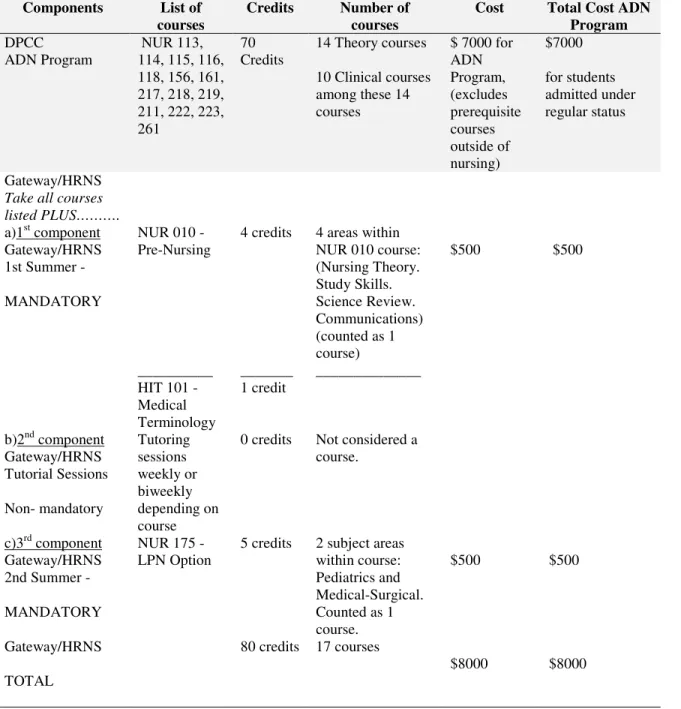
Gateway/HRNS components ……….. 89
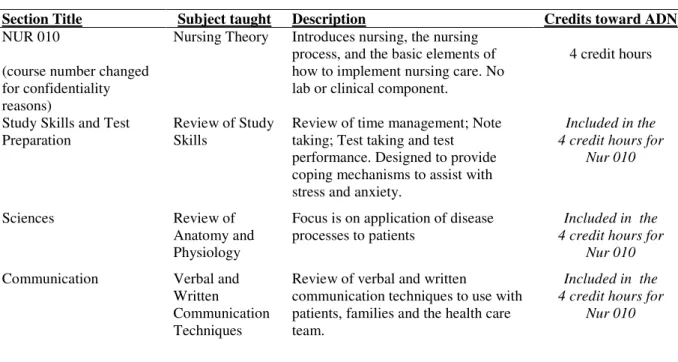
First summer pre-nursing component ……… 90
Theory tutoring ………... 95
Second summer LPN option ………... 95
Participant Selection ………... 97
Nursing faculty ………... 97
Gateway/HRNS ADN graduates ……… 99
Participant Contact Protocol ………... 100
Faculty focus groups’ protocol ………... 100
Faculty participants ………. 101
Graduate participants ……….. 102
Data Collection ………. 102
Semi-Structured Interviews ……… 103
Faculty Focus Groups ………. 104
Documents ……….. 107
Surveys ……… 108
Field Notes ……….. 108
Data Collection Pilots………... 109
Data Analysis ………... 112
Data Managing ……… 113
Reading and Memoing ……… 114
Describing, Classifying and Interpreting ……… 114
Representing and Visualizing ………. 114
Trustworthiness and Validity ………... 116
Triangulation ………... 121
Limitations ……… 122
Researcher as Instrument ………. 125
Summary of Chapter 3 ………. 127
CHAPTER 4: DATA COLLECTION ………. 129
Introduction ………...………... 129
Element One: Site and Participant Selection ………. 130
Site selection ………... 130
Participant selection ……… 130
Faculty participants ………. 131
Gateway/HRNS graduate participants ……… 133
Element Two: Participant Demographics ……….. 134
Faculty participant demographics ………... 135
Faculty for first summer pre-nursing course ………... 135
Faculty second summer LPN option course ………... 137
Gateway/HRNS graduate demographics ……… 138
Element Three: Participant Interviews ……….. 140
Element Four: Archival Documents ……….. 141
Nursing graduate data ………. 143
Cost of Gateway/HRNS Program ………... 146
Element Five: Field Notes ………. 151
Data Analysis ………... 151
Chapter 4 Summary ……….. 154
CHAPTER 5: DATA ANALYSIS ………. 156
How Were Faculty Recruited for the Gateway/HRNS Components………. 157
Both Focus Groups’ Data Analyzed Using Astin’s Theory of Student Involvement ………... 158
Astin’s postulate 1: Involvement refers to the investment of physical and psychological energy the student puts into his or her learning ……….. 158
Astin’s postulate 2: Involvement occurs along a continuum, meaning different students will exhibit different levels of involvement in a given task or object; likewise, the same student will have varying degrees of involvement in various situations ……… 162
Astin’s postulate 3: Involvement by the student incorporates quantitative and qualitative features, and can be measured accordingly. For
example, a student’s hours (qualitative) spent studying can be tabulated; and that same student’s recall of the information and comprehension of the text readings can be measured (quantitative) on
an exam ………... 165
Astin’s postulate 4: The amount of a student’s learning and personal development is directly proportional to the quality and quantity of their involvement ………... 170
Astin’s postulate 5: The efficacy of any educational policy or program is directly related to the capacity to increase student involvement. …….. 173
Gateway/HRNS Graduates and Astin’s Theory of Student Involvement ……… 177
Gateway/HRNS Graduate Participants (GP) ……….. 177
Astin’s postulate 1: Involvement refers to the investment of physical and psychological energy the student puts into his or her learning ……….. 178
Astin’s postulate 2: Involvement occurs along a continuum, meaning different students will exhibit different levels of involvement in a given task or object; likewise, the same student will have varying degrees of involvement in various situations ………. 180
Astin’s postulate 3: Involvement by the student incorporates quantitative and qualitative features, and can be measured accordingly. For example, a student’s hours (qualitative) spent studying can be tabulated; and that same student’s recall of the information and comprehension of text readings can be measured (qualitative) on an exam ………... 181
Astin’s postulate 4: The amount of a student’s learning and personal development is directly proportional to the quality and quantity of their involvement……… 183
Astin’s postulate 5: The efficacy of any educational policy or program is directly related to the capacity to increase student involvement ……... 184
Chapter 5 Summary ………. 188
CHAPTER 6: FINDINGS AND CONCLUSIONS ………... 190
Introduction ……….. 190
Summary of Chapters One to Five ………... 191
Findings and Implications ……… 193
Purpose of the Study ………... 193
Research question 1: What are the activities, characteristics, and outcomes of the Gateway program, using Stufflebeam’s CIPP framework (context, input, process, and product) to guide the analysis? ………... 193
Implications for Community Colleges ………... 197
Research question 2: What Gateway/HRNS program factors do graduates of the Gateway/HRSN program identify as beneficial in helping them persist, graduate and pass the NCLEX-RN licensure exam? ………. 199
Implications for Community Colleges ………... 201
Research question 3: How and in what ways does faculty teaching in the Gateway/HRNS program assist high-risk nursing students to persist, graduate and pass the NCLEX-RN licensure exam? ………. 202
Implications for Community Colleges ………... 203
Conclusion ………... 205
O’Sullivan Strive to Thrive (S2T) Model for High Risk Nursing Student Success………. 206
Steps in O’Sullivan Strive to Thrive (S2T) Model ………. 207
Step 1: Identify high risk students and admit to nursing as “conditional students” ………... 209
Step 2: Mandatory introduction to nursing ……… 210
Step 3: Mandatory weekly tutoring ………... 211
Step 4: Mandatory mid-curricular LPN option or review ………. 212
Step 5: Assign students a success coach ……… 212
Step 6: Assign students a faculty mentor ……….. 213
Step 7: Coordinate success seminars ………. 214
Step 8: Evaluate program ……….. 214
Recommendations for Further Study ………... 216
REFERENCES ……… 218
APPENDICES ………. 229
Appendix A: NLNAC Standards and Criteria for NLN Program Accreditation in the United States ……….. 229
Appendix B: Demographic Questionnaire for Graduate Participants ………. 234
Appendix C: Demographic Questionnaire for All Faculty Focus Group Participants ……….. 235 Appendix D: Informed Consent – Graduate Participant ………. 237
Appendix E: Informed Consent – Faculty Focus Groups ………... 238
Appendix F: Consent for Data Transcriptionist – Individual ………. 239 Appendix G: Gateway/HRNS – Interview Questions Graduate-Nurse Participant… 240
Appendix H: Interview Questions – Faculty Focus Group I ………... 242
Appendix I: Interview Questions – Faculty Focus Group II ………... 243
Appendix J: Conditionally Admitted Students’ Pre-Entrance Data ……… 244
Appendix K: Tutoring Sign-In ……… 245
Appendix L: Tutoring Design – for Regular Nursing Courses – One Hour ………... 246
Appendix M: Program Tracking – Graduate NCLEX Success ………... 247
List of Tables
Table Page
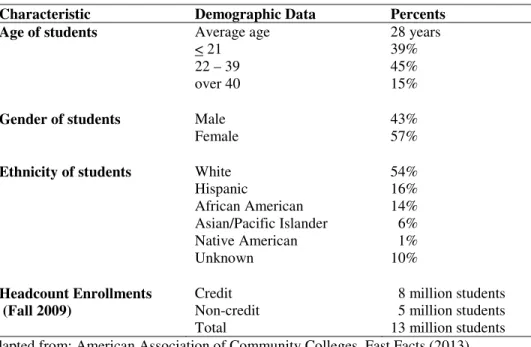
1. Demographics of Community College Students (2009) ………. 28
2. Estimated Number of Accredited Nursing Programs by NLNAC, CCNE, and AACN in 2012 ………. 48
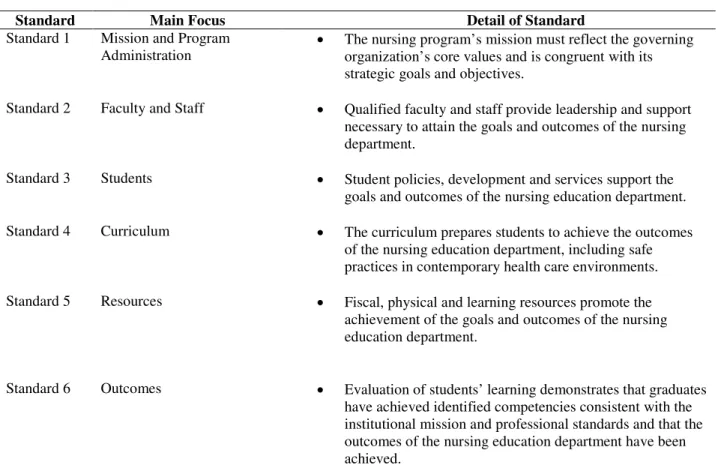
3. NLNAC Six Standards for Nursing Program Accreditation in the United States …... 50
4. Astin’s Theory of Student Involvement ……….. 64
5. Illustration of Items Possibly Reviewed in a CIPP Report ……….. 76
6. Quantitative and Qualitative Research Differences ………. 82
7. Three Gateway/HRNS Program Components ………. 90
8. First Summer Pre-Nursing Course for Gateway/HRNS – NUR 010 ……….. 94
9. Gateway/HRNS Selection Criteria for Faculty Participants ……… 98
10.List of Faculty Invited to Participate in Two Focus Groups ………... 100
11.Five Data Collection Methods Used in Study ………. 103
12.Comparing Qualitative Researchers’ Concepts of Trustworthiness ……… 121
13.Contact Protocol Data Source for Faculty and Gateway/HRNS Participants ………. 131
14.Demographics of NUR 055 – First Summer Pre-Nursing Faculty Focus Group …… 136
15.Demographics of NUR 151 – Second Summer LPN Option Faculty Focus Group ... 137
16.Demographic of Gateway Graduate Participants ……… 138
17.Time Frame of Participants’ Graduation, Licensure and Employment ……….. 139
18.Summarizes Additional Information Obtained from Gateway/HRNS Graduates ….. 140
19.NCLEX-RN First-Time Pass Rates for All DPCC ADN Program Graduates 1998-2011 ………. 144
20.NCLEX-RN First-Time Pass Rates for Non-Gateway ONLY Graduates 1998-2011 145 21.NCLEX-RN Pass Rates for Gateway/HRNS ONLY Graduates 1998-2011 ……….. 145
22.Amount of Annual Federal Funding ……… 146
23.Cost of First Summer Eight-Week Pre-Nursing Component ……….. 147
25.Cost and Revenue for Components of the Gateway/HRNS Program ………. 150 26.Gateway/HRNS Program’s Annual Revenue and Expense Summary ……… 150 27.Faculty’s Interpretation of Students’ Input of Physical and Psychological Energy
Into Gateway/HRNS Program ………. 161
28.Faculty’s Perceived Benefits of the Learning Continuum in Gateway/HRNS ……... 165 29.Ways Faculty Involved and Engaged Students in Learning ……… 169 30.Faculty Thoughts on How Quality of Involvement Was Important for Success ……. 172 31.Focus Groups’ Feelings on the Efficacy of the Gateway/HRNS Program Design in
Helping Students Succeed ………... 176
32.Graduates’ Feelings on Participation in the First Summer Introductory Course …… 179 33.Students’ Comments on Their Investment in Gateway/HRNS Program ……… 181 34.Benefits of the Program as Seen by Graduates ……… 183 35.Graduates’ Thoughts on Involvement With Various Parts of Gateway/HRNS …….. 184 36.Graduates’ Reviews of the Gateway/HRNS Components ……….. 185 37.Did Gateway/HRNS Contribute to Your Success and Attainment of an RN
License? ………...
187 38.Graduate Participants’ Views About the Weekly Tutoring Sessions ……….. 188
List of Figures
Figure Page
1. Three Levels of Nursing Care Providers……….. 34
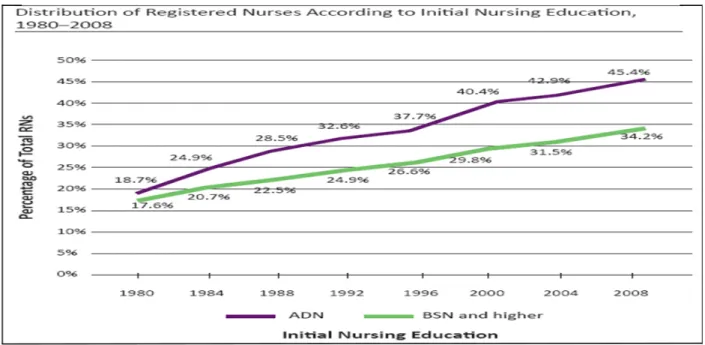
2. Distribution of Registered Nurses According to Initial Nursing Education 1980-2008……….. 40
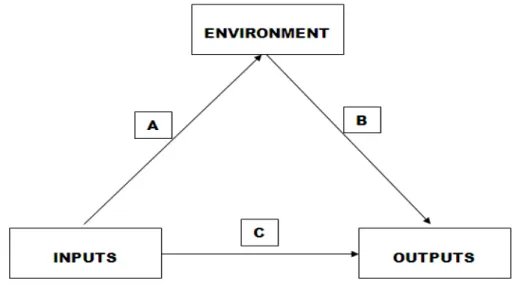
3. Interconnection of Astin’s I-E-O Core Concepts ……… 58
4. Balance of Astin’s and Knowles’ Theories of Adult Learners ……… 66
5. Creswell’s Data Analysis Spiral ……….. 113
6. Four Elements of the Data Collection Process ……… 129 7. O’Sullivan Strive to Thrive (S2T) Model for High Risk Nursing Student Success … 208
CHAPTER 1 INTRODUCTION
Professional Registered Nurses (RNs) have been caring for the sick in the United States and myriad other countries across the globe for centuries. Surveys report year after year that nursing has remained one of the most highly regarded professions for public trust. More nurses will be increasingly needed in the United States to meet the ever-growing demand for RNs in the wake of an aging America, upcoming large numbers of baby boom aged RNs retiring and
technological advances in the health care industry.
The United States Department of Labor, in an otherwise bleak economic picture in 2011, predicted that job opportunities in the nursing profession will grow by 22% through the year 2018, faster than the average for all other occupations (United States Bureau of Labor Statistics, 2011). In fact, the employment outlook for Registered Nurses (RNs) is highly promising. That is good news for people looking to enter the nursing profession, for high school students
investigating career options, and for anyone interested in pursuing a new career. Not all those with a desire to enter nursing school, however, successfully complete a nursing education program and obtain nursing licensure. That is the basis for this study.
The purpose of this research was to provide insight into the factors that help high-risk nursing students (HRNS) who participate in a specialized component of a community college Associate Degree in Nursing (ADN) program, called the Gateway/HRNS program, to persist, graduate and successfully pass the National Council Licensure Exam for Registered Nurses (NCLEX-RN). This chapter will serve as an overview of the research process, the research’s design and the intent of the study.
Background and Context of the Issue
Given the rapid growth of the over-65 population in the United States, estimated to more than double its current 40.2 million in 2010 to a projected 88.5 million by 2050 (Vincent & Velkoff, 2010), nurses will be needed in increasing numbers to assist with caring for an aging nation. Adding to those numbers will be an even larger expansion of those over 85 years old, with that population growing from 5.5 million in 2010 to 19 million by 2050 (Vincent & Velkoff, 2010). Considering most health issues occur over time as people age, the need for nurses will be ever-more present. Advances in health care technology, changing demographics, increasing diversity of populations, economic and social globalization, and higher expectations of the public seeking health care will require increasing numbers of educated nursing
professionals in the decades ahead (Heller, Oros, & Durney-Crowley, 2011).
In addition to the aging of the general population in America, the nursing workforce in the United States is also getting older. Given the professional and physical stress associated with nurses who have been working in direct care patient services for several decades, retirement beckons. According to research by the Health Resources and Services Administration of the United States Department of Health and Human Services, the aging of the nursing workforce is a demographic that will surely impact the profession. In 2008, the average age of RNs in the United States was 47.0 years, up from an estimated 46.8 years in 2004; 45.2 years in 2000; 42.3 years in 1996, and 38 years in 1988 (United States Department of Health and Human Services, 2010a). In 2008, for the first time in the past three decades, the rate of aging of nurses slowed but remained steady (United States Department of Health and Human Services Health Resources and Services Administration, 2010b). The aging of nurses however, remains of great concern for the future of the nation’s nurse workforce.
History of Nursing
Nursing as a modern-day profession is widely believed to have begun with Florence Nightingale, a well-educated, nineteenth-century daughter from a wealthy English family. Through her strong interest in science and mathematics, Nightingale believed nursing provided a needed and respectable social calling for women, who had few other career choices in the late 1800s and early 1900s (O’Connor & Robertson, 2003).
During Britain’s Crimean War of 1854, Nightingale decided to test her new-found
learning of infection control and cleanliness practices. Requested by the British government, she took a small group of nurses she had taught to soldiers in a military hospital in Turkey. The results of her work were astounding; death rates plummeted within weeks of her team’s arrival, and soldiers were not succumbing to illness due to poor sanitation. By the end of the war, the entire western world knew of and shared Nightingale’s beliefs in educated nurses (O’Connor & Robertson, 2003).
After the Crimean War, Florence Nightingale returned to Britain a celebrated woman, and opened the first modern-day school of nursing as the Nightingale Training School and Home for Nurses at St. Thomas’ Hospital in London in July of 1860 (Nelson, 2003). The hospital and school are still operating in 2013 as part of King’s College, London. A multitude of schools have been educating nurses across the world since St. Thomas’ first opened its hallowed doors.
Nursing Education
In the United States, students pursuing nursing education have the choice of three basic types of education programs: a) hospital-based diploma in nursing programs, b) community college two-year Associate Degree in Nursing (ADN) programs, or c) four-year Bachelor of Science in Nursing (BSN) degree programs.
To be employed in the nursing field, an RN with a community college associate’s degree must have graduated from a National League for Nursing (NLN) - approved RN education program, pass the RN national NCLEX-RN licensing exam, and already have their RN license to work as a nurse in the state where they are applying for a position. Having the RN License is crucial; without it, a “nurse” is not a nurse.
Once admitted to a nursing program, each course the student takes on the career track generally is a prerequisite for successive courses. Courses typically follow a prescribed,
chronological order from entry into the nursing program up to the end of the program before the student can graduate. Deviation from course order is not permitted.
Courses within a nursing program are pre-determined prior to the student’s admission and are mandatory, and courses have been sanctioned and approved by the NLN as meeting nursing education standards for entry level practice for registered nurses in the United States. No one course is generally allowed to be taken out of sequence. In other words, a nursing program itself has no elective courses. A student cannot substitute one course for another. All nursing courses in a nursing education curriculum are NLN authorized and are required regardless of whether or not the program is a Diploma-granting hospital school, an ADN granting community college or a BSN degree-granting college or university.
According to the federal government’s latest national survey of RNs in the United States, the ADN degree is the most commonly-reported initial nursing education degree of RNs working in the United States. It represents 45.4% of the nurses surveyed. Bachelor’s or graduate-level degrees were obtained by another 34.2% of RNs and 20.4% of RNs received their initial nursing education in hospital-based diploma nursing programs (United States Department of Health and Human Services Health Resources and Services Administration, 2010b).
Research Purpose Purpose of the Study
The purpose of this research study is to identify program factors of the successful
Gateway/HRNS program for high-risk ADN students that lead to their retention, graduation and passage of the NCLEX-RN licensure exam on the first attempt.
Research Questions
The three research questions arising from this study’s purpose are:
1. What are the activities, characteristics, and outcomes of the Gateway program, using Stufflebeam’s CIPP framework (Context, Input, Process, and Product) to guide the analysis.
2. What Gateway/HRNS program factors do graduates of the Gateway/HRNS program identify as beneficial in assisting them to persist, graduate and pass the NCLEX-RN licensure exam?
3. How and in what ways does faculty teaching in the Gateway/HRNS program assist high-risk nursing students to persist, graduate and pass the NCLEX-RN licensure exam?
Significance of the Study
With the shortage of nurses in the United States, nursing needs a way to attract more students into the profession. Given that the average student retention rate for the first year of Associate Degree nursing programs is 80% (National League for Nursing, 2006), nursing schools need to find ways to retain the remaining 20% of students that either fail courses or leave
programs, particularly from the beginning level nursing courses. The Gateway/HRNS program at DP Community College (a pseudonym) is designed to help high-risk nursing students be retained, graduate from the DP Community College (DPCC) nursing program, and pass the NCLEX-RN licensing exam. Begun in 1991 under a two year grant from the United States Department of Health and Human Services, Health Resources and Services Administration, the project was to last two years. The program was so successful that the grant received a one year
funding extension. Once the grant expired, program costs were assumed by the college and it has run continuously since 1994 as a permanent, regularly budgeted program, now in its 19th year (three years as a federal grant and sixteen years as a college-funded program).
Students admitted to the Gateway/HRNS program are identified only to the Nursing Department Chairperson and the Nursing Department Coordinator, who also serves as the Gateway/HRNS program’s lead faculty and coordinator. Students are not identified to other nursing faculty. These students must attend an “introductory” summer Gateway/HRNS component to prepare them for the regular, and more rigorous, nursing courses that begin the following August of each year immediately following their first summer introductory course. Teaching students a variety of material from nursing assessment to an anatomy and physiology review to therapeutic communication, the Gateway/HRNS program introduces students to information that they will actually be re-introduced to in the regular Fall semester a couple of months later.
According to DPCC’s Nursing Department records, Gateway/HRNS program students for the academic year 2005 were retained at a rate of 95% in the first year of the two year nursing program, compared to a retention rate of 83.6% of non-Gateway/HRNS nursing students at DPCC. The same year’s records show that Gateway/HRNS program students’ pass rates for the NCLEX-RN licensing exam were 90% versus 82% for non-Gateway/HRNS students at DPCC (Kubala, 2008). DPCC NCLEX-RN pass rates in 2006 were 95% for Gateway/HRNS students and 82% for non-Gateway/HRNS students. In comparison, the NCLEX-RN pass rates for Associate Degree educated nurses for the entire United States were 87.5% for 2005 (National Council of State Boards of Nursing, 2006) and 88% for 2006 (National Council of State Boards
of Nursing, 2007). Given the program’s success, and the need for nurses, DPCC made a long-ago commitment to continue the Gateway/HRNS pre-admission program permanently.
Another significance of this research’s findings could be that its worth may lead to other colleges creating a Gateway/HRNS program for their curriculums. If the study’s findings turn out to be as positive as expected, then the potential for such a program to help ease the United States’ foreshadowed nursing shortage in the coming decades is enormous. In actuality, such a program, or even pieces of the program, could be adapted or redeveloped in other countries with the objective to help those nation’s develop additional nurses in their own populations.
Brief Review of the Literature
The literature review offers a contextual lens and framework into the concepts and theories that situate this study, data analysis and findings. The purpose of the study is to determine success factors that enable high risk nursing students in a special component of a community college ADN program to matriculate the courses, graduate on time, and pass the NCLEX-RN licensure exam on the first attempt.
Historical Background and Context of the Study
TheAmerican community college system of education was born in 1901 with the creation of Joliet Junior College (JJC) in Joliet, Illinois as the country’s first public community college, with the school’s academics mirroring the first two years of a four-year college or university (Joliet Junior College, n.d.). Developed by William Rainey Harper, the then-President of the University of Chicago, and J. Stanley Brown, the superintendent of the Joliet Township High School, Rainey and Brown created JJC to accommodate local students who wanted to attend college while remaining in or near their hometown communities. Community colleges have expanded exponentially since those humble beginnings.
From inception, social forces prominent in structuring community colleges were “the need for workers trained to operate the nation’s expanding industries … and the drive for social equality, which supposedly would be enhanced if more people had access to higher education” (Cohen & Brawer, 2008, p. 1). The United States economy was growing, and workers needed education for new jobs being created. One way to more rapidly train these new industrial workers, and alter social equality by enabling them to attain better jobs, was through securing a two-year community college Associate’s Degree education.
Another reason for acquiring an Associate’s Degree is that it allows graduates to increase their incomes as it opens doors to more employment opportunities. “There is a correlation between higher levels of education and higher earnings for all racial/ethnic groups and for both men and women” (Baum & Payea, 2005, p.7). Indeed, even some college has shown to produce clear personal and societal benefits compared to no college experience.
Nursing Education
Nursing schools, in various countries around the world, have been formally educating nurses since the late 1800s. Prior to the establishment of “nurses’ training schools”, nurses had no formal training or education. When the Civil War broke out in the United States, “there was no provision for military nurses …. At the time, there were no nursing schools, no “trained” nurses, and no nursing credentials. The title “nurse” was also rather vague …” (Egenes, 2009, p. 6). The need for formal training in structured educational environments was apparent.
Nursing assumed the role originally of filling a societal need for trained healthcare workers. The world’s first formal modern-day training school for nurses, The Nightingale Training School and Home for Nurses at St. Thomas’ Hospital in London, England was opened by Florence Nightingale in 1860 (Nelson, 2003). In the United States in 1873, Linda Richards
became the nation’s first graduate nurse after completing a one-year nurse training course at the New England Hospital for Women and Children in Boston, Massachusetts (Richards, 1915).
In 1905, Annie Warburton Goodrich became the first woman named president of the American Society of Superintendents of Training Schools for Nurses and established guidelines for nurses’ education and training. She went on to become president of the International Council of Nurses as well as president of the American Nurses Association. She developed, and in 1924 became the dean of the first autonomous nursing program in the United States at Yale
University, still operating today (American Nurses Association, 2011). Other colleges and universities developed nursing schools in the years that followed.
Nursing education in community colleges. Nursing students originally received their education in hospital-based three-year diploma schools of nursing, from where they received a diploma in nursing. This enabled a graduate to sit for the NCLEX-RN board exam to gain licensure as a registered professional nurse.
After World War II, the country was hit with the realization that not all nurses in practice during wartime wanted to remain in peacetime practice. Thus a nursing shortage developed. Community colleges wanted to help. “As early as 1945, the American Association of Junior Colleges (AAJC), now recognized as the American Association of Community Colleges
(AACC), during a meeting with the United States Office of Education, discussed the possibility of including nursing in junior college curricula” (Haase, 1990, as cited in Mahaffey, 2002).
The federal Bolton Act of 1943 (Petry, 1943) funded nursing education and paid a living stipend to nursing students to increase the numbers of nurses in the United States. The
gross national product on healthcare, and thus discontinued the funding for nursing education in 1948. A nursing shortage loomed once again (Haase, 1990, as cited in Mahaffey, 2002).
The W. K. Kellogg Foundation was instrumental in funding several initiatives in the development of Associate Degree nursing education in the United States. In January 1952, a consortium project at Teacher’s College at Columbia University implemented an Associate’s Degree nursing program that attracted older, married females and males that sought to alleviate the critical shortage of nurses by decreasing the length of the education process to two years from the original diploma programs’ three years. The W. K. Kellogg Foundation in 1958 funded the project at seven pilot sites in four states. It was a success. Those original seven burgeoned to 600 Associate Degree programs today (National Organization for Associate Degree Nursing, 2006). Associate Degrees in nursing remain today the most common way for students to receive their primary nursing education in the United States and to be eligible to sit for the NCLEX-RN licensing exam (United States Department of Health and Human Services Health Resources and Services Administration, 2010b).
Adult learning. Conceptually, learning has until more recent times been based on pedagogical learning principles, meaning the way children are taught, through reading and memorizing facts and information, with subsequent testing of the information on graded exams. Through pedagogy, teachers assume responsibility for students’ learning, and the how, what and when it will be learned. Teachers orchestrate and direct the learning (Conner, 2005).
Adults, though, learn differently from children. Psychologist Malcolm Knowles studied adult learning in connection with Human Resources and Organizational Development and theorized principles of adult learning. Considering community colleges’ customers are adults, Knowles’ principles of adult learning can relate directly to community college students. The
principles include self-directed learning for adults, application of life experiences to a student’s learning process, showing relevancy for what the adult is learning, practically-focused learning and showing respect for students as adult learners (Lieb, 1991).
According to Knowles, Holton, and Swanson (2011):
The fact is that all scientific theories of learning have been derived from the study of learning by animals and children. It is obvious that the conditions under which animals learn are more controllable than those under which children learn; and the conditions under which children learn are more controllable than those under which adults learn (p. 12).
Indeed, Knowles et al. (2011) said, “Authoritative teaching, examinations which preclude original thinking, rigid pedagogical formulae – all these have no place in adult education …” (p. 37). Consequently, adult learning – practical, relevant, respectful learning - is what takes place in community colleges. Understanding how adults learn and incorporating those principles in the planning of a program of education is a fundamental construct to this research as the intent and the expectation of the Gateway/HRNS program is to provide the most beneficial assistance to those identified as nursing students at high risk for failure.
Conceptual Framework for the Study Program Evaluation
Program evaluation consists of a systematic assessment of a program, and carefully collecting information about the program, in order to make necessary decisions about the program (McNamara, n.d.). The term “program” may be interpreted as being any organized action such as a media campaign, service provision, public policy, research project or an educational program. Evaluation may be performed to demonstrate a program’s efficacy and worth to its stakeholders, funders, constituents and users, as well as to the general public.
There exists a wide variety of evaluation formats that many disparate businesses, industries, companies, services and schools use to evaluate programs and services. These evaluations can be industry-focused, like an evaluation method for a school’s curriculum, or a self-study evaluation procedure for the NLN that colleges of nursing perform, or the Joint Commission on Accreditation of Healthcare Organizations’ (JCAHO) evaluation for a hospital’s tri-annual accreditation survey. Whether informal and unstructured, or formal and structured, it behooves an organization to evaluate its programs and services periodically to determine whether its goals and objectives are being met, or to assess whether or not customers or users are being served in the intended manner. In this study, a general-purpose program evaluation and a theory of student involvement will be reviewed subsequent to data collection.
Stufflebeam’s CIPP Model for Program Evaluation
According to McLemore (2009), Daniel Stufflebeam’s CIPP (context, input, process and product) model for program evaluation was “developed as a comprehensive framework for guiding formative and summative evaluations of projects, programs, personnel, products, institutions and systems.” (p. 1). The model can be used in companies’ and businesses’ internal departments or company evaluations, self-evaluations, and structured external evaluation
processes. CIPP was designed to connect the evaluation process with decision-making about the program or service being evaluated. Used for purposes of accountability, it provides a record of the evaluated program’s needs, objectives, plans, activities and outcomes.
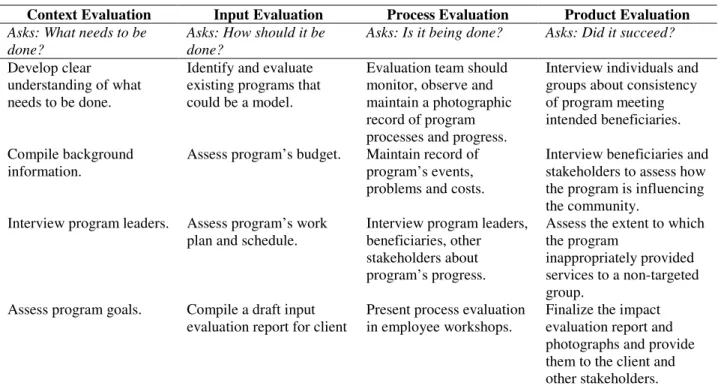
Stufflebeam and Shinkfield (2007) said “evaluation is society’s most fundamental discipline … oriented to assessing and helping to improve all aspects of society.” (p. 4). Stufflebeam’s CIPP model of assessment and evaluation has been used worldwide since its development in the late-1960s. Context evaluations (“C” in CIPP) assess needs, problems, assets
and opportunities to help decision makers define goals and priorities and to judge them as well as to judge whether or not outcomes have been met. Input evaluations (“I” in CIPP) assess
alternative approaches, competing actions, staffing and budget plans for their feasibility and cost-effectiveness. Process evaluations (“P” in CIPP) assess implementation plans that assist staff to carry out an activity and for users to be able to judge program performance. Product evaluations (second “P” in CIPP) identify and assess a project’s intended and unintended outcomes to help maintain the program’s focus and help staff decide whether or not planned needs are being met (Stufflebeam, 2003).
Astin’s Theory of Student Involvement
Alexander Astin’s (1999) theory of student involvement and its impact on student retention and subsequent college graduation is explored in relation to high risk students in this study. The underlying principle forAstin’s theory states the more a student is involved in and committed to their learning, the more success they will realize.
According to Astin, through college students being connected, engaged, and involved in their learning, regardless of the content, educational success rates rise. This research study will examine involvement of high risk students in a special component of an existing nursing
program in a community college. Using this special nursing program for the analysis of data will permit a better understanding of the impact of student involvement to the learning process, particularly for students in this study’s program, the Gateway/HRNS program.
Study Design
Research design is what is used to investigate a study’s research questions (Johnson & Christensen, 2008). Selecting the best research design for this study involved comparing both quantitative and qualitative research methods to decide which one would best suit the research,
the participants and the anticipated findings. Quantitative research involves working with large quantities of study participants and aggregating results into numbers, or collecting numerical data. Qualitative research, on the other hand, involves asking questions of participants and taking notes on their responses; in other words, the collection of non-numerical data. Findings are generated and interpreted through participants’ words, feelings and discussions. A
qualitative method of research is adapted for this study since the study will attempt to analyze factors that students and faculty identify in their own words as being helpful for students to graduate and then pass the NCLEX-RN exam.
Qualitative research involves words and ideas of study participants that cull participants’ words into a series of representations about how participants perceive their world through field notes, interviews, conversations, possibly photographs, recordings and memos (Creswell, 2007). The researcher asks specific questions of participants; possibly reviews memos, studies
recordings, and looks at photographs that relate to the topic of research. The more information the researcher can obtain from study participants, the better the quality and the more weight the information will carry for the eventual value and credibility of the research and its findings.
Qualitative research generally uses a scientific exploratory means of investigating a phenomenon. Qualitative researchers see human behavior as fluid and dynamic, and changes depending on time and place. The qualitative researcher wants to get thick, heavy, rich and detailed information from study participants since participants’ behaviors and beliefs are not generalizable to large groups; rather, those beliefs are expected to depend on the situation and framework of participants as well as being context bound (Johnson & Christensen, 2008), relating specifically to the topic – in this case the Gateway/HRNS program students – being studied.
Creswell (2007) notes that, “Qualitative research begins with assumptions … and the study of research problems and inquiring about the meaning individuals or groups ascribe to a social or human problem” (p. 37). In studying the Gateway/HRNS components of the regular DPCC nursing program, the researcher hopes to acquire students’ and faculties’ perceptions, feelings, thoughts and ideas of what they believe help students to make it through the DPCC nursing education program and eventually graduate and pass the NCLEX-RN to obtain an RN license. Obtained from participants, such valuable information is crucial to the success and the continuation of the Gateway/HRNS pre-admission program and to this research’s findings and discussion.
Site Selection
This research involved a specific program of study for nursing students in a suburban community college. The site was DPCC in northwest suburban Chicago, Illinois. The college offers 2500 courses to students, from Associate Degree credit programs of study to non-credit career enhancement and personal enrichment offerings on two nearby campuses. The nursing program is located on the main campus and annually admits two cohorts of students – a Fall admission cohort in August and a Spring admission cohort in January. After completing all college and program requirements, students graduate approximately 21 months later with officially an Associate of Applied Science degree in nursing, more commonly referred to in literature and colloquially as an Associate’s Degree in Nursing (ADN). This was a single site study because this community college is precisely where Gateway/HRNS originated as a grant-funded program, at this one college, in 1991. It has continued since then without interruption.
Data Collection
Data collection in any research is the means by which the researcher obtains information on the topic being researched. In other words, the data collection phase of research is the information gathering phase. Through various data collection methods – tests, questionnaires, interviews, focus groups, observations, secondary or existing data (Johnson & Christensen, 2008) – the researcher obtains the requested data from study participants.
This research study attempted to identify program factors of the successful
Gateway/HRNS program for high-risk ADN students that led to their retention, graduation and passage of the NCLEX-RN. The study also made recommendations for improving, expanding or maintaining the Gateway/HRNS program. The appropriate data collection procedure to gather this information followed a bounded case study design. Actual data collection methods included a) semi-structured high risk nursing graduate interviews, b) faculty focus groups, c) surveys, d) program documents, and e) archival documents.
These data collection methods were appropriate for the study because they garnered deep, rich, personal information about the Gateway/HRNS program for “conditionally admitted” nursing students. The answers to the questions posed to program graduates and faculty, as well as the review of appropriate documents and surveys, afforded the researcher details of
participants’ thoughts, ideas, feelings and concepts about the value, worth and success of the Gateway/HRNS program.
Participant Selection
Participants interviewed for this research study needed to be graduates of the ADN program at DPCC. Six participants were solicited who were accepted “conditionally” into and maintained status as a Gateway/HRN student throughout the program until graduation. They had
each passed their NCLEX-RN on the first attempt and had possessed registered nurse (RN) licensure to be included as study participants. Current and active employment as an RN was not required to be a study participant.
Faculty who taught in the two summer components of the Gateway/HRNS program were also invited as study participants to gain insight into what they believed were important
components of the program that helped students succeed. DPCC’s entire nursing school faculty did not teach in the Gateway/HRNS program; therefore not all nursing faculty were invited to participate.
Demographic Survey/Background Information Questionnaire
A demographic survey was obtained from research participants prior to their participation in the survey. Their names (pseudonyms), years of graduation from the ADN program, and the year they passed the NCLEX-RN and whether or not they were working as an RN was obtained. Graduates’ names were correlated with the Gateway/HRNS program’s nursing department files at DPCC to assure that chosen participants were in fact Gateway/HRNS and DPCC ADN graduates.
Focus Groups
Faculty who taught in the Gateway/HRNS program were invited to take part in two separate focus groups. Faculty participants were those who taught in the first summer component of Gateway/HRNS, and a different group of faculty who taught in the second summer component. The focus group was thought to be the most conducive for faculty evaluating a program when the desired information about students’ behaviors and motivations were believed to be more complex than the researcher might otherwise have obtained from a questionnaire (New York State Teachers Center, 2008). The focus group also helped to see
whether or not faculty felt a consensus about how the Gateway/HRNS program helped
Gateway/HRNS students to succeed through the program and pass their nursing licensure exams.
Interviews
Six graduates of the Gateway/HRNS program were asked to participate in semi-structured interviews. Interviews of these graduate participants were conducted to gain their thoughts, ideas, insights, feelings and perceptions of how the special Gateway/HRNS program assisted them to succeed in the regular ADN program and pass the NCLEX-RN exam.
Interviews were conducted face-to-face in a comfortable setting and at a time mutually agreed upon by the researcher and interviewees.
Archival Documents
Archived documents from the Gateway/HRNS program were analyzed to discover the nature of the program, how and why it was formulated and designed, its original objectives and who administered it. Discovery of this special program’s original vision for student success, stemming from its program objectives will be crucial. The number of students initially admitted to the first Gateway/HRNS, and what, if any stipulations the college placed on them was also determined. It should be duly noted that some archived documentation were absent or otherwise irretrievable considering the age of this special assistance program.
Documents reviewed included State of Illinois grant reporting requirements, since the original Gateway/HRNS program was funded through a state grant which has long since expired. Other archival documents included the DPCC Nursing Department’s files related to the
Data Analysis Procedures
This research was a qualitative case study and employed the study’s conceptual
framework to analyze the data and information gathered. As Leedy and Ormrod (2010) note, the researcher would “begin with a large body of information and must, through inductive reasoning, sort and categorize it and gradually boil it down to a small set of abstract, underlying themes” (p. 152). That was the case for this study. Each of the graduate interviewees and faculty members was anticipated to give myriad details about their thoughts, feelings and experiences while in the Gateway/HRNS program for high-risk nursing students. This information was transcribed and then coded and analyzed by the researcher to draw similarities, themes, patterns, and conclusions from the data collected. Alexander Astin’s Theory of Student Involvement and Daniel L. Stufflebeam’s CIPP Model for Program Evaluation were utilized to assess the efficacy and worth of this special program for educating high risk nursing students to become licensed Registered Nurses.
Organization of the Dissertation
The purpose of this study was to provide insight into the program factors that helped high risk nursing students (HRNS) who participated in the Gateway/HRNS program at DPCC to persist in their education and successfully pass the National Council Licensure Exam for Registered Nurses (NCLEX-RN) on the first attempt in order to be eligible to work as RNs.
Chapter One provides a brief overview of the issue, an introduction of the purpose of the research, and articulates the research questions for the study. Brief overviews of the research’s methodology and related literature are also included. The significance of findings will assist other ADN programs, and possibly even university nursing programs, thatmay be interested in developing their own assistance programs for high risk students within their curriculums.
Chapter Two reviews the literature pertinent to this research. The historical context of the study focuses on the beginnings and eventual growth and development of the community college system of education in the United States. This chapter also relates the development of nursing education, both in history and in the United States. Also discussed is Alexander Astin’s theory of student involvement and its relationship to student success, as well as the importance of Malcolm Knowles’ principles of adult learning in community college education. Finally, Daniel L. Stufflebeam’s CIPP model for program evaluation is discussed and later employed in an evaluation of this special program.
Chapter Three provides details of the research methodology. The study design describes site and participant selection, a data collection pilot and informed consent of participants. Particular attention is accorded the participant selection process and participant contact protocol due to their absolute criticality to the study. A detailed description of the researcher as the study’s research instrument helps to provide a transparent view of this important aspect to this qualitative study. The chapter later discusses the importance of trustworthiness, reliability, validity and rigor of the study.
Chapter Four describes the data collection process and summarizes the data gathered. Myriad data sources were used which included semi-structured interviews, focus groups, documents and field notes. Tables throughout the chapter illustrate related information. Also included is a discussion of how data analysis is accomplished using Astin’s theory of student involvement and Stufflebeam’s CIPP model for program evaluation.
Chapter Five presents and analyzes the actual data collected through interviews, focus groups and document reviews. Rich, thick, detailed descriptions are presented in the form of quotations from participants as well as in descriptive tables. These data were subsequently
discussed and analyzed in the chapter. Analysis aggregates data obtained from the two individual focus groups and also the six graduate participants. The analysis of participants’ perspectives and information provided is ultimately the basis of this study’s research findings, conclusions and implications for other community college ADN programs and four year baccalaureate nursing programs.
Chapter Six presents the factors that assist these special Gateway/HRN students to matriculate, graduate and pass their RN licensure exam on the first attempt. A summary and interpretations of insights provided by participants are also presented in this chapter, along with a summary of findings and implications for practice. The chapter includes presentation of the O’Sullivan Strive to Thrive Model for Student Success, which can be adapted by any college nursing program that employs a program component for high risk nursing students. Suggestions are included for possible future research that can contribute to the success of high risk nursing students as well as high risk students in other disciplines, regardless of the subject matter or nature of the learning.
CHAPTER 2
REVIEW OF THE LITERATURE Introduction
The United States is heading into a major nursing shortage that has potential to severely disruptthe United States healthcare system (Buerhaus, 2008). Due to the confluence of disparate factors such as the Baby Boomer nurses nearing retirement, a decrease in the number of students entering the nursing field, and an overwhelming shortage of required Master’s prepared nurse faculty, there will be far fewer nurses than needed. This will be reflected in insufficient numbers of nurses to provide direct and indirect health care for patients and clients in hospitals,
rehabilitation centers, nursing homes, outpatient clinics and doctors’ offices. However, this current and future nursing shortage can be ameliorated by admitting more students to registered nurse education programs across the country.
Some of these new nursing students will meet or exceed the admission requirements for nursing programs while others admitted will be considered what is generally known as “high risk” students. To ensure that these high risk nursing students will be successful and working professional nurses, they need consistent and appropriate academic support in order to facilitate educational persistence and graduation.
Pursuing a nursing career is not easy. Simply to apply for entrance into a nursing program, a student must prepare by successfully passing prerequisite college credit courses as well as an entrance exam specified by the college and the nursing program. In most nursing programs, potential nursing student application files are then reviewed by the nursing program’s admission committee and assigned an academic “ranking” based on admission criteria being met. Since competition for seats in nursing programs is substantial, many individuals with a desire to
be a nurse and who meet all of a program’s entrance requirements and “ranking” for admission, are forced to wait several years before being granted admission.
Once finally admitted, students are excited and relieved. However, considering the academic rigor of nursing programs, the concern after a student is accepted and enrolled soon shifts from admission to being successful and graduating from the nursing program. Once enrolled, persisting to graduation and passing the National Council of Licensure Examination for Registered Nurses (NCLEX-RN) is difficult for any nursing student. However, it can be
especially problematic for the academically underprepared, high risk nursing student.
To better address this dilemma of academic support for high risk nursing students, one Illinois community college developed a program for high risk nursing students (HRNS) to help them reach the goal of becoming registered nurses (RNs). While this program has been
successful for nearly twenty years, the reasons for that success and the factors central to why it has been a success have not been investigated in order to be replicated.
The purpose of this exploratory research study is to identify factors of the successful Gateway/High Risk Nursing Student (HRNS) program embedded within the community college’s Associate Degree in Nursing (ADN) program that foster student retention, graduation and passing of the NCLEX-RN licensure exam. The study strives to understand how and in what ways this Illinois community college’s Gateway/HRNS program assists the underprepared nursing student to graduate and pass the licensure exam, and to share that information with other nursing programs. In essence, the study will assess and gain an understanding of the components of this unique assistance program that serves underprepared, high risk students as a “jump-start” or “gateway” for success in the nursing program.
Because of the complexity and holistic nature of the discipline of nursing, it is crucial to evaluate this specific Gateway/HRNS program utilizing a program evaluation model that has previously been used to evaluate all types of disciplines as well as nursing education programs. After review of various program evaluation models (Astin, 1999; Metz, 2007; Stufflebeam, 1983, 2007), because of its depth and breadth, the most complete and appropriate model for this research is Daniel Stufflebeam’s (2007) CIPP Model of Evaluation. The components of the CIPP model are: C = Context; I = Input; P = Process; and P = Product. This model has been used extensively to assist with nursing program assessments and has also been employed for program evaluation in a myriad of other social disciplines.
This chapter provides a review of the literature relevant to high risk college nursing students and with what helps them succeed in higher education. The chapter includes the following: a) history of the community college; b) current nursing education in the United States; c) review of registered nurse (RN) education in community colleges; and d) the study’s conceptual framework. The conceptual framework is comprised of a concept, a model and a theory which are: a) the concept of program evaluation; b) Daniel L. Stufflebeam’s (1966, 1967, 1972, 1983, 2000, 2001, 2003, 2007) Context, Input, Process and Product (CIPP) model for program evaluation; and c) Alexander Astin’s (1984, 1985a, 1985b, 1993, 1996) Theory of Student Involvement. These provide the lens in which this research is situated and with which data is analyzed leading to the study’s findings. This research topic is examined within the context of an associate degree in nursing (ADN) program in one Illinois community college and this specific conceptual framework.
Historical Background of Community Colleges
TheAmerican community college system of education began in earnest in 1901 with the creation of Joliet Junior College (JJC) in Joliet, Illinois, universally acknowledged as the United States’ first public juniorcollege. This concept of a two year junior college was conceived and developed by William Rainey Harper, the President of the University of Chicago, and J. Stanley Brown, the superintendent of the Joliet Township High School. Harper and Brown developed JJC to accommodate local students who wanted to attend college while remaining in or near their home communities. This “junior college” and its academic mission were fashioned to mirror the first two years of a four-year college or university (Cohen & Brawer, 2008).
Community colleges have expanded in numbers exponentially since those beginnings. Today there are 1,132 community colleges serving nearly seven and a quarter million full-time and part-time students in credit-bearing courses in the United States (American Association of Community Colleges, 2011). From their inception, the rationale for establishing these junior colleges was to provide the underprepared students with the first two years of a college education before transferring to a four year institution. In essence, the university leaders wanted to
maintain their elite position and focus on the higher levels of academic learning and research. Later, in the 1930s, the United States economy was growing, manufacturing was
booming, and workers needed to be educated for new jobs being created. Junior colleges rose to the challenge and began developing and providing courses to ready workers for these new jobs. Two benefits were accorded students attending classes at junior colleges. First, these students were able to remain close to home and secondly, these junior colleges were much more affordable than universities. Interestingly, these benefits remain to this day for students attending two year post secondary institutions.