Timed Encryption and Its Application
Shaoquan Jiang
School of Computer Science and Engineering University of Electronic Science and Technology of China
Abstract. In this paper, we propose a new notion of timed encryption, in which the encryption is secure within timetwhile it is totally insecure after some timeT > t.We are interested in the case where t and T are both polynomial. We propose a concrete construction that is provably secure in the random oracle model. We show that it can be generically (although inefficient) constructed from a timed commitment of Boneh and Naor (CRYPTO’00). Finally, we apply this primitive to construct a deniable secure key exchange protocol, where the deniability and secrecy both hold adaptively and the adversary can conduct session state reveal attacks and eavesdropping attacks in the non-eraser model. Our protocol is the first to achieve each of the following properties: adaptive deniability admitting eavesdropping attacks and deniability admitting session state reveal attacks in the non-eraser model. Our protocol is constructed using a timing restriction (inherited from the timed encryption). However, the requirement is rather weak. It essentially asks a user to respond to a ciphertext as soon as possible and hence does not artificially cause any delay. Our usage of timed encryption for the deniability is to use the forceful decryption to obtain the plaintext and hence does not use any random oracle assumption (even if the secrecy proof needs this).
Key Words.Public-key Encryption, Key Exchange, Deniability
1 Introduction
We propose a new notion oftimed encryption. Intuitively, a sender can encrypt a messagem using a receiver’s public key pk such that the latter can normally decrypt using his private key d. It further requires that any one without d can not decrypt the ciphertext within time t while after time T, any person can decrypt it. In this primitive, neither encryption nor decryption needs a trusted agent or needs any interaction. We are interested in the setting where both t and T are polynomial. Practically, t might be a few seconds and T might be is one day. Simply speaking, a timed encryption is a regular public-key encryption, except that it is secure only in timetwhile it is completely insecure after time T > t. It has applications in auction, delayed message broadcast and deniable authentication/key exchange. In auction, it is desired that during the bidding phase, bidders can cast their bids such that no one can read it within timet while it is publicly readable after timeT > t. This can be realized using a timed encryption with a private key known to nobody. A more interesting setting is deniable authentication where a sender authenticates a message to a receiver while the latter can not prove to a third party the fact of the sender’s presence. To achieve this, the receiver can first send a secret key using the sender’s timed encryption. The sender then decrypts this key and uses it to authenticate the message back within time t. Since no one except the sender can reply within timet, the authentication is guaranteed. Finally, after timeT > t, since anybody can decrypt the authentication key and create the authentication tag, the deniability is achieved.
1.1 Related Works
t the owner of the private key is the unique person that can decrypt the ciphertext while in their notion no one can decrypt during this period. Due to this difference, none of the known timed-release encryptions can be easily converted to a timed encryption in our notion. Timed-timed-release encryption has two types of approaches.
Time-lock puzzles. In schemes in [27, 29] and the follow-up [25], a sender generates a RSA scheme and uses the factoring to compute 2t squarings efficiently in order to encrypt a secret while any other person does not have this factoring and hence has to manually repeat 2t squarings in order to decrypt it, due to which the decryption delay is achieved. Note this is different from a timed encryption since it is the sender (instead of a receiver) that knows the factoring.
Trusted Agents. In this approach, the time-delay is achieved since the decryption requires a secret from trusted agents who will release it after timet. The release can be done interactively or non-interactively. See [7, 17, 10, 13, 11, 12, 28] for references.
Identity-based encryption (IBE) [4] can achieve the delay through a decryption key control, where the identity includes a particular release-time and the decryption secret is available only after this time. This essentially still assumes a trusted agent.
Our timed encryption is different from theirs in that we do not assume any trusted party. A more related direction is timed-commitment by Boneh and Naor [8], where a committer can commit to a messagemand within timetthe messagemremains confidential while after timeT the de-commitment can be opened forcefully. They used the time-lock puzzle based on the sequential nature of RSA modular squaring as in [29] to construct a timed commitment. They also applied this commitment into construct a timed signature. Garay and Jakobsson [20] applied timed commitment techniques to achieve the timed-release property for some standard signatures.
1.2 Contribution
In this paper, we propose a new notion of timed encryption, in which the encryption is secure within time t while it is totally insecure after time T > t. We are interested in the case where t and T can be both polynomial. We propose a concrete construction that is provably secure in the random oracle model. We also propose a generic construction from a timed commitment of Boneh and Naor [8]. Finally, we apply this primitive to construct a deniable secure key exchange protocol, where the deniability and secrecy both holds adaptively and the adversary has the capability of issuing session state reveal attacks and eavesdropping attacks. Our protocol is the first to achieve each of the following properties: adaptive deniability admitting eavesdropping attacks and deniability admitting session state reveal attacks both in the non-eraser model. Our protocol works in a timing model (inherited from the timed encryption). However, our timing restriction only requires a user to respond to a message as soon as possible and hence does not artificially cause any communication delay. Pass [9] noticed that deniability in the random oracle model is not trustable. Our deniability proof for the protocol only uses the forceful decryption algorithm of the timed encryption and hence does not depend on a random oracle assumption (even though the secrecy property of the encryption might use it) .
2 Definitions
In this paper, we always use κ to denote the security parameter. PPT stands for probabilistic polynomial time. AlgorithmA(e.g., encryption or commitment) with inputmand randomnessr is written asA(m;r).When ris unspecified, simply write it asA(m). x←A(m) denotes the random output ofA with input m and unspecified randomness.
2.1 Timed Encryption
Timed encryption essentially is a public-key cryptosystem, which, besides the normal encryption and decryption, has a forceful decryption algorithm without a key but using longer time. In this paper, we are interested in the case where both the forceful decryption and normal decryption (with a key) run in a polynomial time. Here we need to be careful about the runtime as it depends on the space model. Specifically, an algorithm implemented in the parallel model runs faster than one in a non-parallel model. This problem has been noticed by Boneh and Naor [8] when they definetimed commitment. They used theparallel random access machine(PRAM) model for this purpose, where an adversary can be implemented usinganypolynomial number of parallel processors. Practically, due to the hardware cost, the degree of parallelism is a priori bounded. Hence, it is useful to consider a bounded PRAM. For a fixed polynomialα, we call an adversary withαprocessorsan adversary in the α-PRAM model or simply anα-PRAM adversary.
Definition 1. A triple of algorithms (G, E, D) is a public key encryption. It is a secure (α, t, T) -timed encryption if the following holds. Let(e, d)←G(1κ).
• Completeness. A ciphertext generated through the specification can always be correctly de-crypted using d. In addition, there exists an algorithm T of time T such that T(C) = Dd(C)
holds for any string C, except for a negligible probability.
• Secrecy. Any PPT α-PRAM adversary A only has a negligible advantage in the chosen ciphertext attack below.
- Challenge. A comes up with two messages m0, m1 of equal length as a challenge pair. In
turn, he will receive Cb =Ee(mb) for b← {0,1}.
- Decryption. A can issue any decryption query C ̸= Cb and receive Dd(C). Finally, he
outputs a guess bit b′ for b. He succeeds if b′ is computed within time t from receiving Cb
and b′=b.
If (G, E, D) is a secure (α, t, T)-timed encryption for any polynomial α, then we call it a secure
(t, T)-timed encryption.
Note that conventionally a CCA2 adversary can issue decryption queries before a challenge query. However, this is unnecessary for timed encryption since the runtime before a challenge is unrestricted (other than PPT) and the attacker thus can run the forceful decryption himself.
2.2 Timed Commitment
Timed commitment is a special commitment whose secrecy is guaranteed only within a given time. It was proposed by Boneh and Naor [8]. Our timed encryption is motivated by this. A timed commitment consists of a committer S and a receiver R and proceeds in three phases.
Open phase: In the open phase, S sends the stringw to R. Then, they execute a protocol DCom, at the end of which R obtains a proof thatwis the committed value.
Forced open phase: IfS refuses to execute theopen phase, there exists an algorithmF-Openthat takes cas input and, within time T, outputswand a proof that w is the commitment inc.
In the security definition, Boneh and Naor requires the commitment remains confidential against any polynomial time PRAM adversary. As for the timed encryption, a α-PRAM model is also practical. We relax Boneh and Naor’s definition to the following.
Definition 2. Algorithm TC = (TC.Com,TC.DCom,TC.FO) is (α, t, T)-secure timed commitment if it satisfies:
Completeness: When R accepts in the commitment phase, his output c must be a valid commit-ment for some w∈ {0,1}n such thatTC.FO(c) =w.
Binding: If TC.Com(w) = c, then S can not convince R in the decommitment phase that c is a commitment of w′ ̸=w. This holds information theoretically.
Soundness: At the end of commitment phase, R is convinced that there exists a forced open algorithmTC.FO(c) that outputs the committed string w in time T.
Privacy: For any α-PRAM adversaryA of time t < T, |Pr[A(tr, w) = 1]−Pr[A(tr, w′) = 1]|is negligible, where tr is the transcript in the commitment phase and the probability is over coins of
S and R.
If TC is(α, t, T)-secure for any polynomial α, then it is a (t, T)-secure timed commitment.
3 Timed Encryption in the Random Oracle Model
In this section, we construct a concrete timed encryption in the random oracle model. The idea is to decompose a secret into many partial secrets. Each part is not long and is deterministically encrypted. With a decryption key, the secret can be decrypted normally. However, without a de-cryption key, one (including a PRAM adversary) has to spend a considerable amount of time on determining all partial secrets. This prevents a PRAM adversary obtaining the secret in a short time. On the other hand, if afforded more time, any one can forcefully decrypt all partial secrets (and hence the secret).
Construction 1. Let E be a public key encryption with public key e and private key d and H : {0,1}∗ → {0,1}ℓ is a hash function. κ is a security parameter and δ ∈ Z. β is a constant.
K:{0,1}∗× {0,1}ℓ→ {0,1}∗ is a symmetric key encryption, whereℓis the key length. To encrypt m, take r0 ← {0,1}κ and ri ← {0,1}βlogκ, i = 1,· · ·, δ, and compute ci = Ee[ri;H(c0r0r1· · ·ri)] and c0 =K[m, H(r0r1· · ·rδ)].CiphertextC =r0c0· · ·cδ.To decrypt C using d, first decrypt{ri}i and then check the consistency of{ci}i with{ri}i and c0. If inconsistent, reject; otherwise, decrypt c0 using secret key H(r0· · ·rδ). The forceful decryption is to search for r1 that is consistent with c0r0c1. After findingr1, tryr2 from c2,r3 fromc3,· · ·.If any ofri’s is not found, reject; otherwise, decrypt c0 using H(r0· · ·rδ).Denote this scheme by tE-RO.
be given in the following theorem and the remark after it. Decryption using d is dominated by δ+ 1 hashes of input length at most βδlogκ and δ encryptions-and-decryptions of E. This does not assume a parallel implementation. If Merkle tree hash structure (see [21] for details) is used, then{H(c0r0· · ·ri)}iδ=1 with input{ri}δi=1 can be computed efficiently withδ2 parallel processors in logδ steps. In this case, the decryption usingdcan be parallelized. The cost is for each processor is just one encryption and one decryption ofE plus logδ evaluations of a basic compressor (in the Merkle tree) with a short input.
Theorem 1. E is IND-CPA secure and K is semantically secure and one-time unforgeable (un-forgeable when given access to one valid ciphertext).H is a random oracle. Then, tE-ROis a secure
(σ, t, µδkβ)-timed encryption, whereµis the time to compute one hash of an input lengthκ+βδlogκ
and one encryption of E, √σtδ−1κ−β/2logκ≤1/3 and δ ≥log2+ϵκ for some ϵ >0.
Proof. Completeness. When a ciphertext is generated normally, it can be decrypted correctly since by the completeness of E,r1,· · ·, rδ can be correctly decrypted and hence the secret key for c0 is uniquely determined and by the completeness of K, the message m is uniquely decrypted. For any string C = r0|c0| · · · |cδ (if C is not in this form, it will be invalid and hence normally rejected), (r1,· · ·, rδ) (exist or not) can be unambiguously determined since we need to verify ci = E[ri;H(c0r0r1· · ·ri)] and also the decryption of E is unique. ri can be either decrypted using dor sequential search over space {0,1}βlogκ.Hence, the forceful decryption and the normal decryption using d have an identical result. The cost for forceful decryption is dominated by δ hashes of length κ+βδlogκ andδ encryptions ofE. So the completeness follows.
Secrecy. We claim that anyσ-PRAM adversaryAcan only break the secrecy negligibly; otherwise, an adversary Dcan useAto break the semantic security ofK.Ddoes the following. He generates (e, d) for the public key encryption and invokes Awithe.
- random oracleH. Upon any queryx, maintain a list LH and first check whether xis recorded inLH. If not, takey← {0,1}ℓ and add (x, y) intoLH.In any case, return y for (x, y)∈LH to the requester.
- Upon a challenge querym0, m1,Doutputs it as his own challenge query. In turn, he will receive
K[mb] for b← {0,1},where the secret key is hidden. He then definesc∗0 =K[mb] and generates r∗0, r∗i ← {0,1}βlogκ, c∗i, i= 1,· · ·, δ normally. Finally, he outputsCb∗ =r0∗c0∗c∗1· · ·c∗δ toA. - Upon decryption query C = r0c0c1· · ·cδ(̸= C∗), D decrypts normally. That is, he uses d to
normally decrypt r1,· · ·, rδ from c1· · ·cδ and then decryptsc0 normally.
sinceA has a polynomial time and polynomial parallel processors, so does D. Hence, to prove the theorem, it is sufficient to prove that Pr[Bad] is negligible.
Lemma 1. Pr[Bad]is negligible.
Proof. We prove this lemma for a relaxed adversary A: A is any PPT adversary, except that after receivingCb∗, he can only issue parallel H-queries fort times and each time includes at most σ H-queries. Here we implicitly assume one hash cost at least one time unit. We now show that the decryption query is unnecessary. To see this, we reviseDsuch that it does not issue aH-query except in creatingCb∗ and the decryption query can be answered only using the existing records for H-queries fromA. Let C=r0c0c1· · ·cδ be a decryption query.D acts as follows.
- If r0c0 ̸= r∗0c∗0, check whether r0c0r1′ for some r1′ was queried to H by A such that c∗1 = E[r1′;H(r0c0r1′)]. If yes, definer1 =r′1and continue similarly to determine r2,· · ·, rδ; otherwise, reject (this decision is correct by Lemma 2 (Appendix B) since H(c0r0r1) is undefined (thus random)). When r1· · ·rδ are all determined, check whether r0· · ·rδ was queried to H. If yes, use H(r0· · ·rδ) to decrypt c0; otherwise, reject (this decision is valid due to the unforgeability of K). As a summary, Dcan decrypt C based on the records forH-queries fromA only. - Ifr0c0 =r∗0c∗0,D searches for r0∗r1· · ·rδ over all records of H-queries such that it is consistent
with c1· · ·cδ. Note such a result is unique if any. If it is found, decrypt c0 using the record H(r0∗r1· · ·rδ); otherwise, reject (this decision is correct due to the unforgeability of K under the undefined (thus random) key H(r0∗r1· · ·rδ)). Again, the decryption is answered only based on records for H-queries fromA.
Therefore, to prove the lemma, it suffices to prove that any PPT adversaryAthat receivesCb∗ and issues at most t times of parallel H-queries, can come up with H-query r0∗· · ·r∗δ (i.e.,Bad event) negligibly.
Use DisOrd to denote the event: there exists (i, j) with j ≥ i+ logκ−1 such that the first H-query with prefixr0∗· · ·r∗i is aH-query with prefixr∗0r∗1· · ·r∗j. We first prove the following claim.
Claim 1. Pr[DisOrd] = negl(κ) holds for any PPT A in the PRAM model (not just σ-PRAM model).
Proof. Otherwise, since there are at mostδ2 possible (i, j) pairs, there exist (i∗, j∗) so thatDisOrd
u= 0,r∗0|E[r∗1;H(r0∗r1∗)]| · · · |E[ri∗∗−1;H(r∗0· · ·r∗i∗−1)]|E[0]| · · ·
|E[0] is the challenge tuple.
We show thatDisOrd(i∗, j∗) in this case occurs negligibly. We show this by reducing to Lemma 5 (Appendix B). In fact, adversaryCin Lemma 5 can carry out the simulation ofBfor caseu= 0 as follows. He preparesr∗0,· · ·, ri∗∗−1, c∗0 as done byB, letsr∗i∗−1+v =x∗v(unknown),v= 1,· · ·, δ−i∗+ 1 and defines the valuesH(c∗0r0∗· · ·r∗i), i=i∗,· · ·, δrandomly without specifying its input. In addition, n=j∗−i∗. Finally, H-queryr0· · ·ri is answered as follows. When i < i∗, the answer is normal as r0∗· · ·ri∗−1is known; whenr0· · ·ri∗−1̸=r0∗· · ·r∗i∗ is answered with a random hash result; otherwise, query whether ri∗· · ·ri equals x∗1· · ·xi−i∗+1 (i.e., ri∗· · ·ri). In case of no, answer the hash result as a random number; in case of yes,RevN (in Lemma 5) occurs if and only if DisOrd(i∗, j∗) inC’s simulation occurs. Hence, when AmakesN times parallel queries,
Pr[DisOrd(i∗, j∗)] = Pr[RevN]≤ κN(j·∗−P olyi∗+1)(κ)β ≤ N·P oly(κ)
2βlog2κ ,
negligible, where P oly(κ) is the degree of parallelism of A. When u = 1, Pr[DisOrd(i∗, j∗)] is non-negligible. Hence, the advantage of B is non-negligible, contradicting the semantic security of E.
In the following, we assume DisOrd never occurs. Thus, for any i and j ≥ i+ logκ−1, the H-query with prefixr∗0· · ·r∗i (but not prefixr∗0· · ·r∗j) always occurs prior to one with prefixr0∗· · ·r∗j.
Let ν be the number of times that A makes parallel H-queries. Let nu denote the number of times A make parallel H-queries after a query with prefix r0∗r∗1r∗2· · ·r1+(∗ u−1) logκ but till a query with prefix
r∗0r∗1r∗2· · ·r1+∗ ulogκ (By Claim 1,nu ≥1).
We have that Pr[ν ≤ t] ≤ Pr[∑uδ/=0logκ−1nu ≤ t]. To bound this probability, we first show the following.
Claim 2. Pr[n0 ≤a0,· · ·, nδ/logκ−1≤aδ/logκ−1]≤(σ/κβ)δ/logκ·
∏δ/logκ−1
u=0 au≤(
tσlogκ δκβ )
δ/logκ .
Proof. Similar to the treatment for DisOrd, we can show that Pr[n0 ≤ a0] ≤ aκ0βσ. By Lemma 4
(Appendix B), given the view (denoted by y0) of A till the first queryq0 with prefix r∗0r∗1, string r1+logκ· · ·rδ remains uniformly random to him, wherex∗i =r∗i and Ω is the set of queries prior to query q0 and u0 is query q0 (x∗0x∗1x2· · ·xlogκ ̸=x∗0x1∗x∗2· · ·x∗logκ is guaranteed by Claim 1). Hence, we can use the approach for bounding Pr[DisOrd] to show that Pr[n1 ≤ a1|y0]≤ aκ1βσ, where y0 is
the adversary view till the query with prefix r0∗r∗1 occurs. Since DisOrd is assumed not to occur, this inequality holds for ally0. Sincen0 is deterministic iny0, by Lemma 3 (Appendix B), Pr[n1≤ a1|n0 ≤a0]≤ aκ1βσ. Similarly, we can show that Pr[ni≤ai|n0≤a0, n1 ≤a1,· · ·, ni−1 ≤ai−1]≤
aiσ
κβ.
The first inequality follows. The second one is from the geometry inequality. We come back to bound Pr[ν ≤ t] ≤ Pr[∑δ/u=0logκ−1nu ≤ t]. Since ni ≥ 1, if t < δ/logκ, Pr[ν ≤t] = 0. Ift≥δ/logκ, sincen0+· · ·+nδ/logκ−1 ≤thas
( t
δ/logκ
)
≤(3tlogδ κ)δ/logκ solutions, by Claim 2, we have that
Pr[∑δ/u=0logκ−1nu ≤t]≤(
√
3t√σlogκ δκβ/2 )
2δ/logκ
<3−δ/logκ,
Corollary 1. tE-RO is secure (δ/logκ−1, µκβδ)-timed encryption for anyδ >logκ.
Proof. σ-PRAM condition in the proof of Theorem 1 is used only in Claim 2. If t < δ/logκ, Claim 2 is not used in the proof and Pr[ν ≤t] = 0 (because ni ≥1), where some negligible events
are ignored.
Efficiency. tE-ROcan be setup according to the adversary type. For σ-PRAM adversary, we can set β = log(t2σ) and δ= log2.5κ, where tcan be set according to the overall secrecy requirement. Under this setting, our theorem guarantees that no PPT adversary in the σ-PRAM can break the secrecy of the timed encryption with non-negligible advantage. On the other hand, the normal encryption ofE∗is dominated by log2.5κencryptions ofEand hashing ofH; the normal decryption is dominated by log2.5κ encryptions and decryptions ofE and hashing of H.
Forceful decryption is dominated by 12κβlog2.5κencryptions ofE and hashing ofH. IfE uses a hybrid encryption, the cost for normal encryption/decryption ofE∗ does not increase much withβ since the added cost are only from the hashingH and the (symmetric) data encryption part inE, both of which are cheap. When necessary,Ee∗()/Dd∗() can also be implemented in the parallel model for a speedup.tcan be taken as large asκβ/2/√σ. Hence, the secrecy level can be conveniently set without affecting the normal encryption/decryptions efficiency. For PRAM adversary (i.e., a PPT adversary with any polynomial parallelism, instead of a fixed σ-PRAM we just discussed), we are only guaranteed that the secrecy holds within time δ/logκ−1 where the time unit is one hash of input size κ+β. In this case, the scheme is meaningful only if Ee∗()/D∗d() is implemented in the parallel model since otherwise the adversary is only given an attack time that is less than the time for a normal encryption/decryption, which is unreasonable. As said before ifH uses Merkle tree hash structure, thenEe∗()/D∗d() can be implemented in δ2 parallel-processor model. Each processor has time independent ofδ (specifically, one encryption and decryption ofE and logδbasic compression of small input). It should be noted that this parallel implementation is practical only ifδ is small (hence a small secrecy time bound t). In application of deniable key exchange at Section 5, the encryption secrecy is required only to hold for a few seconds. Hence this type of setup is enough. For applications requiring a large δ, our scheme is not suitable.
4 Timed Encryption without a Random Oracle
In the last section, we have constructed a timed encryption in the random oracle model. In the following, we show that one can generically convert a timed commitment into a timed encryption. Since Boneh and Naor [8] constructed a timed commitment without a random oracle, a random oracle free timed encryption exists too. The idea is as follows. A timed commitment already has a forceful opening. But it lacks an efficient way (using a secret) to decrypt. Hence, naturally we can use a normal encryption to encrypt m and use a timed commitment to commit. With a decryption key, one can obtainmfrom the normal encryption while, without a decryption key, one can forcefully compute m from the timed commitment. To make sure the force commitments and normal encryptions are consistent in m, a non-interactive zero-knowledge (NIZK) proof is used. The formal description follows.
Construction 2. Let (e, d) be a public/private key pair for a public key encryption (E, D).
TCom is a timed commitment. P is a non-interactive zero knowledge using a common random string σ for relation Re =
{
⟨(Ee[m;r],TCom[m;r′]), m, r, r′⟩ | m, r, r′ ∈ {0,1}∗
}
. To encrypt m,
π = Pσ[C, τ;m, r, r′], where the input is (C, τ) and witness is (m, r, r′). The final ciphertext is γ = (C, τ, π).Uponγ = (C, τ, π), the normal decryption with dis to first verify ifπ is valid. If yes, decryptm=Dd(C); otherwise,⊥.Forced decryption algorithmTforγ is to first verifyπ. If valid, forcefully openτ; reject otherwise. Denote this scheme by (E∗, D∗).
Theorem 2. If (E, D) is CCA2 secure, TCom is a secure (α, t, T)-timed commitment and P is a one-time simulation sound adaptive NIZK (See Appendix A), then (E∗, D∗) is a secure (α, t, T) -timed encryption.
The proof follows from the intuition presented before; see Appendix C for details.
Corollary 2. In Theorem 2, ifTComis a secure(t, T)-timed commitment, then(E∗, D∗)is a secure
(t, T)-timed encryption.
Proof. A secure (t, T)-timed commitment is a secure (α, t, T)-timed commitment for any polyno-mialα. By Theorem 2, (E∗, D∗) is also a secure (α, t, T)-timed encryption.
5 Application to Adaptive Deniable Key Exchange
Deniable key exchange is a protocol that allows two parties to securely establish a common secret while neither of them can prove to a third party that the protocol execution between them has actually occurred. Technically, this can be achieved by requiring that the interaction be simulatable by each of them alone. This property prevents the communication record from being maliciously used as an evidence (i.e., at the court) against an honest user. Deniable key exchange has recently been actively studied in the literature [26, 16, 22]. We are especially interested in the deniability advocated by Di Raimondo et al. [16], where the deniability remains valid even if the adversary can eavesdrop some communication records between honest users. Eavesdropping could add to the difficulty of deniability. Indeed, the eavesdropped transcript is usually linkable to an honest user and its randomness is unknown to the attacker. If an adversary uses part of this transcript in an attack session, this linkage might remain. Adaptivity for deniability is also important, where an adversary can corrupt any user with the time going on. To our knowledge, no adaptive deniable key exchange in the eavesdropping model has been proposed before. In this section, we will resolve this question using a timed encryption (hence in the timing model). Our timing restriction is rather weak. It essentially asks a user to process the ciphertext as soon as possible and hence does not artificially cause any communication delay (unlike [19]). Our deniable security is proven in the non-eraser model, where the intermediate data in the protocol execution can not be erased and, when an instance is corrupted, it has to handled out the state faithfully.
The security model considered here is from Bellare-Rogaway [2] for session key security and from [19, 22] for deniability. Assume there arenpartiesP1,· · ·, Pn.Pi andPj might jointly execute a key exchange protocolΞ to establish a common secret (called session key).
Notions. Πℓi
i denotes a protocol instance in Pi, which is a copy of Ξ in it and ℓi is its instance id. sidℓi
i is a session identifier for Π ℓi
i and will be specified when analyzing the protocol security. Supposedly, two communicating instances should share the same session identifier. pidℓi
i is the
partner party ofΠℓi
i that he presumably interacts with. stat ℓi
i is the internal state of Π ℓi
i . We also usestati to denote an internal state for an unspecified instance inPi. skℓii is the session key inΠiℓi. Πℓi
i and Π
ℓj
j are partnered if (1)pid ℓi
i = Pj and pid ℓj
j =Pi; (2)sidℓii = sid ℓj
Adversarial Model. Now we introduce the attack model. Essentially, we would like to capture the concern that the adversary can fully control the network. In particular, he can inject, modify, block and delete messages at will. He can also corrupt some users and obtain their secret keys and internal states. He is also able to collect some selected session keys. Finally,Ξis secure if the session key of any adversarially chosen instance remains computationally random, where the adversary is assumed not to compromise this session key in an obvious way (e.g., corruption or session key request). The formal model is defined as a game between a challenger and an attacker A. The challenger maintains a set of oracles that represent events during protocol executions. Adversarial capabilities are modeled as queries to these oracles adaptively.
Send(i, ℓi, M). In this query, A can send any message M to Πiℓi. The result is whatever the latter returns according to the specification. This models Pi’s response to an incoming message. Note Send(i, ℓi, F lowa) and Send(i, ℓi, F lowa+2z) for a, z ∈ Z must be consistent. Especially, the latter will start from the internal state of the former. For instance, in our construction at the next subsection, Pj requires that F low3 be received within time t from receiving F low1. Toward this, uponSend(j, ℓj, F low1), a timer is set and as a part of the internal state it will be feeded to
Send(j, ℓj, F low3), as Πjℓj does in the real execution.
Reveal(i, ℓi). In this query,A can ask for a session key skℓii inΠ ℓi
i . It models a session key loss attack.
Corrupt(i, ℓi). In this query,A can ask to corrupt Πℓi
i . In turn, state stat ℓi
i is given. Note that Pi’s long term secret key is not part of statℓii. This threat is also called session state reveal attack [1, 6]. Security against such an attack essentially means that compromising one session does not affect other sessions.
Corrupt(i). Upon this, Acan corruptPi and obtains his long term secret and all internal states
{statℓi
i }ℓi. In addition, Pi’s future action is taken by A. This models the case where some users
become malicious.
Test(i, ℓi). This is the security test and is allowed to query it only once. The queried session must be completed and accepted. Furthermore, this session should not be compromised (see the definition below). When this oracle is called, it flips a fair coinb and provides a number αb toA, where α0 =skℓii and α1 ← K and K is the space of skℓii.A then tries to output a guess bit b′. He is informedsuccess ifb′=b; otherwise,fail.
Πℓi
i is said compromised if Revealor Corrupt query was issued to it or its partnered session, or ifPi orpidℓii is Corrupted.
The security of the protocol is defined through correctness, secrecy, authentication and denia-bility.
Correctness. If two partnered instancesΠℓi
i and Π
ℓj
j successfully complete, thensk li
i =sk ℓj
j .
Secrecy. Let Succ(A) denote the success event in the Test query. The secrecy requires that Pr[Succ(A)]< 12 +negl(κ) (i.e., randomly guessingb is the best strategy).
Authentication. Essentially, authentication is to require that when one instanceΠℓi
i successfully completes the execution of Ξ, indeed pidℓi
i attended this execution. Formally, letΠ ℓi
i be the test session andNon-Auth be the event: either there does not exist any partnered instance forΠℓi
i or its partnered instance is not unique. ThenΞis said to beauthenticatedif Pr[Non-Auth(A)] is negligible. Note that as mentioned in [22], definingNon-Auth on the test session is for simplicity only.
against deniability of other users. Formally, the simulated interaction and the real interaction should be statistically close. In our case, it suffices that the oracles can be maintained using all users’ public keys and (adaptively) corrupted users’ secret keys (when corruption occurs), where a corrupted user’s secret key will be provided to the simulator when adversary issues this corruption query. Hence, we can define the deniability as the statistical closeness between the adversary view when the oracles are maintained as specified and the adversary view when the oracles are simulated. As mentioned in the beginning, the deniability should hold against eavesdropping attack. This can be modeled by one more oracle below that is maintained by a trusted party.
- Execute(i, ℓi, j, ℓj). This oracle is maintained by a trusted party. When this oracle is called, a complete protocol execution between Πℓi
i and Π
ℓj
j is carried out. Finally,A and the simulator will be provided with a protocol transcript tr.This captures an eavesdropping attack, whereA (and the simulator) does not know the randomness for data in the transcript.
Definition 3. A key exchange protocolΞ isdeniable secureif for any PPTA, correctness, secrecy, authentication and deniability are all satisfied.
Remark. In the next subsection, we will construct a key exchange protocol whose specification requires a timing restriction (e.g., Pj requires that F low3 must be received within time T after he sends out F low2). We remark that our deniability definition in the above is for a general key exchange. It of course is suitable for our construction where the timing restriction is a part of the protocol. Due to this restriction, the deniable security in the above definition can be easily shown. In other words, this restriction is not an assumption for the protocol’s deniability. That is why our definition of deniable security does not mention the timing restriction.
5.1 Construction
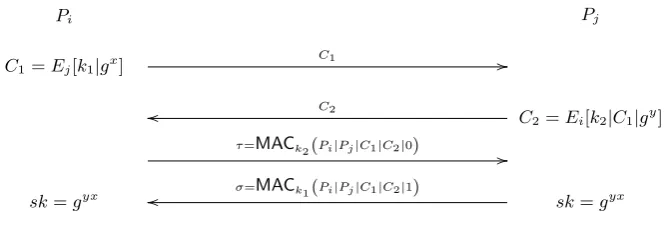
In the following, we use a timed encryption to construct a new key exchange protocol that is adaptively deniable secure, where eavesdropping attacks and session state reveal attacks are both allowed. Our protocol is presented as follows (also see Fig. 1).
Pi Pj
C1=Ej[k1|gx] C1 //
C2=Ei[k2|C1|gy] C2
o
o
τ=MACk2(Pi|Pj|C1|C2|0) //
sk=gyx sk=gyx
σ=MACk1(Pi|Pj|C1|C2|1)
o
o
Fig. 1.OurTimedEncryption-basedDeniableKey ExchangetE-DKE(See details in the bodytext)
1. Pi takes x←Zq, k1← {0,1}κ and sendsC1 =Ej[k1|gx] toPj.
2. Upon C1, Pj takes y←Zq, k2← {0,1}κ and sends C2 =Ei[k2|C1|gy] toPi.
3. Upon C2,Pi checks whetherDi(C2) =k2|C1|Y for some k2 ∈ {0,1}κ and Y ∈ ⟨g⟩.If no, reject; otherwise, send MACk2(Pi|Pj|C1|C2|0) toPj.
4. Upon τ, if τ =MACk2(Pi|Pj|C1|C2|0) and τ is received within time tfrom sending out round two message and if Dj(C1) = k1|X for some X ∈ ⟨g⟩ and k1 ∈ {0,1}κ, setsk = Xy and then compute and send σ=MACk1(Pi|Pj|C1|C2|1) toPi; otherwise, reject.
5. Uponσ, Ifσ ̸=MACk1(Pi|Pj|C1|C2|1) orσ is received more than timetfrom sending out round one message, reject; otherwise, set sk =Yx.
Remark. To better understand our protocol, some remarks are necessary.
(1) One careful reader might realize that the final message flow seemingly can be moved to the second round (i.e., put together with C2). If so, Pj needs to first derive k1 from C1 in order to compute MACk1(∗) . We show that this variant suffers from a session state reveal attack. Assume Πℓi
i sends C1 to P ℓj
j . When Π ℓj
j replies withC2 and σ, the attacker reveals the state of Π ℓj
j and obtains k1 in C1. With k1, the attacker forges a newC2′ and σ′ with a known y′. Now when Piℓi successfully completes, it has no partner in Pj and in addition skiℓi is known to the attacker. A simple counter measure for this attack is to erase k1 after computing σ (noticing k1 will not be used by Pℓj
j anymore). However, this works only in the eraser model, which is not the interest of this work. If τ is sent in the 4th flow as we do, this attack will not occur. Intuitively, this is true since a party decrypts k1 or k2 only after C1 and C2 both are known to him. Hence, the attacker can not compute aσ′ in order to authenticate his ownX orY.
(2) If C1 is not encrypted in C2, the protocol again will suffer from a session state reveal attack. Indeed, when an attacker A sees Πℓi
i ’s message C1 = Ej[k1|gx], he changes it to C1′ = Ej[k1′|gx ′
] and sends it to Πℓj
j . After seeingC2, he forwards to Π ℓi
i . When Π ℓi
i sends out τ,A corrupts Π ℓi
i and obtains k2, with whichA computes τ′ that matches C1′ and C2.Πℓj
j then will be deceptively convinced. Our protocol will not suffer from this attack since C1 is encrypted inC2 and so Acan not mallC2 toC2′ that contains C1′ but does not changek2.
(3) If gx is not encrypted in C1 but it is included in the input for τ and σ, then it still suffers from a session state reveal attack. The procedure is similar to the case in item (2).
(4) Deniability of our protocol is intuitively showed as follows. We are required to simulate the oracle response without using an honest user’s decryption key. This is done due to the forceful decryption for the timed encryption. Specifically, when receiving C2, the simulator can suspend the adversary and forcefully decrypt it. Note that in order for a protocol to be deniable, it only requires that based on public keys the simulator can simulate the adversary view in a polynomial time (i.e., in the same complexity class with the adversary so that toward deniability the code of the simulator can be run by the attacker himself). In timed encryption, the forceful decryption runs in a polynomial time and hence the simulation lies in the complxity class of an adversary. The suspension based simulation is used by Dwork, Naor and Sahai [19].
5.2 Security
launch an eavesdropping attack. This is the first protocol in the literature that achieves this. Our se-crecy property holds even if the adversary can launch a session state reveal attack in the non-eraser model, where all the intermediate data of an instance will not erased and (when revealed) will be given to the adversary. Avoiding such an attack is meaningful as it essentially means that compro-mising one session should not have a security effect on other non-partnered sessions. Before proceed-ing, we define the session identifier. For an initiator instanceΠℓi
i , letsid ℓi
i =⟨Pi, Pj, Ej[k1|gx], C2⟩. Similarly, we define one for a responding instance.
Deniability intuitively follows from the forceful decryption of timed encryption and suspension strategy of [19] as seen in the above remark. The secrecy is to say that an adversary in the secrecy test can not have a success probability better than a n¨aive guess. A routine proof strategy is to use a sequence of game method to modify the oracles gradually such that the final game is easy to analyze. But one pitfall here is that since E is a timed encryption, we can not modify the encryption content; otherwise, the adversary will detect the modification asT is also a polynomial. In our proof, we will only modify the test instance and in addition the simulation will end when time t is elapsed since the modified ciphertext is sent. Hence, the adversary will not have enough time to detect the modification. The authentication property will be showed when we prove the secrecy property, where a test session provably has a unique partner instance.
Theorem 3. If (G, E, D) is a (α, t, T)-timed encryption and MAC is an existentially unforgeable message authentication code, then tE-DKEis adaptively deniable secure against any PPT α-PRAM
suspendible adversary.
Proof. AssumeΠℓi
i and Π ℓj
j share an identical sid and also both accepts. Using the notion in the protocol description,
⟨Pi, Pj, Ej[k1|gx], C2⟩=⟨Pi, Pj, C1, Ei[k2|C1|gy]⟩.
Then Πℓi
i is the initiator and Π ℓj
j is the responder. Also C1 = Ej[k1|gx] and C2 = Ei[k2|C1|gy]. Hence, they have an identical view on (gx, gy). Since both accept, both compute sk = gxy. This concludes the completeness.
We now consider the adaptive deniability. The oracle simulator is simple: it behaves normally except when he needs to useDi to decrypt a ciphertextC. In this case, he suspends the adversary
A and uses forced decryption to obtain m = T(C). After that, he frees A and continues the normal execution. Due to the completeness of (α, t, T)-timed encryption, the outcome of T differs from Di(C) only negligibly. Note this holds regardless how C is computed (especially it could be computed under the help ofExecuteoracle or even it is invalid). Hence, the simulation is statistically close to the real one. Adaptive deniability follows1.
Now we consider the authentication property. IfΠℓt
t is the test instance, we need to show that there is a unique partnered instance Πℓs
s for it. We only need to prove the existence since the probability in an instance to repeatedly sample the same x (or y) is negligible. First consider the caseΠℓt
t is a responder instance and after receiving a round one messageC1∗from a claimed partyPs, he sendsC2∗=Es[k2∗|C1∗|gy
∗
] toPs. Denote the event thatΠtℓt receives a valid third round message τ∗ within timetfrom his sending outC2∗but no partnered instance inPsexists forΠtℓt, byImp.We
1
need to show that Pr[Imp] is negligible. Denote the real game byΓ. We modifyΓ toΓ′ such that the game terminates after time t from the moment Πℓt
t sends out C2∗. Pr[Imp(Γ)] = Pr[Imp(Γ′)] since ifImpoccurs, it must happen within timetsince the momentΠℓt
t sends outC2∗. We further modify Γ′ to Γ′′ such that Es[k∗2|C1∗|gy
∗
] in Πℓt
t is replaced by Es[0|C1∗|gy ∗
]. To be consistent, whenever Ps receives the same Es[0|C1∗|gx
∗
], it proceeds normally with assuming the decryption result being (k∗2|C1∗|gy∗) and soτ is computed usingk∗2.By reducing to the secrecy property ofE under CCA2 attack, we show that Pr[Imp(Γ′)] = Pr[Imp(Γ′′)] +negl(κ). Otherwise, an α-PRAM attacker D for E is described as follows. Assume there are at most µ responder instances. Given a challenge public key E, D takes u ← {1,· · ·, µ} and s ← {1,· · ·, n}. He sets up the system normally with
A against it, except Es = E. He simulates Γ′ normally, except when the uth responder instance Πℓt
t is invoked. In this case, if pid ℓt
t ̸= Ps or if Ps is corrupted, determinate with 0; otherwise, it takes y∗, k∗2 randomly and outputs the challenge pair as (0|C1∗|gy∗, k2∗|C1∗|gy∗).In turn, he receives C2∗ and sends toPs.Later D simulates the game normally, except whenever (1) Ps receivesC2∗, it proceeds usingk∗2|C1∗|gy∗ (e.g. session statestatℓs
s also usesk2∗); (2)PsreceivesC2 ̸=C2∗, he asks his decryption oracle to compute k2|C1|gy. Finally, when Ptℓt receives a valid round three message τ within timetfrom the moment its sendingC2∗ while no partnered instance inPsexists forPℓt
t , then
Doutputs 1; otherwise 0. The probability that theuth instanceΠℓt
t is the test instance andPsis its partner party is nu1 . When the guess is correct,C2∗encoding0|C1∗|gy∗ (resp.k2∗|C1∗|gy∗) corresponds to the simulation of Γ′′ (resp. Γ′). Hence, the non-negligible gap of event in Imp between them implies the non-negligible advantage ofD. In addition, since A is in theα-PRAM model, so is D.
D does not add any delay in converting the challenge/answer ofA to his own. Thus, D is a valid attacker. This contradicts to the secrecy ofE. Finally, Pr[Imp(Γ′′)] is negligible asImpevent (non-partnering) implies that C1∗ in C2∗ was never computed by Ps and hence message C2 will not be accepted by any instance inPs. Therefore, the usage ofk∗2 in the simulation ofΓ′′is only to evaluate
MACk∗2(·) (especially recallP ℓt
t can not be issued a session state reveal) and hence the non-negligible probability ofImp(Γ′′) event can be reduced to breakMAC, contradiction! This completes the case Πℓt
t is a responder. When Π ℓt
t is an initiator, the proof is similar that whenΠ ℓt
t receivesσ, there must exist a unique partnered instance inPsfor it. As a summary, we conclude that Pr[Imp(Γ)] is negligible and hence the authentication property holds.
We now consider the secrecy. We have showed that the test instance Πℓt
t must have a unique partnered instance Πℓs
s . In addition, this Πsℓs also only have Πtℓt as its unique partnered instance inPt. This is so due to the fact that sampling a repeated x ory inPt has a negligible probability (we ignore it). Now we argue the adversary success in the test session is 1/2 +negl(κ); otherwise, an attacker B can break DDH assumption as follows. Given a challenge tuple (α, β, γ), B sets up Γ normally with A against it. It takes a distinct pair u < v randomly from {1,· · ·, µ}. Then it simulates Γ normally, except when the uth instance Πℓt
t or vth instance Πsℓs is invoked. In the former case directly define gx as α and in the latter case define gy as β. In this simulation, x= loggαandy = loggβ are unknown. WheneverΠℓt
t orΠsℓs iscompromisedor ifΠtℓt andΠsℓs are not partnered instances or if neither of them is chosen as the test session, then aborts; otherwise, defineγ as the challenge session key for the test session (which is eitherΠℓt
adversary view is according to the real distribution in Γ. Hence, non-negligible advantage of Ain Γ implies a non-negligible advantage ofB in his DDH game, contradiction!
Corollary 3. In Theorem 3, if (E, D) is (t, T)-timed encryption, then tE-DKE is adaptively deni-able secure against any PPT PRAM suspendible adversary.
Proof. For any polynomial α, (E, D) is (α, t, T)-timed encryption. By Theorem 3, tE-DKE is deniable secure against any PPT α-PRAMsuspendible adversary. The claim follows.
References
1. M. Bellare, R. Canetti, and H. Krawczyk, a modular approach to the design and analysis of authentication and key exchange protocols,Proceedings of the Thirtieth Annual ACM Symposium on the Theory of Computing, pp. 419-428, 1998, Dallas, Texas, USA.
2. M. Bellare, P. Rogaway, Entity Authentication and Key Distribution.CRYPTO 1993: 232-249.
3. M. Bellare and P. Rogaway, Random Oracle is Practical: A Paradigm for Designing Efficient Protocols, ACM CCS’93, pp. 62-73.
4. Dan Boneh, Matthew K. Franklin: Identity-Based Encryption from the Weil Pairing. SIAM J. Comput.32(3): 586-615 (2003).
5. R. Canetti and H. Krawczyk, Analysis of Key-Exchange Protocols and Their Use for Building Secure Channels, Eurocrypt 2001: 453-474.
6. K. Choo, C. Boyd and Y. Hitchcock, Errors in Computational Complexity Proofs for Protocols,Advances in Cryptology-ASIACRYPT’05, B. Roy (Ed.), LNCS 3788, Springer-Verlag, pp. 624-643, 2005.
7. I. F. Blake and A. C.-F. Chan, Scalable, Server-Passive, User- Anonymous Timed Release Public Key Encryption from Bilinear Pairing, inICDS 2005: Proceedings of the 25th International Conference on Distributed Computing Systems, Jun. 2005, pp. 504-513.
8. Dan Boneh and Moni Naor, Timed Commitments and Applications,CRYPTO’00.
9. R. Pass, On the deniability in the common reference string and random oracle model,CRYPTO’03, pp. 316-337, 2003.
10. J. Cathalo, B. Libert, and J.-J. Quisquater, Efficient and Non-interactive Timed-Release Encryption, inICICS 2005: Proceedings of the 7th International Conference on Information and Communications Security, Dec. 2005, pp. 291-303.
11. Jung Hee Cheon, Nicholas Hopper, Yongdae Kim and Ivan Osipkov, Timed-Release and Key-Insulated Public Key Encryption,Financial Cryptography 2006.
12. Jung Hee Cheon, Nicholas Hopper, Yongdae Kim and Ivan Osipkov, Provably Secure Timed-Release Public Key Encryption,ACM Trans. Inf. Syst. Secur.11, 2, Article 8 (May 2008), 44 pages.
13. Giovanni Di Crescenzo, Rafail Ostrovsky, and S. Rajagopalan, Conditional Oblivious Transfer and Timed-Release Encryption,EUROCRYPT’99.
14. M. Di Raimondo, R. Gennaro, New Approaches for Deniable Authentication,ACM CCS’05.
15. M. Di Raimondo, R. Gennaro, New Approaches for Deniable Authentication,J. Cryptology(2009) 22: 572-615. 16. M. Di Raimondo, R. Gennaro and H. Krawczyk, Deniable Authentication and Key Exchange,ACM CCS’06. 17. Y. Dodis, D.-H. Yum, Time Capsule Signatures,Proc. of Financial Cryptography 2005, 2005.
18. Y. Dodis, J. Katz, A. Smith and S. Walfish, Composability and On-line Deniability of Authentication,TCC’09. 19. C. Dwork, M. Naor and A. Sahai, Concurrent Zero-Knowledge,STOC’98,pp. 409-418, 1998.
20. J. A. Garay and M. Jakobsson, Timed Release of Standard Digital Signatures, in FC 2002: Proceedings of the 6th International Conference on Financial Cryptography, Mar. 2003, pp. 168-182.
21. O. Goldreich,Foundations of Cryptography: Applications, Cambridge University Press, 2004. 22. S. Jiang and R. Safavi-Naini, An Efficient Deniable Key Exchange Protocol,FC’08, 2008.
23. H. Krawczyk, SKEME, a versatile secure key exchange mechanism for Internet,NDSS’96, pp. 114-127.
24. Y. Lindell, A Simpler Construction of CCA2-secure Public-key Encryption under General Assumptions, EURO-CRYPT’03, pp. 241-254.
25. W. Mao, Timed-Release Cryptography, inSAC 2001: Proceedings of the 8th Annual International Workshop on Selected Areas in Cryptography, Aug. 2001, pp. 342-357.
27. T. May, Timed-release crypto, 1993. Available at http://www.cyphernet.org/cyphernomicon/chapter14/ 14.5.html
28. Kenneth G. Paterson and Elizabeth A. Quaglia, Time-Specific Encryption,IACR eprint 2010.
29. R. Rivest, A. Shamir and D. Wagner, Time-lock puzzles and time-release crypto,unpublished manuscript, 1996.
Appendix A. One-time Simulation Sound Non-Interactive Zero Knowledge (NIZK)
One-time simulation sound NIZK essentially means that except the usual adaptive NIZK prop-erty, the adversary can not prove a false theorem even if the adversary sees a simulated proof for a false theorem. The formulation below essentially follows from [21, 24].
Definition 4. A pair of probabilistic polynomial time machines (P, V) with a common random string σ is an adaptive non-interactive zero-knowledge (Adaptive NIZK) proof system for an N P -language L with N P-relation RL if the following holds.
- Completeness. For any (x, w)∈ RL, it holds that Pr[V(x, σ, P(x, w, σ)) = 1] = 1−negl(κ), where σ is uniformly random over {0,1}poly(κ) and the probability is over the choices of σ and coins of P.
- Adaptive Soundness. For σ ← {0,1}κ, the probability that there existsx ̸∈L and a proof π
such that (σ, x, π) is accepting, is negligible, where the probability is over the choices ofσ.
- Adaptive Zero Knowledge. For any non uniform PPT adversary A, there exists a simulator SIM such that (σ, x, π) generated in the following two processes are indistinguishable.
⋄ Take σ← {0,1}ℓ; (x, w)← A(σ) s.t. (x, w)∈RL;π =P(x, w, σ).
⋄ SIM simulates σ with a trapdoor τ; (x, w) ← A(σ) s.t. (x, w) ∈ RL; SIM computes π
from(x, σ, τ).
Adatpive NIZK isone-time simulation sound if there exists adaptive NIZK simulatorSIM such that for any PPT adversary A the following holds negligibly.
• SIM outputs(σ, τ) and givesσ to A;A(σ) computes statementx and gives it to SIM;SIM generates a proof π for x using σ and τ and gives it to A; A generates a statement x′ and its proof π′) using (x, σ, π).A succeeds if V(x′, σ, π′) = 1,(x′, π′)̸= (x, π) and x′̸∈L.
Appendix B. Some Useful Lemmas.
Lemma 2. Let (G, E, D) be an IND-CPA secure public key encryption. Let (e, d) ← G(1κ) be a public/private key pair. Then for any c, Pr[Ee(Dd(c)) =c] =negl(κ),where the probability is over
the randomness of Ee(·) and G(1κ).
Proof. Otherwise, assume the claim is violated by a (valid!) ciphertext α. Recall that IND-CPA security states that forany m0, m1 of the same length,
Pr[A(E(mb)) =b] = 1/2 +negl(κ).
Especially, consider m0 = Dd(α) and m1 = 0 of the same length. An adversary A incorporating (m0, m1) can break IND-CPA of (E, D) as follows. When receiving cb = Ee(mb), A computes c ← Ee(m0). If c = cb, then he outputs 0; otherwise, output 0/1 randomly. Note c = cb implies b= 0 since the decryption ofE is unique. Hence, Pr[A(cb) =b] = 1/2 + Pr[c=cb]/2.On the other hand, Pr[c=cb] = Pr[b= 0]·
∑
u∈Ee(m0)Pr
2[E
e(m0) =u]≥Pr2[Ee(m0) =α]/2, non-negligible. So
Lemma 3. Let X and Y be random variables over sets X,Y respectively and f : Y → Z is a deterministic function, where Z is an arbitrary set and X ⊆ R. If Pr[X ≤ x|Y = y]≤ λ for all
x∈ X and y∈ Y, then Pr[X ≤x|f(Y) =f(y)]≤λfor all x∈ X and y∈ Y.
Proof. Pr[X≤x, f(Y) =f(y)] =∑y′∈f−1(f(y))Pr[X≤x, Y =y′]
≤∑y′∈f−1(f(y))λPr[Y =y′]
=λPr[f(Y) =f(y)]. The lemma follows.
Lemma 4. Let x∗0 ∈ {0,1}∗ and x∗i ← {0,1}a, i = 1,· · ·, n. H : {0,1}∗ → {0,1}ℓ is a random oracle. Consider a setΩ⊆ {x∗0x1s|s∈ {0,1}∗, x1 ∈ {0,1}a, x1 ̸=x∗1}and1≤j < j′≤n. Fixu0= x∗0x∗1x2· · ·xj′ for some xi ∈ {0,1}a∪ {empty string} but x2x3· · ·xj ̸= x∗2x∗3· · ·x∗j. Then, x∗j+1· · ·x∗n
is uniformly distributed over {0,1}a(n−j), givenx∗1x∗2· · ·x∗j, Ω, u0,{H(u)|u∈Ω},{H(x∗0x∗1· · ·x∗i)| i= 1,· · ·, n} and {H(u0)}.
Proof. We now fix x∗0x∗1· · ·xj∗. For any possible value ofx∗j+1· · ·x∗n, the conditions in the lemma will be valid and sets Ω, {u0} and {x∗0x1∗,· · ·, x∗0x∗1· · ·x∗n} are mutually disjoint. By the random oracle definition, the randomness ofH values {H(u)|u∈Ω},{H(x∗0x∗1· · ·x∗i)|i= 1,· · ·, n} and
{H(u0)} are all jointly independent. Hence, they are jointly independent of the randomness for x∗j+1· · ·x∗n (more specifically, for any value x∗j+1· · ·x∗n ∈ {0,1}ℓ(n−j), the randomness for these H
values are unchanged).
Lemma 5. Consider the following game. Take x∗i ← {0,1}a, i = 1,· · ·, m. An adversary A can
adaptively query whether any string x1x2· · ·xi equals x∗1x2∗· · ·x∗i for any i= 1,· · ·, m. Let n < m.
RevN(m, n) denotes the event that, within N queries, a query x1∗x∗2· · ·x∗i for some i > n occurs
prior to any query x∗1x∗2· · ·x∗i for i≤n. Then, Pr[RevN(m, n)]≤ 2a(Nn+1).
Proof. First of all, Pr[RevN(m, n)] ≤ Pr[RevN(n+ 1, n)] since an adversary A in the game for case m = n+ 1 can simulate an environment for the case m > n+ 1 by taking x∗n+2,· · ·, x∗m normally. In the simulated environment, any queryx1· · ·xi fori≤n+ 1 is answered by forwarding to A’s challenger; any wuery x1· · ·xi for i > n+ 1 is handled by querying his own challenger whether x1· · ·xn+1 is correct. In case of yes andxn+2· · ·xi =x∗n+2· · ·x∗i holds as well, return ‘=’; otherwise, return ‘̸=’. The simulation is perfect. Thus, RevN(m, n) for the casem > n+ 1 implies
RevN(n+ 1, n). We concentrate on Pr[RevN(n+ 1, n)].RevN(n+ 1, n) occurs if and only if query x∗1x∗2· · ·x∗n+1 occurs before any query x∗1x∗2· · ·x∗i for i≤n. Letpt be the probability of event that query x∗1x∗2· · ·x∗n+1 occurs at queryt while, before this, no query x∗1x∗2· · ·x∗i occurs for any i≤n. Then Pr[RevN(n+ 1, n)] =
∑N
t=1pt. Now we compute pt. We consider the candidate set Sℓ for x∗1· · ·x∗n+1 in view of Aafter query ℓ. Initially, no query is issued and S0 ={0,1}a(n+1).At query ℓ < t, observe that when a queryx1x2· · ·xiis answered with ‘̸=’, thenx1x2· · ·xi∗∗∗ ̸=x∗1x∗2· · ·x∗n+1 and hence this pattern can be removed from Sℓ−1 and any sequence in Sℓ satisfies queries issued so far by Aand is a candidate for x∗1· · ·x∗n+1. So pt= ||SS10||·||SS21||· · ·||SStt−1−2||·|St1−1| = |S10| = 2−a(n+1).
The lemma follows.
Appendix C. Proof of Theorem 2