Unconditionally Secure Asynchronous Multiparty Computation with
Linear Communication Complexity
Ashish Choudhury∗ Martin Hirt† Arpita Patra‡
Abstract
Unconditionally secure multiparty computation (MPC) allows a set ofnmutually distrusting parties to securely compute an agreed function f over some finite field in the presence of acomputationally unbounded adversary, who can actively corrupt any t out of the nparties. Designing an asynchronous MPC (AMPC) protocol with a communication complexity ofO(n)field elements per multiplication gate is a long standing open problem. We solve the open problem by presenting two AMPC protocols with the corruption thresholdt < n/4. Our first protocol is
statisticallysecure (i.e. involves a negligible error in the protocol outcome) in a completely asynchronous setting and improves the communication complexity of the previous best AMPC protocol in the same setting by a factor ofΘ(n). Our second protocol isperfectlysecure (i.e. error free) in ahybridsetting, where one round of communication is assumed to be synchronous and improves the communication complexity of the previous best AMPC protocol in the hybrid setting by a factor ofΘ(n2).
Starting with the seminal work of Beaver (CRYPTO 1991), it is by now a well-known technique to evaluate mul-tiplication gates in an MPC protocol using shared randommultiplication triples. The central contribution common to both the presented protocols is a new and simple framework for generating shared random multiplication triples. All the existing protocols approach the problem by first producing sharedpairsof random values, followed by computing the shared product of each pair of random values by invoking known protocols for multiplication. Our framework takes a completely different approach and avoids using the multiplication protocols that are typically communica-tion intensive. Namely, we ask the parties to verifiably share random multiplicacommunica-tion triples and then securely extract shared random multiplication triples unknown to the adversary. The framework is of independent interest and can be adapted to anyhonest majoritysetting.
Keywords: Unconditional Security, Asynchronous Protocols, Secret Sharing.
∗
Department of Computer Science, University of Bristol, UK, Email:[email protected].
†
Department of Computer Science, ETH Zurich, Switzerland, Email:[email protected]
‡
1
Introduction
Threshold unconditionally secure multiparty computation (MPC) is a powerful concept in secure distributed computing. It enables a set ofnmutually distrusting parties to jointly and securely compute a publicly known functionf of their private inputs over some finite field F, even in the presence of acomputationally unbounded active adversary Adv,
capable of corrupting anytout of thenparties. In any general MPC protocol [8, 14, 32, 2], the functionf is usually expressed as an arithmetic circuit (consisting of addition and multiplication gates) overFand then the protocol evaluates
each gate in the circuit in a shared/distributed fashion. More specifically, each party secret share its private inputs among the parties using a linear secret sharing scheme (LSS) [15], say Shamir [33], with thresholdt1. The parties then interact
to maintain the following invariant for each gate in the circuit: given that the input values of the gate are secret shared among the parties, the corresponding output value of the gate also remains secret shared among the parties. Finally the (shared) circuit output is publicly reconstructed. Intuitively, the privacy follows since each intermediate value during the shared circuit evaluation remains secret shared. Due to thelinearityof the LSS, the addition (linear) gates are evaluated
locally by the parties. However, maintaining the above invariant for the multiplication (non-linear) gates requires interaction among the parties. The focus therefore is rightfully placed on measuring the communication complexity (namely thetotalnumber of field elements communicated) required to evaluate the multiplication gates in the circuit.
In the recent past, several efficient unconditionally secure MPC protocols have been proposed [23, 22, 3, 18, 5, 10]. The state of the art unconditionally secure MPC protocols havelinear(i.e.O(n)field elements)amortized communica-tion complexity per multiplicacommunica-tion gate for both theperfectsetting [5] (i.e. error-free) as well as for thestatisticalsetting [10] (where a negligible error is allowed). The amortized communication complexity is derived under the assumption that the circuit is large enough so that the terms that are independent of the circuit size can be ignored [10]. Moreover, these protocols have theoptimal resilienceoft < n/3andt < n/2 respectively. The significance of linear commu-nication complexity roots from the fact that the amortized commucommu-nication done byeachparty for the evaluation of a multiplication gate isindependentofn. This makes the protocol “scalable” in the sense that the communication done by an individual party does not grow with the number of parties in the system. In fact, even the best known unconditionally secure MPC protocol in thepassivesecurity setting [18] does not achieve amortized communication complexity better than O(n) field elements per multiplication gate. We note that if one is willing to reduce the resiliencet from the optimal resilience by a constant fraction oft, then by using techniques like packed secret sharing [21] and committee election [12], one can break theO(n)barrier as shown in [17, 16]. However, the resultant protocols are quiet involved.
Our Motivation. All the results discussed above are in thesynchronous network setting, where the delay of every message in the network is bounded by a known constant. However, it is well-known that such networks do not ap-propriately model the real-life networks like the Internet. Consequently, the asynchronous network model has been proposed [7], where there are no timing assumptions and the messages can be arbitrarily delayed. The protocols in the asynchronous model are much more involved than their synchronous counterparts due to the following general phenom-ena, which is impossible to avoid in a completely asynchronous setting: if a party does not receive an expected message, then it does not know whether the sender is corrupted (and did not send the message at all) or the message is just delayed in the network. Thus, at any “stage” of an asynchronous protocol, no party can afford to listen the communication from all thenparties, as the wait may turn out to be endless and so the communication fromt(potentially honest) parties has to be ignored. It is well known that perfectly secure (i.e. error-free) asynchronous MPC (AMPC) is possible if and only ift < n/4[7], while statistically secure AMPC (involving negligible error) is possible if and only ift < n/3[9].
Unconditionally secure AMPC protocols are presented in [7, 9, 34, 31, 4, 29, 28]. The best known unconditional AMPC protocol is reported in [28]. The protocol is perfectly secure with resiliencet < n/4and amortized communica-tion complexity ofO(n2)field elements per multiplication gate. Designing AMPC protocols with linear communication
complexity per multiplication gate is the focus of this paper.
Our Results. We present two AMPC protocols with (amortized) communication complexity ofO(n)field elements per multiplication gate and with resiliencet < n/4. The first protocol is statistically secure and works in a completely asynchronous setting. Though non-optimally resilient, the protocol is the first AMPC protocol with linear communi-cation complexity per multiplicommuni-cation gate. Our second protocol trades the network model to gain perfect security with
1
optimal resilience oft < n/4. The protocol is designed in ahybridsetting, that allows a single synchronous round at the beginning, followed by a fully asynchronous setting. The hybrid setting was exploited earlier in [24, 4, 6] to enforce “input provision”, i.e. to consider the inputs of all thenparties for the computation, which is otherwise impossible in a completely asynchronous setting. The best known AMPC protocol in the hybrid setting was proposed in [4] with perfect security, resiliencet < n/4and communication complexity ofO(n3)field elements per multiplication gate. Thus, our protocol significantly improves over the hybrid model protocol of [4]. Finally, we stress thatnocryptographic tools are employed in our protocols, as we aim for unconditional security against a computationally unbounded adversary.
1.1 Our Results: A Closer Look
We follow the well-known “offline-online” paradigm used in most of the recent MPC protocols [3, 4, 18, 5, 10]: the offline (preprocessing) phase producest-sharing ofcM randommultiplication triples{(a(i), b(i), c(i))}i∈[cM]unknown
2
toAdv, wherec(i) =a(i)b(i). The shared multiplication triples are completelyindependentoff and the private inputs
of the parties; so this phase can be executed well ahead of the actual circuit evaluation (and hence the name offline phase). Later, during the online phase the shared triples are used for the shared evaluation of the multiplication gates in the circuit, using the standard Beaver’s circuit randomization technique [2] (see Sec. 3). The efficiency of the MPC protocol is thus reduced to the problem of efficiently generating shared random multiplication triples. We propose a new approach for this problem that significantly outperforms the existing ones in terms of the efficiency and simplicity.
The traditional way of generating the shared multiplication triples{(a(i), b(i), c(i))}
i∈[cM]is the following: first the
individual parties are asked tot-share randompairsof values on which a “randomness extraction” algorithm (such as the one based on Vandermonde matrix [18] or the one based on Hyper-invertible matrix [5] or the simplest of all, namely to add all the pairs) is applied to generatet-sharing of “truly” random pairs{a(i), b(i)}
i∈[cM]. Then known multiplication
protocols are invoked to compute t-sharing of {c(i)}i∈[c
M]. Instead, we find it a more natural approach to ask the
individual parties to “directly” share random multiplication triples and then “extract” shared random multiplication triples unknown to Adv from the triples shared by the individual parties. This leads to a communication efficient, simple and more natural “framework” to generate the triples. The framework is built with the following two modules:
• Multiplication Triple Sharing (Section 6.1). The first module allows a party Pi torobustly and “verifiably”
t-shareΘ(n)random multiplication triples withO(n2)communication complexity and thus requiresO(n) “over-head”. The verifiability ensures that the shared triples are indeed multiplication triples. Moreover for anhonest
Pi, the shared triples remain private fromAdv. Such shared triples, shared by the individual parties are referred aslocaltriples. Thus far, none of the existing protocol (including synchronous world) meets these requirements.
• Multiplication Triple Extraction (Section 6.2). The second module allows the parties to securely extractΘ(n)
t-shared random multiplication triples unknown toAdvfrom a set of3t+ 1localt-shared multiplication triples withO(n2)communication complexity (and thus withO(n)“overhead”), provided that at least2t+ 1out of the 3t+ 1local triples are shared by thehonestparties (and hence are random and private). We stress that known techniques for the extraction of sharedrandom valuesfrom a set of shared random and non-random values fail to extractrandom multiplication triplesfrom a set of random and non-random multiplication triples3.
We note that our framework has implications in other settings as well. For example, when compiled in a completely synchronous setting withhonest majority, our framework leads to a very simple preprocessing phase which reduces the overall round round complexity of the existing round efficient MPC protocols of [25, 26] in point-to-point networks; however, providing the exact details is out of scope of the current paper. For our first module, we present two protocols: the first oneprobabilisticallyverifies the correctness of the shared multiplication triples, leading to our statistical AMPC protocol. The second protocol verifies the shared multiplication triples in an error-free fashion in a hybrid setting, leading to our perfectly secure hybrid AMPC protocol. For the second module, we present anerror-freetriple extraction protocol. We do not employ (somewhat complex) techniques likeplayer elimination[23, 5] anddispute control[3, 18,
2
A valuevisd-shared (see Definition 2.3) if there exists a random polynomialp(·)of degree at mostdwithp(0) =dand every honest party holds a distinct point onv(·). HerecMdenotes the number of multiplication gates in the circuit. By[X], we refer to the set{1, . . . , X}.
3Intuitively this is because all these existing information theoretically secure randomness extraction techniques apply a linear function to the
10] in our protocols. These techniques have been used in the most recent synchronous unconditional MPC protocols to obtain linear complexity. Briefly, these techniques suggest to carry out a computation optimistically first assuming no corruption will take place and in case corruption occurs, fault/dispute is detected and memorized so that the same fault/dispute does not cause failure in the subsequent computation. However, their applicability is yet to be known in the asynchronous settings. At the heart of all our protocols lie the following two simple and interesting building blocks.
Verifiable Secret Sharing with Linear Overhead (Section 4): We propose arobust asynchronous verifiable secret sharing(AVSS) protocol that allows adealerDto “verifiably”t-shareΘ(n)secret values withO(n2)communication complexity (i.e.O(n)overhead). The protocol is obtained by modifying the perfectly secure AVSS protocol of [29, 28] that allows Dto2t-share asinglevalue. To the best of our knowledge, we are unaware of any robust secret sharing protocol (witht < n/4) having linear overhead, even in the synchronous setting.
Transforming Independent Triples to Co-related Triples with Linear Overhead (Section 5): Taking 3t+ 1 = Θ(n) t-shared input triples (which may not be multiplication triples), say {(x(i), y(i), z(i))}i∈[3t+1], the protocol
out-puts3t+ 1t-shared triples, say{(x(i),y(i),z(i))}
i∈[3t+1], such thex,yandzvalues lie on three polynomials of degree
3t/2,3t/2and3trespectively. Namely, there exists polynomialsX(·),Y(·)andZ(·) of degree at most 32t,32t and3t
respectively, whereX(αi) =x(i),Y(αi) =y(i)andZ(αi) =z(i)holds for3t+1distinctαis. The protocol has commu-nication complexityO(n2)(i.e.O(n)overhead). The protocol further ensures the following one-to-one correspondence between the input and the output triples: (1). theith output triple is amultiplication tripleif and only if theith input triple is a multiplication triple; (2). theith output triple is known toAdvif and only if the ith input triple is known toAdv. The former guarantees that the relation Z(·) = X(·)Y(·) is true if and only if all the3t+ 1input triples are multiplication triples, while the later guarantees that ifAdvknowst0input triples, then it implies 32t+ 1−t0 “degree of freedom” in the polynomialsX(·),Y(·)andZ(·), providedt0 ≤ 3t
2. The protocol is borrowed from the batch verification
protocol of [10], where the goal was toprobabilisticallycheck whether a set of input triples are multiplication triples. We use the protocol intwodifferent contexts and “post-process” the output of the protocol (more details later).
Given the above two building blocks, our first module is realized by asking each party Pi to invoke the AVSS pro-tocol to generate t-sharing of 3t+ 1 random multiplication triples {(x(i), y(i), z(i))}i∈[3t+1]. All that is left is to verify if the shared triples are indeed multiplication triples. This is achieved by transforming the shared triples to
{(x(i),y(i),z(i))}i∈[3t+1]using the triple transformation protocol and then verifying ifZ(·) ?
=X(·)Y(·)whereX(·),Y(·) andZ(·)are the underlying polynomials, associated with{(x(i),y(i),z(i))}i∈[3t+1]. Two different methods are then pro-posed for the verification; one leads to our statistical AMPC and the other leads to perfect AMPC in hybrid model.
The second module of the framework takes the set of 3t + 1 local t-shared multiplication triples (verifiably shared by individual parties), say{(x(i), y(i), z(i))}i∈[3t+1] such that at least2t+ 1 of them are shared by the hon-estparties. Then using our triple transformation protocol, the parties compute the set of shared multiplication triples
{(x(i),y(i),z(i))}i∈[3t+1]. Since all the input triples are guaranteed to be multiplication triples, the relation Z(·) =
X(·)Y(·)holds. Furthermore, sinceAdvmay know at mosttinput local triples, toutput triples are leaked, leaving 2t “degree of freedom” in the polynomials, which is used to extract 2t random and private multiplication triples.
2
Model, Definitions and Notations
Model. We consider a set P = {P1, . . . , Pn} of n = 4t+ 1 parties, connected by pair-wise secure (private and authentic) channels; heretis the number of parties which can be under the control of a computationally unbounded active (Byzantine) adversary Adv. The adversary can force the corrupted parties to deviate in any arbitrary manner during the execution of a protocol. The communication channels are asynchronous allowing arbitrary, but finite delay (i.e. the messages will reach to their destination eventually). The order of the message delivery is decided by ascheduler
it performs an internal computation and then possibly sends messages on its outgoing channels. The order of the atomic steps are controlled by the scheduler. At the beginning of the computation, each party will be in a specialstartstate. A party is said to terminate/complete the computation if it reaches ahalt state, after which it does not perform any further computation. A protocol execution is said to be complete if all the honest parties terminate the commutation.
We assume that the functionf to be computed is specified as a publicly known arithmetic circuitC over a finite fieldF, where |F| > 2nandα1, . . . , αn, β1, . . . , βn are publicly known distinct elements fromF. For ourstatistical
AMPC protocol, we additionally require that|F| ≥n2·2κ, for a given error parameterκ, to bound the error probability by 2−κ. The circuitC consists of input, addition (linear), multiplication, random and output gates. Without loss of generality, we assume thatf :Fn → F, wheref(x1, . . . , xn) =y, such thatxi ∈Fis the input ofPi and every party is supposed to receive the outputy ∈F. We denote bycM andcRthe number of multiplication and random gates inC respectively. By[X]and[X, Y]forY ≥X, we denote the sets{1, . . . , X}and{X, X+ 1, . . . , Y}, respectively.
Definitions. A “property based” definition of secure AMPC in the unconditional setting was followed in [9], which in essence is “equivalent” to the more rigorous simulation based definition of secure AMPC in the “real-world/ideal-world” paradigm [7]. All the papers on AMPC since then follow the style of definition used in [9]. As our main goal is to provide efficient AMPC protocols, we keep the formalities to a bare minimum and instead use the property based definition to prove the security. However, our protocols can be proved secure according to the definition of [7].
Letf : Fn → F be a publicly known function and partyPi has input xi ∈ F. In any asynchronous multiparty
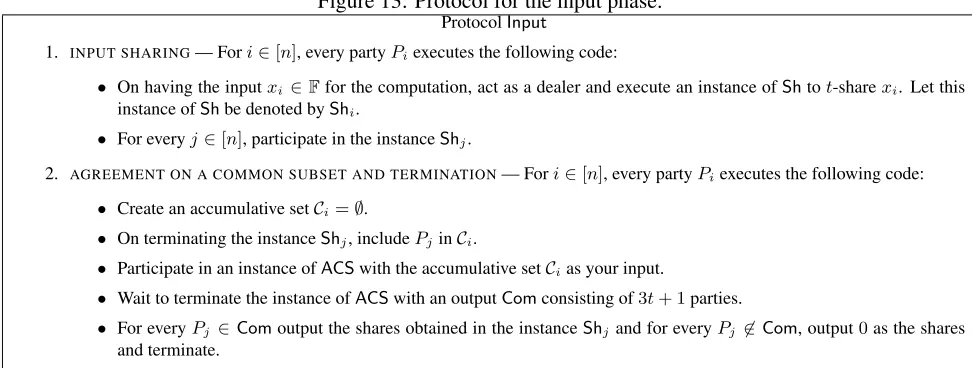
computation, each partyPi first secret share its input. Letxi be the value shared byPi. IfPi is honest thenxi =xi. Due to the asynchronicity, the parties cannot wait for all thenparties to share their inputs and so the parties agree on a subsetComof sizen−tof shared inputs. Finally, the parties compute anestimationoff asy=f(x1, . . . ,xn)and everyone receivesy, wherexi = 0ifPi6∈Com.
Definition 2.1(Secure AMPC (Informal) [9]). An asynchronous protocolΠ among thenparties securely computes
f if it satisfies the following conditions for every possibleAdv and every possible scheduler, on all possible inputs:
(1) TERMINATION: All the honest parties terminate Π almost surely, i.e. with probability4 1. (2) CORRECTNESS: Every honest partyPi correctly obtainsy(the estimation off) after completingΠ, irrespective of the behavior of the
corrupted parties.(3)PRIVACY: The adversary obtains no additional information about the inputs of the honest parties inCom(in the information theoretic sense), other than what is inferred from the inputs and the outputs of the corrupted parties.
Definition 2.2(Statistical and Perfect AMPC [7, 9]). A statistical AMPC protocol satisfies the termination and correct-ness with probability at least(1−2−κ), for a given error parameterκ(no compromise in the privacy property is made). A perfect AMPC protocol satisfies the termination and correctness with probability1.
Definition 2.3(d-sharing [3, 4, 18, 5]). A values ∈ Fis said to be d-sharedamong a set of partiesP ⊆ P if every (honest) party Pi ∈ P is holding asharesi ofs, such that there exists a polynomialp(·)of degree at mostd, where
p(0) =sandp(αi) =siholds for every (honest)Pi∈ P. The vector of shares corresponding to the (honest) parties in
P is called ad-sharing ofsand denoted by[s]Pd. A vectorS~ = (s(1), . . . , s(`))of`values is said to bed-shared among a set of partiesP if eachs(l) ∈S~isd-shared among the parties inP.
We write [s]d (ignoring the superscript) to mean thatsisd-shared amongall thenparties. Note thatd-sharings are
linear: given[a]dand[b]d, then[a+b]d= [a]d+ [b]dand[c·a]d=c·[a]d, for a publicly known constantc. In general, given `sharings[x(1)]d, . . . ,[x(`)]d and a publicly known linear functiong : F` → Fm, where g(x(1), . . . , x(`)) =
(y(1), . . . , y(m)), then g([x(1)]d, . . . ,[x(`)]d) = ([y(1)]d, . . . ,[y(m)]d). By saying that the parties compute(locally) ([y(1)]d, . . . ,[y(m)]d) = g([x(1)]d, . . . ,[x(`)]d), we mean that every party Pi (locally) computes (yi(1), . . . , y(im)) =
g(x(1)i , . . . , xi(`)), whereyi(l)andx(il)denotes theith share ofy(l)andx(l)respectively.
Definition 2.4(Random Multiplication Triples). A triple(x, y, z)∈F3is called a multiplication triple, ifz=xyholds.
A multiplication triple(x, y, z)is called random ifx, yandzare uniformly random subject toz=xy.
4
3
Existing Building Blocks
Private and Public Reconstruction ofd-shared Values: Let[v]Pd be ad-sharing ofv, shared through a polynomial
p(·) of degree at mostd, whered < |P| −2t. The goal is to make some party PR ∈ P to privatelyreconstructv. The well-knowonline error correction(OEC) algorithm [7, 13] allowsPRto reconstructp(·)and thusv, asp(0) =v. We call the protocol asOEC(PR, d,[v]dP), which requires a communication ofO(n)field elements; moreover ifPRis
honestthen no additional information aboutvis leaked toAdv. The protocol can be found in Appendix A.1.
Let{[u(i)]Pd}i∈[t+1]be a batch oft+ 1 = Θ(n) d-shared values whered < |P| −2t. The goal is to makeevery
party inP reconstruct{u(i)}i∈[t+1]. This can be achieved with communication complexity ofO(n2)by using an idea presented in [18, 5]. The protocol calledBatRecPubl(P, d,[u(1)]P
d, . . . ,[u(t+1)]Pd)can be found in Appendix A.2.
Batch Multiplication of ` Pairs of t-shared Values using Beaver’s Technique Beaver’s circuit randomization method [2] is a well known method for securely computing[x·y]tfrom[x]tand[y]t, at the expense of twopublic recon-structions, using apre-computedt-shared random multiplication triple (from the offline phase), say([a]t,[b]t,[c]t). For this, the parties first (locally) compute[e]tand[d]t, where[e]t= [x]t−[a]t= [x−a]tand[d]t= [y]t−[b]t= [y−b]t, followed by the public reconstruction ofe= (x−a)andd= (y−b). Since the relationxy = ((x−a)+a)((y−b)+b) =
de+eb+da+cholds, the parties can locally compute[xy]t=de+e[b]t+d[a]t+ [c]t, oncedandeare publicly known. The above computation leaks no information aboutxandyifaandbare random and unknown toAdv. For the sake of efficiency, we will apply the Beaver’s trick on a batch of`pairs oft-shared values simultaneously, where`≥t+ 1.
BatRecPublis then used to efficiently perform the public reconstruction of the2`values (note that two reconstructions are required for each pair) with a communication ofO(dt2+1` e ·n2) = O(n`)field elements. We call the protocol as
BatchBeaver({([x(i)]t,[y(i)]t,[a(i)]t,[b(i)]t,[c(i)]t)}i∈[`])and present it in Appendix A.3.
Agreement on a Common Subset (ACS) and Asynchronous Broadcast ProtocolACS[7, 9] is a well known asyn-chronous protocol that allows the (honest) parties to agree on a common subset Comof (n−t) parties, who have correctly shared “values”; the values may be the inputs of the individual parties or a multiplication triple or a random value. The protocol is presented in Appendix A.4 and has communication complexityO(poly(n)).
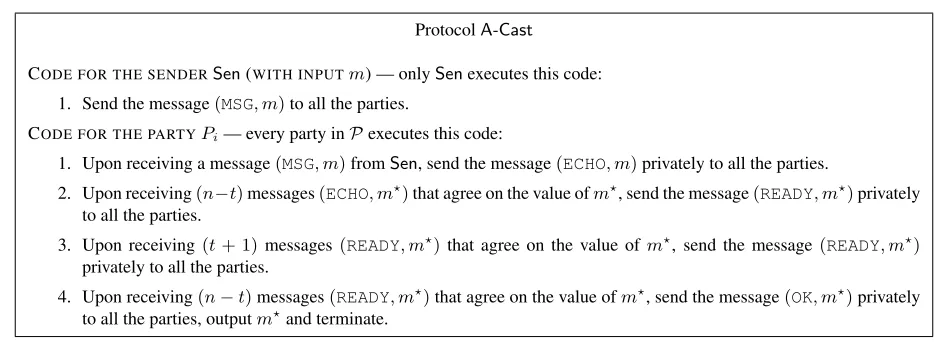
Bracha’s asynchronous broadcast protocol (calledA-Cast) [11] allows a senderSen ∈ P to send some message
m identically to all thenparties. If Senishonestthen all the honest parties eventually terminate with output m. If
Seniscorruptedand some honestparty terminates with outputm0, then every other honest party eventually does the same. The protocol needs a communication ofO(n2|m|)for a message of size|m|. We say thatP
ireceivesmfrom the broadcast ofPjifPioutputsmin the instance ofA-CastwherePj is acting asSen; see Appendix A.5 for the protocol.
Generating a Random Value: Protocol Randallows the parties to generate a uniformly random valuer ∈ Fand requires a communication complexity ofO(poly(n)); see Appendix A.6 for the protocol5.
4
Batch Generation of
t
-shared Values
We present a protocol calledSh, which allows a dealerD∈ P tot-share`valuesS~ = (s(1), . . . , s(`))in a “verifiable” manner, where`≥t+ 1. The “verifiability” ensures that irrespective of whetherDis honest or not, if the honest parties terminate the protocol then the output sharings aret-sharing. Moreover the shared secrets are private ifDishonest. The protocol communicatesO(n`)field elements and broadcastsO(n2)field elements. We first explain the protocol assuming thatS~ containst+ 1secrets and later discuss how to extend it to share more thant+ 1values together.
The starting point of our protocol Sh is the sharing protocol of the perfectly secure AVSS scheme of [28, 29]. The AVSS protocol of [28, 29] enablesDto2t-share (note the degree of sharing) asinglesecrets. The2t-sharing is achieved via a univariate polynomialF(x,0)of degree at most2t, whereF(x, y)is a random bi-variate polynomial of degree at most2tinxand at mosttiny(note the difference in degrees), such thatF(0,0) =s. Initially,Dis asked to
5
pickF(x, y)and hand over theith row polynomialfi(x)of degree at most2tand theith column polynomialgi(y)of
degree at mosttto the partyPi, wherefi(x) def= F(x, αi)andgi(y) def= F(αi, y). If the sharing protocol terminates, then it is ensured that there exists a bi-variate polynomialF0(x, y)of degree at most2tinxand at mosttiny, such that everyhonestpartyPj holds a column polynomialgj0(y)of degree at mostt, wheregj0(y) =F0(αj, y). This makes the secrets0 def= F0(0,0)to be2t-shared through the polynomialf00(x)of degree at most2twheref00(x) def= F0(x,0) and everyhonestpartyPj holds its shares0j of the secrets0, withs0j =f00(αj) =F0(αj,0) =gj0(0). For anhonestD,
F0(x, y) =F(x, y)will hold and thusswill be2t-shared though the polynomialf0(x)def= F(x,0).
In the above sharing protocol of [29, 28], we first note that the adversary’s view leaves(t+1)(2t+1)−t(2t+1)−t= (t+ 1)“degree of freedom” in the polynomialF(x, y)when Dishonest. Informally the reason is thatAdvreceives
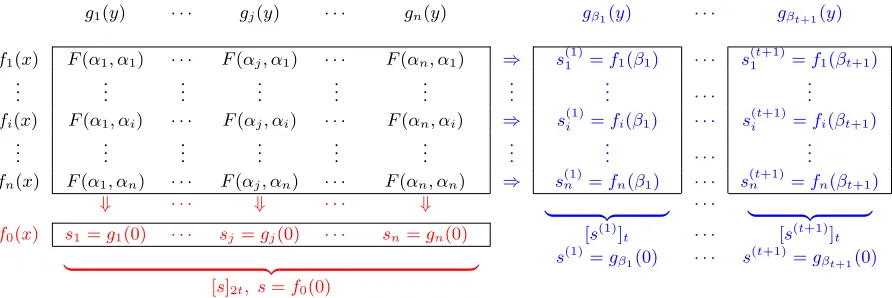
t(2t+ 1) +t distinct points on F(x, y) through the t row and column polynomials of the corrupted parties while (t+ 1)(2t+ 1) distinct points are required to completely defineF(x, y). While [29, 28] used the t+ 1 degree of freedom for asingle2t-sharing by embedding a single secret inF(x, y), we use it to createt-sharing oft+ 1different secrets by embeddingt+ 1secrets inF(x, y). Namely, givent+ 1secretsS~ = (s(1), . . . , s(t+1)), the dealerDin our protocol fixesF(βl,0) =s(l)forl∈[t+ 1], whereF(x, y)is otherwise a random polynomial of degree at most2tin
x and at mosttiny. At the end, the goal is that the secrets(l)ist-shared among the parties through the polynomial F(βl, y)of degree at mostt, which we denote bygβl(y). As depicted in Fig. 1 (in blue color), anhonestpartyPi can
compute its shares of the secrets inS~by local computation on the polynomialfi(x) =F(x, αi). This follows from the fact that forl∈[t+ 1]theith shares(il)of the secrets(l)satisfiess(il)=gβl(αi) =fi(βl).
So all that is left is to ensure that every Pi gets fi(x) in Sh protocol. For this recall that the sharing protocol of [29, 28] ensures that everyhonestPj holdsg0j(y)such that there exists a bi-variate polynomialF0(x, y)of degree at most2tinxand at mosttinywhereF0(αj, y) =gj0(y)holds; furthermore for an honestD,F0(x, y) =F(x, y)holds. Now note that gj0(αi)is the same as fi0(αj)and thus everyPj holds a point on everyfi0(x). Now Pi can reconstruct
fi0(x)by asking every partyPj to send its point onfi0(x)toPi. Sincefi0(x)has degree at most2tand there are4t+ 1 parties,OECenablesPito computefi0(x)from the received points. Finally, we note that for acorruptedD, the values
~
S0 = (F0(β1,0), . . . , F0(βt+1,0))will bet-shared and in case of an honestD,S~0 =S~ will hold.
g1(y) · · · gj(y) · · · gn(y) gβ1(y) · · · gβt+1(y)
f1(x) F(α1, α1) · · · F(αj, α1) · · · F(αn, α1) ⇒ s(1)1 =f1(β1) · · · s(1t+1)=f1(βt+1)
..
. ... ... ... ... ... ... ... · · · ...
fi(x) F(α1, αi) · · · F(αj, αi) · · · F(αn, αi) ⇒ s(1)i =fi(β1) · · · s(it+1)=fi(βt+1)
..
. ... ... ... ... ... ... ... · · · ...
fn(x) F(α1, αn) · · · F(αj, αn) · · · F(αn, αn) ⇒ s (1)
n =fn(β1) · · · s
(t+1)
n =fn(βt+1)
⇓ · · · ⇓ · · · ⇓
| {z }
· · ·
| {z }
f0(x) s1 =g1(0) · · · sj=gj(0) · · · sn=gn(0) [s(1)]t · · · [s(t+1)]t
| {z }
s(1)=gβ1(0) · · · s
(t+1)
=gβt+1(0)
[s]2t, s=f0(0)
Figure 1: Pictorial representation of the values distributed by (an honest)Din the AVSS scheme of [29, 28] and our sharing protocolSh. The polynomialsf1(x), . . . , fn(x), g1(y), . . . , gn(y)computed from the bi-variate polynomialF(x, y)of degree at most2tandtinxandyare
distributed in both the protocols. In the AVSS protocol,sis2t-shared through the row polynomialf0(x)(shown in red color) of degree2t, while
inSh,t+ 1valuess(1), . . . , s(t+1)aret-shared through thet+ 1column polynomialsgβ1(y), . . . , gβt+1(y)(shown in blue color) of degreet.
We note that our idea of embedding several secrets in a singlebi-variatepolynomial is to be distinguished from the notion ofpacked secret sharing[21] whereksecrets are embedded in a singleunivariatepolynomial of degree at most
tsuch that each party receives a single share, namely a distinct point on the polynomial. In the later, a single share is the share forksecrets and the robust reconstruction of the secrets is possibleonly ifthe adversary controls at mostt−k+ 1 instead oftparties. ProtocolSh, on the other hand, ensures thateachsecret inS~ isindependentlyt-shared and thus the robust reconstruction of each secret is possible even when the adversary corruptstparties.
Sharing more than t+ 1Values Together. On having`secrets for ` > t+ 1, Dcan divide them into groups of
t+ 1and execute an instance ofShfor each group. This will require communication ofO(d(t+1)` e ·n2) =O(n`)field elements, since (t+ 1) = Θ(n). The broadcast communication can be keptO(n2) (independent of`) by executing all instances ofSh(each handlingt+ 1secrets) in parallel and by asking each party to broadcast only once for all the instances, after confirming the veracity of the “pre-condition” for the broadcast forallthe instances ofSh. The sharing protocol of the AVSS scheme of [29, 28] describes the same idea to keep the broadcast communication independent of
`whenD2t-shares `secrets; for details see Appendix B. In the rest of the paper, we will say that a partyt-shares`
values, where`≥t+ 1using an instance ofShto mean the above.
5
Transforming Independent Shared Triples to Co-related Shared Triples
We present a protocolTripTranswhich takes as input a set of(3t+1)“independent”t-shared triples, say{([x(i)]t,[y(i)]t, [z(i)]
t)}i∈[3t+1], and outputs a set of (3t+ 1)“co-related” t-shared triples, say{([x(i)]t,[y(i)]t,[z(i)]t)}i∈[3t+1], such
that the following holds: (a)There exist polynomialsX(·),Y(·) andZ(·)of degree at most 32t,32t and3trespectively, such thatX(αi) =x(i),Y(αi) =y(i)andZ(αi) =z(i)holds, fori∈[3t+ 1].(b)Theith output triple(x(i),y(i),z(i)) is a multiplication triple if and only if theith input triple(x(i), y(i), z(i))is a multiplication triple. This further implies thatZ(·) = X(·)Y(·)is true iff all the3t+ 1input triples are multiplication triples. (c)IfAdvknowst0 input triples and ift0 ≤ 32t, thenAdvlearnst0 distinct values ofX(·),Y(·)andZ(·), implying 32t + 1−t0 “degree of freedom” on
X(·),Y(·)andZ(·). Ift0 > 32t, thenAdvwill completely knowX(·),Y(·)andZ(·).
The protocol is inherited from the protocol for the batch verification of the multiplication triples proposed in [10]. The idea is as follows: we assumeX(·)andY(·)to be “defined” by the first and second component of thefirst 32t + 1 input triples, compute 32t “new” points on theX(·)andY(·)polynomials and compute the product of the 32t new points using Beaver’s technique making use of theremaining 32t input triples. TheZ(·) is then defined by the 32t computed products and the third component of the first 32t+ 1input triples. In a more detail, we define the polynomialX(·)of degree at most 32tby settingX(αi) =x(i)fori∈[32t+ 1]and get[x(i)]t= [X(αi)]t= [x(i)]tfori∈[32t+ 1]. Following the same logic, we defineY(αi) =y(i)fori∈[32t+ 1]and get[y(i)]t= [Y(αi)]t= [y(i)]tfori∈[32t + 1]. Moreover, we setZ(αi) =z(i)fori∈[32t+ 1]and get[z(i)]t= [Z(αi)]t= [z(i)]tfori∈[32t+ 1].
Now fori∈[32t+ 2,3t+ 1], we compute[x(i)]t= [X(αi)]tand[y(i)]t= [Y(αi)]twhich requires only local compu-tation on thet-sharings([x(i)]t,[y(i)]t) i∈[3t
2+1]
, as this is computing a linear function. Fori∈[32t+ 2,3t+ 1], fixing
z(i)to be the same asz(i)will, however, violate the requirement thatZ(·) =X(·)Y(·)holds when all the input triples are multiplication triples; this is because fori∈[32t+2,3t+1],x(i)=X(α
i)6=x(i)andY(αi) =y(i)6=y(i)and thusz(i)=
x(i)y(i) 6=x(i)y(i). Here we resort to the Beaver’s technique to find[z(i)]t = [x(i)y(i)]tfrom[x(i)]tand[y(i)]t, using thet-shared triples{([x(i)]t,[y(i)]t,[z(i)]t)}i∈[3t
2+2,3t+1]. We note that the triples
{([x(i)]t,[y(i)]t,[z(i)]t)}i∈[3t
2+2,3t+1]
used for the Beaver’s technique are never touched before for any computation.
It is easy to see that (x(i),y(i),z(i)) is a multiplication triple if and only if (x(i), y(i), z(i)) is a multiplication triple. For i ∈ [32t + 1], this is trivially true, as for such ani, ([x(i)]t,[y(i)]t,[z(i)]t) = ([x(i)]t,[y(i)]t,[z(i)]t). For
i∈[32t+ 2,3t+ 1], it follows from the correctness of the Beaver’s technique and the fact that([x(i)]t,[y(i)]t,[z(i)]t)is used to compute[z(i)]tfrom[x(i)]tand[y(i)]tand soz(i)=x(i)y(i)if and only ifz(i) =x(i)y(i).
For privacy, we see that ifAdv knows the ith input triple then the ith output triple will be known to Adv: for
i ∈ [32t + 1] the statement is trivially true, while for i ∈ [32t + 2,3t+ 1], the statement follows because Adv will know theith input triple(x(i), y(i), z(i)), which is used to compute[z(i)]tfrom[x(i)]tand[y(i)]t. Since(x(i)−x(i)) and(y(i)−y(i))are disclosed during the computation of[z(i)]t,Advwill learnx(i),y(i)andz(i). Thus ifAdvknows
t0 input triples wheret0 ≤ 3t
2 thenAdvwill learn t
0 output triples and hencet0 values ofX(·),Y(·)andZ(·), leaving
3t
2 + 1−t
0 degree of freedom in these polynomials. The protocol is presented in Fig. 2. The properties of the protocol
Figure 2: Protocol for transforming a set of independent shared triples to a set of co-related shared triples.
ProtocolTripTrans({([x(i)]t,[y(i)]t,[z(i)]t)}i∈[3t+1])
1. For eachi∈[3t
2 + 1], the parties locally set[x (i)]
t= [x(i)]t,[y(i)]t= [y(i)]tand[z(i)]t= [z(i)]t.
2. Let the points{(αi,x(i))}i∈[3t
2+1]and the points{(αi,y
(i)
)}i∈[3t
2+1]define the polynomialX(·)andY(·)respectively of degree at most3t
2. The parties locally compute[x (i)]
t= [X(αi)]tand[y(i)]t= [Y(αi)]t, for eachai∈[3t2 + 2,3t+ 1].
3. The parties execute BatchBeaver({([x(i)]t,[y(i)]t,[x(i)]t,[y(i)]t,[z(i)]t)}i∈[3t
2+2,3t+1]) to compute
3t
2 sharings
{[z(i)] t}i∈[3t
2+2,3t+1]and let the points{(αi,z
(i))}
i∈[3t+1]define the polynomialZ(·)of degree at most3t. The parties
output{([x(i)]t,[y(i)]t,[z(i)]t)}i∈[3t+1]and terminate.
a
Computing a new point on a polynomial of degreedis a linear function ofd+ 1given unique points on the same polynomial.
6
The Framework for Generating Multiplication Triples
We are now ready to present our new framework for generating t-sharing ofcM +cR random multiplication triples unknown toAdv, which requires communication ofO((cM+cR)n)and broadcast ofO(n3)field elements. As discussed earlier, the framework consists of two modules, elaborated next.
6.1 Module I: Verifiably Sharing Multiplication Triples
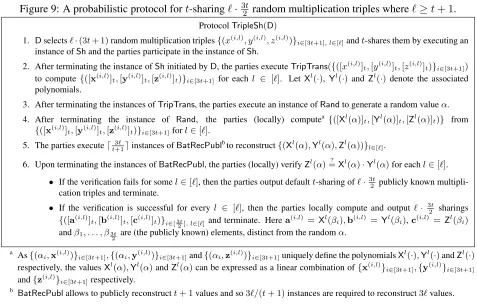
A Probabilistic Solution in a Completely Asynchronous Setting. Our protocolTripleShallows a partyD ∈ P to verifiably share multiplication triples with linear “overhead”, where the verification resorts to a probabilistic approach. In the protocol, D is asked to t-share 3t+ 1 random multiplication triples {(x(i), y(i), z(i))}i∈[3t+1] using protocol
Sh. To check if the triples are multiplication triples or not, the sharings of these triples are first transformed to
{([x(i)]
t,[y(i)]t,[z(i)]t)}i∈[3t+1] via TripTransand then the relation Z(·) ?
= X(·) ·Y(·) is verified through a public
checking ofZ(α) =? X(α)·Y(α)for a randomαfromF. To ensure that nocorruptedDcan pass this test, the valueα
should be generated usingRandonceDcompletes sharing of the triples. It follows via the property ofTripTransthat if all the input triples {(x(i), y(i), z(i))}i∈[3t+1] are not multiplication triples, then Z(α) 6= X(α)·Y(α) except with probability at most |3t
F| for a randomα, sinceZ(α) is of degree at most 3t. Moreover if Dis honest then Adv will
learn only one point onX(·),Y(·) andZ(·)(namely atα) leaving 32t “degree of freedom” in these polynomials. So if the verification passes, then the parties output 32t shared triples{([a(i)]t,[b(i)]t,[c(i)]t)}on the “behalf” ofD, where
a(i)=X(βi),b(i)=Y(βi)andc(i) =Z(βi)for 32t βis distinct from the randomα.
InTripleSh, the above idea is applied on`batches of3t+ 1t-shared triples, where`≥t+ 1and a single random
αis used for all the`batches. UsingBatRecPubl, we then efficiently perform the public reconstruction of3`values, namely the values of the polynomials atα. The protocol thus outputs`·32t = Θ(n`)shared multiplication triples. The protocol and its proof can be found in Appendix D. We note that for anhonestD, all the honest parties will eventually terminate the protocol and the output multiplication triples will remain private. For acorruptedD, if some honest party terminates, then all the honest parties eventually do the same and the output triples are multiplication triples except with probability |3t
F|. Finally the protocol requires communication ofO(n
2`)and broadcast ofO(n2)elements from
F.
An Error-Free Solution in a Hybrid Setting: An inherent drawback of a completely asynchronous setting is that the inputs of up totpotentially honest parties may get ignored. Since this might be undesirable for many real-world applications, [4, 6] introduced a “partial synchronous” or hybrid setting wherein the veryfirstcommunication round is a synchronous round. It was shown in [4] how to enforce “input provision” from all thenparties using the synchronous round (with some additional technicalities). We further utilize the first synchronous round to present anerror-freetriple sharing protocol calledHybTripleShfort-sharing multiplication triples. We dispose the high level idea in the following and defer the details to Appendix E.
on each of the polynomials for anhonestD, the parties output t2shared multiplication triples{[a(i)]t,[b(i)]t,[c(i)]t}i∈[2t]
on the behalf ofDafter successful verification, wherea(i) = X(βi),b(i) = Y(βi)andc(i) = Z(βi). The idea for the error-free verification is the following: eachpartyPi is given “access” to the triple(X(αi),Y(αi),Z(αi))and is given the responsibility of confirming if it is a multiplication triple. If the confirmation comes from all the parties, then it can be concluded that the relation Z(·) = X(·)Y(·) is true. This is because the confirmation comes from at least (n−t) = 3t+ 1honestparties and the degree of the polynomialsX(·),Y(·)is at most 32t and the degree ofZ(·)is at most3t. Moreover, at mosttvalues on each polynomial are leaked toAdvthrough thetcorrupted parties (for anhonest
D). Unfortunately, in a completely asynchronous setting, we cannot wait for the confirmation from all the parties inP, as the wait may turn out to be endless6. The synchronous round in the hybrid setting thus comes to our rescue.
In the synchronous round, every partyPi is asked to “non-verifiably”t-share adummy multiplication triple, say (f(i), g(i), h(i))which is used later to verify if(X(αi),Y(αi),Z(αi))is a multiplication triple on behalf ofPi, although
without further participationofPi. By non-verifiably we mean that neither the correctness of thet-sharing nor the fact that the shared triple is a multiplication triple is guaranteed ifPiiscorrupted. The synchronous round however ensures that a dummy triple is non-verifiably shared on the behalf ofeverypartyPi. Even if a corruptedPi does not send the shares of the dummy triples to some party by the end of the round, the receiver can take some default value to complete the sharing. By defining “good” dummy triples as the ones that aret-shared and are multiplication triples, we now show how the verification is carried out using these dummy triples. Note that the honest parties share good dummy triples.
Given a dummy triple(f(i), g(i), h(i)), we check if(X(αi),Y(αi),Z(αi))is a multiplication triple by computing the sharing of the product ofX(αi)andY(αi)via the Beaver’s technique and using the shared dummy triple and then publicly verifying if the resultant product is the same asZ(αi). The later can be verified by checking if the difference of the product andZ(αi)is0or not. IfPi ishonestthen the dummy triple is random and thus no information is leaked about(X(αi),Y(αi),Z(αi)). If the checking fails, then the sharing of(X(αi),Y(αi),Z(αi))are publicly reconstructed for its public verification. Note that in such a case, eitherPi orDmust becorruptedand thus the privacy of the triple is lost already. However, if(X(αi),Y(αi),Z(αi))is found to be a non-multiplication triple thenDis definitely corrupted in which case the protocol is halted after outputting 2t default sharing of multiplication triples.
When the shared triple(f(i), g(i), h(i))isnota good dummy triple due to the reason that it is a non-multiplication triple (butt-shared correctly), the checking of the corresponding multiplication triple(X(αi),Y(αi),Z(αi))might fail leading to its public reconstruction and verification. But in this casePiis surely corrupted and thus loosing the privacy of the triple does not matter. Furthermore, the public verification of the multiplication triple will be successful for an
honestD, implying that an honestDcannotbe disqualified. The case when the shared triple(f(i), g(i), h(i))isnota good dummy triple due to the reason that it is not t-shared correctly is more intricate to handle. The problem could be during the reconstruction of the values that are nott-shared, while executing the Beaver’s technique. We solve this problem via a “variant” ofOECthat concludes the reconstructed value upon receiving shares fromany3t+ 1parties without further waiting. This however, might cause different parties to reconstruct different values when the input sharing is nott-shared. Therefore an ABA protocol is run to reach agreement and then continue with the agreed value.
Finally we note that in the protocol HybTripleSh, the above idea is actually applied on ` batches of 3t+ 1 t -shared triples in parallel, where` ≥t+ 1. This allows the efficient public reconstruction of all the required sharings (corresponding to the` batches) usingBatRecPubl. The protocol thus outputs `· 2t = Θ(n`) shared multiplication triples. The protocol and its properties are available in Appendix E. We note that the properties of the protocol are same as that ofTripleSh, except that now the output triples will be multiplication triples without any error.
6.2 Module II: Extraction of Random Multiplication Triples from Local Multiplication Triples
Let Com ⊂ P be a publicly known set of 3t + 1 parties, such that every party in Com has verifiably t-shared `
multiplication triples among the parties inP, where the the triples shared by the honest parties are random and unknown to Adv. We present a protocol calledTripExt that “extracts” `· t
2 = Θ(n`) randomt-shared multiplication triples
unknown toAdvfrom these`·(3t+ 1)“local”t-shared multiplication triples with a communication ofO(n2`). The high level idea of the protocol is as follows: the input triples from the parties in Comare perceived as` batches of 3t+ 1triples where thelth batch contains thelth local triple from each party inCom. Then the transformation protocol
6
TripTransis executed on thelth batch to obtain a new set of 3t+ 1 triples and the three associated polynomials of degree 32t, 32t and3t, namelyXl(·),Yl(·)andZl(·). Since, each input triple is guaranteed to be a multiplication triple, the multiplicative relation holds among the polynomials, i.e. Zl(·) = Xl(·)Yl(·). SinceAdv gets to know at mostt
input triples in the lth batch, the transformation ensures that Advgets to know at most tpoints on each of the three polynomials, leaving 2t degree of freedom on each polynomial. The random output multiplication triples for thelth batch, unknown toAdv, are then extracted as([Xl(βi)]t,[Yl(βi)]t,[Zl(βi)]t) i∈[t
2]
; see Appendix F for the details.
6.3 Module I+Module II⇒Preprocessing (Offline) Phase with Linear Overhead
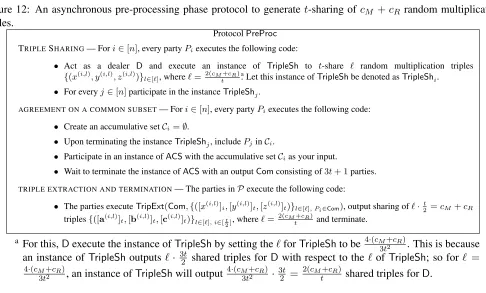
Our preprocessing phase protocol now consists of the following steps: (1) Every party inP acts as a dealer andt -share 2(cM+cR)
t random multiplication triples, either using an instance of the protocol TripleSh (if it is a completely asynchronous setting) or an an instance of the protocol HybTripleSh (if it is a hybrid setting). (2) The parties then execute an instance ofACSto decide on a common setComof3t+ 1dealers who have correctly shared multiplication triples in their respective instances ofTripleSh/HybTripleSh.(3)Finally the parties execute the triple extraction protocol
TripExton the triples shared by the parties inComto extract(cM +cR)random shared multiplication triples.
Now depending upon whether we use the protocolTripleShorHybTripleShabove, we get either a completely asyn-chronous preprocessing phase protocolPreProcinvolving an error of 3|t2
F| in the output or an error-free preprocessing
phase protocolHybPreProfor the hybrid setting. The output triples will be private, as the multiplication triples of the honest dealers inComare random and private. The protocols and their properties are provided in Appendix G.
7
The New AMPC Protocols
Once we have a preprocessing phase protocol, the online phase protocol for the shared circuit evaluation is straight forward, based on the standard technique of circuit evaluation in the information theoretic setting using preprocessed multiplication triples [3, 18, 4, 5, 10]. As this approach is quiet standard, we present the complete details in Appendix H. We note that in our hybrid AMPC protocol, during the offline phase, apart from t-sharing of (cM +cR) random multiplication triples, the parties generatet-sharing ofn·(t+ 1)additionalmultiplication triples. The additional triples are used to enforce “input provision” fromallthenparties during the online phase by using the method of [4]. This implies that now the preprocessing phase protocol and the online phase protocol starts in parallel, so that both can use the first synchronous round. While the preprocessing phase protocol uses it for the error-free generation of the multiplication triples, the online phase protocol uses it to enforce input provision. As the values shared by the parties in these two protocols are independent, this will not cause any problem. Finally we have the following theorem:
Theorem 7.1(The AMPC Theorem). Letf :Fn → Fbe a function expressed as an arithmetic circuit over a finite
fieldF, consisting ofcM andcRmultiplication and random gates. Then for every possibleAdvand for every possible
scheduler, there exists a statistical AMPC protocol to securely compute f, provided |F| ≥ max{3t2 ·2κ,2n} for a given error parameterκ. The protocol incurs communication ofO((cM +cR)n)elements (over the pair-wise secure
channels) and broadcast ofO(n3)elements fromFand requires two invocations toACSandninvocations toRand. If the first communication round is synchronous, then there exists a perfect AMPC protocol to securely compute
f, for every possibleAdvand for every possible scheduler, provided|F| ≥ 2n. In the protocol, the inputs of all (the
honest) parties are considered for the computation. The protocol requires communication ofO((cM+cR)n+n3)and
broadcast ofO(n3)elements fromF. It also requires two invocations toACSandn2invocations to ABA.
References
[1] I. Abraham, D. Dolev, and J. Y. Halpern. An almost-surely terminating polynomial protocol for asynchronous Byzantine agreement with optimal resilience. In R. A. Bazzi and B. Patt-Shamir, editors, Proceedings of the Twenty-Seventh Annual ACM Symposium on Principles of Distributed Computing, PODC 2008, Toronto, Canada, August 18-21, 2008, pages 405–414. ACM, 2008.
[2] D. Beaver. Efficient multiparty protocols using circuit randomization. In J. Feigenbaum, editor, Advances in Cryptology - CRYPTO ’91, 11th Annual International Cryptology Conference, Santa Barbara, California, USA, August 11-15, volume 576 ofLecture Notes in Computer Science, pages 420–432. Springer Verlag, 1991.
[3] Z. Beerliov´a-Trub´ıniov´a and M. Hirt. Efficient multi-party computation with dispute control. In S. Halevi and T. Rabin, editors, Theory of Cryptography, Third Theory of Cryptography Conference, TCC 2006, New York, NY, USA, March 4-7, 2006, Proceedings, volume 3876 of Lecture Notes in Computer Science, pages 305–328. Springer Verlag, 2006.
[4] Z. Beerliov´a-Trub´ıniov´a and M. Hirt. Simple and efficient perfectly-secure asynchronous MPC. In K. Kurosawa, editor,Advances in Cryptology - ASIACRYPT 2007, 13th International Conference on the Theory and Application of Cryptology and Information Security, Kuching, Malaysia, December 2-6, 2007, Proceedings, volume 4833 of
Lecture Notes in Computer Science, pages 376–392. Springer Verlag, 2007.
[5] Z. Beerliov´a-Trub´ıniov´a and M. Hirt. Perfectly-secure MPC with linear communication complexity. In R. Canetti, editor,Theory of Cryptography, Fifth Theory of Cryptography Conference, TCC 2008, New York, USA, March 19-21, 2008, volume 4948 ofLecture Notes in Computer Science, pages 213–230. Springer Verlag, 2008.
[6] Z. Beerliov´a-Trub´ıniov´a, M. Hirt, and J. B. Nielsen. On the theoretical gap between synchronous and asyn-chronous mpc protocols. In A. W. Richa and R. Guerraoui, editors,Proceedings of the 29th Annual ACM Sympo-sium on Principles of Distributed Computing, PODC 2010, Zurich, Switzerland, July 25-28, 2010, pages 211–218. ACM, 2010.
[7] M. Ben-Or, R. Canetti, and O. Goldreich. Asynchronous secure computation. In S. R. Kosaraju, D. S. Johnson, and A. Aggarwal, editors,Proceedings of the Twenty-Fifth Annual ACM Symposium on Theory of Computing, May 16-18, 1993, San Diego, CA, USA, pages 52–61. ACM, 1993.
[8] M. Ben-Or, S. Goldwasser, and A. Wigderson. Completeness theorems for non-cryptographic fault-tolerant dis-tributed computation (extended abstract). In J. Simon, editor,Proceedings of the 20th Annual ACM Symposium on Theory of Computing, May 2-4, 1988, Chicago, Illinois, USA, pages 1–10. ACM, 1988.
[9] M. Ben-Or, B. Kelmer, and T. Rabin. Asynchronous secure computations with optimal resilience (extended abstract). In J. H. Anderson, D. Peleg, and E. Borowsky, editors, Proceedings of the Thirteenth Annual ACM Symposium on Principles of Distributed Computing, Los Angeles, California, USA, August 14-17, 1994, pages 183–192. ACM, 1994.
[10] E. Ben-Sasson, S. Fehr, and R. Ostrovsky. Near-linear unconditionally-secure multiparty computation with a dishonest minority. In R. Safavi-Naini and R. Canetti, editors,Advances in Cryptology - CRYPTO 2012 - 32nd Annual Cryptology Conference, Santa Barbara, CA, USA, August 19-23, 2012. Proceedings, volume 7417 of
Lecture Notes in Computer Science, pages 663–680. Springer, 2012.
[11] G. Bracha. An asynchronous [(n-1)/3]-resilient consensus protocol. In T. Kameda, J. Misra, J. Peters, and N. San-toro, editors,Proceedings of the Third Annual ACM Symposium on Principles of Distributed Computing, Vancou-ver, B. C., Canada, August 27-29, 1984, pages 154–162. ACM, 1984.
[12] G. Bracha. An O(log n) expected rounds randomized Byzantine generals protocol. J. ACM, 34(4):910–920, 1987.
[14] D. Chaum, C. Cr´epeau, and I. Damg˚ard. Multiparty unconditionally secure protocols (extended abstract). In Janos Simon, editor,Proceedings of the 20th Annual ACM Symposium on Theory of Computing, May 2-4, 1988, Chicago, Illinois, USA, pages 11–19. ACM, 1988.
[15] R. Cramer, I. Damg˚ard, and U. M. Maurer. General Secure Multi-party Computation from any Linear Secret-Sharing Scheme. In B. Preneel, editor,Advances in Cryptology - EUROCRYPT 2000, International Conference on the Theory and Application of Cryptographic Techniques, Bruges, Belgium, May 14-18, 2000, Proceeding, volume 1807 ofLecture Notes in Computer Science, pages 316–334. Springer Verlag, 2000.
[16] I. Damg˚ard, Y. Ishai, and M. Krøigaard. Perfectly secure multiparty computation and the computational overhead of cryptography. In H. Gilbert, editor,Advances in Cryptology - EUROCRYPT 2010, 29th Annual International Conference on the Theory and Applications of Cryptographic Techniques, French Riviera, May 30 - June 3, 2010. Proceedings, volume 6110 ofLecture Notes in Computer Science, pages 445–465. Springer, 2010.
[17] I. Damg˚ard, Y. Ishai, M. Krøigaard, J. B. Nielsen, and A. Smith. Scalable multiparty computation with nearly optimal work and resilience. In D. Wagner, editor,Advances in Cryptology - CRYPTO 2008, 28th Annual In-ternational Cryptology Conference, Santa Barbara, CA, USA, August 17-21, 2008. Proceedings, volume 5157 of
Lecture Notes in Computer Science, pages 241–261. Springer, 2008.
[18] I. Damg˚ard and J. B. Nielsen. Scalable and unconditionally secure multiparty computation. In A. Menezes, editor,
Advances in Cryptology - CRYPTO 2007, 27th Annual International Cryptology Conference, Santa Barbara, CA, USA, August 19-23, 2007, Proceedings, volume 4622 of Lecture Notes in Computer Science, pages 572–590. Springer Verlag, 2007.
[19] V. Dani, V. King, M. Movahedi, and J. Saia. Brief Announcement: Breaking the O(nm) Bit Barrier, Secure Multiparty Computation with a Static Adversary. In D. Kowalski and A. Panconesi, editors,ACM Symposium on Principles of Distributed Computing, PODC ’12, Funchal, Madeira, Portugal, July 16-18, 2012, pages 227–228. ACM, 2012.
[20] M. J. Fischer, N. A. Lynch, and M. Paterson. Impossibility of distributed consensus with one faulty process. J. ACM, 32(2):374–382, 1985.
[21] M. K. Franklin and M. Yung. Communication complexity of secure computation (extended abstract). In S. R. Kosaraju, M. Fellows, A. Wigderson, and J. A. Ellis, editors,Proceedings of the 24th Annual ACM Symposium on Theory of Computing, May 4-6, 1992, Victoria, British Columbia, Canada, pages 699–710. ACM, 1992.
[22] M. Hirt and U. M. Maurer. Robustness for free in unconditional multi-party computation. In J. Kilian, edi-tor,Advances in Cryptology - CRYPTO 2001, 21st Annual International Cryptology Conference, Santa Barbara, California, USA, August 19-23, 2001, Proceedings, volume 2139 of Lecture Notes in Computer Science, pages 101–118. Springer, 2001.
[23] M. Hirt, U. M. Maurer, and B. Przydatek. Efficient secure multi-party computation. In T. Okamoto, editor,
Advances in Cryptology - ASIACRYPT 2000, 6th International Conference on the Theory and Application of Cryptology and Information Security, Kyoto, Japan, December 3-7, 2000, Proceedings, volume 1976 ofLecture Notes in Computer Science, pages 143–161. Springer, 2000.
[24] M. Hirt, J. B. Nielsen, and B. Przydatek. Cryptographic asynchronous multi-party computation with optimal resilience (extended abstract). In R. Cramer, editor,Advances in Cryptology - EUROCRYPT 2005, 24th Annual International Conference on the Theory and Applications of Cryptographic Techniques, Aarhus, Denmark, May 22-26, 2005, Proceedings, volume 3494 ofLecture Notes in Computer Science, pages 322–340. Springer, 2005.
[26] C. Y. Koo. Studies on Fault-Tolerant Broadcast and Secure Computation. PhD thesis, University of Maryland, 2007.
[27] F. J. MacWilliams and N. J. A. Sloane. The Theory of Error Correcting Codes. North-Holland Publishing Com-pany, 1978.
[28] A. Patra, A. Choudhary, and C. Pandu Rangan. Communication efficient perfectly secure VSS and MPC in asynchronous networks with optimal resilience. In D. J. Bernstein and T. Lange, editors,Progress in Cryptology - AFRICACRYPT 2010, Third International Conference on Cryptology in Africa, Stellenbosch, South Africa, May 3-6, 2010, volume 6055 of Lecture Notes in Computer Science, pages 184–202. Springer Verlag, 2010. Full version available at [29].
[29] A. Patra, A. Choudhury, and C. Pandu Rangan. Efficient asynchronous verifiable secret sharing and multiparty computation. Cryptology ePrint Archive, Report 2010/007, 2010. A preliminary version appeared as [28].
[30] A. Patra and C. Pandu Rangan. Brief announcement: communication efficient asynchronous Byzantine agreement. In A. W. Richa and R. Guerraoui, editors, Proceedings of the 29th Annual ACM Symposium on Principles of Distributed Computing, PODC 2010, Zurich, Switzerland, July 25-28, 2010, pages 243–244. ACM, 2010.
[31] B. Prabhu, K. Srinathan, and C. Pandu Rangan. Trading players for efficiency in unconditional multiparty compu-tation. In S. Cimato, C. Galdi, and G. Persiano, editors,Security in Communication Networks, Third International Conference, SCN 2002, Amalfi, Italy, September 11-13, 2002. Revised Papers, volume 2576 ofLecture Notes in Computer Science, pages 342–353. Springer, 2002.
[32] T. Rabin and M. Ben-Or. Verifiable secret sharing and multiparty protocols with honest majority (extended ab-stract). In D. S. Johnson, editor,Proceedings of the 21st Annual ACM Symposium on Theory of Computing, May 14-17, 1989, Seattle, Washigton, USA, pages 73–85. ACM, 1989.
[33] A. Shamir. How to share a secret. Commun. ACM, 22(11):612–613, 1979.
[34] K. Srinathan and C. Pandu Rangan. Efficient asynchronous secure multiparty distributed computation. In B. K. Roy and E. Okamoto, editors, Progress in Cryptology - INDOCRYPT 2000, First International Conference in Cryptology in India, Calcutta, India, December 10-13, 2000, Proceedings, volume 1977 of Lecture Notes in Computer Science, pages 117–129. Springer, 2000.
A
Exiting Building Blocks in Details
A.1 Private Reconstruction of ad-shared Value using OEC [7, 13, 29]
Letvbe a value which isd-shared among a set of partiesP ⊆ P, whered <|P| −2t. The goal is to make some party, sayPR, to reconstruct the valuevrobustly. In the synchronous setting, this can be achieved by asking every party in
P to send its share ofvtoPR, who can apply the Reed-Solomon (RS) error correction [27] algorithm on the received shares to reconstruct the value. Given the condition thatd < (|P| −2t), the reconstruction will be robust, even if at mosttcorrupted parties inP send incorrect or no shares. In an asynchronous setting, achieving the same requires a bit of trick as explained in the OEC protocol of [13].
The intuition behind the OEC is thatPRkeeps waiting till it receivesd+t+ 1shares which ared-consistent (i.e. lie on a unique polynomial of degree at mostd). This step requires applying the RS error correction algorithm repeatedly. LetRSDec(d, r,I)denote an RS error correction procedure, which takes as input a setI of shares (contains possibly some incorrect shares) of ad-shared value (that we would like to reconstruct) and outputs a polynomial of degree at mostd, by correcting at mostrerrors (incorrect shares) inI. Coding theory [27] says that RSDeccan correct uptor
parties in P and those d+ 1 shares uniquely define the original polynomial p(·) implying that p(·) = p(·). Note that the corrupted parties inP may send incorrect shares toPRor may not send any value. But the shares of at least
|P| −t≥(d+t+ 1)honest parties in the setP ared-consistent and they will eventually reach toPR. As mentioned in [7, 29], the above procedure is nothing but applying the RS error correction algorithm in an “online” fashion.
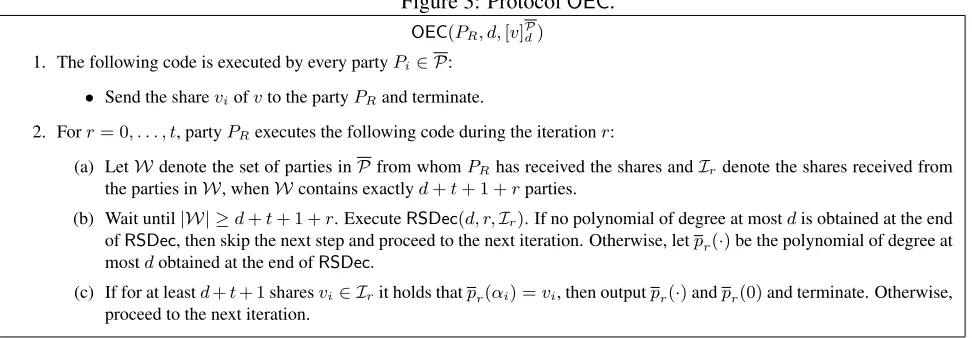
The above steps are formally described in the protocolOECpresented in Fig. 3. The current description is inspired from [13] (skipping several other formal details).
Figure 3: ProtocolOEC.
OEC(PR, d,[v]Pd)
1. The following code is executed by every partyPi∈ P:
• Send the shareviofvto the partyPRand terminate.
2. Forr= 0, . . . , t, partyPRexecutes the following code during the iterationr:
(a) LetWdenote the set of parties inPfrom whomPRhas received the shares andIrdenote the shares received from
the parties inW, whenWcontains exactlyd+t+ 1 +rparties.
(b) Wait until|W| ≥d+t+ 1 +r. ExecuteRSDec(d, r,Ir). If no polynomial of degree at mostdis obtained at the end
ofRSDec, then skip the next step and proceed to the next iteration. Otherwise, letpr(·)be the polynomial of degree at
mostdobtained at the end ofRSDec.
(c) If for at leastd+t+ 1sharesvi∈ Irit holds thatpr(αi) =vi, then outputpr(·)andpr(0)and terminate. Otherwise,
proceed to the next iteration.
The properties of the protocolOECare stated in Lemma A.1.
Lemma A.1. Given[v]Pd forP ⊆ P andd <|P| −2t, let the sharing is done using polynomialp(·)of degree at most
d. Then for every possibleAdvand for every possible scheduler, protocolOECachieves:
(1)TERMINATION: Every honest party inP will eventually terminate the protocol. Moreover, ifPRis honest thenPR
will also eventually terminate the protocol.(2)CORRECTNESS: PartyPRwill outputp(·)andv.(3)PRIVACY: IfPRis
honest thenAdvobtains no additional information aboutv.(4)COMMUNICATIONCOMPLEXITY: The protocol incurs communication ofO(n)elements fromF.
PROOF: TheTERMINATIONproperty is argued as follows. The honest parties inP will terminate the protocol trivially after sending their shares of v to PR. We now argue that (an honest) PR will terminate the protocol as well. Let
Adv corruptsˆr parties inP, whererˆ ≤ t. Further assumerˆ1 corrupted parties send wrong values andrˆ2 corrupted
parties send nothing ever, subject torˆ1 + ˆr2 = ˆr. Consider the(t−rˆ2)th iteration; sinceˆr2 parties inP never send
any value,PRwill received+t+ 1 +t−r2ˆ distinct values on the polynomialp(·), of whichr1ˆ are corrupted. Since
|It−rˆ2|=d+t+ 1 +t−r2ˆ ≥d+ 2 ˆr1+ 1, the algorithmRSDecwill correctr1ˆ errors and will returnpt−rˆ2(·) =p(·)
during the(t−rˆ2)th iteration. Therefore the protocol will terminate at the latest after(t−rˆ2)th iteration.
To argueCORRECTNESS, assume that the protocol terminates during therth iteration andPRoutputs p¯r(0)such that the polynomial p¯r(·) is consistent withd+t+ 1 shares fromIr. To prove the correctness, we now show that
¯
pr(·) =p(·). However, the equality follows from the fact that at leastd+ 1shares inIrbelong to the honest parties and thus they lie onp(·)as well. In other words, thesed+ 1shares are the common points of the two polynomials which are of degree at mostd.
ThePRIVACY is argued as follows. It is easy to see that ifPRis honest, thenAdv gets no additional information aboutv. Since the (honest) parties inP send their shares toPRover the point-to-point private channels, no additional information aboutvor the values ofp(·)is revealed toAdvduringOEC.
In the protocol, each party inP sends its share toPR, leading to the communication ofO(n)elements fromF. 2
A.2 Batch Public Reconstruction of Severald-shared Values
Let u(1), . . . , u(t+1) be d-shared among a set of parties P ⊆ P, whered < |P| −2t; i.e., [u(1)]Pd, . . . ,[u(t+1)]Pd is available. The goal is to makeeveryparty inP to reconstructu(1), . . . , u(t+1). Trivially this can be done by executing
n·(t+ 1)instances of OEC (ninstances for each [u(i)]P
Instead, by using an idea presented in [18, 5] (for the synchronous setting), we present a protocolBatRecPublwhich requires to communicateO(n2) field elements. The idea is the following: we first “expand” thet+ 1sharings to n
sharings, say [v(1)]Pd, . . . ,[v(n)]Pd, by applying a linear function. Specifically, by interpreting u(1), . . . , u(t+1) as the coefficients of a polynomialu(·) of degree at mostt and by letting v(1), . . . , v(n) to be the evaluations of u(·) at n
publicly known distinct points, each[v(i)]dcan be computed as linear combination of the givent+ 1sharings. Once the parties compute[v(1)]d, . . . ,[v(n)]d, thenv(i)is reconstructed towards the partyPiusing an instance ofOEC. Each
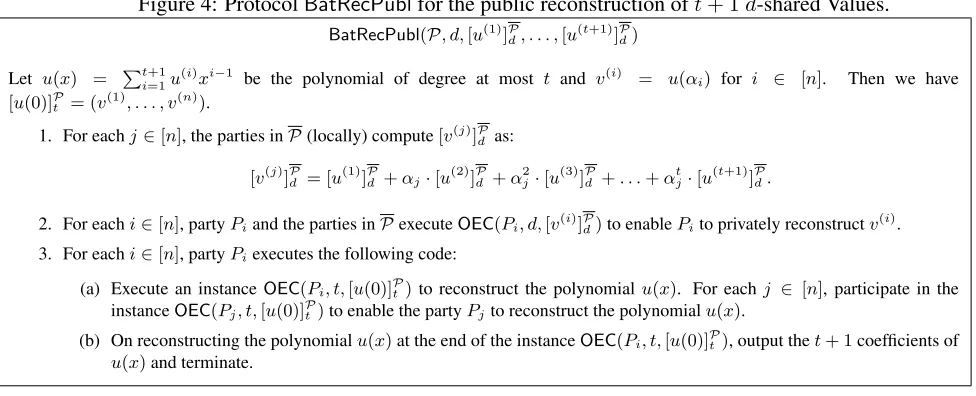
Pi then sendsv(i) to every other party inP. Finally, each party appliesOEC on the receivedv(i)s to reconstruct the polynomialu(·)and outputsu(1), . . . , u(t+1). The protocol is presented in Fig. 4.
Figure 4: ProtocolBatRecPublfor the public reconstruction oft+ 1d-shared Values.
BatRecPubl(P, d,[u(1)]Pd, . . . ,[u (t+1)
]Pd)
Let u(x) = Pt+1 i=1u
(i)
xi−1 be the polynomial of degree at most t and v(i) = u(αi) for i ∈ [n]. Then we have
[u(0)]Pt = (v(1), . . . , v(n)).
1. For eachj∈[n], the parties inP(locally) compute[v(j)]Pd as:
[v(j)]Pd = [u (1)
]Pd +αj·[u(2)] P d +α
2 j·[u
(3)
]Pd +. . .+α t j·[u
(t+1)
]Pd.
2. For eachi∈[n], partyPiand the parties inPexecuteOEC(Pi, d,[v(i)]Pd)to enablePito privately reconstructv(i).
3. For eachi∈[n], partyPiexecutes the following code:
(a) Execute an instanceOEC(Pi, t,[u(0)]Pt)to reconstruct the polynomial u(x). For eachj ∈ [n], participate in the
instanceOEC(Pj, t,[u(0)]tP)to enable the partyPjto reconstruct the polynomialu(x).
(b) On reconstructing the polynomialu(x)at the end of the instanceOEC(Pi, t,[u(0)]Pt ), output thet+ 1coefficients of
u(x)and terminate.
The properties of the protocolBatRecPublare stated in Lemma A.2.
Lemma A.2. Given[u(1)]Pd, . . . ,[u(t+1)]Pd forP ⊆ Pandd <|P| −2t, for every possibleAdvand for every possible scheduler, protocolBatRecPublachieves:
(1)TERMINATION: Every honest party inP will eventually complete the protocol. (2)CORRECTNESS: Every honest party inP will outputu(1), . . . , u(t+1). (3)COMMUNICATIONCOMPLEXITY: The protocol incurs communication of
O(n2)elements from
F.
PROOF: TheTERMINATIONproperty of the protocol follows from the termination property ofOEC(Lemma A.1). For
CORRECTNESS, we note that the correctness property ofOEC(Lemma A.1) implies that each honest partyPi∈ Pwill eventually reconstructv(i)at the end of the instanceOEC(P
i, d,[v(i)]Pd). Moreover,(v(1), . . . , v(n)) = [u(0)]Pt; so from the correctness property ofOEC, each honest partyPiwill output the polynomialu(x)at the end ofOEC(Pi, t,[u(0)]Pt) and hence will outputu(1), . . . , u(t+1), which are the coefficients ofu(x). TheCOMMUNICATION COMPLEXITY
fol-lows from the communication complexity ofOEC(Lemma A.1) and the fact that2ninstances ofOECare executed.2
We note that unlike OEC that enables the reconstruction of the polynomial used for the given input sharing, proto-colBatRecPublallows to reconstruct only thed-shared values and not the individual polynomials that are used for the sharings. We further note that the above mentioned property ofOECis instrumental in the correctness ofBatRecPubl, since the entire polynomial u(x)is required to be reconstructed inBatRecPubl in order to output the coefficients of
u(x).
A.3 Batch Multiplication of`Pairs oft-shared Values using Beaver’s Technique
ProtocolBatchBeaveris presented in Fig. 5.
The properties of the protocolBatchBeaverare stated in Lemma A.3.
Lemma A.3. Let{([x(i)]t,[y(i)]t)}i∈[`] be a batch of ` pairs of t-sharing and {([a(i)]t,[b(i)]t,[c(i)]t)}i∈[`] be the t
![Figure 5: Protocol to perform batch multiplication of ℓ pairs of t-shared values where ℓ ≥ t + 1.Protocol BatchBeaver({([x(i)], [y(i)], [a(i)], [b(i)], [c(i)])})](https://thumb-us.123doks.com/thumbv2/123dok_us/7886457.1308544/17.612.67.545.56.187/figure-protocol-perform-multiplication-shared-values-protocol-batchbeaver.webp)
![Figure 8: The sharing protocol of the AVSS of [28, 29].](https://thumb-us.123doks.com/thumbv2/123dok_us/7886457.1308544/20.612.63.547.83.608/figure-sharing-protocol-avss.webp)