Optimally Robust Private Information Retrieval
∗
Casey Devet
Ian Goldberg
University of Waterloo
{
cjdevet,iang
}
@cs.uwaterloo.ca
Nadia Heninger
University of California, San Diego
[email protected]
Abstract
We give a protocol for multi-server information-theoretic private information retrieval which achieves the theoret-ical limit for Byzantine robustness. That is, the protocol can allow a client to successfully complete queries and identify server misbehavior in the presence of the max-imum possible number of malicious servers. We have implemented our scheme and it is extremely fast in prac-tice: up to thousands of times faster than previous work. We achieve these improvements by using decoding al-gorithms for error-correcting codes that take advantage of the practical scenario where the client is interested in multiple blocks of the database.
1
Introduction and related work
Private information retrieval(PIR) is a way for a client
to look up information in an online database without let-ting the database servers learn the query terms or re-sponses. A simple if inefficient way to do this is for the database server to send a copy of the entire database to the client, and let the client look up the information for herself. This is calledtrivial download. The goal of PIR is to transmit less data while still protecting the privacy of the query. PIR is a fundamental building block for many proposed privacy-sensitive applications in the liter-ature, including patent databases [2], domain name reg-istration [28], anonymous email [33], and improving the scalability of anonymous communication networks [26]. The simplest kind of query one can make with PIR is to consider the database to be composed of a number of blocks of equal size, and to retrieve a particular block from the database by its absolute position [10]. Although this simple type of query does not appear to be very use-ful in practice, it turns out that it can be used as a black-box building block to construct more complex and
use-∗This is an extended version of our conference paper, which ap-peared at the 2012 USENIX Security Symposium. [13]
ful queries, such as searching for keywords [9] or private SQL queries [28].
PIR protocols can be grouped into two classes corre-sponding to the security guarantees they provide. One class is computational PIR [8], in which the database servers can learn the client’s query if they can ap-ply sufficient computational power to break a particular cryptographic system. The other class of protocols — those we will consider in this work — is
information-theoretic PIR [10, 11], in which no amount of
IT-PIR client would send one block of data to, and receive one block of data from, each server. The servers each perform about 1.4 CPU seconds of computation, and the client performs about 140 ms of computation.
1.1
Byzantine robustness
An important practical consideration with multi-server PIR is how to deal with servers that do not respond
to a client’s queries, or thatrespond incorrectly, either through malice or error. These are respectively termed
therobustnessandByzantine robustnessproblems.
The main result of this paper is to improve the Byzan-tine robustness of information-theoretic PIR. In order to guarantee information-theoretic PIR, one must have mul-tiple servers in the protocol; Byzantine robustness guar-antees that the protocol still functions correctly even if some of the servers fail to respond or give incorrect or malicious responses. Byzantine robustness makes no assumptions on the type of errors that can appear—the model covers spurious or random errors as well as ma-licious interference—and the bounds are given in terms of the number of servers which ever give incorrect re-sponses. The client must still be able to determine the an-swer to her query, even when some number of the servers fail to respond, or give incorrect answers; further, in the latter case, the client would like to learn whichservers misbehaved so that they can be avoided in the future. (In the single-server case, the owner of the database can pro-vide a cryptographic signature on each block in order to ensure integrity, as PIR-Tor [26] does. Without computa-tional assumptions or some kind of shared secret, it does not make much sense to consider robustness or Byzan-tine robustness in a single-server PIR setting.)
Beimel and Stahl [3, 4] were the first to consider ro-bustness and Byzantine roro-bustness for PIR. Consider an
`-server information-theoretic PIR setting, where onlyk
of the servers respond, vof the servers respond incor-rectly, and the system can withstand up tot colluding servers without revealing the client’s query (t is called
theprivacy level). (This is termed “t-privatev-Byzantine
robustk-out-of-`PIR”.) Then the protocol of Beimel and Stahl works whenv≤t<k/3. Under those conditions, the protocol will always output to the client a unique block, which will be the correct one; this is calledunique
decoding.
In 2007, Goldberg [19] observed that by allowing for the possibility oflist decoding— that is, that the protocol may sometimes output a small number of blocks instead of just one — the privacy level and the number of misbe-having servers can be substantially increased, up tot<k
andv<k− b√ktc. He also showed that in many scenar-ios, the probability of more than one block being output by the protocol is vanishingly small, while in others, one
can employ standard techniques to convert list decoding to unique decoding [25] at the cost of slightly increasing the size of the database. The communication overhead of Goldberg’s protocol isk+`; that is, to retrieve one block of data (saybbits), the protocol transfers a total of
(k+`)bbits, for the optimal choice of block sizeb.
1.2
Our contributions
• We change only the client side of Goldberg’s 2007 protocol to improve its Byzantine robustness from
v<k− b√ktctov<k−t−1, which is the theoret-ically maximum possible value. Depending on the deployment scenario, the communication overhead of our protocol ranges from a factor of k+` to a maximum ofv(k+`).
• Our protocol is considerably faster than Goldberg’s protocol for many reasonable parameter choices. We implemented our protocol on top of Goldberg’s open-source Percy++ [18] distribution and find that our new protocol can be up to3–4 orders of magni-tude(thousands of times) faster than the original in reconstructing the correct response to a query in the presence of Byzantine servers.
The robustness and efficiency improvements to the PIR protocol given in this paper mean that recovering from Byzantine errors even in an extremely adversarial or noisy setting is not just academically feasible, but is completely reasonable for user-facing applications.
Goldberg’s protocol uses Shamir secret sharing to hide the query; since Shamir secret sharing is based off of polynomial interpolation, the problem of recovering the response in the case of Byzantine failures corresponds to noisy polynomial reconstruction, which is exactly the problem of decoding Reed-Solomon codes. The theo-retical contribution of this work is to observe that the practical setting of clients performing multiple queries allows us to use sophisticated decoding algorithms that can decode multiple queriessimultaneouslyand achieve an enormous improvement in both performance and the level of robustness.
1.3
Organization
2
Preliminaries
2.1
Notation
We will use the following variables throughout the paper:
• `denotes the total number of servers
• t is the privacy level: no coalition of t or fewer servers can learn the client’s query
• kis the number of servers that respond
• vis the number of Byzantine servers that respond andhis the number of honest servers that respond (soh+v=k). Byzantine servers may respond with any maliciously chosen value.
• Dis the database
• ris the number of blocks in the database
• sis the number of words in each database block
• wis the number of bits per word
We denote by ej the standard basis vector
h0, . . . ,0,1,0, . . . ,0i where the 1 is in the jth place.
x∈R X means selecting the element x uniformly at
random from the spaceX.
2.2
Shamir secret sharing
The classic Shamir secret sharing scheme [34] allows a
dealerto choose a secret valueσ, and distributeshares
of that secret to `players. Ift or fewer of the players come together, they learn no information aboutσ, but if
more thantpool their shares, they can easily recover the secret. (tand`are parameters of the scheme, witht< `.) The scheme works as follows: let σ be an
arbi-trary element of some finite fieldF(not necessary uni-formly distributed). The dealer selects`arbitrary distinct non-zero indicesα1, . . . ,α`∈F, and selectst elements
a1, . . . ,at ∈RF uniformly at random. The dealer con-structs the polynomialf(x) =σ+a1x+a2x2+· · ·+atxt,
and gives to player i the share(αi,f(αi))∈F×F for 1≤i≤`. Note that the secretσ is just f(0). Now any
t+1 or more players can use Lagrange interpolation to reconstruct the polynomial f, and evaluatef(0)to yield
σ. However,tor fewer players learn absolutely no infor-mation aboutσ.
Complications arise during reconstruction, however, when some of the shares being brought together to re-constructf are incorrect. Dealing with this case involves working with error-correcting codes, and will be dis-cussed in Section 2.3, next.
Sharing a vector of elements inFrrather than a single field element is done in the straightforward way: each coordinate of the vector is secret shared separately, using
rindependent random polynomials.
2.3
Error-correcting codes
We will use error-correcting codes to handle Byzantine robustness. In the case of servers that merely fail to respond, we could try to use an erasure code — an error-correcting code which can be decoded when some symbols are erased by the channel. In order to handle Byzantine failures, we will use error-correcting codes that can handle both corrupted and missing symbols. Our scheme will transform malicious errors into random er-rors, which will allow us to achieve much higher robust-ness (with high probability) than was efficiently possi-ble before. In addition, the use of these error-correcting codes allows us to identify servers that cheat during the protocol, and not use them in the future.
The error-correcting codes that we will use in our pro-tocol are based off of Reed-Solomon codes. [32] This is a natural choice to use with Shamir secret sharing, as they both use polynomial interpolation. If a message of length t+1 consists of elements {a0,a1, . . . ,at} in
some fieldFthen we can define the degree-tpolynomial
f(x) =a0+a1x+· · ·+atxt. Fixkdistinct field elements
α1, . . . ,αk. A Reed-Solomon codeword consists of the
evaluations of f at each point:{f(α1), . . . ,f(αk)}.
The Berlekamp-Welch [5] algorithm can efficiently decode a Reed-Solomon codeword with up tov<(k− t)/2 errors, which is the theoretical maximum for unique decoding. However, if one is willing to accept the pos-sibility of decoding to multiple valid codewords, the Guruswami-Sudan algorithm [22] improves the
decod-ing radiustov<k−√kt. This is known aslist decoding:
the algorithm returns a list of all valid codewords.
2.3.1 Multi-polynomial reconstruction
The above decoding algorithms all consider the case of noisy interpolation of a single polynomial. More re-cently, Parvaresh and Vardy [31], and Guruswami and Rudra [21] designed codes that could be efficiently list decoded, approaching the asymptotic limit ofv<k− t−1. These codes are based around the idea of extend-ing the Reed-Solomon code to evaluatemultiple
polyno-mialssimultaneously, and using clever constructions of
the polynomials in order to efficiently decode the code-words. One of the main contributions of this paper is to adapt these ideas to a cryptographic setting. We can-not directly use their constructions, as their polynomials have a special structure that would make them unsuit-able for secret sharing. However, using a randomized construction we can nonetheless efficiently decode such multi-polynomial codes in practice with high probability, yielding a secret sharing system robust to many errors.
points. Definempolynomials
f1(x) =a10+a11x+· · ·+a1txt,
.. .
fm(x) =am0+am1x+· · ·+amtxt.
Then a codeword will consist of the evaluations of each of these polynomials at pointsα1, . . . ,αk:
f1(α1), . . . ,fm(α1),
.. .
f1(αk), . . . ,fm(αk)
This general case is considered by Cohn and Heninger [12], who give an algorithm that heuristi-cally reconstructs every polynomial as long as there are no more than v<k−tm/(m+1)k1/(m+1) values of i for
which the received value of some fp(αi)is incorrect. In
our application to PIR, each polynomial will correspond to a column of the database matrixD, and each valueαi
will correspond to a PIR server; therefore, we will be able to toleratevdishonest servers.
2.3.2 Linear multi-polynomial decoding
The list-decoding algorithms of Guruswami-Sudan, Parvaresh-Vardy, and Cohn-Heninger all work by con-structing a polynomial which vanishes to high multiplic-ity at the codeword. If one simply uses multiplicmultiplic-ity one, one can obtain a “linear” variant of the Cohn-Heninger algorithm [12] which is extremely fast in practice. It re-constructs each polynomial uniquely when no more than
v≤ m
m+1(k−t−1) values of i have incorrect received
values of some fp(αi). This algorithm works with high
probability in practice as long as the errors are random-ized. We will show later how to set up our protocol to enforce that even malicious servers can only insert ran-dom errors.
Since this linear variant is not explicitly described in their work, we provide a brief outline in Algorithm 1.
Polynomial lattice basis reduction. Step 4 in the
al-gorithm uses a “polynomial lattice basis row reduction algorithm”. This is an algorithm which takes as input a matrixM ofpolynomialsand applies elementary row operations over the ring of polynomials to produce a ma-trixM0whose coefficient polynomials have minimal de-gree. [37] There are several polynomial-time polynomial lattice basis reduction algorithms. (This is a refreshing contrast to the case ofintegerlattices where finding ex-act shortest vectors is NP-hard and efficient algorithms
Algorithm 1Fast multi-polynomial reconstruction
Input: kmpoints(αi,yip)1≤i≤k, 1≤p≤m, degree
boundt, and minimum number of correct pointsh=
k−v.
Output: m polynomials f1, . . . ,fm of degree at mostt
such that for at leasth values ofi, fp(αi) =yip for
all 1≤p≤m
1: Use Lagrange interpolation to constructm polyno-mials f∗pof degree at mostk−1 s.t. fp∗(αi) =yipfor
each 1≤i≤k.
2: Construct the degree-kpolynomial
N(x) =
k
∏
i=1
(x−αi)
3: Construct the(m+1)×(m+1)polynomial matrix
M=
xt −f1∗(x)
xt −f2∗(x)
. ..
xt −fm∗(x)
N(x)
4: Run a polynomial lattice basis row reduction algo-rithm onM.
5: Discard the largest-degree row in the reduced matrix. If any remaining row has degree larger thanh, abort.
6: Write the remaining m×(m+1) matrix as [A|b], whereAis anm×mmatrix, andbis anm×1 col-umn vector.
7: Solve the linear system of equations
1
xtA
f1 f2
.. .
fm
=b
8: return (f1, . . . ,fm)
such as LLL [24] can only obtain an exponential approx-imation.) The algorithm of Giorgi et al. [17] runs in time
O(δnω+o(1))whereδ is the maximum degree of the
in-put basis,n is the dimension, andω is the exponent of
matrix multiplication. Our implementation uses the al-gorithm of Mulders and Storjohann [27] which runs in timeO(n3δ2)but is much simpler and easier to
imple-ment, and yields excellent running times for the input sizes we care about.
see later, if the errors are random, this step aborts only with very low probability.
Without any imposed structure on the codeword poly-nomials, the Cohn-Heninger algorithm isheuristic; that is, they conjecture that it will succeed for sufficiently random input. The linear version that we use here is also heuristic: there are adversarial inputs on which it may fail. However, we observe in experiments (see Sec-tion 5.3) that the heuristic assumpSec-tion holds with high probability forrandominputs, which is the situation we need for our cryptographic purposes here. We conjecture based on the experimental evidence presented in Sec-tion 5.3 that the probability of failure depends only on the size of the underlying fieldF. In particular, the algo-rithm will work with high probability for random poly-nomials if the errors are uncorrelated. We will see later that we can enforce this restriction in our protocol even in the case of Byzantine servers.
2.3.3 Optimality
Relating this to our PIR application, we will be able to use this algorithm to correctly decode the results oft -private PIR queries. Ifkservers respond to us, of which
vare Byzantine (soh=k−vare honest), then this algo-rithm will succeed with high probability after we query for mblocks, satisfyingv≤ m
m+1(k−t−1), or
equiva-lently,m≥ v
h−t−1. That is, formlarge enough, we can
handle any number of Byzantine serversv<k−t−1. We note that this bound onvisoptimal—ifv=k−t−1, or equivalently,h=t+1, thenanysubset oft+1 servers’ responses will form a polynomial of degree at most t. This means that the number of possible valid blocks will always be exponential, and no polynomial-time algo-rithm could hope to address this case.
2.4
Dynamic programming
In practice, each of the algorithms we have described above has different performance characteristics for dif-ferent inputs. Thus in our implementation, we achieve the best performance by assembling all of them together into aportfolio algorithm. This algorithm optimistically attempts to decode a given input using Lagrange inter-polation, and if that fails, uses a dynamic program with timing measurements to fall back to an optimal sequence of decoding algorithms. See Section 5.2 for more details.
3
Protocols for PIR
In this section, we will introduce the ideas from previous PIR protocols that will form the basis for our protocol.
3.1
Database queries as linear algebra
We begin with a general mathematical setting of the PIR schemes we will be considering.
Our databaseDis structured as anr×smatrix with
rrows. Each row represents one block of the database, and consists ofswords ofwbits each. The databaseD
resides on a remote server. The client wishes to retrieve one block (row) of the database from the server.
D=
w11 w12 . . . w1s
w21 w22 . . . w2s
..
. ... ...
wr1 wr2 . . . wrs
One non-private protocol for the client to retrieve row
β of the database would be to transmit the vectoreβ
con-sisting of all zeros except for a single 1 in coordinateβ
to the server. The server considerseβas a row vector and computes the producteβ·D, which it sends back to the client.
0 0 . . . 1 . . . 0
w11 w12 . . . w1s
w21 w22 . . . w2s
..
. ... ...
wr1 wr2 . . . wrs
=
wβ1 wβ2 . . . wβs
We will show how to construct two information-theoretic PIR schemes that modify this basic scheme to retrieve blocks from the database without revealing the query or result to an adversary.
3.2
A simple PIR scheme due to Chor et al.
We next present a simple PIR scheme due to Chor et al. [10] We begin with the same setup as above. In this protocol, the words will be single bits, sow=1, andD
is anr×smatrix of bits. Since we will be construct-ing information-theoretic PIR, we will be queryconstruct-ing more than one server. We will require that not all of the servers are colluding to reveal the client’s query. Each of the
`≥2 servers gets a copy ofD.
A client wishing to retrieve block β of the database generates the basis vectoreβ as above to select
coordi-nateβ. Then in order to hide this query vector from the servers, the client picks `−1 vectors v1, . . . ,v`−1
uniformly at random from GF(2)r (that is, `−1
uni-formly randomr-bit binary strings), and computesv`= eβ⊕(v1⊕ · · · ⊕v`−1). v` will be a uniformly random
(though not independent)r-bit string, as`≥2.
The client sendsvito serverifor each 1≤i≤`. Server
settingrito be the XOR of those blocks jin the database
for which the jthbit ofviis 1. Each serverireturnsrito
the client.
The client XORs the results to obtainr=r1⊕ · · · ⊕
r`= (v1⊕ · · · ⊕v`)·D=eβ·D, which is theβ
thblock of
the database, as required.
Note that this scheme is (`−1)-private; that is, no combination of`−1 or fewer servers has enough infor-mation to determineifrom the information they receive from, or send to, the client. Choosingr=s=√nyields a total communication of 2`√nbits to privately retrieve a block of size√nbits.
3.3
Goldberg’s PIR scheme
Chor’s scheme, above, is not robust; if even one server fails to respond, the client cannot reconstruct her answer. Further, it is not Byzantine robust; if one server gives the wrong answer, then the client not only will reconstruct the wrong block, but the client will be unable to deter-mine which server misbehaved.
Goldberg [19] modified Chor’s scheme to achieve both robustness and Byzantine robustness. Rather than work-ing over GF(2) (binary arithmetic), his scheme works over a larger fieldF, where each element can represent
wbits (sow=blg|F|c). The databaseDis then anr×s matrix of elements of F. In Goldberg’s simplest con-struction, as with Chor’s scheme, each of`≥2 servers gets a copy of the database.
To transform this into a t-private PIR protocol, the client uses (`,t) Shamir secret sharing to share the vector
eβ ∈Fr into`independent shares(α1,v1), . . . ,(α`,v`).
That is, the client createsrrandom degree-tpolynomials
f1, . . . ,frsatisfying fj(0) =eβ[j]and chooses`distinct
non-zero elementsαi∈F. Serveri’s share will be the vectorvi=hf1(αi), . . . ,fr(αi)i.
Each server then computes the productri=vi·D=
∑jfj(αi)wj1, . . . , ∑jfj(αi)wjs∈Fs.
f1(αi) . . . fr(αi)
w11 w12 . . . w1s
w21 w22 . . . w2s
..
. ... ...
wr1 wr2 . . . wrs
=
∑jfj(αi)wj1 . . . ∑jfj(αi)wjs
By the linearity property of Shamir secret sharing, since {(αi,vi)}`i=1 is a set of Shamir secret shares of
eβ,{(αi,ri)}`i=1will be a set of Shamir secret shares of
eβ·D, which is theβth block of the database.
Look-ing at it another way, the vector hr1[q],r2[q], . . . ,r`[q]i
is a Reed-Solomon codeword encoding the polynomial
gq=∑jfjwjq, and the client wishes to computegq(0)
for each 1≤q≤s.
However, some of the servers may be down or Byzan-tine, so some of the shares returned by these servers may be missing or incorrect. Goldberg’s scheme first op-timistically assumes that all of the servers that replied gave correct responses, and uses Lagrange interpolation to attempt to reconstruct the database row (his EASYRE
-COVER algorithm). He bases this optimistic assump-tion on the fact that Byzantine servers are discovered by his scheme, which disincentivizes servers to act ma-liciously. If the optimism is not justified, however, his scheme then uses the Guruswami-Sudan algorithm [22] (his HARDRECOVER algorithm) to do error correction (see Section 2.3).
This scheme is t-private, and the Guruswami-Sudan algorithm can correctv<k− b√ktcincorrect server re-sponses. Choosingr=s=pn/wyields a total commu-nication of(k+`)√nwbits to privately retrieve a block of size√nwbits.
Goldberg’s scheme also allows for an extension called
τ-independence[16], in which the database itself is
se-cret shared among the `servers, so that no coalition of
τor fewer servers can learn the contents of the database.
We will omit the details for ease of presentation, but our scheme extends naturally to this scenario as well.
4
Our algorithm
Our algorithm follows the same general idea as Gold-berg during the client-server interaction and Shamir se-cret sharing. We change the way that queries are ran-domized and make improvements to the client-side pro-cessing to greatly improve robustness and the speed of processing.
Goldberg’s block reconstruction technique uses the Guruswami-Sudan algorithm to reconstruct the block a single word at a time. However, we can achieve bet-ter error-correction bounds with the algorithm of Sec-tion 2.3.2 by considering multiple blocks simultaneously. This takes advantage of the observation that a server is either Byzantine or not; if it is not, it will give correct results foreveryquery.
If the Reed-Solomon codewords the client expects to receive from the servers areR∗1[q],R2∗[q], . . . ,R∗`[q]
for 1≤q≤s, what it actually receives may differ because some number of servers may be down, and some further number may be Byzantine. Of the`servers, it may only receive a response fromkof them, and of those, vmay be incorrect.
If the client receives hR1[q],R2[q], . . . ,R`[q]i for 1≤
f1(α1) . . . fr(α1)
..
. ...
f1(α`) . . . fr(α`)
w11 w12 . . . w1s
w21 w22 . . . w2s
..
. ... ...
wr1 wr2 . . . wrs
=
R1[1]
.. .
R`[1]
R1[2] . . . R1[s]
..
. ...
R`[2] . . . R`[s]
=
g1(α1)
.. .
g1(α`)
g2(α1) . . . gs(α1)
..
. ...
g2(α`) . . . gs(α`)
Figure 1: Our PIR protocol illustrated. Each row of the leftmost matrix corresponds to a Shamir secret share of the database row being queried; each column of the rightmost two matrices corresponds to a Reed-Solomon codeword encoding a word of the queried database row. The client sends theithrow of the leftmost matrix to serveriand expects
to receive theithrow of the rightmost matrix in reply.
• For`−kvalues ofi,Ri[q] =⊥for allq (these are
the down servers)
• For at leasth=k−vvalues ofi,Ri[q] =R∗i[q]for
allq(these are the honest servers)
• For the remaining at most v values of i, Ri[q] =
R∗i[q] +∆iqfor error terms∆iq(these are the
Byzan-tine servers)
4.1
Randomizing queries
In order to use the algorithm of section 2.3.2, we need to ensure that the Byzantine servers producerandomerrors; that is, that the∆iqterms are randomly and independently
chosen in themcodewords we supply to that algorithm. We make no a priori assumptions on the types of errors that the Byzantine servers may produce, but we will ran-domize the algorithm to cause any kind of spurious or malicious error to appear random.
To accomplish this, we make the following modi-fication to Goldberg’s protocol: the client chooses a uniformly random non-zero element ci∈RF∗ for each server and sends the server a “blinded” query ciQi =
hcif1(αi), . . . ,cifr(αi)i instead of just Qi. When the
serverireturns a vectorR0i, the client unblinds it by di-viding bycito yieldRi=c−1i R
0
i.
This ensures that if the server’s responseR0i was the correct response to queryciQi, thenRiwill be the correct
response to query Qi. Further, for a Byzantine server,
the error∆0iq=R0i[q]−ciR∗i[q]it maliciously introduces
will be randomized unpredictably by the client to∆iq=
c−1i ∆0iq=Ri[q]−R∗i[q].
Note, however, that different errors within the same server’s response to a single query arenotindependently randomized; if a Byzantine server just adds a constantC
to each word of the correct resultciR∗i before returning it
to the client, the client will see a resultRithat has had the
constantc−1i Cadded to each word of the correct result. Errors from different servers, or from different queries, though,areindependent, and it is this indepen-dence we leverage to get the linear multi-polynomial
al-gorithm in Section 2.3.2 to work: after mqueries, we will havemresponses each with independently random errors, and we can use the algorithm to decode them si-multaneously with high probability.
4.2
Reconstructing responses
After unblinding, the client possesses responsesRifrom
kservers; for ease of notation, suppose they are servers 1 throughk. EachRiis a vectorhRi[1], . . . ,Ri[s]iwheres
is the number of words (elements ofF) in one database block. EachhR1[q], . . . ,Rk[q]ifor 1≤q≤sis a
Reed-Solomon codeword with errors (the`−knon-responding servers’ entries having been removed) encoding a poly-nomialgq; see Figure 1. The client’s desired block is
hg1(0), . . . ,gs(0)i.
As with Goldberg’s scheme, the client first optimisti-cally attempts to reconstruct eachgqusing Lagrange
in-terpolation on the points{(α1,R1[q]), . . . ,(αk,Rk[q])}to
see if the resulting polynomial has degree at mostt. If there were no Byzantine servers, this will be successful. For anygjfor which Lagrange interpolation fails, we
ap-ply an escalating sequence of error-correction algorithms from Section 2.3 to attempt to recovergj. Our
imple-mentation ties these together in a portfolio algorithm; see Section 5.2. If at any time, the error correction algorithm identifies a particular server as Byzantine, that server’s results are discarded for all future computations.
If there is still at least onegjwhich was not yet able to
be reconstructed, any one such unsuccessfully decoded codewordhR1[q], . . . ,Rk[q]iis stored for later
algo-rithms) or another codeword gets stored for later recon-struction.
When m= v h−t−1
≤v such codewords have been collected, we can apply the algorithm of Section 2.3.2. Since the stored codewords have independent errors, the algorithm will succeed with high probability. At that point, allmstored computations can be concluded, them
blocks will be returned to the client, and thev<k−t−1 Byzantine servers will be identified. The client can then avoid those servers in the future.
Note that the decoding algorithm is randomized, so there is a small chance of failure even when the client has collected the results ofmqueries. In this case, the client can continue to collect queries and construct new codewords until the algorithm succeeds.
Algorithm 2 summarizes the process.
Algorithm 2Robust PIR Protocol
Goal: Client wishes to query row β from database D
stored on`servers.
1: Client chooses ` distinct non-zero elements
α1, . . . ,α`∈F∗.
2: Client chooses r random degree-t polynomials
f1, . . . ,fr∈RF[x]satisfying fj(0) =1 for j=β and
fj(0) =0 otherwise.
3: Client chooses ` random non-zero elements
c1, . . . ,c`∈RF∗.
4: Client sends the vector
Qi=hcif1(αi),cif2(αi), . . . ,cifr(αi)i
to serveri.
5: Serverireceives vectorQi.
6: Serverisends the productR0i=Qi·Dto client.
7: Client receivesR01, . . . ,R0`.
8: Client computesRi=c−1i R
0
ifor eachi.
9: Client considers vectorsSq=hR1[q], . . . ,R`[q]ias
re-ceived Reed-Solomon codewords and uses the algo-rithms from Section 2.3 to recover wordqof rowβ
ofD.
10: If the recovery algorithm fails, postpone decod-ing until m= v
h−t−1
≤v blocks have been re-quested (requesting blocks multiple times if neces-sary). Then use the algorithm from Section 2.3.2 to recover all of the blocks simultaneously.
5
Implementation and experiments
We implemented the algorithm described in this paper as an extension of Goldberg’s implementation of his protocol, available as the Percy++ project on
Source-Forge [18]. The software is implemented in C++ using the NTL library [35].
In this paper we are concerned with the speed of the client-side block reconstruction operation in the pres-ence of Byzantine servers. Our work does not change the server side of Goldberg’s protocol in any way; to see speeds for the server-side operations, see Olumofin and Goldberg’s 2011 paper [29].
5.1
Choice of underlying field
Goldberg’s 2007 work used a 128-bit prime field as the fieldF. Subsequent releases of Percy++, however, were able to use different fields, including prime fields of dif-ferent sizes as well asGF(28). This last field turns out to be a very efficient choice, as additions in this field can be implemented as XOR operations and multiplications are simple lookups in a 64 KB table.
Our implementation of our protocols uses C++ tem-plates to abstract the fieldF, making it very easy to work over any desired field.
5.2
Portfolio algorithms for decoding
Our implementation assembles the error correction al-gorithms described in Section 2.3 into a portfolio algo-rithm [20] to do efficient decoding. We use dynamic programming to choose an optimal sequence of decod-ing algorithms to try.
Each of the error correction algorithms we use is char-acterized by the tuple(k,t,h)withk≥h>t: we wish to find a polynomial of degree at mosttthat passes through at leasthof thekinput points.
We have a few different choices of algorithm to solve this problem directly:
Berlekamp-Welch: If h > k+2t, we can use the
Berlekamp-Welch algorithm to find the unique polynomial solution, if it exists. This algorithm is quite fast, and we use it whenever it is applicable.
Guruswami-Sudan: If h > √kt, we can use the
Guruswami-Sudan algorithm to find all solutions. It turns out this algorithm is very inefficient ifh2−kt
is small; for the parameter sizes we care about, we avoid this algorithm if this value is less than 10.
Brute force: Lagrange interpolate each subset oft+1
points to form a polynomial of degreet, and see if it passes through at leasthpoints. This works for any
h>t, but is inefficient if t+1k
is large.
solve an instance of this size; we will bound this cost as a function of the costs of solving smaller instances.
Guessgincorrect points: If the client can guess that a
particular point is wrong (that is, that the server that provided that point is Byzantine), then it can just throw away the point, and solve the remaining problem, with parameters(k−1,t,h). In general, it might guess g points to be wrong, and solve a problem of size(k−g,t,h). Since at leasthof the original k points are correct, for any set of h+g
points, there exists a subset ofgpoints that can be removed from the originalkso that there are at least
hcorrect points in thek−gpoints remaining. Thus by recursively solving h+ggsmaller instances and combining the results, we are guaranteed to find all solutions to our original problem. Thus we see that
C(k,t,h)≤min
g
h+g
g
·C(k−g,t,h)
Guessgcorrect points: Conversely, the client might
guess that a particular subset ofgpoints are all cor-rect (that is, that the servers that provided them are honest), and recursively try to find a polynomial of degree at mostt−gthat passes through at leasth−g
of the remainingk−gpoints.1Similar to the above, we get that we need to recursively solve k−hg+g subproblems with parameters(k−g,t−g,h−g), so we get
C(k,t,h)≤min
g
k−h+g
g
·C(k−g,t−g,h−g)
Guess whetherdpoints are correct or incorrect: The
above strategies may not be helpful if the binomial coefficients are large. Our final strategy is to pick a fixed set ofdpoints. For allg, and for all choices of
gcorrect andd−gincorrect points within that set, we recursively try to find polynomials of degree at mostt−g that pass through at least h−g of the remainingk−dpoints. As before, we get that
C(k,t,h)≤min
d
∑
g
d g
·C(k−d,t−g,h−g)
Given these three algorithms to directly solve the prob-lem, and three strategies to indirectly solve it by combin-ing solutions to smaller instances, we use dynamic pro-gramming to build a table of the best strategy to use to
1The remaining points are actually slightly modified before solv-ing recursively. If(α∗,y∗)is guessed to be correct, then each other point(αi,yi)is modified to(αi, yi−y
∗
αi−α∗)before recursively solving.
If f(x) interpolates at least h−1 points of the latter form, then
f(x)·(x−α∗) +y∗interpolates the correspondingh−1 original points and also the guessed point.
minimize the expected run time for inputs of each com-bination of parameters(k,t,h). We measure the runtimes of the direct algorithms experimentally, and compute the times for the indirect strategies. We pick the lowest result of the six, and setC(k,t,h)to that value. We currently do this in a precomputation step for allk≤25 and give the PIR client access to this table.
5.3
Multi-polynomial decoding
We also implemented the linear multi-polynomial decod-ing algorithm described in Section 2.3.2 as an extension of Percy++ using C++ and the NTL library. For the lat-tice reduction step, our implementation uses the latlat-tice reduction algorithm by Mulders and Storjohann [27]. Al-though its theoretical runtime is not the fastest known, we chose this algorithm because of its simplicity. Af-ter the lattice reduction, the implementation then solves the resulting system of linear equations using Gaussian elimination.
As previously mentioned, if the errors are random, then there is a very low probability that this algo-rithm will fail. Based on experimental investigation, we conjecture the probability of failure is, to first order,
1 |F|
m(h−t−1)−v+1
. (Recall from Section 2.3.3 that in or-der for the algorithm to work,m≥ v
h−t−1, or equivalently, m(h−t−1)−v≥0.) See the appendix for more details on these experiments. This probability of failure falls within the confidence intervals for all of our tests with
|F| ≥256. We also ran tests with an extremely small field of|F|=16, and found that failures in that field oc-curred slightly (but statistically significantly) more often than our conjecture predicts. This leads us to believe that there is a missing second-order term in our conjecture, which is negligible for reasonable field sizes, but signif-icant for tiny fields. We hope to nail down the missing term in future work.
In the cases where the linear multi-polynomial algo-rithm does fail, our algoalgo-rithm will wait until another block is requested and then try again. This increasesm
by one and reduces the probability that the algorithm will fail by a factor of|F|h−t−1; therefore, sinceh−t≥2, the probability it will fail a second time is extremely tiny.
5.4
Measuring improvements to Percy++
Table 1: Measuring improvements to Percy++’s client-side decoding algorithms. For these measurements we ran 100 trials using the parameters(k,t,h) = (20,10,15).
Implementation Algorithm Field Time
timing reported by Goldberg [19] Guruswami-Sudan in MuPAD 128-bit prime “several minutes” Percy++ Guruswami-Sudan in C++ 128-bit prime 9000±3000 ms Percy++ Guruswami-Sudan in C++ GF(28) 3000±900 ms this work Cohn-Heninger in C++ withm=2 blocks 128-bit prime 2.2±0.9 ms this work Cohn-Heninger in C++ withm=2 blocks GF(28) 1.3±0.4 ms
his HARDRECOVER algorithm takes “several minutes” when using the values(k,t,h) = (20,10,15)[19].
Since the writing of that paper, the Percy++ software has improved. The first improvement was to imple-ment the parts of the HARDRECOVER subroutine pre-viously written using MuPAD in native C++. We timed HARDRECOVER100 times using only this change, and found the running time reduced to 9000±3000 ms.
The other improvement in the latest version of Percy++ is to useGF(28)as the underlying field, rather
than a 128-bit prime field. With this change, we again measured HARDRECOVER100 times, and found the run-ning time further reduced to 3000±900 ms.
Finally, using the implementation of our algorithm de-scribed in Section 4 we further improve the running time, again tested with 100 trials using multi-polynomial de-coding with just m=2 blocks. With a 128-bit prime field, our algorithm completes in 2.2±0.9 ms; with
GF(28), in just 1.3±0.4 ms.
This is a reduction of over three orders of magnitude in client-side decoding time versus the latest software, and of over five orders of magnitude versus Goldberg’s 2007 reported measurements. This comes at a cost of fetching just two blocks instead of one — something the client is likely to have done anyway. The results are summarized in Table 1.
5.5
New client-side measurements
We next outline the results of measurements taken of the implementation of our new algorithm described in Sec-tion 4. These measurements are only on the client-side decoding operations. For these measurements we used a server with a 2.40 GHz Intel dual-core CPU running Ubuntu Linux. For each case, we ran at least 100 trials, all using only a single core. We used the fieldGF(28)
for all experiments in this section.
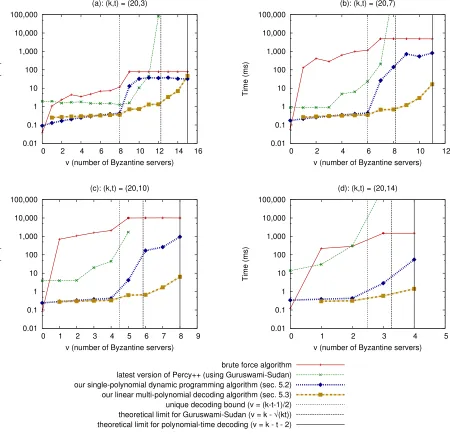
To illustrate the improvements that our algorithm pro-vides, we compare time measurements for four algo-rithms in Figure 2:
• the potentially exponential-time brute force decod-ing algorithm
• the Guruswami-Sudan list decoding algorithm from the latest release of Percy++
• the single-polynomial dynamic programming algo-rithm described in Section 5.2; and
• the linear multi-polynomial algorithm described in Section 5.3
Note that the data is plotted on a log scale so that the results can be easily compared, even though they span five orders of magnitude.
Observe that the Guruswami-Sudan algorithm only works when the number of Byzantine serversv=k−h
is less thank− b√ktc, and its running time blows up asv
nears that bound. Past that bound, with more Byzantine servers, the only prior way for the client to decode the re-sult was to use the brute-force decoding algorithm. Now, we can see that our single-polynomial dynamic program-ming algorithm and our multi-polynomial decoding al-gorithm both outperform the brute-force alal-gorithm, of-ten substantially. For example, in Figure 2(c) we see that for eight Byzantine servers with (k,t) = (20,10), the Guruswami-Sudan algorithm is ineffective, and the brute-force algorithm takes about 10 seconds. Mean-while, our dynamic programming algorithm takes about 1.5 seconds, and our multi-polynomial decoding algo-rithm takes about 6milliseconds.
The multi-polynomial algorithm comes at a cost, how-ever, of forcing the client to fetch multiple blocks. In this case,m= v
h−t−1
=8 blocks. If the client were going to fetch that many blocks anyway, there is no addi-tional overhead to the scheme. Otherwise, the client may have to request some blocks multiple times. In the worst case, the client only wishes to fetch one block, and there arev=k−t−2 Byzantine servers. In this worst case,
h=t+2, and the client must request its desired block
0.01 0.1 1 10 100 1,000 10,000 100,000
0 2 4 6 8 10 12 14 16
Time (ms)
v (number of Byzantine servers) (a): (k,t) = (20,3)
0.01 0.1 1 10 100 1,000 10,000 100,000
0 2 4 6 8 10 12
Time (ms)
v (number of Byzantine servers) (b): (k,t) = (20,7)
0.01 0.1 1 10 100 1,000 10,000 100,000
0 1 2 3 4 5 6 7 8 9
Time (ms)
v (number of Byzantine servers) (c): (k,t) = (20,10)
0.01 0.1 1 10 100 1,000 10,000 100,000
0 1 2 3 4 5
Time (ms)
v (number of Byzantine servers) (d): (k,t) = (20,14)
brute force algorithm latest version of Percy++ (using Guruswami-Sudan) our single-polynomial dynamic programming algorithm (sec. 5.2) our linear multi-polynomial decoding algorithm (sec. 5.3) unique decoding bound (v = (k-t-1)/2) theoretical limit for Guruswami-Sudan (v = k - √(kt)) theoretical limit for polynomial-time decoding (v = k - t - 2)
Figure 2: Timing measurements for the client-side decoding algorithms discussed in this paper for different param-eters. We ran each algorithm 100 times for each choice of feasible parameters and plot the mean running times in milliseconds. Note that times are plotted on a log scale.
The three vertical lines on each plot show the unique decoding radius for Reed-Solomon codes, on the left, the the-oretical bound past which the Guruswami-Sudan algorithm used in Percy++ fails, in the middle, and the thethe-oretical bound past which efficient decoding with any algorithm is impossible, on the right.
The main results of this paper are to give two client-side decoding algorithms that outperform Guruswami-Sudan in its feasible region, and allow us to extend the range of efficient client-side decoding to the region of interest between the two vertical lines on the right. Note that the Guruswami-Sudan algorithm performs much slower in practice than the Berlekamp-Welch algorithm used by our dynamic programming portfolio algorithm within the unique decoding radius, and its running time blows up very quickly for parameters approaching its theoretical limit.
6
Conclusions
We have improved the client side of Goldberg’s 2007 Byzantine-robust information-theoretic private informa-tion retrieval protocol to use state-of-the-art decoding al-gorithms to improve the Byzantine robustness of the pro-tocol to its theoretical limit. We did this using decoding algorithms that are able to take advantage of decoding information in multiple blocks of data simultaneously, observing that in practical scenarios, clients will often be interested in more than one block at a time.
We implemented our protocol and found that it is very fast in practice:several thousand timesfaster than previ-ous protocols, and usually less than 10 ms for the param-eter choices in our experiments.
Combined with fast processing on the server side [29] and scenarios in which the database servers are not in collusion [28], we can see that information-theoretic pri-vate information retrieval can be practical even in highly adversarial settings.
Acknowledgements
We thank Dan Bernstein for pointing out the connections between multi-polynomial error correction and some kinds of PIR. We thank Mark Giesbrecht and Arne Stor-johann for their pointers on implementing polynomial lattice basis reduction. This material is based upon work supported by NSERC, Mprime, the National Sci-ence Foundation under Award No. DMS-1103803, and the MURI program under AFOSR Grant No. FA9550-08-1-0352. Finally, we thank the Shared Hierarchical Academic Research Computing Network (SHARCNET) and Compute/Calcul Canada for the computing cluster on which we ran the experiments in Section 5.3 and the appendix.
References
[1] C. Aguilar Melchor and P. Gaborit. A lattice-based computationally-efficient private information retrieval protocol. In Western European Work-shop on Research in Cryptology (WEWoRC2007),
Bochum, Germany. Book of Abstracts, pages 50–
54, 2007.
[2] D. Asonov. Private Information Retrieval: An overview and current trends. In ECDPvA Work-shop, 2001.
[3] A. Beimel and Y. Stahl. Robust information-theoretic private information retrieval. In Proceed-ings of the 3rd International Conference on
Secu-rity in Communication Networks (SCN’02), pages
326–341, 2003.
[4] A. Beimel and Y. Stahl. Robust information-theoretic private information retrieval. Journal of
Cryptology, 20:295–321, 2007.
[5] E. Berlekamp and L. Welch. Error correction of al-gebraic block codes. US Patent Number 4,633,470, 1986.
[6] R. Carback, D. Chaum, J. Clark, J. Conway, A. Es-sex, P. S. Herrnson, T. Mayberry, S. Popoveniuc, R. L. Rivest, E. Shen, A. T. Sherman, and P. L. Vora. Scantegrity II Municipal Election at Takoma Park: The First E2E Binding Governmental Elec-tion with Ballot Privacy. In19th USENIX Security
Symposium, pages 291–306, 2010.
[7] D. L. Chaum. Untraceable electronic mail, re-turn addresses, and digital pseudonyms. Commun. ACM, 24(2):84–90, Feb. 1981.
[8] B. Chor and N. Gilboa. Computationally private information retrieval (extended abstract). In29th annual ACM Symposium on Theory of Computing
(STOC’97), pages 304–313, 1997.
[9] B. Chor, N. Gilboa, and M. Naor. Private informa-tion retrieval by keywords. Technical Report TR CS0917, Department of Computer Science, Tech-nion, Israel, 1997.
[10] B. Chor, O. Goldreich, E. Kushilevitz, and M. Su-dan. Private information retrieval. In36th Annual IEEE Symposium on Foundations of Computer
Sci-ence (FOCS’95), pages 41 –50, oct 1995.
[11] B. Chor, E. Kushilevitz, O. Goldreich, and M. Su-dan. Private information retrieval.J. ACM, 45:965– 981, November 1998.
[12] H. Cohn and N. Heninger. Approximate common divisors via lattices. Cryptology ePrint Archive, Report 2011/437, 2011. http://eprint.iacr. org/.
[13] C. Devet, I. Goldberg, and N. Heninger. Opti-mally Robust Private Information Retrieval. In21st
USENIX Security Symposium, 2012.
[14] R. Dingledine, N. Mathewson, and P. Syverson. Tor: the second-generation onion router. In13th
USENIX Security Symposium, 2004.
[15] W. I. Gasarch. A survey on private information re-trieval (column: Computational complexity).
[16] Y. Gertner, S. Goldwasser, and T. Malkin. A Random Server Model for Private Information Re-trieval. In2nd International Workshop on Random-ization and Approximation Techniques in Computer
Science, pages 200–217, 1998.
[17] P. Giorgi, C.-P. Jeannerod, and G. Villard. On the complexity of polynomial matrix computations. In
2003 International Symposium on Symbolic and
Al-gebraic Computation, pages 135–142, 2003.
[18] I. Goldberg. Percy++ project on sourceforge.
http://percy.sourceforge.net. Accessed February 2012.
[19] I. Goldberg. Improving the robustness of private information retrieval. In2007 IEEE Symposium on
Security and Privacy, pages 131–148, 2007.
[20] C. Gomes and B. Selman. Algorithm Portfolios.
Artificial Intelligence, 126(1):43–62, 2001.
[21] V. Guruswami and A. Rudra. Explicit codes achiev-ing list decodachiev-ing capacity: Error-correction with optimal redundancy. IEEE Transactions on
Infor-mation Theory, 54(1):135–150, 2008.
[22] V. Guruswami and M. Sudan. Improved decoding of Reed-Solomon and algebraic-geometric codes.
39th Annual IEEE Symposium on Foundations of
Computer Science (FOCS’98), pages 28–39, 1998.
[23] E. Kushilevitz and R. Ostrovsky. Replication is not needed: single database, computationally-private information retrieval. In 38th Annual Symposium
on Foundations of Computer Science (FOCS’97),
pages 364–373, 1997.
[24] H. W. Lenstra, A. K. Lenstra, and L. Lov´asz. Fac-toring polynomials with rational coeficients.
Math-ematische Annalen, 261(4):515–534, 1982.
[25] S. Micali, C. Peikert, M. Sudan, and D. A. Wilson. Optimal Error Correction Against Computationally Bounded Noise. In 2nd Theory of Cryptography
Conference, pages 1–16, February 2005.
[26] P. Mittal, F. Olumofin, C. Troncoso, N. Borisov, and I. Goldberg. PIR-Tor: Scalable Anony-mous Communication Using Private Information Retrieval. In 20th USENIX Security Symposium, pages 475–490, 2011.
[27] T. Mulders and A. Storjohann. On lattice reduc-tion for polynomial matrices. Journal of Symbolic
Computation, 35(4):377 – 401, 2003.
[28] F. Olumofin and I. Goldberg. Privacy-preserving queries over relational databases. In 10th Inter-national Privacy Enhancing Technologies Sympo-sium, pages 75–92, 2010.
[29] F. Olumofin and I. Goldberg. Revisiting the Com-putational Practicality of Private Information Re-trieval. In15th International Conference on
Finan-cial Cryptography and Data Security, pages 158–
172, 2011.
[30] F. Olumofin, P. Tysowski, I. Goldberg, and U. Hen-gartner. Achieving efficient query privacy for lo-cation based services. In 10th International
Pri-vacy Enhancing Technologies Symposium, pages
93–110, 2010.
[31] F. Parvaresh and A. Vardy. Correcting errors be-yond the Guruswami-Sudan radius in polynomial time. In46th Annual IEEE Symposium on
Founda-tions of Computer Science (FOCS’05), pages 285–
294, 2005.
[32] I. S. Reed and G. Solomon. Polynomial Codes over Certain Finite Fields. Journal of the
Soci-ety for Industrial and Applied Mathematics (SIAM),
8(2):300–304, 1960.
[33] L. Sassaman, B. Cohen, and N. Mathewson. The Pynchon Gate: a Secure Method of Pseudony-mous Mail Retrieval. InProceedings of the 2005 ACM Workshop on Privacy in the Electronic
Soci-ety (WPES ’05), pages 1–9, 2005.
[34] A. Shamir. How to share a secret. Commun. ACM, 22:612–613, November 1979.
[35] V. Shoup. NTL, a library for doing number theory.
http://www.shoup.net/ntl/, 2005. Accessed February 2012.
[36] R. Sion and B. Carbunar. On the computational practicality of private information retrieval. In Pro-ceedings of the Network and Distributed Systems
Security Symposium, 2007.
[37] J. von zur Gathen. Hensel and Newton methods in valuation rings.Math. Comp., 42(166):637–661, 1984.
1e-08 1e-07 1e-06 1e-05 0.0001 0.001 0.01 0.1
16 256 65537
Proportion of Failures
Size of the Field (a) Varying the Field Size
1e-08 1e-07 1e-06 1e-05 0.0001 0.001 0.01 0.1
10 11 12
Proportion of Failures
v (Number of Byzantine Servers) (b) Varying the Number of Byzantine Servers
1e-08 1e-07 1e-06 1e-05 0.0001 0.001 0.01 0.1
2 3 4
Proportion of Failures
m (Number of Polynomials) (c) Varying the Number of Polynomials (GF(28))
1e-08 1e-07 1e-06 1e-05 0.0001 0.001 0.01 0.1
3 4 5
Proportion of Failures
m (Number of Polynomials) (d) Varying the Number of Polynomials (GF(24))
Conjectured Failure Rate 0
0.002 0.004 0.006 0.008 0.01
0 5 10 15 20 25 30 35 40
Proportion of Failures
m (Number of Polynomials)
(e) Varying the Number of Polynomials with Maximum Number of Byzantine Servers
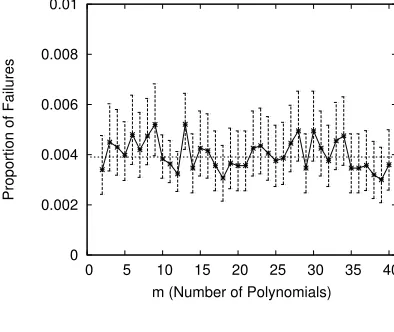
Figure 3: In Section 5.3, we conjectured that the linear multi-polynomial algorithm we present will fail with probability
1 |F|
m(h−t−1)−v+1
Appendix: Failure rate of Algorithm 1
The linear multi-polynomial algorithm described in Sec-tion 2.3.2 is probabilistic and may fail with some prob-ability. We conjecture that the probability of failure is
1 |F|
m(h−t−1)−v+1
but do not have a proof. We ran hun-dreds of millions of tests, varying each of the parameters in the expression, in order to validate this conjecture ex-perimentally. Figure 3 contains plots of the results; the raw data can be found in Table 2.
Table 2: Experimental observations of failure frequency of the multi-polynomial decoding algorithm from Sec-tion 2.3.2.
Varying|F|:
v t h m |F| Trials Failures 95% Confidence Interval |F|−(m(h−t−1)−v+1) In Interval 10 3 5 10 16 1,000,000 66172 [6.56·10−2,6.67·10−2] 6.25·10−2 No 10 3 5 10 256 1,000,000 3956 [3.83·10−3,4.08·10−3] 3.91·10−3 Yes 10 3 5 10 65537 100,000,000 1543 [1.47·10−5,1.62·10−5] 1.53·10−5 Yes Varyingv:
v t h m |F| Trials Failures 95% Confidence Interval |F|−(m(h−t−1)−v+1) In Interval 10 3 8 3 256 100,000,000 8 [3.75·10−8,16.09·10−8] 5.96·10−8 Yes 11 3 8 3 256 1,000,000 12 [0.66·10−5,2.12·10−5] 1.53·10−5 Yes 12 3 8 3 256 1,000,000 4023 [3.90·10−3,4.14·10−3] 3.91·10−3 Yes Varyingm:
v t h m |F| Trials Failures 95% Confidence Interval |F|−(m(h−t−1)−v+1) In Interval 6 3 6 3 16 1,000,000 66087 [6.56·10−2,6.66·10−2] 6.25·10−2 No 6 3 6 4 16 1,000,000 291 [2.59·10−4,3.26·10−4] 2.44·10−4 No 6 3 6 5 16 100,000,000 93 [7.58·10−7.11.40·10−7] 9.54·10−7 Yes 2 3 5 2 256 1,000,000 3891 [3.77·10−3,4.02·10−3] 3.91·10−3 Yes 2 3 5 3 256 1,000,000 17 [1.03·10−5,2.74·10−3] 1.53·10−5 Yes 2 3 5 4 256 100,000,000 4 [1.15·10−8,10.69·10−8] 5.96·10−8 Yes
Varyingmand using the maximum possible value ofv(in these tests,m= v
h−t−1
=v):
v t h m |F| Trials Failures 95% Confidence Interval |F|−(m(h−t−1)−v+1) In Interval