Copyright1998 by the Genetics Society of America
Mitochondrial DNA Variation and Evolution of Japanese Black Cattle (Bos taurus)
H. Mannen,* S. Tsuji,* R. T. Loftus
†and D. G. Bradley
†*Faculty of Agriculture, Kobe University, Kobe 657, Japan and†Department of Genetics, Trinity College, Dublin 2, Ireland
Manuscript received May 18, 1998 Accepted for publication August 11, 1998
ABSTRACT
This article describes complete mitochondrial DNA displacement loop sequences from 32 Japanese Black cattle and the analysis of these data in conjunction with previously published sequences from African, European, and Indian subjects. The origins of North East Asian domesticated cattle are unclear. The earliest domestic cattle in the region were Bos taurus and may have been domesticated from local wild cattle (aurochsen; B. primigenius), or perhaps had an origin in migrants from the early domestic center of the Near East. In phylogenetic analyses, taurine sequences form a dense tree with a center consisting of intermingled European and Japanese sequences with one group of Japanese and another of all African sequences, each forming distinct clusters at extremes of the phylogeny. This topology and calibrated levels of sequence divergence suggest that the clusters may represent three different strains of ancestral aurochs, adopted at geographically and temporally separate stages of the domestication process. Unlike Africa, half of Japanese cattle sequences are topologically intermingled with the European variants. This suggests an interchange of variants that may be ancient, perhaps a legacy of the first introduction of domesticates to East Asia.
C
ATTLE have had an important but incompletely but whether its domestication led to North East Asian understood association with early human civiliza- cattle, or if these were introduced from older exotic tion, and study of their origins may enlighten us on domestic stocks, is unknown.hitherto unknown aspects of prehistory. All modern Around the second century A.D., cattle migrated from cattle have been considered to have the same roots in North China via the Korean peninsula to Japan. This captured aurochsen from the primary domestication cattle movement was accompanied by the introduction centers of Anatolia and the Fertile Crescent (Perkins of rice cultivation. Both genetic (Namikawa1980) and 1969;Epstein1971;EpsteinandMason1984;Payne morphological (Ogawaet al. 1989) studies have illus-1991). However, this is an opinion that may be an arti- trated that native Japanese cattle are B. taurus and are fact of the history of archaeology (Meadow1993). For representatives of the “Turano-Mongolian” type (Felius example, Loftus et al. (1994) have provided molecu- 1995). However, no further genetic information is avail-lar evidence for a predomestic divergence between able concerning the origins of the B. taurus populations zebu, or humped cattle (Bos indicus), and taurine, or of North East Asia. In addition, several European breeds humpless cattle (B. taurus), using mtDNA displacement have been used for upgrading native breeds in many loop (D-loop) variation. A subsequent study has also countries of North East Asia. Japanese Black cattle, argued that modern mtDNA sequence distributions are which is the majority of beef breed in Japan, is less suggestive of biologically distinct origins for the indige- influenced by European breeds than other breeds in nous B. taurus populations of Africa and Europe (Brad- Japan and other countries. Therefore, Japanese Black
leyet al. 1996). is a useful population to understand the origins of cattle
In North Eastern Asia (Mongolia, North China, Korea, in North East Asia.
and Japan), most cattle lack humps and are classified In this study, we present an analysis of a large data as Bos taurus (Phillips 1961). The earliest domestic set comprising mtDNA D-loop sequences for Japanese cattle in the region were probably of this type and ap- Black cattle. We analyze these in conjunction with pub-pear between 5000 and 4000 YBP, several thousand years lished sequences of bison and of European, African, after primary aurochs domestication in West Asia and India cattle and have assessed the relationships (Payne and Hodges 1997). The extinct wild ox (B. among them. The patterns of genetic variation suggest
primigenius) is thought to have been distributed locally, ancient population expansion and illustrate distinct
tau-rine mtDNA lineages, which may have separate, predo-mestic ancestral origins. This study also indicates that
Corresponding author: Hideyuki Mannen, Laboratory of Animal
Japanese cattle have been subjected to the introgression
Breeding and Genetics, Faculty of Agriculture, Kobe University, 1-1
Rokkoudai, Kobe 657, Japan. E-mail: [email protected] of mtDNA that are similar to European types and that
may reflect either historical importation or a more an- that has been previously noted for bovine mtDNA ( Lof-tus et al. 1994;Bradley et al. 1996). The geographic cient interplay between the cattle of Asia and Europe.
structure of sequence variation is observed from the large number of consistent nucleotide differences ob-MATERIALS AND METHODS
served between Indian, African, and European haplo-types (Figure 1). Additionally, the first eight Japanese
Animals:We obtained 32 DNA samples of Japanese Black
fattening cattle from 30 prefectures in Japan. DNA was ex- sequences ( J1–J8) display some consistent substitutions,
tracted from lymphonoduli of the kidney knob. Complete which separate them as a group. However, the others
D-loop sequences of European, African, and Indian cattle have
( J9–J18) seem similar to European sequences. These been previously reported in GenBank (accession no.
L27712-two groups are clearly distinct; we refer to the first eight L27737 and U51806-U51842). Samples of the outgroup
spe-cies (Bison bison) were also obtained from GenBank (acces- Japanese haplotypes as the “Japan I” group and the
sion no. BBU12936, BBU12946, BBU12948, BBU12955, and remaining as the “Japan II” group.
BBU12959). Global genetic structure:Genetic structure of B.
tau-Sequencing:The D-loop region of mtDNA was amplified
rus sequence variation was studied using the AMOVA
using PCR with primers constructed from the published
approach (Excoffieret al. 1992). This procedure
incor-proline tRNA (59-CTGCAGTCTCACCATCAACC-39) and 12S
rRNA (59-CTCCTCGGACAAGATATTAG-39) gene sequences porates both the estimated divergence between
se-(Loftuset al. 1994). Amplification and purification of product
quences and the frequencies. Through estimating
vari-were carried out according to the method of Loftuset al.
ance components, the structure of genetic variation (1994). Standard double-strand DNA sequencing was
per-between hierarchical groupings may be assessed. An
formed usingz200–500 ng of the amplified product.
Varia-AMOVA performed after the exclusion of the highly tions in the D-loop region of Japanese Black cattle were
de-fined by comparison with the standard bovine mtDNA divergent Bison and Indian sequences estimated that
sequence (accession numbers V00654) published by
Ander-only 36.6% of the variance could be accounted for by sonet al. (1982).
a partition of the data into the continental African,
Sequence analysis: Alignment of sequences was achieved
European, and Japanese groupings. The quality of this
using the CLUSTALW package (Thompsonet al. 1994). Sites
partition, when tested by a permutation test, was not representing a gap in any of the aligned sequences were
ex-cluded from the analysis, and distances between whole D-loop quite significant with P50.059. In contrast, when the
sequences were estimated using the substitution model of Japanese cluster was separated into Japan I and Japan
TamuraandNei(1993) with aGdistribution parameter value
II, then considered with Africa and Europe, the
percent-a 50.27 [estimated from these data using the method used
age of the total variance explained by the divisions of
byKocherandWilson(1991)]. This distance computation
is incorportated in the MEGA package (Kumaret al. 1994). the data was 51.7% with a probability value (P,0.010)
A reduced median network was constructed by hand after the that a more excellent partition would arise by chance.
recommendations of Bandelt et al. (1995), and additional
Genetic distances and divergence times: Table 1 phylogenies were constructed using the NEIGHBOR and
shows mean sequence divergence values between
popu-FITCH programs incorporated in the PHY LIP package (
Fel-lations and within popuFel-lations. The cattle popuFel-lations
senstein1993). Analysis of molecular variance (AMOVA) and
pairwise FST’s were calculated using ARLEQUIN and earlier each displayed similar levels of mean divergence (0.37–
software (Excoffieret al. 1992;Schneideret al. 1997).
0.43%) with the exception of the Japan I sequence clus-ter, the members of which differed on average by only 0.12%. Japanese groups were related more closely to RESULTS
Europe than to Africa, and when grouped separately, Variation in the bovine mtDNA D-loop: Twenty-five Japan II sequences were related more closely to Europe complete bovine mtDNA D-loop sequences had been
reported and analyzed previously (Andersonet al. 1982;
Loftuset al. 1994). Here, we have sequenced an addi- TABLE 1
tional 32 Japanese Black cattle (accession numbers
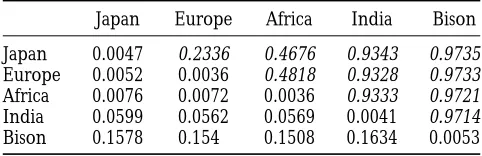
Sequence divergence of cattle populations and bison
U87633–U87650). Alignment of these 57 complete D-loop sequences illustrated 43 unique Bos haplotypes
Japan Europe Africa India Bison
(Figure 1). In 32 Japanese Black cattle, 18 haplotypes
Japan 0.0047 0.2336 0.4676 0.9343 0.9735
were found, including 1 ( J5) that was represented 10
Europe 0.0052 0.0036 0.4818 0.9328 0.9733
times, 1 ( J14) that was represented 3 times, and 3 ( J9,
Africa 0.0076 0.0072 0.0036 0.9333 0.9721
J15, J17) that were represented in duplicate. One other
India 0.0599 0.0562 0.0569 0.0041 0.9714
haplotype (E12) was shared between two European ani- Bison 0.1578 0.154 0.1508 0.1634 0.0053 mals, and one (A5) between two Africans. No identical
Below the diagonal and on the diagonal are the average sequences were shared across continental groups.
Sev-sequence divergences between populations and within popula-enty-three variable sites included two 1-bp insertion/
tions, respectively. Above the diagonal (italics) are genetic deletions and one encompassed length variation in a distances between populations calculated as pairwise F
STvalues
poly(C) tract. Only one newly described substitution (Slatkin1995). All pairwise FSTvalues were significant at P, 0.01.
Figure 1.—Sequence varia-tion observed among 58 cattle D-loop sequences. Sequence codes and numbers are given in the first column. Their ini-tials show regional codes: A, Af-rica; E, Europe; J, Japan; and I, India. Breed names examined are as follows: E1, Friesian,
se-quence published by
Ander-sonet al. (1982); J1–18, Japa-nese Black cattle; E2 and 3, Aberdeen Angus; E4, Charo-lais; E5 and 6, Friesian; E7 and 8, Hereford; E9 and 10, Jersey; E11 and 12, Simmental; A1 and 2, Butana; A3, Fulani; A4 and 5, Kenana; A6 and 7, N’Dama; I1 and 2, Hariana; I3 and 4, Sahiwal; I5 and 6, Tharparkar. One Fulani and one Charolais
showed identical sequences
with Kenana (A5) and Sim-mental (E12), respectively. Se-quences J9, J15, and J17 are each represented twice, J14 3 times, and J5 was encountered 10 times in the Japanese sam-ple. Only variable sites, with se-quence positions given above, are shown. Identity with the first sequence is denoted by a dash, substitution by a differ-ent base letter, and deletions by asterisks. Positions 16200i and 221i–iii indicate nucleo-tide insertions relative to the
sequence published in
Ander-sonet al. (1982).
than were Japan I. Values above the diagonal show pair- Y BP, and the average divergence times between Japan and Europe and between Japan and Africa yield esti-wise FST values, which function as short-term genetic
distances between populations (Slatkin1995). mates of 33,100 Y BP and 48,400 Y BP, respectively. Al-though somewhat insecure, these estimates point away Comparison between bison and cattle sequences and
assumption of a 1-myr separation time for the ancestral from a postulated single origin for all taurine cattle breeds within the z10,000-yr history of animal hus-lineages has allowed an estimation of substitution rate in
the bovine mtDNA D-loop at 30.1% per myr (Bradleyet bandry.
Phylogenetic analysis:Figure 2 shows a phylogenetic
al. 1996). When calculated using a differentG
distribu-tion parameter value (a 50.27), estimated using these reconstruction featuring Indian, African, European and Japanese cattle populations including bison as a rooting data, the rate becomes 15.7% per myr. It is recognized
that any calibration of the rate of substitution in the outgroup and using pairwise FSTvalues. All populations were significantly different (P , 0.01) when assessed mtDNA D-loop is an exercise fraught with difficulty and
subject to wide errors (TamuraandNei1993;Parsons using an exact test of population differentiation ( Ray-mond and Rousset 1995). This phylogeny illustrates
et al. 1997). Nevertheless, it is clear from previous work
that the divergence between B. indicus and B. taurus that mtDNA sequences are separated into two major clades: Indian B. indicus and the remaining B. taurus. sequences is ancient and must predate domestication
(Loftus et al. 1994). The mean divergence within B. In accordance with the findings ofBradleyet al. (1996), all African mtDNA are assumed to be of taurine origin
Figure 2.—Phylogenetic relationships among bison, In-dian, African, European, and Japanese cattle populations
con-structed using pairwise FSTdistances and the neighbor-joining
method.
despite the hybrid morphology of many of the animals. The Japan population branches more closely to Europe than to Africa.
To focus on the relationships among African, Euro-pean, and Japanese cattle, two types of trees were
con-Figure 3.—Unrooted neighbor-joining tree constructed
structed using individual sequences as nodes and
ex-from bison, African, European, and Japanese sequences. cluding the obviously divergent Indian samples; Figure
3 is a neighbor-joining tree, and Figure 4 is a reduced
median network. For a number of such character conflicts, the network
The major feature of the neighbor-joining tree shown has been reduced using the principle of compatibility in Figure 3 is a central starburst including intermingled (Bandeltet al. 1995). Thus, of the substitutions at sites European and Japanese sequences. One distinct group 16,050, 16,022, and 16,119, eight have been split into of Japanese sequences (corresponding to the Japan I two parallel events, and those at 16,042 and 16,122 have partition) cluster separately and distantly from the cen- been split into three parallel events. As in the neighbor-ter, as do the African sequences. Limitations with a joining tree, there is a group of Japanese sequences, neighbor-joining tree constructed from many closely which are more distinct from Europeans, and these related sequences are that this tree may impose only cluster around the most numerous J5. Other Japanese one of many solutions of similar validity and that it sequences (with the exception of J10) are intermingled usually produces an artificially high level of resolution with the Europeans. Here also, more numerous se-(Bandelt et al. 1995). In this case, bootstrap support quences tend toward the center of this radiation. Afri-values are low (30–40%) for the important divisions. cans are separate and show no topological intermingling
A median network is a presentation that includes most with the samples from the other continents. parsimonious trees supported by the data; Figure 4 is a
reduced network incorporating the same sequences in
DISCUSSION Figure 1. This network allows extant sequences as
inter-nal nodes, and the frequency with which each haplotype In this study, we have obtained mtDNA D-loop se-occurs is indicated by the area of the circle representing quences of Japanese Black cattle, which represent the it. Lines connecting sequence nodes denote substitu- first of such data from East Asian domesticates, and tion. Small empty circles represent hypothetical se- we have analyzed these in conjunction with previously quences that have not been found in the previous and published data from Europe, India, and Africa. Se-present study. However, the phylogenetic reconstruc- quence comparisons, AMOVA, and phylogenetic analy-tion suggests the circles as possible intermediates. Thus ses reveal that two major mtDNA families are repre-A5 is represented in two samples and differs from A7 sented in Japanese Black cattle; one has been detected by one transition in position 16,057. J9 differs from A5 exclusively in Japanese samples, whereas the second is by two transitions and through two possible hypothetical comprised of samples that show sequences and patterns intermediates. Reticulations (ladders and squares) in of variability similar to those found in Europe. Two the network indicate where character conflicts exist as explanations are possible for the presence of the latter a result of homoplasies (parallel mutations), and the group.
Figure 4.—A reduced median network constructed from African, European, and Japanese cattle. The number of times each variant is represented is proportional to the area of its circle. Lines connecting sequence nodes denote substitutions, the positions of which are given, and which are all transitions, unless otherwise noted. The topology of the tree enforces the splitting of substitutions into separate events, denoted by a, b, and, if necessary, c. Small open circles represent hypothetical sequences, which have not been found in the sequencing exercise. Breed abbreviations are shown in Figure 1.
pose of upgrading native breeds. It is possible that some from herds to re-create completely pure breeds. Addi-tionally, most of the imported cattle used were bulls, of this exotic genetic material retains an influence in
modern Japanese cattle. However, the original importa- and previous work has illustrated a striking retardation of maternal lineage introgression in cattle populations tion strategy failed because hybrid cattle required more
feed than natives and became less active for draft (Machugh et al. 1997). Specifically, despite the over-whelming and ancient zebu introgression into the origi-(Mukaiet al. 1989). The implementation of a resulting
variants have been discovered in eight populations (in- European and Japanese sequences plus groups of Japa-nese and African sequences, which each form distinct cluding five zebu) investigated (Bradley et al. 1996;
Suzukiet al. 1993). In this study, the frequency of Japa- clusters at extremes of the phylogeny. This topology and calibrated levels of sequence divergence suggest nese mtDNA, which are similar to European type, is
48% and thus seems too high to be explained solely by that the clusters may represent different strains of ances-tral aurochs, adopted at geographically and temporally the above hypothesis. In addition, no shared haplotypes
are observed between Japan and Europe, despite five separate stages of the domestication process. It is also tempting to speculate that some of the more divergent haplotypes that are represented more than once within
each group. This is suggestive of a nonrecent introgres- haplotypes within each continent may be the descen-dants of minor adoptions of wild stock.
sion.
A second hypothesis is that the mixture between Japa- The authors thank the Wagyu Registry Association for partial finan-nese and European cattle may be due to more ancient cial support. R.T.L. is supported under EU BIOTECH contract ERBBI-O4CT961189. The Irish National Centre for Bioinformatics provided
interchange between the two continental populations
valuable assistance. We are also grateful for constructive criticism
before migration from North China to Japan. The
Japa-provided by two anonymous reviewers.
nese Black are representatives of the Asian “Turano-Mongolian” type of cattle (Felius1995). It is likely that the continuity of the Asian and European Steppe
facili-LITERATURE CITED tated trades or plunders of cattle in ancient times. For
example, in 1280 A.D., the Mongol Empire stretched Anderson, S., M. H. L. Deburijn, A. R. Coulson, I. C. Epersonand
from the Yellow Sea to the Mediterranean. F. Sanger,1982 Complete sequence of bovine mitochondrial
DNA. J. Mol. Biol. 156: 683–717.
A development of this hypothesis is that the pattern
Bandelt, H. J., P. Forster, B. C. SykesandM. B. Richards,1995
of Japanese mtDNA variation is a legacy of the early Mitochondrial portraits of human populations using median net-origins of North East Asian cattle. The major feature of works. Genetics 141: 743–753.
Bradley, D. G., D. E. Machugh, P. CunninghamandR. T. Loftus,
the network (Figures 3 and 4) is the existence of three
1996 Mitochondrial diversity and the origins of African and
clusters of some phylogenetic and also geographical European cattle. Proc. Natl. Acad. Sci. USA 93: 5131–5135. integrity. One interpretation of the present data is that Epstein, H.,1971 The Origin of the Domestic Animals of Africa, Vol. 1,
pp. 185–555. Africana Publishing Corporation, New York.
the central European/Japanese cluster, the African
se-Epstein, H.,andI. L. Mason,1984 Cattle, pp. 6–27 in Evolution of
quences, and the separate Japanese cluster centering Domesticated Animals, edited byI. L. Mason.Longman, New York.
on sequence J5 represent the descendants of West Asian, Excoffier, L., P. E. SmouseandJ. M. Quattro,1992 Analysis of
molecular variance inferred from metric distances among DNA
African, and North East Asian strains of wild B.
primigen-haplotypes: application to human mitochondrial DNA restriction
ius, respectively. In each population, the numerical pre- data. Genetics 131: 479–491.
dominance and topological centrality (E12, A5, and Felius, M.,1995 Cattle Breeds—An Encyclopedia. Misset, Doetinchem,
The Netherlands.
most strikingly J5; Figure 4) suggest that these
haplo-Felsenstein, J.,1993 PHYLIP (Phylogeny Inference Package). University
types may represent ancestral mitochondrial types of of Washington, Seattle, WA.
closely related variants in each region. Kocher, T. D.,andA. C. Wilson,1991 Sequence evolution of
mito-chondrial DNA in human and chimpanzees: control region and
The earliest remains of cattle in a domestic context
protein coding region, pp. 391–413 in Evolution of Life: Fossils
occur in Anatolia from at least 8000 Y BP (Perkins
Molecules and Culture, edited byS. OsawaandT. Honjo.
Springer-1969). The site of Mehrgarh in Pakistan shows evidence Verlag, Tokyo.
Kumar, S., K. TamuraandM. Nei,1994 MEGA: Molecular
Evolu-for cattle herding as early as 7000 Y BP, and the earliest
tionary Genetics Analysis software for microcomputers. Comput.
securely identified African domestic cow dates to only Appl. Biosci. 10: 189–191.
500 yr later (Meadow1993;Roubet1978). The earliest Loftus, R. T., D. E. Machugh, D. G. Bradley, P. M. SharpandP. Cunningham,1994 Evidence for two independent
domestica-domestic bovine, found in North East Asia, dated only
tions of cattle. Proc. Natl. Acad. Sci. USA 91: 2757–2761.
to 5000 Y BP (Payne and Hodges 1997). A plausible
Machugh, D. E., M.D. Shriver, R.T. Loftus, P.Cunningham
scenario is that the modern Japanese sequences are andD. G. Bradley,1997 Microsatellite DNA variation and the
evolution, domestication and phylogeography of taurine and
descended from a mixture of early migrants from the
zebu cattle (Bos taurus and Bos indicus). Genetics 146: 1071–1086.
original domestic centers of West Asia and a locally
Meadow, A.,1993 Animal domestication in the Middle East: a
re-domesticated strain of wild oxen, represented by se- vised view from the Eastern margin, pp. 295–320 in Harappar
Civilization, edited byG. Possehl.Oxfird abd IBH, New Dehli.
quence J5 and its putative derivatives. A survey of
Mukai, F., S. Tsuji, K. Fukazawa, S. OhtagakiandY. Nambu,1989
mtDNA variation involving almost a hundred Middle
History and population structure of a closed strain of Japanese
Eastern and Anatolian samples has not revealed haplo- Black cattle. J. Anim. Breed. Genet. 106: 254–264.
Namikawa, T.,1980 Genetical aspect of domestication and
phylog-types showing affinity with the Japan cluster (C. S. Troy
eny in the cattle. Jap. J. Zoothech. Sci. 49: 817–827.
andD. G Bradley,unpublished results).
Ogawa, Y., M. DaigoandH. Amasaki,1989 Craniometrical
estima-In conclusion, bovine mtDNA D-loop sequences fall tion of the native Japanese Mishima cattle. Anat. Anz. Jena. 168:
197–203.
into four clusters: a highly divergent B. indicus group
Parsons, T. J., D. S. Muniec, K. Sullivan, N. Woodyatt, R.
Allis-sampled in India and three less divergent B. taurus
ton-Greineret al., 1997 A high observed substitution rate in
groupings. In phylogenetic analysis, the latter form a the human mitochondrial DNA control region. Nat. Genet. 15:
363–368.
Payne, W. J. A.,1991 Cattle genetic resources, pp. 51–72 in World Slatkin, M.,1995 A measure of population subdivision based on
microsatellite allele frequencies. Genetics 134: 983–993.
Animal Series B7, edited by C. G. Hickman. Elsevier Science,
Amsterdam. Suzuki, R., S. J. KempandA. J. Teale,1993 Polymerase chain
reac-tion analysis of mitochondrial DNA polymorphism in N’Dama
Payne, W. J. A.,andJ. Hodges,1997 Tropical Cattle, Origins, Breeds
and Breeding Policies. Blackwell Science Ltd., Oxford. and Zebu cattle. Anim. Genet. 24: 339–343.
Tamura, K.,andM. Nei,1993 Estimation of the number of nucleo-Perkins, D., Jr.,1969 Fauna of catal huyuk: evidence for early cattle
domestication in anatolia. Science, 164: 177–179. tide substitutions in the control region of mitochondrial DNA
Phillips, W.,1961 World distribution of the major types of cattle. in humans and chimpanzees. Mol. Biol. Evol. 10: 512–526.
J. Hered. 52: 207–213. Thompson, J. D., D. G. HigginsandT. J. Gibson,1994 CLUSTAL Raymond, M.,andF. Rousset,1995 An exact test for population W: improving the sensitivity of progressive multiple sequence
differentiation. Evolution 49: 1280–1283. alignment through sequence weighting, position-specific gap
penal-Roubet, C.,1978 Une e´conomie pastorale, pre´-agricaole en Alge´rie ties and weight matrix choice. Nucleic Acids Res. 22: 4673–4680.
orientale: le Ne´olithique de tradition Capsienne. L’Anthropologie Wakeley, J.,1993 Substitution rate variation among sites in hyperva-(Paris) 82: 583–586. riable region 1 of human mitochondrial DNA. J. Mol. Evol. 37:
Schneider, S., J. M. Kueffer, D. RoessliandL. Excoffier, 1997 613–623. Arlequin 1.1: A Software for Population Genetic Data Analysis. Genetics