SOME LESSONS LEARNED FROM TESTS OF VTT IMPACT
PROGRAM, PHASES I AND II
François Tarallo1, Jean Mathieu Rambach1
1
Civil Engineers, Institut de Radioprotection et de Sûreté Nucléaire (IRSN), Fontenay-aux-Roses, France ([email protected]) & ([email protected] )
ABSTRACT
The phases 1 and 2 of the experimental project IMPACT finished in 2012 and have provided valuable data on the behavior of deformable missiles and concrete targets during medium velocity impacts.
The tests involving deformable missiles appear as consistent and repeatable. Their results confirm the validity of the Riera method, with a modification when some water is present in the missile. The greater severity of impact observed for tests in which missile is partially filled with water compared to the “dry” missile tests, is due to a greater impulse, corresponding to water rebound, but also and mainly, to shorter loading duration and higher peak values. The dynamic behavior of reinforced concrete elements (beams, one-way or two-way slabs) can be conveniently simulated using simplified codes developed on spreadsheets, giving way to quick sensitivity analyses well-fit to engineering use.
Concerning impacts involving rigid missiles on reinforced concrete slabs, the results of tests do not show a clear effect of shear reinforcement nor of pre-stressing. The predictions of several well known empirical formulae are not always satisfactory. More tests could precise that statement. They should be simple enough, and incorporate variations of the missile’s mass, of the thickness of the slab and of the diameter of the missile.
The present paper, still synthetic and limited, reflects the authors present understanding. It will be followed by others, founded on more experiments and interpretation, with the aim of developing simplified calculation codes and improving the impact engineering practice.
INTRODUCTION
The consequences of various impacts (dropped loads, parts of equipment after failure, airplanes) on civil structures must be analysed when designing or assessing nuclear facilities. The progress in that field of knowledge needs a combination of experiments and numerical simulations. Since year 2006, the VTT IMPACT experimental Project, carried out by VTT Laboratory in Finland, has been a rare opportunity for engineers involved to improve their understanding of the behaviour of reinforced concrete plates impacted by rigid or deformable missiles. The impact test facility, the missiles and targets, and a general description of the tests performed have been presented by Saarenheimo (2006) and Lastunen (2007).
The French Institute for Radiological Protection and Nuclear Safety (IRSN) is one of the partners who have joined the IMPACT Project. The aim of this article is to point out a few lessons gained by IRSN from the phases I and II of the program, finished in 2012, and to give some hints for future testing.
RESPONSE OF ONE-WAY CONCRETE SLABS TO SOFT IMPACTS
been tested and reported in various papers. In Tarallo et al. (2007) the crushing of deformable missiles and the response of the targets (one-way slabs behaving like simply supported beams) was modeled and discussed; the presence of water in the missile was found to generate more severe impacts than the impacts of missiles without water. For instance, the impacts of missiles carrying half their weight of waters lead to deflections of one-way slabs 20 or 30 % higher than the corresponding impacts of missiles without water. However, more testing and analysis were deemed necessary to confirm and explain clearly that conclusion. As a consequence, additional tests have been carried out and a new simplified model has been developed, as presented in the next two sections: analysis of force plate tests and response of two-way concrete slabs.
ANALYSIS OF FORCE PLATE TESTS: LOADINGS ASSOCIATED TO DEFORMABLE MISSILES
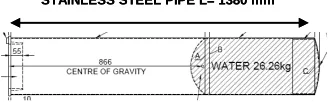
Through rigid steel targets (named Force Plates) VTT record successfully the force time functions associated to the impact of deformable missile on a concrete wall: see Saarenheimo (2006) and Lastunen (2007). The Phase II of IMPACT Project includes impacts on Force Plates using two types of missiles: hollow stainless steel pipes (named “dry” missiles), and stainless steel pipes partially filled with water (named “wet” missiles), as shown in figure 1.
“Dry” missile “Wet” missile (water at the front)
Figure 1. IMPACT Phase II: Sketches of dry and wet missiles
To compare the effects of dry and wet missiles, the authors have selected 6 characteristic force plate tests, as shown in Table 1. All missiles are made of stainless steel pipes, diameter 254 mm and wall thickness 2 mm.
Table 1: Study of the impact forces of deformable missiles: characteristics of force plate tests
Test number
Missile type and length
Total mass M (kg)
Mass of water (kg)
Impact speed V (m/s)
Missile’s momentum:
M.V (kN.s)
Impulse on target at impact end
Ratio: Impulse
MV
FP4 Dry missile
2000 mm 50.1 none 138 6.90 6.88 kN.s 1.00
FP8 Dry missile
2250 mm 50.1 none 102 5.12 5.20 kN.s 1.02
FP9 Wet missile
1380 mm 50.1
25.4 kg in
the center 105 5.26 6.36 kN.s 1.21
FP10 Wet missile
1380 mm 50.1
25.3 kg in
the center 135 6.76 8.45 kN.s 1.25
FP16 Wet missile
1525 mm 51.6
26.6 kg at
the front 108 5.59 6.47 kN.s 1.16
FP17 Wet missile
1525 mm 51.5
26.4 kg at
the front 127 6.55 7.59 kN.s 1.16
STAINLESS STEEL PIPE DIA. 254 mm th. 2 mm L= 2250 mm
STAINLESS STEEL PIPE L= 1380 mm STAINLESS STEEL PIPE DIA. 254 mm th. 2 mm L= 2250 mm
The force time functions provided by the force plates during the impact, and the corresponding impulses obtained by integration of those functions, are shown in figures 2 and 3, for two ranges of impact velocities: around 105 m/s and around 135 m/s.
Figure 2. Results from force plate tests FP 4 (dry missile) and FP 10 & 17 (wet missiles). Velocity range 105 m/s.
Figure 3. Results from force plate tests FP 8 (dry missile) and FP 9 & 16 (wet missiles). Velocity range 135 m/s
Impact force FP 4
Impact force FP 10
Impact force FP 17
6,88
Impulse FP 4
8,45
Impulse FP 10
7,59
Impulse FP 17
Momentum FP4 Momentum FP10 Momentum FP17 0 100 200 300 400 500 600 700 800 900 1000 1100 1200 1300 1400 1500 1600 1700 1800
0 10 20
Time (ms) Imp a c t fo rc e ( k N ) 0 1 2 3 4 5 6 7 8 9 Imp u ls e ( k N .s )
End of impact FP17
End of impact FP10 End of impact FP4
Impact force FP 4
Impact force FP 10
Impact force FP 17
6,88
Impulse FP 4
8,45
Impulse FP 10
7,59
Impulse FP 17
Momentum FP4 Momentum FP10 Momentum FP17 0 100 200 300 400 500 600 700 800 900 1000 1100 1200 1300 1400 1500 1600 1700 1800
0 10 20
Time (ms) Imp a c t fo rc e ( k N ) 0 1 2 3 4 5 6 7 8 9 Imp u ls e ( k N .s )
End of impact FP17
End of impact FP10 End of impact FP4
Impact force FP 8
Impact force FP 9
Impact force FP 16
Impulse FP 8
5,20
Impulse FP 9 6,47
Impulse FP 16 6,36
Mome ntum FP8
Mome ntum FP9
Mome ntum FP16
0 100 200 300 400 500 600 700 800 900 1000 1100 1200 1300 1400 1500
0 10 20
Time (ms) Im p a c t fo rc e ( k N ) 0 1 2 3 4 5 6 7 Imp u ls e ( k N .s )
End of impact FP16
End of impact FP9
End of impact FP8
Impact force FP 8
Impact force FP 9
Impact force FP 16
Impulse FP 8
5,20
Impulse FP 9 6,47
Impulse FP 16 6,36
Mome ntum FP8
Mome ntum FP9
Mome ntum FP16
0 100 200 300 400 500 600 700 800 900 1000 1100 1200 1300 1400 1500
0 10 20
Time (ms) Im p a c t fo rc e ( k N ) 0 1 2 3 4 5 6 7 Imp u ls e ( k N .s )
End of impact FP16
End of impact FP9
Figures 2 and 3 show the consistency of the results: comparable tests give comparable results, and discrepancies can be explained. For instance the location of water tanks in “wet” tests may easily be retrieved along the curves, by the force peaks location: the water tank is located in the missile center for FP9 and FP10 tests, whereas it is located at the front of the missile for FP16 and FP17 tests.
The Riera’s method is well-fit to predicting force time functions of dry missiles, but not to wet missiles. That topic is investigated as follows.
From table 1 and figures 2 and 3, one can see that the impulses delivered to the target are equal to the initial momentum of the missile in the case of dry missiles, but those impulses are at least 15% above the missile momentum in the case of wet missiles. Since wet missiles carry half weight of water, it can be concluded that the momentum of the water gives way to a 30% higher impulse. Why such an effect, similar to a partially “hard” impact? The video films of the tests show the water bouncing on the target and going back with some speed, while the metal part of the missile stops on the target and falls down at its foot. This has been investigated by modeling the missile behavior with the distinction between the effects of the missile structure, modeled by Riera’s method, and the effect of the water itself which is supposed to splash the target at the velocity V with the force µV² up to the end of this water segment, without influence on the motion of the still uncrushed part of the missile (i.e. the water mass is not added to the structural mass of the missile). In addition, at the end of the direct impact of the water, a rebound effect is introduced which is characterized by an impulse equal to the difference between the impulse from recorded impact forces and the missile momentum value. The duration of the rebound effect is such that its product by the force rebound value is equal to the supplementary impulse while the rebound force intensity may be equal to a fraction of the force µV².
RESPONSE OF TWO-WAY CONCRETE SLABS TO SOFT IMPACTS
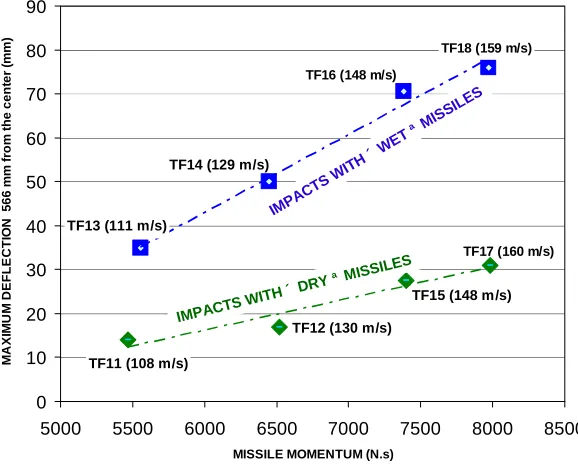
In Phase II of IMPACT Project, “dry” or “wet” deformable missiles identical to the ones of force plate tests discussed above (see fig. 1), were launched onto two-way reinforced concrete slabs (dimensions 2m x 2m x 0.15 m). In particular dry missiles and wet missiles were launched at 4 increasing velocities on similar slabs. One simple result of that series of 8 tests is the maximum deflection of each slab during the impact, as presented on figure 4.
Figure 4. Maximum deflections of two-way slabs, captured during the impact
TF12 (130 m/s)
TF11 (108 m/s) TF13 (111 m/s)
TF14 (129 m/s)
TF15 (148 m/s) TF16 (148 m/s)
TF17 (160 m/s) TF18 (159 m/s)
0 10 20 30 40 50 60 70 80 90
5000 5500 6000 6500 7000 7500 8000 8500
MISSILE MOMENTUM (N.s)
M A X IM U M D E F L E C T IO N 5 6 6 m m f ro m t h e c e n te r (m m ) IMPA CTS WITH «W
ET» M ISSILE
S
IMPACTS WITH « D
RY »MISS ILES
TF12 (130 m/s)
TF11 (108 m/s) TF13 (111 m/s)
TF14 (129 m/s)
TF15 (148 m/s) TF16 (148 m/s)
TF17 (160 m/s) TF18 (159 m/s)
0 10 20 30 40 50 60 70 80 90
5000 5500 6000 6500 7000 7500 8000 8500
MISSILE MOMENTUM (N.s)
M A X IM U M D E F L E C T IO N 5 6 6 m m f ro m t h e c e n te r (m m ) IMPA CTS WITH «W
ET» M ISSILE
S
IMPACTS WITH « D
The relationship between the momentum of the missile and the maximum deflection of the slab appears clearly on that figure, as well as the contrast in slab motion when dry or wet missiles are involved. In order to investigate the dynamic behavior of both missile and target during an impact, and with the help of force plate tests that are associated to concrete slab tests, some structural analyses and discussions are presented hereafter.
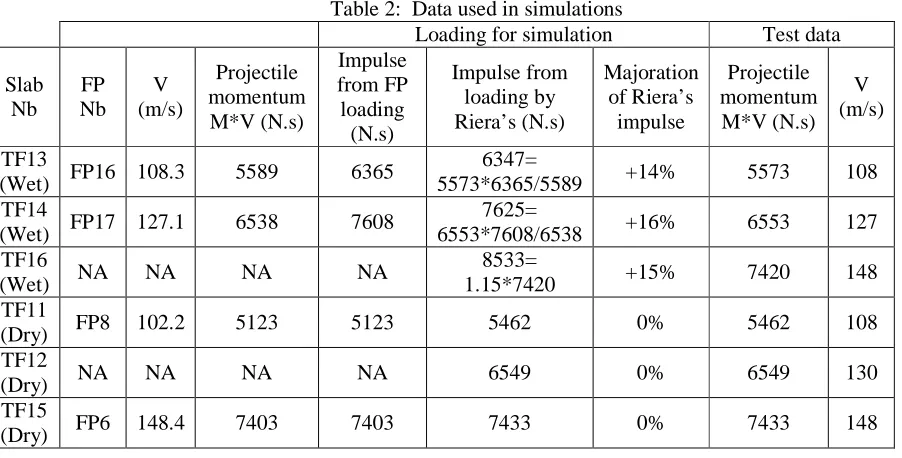
The motion of the two-way concrete slabs is analyzed by using a simplified model called PENTABLOC whose principles are provided in Rambach et al. (2008) and by using a loading function obtained with Riera’s method (with the improvement of the water effect as above mentioned). These tests have been performed on slabs having same geometry, limit conditions and mechanical characteristics (in terms of concrete and rebars), the simulations have been computed with same characteristics (the dynamic Young moduli, before and after plastic deformations, have been tuned on TF13 results). The following table sums up the data used in the simulations.
Table 2: Data used in simulations
Loading for simulation Test data
Slab Nb
FP Nb
V (m/s)
Projectile momentum M*V (N.s)
Impulse from FP loading (N.s)
Impulse from loading by Riera’s (N.s)
Majoration of Riera’s
impulse
Projectile momentum
M*V (N.s) V (m/s)
TF13
(Wet) FP16 108.3 5589 6365
6347=
5573*6365/5589 +14% 5573 108
TF14
(Wet) FP17 127.1 6538 7608
7625=
6553*7608/6538 +16% 6553 127
TF16
(Wet) NA NA NA NA
8533=
1.15*7420 +15% 7420 148
TF11
(Dry) FP8 102.2 5123 5123 5462 0% 5462 108
TF12
(Dry) NA NA NA NA 6549 0% 6549 130
TF15
(Dry) FP6 148.4 7403 7403 7433 0% 7433 148
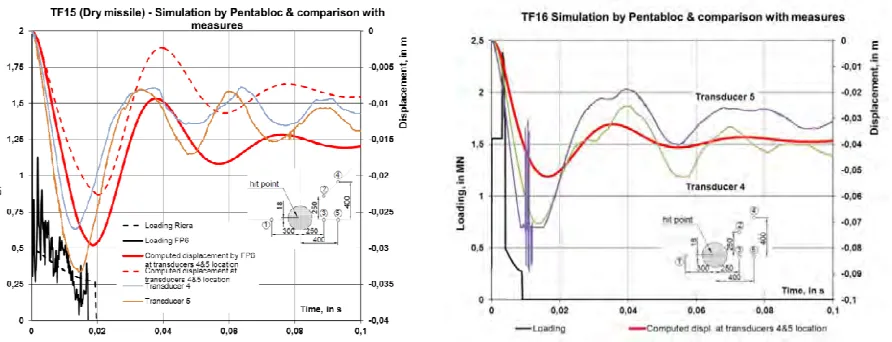
The following figures represent the results of some tests with their simulation.
Figure 6. Experimental loading and displacement of tested slab compared to simulated loading and displacement, for dry missile (left) and wet missile (right) at 127 m/s
Figure 7. Experimental loading and displacement of tested slab compared to simulated loading and displacement, for dry missile (left) and wet missile (right) at 148 m/s
One can notice that:
• the motion (in terms of displacement of given points of slab surface) is fairly reproduced by the simplified code, whatever the impact velocity (around 100 m/s, 125 m/s and 150 m/s) and whatever the type of missile (dry or wet);
• the Riera’s method for impact loading determination is confirmed by the recording of the applied impact force by the “Force Plate” measuring device;
• the slab motion is not dependent on the smoothening generated by the Riera’s method assumptions;
IMPACTS BY RIGID MISSILES AND USE OF EMPIRICAL FORMULAE TO PREDICT PERFORATION OF CONCRETE SLABS
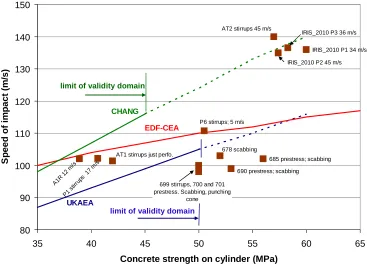
Roughly half of the tests of the IMPACT Project are devoted to the study of the impact of a rigid missile onto a concrete target: penetration of the missile, scabbing, cone cracking and perforation. The present paper deals with the 11 tests which are public, together with the 3 tests carried out for the purpose of IRIS_2010, the latter being described in Vepsa et al. (2011). All those tests have common features: the dimensions of the concrete wall, including its thickness (0.25 m), its bending reinforcement (10 mm rebars spacing 90 mm, each way each face), the diameter (168 mm) and the mass (between 47 and 47.5 kg) of the rigid missile.
The parameters that vary among the tests are:
• the impact velocity of the missile, from 98 to 153 m/s
• the shear reinforcement in the wall (0 or 140 cm2/m2)
• the amount of bi-axial prestressing of the wall (0 MPa, 5 MPa or 10 MPa)
• the uniaxial concrete strength, from 39 to 60 MPa on cylinder.
The information concerning the tests is presented on the figure 8, together with the just perforation curves corresponding to 3 well known empirical formulae. The EDF-CEA, Chang and UKAEA formulae are respectively described in Buzaud et al. (2007), Chang (1984) and Li et al. (2007). Those curves are doted lines in the zones outside their validity domain. In the figure 8 each test number is accompanied by the relevant information: presence of stirrups or pre-stressing, brief description of target damage (scabbing, punching cone, and the value of the residual speed of the missile in case of perforation).
Figure 8. Tests with rigid missiles: 11 IMPACT Project tests and the 3 IRIS_2010 ones
IRIS_2010 P1 34 m/s
678 scabbing
699 stirrups, 700 and 701 prestress. Scabbing, punching
cone AT1 stirrups just perfo.
A1R 12
m/s
P1 stirr
ups 17
m/s
IRIS_2010 P2 45 m/s IRIS_2010 P3 36 m/s AT2 stirrups 45 m/s
P6 stirrups; 5 m/s
685 prestress; scabbing
690 prestress; scabbing
UKAEA
EDF-CEA CHANG
80 90 100 110 120 130 140 150
35 40 45 50 55 60 65
Concrete strength on cylinder (MPa)
S
p
e
e
d
o
f
im
p
a
c
t
(m
/s
)
limit of validity domain
limit of validity domain
IRIS_2010 P1 34 m/s
678 scabbing
699 stirrups, 700 and 701 prestress. Scabbing, punching
cone AT1 stirrups just perfo.
A1R 12
m/s
P1 stirr
ups 17
m/s
IRIS_2010 P2 45 m/s IRIS_2010 P3 36 m/s AT2 stirrups 45 m/s
P6 stirrups; 5 m/s
685 prestress; scabbing
690 prestress; scabbing
UKAEA
EDF-CEA CHANG
80 90 100 110 120 130 140 150
35 40 45 50 55 60 65
Concrete strength on cylinder (MPa)
S
p
e
e
d
o
f
im
p
a
c
t
(m
/s
)
limit of validity domain
The analysis of the above mentioned tests leads to some comments, to be considered with caution because of the limited number of tests:
• the effect of the concrete strength appears clearly when comparing tests 678 and A1R,
• the positive effect of shear reinforcement does not appear when comparing tests 678 and 699, or when comparing AT2 with the IRIS_2010 tests, or when comparing tests A1R and P1
• the presence of prestressing does not seem clearly beneficial nor detrimental when comparing tests 678, 685 and 690, or when comparing tests 699, 700 and 701.
Finally, the only parameters that appear as clearly leading the amount of damage in the target are the concrete strength and the impact speed, which is in no way a new result.
From the few tests represented on figure 8, the UKAEA just perforation formula appears as reasonably conservative, the EDF-CEA formula seems slightly optimistic, and the Chang formula appears as too optimistic. More tests are needed to confirm or alter those preliminary statements; the authors think those additional tests should be simple enough (no pre-stressing is wished), and should incorporate variations of the missile’s mass and of the ratio H/D, where H is the thickness of the slab and D is the diameter of the missile.
CONCLUSION
The phases 1 and 2 of the experimental project IMPACT have spread during years 2006-2012. They have provided valuable data concerning the behavior of deformable missiles and concrete targets during medium velocity impacts, and they have pushed to the development of simplified methods of structural analysis, useful for engineering purposes.
Concerning impacts involving deformable missiles, the tests appear as consistent and repeatable. The association of force measurements (through Force Plate tests) with impact tests on concrete slabs provides data that help elucidate the quantification of the loading and the effect of that loading on the civil structure. The results confirm the validity of the Riera method, with an extension when some water is present in the missile. The greater severity of impact observed for tests in which missile is partially filled with water compared to the “dry” missile tests, is due to a greater impulse, corresponding to water rebound, but also and mainly, to shorter loading duration and higher peak values. Due to the nonlinear behavior of the slab in post elastic domain, the motion is sensitive to the shape of the loading signal.
The dynamic behavior of reinforced concrete elements (beams, one-way or two-way slabs) can be conveniently simulated using simplified codes developed on spreadsheets, giving way to quick sensitivity analyses well-fit to everyday engineering use.
Concerning impacts involving rigid missiles on reinforced concrete slabs, the results of the tests do not show a clear effect of shear reinforcement nor the one of pre-stressing. Finally, the only parameters that appear as clearly leading the amount of damage in the target are the concrete strength and the impact speed, which is in no way a new result. The predictions of several well known empirical formulae are not always satisfactory. More tests are needed to confirm or alter those statements. They should be simple enough, and incorporate variations of the missile’s mass, of the thickness of the slab and of the diameter of the missile.
REFERENCES
Buzaud, E. et al. (2007). „Assessment of empirical formulae for local response of concrete structures to hard projectile impact“. CONSEC conference, Tours, France.
Chang, W.S. (1984). “Impact of solid missiles on concrete structures“. ASCE J Struct Div 1984;110(5);948-60
Lastunen, A. et al. (2007). „Impact Test Facility“. In Transactions SMiRT-19 August 2007, Toronto, Canada.
Li, Q.M., Reid, S.R., Wen, H.M. and Telford, A.R. (2005). “Local impacts effects of hard missiles on concrete targets”. International Journal of Impact Engineering 32 (2005) 224-284
Rambach, J.-M. and Tarallo, F. (2008). “Simple Analytical Models for Beams and Slabs under Soft Impacts at Medium Speed”. Proceedings of the 16th International Conference on Nuclear Engineering Icone 16, Orlando, Florida, USA
Saarenheimo, A. et al. (2006). „Numerical and experimental studies on impact loaded concrete structures“. Proceedings of the 14th International Conference on Nuclear Engineering Icone-14 2006 Miami, Florida, USA.
Tarallo, F., Cirée B., Rambach J.M. (2007) “Interpretation of soft impact medium velocity tests on concrete slabs”. In Transactions SMiRT-19 Toronto, Canada.
Tarallo, F., Rambach J.M., Bourasseau N., and Phatthanasinh L. (2009). “VTT IMPACT program - First phase : Lessons gained by IRSN”. In Transactions SMiRT-20 Espoo, Finland.