Proceedings of Recent Advances in Natural Language Processing, pages 543–550,
Robust Tuning Datasets for Statistical Machine Translation
Preslav Nakov and Stephan Vogel
ALT Research Group
Qatar Computing Research Institute, HBKU
{pnakov, svogel}@hbku.edu.qa
Abstract
We explore the idea of automatically craft-ing a tuncraft-ing dataset for Statistical Machine Translation (SMT) that makes the hyper-parameters of the SMT system more ro-bust with respect to some specific deficien-cies of the parameter tuning algorithms. This is an under-explored research direc-tion, which can allow better parameter tun-ing. In this paper, we achieve this goal by selecting a subset of the available sentence pairs, which are more suitable for spe-cific combinations of optimizers, objective functions, and evaluation measures. We demonstrate the potential of the idea with the pairwise ranking optimization (PRO) optimizer, which is known to yield too short translations. We show that the learn-ing problem can be alleviated by tunlearn-ing on a subset of the development set, se-lected based on sentence length. In par-ticular, using the longest 50% of the ing sentences, we achieve two-fold tun-ing speedup, and improvements in BLEU score that rival those of alternatives, which fix BLEU+1’s smoothing instead.
1 Introduction
Modern Statistical Machine Translation (SMT) systems have several, somewhat independent, components that work together to generate a good translation, and are typically combined in a log-linear framework, where the language model, the translation model, the reordering model, etc., contribute to the hypothesis score with differ-ent weights. It is now standard to learn these weights discriminatively, from a development dataset, e.g., by optimizing BLEU (Papineni et al.,
2002) or some other measure directly.
A tuned system can often yield very significant improvements in terms of translation quality com-pared to a system that uses standard, untuned de-fault parameters. Thus, a lot of research attention in SMT has been devoted to designing different algorithms for parameter optimization. For years, it was typical to use minimum error rate training, or MERT (Och, 2003), which works quite well when the number of parameters is small. As the number of parameters has grown, rivaling optimiz-ers such as MIRA (Watanabe et al.,2007;Chiang et al., 2008) and PRO (Hopkins and May, 2011) have been developed, as well as various variations thereof (Bazrafshan et al.,2012;Cherry and Fos-ter,2012;Gimpel and Smith,2012).
These optimization algorithms have focused on learning from a given fixed dataset, relying on the standard machine learning assumption that the training and the development data come from the same distribution as the test data, e.g., in terms of domain, coverage, genre, length, etc. In practi-cal terms, this is especially important for the de-velopment/tuning data, but with standard datasets, there is often no way to guarantee this, and many researchers have determined empirically the most suitable tuning dataset by observing the translation score on the test dataset. Yet, the choice of tuning dataset can considerably affect the results; for ex-ample,Zheng et al.(2010) report variation across different standard NIST tuning MTxx datasets of over six BLEU points for Chinese-English SMT when testing on the NIST MT08 test dataset.
Given areasonable tuning set, i.e., one that is really coming from the same distribution as the test dataset, agoodoptimization algorithm should be able to learn to produce optimal weights. Yet, the choice of optimization objective can yield dra-matically different translations since different al-gorithms might need to stress some aspects of the tuning dataset and downplay others.
One reason for this is that different optimizers in-teract differently with different objectives. For ex-ample, we have previously shown that sentence-level optimizers yield too short translations when optimizing BLEU+1 (Nakov et al.,2012).
In this paper, we advocate the idea of automat-ically crafting a tuning dataset that makes tuning parameters lesssusceptible to the deficiencies of the learning algorithms. More specifically, in or-der to bridge this gap, we propose to customize the tuning dataset by selecting a subset of the avail-able sentence pairs, taking into account the target domain and the peculiarities of the optimization algorithm, objective function, and evaluation mea-sure used. This is important because it brings us a step closer to robust learning, instead of simply overfitting the tuning dataset.
Below, we focus specifically on sentence length as a selection criteria. We chose length because it can have consequences on how translations are scored w.r.t. to metrics like BLEU, and besides, it is a known issue for PRO. Still, to the best of our knowledge, the interaction between the opti-mizer, the optimization objective, the evaluation measure, and the development dataset has been largely neglected so far. For instance, we show that the problem of short translations when tuning with PRO (Hopkins and May,2011) is worsened when tuning on short sentence pairs, and alleviated when emphasizing the longer tuning sentences.
Tuning set crafting can be done in various ways, e.g., by removing examples with sub-optimal characteristics (e.g., short sentences) or by oversampling the ones with desired characteristics (e.g., longer sentences). Here we focus on selec-tion from a single tuning set because it is applica-ble to different datasets. We show that significant performance gains are possible with PRO when se-lecting just a subset of the tuning dataset based on length. Our objective here is to draw the attention of the research community to the possibilities that dataset customization through subset selection can offer for different experimental conditions. We be-lieve that this is a very promising, yet largely un-derexplored research direction.
Naturally, one could also try to select data from elsewhere and build a completely custom dataset, e.g., by selecting sentences from the train-ing dataset. However, this is not possible in case of multiple references (the training bi-text has only one reference).
One could also try to select/fuse from different available tuning datasets, but it is rare to have mul-tiple tuning datasets.
It has also been observed that having multiple references in the tuning dataset can yield more accurate parameter estimates and thus better test translation scores (Madnani et al., 2008). Thus, adding a few human translations, could signif-icantly boost translation quality. Since this is costly, some researchers have resorted to using au-tomatically generated references, with modest per-formance gains.
The remainder of the paper is organized as fol-lows: Section2introduces related work, Section3
describes the method, Section 4 presents the ex-perimental setup, Section5 discusses the evalua-tion results, and Secevalua-tion6provides deeper analy-sis and further discussion. Finally, Section7 con-cludes with possible directions for future work.
2 Related Work
Tuning the parameters of a log-linear model for SMT is an active area of research. The typical way to do this is to use minimum error rate training, or MERT, (Och,2003), which optimizes the standard dataset-level BLEU directly.
Recently, there has been a surge in new opti-mization techniques for SMT. Most notably, this includes the margin-infused relaxed algorithm or MIRA (Watanabe et al., 2007; Chiang et al.,
2008, 2009), which is an on-line sentence-level perceptron-like passive-aggressive optimizer, and pairwise ranking optimization or PRO (Hopkins and May, 2011), which operates in batch mode and sees tuning as ranking.
A number of improved versions thereof have been proposed including a batch version of MIRA (Cherry and Foster,2012) and a linear regression version of PRO (Bazrafshan et al., 2012). An-other recent optimizer is Rampeon (Gimpel and Smith, 2012). We refer the interested reader to three recent overviews on parameter optimization for SMT: (McAllester and Keshet, 2011; Cherry and Foster,2012;Gimpel and Smith,2012).
With the emergence of new optimization tech-niques, there have been also studies that compare stability between MIRA–MERT (Chiang et al.,
More relevant to the present work, there has been some interest in analyzing how different optimiz-ers interact with specific metrics. For example, pathological verbosity was reported when tuning MERT on recall-oriented metrics such as ME-TEOR (Lavie and Denkowski, 2009;Denkowski and Lavie, 2011), large variance was observed with MIRA (Simianer et al.,2012), andmonsters
were found when using PRO with too long tuning sentences (Nakov et al.,2013b). In previous work, we also found that MERT learns verbosity, while PRO learns length (Guzm´an et al.,2015b).
It has been also observed that having multiple references for the tuning dataset can yield better test-time translation performance (Madnani et al.,
2007). Thus, adding a few extra human refer-ence translations could significantly boost transla-tion quality. Since this is costly, some researchers have resorted to using automatically generated ref-erences,1 via paraphrasing (Madnani et al.,2008)
and back-translation (Dyer et al.,2011), with mod-est performance gains.
There has been also work on tuning data selec-tion and/or fusion in the special case when mul-tiple versions of the source sentence are available (Nakov et al.,2013a). This is a fairly rare situation for such approaches to be broadly applicable.
Most relevant to our work, there were efforts to build tuning datasets using information retrieval (Zheng et al., 2010;Tamchyna et al., 2012), text clustering (Li et al., 2010), and sentence-length based features (Guzm´an et al., 2012). To avoid data sparseness, most of these approaches require a larger pool of data, which they typically select from the training bi-text, thus reducing the amount of data available for model training. This makes such approaches inapplicable in multi-reference testset contexts since the bi-text only has one translation per source sentence. Moreover, the se-lection is typically done based on the actual test input, which is not known a priori in a realistic SMT setup, e.g., in online translation.
In contrast, we aim to produce customized datasets that are less susceptible to that, and are suitable for specific combinations of optimizers, objective functions, and evaluation measures. This can yield better parameter estimation, while using less data and more efficient tuning with faster iter-ations and a smaller computational footprint.
1Paraphrasing was also applied to the training bi-text
(Nakov,2008;Nakov and Ng,2009) and to the phrase table (Callison-Burch et al.,2006).
3 Method
Below we present one particular example of tun-ing dataset customization in order to illustrate the potential of the idea.
In previous work, we have shown that the PRO optimizer yields SMT parameters that yield test-time translations that are shorter than they should be. We have addressed this by changing the ob-jective function, sentence-level BLEU+1, and we have proposed to replace it with one with better smoothing (Nakov et al.,2012). Here we propose an alternative solution, which customizes the tun-ing dataset by selecttun-ing a subset of higher average length.
Observe that, if the reason for PRO yielding too short translations is the add-one smoothing in BLEU+1, this should affect shorter sentences to a greater extent, since the effect of the smoothing is bigger for them. I.e., we should expect that, when tuning with PRO, the translations of short sentences should get relatively shorter translations than those of long sentences. This means that we should expect to get longer translations if we tune on longer sentences, i.e., if we customize the tun-ing dataset, which can be done, e.g., (a) by ex-cluding some of the short sentences or (b) by over-sampling some of the long sentences. We will ex-plore approach (a) below: in particular, we will exclude half of the sentences, keeping the longest 50% only.
4 Experimental Setup
We experimented with Arabic-to-English SMT, training on the Arabic-English data that was made available for the NIST 2012 OpenMT Evaluation.2
We used all training data except for the UN cor-pus, we tuned on MT06 (and subsets thereof), and we tested on MT09, which have four English ref-erence translations.
We trained a phrase-based SMT model (Koehn et al., 2003) as implemented in the Moses toolkit (Koehn et al., 2007). We tokenized and truecased the English side of the train-ing/development/testing bitexts, and the monolin-gual data for language modeling using the stan-dard tokenizer of Moses. We segmented the words on the Arabic side of all bitexts using the MADA ATB segmentation scheme (Roth et al.,2008).
Tuning BLEU BP
1 BP-smooth=1, grounded 47.61 0.991
2 BP-smooth=1 47.52 0.984
3 top50 47.47 0.980
4 mid50 47.44 0.977
5 rand50 47.43 0.978
6 low50 46.38 0.961
7 full 47.18 0.972
Table 1: Multi-reference PRO experiments: test-set BLEU and BP when tuning on different length-based subsets of the tuning dataset (lines 3-6). For comparison, we also show the results when tuning on the full tuning dataset (line 7), as well as what the PRO-fixes proposed in (Nakov et al., 2012) would achieve when tuning on the full dataset (lines 1-2).
We then built a phrase table using the Moses pipeline with max-phrase-length 7 and Kneser-Ney smoothing, as well as a lexicalized reorder-ing model (Koehn et al.,2005): msd-bidirectional-fe. We used a 5-gram language model trained on GigaWord v.5 with Kneser-Ney smoothing using KenLM (Heafield,2011). On tuning and testing, we dropped the unknown words.
For tuning, we used PRO. In order to avoid in-stabilities when tuning on long sentences, we used a slightly modified, fixed version of PRO, as we recommended in (Nakov et al.,2013b), where we limited the difference between the positive and the negative example in a training sentence pair to be no more than ten BLEU+1 points. Moreover, in order to ensure convergence, we let PRO run for up to 25 iterations (default: 16); we further used 1000-best lists in each iteration (default: 100).
In our experiments, we performed three reruns of parameter optimization, and we report BLEU averaged over the three reruns, as suggested by
Clark et al.(2011) as a way to stabilize MERT. We calculated BLEU using NIST’s scoring tool v.13a, in case-sensitive mode.
5 Experiments and Evaluation
In this section, we verify experimentally whether tuning on short sentences can make PRO’s length issue worse and whether tuning on longer sen-tences could help in that respect. We further compare the effect of tuning on long sentences (i.e., of tuning dataset customization) to using bet-ter smoothing for BLEU+1 (as we have proposed in our earlier work).
Tuning BLEU BP
1 BP-smooth=1, grounded 29.68 0.979
2 BP-smooth=1 29.43 0.962
3 top50 29.51 0.969
4 mid50 29.11 0.950
5 rand50 28.96 0.941
6 low50 27.44 0.894
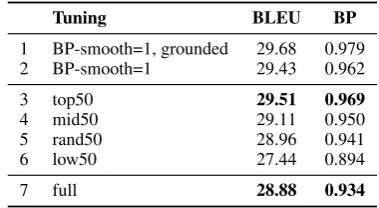
7 full 28.88 0.934
Table 2: Single-reference PRO experiments: test-set BLEU and BP when tuning on different length-based subsets of the tuning dataset (lines 3-6). We also show the results when tuning on the full tun-ing dataset (line 7), as well as what the PRO-fixes proposed in (Nakov et al., 2012) would achieve when tuning on the full dataset (lines 1-2).
Lines 3-6 in Table1show the results when tuning on the longest (top50), middle (mid50), random (rand50) and shortest (low50) 50% of the tuning sentences. Comparing this to line 7 (tuning on the full MT06), we can see that tuning on the shortest sentences lowers the hypothesis-to-reference ratio (BP), while tuning on top50 improves it,3with the
BP for mid50 and rand50 in between.
Lines 3-6 further show that better BP corre-sponds to better BLEU. We can also see that both BP and BLEU for top50 are better than those for the full MT06 tuning dataset. Despite top50 being tuned on less data, its BP and BLEU are compa-rable to those achieved by the BLEU+1 smooth-ing approaches shown in lines 1-2 (Nakov et al.,
2012), which use the full tuning dataset.
Note that when calculating BP and BLEU, for the 4-reference MT06 dataset, we used the length of the reference sentence that is closest to the length of the hypothesis. This is theeffective ref-erence length from the original paper on BLEU (Papineni et al.,2002), and it is also the default in NIST scoring tool v13a, which we use.
Using the closest reference yields a very for-giving BP. Yet, few datasets have multiple refer-ences. Thus, we also experimented with a single (ref0) reference for both tuning and testing. The results are shown in Table2. Comparing the cor-responding lines of Tables2and1, we see that in this case, the length problem is more severe and affects BLEU more. More importantly, note that the top50 customized tuning dataset is much more effective with a single reference translation.
28.8 29.0 29.2 29.4 29.6
0.94 0.95 0.96 0.97
Brevity penalty
MT09 BLEU (cased)
setting full top90 top80 top70 top60 top50
Figure 1: Single-reference PRO experiments. Cor-relation between cutoff, BP and BLEU score. The x-axis shows the brevity penalty (BP), and the y-axis contains the BLEU score on the testing MT09 dataset. Different colors show the different levels of cutoff. We show the results for three reruns in each setting.
6 Discussion
In this section, we perform further analysis, in or-der to better unor-derstand the improvements when tuning in longer sentences. We consider three as-pects: (i) amount of training data, (ii) genre over-lap between tuning and test datasets, and (iii) dif-ferences in the learned SMT parameters.
6.1 Amount of Tuning Data
In our experiments, we saw that tuning on longer sentences yields better results than tuning on shorter ones. However, one might argue that the subsets with longer sentences have access to more training data in terms of number of word tokens. In order to shed some light on this, we exper-imented with varying the percentage of longest sentences that we keep in decreasing order: from the full dataset (100%), we gradually removed the shortest sentences in increments of 10% until we ended up with just 50% of the data. The results are shown in Figure1. We can see that as the cutoff increases, so does BP, which in turn yields better BLEU. This suggests that by varying the length of the tuning sentences, we can effectively control the verbosity that PRO learns. We can further con-clude that it is not the amount of tuning data that matters but rather its characteristics.
6.2 Genre Overlap
MT06 is a mixture of three genres: newswire (nw), weblogs (wb) of almost equal sizes, and a much smaller size of broadcast news (bn). MT09 is also a mixture, but of two genres only: it only contains newswire and weblogs. Thus, one could ask the question of whether the observed improvements are due to better overlap between the genres of the tuning and of the testing datasests.
bn nw wb DKL
MT06
full 8% 46% 46% 3.93 low50 7% 25% 64% 7.42 mid50 9% 46% 41% 6.41 top50 8% 63% 26% 12.09
MT09
full 45% 55%
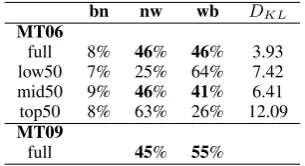
Table 3: Distribution of genres for the differ-ent partitions of the tuning data (MT06) and the test data (MT09). While MT06 has newswire (nw), and weblogs(wb) in equal amounts (with a lower proportion of broadcast news (bn)), MT09 has slightly higher proportion of weblog data than newswire. Based on Kullback–Leibler divergence (DKL), the full partition is closest to the test data, followed by the mid50 partition.
Table 3 could help answer this question; it shows the genre distribution for the different parti-tions of the tuning dataset. We can see that the dis-tribution of genres in the full MT06 dataset is bet-ter than for top50, mid50, and low50, having the smallest Kullback–Leibler divergence with the test set; the mid50 partition comes second. In contrast, top50, the best-performing partition among the ones we explored, has the most divergent genre-distribution with respect to the test dataset. From this, we can conclude that the improvements in BLEU for top50 are definitely not due to better genre/domain overlap.
6.3 Better Parameters
0.04 0.06 0.08 0.10
full top90 top80 top70 top60 top50
Tuning conditions
Optimiz
ed f
eature w
eight v
alue
feat ldm.f_mono lm0 tm.fe_lex tm.ef_lex wp
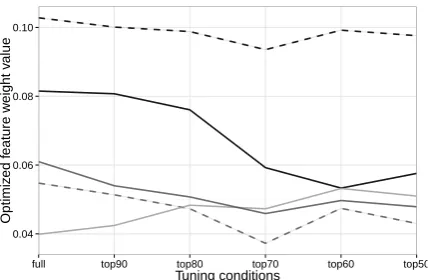
Figure 2: Optimized feature weight values for each of the different tuning settings. Only a subset out of the 14 different tuning weights that are used by the SMT model, and are thus being optimized, are shown in the figure, namely the following: monotone lexicalized reordering (ldm.f mono), language model (lm0), reverse lexical phrase translation probabilities (tm.fe lex), direct lexi-cal phrase translation probabilities (tm.ef lex), and word penalty (wp).
We selected the most important feature weights in terms of their correlation with changes in the brevity penalty (and BLEU). The results are shown in Figure2. As expected, the average value for the word penalty weight (dark gray solid line) is reduced as we increase the average length of our tuning set. This results in lower costs for longer sentences, explaining why we have higher verbosity.
However, this is not the full picture. The mono-tone lexicalized reordering model (black solid line) sees significant reduction in its weight, al-lowing for more reordering. Furthermore, the weight for the direct lexical phrase translation (light gray line) slightly increases as we increase the length of our tuning data. This can be in-terpreted as increased reliance on word-to-word translations.
Thus, by changing the length of the develop-ment set, we not only affect the word penalty, but also allow for changes in other parameters, which jointly yield better translation.4
4To be more precise in this analysis, more careful study
needs to be done using theexpected decoding cost, i.e., multi-plying the optimized weights by the mean feature values on a specific set. Nonetheless, there is no clear way to obtain such a mean feature vector without using a specific set of weights for decoding in the first place.
7 Conclusion and Future Work
We have explored the idea of customizing the tuning dataset for Statistical Machine Translation (SMT) that makes the hyper-parameters of the SMT system more robust with respect to some specific deficiencies of the parameter tuning al-gorithms. This is an under-explored research di-rection, which can allow better parameter tuning. In this paper, we achieved this goal by selecting a subset of the available sentence pairs, which are more suitable for specific combinations of opti-mizers, objective functions, and evaluation mea-sures. In particular, we experimented with the pairwise ranking optimization (PRO) optimizer, which is known to yield too short translations. We have shown that the problem can be alleviated by tuning on a subset of the development dataset, selected based on sentence length. In particu-lar, when selecting the longest 50% of the tuning sentences, we achieved two-fold tuning speedup and competitive scores in terms of BLEU, while having a more compact dataset. These results ri-val those of alternative solutions that we proposed in our previous work, which fix the tuning-time BLEU+1 smoothing instead. Our analysis shows that this is due to improved parameter tuning.
Overall, our goal was not just to show how one can improve PRO, but rather to draw the research attention to the more general idea of customizing a tuning set through subset selection, which can offer a number of opportunities for different ex-perimental conditions, and more efficient training. We believe that this is a very promising research direction, which is worth exploring further.
In the future, we plan to experiment with other language pairs and translation directions, as well as with other optimizers such as MERT and MIRA (instead of PRO), and with other evaluation mea-sures such as TER (Snover et al., 2006), ME-TEOR (Lavie and Denkowski, 2009), and Dis-coTK (Joty et al., 2014), including also pair-wise measures (Guzm´an et al.,2015a) (instead of BLEU). We further want to study the sensitivity of these optimizer and metric combinations with respect to length and other characteristics of the tuning dataset, which would allow us to design tar-geted dataset customization strategies for them.
Acknowledgements
References
Marzieh Bazrafshan, Tagyoung Chung, and Daniel Gildea. 2012. Tuning as linear regression. In Proceedings of the 2012 Annual Conference of the North American Chapter of the Association for Computational Linguistics: Human Language Technologies. Montr´eal, Canada, NAACL-HLT ’12, pages 543–547.
Chris Callison-Burch, Philipp Koehn, and Miles Os-borne. 2006. Improved statistical machine transla-tion using paraphrases. InProceedings of the Main Conference on Human Language Technology Con-ference of the North American Chapter of the As-sociation of Computational Linguistics. New York, NY, USA, HLT-NAACL ’06, pages 17–24.
Colin Cherry and George Foster. 2012. Batch tun-ing strategies for statistical machine translation. In Proceedings of the 2012 Annual Conference of the North American Chapter of the Association for Computational Linguistics: Human Language Technologies. Montr´eal, Canada, NAACL-HLT ’12, pages 427–436.
David Chiang, Kevin Knight, and Wei Wang. 2009. 11,001 new features for statistical machine transla-tion. InProceedings of the 2009 Annual Conference of the North American Chapter of the Association for Computational Linguistics: Human Language Technologies. Boulder, Colorado, USA, NAACL-HLT ’09, pages 218–226.
David Chiang, Yuval Marton, and Philip Resnik. 2008. Online large-margin training of syntactic and struc-tural translation features. In Proceedings of the 2008 Conference on Empirical Methods in Natu-ral Language Processing. Honolulu, Hawaii, USA, EMNLP ’08, pages 224–233.
Jonathan H. Clark, Chris Dyer, Alon Lavie, and Noah A. Smith. 2011. Better hypothesis testing for statistical machine translation: Controlling for opti-mizer instability. InProceedings of the 49th Annual Meeting of the Association for Computational Lin-guistics: Human Language Technologies. Portland, Oregon, USA, ACL ’11, pages 176–181.
Michael Denkowski and Alon Lavie. 2011. Meteor-tuned phrase-based SMT: CMU French-English and Haitian-English systems for WMT 2011. Techni-cal report, CMU-LTI-11-011, Language Technolo-gies Institute, Carnegie Mellon University.
Chris Dyer, Kevin Gimpel, Jonathan H. Clark, and Noah A. Smith. 2011. The CMU-ARK German-English translation system. InProceedings of the Sixth Workshop on Statistical Machine Translation. Edinburgh, Scotland, UK, WMT ’11, pages 337– 343.
Kevin Gimpel and Noah A. Smith. 2012. Struc-tured ramp loss minimization for machine transla-tion. InProceedings of the 2012 Annual Conference of the North American Chapter of the Association
for Computational Linguistics: Human Language Technologies. Montr´eal, Canada, NAACL-HLT ’12, pages 221–231.
Francisco Guzm´an, Shafiq Joty, Llu´ıs M`arquez, and Preslav Nakov. 2015a. Pairwise neural machine translation evaluation. InProceedings of the 53rd Annual Meeting of the Association for Computa-tional Linguistics and the 7th InternaComputa-tional Joint Conference on Natural Language Processing. Bei-jing, China, ACL-IJCNLP ’15, pages 805–814. Francisco Guzm´an, Preslav Nakov, Ahmed Thabet, and
Stephan Vogel. 2012. QCRI at WMT12: Experi-ments in Spanish-English and German-English ma-chine translation of news text. InProceedings of the Seventh Workshop on Statistical Machine Transla-tion. Montr´eal, Canada, IWSLT ’12, pages 298–303. Francisco Guzm´an, Preslav Nakov, and Stephan Vo-gel. 2015b. Analyzing optimization for statistical machine translation: MERT learns verbosity, PRO learns length. InProceedings of the Nineteenth Con-ference on Computational Natural Language Learn-ing. Beijing, China, CoNLL ’15, pages 62–72. Kenneth Heafield. 2011. KenLM: Faster and smaller
language model queries. InProceedings of the Sixth Workshop on Statistical Machine Translation. Edin-burgh, Scotland, UK, WMT ’11, pages 187–197. Mark Hopkins and Jonathan May. 2011. Tuning as
ranking. InProceedings of the 2011 Conference on Empirical Methods in Natural Language Process-ing. Edinburgh, Scotland, UK, EMNLP ’11, pages 1352–1362.
Shafiq Joty, Francisco Guzm´an, Llu´ıs M`arquez, and Preslav Nakov. 2014. DiscoTK: Using discourse structure for machine translation evaluation. In Proceedings of the Ninth Workshop on Statistical Machine Translation. Baltimore, Maryland, USA, WMT ’14, pages 402–408.
Philipp Koehn, Amittai Axelrod, Alexandra Birch Mayne, Chris Callison-Burch, Miles Osborne, and David Talbot. 2005. Edinburgh system description for the 2005 IWSLT speech translation evaluation. In Proceedings of the International Workshop on Spoken Language Translation. Pittsburgh, Pennsyl-vania, USA, IWSLT ’05, pages 68–75.
Philipp Koehn, Hieu Hoang, Alexandra Birch, Chris Callison-Burch, Marcello Federico, Nicola Bertoldi, Brooke Cowan, Wade Shen, Christine Moran, Richard Zens, Chris Dyer, Ondrej Bojar, Alexan-dra Constantin, and Evan Herbst. 2007. Moses: Open source toolkit for statistical machine transla-tion. In Proceedings of the 45th Annual Meeting of the Association for Computational Linguistics. Prague, Czech Republic, ACL ’07, pages 177–180. Philipp Koehn, Franz Josef Och, and Daniel Marcu.
Linguistics on Human Language Technology. Ed-monton, Canada, HLT-NAACL ’03, pages 48–54.
Alon Lavie and Michael J. Denkowski. 2009. The ME-TEOR metric for automatic evaluation of machine translation.Machine Translation23:105–115.
Mu Li, Yinggong Zhao, Dongdong Zhang, and Ming Zhou. 2010. Adaptive development data selection for log-linear model in statistical machine trans-lation. In Proceedings of the 23rd International Conference on Computational Linguistics. Beijing, China, COLING ’10, pages 662–670.
Nitin Madnani, Necip Fazil Ayan, Philip Resnik, and Bonnie Dorr. 2007. Using paraphrases for parame-ter tuning in statistical machine translation. In Pro-ceedings of the Second Workshop on Statistical Ma-chine Translation. Prague, Czech Republic, pages 120–127.
Nitin Madnani, Philip Resnik, Bonnie J. Dorr, and Richard Schwartz. 2008. Are multiple reference translations necessary? Investigating the value of paraphrased reference translations in parameter op-timization. InProceedings of the Eighth Conference of the Association for Machine Translation in the Americas. Waikiki, Hawaii, AMTA ’08’.
David McAllester and Joseph Keshet. 2011. Gener-alization bounds and consistency for latent struc-tural probit and ramp loss. In J. Shawe-Taylor, R.S. Zemel, P. Bartlett, F.C.N. Pereira, and K.Q. Weinberger, editors, Advances in Neural Informa-tion Processing Systems 24. Granada, Spain, NIPS ’11, pages 2205–2212.
Preslav Nakov. 2008. Improved statistical machine translation using monolingual paraphrases. In Pro-ceedings of the 18th European Conference on Ar-tificial Intelligence. Amsterdam, The Netherlands, ECAI ’08, pages 338–342.
Preslav Nakov, Fahad Al Obaidli, Francisco Guzm´an, and Stephan Vogel. 2013a. Parameter optimization for statistical machine translation: It pays to learn from hard examples. InProceedings of the Interna-tional Conference Recent Advances in Natural Lan-guage Processing. Hissar, Bulgaria, RANLP ’13, pages 504–510.
Preslav Nakov, Francisco Guzm´an, and Stephan Vo-gel. 2012. Optimizing for sentence-level BLEU+1 yields short translations. InProceedings of the 24th International Conference on Computational Lin-guistics. Mumbai, India, COLING ’12, pages 1979– 1994.
Preslav Nakov, Francisco Guzm´an, and Stephan Vogel. 2013b. A tale about PRO and monsters. In Pro-ceedings of the 51st Annual Meeting of the Associa-tion for ComputaAssocia-tional Linguistics. Sofia, Bulgaria, ACL ’13, pages 12–17.
Preslav Nakov and Hwee Tou Ng. 2009. Improved statistical machine translation for resource-poor lan-guages using related resource-rich lanlan-guages. In Proceedings of the 2009 Conference on Empirical Methods in Natural Language Processing. Singa-pore, EMNLP ’09, pages 1358–1367.
Franz Josef Och. 2003. Minimum error rate training in statistical machine translation. InProceedings of the 41st Annual Meeting on Association for Computa-tional Linguistics. Sapporo, Japan, ACL ’03, pages 160–167.
Kishore Papineni, Salim Roukos, Todd Ward, and Wei-Jing Zhu. 2002. BLEU: a method for automatic evaluation of machine translation. InProceedings of the 40th Annual Meeting of the Association for Com-putational Linguistics. Philadelphia, Pennsylvania, USA, ACL ’02, pages 311–318.
Ryan Roth, Owen Rambow, Nizar Habash, Mona Diab, and Cynthia Rudin. 2008. Arabic morphological tagging, diacritization, and lemmatization using lex-eme models and feature ranking. InProceedings of the 46th Annual Meeting of the Association for Com-putational Linguistics: Human Language Technolo-gies. Columbus, OH, USA, ACL ’08, pages 117– 120.
Patrick Simianer, Stefan Riezler, and Chris Dyer. 2012. Joint feature selection in distributed stochastic learn-ing for large-scale discriminative trainlearn-ing in SMT. In Proceedings of the 50th Annual Meeting of the Association for Computational Linguistics. Jeju Is-land, Korea, ACL ’12, pages 11–21.
Matthew Snover, Bonnie Dorr, Richard Schwartz, Lin-nea Micciulla, and John Makhoul. 2006. A study of translation edit rate with targeted human annota-tion. InProceedings of the Conference of the As-sociation for Machine Translation in the Americas. Cambridge, Massachusetts, USA, AMTA ’06, pages 223–231.
Aleˇs Tamchyna, Petra Galuˇsˇc´akov´a, Amir Kamran, Miloˇs Stanojevi´c, and Ondej Bojar. 2012. Selecting data for English-to-Czech machine translation. In Proceedings of the Workshop on Statistical Machine Translation. Montr´eal, Canada, WMT ’12, pages 374–381.
Taro Watanabe, Jun Suzuki, Hajime Tsukada, and Hideki Isozaki. 2007. Online large-margin training for statistical machine translation. InProceedings of the 2007 Joint Conference on Empirical Methods in Natural Language Processing and Computational Natural Language Learning. Prague, Czech Repub-lic, EMNLP-CoNLL ’07, pages 764–773.