Smooth Projective Hashing and Two-Message Oblivious Transfer
Shai Halevi IBM Research
Yael Tauman Kalai∗ Microsoft Research
October 31, 2010
Abstract
We present a general framework for constructing two-message oblivious transfer protocols using a modification of Cramer and Shoup’s notion of smooth projective hashing (2002). This framework is an abstraction of the two-message oblivious transfer protocols of Naor and Pinkas (2001) and Aiello et al. (2001), whose security is based on the Decisional Diffie Hellman As-sumption. In particular, we give two new oblivious transfer protocols. The security of one is based on the Quadratic Residuosity Assumption, and the security of the other is based on the N’th Residuosity Assumption. Compared to other applications of smooth projective hashing, in our context we must deal also with maliciously chosen parameters, which raises new technical difficulties.
We also improve on prior constructions of factoring-based smooth universal hashing, in that our constructionsdo not require that the underlying RSA modulus is a product of safe primes. (This holds for the schemes based on the Quadratic Residuosity Assumption as well as the ones based on the N’th Residuosity Assumption.) In fact, we observe that the safe-prime requirement is unnecessary for many prior constructions. In particular, the factoring-based CCA secure encryption schemes due to Cramer-Shoup, Gennaro-Lindell, and Camenisch-Shoup remain secure even if the underlying RSA modulus is not a product of safe primes.
1
Introduction
In [5], Cramer and Shoup introduced the first practical encryption scheme that was proved CCA secure in the standard model, with security based on the Decisional Diffie Hellman (DDH) Assump-tion. They later presented an abstraction of this scheme based on a notion that they called “smooth projective hashing” [6]. This abstraction yielded two new CCA secure encryption schemes; the se-curity of one is based on the Quadratic Residuosity Assumption [12] and the sese-curity of the other is based on the N’th Residuosity Assumption [19].1 The notion of smooth projective hashing was later used by Gennaro and Lindell [10] in the context of key generation from humanly memorizable passwords. That work abstracts and generalizes an earlier protocol for this problem due to Katz et al. [14], whose security is based on the DDH Assumption.
In this work we use smooth projective hashing to construct efficient two-message oblivious transfer protocols. Our work follows the same pattern, in that it abstracts and generalizes earlier
∗Much of this work was carried out while visiting IBM T.J. Watson Research, New York. Also supported in part
by NSF CyberTrust grant CNS-0430450.
1TheN’th Residuosity Assumption is also referred to in the literature as the Decisional Composite Residuosity
protocols for this problem [17, 1] whose security is based on the DDH Assumption. Using smooth projective hashing in this context raises a new issue. Specifically, we must deal with the case that the hash family itself is chosen maliciously by the adversary. To this end, we add an extra requirement to the definition of smooth projective hashing. This issue did not arise in the previous two applications because these were either in the public key model or in the common reference string model, and in these models the parameters can be assumed to be generated honestly.
We show that even with this additional requirement, we can still construct smooth projective hashing from any of the following assumptions: the DDH Assumption, the N’th Residuosity As-sumption, and the Quadratic Residuosity Assumption. Moreover, for the last two constructions we can prove security even when the underlying RSA modulus is not a product of safe primes. We note that all previous factoring-based constructions of smooth projective hashing did rely on the assumption that the underlying RSA modulus is a product of safe primes.
1.1 Oblivious Transfer
Oblivious transfer, first introduced by Rabin [20], is a central primitive in modern cryptography. It is a protocol between a sender, holding two strings γ0 and γ1, and a receiver holding a choice bitb. At the end of the protocol the receiver should learn the string of his choice (i.e.,γb) but learn nothing about the other string. The sender, on the other hand, should learn nothing about the receiver’s choice b. Oblivious transfer serves as the basis of a wide range of cryptographic tasks. Most notably, any secure multi-party computation can be based on a secure oblivious transfer protocol [21, 11, 15]. Oblivious transfer has been studied in several variants, all of which have been shown to be equivalent. The variant considered in this paper is the one by Even, Goldreich and Lempel [9] (a.k.a. 1-out-of-2 oblivious transfer), shown to be equivalent to Rabin’s original definition by Cr´epeau [7].
Much work has been devoted to improving the efficiency of oblivious-transfer protocols, mo-tivated by the fact that oblivious transfer is many times the main efficiency bottleneck with in protocols for secure multi-party computation. In particular, constructing round-efficient oblivious transfer protocols is an important task. Indeed, Naor and Pinkas [17, Protocol 4.1] and Aiello et al. [1] independently constructed atwo-message(1-round) oblivious transfer protocol based on the DDH Assumption. Their work was the starting point of our work.
1.2 Smooth Projective Hashing
1.3 Oblivious transfer from smooth projective hashing
We present a methodology for constructing a two-message oblivious transfer protocol from any (variant of a) smooth projective hash family. In particular, the protocols in [17, 1] can be viewed as a special case of this methodology. Moreover, we show that this methodology gives rise to two new oblivious transfer protocols; one based on the Quadratic Residuosity Assumption, and the other based on theN’th Residuosity Assumption. Similarly to the protocols from [17, 1], our protocols achieve a indistinguishability-based security notion, not a simulation-based notion, see Section 3 for further discussion of this point.
The basic idea. Given a smooth projective hash family with the hard subset membership prop-erty, consider the following two-message oblivious transfer protocol. Recall that the senderS takes as input a pair of strings γ0, γ1, and the receiverR takes as input a choice bit b.
R→S: Generate the hashing parameters Λ (that define the domainX and the special subsetL). Choose a random triple (x0, x1, wb) wherexb
$
←L,wbis a “witness” for membership ofxb ∈L, and x1−b
$
←X\L. Send (Λ, x0, x1).
S →R: Choose independently at random a primary hashing keykand a corresponding projective keyspk. Send pk along with y0←γ0⊕Hk(x0) and y1←γ1⊕Hk(x1).
R: Retrieveγb by computing yb⊕Hk(xb), using the witnesswb and the projective keypkb.
The functionality of the protocol is implied by the projection property. The security of the receiver is implied by the hardness of the subset membership problem onX, since guessing the value ofb implies distinguishing between a random member and a random non-member. The security of the sender (against an honest-but-curious receiver) is implied by the smoothness property of the hash family. Specifically, given a random projective keypkand any element inx∈X\L, the value Hk(x) is statistically indistinguishable from random. Thus, the messagey1−b gives no information about γ1−b (since x1−b ∈X\L).
Malicious receivers. The above protocol works for an honest-but-curious receiver, but the se-curity of the sender is no longer guaranteed when considering malicious receivers. For example, a malicious receiver might choose x0, x1 ∈ L and learn both γ0 and γ1. To overcome this problem, we extend the notion of smoothness so that it is possible to verify that the function is smooth on at least one of x0, x1. Note that this must hold even if the hashing parameters Λ are maliciously chosen by the receiver.
Implementing this extended notion in the context of the DDH assumption is straightforward [17, 1]. Loosely speaking, in this case the hashing parameters consist of a primepand two elements g0, g1 ∈Z∗p of prime order q|(p−1). The hashing domain isX
def
= ⟨g0⟩ × ⟨g1⟩={(gr00, g r1
1 ) :r0, r1 ∈
Zq}, the special subset is L def= {(gr
0, gr1) : r ∈ Zq}, and the witness is the exponent r. To enable the sender to verify that two elementsx0, x1 are not both inL, we instruct the receiver to generate x0, x1 by choosing at random two distinct elements r0, r1 ∈ Zq, setting xb ← (g0r0, g
r0
1 ), wb ← r0, and x1−b ← (g0r0, g
r1
1.4 Factoring-based smooth projective hashing
Implementing smooth projective hashing with the extra verifiability property in the context of the Quadratic Residuosity Assumption and theN’th Residuosity Assumption is not as easy. This part contains the bulk of technical difficulties of this work.
On top of providing the additional verifiability property, we were also able to somewhat relax the underlying assumptions that were used in prior work. The factoring-based constructions of smooth projective hashing, in the work of Cramer and Shoup (as well as all subsequent works), were only proved secure for the special case where the RSA modulus in use is a product of safe primes. Namely, they usedN ←pq wherep, q are distinct odd primes such thatp′ = (p−1)/2 and q′ = (q−1)/2 are also odd primes.2 This restriction was explained by “technical reasons,” but we observe that it is not needed: in fact our factoring-based constructions can be proved secure also for “generic” RSA moduli (i.e., for anyN ←pq wherep, q are two odd primes of the same size).
Moreover, using the same tools we can eliminate the need for safe primes in the CCA encryption schemes that are based on smooth projective hashing (i.e., they too can be implemented without safe primes). Indeed, we observe that encryption schemes in the literature that are based on the N’th Residuosity or Quadratic Residuosity Assumptions (cf. [6, 10, 3]) remain secure even when the underlying RSA modulus is not chosen as a product of safe primes. In the appendix we explain how the proofs for the existing schemes can be modified to prove this stronger result, and exemplify it in detail for the proof of Camenisch and Shoup from [3].
Eliminating the safe primes. We describe the idea that allows us to eliminate the need for safe primes in the construction of smooth projective hashing based on theN’th Residuosity Assumption. (For the construction based on the Quadratic Residuosity Assumption, the idea is similar but even simpler.)
The only place where prior work really used the safe-prime condition is in proving the hard subset membership property. Namely, one needs to prove that it is hard to distinguish the special subset of the hashing scheme from the entire domain.
In the construction based on theN’th Residuosity Assumption, the hashing parameters are the RSA modulus N and a random N’th residueg modulo N2, such thatg is a quadratic non residue with Jacobi symbol +1. The hashing domain is all the elements in ZN∗2 with Jacobi symbol +1,
denoted byJN2, and the special subset is the subgroup⟨g⟩that is generated by g. The safe-prime
condition is used to argue that, with high probability, g generates the subgroup of all the N’th residues with Jacobi symbol +1. This is the case since the size ofJN2 is φ(N2)/2 =N φ(N)/2 =
N(p−1)(q−1)/2 = 2N p′q′. Thus, with high probability, a random quadratic non residue in the groupJN2 generates the entire groupJN2, which implies that, with high probability,ggenerates the
subgroup of all theN’th residues with Jacobi symbol +1. Thus, theN’th Residuosity Assumption (for elements with Jacobi symbol +1) immediately implies that it is hard to distinguish the special subset from the entire domain.
When N is just a plain old RSA modulus, we lose the property that with high probability g generates the subgroup of all theN’th residues with Jacobi symbol +1 (this subgroup is typically not cyclic). We thus need a slightly more involved reduction to prove the hard subset membership property. In Lemma 5 we show that the N’th Residuosity Assumption implies that it is hard to distinguish the subgroupLdef= ⟨g⟩from the subgroupX def= ⟨g⟩·⟨1 +N⟩of all the elements that can
2
be generated as x ← gr(1 +N)smodN2. We therefore get a smooth projective hashing scheme with domainX and special subsetL, and we have the hard subset membership property.
One can see, however, that this construction is still missing one aspect that was present in prior notions. Namely, there could be elements ofZN∗2 that are not in the hashing domainX. Moreover,
given the parameters N, g and an element x ∈ ZN∗2, there does not seem to be an easy way of
deciding whether or not x ∈ X. This does not pose any problem for the application to oblivious transfer, but it potentially poses some problems in the case of chosen-ciphertext-secure encryption. Luckily, we show in the appendix that the proof of CCA security can be carried through even with this aspect missing.
2
Notations
For any positive integer X we denote the set {0,1, . . . , X −1} by either [X] or ZX. We always denote the security parameter by n. A functionν :N→ [0,1] is said to be negligible if for every polynomial p(·) and for every large enough n, ν(n) < 1/p(n). For an algorithm A, y ← A(x) denotes running A on input x and assigning the result to y. If A is randomized then we denote y ←$ A(x) and y is a random variable. We also denote by x←$ S the action of uniformly choosing an element from the set S.
For any two random variablesX, Y, letDist(X, Y) denotes the statistical difference betweenX and Y, namely Dist(X, Y) , 12∑s∈S|Pr[X = s]−Pr[Y = s]|, where S contains the support of bothX andY. We say thatX andY areϵ-close, denoted X≈ϵ Y, ifDist(X, Y)≤ϵ. We say that the ensemblesX ={Xn}n∈N and Y ={Yn}n∈N arestatistically indistinguishable, denotedX ≡s Y, if there exists a negligible function ϵ(·) such that for everyn∈N, the random variablesXn andYn areϵ(n)-close.
We say that the ensembles X={Xn}n∈N andY ={Yn}n∈N arecomputationally indistinguish-able, denoted X ≡c Y, if for every non-uniform probabilistic polynomial-time (PPT) distinguisher Dthere exists a negligible function ϵ(·) such that for everyn∈N,
|Pr[D(Xn) = 1]−Pr[D(Yn) = 1]|< ϵ(n)
For simplicity, throughout this paper we say that two random variables Xn and Yn are computa-tionally (or statistically) indistinguishable, meaning that the corresponding distribution ensembles {Xn}n∈Nand {Yn}n∈N are computationally (or statistically) indistinguishable.
3
Security of Oblivious Transfer
Our definition of oblivious transfer is similar to the ones considered in previous works on oblivious transfer in the Bounded Storage Model [8, 2], and similar to the definition considered in [17] in the context of their DDH-based two-message oblivious transfer protocol. We remark that the definition below is specific for two-message protocols, as we only deal with such protocols in this work. In these protocols, the receiverR sends the first message, and the senderS sends the second message.
get as input a security parameter n in unary representation. Moreover, the sender gets as input two strings γ0, γ1 ∈ {0,1}ℓ(n), the receiver gets as input a choice bit b ∈ {0,1}, and the following conditions are satisfied:
• Functionality: If the sender and the receiver follow the protocol then for any security parameter n, any two input strings γ0, γ1 ∈ {0,1}ℓ(n), and any bitb, the receiver outputs γb whereas the sender outputs nothing.3
• Receiver’s security: Denote by R(1n, b) the message sent by the honest receiver with input (1n, b). Then the ensembles {R(1n,0)}n∈N and {R(1n,1)}n∈N are computationally indistin-guishable; {R(1n,0)}n∈N≡ {R(1c n,1)}n∈N.
• Sender’s security: Denote by S(1n, γ
0, γ1, q) the response of the honest sender with input (1n, γ0, γ1) when the receiver’s first message is q. Then there is a negligible function ν such that for any n > 0, any three messages γ0, γ1, γ′ ∈ {0,1}ℓ(n), and any message q ∈ {0,1}∗ (from a possibly cheating, not necessarily polynomial-time receiver), it holds that
Dist(S(1n, γ0, γ1, q), S(1n, γ0, γ′, q))≤ν(n) or Dist(S(1n, γ0, γ1, q), S(1n, γ′, γ1, q))≤ν(n)
Note that similarly to the definitions in [8, 2, 17], Definition 1 is not a simulation-based definition but rather an indistinguishability-based one. Although it is a meaningful notion and is sufficient for some application, it is still weaker than the simulation-based notion: In particular it is cannot offer the same composability properties, and hence it is harder to use it as a building block in secure multi-party computation protocols.
The simulation-based definition compares the “real world,” where the parties execute the pro-tocol, to an “ideal world,” where no message is exchanged between the two parties; rather, there is a trusted party that takes an input from both parties, computes the output of the Oblivious Transfer functionality on these inputs, and sends the corresponding output to each party. Loosely speaking, the simulation-based definition asserts that for every efficient adversary A (controlling either the sender or the receiver) in the “real world” there exists an efficient simulator S, control-ling the same party in the “ideal world,” so that the outputs of the parties in the ideal world are computationally indistinguishable from their outputs in the real world. In particular, the simulator S needs to simulate the view of the adversaryA in a computationally indistinguishable manner.
We note that Definition 1 does give a simulation-based guarantee in the case that the sender is corrupted (if you allow a resetting simulator). In this case, the simulator (who does not know the choice bit of the actual receiver) simulates the (honest) receiver first with choice bitb= 0, and then it resets the sender and simulates the honest receiver with choice bitb= 1. This way the simulator extracts both messagesγ0 andγ1 from the corrupted senderA. It then gives (γ0, γ1) to the trusted party. Then the simulator uses the view of the cheating sender Ain the first execution (with the choice-bit b = 0). The fact that this view is indistinguishable from the “real world” view follows from the receiver’s security which asserts that {R(1n,0)}n∈N ≡ {R(1c n,1)}n∈N, and from the fact that sender does not receive any output from the trusted party.
On the other hand, Definition 1 does not give a simulation-based guarantee in the case that the receiver is corrupted. The reason is that a malicious receiver is not guaranteed to “know its own choice bitb”, and therefore the simulator does not know which input bit to send to the trusted party
in order to obtain the desired outputγb. However, Definition 1 does guarantee an exponential time simulation of the receiver’s view of the interaction (similarly to the definition from [17]). Loosely speaking, the simulator can extract in exponential time a choice-bit b that is consistent with the receiver’s first message q. Then the simulator gives this bit b to the trusted party, receives an output γ, and simulates the sender’s message in the protocol by setting it to be S(γ,0ℓ(n), q) if b= 0 and S(0ℓ(n), γ, q) ifb= 1. This implies that the interaction gives no more information than what an unbounded receiver can derive from just the value of γb. (We note that if the receiver is “honest but curious” then the same simulation strategy can be implemented in polynomial time, and thus Definition 1 does guarantee simulation-based security for honest-but-curious adversaries.)
4
Smooth Projective Hash Functions
Our definition of smooth projective hashing differs in some ways from prior definitions [6, 10], mainly in that we add the requirement that it is possible to verify that at least one of two given elements is a non-member. We also depart from the presentation in previous work and define the notion of smooth projective hashing in terms of the procedures that are used to implement it rather than in terms of languages and sets. (This is merely a presentation issue, we believe that it makes the presentation clearer.) At the end of this section we briefly discuss the mapping between our presentation and the one used in previous work.
Syntax. A hash family H is defined by means of the following six polynomial-time algorithms, H= (PG,IS,IT,HG,Hash,pHash):
• The parameter-generator PG is a randomized algorithm that takes as input the security parameter and outputs some parameters, Λ←$ PG(1n).We assume that the security parameter can be inferred from Λ, and denote the security parameter corresponding to Λ by n(Λ).
• Theinstance-sampler ISis a randomized algorithm that takes as input the parameters Λ and outputs a triple, (w, x, x′)←$ IS(Λ).The intent is that xis a member of the special subset,x′ is a non-member, andw is a witness for the membership ofx in the special subset.
• The instance-testing algorithm IT tests the parameters Λ and two strings x0, x1, namely IT(Λ, x0, x1)∈ {0,1}.The intent is to test that at least one of x0, x1 is not a member in the special subset.
• The hash-key generatorHG is a randomized algorithm that takes as input the parameters Λ and outputs two keys (i.e., a primary hashing key and a projective key), (k, pk)←$ HG(Λ).
• The primary hash algorithm Hash takes the parameters Λ, a hash key k, and an element x, and outputs a stringy←Hash(Λ, k, x).
For every string Λ, consider using Λ as the hashing parameters and let GΛ denote the set of possible hash values with these parameters, namely
GΛ def= {Hash(Λ, k, x) : (w, x, x′)∈support(IS(Λ)), (k, pk)∈support(HG(Λ))} ∪ {Hash(Λ, k, x′) : (w, x, x′)∈support(IS(Λ)), (k, pk)∈support(HG(Λ))}
It helps to think of GΛ as a group where we can efficiently compute the group operation and its inverse. In most of this paper, the groupGΛ will be the set ofℓ-bit strings (with the xor operation) whereℓ=ℓ(n(Λ)) for some polynomially-bound functionℓ(·).
Definition 2 Let H= (PG,IS,IT,HG,Hash,pHash) and let Λ and x be two strings.
Smoothness. Let ϵ ≥0. We say that H is ϵ-smooth on (Λ, x) if the following two distributions are ϵ-close:
[
(pk,Hash(Λ, k, x))
]
(k,pk)←$HG(Λ) and
[
(pk, y)
]
(k,pk)←$HG(Λ), y←$GΛ
The first distribution is induced by choosing(k, pk)←$ HG(Λ)and outputting(pk,Hash(Λ, k, x)), and the second is induced by choosing independently y←$ GΛ and (k, pk)
$
← HG(Λ) and out-putting (pk, y).
Projection. We say that His projective on(Λ, x) if for every pair of primary hashing keysk, k′ for which there exist a projective keypk such that both (k, pk) and (k′, pk) are in the support of HG(Λ), it holds thatHash(Λ, k, x) =Hash(Λ, k′, x).
It is easy to verify thatϵ-smoothness on (Λ, x) and projection on (Λ, x) are contradictory require-ments (assuming that ϵ <1−|G1
Λ|).
Definition 3 (Smooth Projective Hashing) A family H = (PG,IS,IT,HG,Hash,pHash) is a smooth projective hash family if there exists a negligible function ϵ:N→[0,1] such that for every Λ ∈ support(PG), every (w, x, x′) ∈ support(IS(Λ)), and every (k, pk) ∈ support(HG(Λ)), it holds that
(a) pHash(Λ, pk, w, x) =Hash(Λ, k, x). (b) H isϵ(n(Λ))-smooth on(Λ, x′).
(Clearly condition (a) above implies in particular thatHis projective on (Λ, x), since the left-hand-side is independent of kexcept via the corresponding pk.)
Definition 4 (Verifiable Smoothness) A smooth projective hash family H = (PG,IS,IT,HG, Hash,pHash) is verifiably smooth if, in addition to the properties (a) and (b) in Definition 3, it holds that:
(d) For every Λ, x0, x1 such that IT(Λ, x0, x1) = 1, it holds that either H is ϵ(n(Λ))-smooth on (Λ, x0) or it is ϵ(n(Λ))-smooth on (Λ, x1) (or both).
Definition 5 (Hard Subset Membership) A smooth projective hash family H = (PG,IS,IT, HG,Hash,pHash) is said to have a hard subset membership property if the distribution ensembles {An}n∈N, {Bn}n∈N defined below are computationally indistinguishable:
Distribution An: Choose at random Λ $
←PG(1n) and (w, x, x′)←$ IS(Λ) and output (Λ, x, x′). Distribution Bn: Choose at random Λ
$
←PG(1n) and (w, x, x′)←$ IS(Λ) and output (Λ, x′, x). Note that the difference between An and Bn is just in the order of x and x′. Note also that this condition is stronger than just requiring indistinguishability between members and non-members in the special subset (sincexandx′ may be chosen in a dependent manner). This stronger requirement is needed for the Oblivious Transfer application.
4.1 Comments
The definitions above are formulated in a way that is convenient for use in our application of Oblivious Transfer, but may make it harder to see the correspondence to the notions that were defined in previous work [6, 10]. We now briefly discuss this correspondence and provide some other clarifications.
Dealing with “bad inputs.” We stress from the outset that many of the notations and defini-tions above do not depend on the inputs to the various algorithms being chosen “the right way.” For example, the set GΛis well defined even when Λ is not in the support of the parameter-generation algorithm, and similarly the property of H being ϵ-smooth on (Λ, x) is well-defined for any two strings Λ and x.
In our application to Oblivious Transfer, we will use the hashing values only for instances that pass the instance-testing procedure, and will use that procedure to weed out nonsensical inputs. In particular, if we have some parameters Λ′ that are malformed (in a recognizable way) we can have the instance-testing always rejecting them, and then the verifiable-smoothness requirement will be vacuous for such parameters.
Hash domain and the “special subset.” Previous works presented the definitions in terms of some (parameter dependent) domain XΛ for the hash function, and a “special subset” of that domain, which is an NP languageLΛ ⊂XΛ. They also required that it be possible to sample both members of LΛ and non-members in XΛ\LΛ. In our case, the special subset LΛ is the support of the second element in the output of the instance-sampler, and the non-membersXΛ\LΛ is the support of the third element, namely
LΛ = {x:∃w, x′ s.t.(w, x, x′)∈support(IS(Λ))} XΛ\LΛ = {x′ :∃w, x s.t. (w, x, x′)∈support(IS(Λ))}.
Since we require that the hash family is projective on members of the special subset and smooth on non-members, it follows that these two sets are indeed disjoint (assuming that|GΛ|>1).
Projection and smoothness. The projection definition that we use is the usual one: forx∈LΛ (i.e., x that was output as the second element in the output of IS(Λ)), the value of Hash(Λ, k, x) is determined by the corresponding projective keypk, and moreover it can be efficiently computed given a “witness”wusing the algorithmpHash(Λ, pk, w, x). (This implies in particular that if there are a few “witnesses” for the samex, the value ofpHash(Λ, pk, w, x) is the same for all of them.)
Our smoothness definition is the per-instance definition of Gennaro-Lindell rather than “random instance” definition of Cramer-Shoup. That is, we need H to be smooth for every non-member x rather than just for a random non-member.
Some redundancies. One can observe that the definitions above are somewhat redundant. For example, it is not hard to see that conditions (a), (c) and (d) of Definitions 3 and 4 together imply also condition (b) (assuming that |GΛ|>1). Also if H has the hard subset membership property then requiring IT(Λ, x, x′) = 1 in condition (c) of Definition 4 implies that also IT(Λ, x′, x) = 1 (except perhaps with a negligible probability).
5
Constructing 2-Message OT Protocols
We now show how to construct a two-message Oblivious Transfer protocol from smooth projective hash functions (defined in Section 4).
Letℓ:N→Nbe a (polynomially-bounded, efficiently computable) function, letH= (PG,IS,IT, HG,Hash,pHash) be a verifiably-smooth projective hash family with the hard subset membership property (cf. Definitions 3-5), and assume for simplicity that for every setting of the parameters Λ ∈ {0,1}∗ it holds that GΛ = {0,1}ℓ(n(Λ)). (At the end of this section we briefly discuss the (straightforward) modifications that are needed to deal with other domains.)4
Let n be the security parameter. Let (γ0, γ1) be the input of the sender, where γ0 and γ1 are ℓ(n)-bit strings, and letb∈ {0,1} be the input of the receiver.
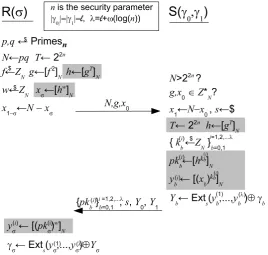
R→S: The receiver chooses the hashing parameters Λ←$ PG(1n), then samples random instances (w, x, x′)←$ IS(Λ), setsxb←x and x1−b←x′, and sends (Λ, x0, x1) to the sender.
S → R: The sender invokes the testing algorithm IT(Λ, x0, x1) (to verify that the hashing is smooth on at least one ofx0, x1). If the test fails then the sender aborts.
Otherwise the sender runs the hash-key generation algorithm twice independently to get (k0, pk0)
$
← HG(Λ) and (k1, pk1) $
← HG(Λ), sets y0 ← γ0⊕Hash(Λ, k0, x0) and y1 ← γ1⊕ Hash(Λ, k1, x1), and sends (pk0, pk1, y0, y1) to the receiver.
R: The receiver retrievesγb by computing γb ←yb⊕pHash(Λ, pkb, w, x).
We next prove that the above protocol is secure according to Definition 1. The functionality follows from the fact thatHis projective, which means that the valueHash(Λ, k, xb) that the sender computes is equal to the value pHash(Λ, pkb, w, x) that the receiver computes. The receiver’s secu-rity follows from the hard subset membership property, which means that it is hard to distinguish between the pairs (x, x′) and (x′, x). The sender’s security follows from verifiable smoothness,
which means that for at least one of b ∈ {0,1} the value of Hash(Λ, kb, xb) is (almost) random in GΛ={0,1}ℓ, even given the projective key pkb.
Theorem 1 The above 2-message OT protocol is secure according to Definition 1, assuming that H is a verifiably-smooth projective hash family that has the hard subset membership property.
Proof The functionality trivially follows from Hbeing projective. Similarly, the receiver’s secu-rity trivially follows from H having the hard subset membership property, since {R(1n,0)}n∈N = {An}n∈N and {R(1n,1)}n∈N = {Bn}n∈N, where {An}n∈N and {Bn}n∈N are from in Definition 5. Hence a probabilistic polynomial-time sender ˆS that can predict with non-negligible advantage the choice bit b when interacting with R(1n, b) (on infinitely many auxiliary inputs{zn}n∈N with |zn| ≤poly(n)) is by definition a distinguisher between{An}n∈N and {Bn}n∈N.
It is left to prove the sender’s security. Fixn∈Nand γ0, γ1, γ′∈ {0,1}ℓ(n). Let X= (Λ, x0, x1) be the first message sent by the receiver. IfXis rejected by the testing algorithm, i.e. IT(Λ, x0, x1) = 0, then the sender aborts regardless of its input (so the three random variables S(1n, γ0, γ1, X), S(1n, γ0, γ′, X), andS(1n, γ′, γ1, X) are identical). IfIT(Λ, x0, x1) = 1 then by verifiable smoothness we know that eitherHisϵ-smooth on (Λ, x0) or it isϵ-smooth on (Λ, x1), for some negligible ϵ. In the latter case we have
S(1n, γ0, γ1, X) = (pk0, pk1, γ0⊕Hash(Λ, k0, x0), γ1⊕Hash(Λ, k1, x1)) ϵ
≈ (pk0, pk1, γ0⊕Hash(Λ, k0, x0), γ1⊕y)
y←{$ 0,1}ℓ(n)
= (pk0, pk1, γ0⊕Hash(Λ, k0, x0), γ′⊕y)
y←{$ 0,1}ℓ(n)
ϵ
≈ (pk0, pk1, γ0⊕Hash(Λ, k0, x0), γ′⊕Hash(Λ, k1, x1)) = S(1n, γ0, γ′, X)
and in the former case we similarly getS(1n, γ0, γ1, X) 2ϵ
≈S(1n, γ′, γ1, X). This concludes the proof, sinceϵ=ϵ(n) is negligible inn.
Why two hashing keys? We note that in the protocol above the sender chooses two independent hashing key pairs (k0, pk0), (k1, pk1). One may wonder whether the proof would go through if the sender used only one hashing key pair. We claim that the answer is no, and that choosing two independent hash key pairs is essential, since otherwise the sender’s security property of Definition 1 may be compromised. To see this, consider a modification where the sender uses only one key pair (k, pk), and consider a cheating receiver who sends a message X = (Λ, x0, x1) where H is smooth on both (Λ, x0) and (Λ, x1). In this case, the definition of smooth projective hashing does not rule out the possibility that each of the values Hash(Λ, k, x0), Hash(Λ, k, x1) separately is enough to uniquely determines the hashing key k. In this case, the sender’s message implies some relation betweenγ0 and γ1, violating Definition 1.
5.1 Working with different GΛ
natural to work with the underlying DDH group. The properties that we need from GΛ for our construction to work are the following:
• GΛ should be a quasi-group: Denoting the (quasi) group operation by ‘+’, this means that for all a, b∈GΛ there exist uniquex, y∈GΛ such that a+x=y+a=b.
• The group operation ‘+’ and its inverse ‘−’ can be computed efficiently. Namely, there should be a polynomial-time algorithm that on inputs Λ and a, b ∈GΛ computes c = a+b∈ GΛ, and another one that on inputs Λ andb, c∈GΛ computes a=c−b (i.e., an elementa∈GΛ such thata+b=c).
• It should be possible to encode and decode the sender’s inputs as elements in GΛ. If the sender’s inputs areℓ-bit strings, there should be polynomial-time algorithmsEncode,Decode so that for alls∈ {0,1}ℓ it holds that Encode(Λ, s)∈G
Λ and Decode(Λ,Encode(Λ, s)) =s. To work with such a (quasi) group, we modify the protocol so that instead of just computing yb ← γb ⊕Hash(Λ, kb, xb), the sender encodes γb as an element Γb ∈ GΛ and then sends to the receiver Yb ← Γb +Hash(Λ, kb, xb). Similarly, the receiver computes the inverse operation Γb ← Yb−pHash(Λ, pkb, w, x) and decode Γb to getγb.
The security of this protocol is proved similarly to Theorem 1. The arguments for functionality and receiver security are exactly as before. As for the sender security, we now replace γ⊕y for y← {$ 0,1}ℓ(n)by Γ +Y fory←$ GΛ. SinceGΛis a quasi-group, this last distribution is the uniform distribution overGΛ, regardless of what Γ is, and the proof follows.
6
Constructing Smooth Projective Hash Families
We next present two constructions of verifiably-smooth projective hash families with the hard subset membership property. In one construction the hard subset membership property is based on the Quadratic Residuosity Assumption, and in the other the hard subset membership property is based on theN’th Residuosity Assumption. A key vehicle in both constructions is the notion of a verifiably-ϵ-universal projective hash family.
Definition 6 (Universal Hashing) Let H = (PG,IS,IT,HG,Hash,pHash), let Λ and x be two strings, and letϵ >0. We say thatHisϵ-universalon(Λ, x)if for ally0 ∈GΛ and allpk0∈ {0,1}∗ it holds that
Pr
(k,pk)[pk=pk0 and Hash(Λ, k, x) =y0] ≤ ϵ·(k,pkPr)[pk=pk0] where the probability is taken over a random choice (k, pk)←$ HG(Λ).
The definition of Verifiably-ϵ-universal Projective Hashing is similar to Definitions 3 and 4 of Verifiably-ϵ-smooth Projective Hashing. Specifically, conditions (a) and (c) below are identical to the ones in Definitions 3 and 4, and conditions (b′) and (d′) only differ in that we replacedϵ-smooth by ϵ-universal (and ϵneed not be negligible).
(a) pHash(Λ, pk, w, x) =Hash(Λ, k, x). (b′) H isϵ(n(Λ))-universal on (Λ, x′).
We say that H is verifiably-ϵ-universal projective hash family if in addition:
(c) For every Λ in the support of PG and every (w, x, x′) in the support of IS(Λ), it holds that IT(Λ, x, x′) =IT(Λ, x′, x) = 1.
(d′) For every Λ, x0, x1 such that IT(Λ, x0, x1) = 1, it holds that either H isϵ(n(Λ))-universal on (Λ, x0) or it is ϵ(n(Λ))-universal on (Λ, x1) (or both).
Cramer and Shoup have shown in [6] how to transform an ϵ-universal projective hash family into a smooth projective hash family (for any ϵ < 1), and the same transformation also works for transforming verifiably-ϵ-universal projective families into verifiably-smooth projective families. In a nutshell, one first reduces ϵto ϵt by choosing t independent hashing key-pairs and hashing t times the same element. One then uses a “strong randomness extractor” [18] to extract a nearly uniform bit string from the thash values. The new hash algorithms thus use tkeys of the original algorithms and also the seeds for the extractor, setting
Hash′(Λ,(s, k1, . . . , kt), x) = Extract(s;Hash(Λ, k1, x), . . . ,Hash(Λ, kt, x))
pHash′(Λ,(s, pk1, . . . , pkt), w, x) = Extract(s;pHash(Λ, pk1, w, x), . . . ,pHash(Λ, pkt, w, x))
To extract ℓ bits, it is sufficient to choose t so that t·log(1/ϵ) ≥ ℓ+ω(log(n(Λ))) (see, e.g., Lemma 4 in the long version of [6]).5 We comment that the resulting construction always has G′Λ = {0,1}ℓ, regardless of the group GΛ of the original construction. In the remainder of this paper we present two such constructions, one based on the Quadratic Residuosity Assumption and the other based on theN’th Residuosity Assumption. Both schemes are obtained by modifying the universal projective schemes of Cramer and Shoup to add the verifiable-universality property (and also to improve some parameters).
6.1 Some Algebraic Facts
We begin by recalling some algebraic facts that are used throughout the two constructions. For a finite algebraic group G(written multiplicatively), the order of G is the number of elements in it. The order of an elementx∈G, denoted ord(x), is the smallest positive integeresuch thatxe= 1, and it always divides the order of the group. Some other useful facts about the order of groups and elements are stated below.
1. For anyx∈G, ord(1/x) = ord(x). Also for anyx, y∈G, ord(xy) divides ord(x)·ord(y).
2. For any integer m and element x ∈ G, ord(xm) = GCDord((m,ord(x) x)). In particular, if ord(x) is co-prime with m then ord(xm) = ord(x), and if ord(x) is not co-prime with m then ord(xm)≤ord(x)/2.
3. Ifm is co-prime with the order of G, then the mapx7→xm is a permutation on G.
5
An easy corollary from the second fact above, is that if ord(x)<2ℓ then the order of xmℓ must be co-prime withm. Another corollary of the facts above, which we use in Section 6.3, is the following:
Lemma 2 Let x, y∈G be two elements and let m= ord(x/y). Then there exist two integers α, β, such that α dividesord(x), β dividesord(y), and αβ=m.
Proof If we set α ← GCD(m,ord(x)) then clearly α divides both m and ord(x). It is left to show thatβ def= m/α divides ord(y). Denoteρdef= ord(x)/αand observe that ρ and β are co-prime (sinceρ= ord(x)/GCD(m,ord(x)) andβ =m/GCD(m,ord(x))). Nowm= ord(x/y) must divide ord(x)·ord(1/y) = ord(x)·ord(y). This means that also mα divides ord(x)ord(α y), namelyβ |ρ·ord(y). But since β and ρ are co-prime, thenβ must divide ord(y).
6.2 A construction based on the Quadratic Residuosity Assumption
Let p, q be distinct odd primes, let N ← pq and let QRN denote the subgroup consisting of all squares of elements in the multiplicative groupZN∗. Also, letJN be the subgroup ofZN∗ consisting of all elements with Jacobi symbol +1. Then the order ofZN∗ isφ(N), the order of JN is φ(N)/2, and the order ofQRN isφ(N)/4. The Quadratic Residuosity Assumption asserts (informally) that given only N, it is hard to distinguish random elements inJN from random elements in QRN.
Assumption 8 (Quadratic Residuosity [12]) The following ensembles are computationally in-distinguishable
{(N, x) : p, q←$ Primes(n), N ←pq, x←$ JN}n∈N
c
≡ {(N, y) : p, q←$ Primes(n), N ←pq, x←$ ZN∗, y ←x2 modN}n∈N
where Primes(n) denotes the set of prime numbers between 2n and 2n+1 andJN is the subgroup of ZN∗ of elements with Jacobi symbol +1.
Blum integers. A Blum integer is a product of two primes, both of which are congruent to 3 modulo 4. It is not hard to see that if the Quadratic Residuosity Assumption holds, it must also hold when the moduli are chosen as Blum integers. This follows since (a) Blum integers are “dense” (i.e., when choosingp, q←$ Primes(n), there is a non-negligible probability to getp≡q ≡3 (mod 4)), and (b) Given a reliable oracle for Quadratic Residuosity, it is easy to check if a modulus N = pq is a Blum integer (by checking that N ≡ 1 (mod 4) and that N −1 is not a quadratic residue modulo N). Below we will assume that determining quadratic residuosity is hard modulo Blum integers.
elements of even order). Given the witnessw for the elementx and the projective keypk, one can compute the hash value as
pHash(N, g, pk, w, x) =pkw=g2kw =xk (modN)
Cramer and Shoup proved that when N is a product of two safe primes, this scheme is a (1/2)-universal projective family. Moreover, they also proved that when N is a product of two safe primes, distinguishing members from non-members can be reduced to the Quadratic Residuosity Assumption. These proofs make strong use of the fact that whenN is a product of two safe primes, the subgroup of quadratic residues is cyclic and consists of exactly those elements in ZN∗ whose order is odd.
Our Modifications. In our case we must also consider a maliciously chosen modulusN that is not necessarily a product of two primes. To get verifiable smoothness (or verifiable universality) we need a way of checking that (a) the order of the elementg is odd, and (b) the order of at least one of the two given elementsx0, x1 is even. The latter test can be done by checking that x0 =N−x1 (which implies that ord(x1/x0) = 2, and hencex0, x1 cannot both have odd order). For the former test, since we do not know how to test thatg has odd order, we instead force it into the subgroup of odd-order elements by raising it to the power of 2⌈logN⌉. Namely, instead of using the element g itself we use the elementg2⌈logN⌉. (We note that the trick of forcingg into the odd-order subgroup was used also in [13], as a way of eliminating the need for moduli of a special form.)
6.2.1 Detailed Construction
Using our notations from Section 4, we now describe the six algorithms that define the hash family HQR= (PG,IS,IT,HG,Hash,pHash).
Parameter-generator PG(1n). Choose at random two n-bit prime numbers p, q, with p < q < 2p −1 and p ≡ q ≡ 3 (mod 4). Set N ← pq, choose at random an element g′ ←$ ZN∗, set g←(g′)2 modN, and output Λ←(N, g).
Instance-sampler IS(N, g). Choose at random w←$ ZN, compute T ←2⌈logN⌉,x ←(gT)w mod N and x′←N −x. Output (w, x, x′).
Instance-testing algorithm IT(N, g, x, x′). Check that N > 22n, g, x ∈ Z∗
N, and x′ = N −x. Output ‘1’ if all the tests pass and ‘0’ otherwise.
Hash-key generator HG(N, g). Choose k ←$ ZN, set T ← 2⌈logN⌉ and pk ← (gT)k modN. Output (k, pk).
Primary hashing algorithm Hash(N, g, k, x). Output xkmodN.
Projective hash algorithm pHash(N, g, pk, w, x). Output pkw modN.
6.2.2 Proof of Security
We now show that the construction above has a hard subset membership domain under the Quadratic Residuosity Assumption, and that it is a verifiable-ϵ-universal projective hash family withϵ≈ 12.
Lemma 3 Under the Quadratic Residuosity Assumption, the construction ofHfrom Section 6.2.1 has the hard subset membership property.
Proof We need to prove indistinguishability between the ensembles
An=
⟨
N, g, x, x′⟩n and Bn=
⟨
N, g, x′, x⟩
where arithmetic is modulo N, and both ensembles are taken over choosing
p, q←$ Primes(n) s.t. p≡q ≡3 (mod 4), N ←pq, T ←2⌈logN⌉, g′ ←$ ZN∗, g←(g′)2, w←$ ZN, x←(gT)w, x′←N −x (modN)
Recall that when N is a Blum integer, then the quadratic residues modulo N are exactly these elements that have odd order inZN∗ (since the order ofQRN isφ(N)/4, which is odd). Moreover, every quadratic residue has exactly four square roots moduloN. If (r1, r2, r3, r4) are the four square roots of somex∈QRN then exactly one of them is itself a quadratic residue moduloN (call itr1), and exactly two have Jacobi symbol +1 moduloN, namely r1 andN −r1.
Assume for the sake of contradiction that there exists a PPT algorithm A that distinguishes between the ensemblesAn andBn with non-negligible probability. Let
p1(n) def
= Pr[A(N, g, x, x′) = 1], p2(n) def
= Pr[A(N, g, x′, x) = 1], and ϵ(n)def= |p1(n)−p2(n)|
We describe a PPT distinguisherDfor Quadratic Residuosity modulo Blum integers with advantage (close to) ϵ(n). Since the Quadratic Residuosity Assumption implies in particular that it is hard to decide quadratic residuosity modulo Blum integers, then D violates the Quadratic Residuosity Assumption. The distinguisherD(N, z) in our reduction works as follows:
1. Choose w←$ ZN and set T ←2⌈logN⌉.
2. Setg←z2 modN,x0 ←z·(gT)w modN and x1 ←N−x0.
3. Run Ato getb← A(N, g, x0, x1), and output b.
Below we analyze the reduction under the simplifying assumption that the exponent w is chosen uniformly inZφ(N) rather than inZN, both in the scheme and in the reduction. It is well known that this modification changes the various distributions by only O(2−n) (wherenis the bit-length of p, q).
In both cases, the modulus N is chosen just like in the scheme HQR and the element g is a random quadratic residue moduloN. It is left to show that (x0, x1) in the reduction are distributed like (x, x′) in the scheme when z is a quadratic residue, and like (x′, x) in the scheme whenz is a quadratic non-residue.
Case 1: z∈QRN. In this case we know thatβ def= ord(z) is an odd integer, which implies that the order ofg=z2 modN is the same as the order ofz, namely ord(g) = ord(z) =β. Also, sinceβ is odd then µdef= 2−1 modβ and τ def= T−1modβ exist, and we havez=gµ (mod N). Hence in this case we can write
x0=z·(gT)w=gµ+T w=gT(τ µ+w) (modN)
Now notice that sincewis random inZφ(N)andβdividesφ(N), the random variablesτ µ+wmodβ and wmodβ are identically distributed, so x0 ← gT(w+µτ)modN in the reduction is distributed identically tox←(gT)w modN in the protocol.
Case 2: z∈JN \QRN. In this case we know thatz′ def
= N −z is a quadratic residue modulo N. By the same reasoning as above, we know thatβ def= ord(z′) is an odd integer, which implies that the order of g←z2 = (z′)2 modN is also β, that µdef= 2−1 modβ and τ def= T−1 modβ exist, and thatz′ ←gµmodN. Hence in this case we can write
x1 =−(z·(gT)w) =z′·(gT)w =gµ+T w =gT(τ µ+w) (modN)
and by the same arguments as above we have that x1 ← gT(w+µτ) modN in the reduction is distributed identically to x←(gT)wmodN in the protocol.
Lemma 4 The construction of HQR from Section 6.2.1 is a verifiable-ϵ-universal projective hash family, where ϵ < 12 +O(2−n).
Proof The projectiveness and the completeness of the instance-testing (conditions (a) and (c) in Definition 7) are easy to check: For any RSA modulusN and anyg∈QRN,w∈ZN, andk∈ZN, setting x←(gT)wmodN andpk←(gT)kmodN (whereT = 2⌈logN⌉) we get for Condition (a):
pHash(N, g, pk, w, x) =pkw = (gT k)w= (gT w)k=xk=Hash(N, g, k, x) (mod N)
Also Condition (c) holds trivially.
The more interesting property is the verifiable-ϵ-universality (property (d′)), which we prove next. (Note that properties (a), (c), and (d′) together imply also property (b′).) Let (N, g, x, x′) be any four elements such that IT(N, g, x, x′) = 1. Namely, N >22n, g, x∈ZN∗, and x′ =N−x. Note that sincex/x′ =−1 (modN) and ord(−1) = 2, then at least one of x, x′ has an even order modulo N. We next show that for any element z of even order, HQR is ϵ-universal on (N, g, z), which implies that it must beϵ-universal on at least one ofx, x′.
Fix an odd modulus N > 2 and some g, z ∈ ZN∗ such that e def= ord(z) is even. Also denote τ def= ord(gT) (where T = 2⌈logN⌉) and observe that τ must be odd and must divide φ(N). We again make the simplifying assumption that the hashing keykis chosen fromZφ(N)instead of from ZN, thus introducing an error ofO(1/
√
N) =O(2−n) into the analysis. Under this assumption we show that for anypk and anyy, it holds that
Pr k←$Zφ(N)
[gT k=pk, y=zk] ≤ 1 2·k$Pr
←Zφ(N)
We consider the following procedure for choosing k ←$ Zφ(N): First choose k0 $
← {0, . . . , τ −1}, thenk1
$
← {0,1, . . . ,φ(τN)−1}, and then setk←k0+τ·k1. Note thatpk= (gT)k depends only on the choice of k0. It is therefore sufficient to show that for anyk0 (that determines pk) and anyy, it holds that Prk1[z
k0+τ·k1 =y]≤ 1
2. In other words, letKy be the set of all values that yieldy,
Ky def=
{
k1 ∈
[
0,φ(τN)−1
]
: zk0+τ·k1 =y (modN) }
,
and we need to show that Ky contains no more than φ(2Nτ) values. We observe that e (the order of z) does not divide τ (the order ofgT) since eis even and τ is odd. Therefore zτ ̸= 1 (modN), which means that for any value of k1,zk0+τ·k1 ̸=zk0+τ·(k1+1) (mod N). Hence the set Ky cannot contain two consecutive integers, and since φ(τN) is even then Ky cannot contain more than half the values in [0,φ(τN) −1]. This concludes the proof.
6.3 A construction based on the N’th Residuosity Assumption
LetN be an odd positive integer and consider the multiplicative groupZN∗2 and the two subsets
RN def
= {xN :x∈ZN∗2} and GN def
= {1 +vN :v∈ZN}
RN is the set ofN’th residues, which is a subgroup ofZN∗2 of orderφ(N). GN is also a subgroup
of ZN∗2, which is homomorphic to the additive group ZN (and thus has order N). Moreover, the order of an element (1 +vN) in ZN∗2 equals the order of v in the additive group ZN. The group ZN∗2 is homomorphic to the direct product ofGN andRN,ZN∗2 ≈GN×RN. In particular,ZN∗2 has
order N ·φ(N). The N’th Residuosity Assumption, originally introduced by Paillier [19], asserts (informally) that for an RSA modulus N, it is hard to distinguish random elements of ZN∗2 from
random elements of RN.
Assumption 9 (N’th Residuosity [19]) The following ensembles are computationally indistin-guishable
{(N, x) : p, q←$ Primes(n), N ←pq, x←$ ZN∗2}n∈N
c
≡ {(N, y) : p, q←$ Primes(n), N ←pq, x←$ ZN∗2, y ←xN modN2}n∈N
where Primes(n) denotes the set of prime numbers between 2n and 2n+1.
by p orq. Given the witness w for the elementx and the projective key pk, one can compute the hash value as
pHash(N, g, pk, w, x) =pkw =gkw=xk (modN2)
Cramer and Shoup proved that whenN is a product of two safe primes, this scheme is anϵ-universal projective family with ϵ ≈max{1/p, 1/q}). Moreover, for that case they reduced distinguishing members from non-members to the N’th Residuosity Assumption. Similarly to the Quadratic Residuosity construction, here too the proofs make strong use of the fact that whenN is a product of two safe primes, the N’th residues are exactly those elements of ZN∗2 whose order is co-prime
toN, and moreover the subgroup ofN’th residues with Jacobi symbol +1 is cyclic.
Our Modifications. In our case we must also consider a maliciously chosen modulusN that is not necessarily a product of two primes. To get verifiable smoothness (or verifiable universality) we need a way of checking that (a) the order of the elementg is co-prime withN, and (b) the order of at least one of the two given elements x0, x1 is not co-prime with N. For the former, since we do not know how to test thatg belongs to the subgroup of elements whose order is co-prime with N, we instead force it into that subgroup by raising it to the power of N⌈2 logN⌉. Namely, instead of using the element g itself we use the element gN⌈2 logN⌉ modN2. (Again, the use of this trick is similar to [13].)
The latter verification can in principle be done by checking thatx1 ̸=x0and that (x1/x0)N = 1 (modN2). This implies that the order of x1/x0 in ZN∗2 divides N and is greater than one, and
as ord(x1/x0) divides ord(x1)·ord(1/x0) = ord(x1)·ord(x0), it means that ord(x1) and ord(x0) cannot both be co-prime with N. In our scheme, however, we use a slightly more elaborate test that yields better universality bound ϵ. Specifically, we test that x1/x0 is of the form (1 +vN) wherev and N are co-prime. With these modifications (which are introduced to get verifiability), we also observe that we no longer need the RSA modulus to be a product of safe primes, and also we do not restrict our attention to elements with Jacobi symbol +1.
6.3.1 Detailed Construction
Using our notations from Section 4, we now describe the six algorithms that define the hash family HN R= (PG,IS,IT,HG,Hash,pHash).
Parameter-generator PG(1n). Choose two random n-bit prime numbersp, q (with p < q <2p). SetN ←pq, choose an elementg′ ←$ ZN∗2, set g←(g′)N modN2, and output Λ←(N, g).
Instance-sampler IS(N, g). Choosev, w←$ ZN∗, computeT ←N⌈2 logN⌉,x←(gT)w modN2 and x′ ←x·(1 +vN) modN2. Output (w, x, x′).
Instance-testing algorithm IT(N, g, x, x′). Check that N >22n and that g, x∈ZN∗2. Then set
d←x′/xmodN2, verify that (d−1) is divisible byN (over the integers) and setv←(d−1)/N. Finally, verify that v and N are co-prime. Output ‘1’ if all the tests pass and ‘0’ otherwise.
Hash-key generator HG(N, g). Choose k ←$ ZN2, set T ← N⌈2 logN⌉ and pk ← (gT)k modN2.
Output (k, pk). (Note that the order ofgT must be co-prime withN.)
Primary hashing algorithm Hash(N, g, k, x). Output xkmodN2.
Remark. Since we only use the valuegT for hashing (nevergitself), one can be tempted to drop the exponentiation in the Parameter-generator and simply choose at random g ←$ ZN∗2. We note,
however, that our proof of the hard subset membership property (Lemma 5) relies on this extra exponentiation.
6.3.2 Proof of Security
Lemma 5 Under the N’th Residuosity Assumption, the construction of HN R from Section 6.3.1 has the hard subset membership property.
Proof We need to prove indistinguishability between the ensembles
An=
⟨
N, g, x, x′⟩n and Bn=
⟨
N, g, x′, x⟩
where the arithmetic is modulo N2, and both ensembles are taken over choosing
p, q←$ Primes(n), N ←pq, T ←N⌈2 logN⌉, g′ ←$ Z∗ N2,
g←(g′)N, w, v←$ Z∗
N, x←(gT)w, x′ ←x(1 +vN) (modN2)
Assume for the sake of contradiction that there exists a PPT algorithmAthat distinguishes between the ensemblesAnand Bn with non-negligible probability. Let
p1(n) def
= Pr[A(N, g, x, x′) = 1], p2(n) def
= Pr[A(N, g, x′, x) = 1], and ϵ(n)def= |p1(n)−p2(n)|
Assume without loss of generality that there is an infinite set S ⊆N such that for every n∈S it holds that p1(n) ≥ p2(n), and moreover ϵ(n) = p1(n)−p2(n) ≥ poly1(n). We now describe a PPT distinguisher D for the N’th Residuosity Assumption with advantage (close to) ϵ(n)/2 for every n∈S, using Aas a subroutine. D(N, z) works as follows:
1. Choose a random bitb← {$ 0,1} and v, w←$ ZN∗.
2. Setg←zN modN2,x←zw modN2, andx′ ←x(1 +vN) modN2.
3. Setxb ←x and x1−b ←x′, run Ato getb′ ← A(N, g, x0, x1), and outputb′⊕b.
We first claim that when the input z is chosen as a randomN’th residue moduloN2 then the distribution on (N, g, x, x′) is nearly identical to the distribution in the actual scheme. To see this, first note that since N was chosen asN ← pq where p, q are primes and p < q <2p−1, then N and φ(N) are co-prime. Next, we make the simplifying assumption that the exponentw is chosen at random inZφ(N) instead of fromZN∗ (in both the reduction and the instant-sampling algorithm of the scheme itself). It is well known that this modification changes the various distributions by only O(2−n) (wherenis the bit-length of p, q).
Since RN has order φ(N), which is co-prime withN, it follows that the mapsx7→xN,x7→xT and x 7→ xN−1modφ(N) are all permutations on RN. Hence choosing g
$
← RN (as done in the scheme) induces the same distribution as choosingz←$ RNand settingg←zN(as in the reduction). Moreover, choosing w ←$ Zφ(N) and setting x ← (gT)w (as in the scheme) induces the same
distribution as choosing w←$ Zφ(N) and setting x ←zw =gN
−1w (modφ(N))