A Dynamic and Differential CMOS Logic Style to
Resist Power and Timing Attacks on Security IC’s.
Kris Tiri and Ingrid Verbauwhede
Contact Address:
Kris Tiri
UCLA Electrical Engineering Department
7440B Boelter Hall
P.O. Box 951594
Los Angeles, CA 90095-1594
Tel: 1-310-267-4940, Fax: 1-310-794-1592
E-Mail: [email protected]
Abstract
I. INTRODUCTION
Electronic banking, e-commerce, virtual private networks and so on cannot operate without encryption technology and a secure implementation of the encryption technology. To obtain security, many strong encryption algorithms have been developed. While usually strong against mathematical attacks, Side Channel Attacks (SCA’s) can reveal the secret key through information leaked by the actual implementa-tion of the encrypimplementa-tion module [1]. Various attacks based on power consumpimplementa-tion and timing informaimplementa-tion have been successfully mounted on hard- and software implementations of a wide range of encryption algorithms.
Differential Power Analysis (DPA) is the most powerful SCA. The attack is based on the fact that CMOS logic and application specific details cause logic operations to have power characteristics that de-pend on the input data. It relies further on statistical analysis and error correction to extract the informa-tion from the power consumpinforma-tion that is correlated to the secret key [2]. Numerous techniques have been proposed to prevent DPA. On the algorithmic level, random process interrupts interleave dummy instruc-tions to avoid sequential execution of the algorithm [2],[3]. Integration techniques however, are able to resynchronize the power traces [4]. Masking is a technique that prevents intermediate variables to depend on an easily accessible subset of the secret key [5]. But DPA has been modified to handle masking [6],[7]. On the architectural level, techniques include adding random power consuming operations [2],[3] and duplicating logic with complementary operations. These procedures merely lower the side-channel infor-mation [2],[5] and might easily be disabled through tampering. Active power signal filtering with power consumption compensation, passive filtering, battery on chip and detachable power supply influence the power transfer itself [8]. The first method is likely to lag behind the fast power fluctuations [8],[9] and physical dimensions limit the latter three [8].
encryp-tion module or at least the sensitive parts of it implemented in a logic, whose power consumpencryp-tion is inde-pendent of the signal transitions. This can be achieved by two means. A first approach is to draw a fixed current from the supply as in Current Mode Logic (CML) [10]. Static power dissipation is the major drawback of CML. A better alternative is to charge in every cycle a capacitance with a constant value as we first proposed with Sense Amplifier Based Logic (SABL) [11]. Differential Logic, often put forward as the solution when first introduced to DPA, does not have a signal independent power consumption, nor do Dynamic Logic and regular Dynamic and Differential Logic (DDL). In this work, we will elaborate SABL and judge it against CML and DDL.
Another research effort also situated at the logic level consists of implementing asynchronous logic [12]. Asynchronous logic achieves its resistance against DPA through (1) a 1-of-n coding scheme, which produces a DDL-behavior and thus guarantees one wire transition for every symbol; and (2) a randomized execution process, which eliminates a time reference and thus obstructs the recovery of the remaining power differences immanent in genuine DDL. Its major disadvantage is a complex design flow.
II. REQUIREMENTS FOR TRANSISITON INDEPENDENT POWER CONSUMPTION Static Complementary CMOS Logic (SC-CMOS), which is the default logic style in standard cell librar-ies used for security IC's, primarily consumes its energy from the power supply when the output sees a ‘0’ to ‘1’ transition. During the ‘1’ to ‘0’ transition, the energy previously stored in the output capacitance is dissipated, but aside from a direct-path current no energy is consumed from the power supply. The ‘0’ to ‘0’ and the ‘1’ to ‘1’ transitions are degenerated events, in which a charge transfer does not occur. This asymmetric power demand provides the information used in DPA to find the secret key.
A logic style with transition-independent power consumption does not reveal this information. When logic values are measured by charging and discharging capacitances, we need to use a fixed amount of energy for every transition. In other words, even though different capacitances are switched, we need a logic style with the unique property of charging in every cycle a “total” capacitance with a constant value. This can be assured by fulfilling two requirements: (1) the logic style has one and only one switch-ing event per cycle and this independently of the input signals; and (2) the logic style charges a constant capacitance during that switching event.
Implementing a Dynamic and Differential Logic style meets the first requirement: DDL has a switch-ing factor of 100% and does not suffer from glitchswitch-ing. A Dynamic Logic style alternates precharge and evaluation phases, in which the output is precharged to ‘1’ and conditionally evaluated to ‘0’ respectively. A Differential Logic style holds two output signals with opposite polarity. As a result, the combination of Dynamic and Differential Logic will evaluate exactly one of both precharged output nodes to ‘0’ in order to generate a complementary output and this independently of the input value. During the subsequent pre-charge phase, the dispre-charged node is pre-charged and this independently of the input sequence.
(e.g. duplicating the module with a complementary module) or logic level (e.g. Differential Logic), the degenerated ‘0’ to ‘0’/’1’ to ‘1’ output-transitions do not consume power.
To fulfill the second requirement, the load at the two differential output nodes should be balanced. Both capacitances are identical if all its components, which are the intrinsic output capacitances of the gate, the interconnect capacitances and the input capacitances of the following gates, can be balanced through a careful layout.
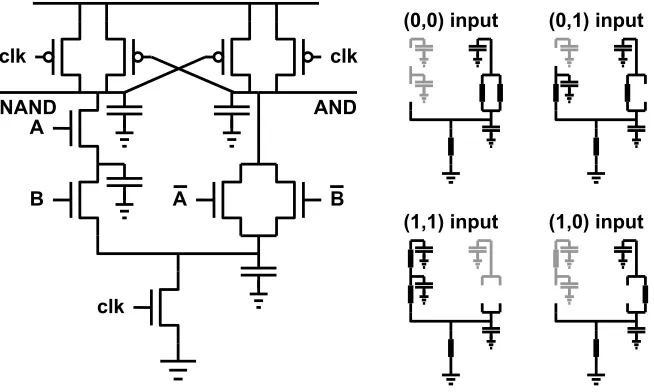
(Dis)charging parasitic capacitances, which are internal to the gate, have an influence on the power con-sumption as well. This is the reason that genuine DDL [13],[14] cannot be used. Simulations indicate that e.g. for the AND-NAND gate in Cascode Voltage Switch Logic (CVSL) [15], which is depicted in Figure 1(left), the variation on the power consumption varies between 10 and 50% depending on the implemen-tation. The variation originates from asymmetry in the gate. Depending on the input, different parasitic capacitances discharge during the evaluation phase, as is shown in Figure 1(right). In none of the 4 subse-quent precharge events, the same combination of capacitances is charged. It is virtually impossible to match the discharge events by manipulating transistor sizes and/or layouts. The contribution of the inter-nal nodes however, should and can be controlled exactly by making sure that all interinter-nal nodes eventually discharge and this independently of the inputs, as will be explained in the next section.
III. SENSE AMPLIFIER BASED LOGIC
Conforming to the observations made in section II, we design a gate that (1) is dynamic and differential; (2) is symmetric at both the input and the output nodes; and (3) discharges all the internal nodes of the Differential Pull Down Network.
A. SABL gate
a logic function by exchanging the input differential pair for a Differential Pull Down Network. Figure 2(left) depicts the SABL gate. The DPDN, of which the design and the special characteristics are dis-cussed in subsection 1, will connect for a complementary input one of the external nodes X and Y to the common node Z.
The behavior of a SABL gate matches the behavior of the SA, which has been detailed in literature [17]. During the precharge phase (clk-signal low), node Z is disconnected from GND and the output nodes and nodes X and Y are precharged to VDD and VDD–Vt respectively, where Vt is the threshold voltage. Dur-ing the evaluation phase (clk-signal high), the cross-coupled inverter will toggle and provide a stable out-put as soon as a branch of the DPDN provides a path to GND. In case node X is connected to node Z, node out will become ‘0’, while node
out
remains at ‘1’, and vice versa in case node Y is connected to node Z, nodeout
will become ‘0’.Transistor M1, which is always on, has been integrated into the SA to guarantee static operation during the evaluation phase. Even if the input to the differential pair would change after the SA has toggled, the ‘0’ output node is always connected to GND. The inputs to the SABL gate however, do not change after their initial transition, as they come from stable outputs of previous SABL gates. In our design, M1 serves to discharge both external nodes X and Y of the DPDN. Whichever branch of the DPDN is on, both nodes are connected through M1 and will eventually be discharged together with one of the output nodes. Dur-ing the precharge phase, all the discharged nodes and capacitances are charged.
1. Special Differential Pull Down Network (DPDN)
We create a special DPDN in order to control the contribution of the internal parasitic capacitances into the power consumption. In contrast with genuine DDL, where the design constraints are to minimize the device count and the number of stacked levels [18], the DPDN is designed such that for a differential in-put all internal nodes are connected to one of the external nodes. As a result, since both external nodes X and Y eventually discharge, all the internal nodes are discharged and will be charged together with one of the balanced output loads during precharge. That means that in every cycle SABL charges the same ca-pacitance value: one of the balanced load caca-pacitances and the sum of all the internal node caca-pacitances. Hence SABL has signal independent power consumption.
As an example, Figure 3 shows the transformation of the DPDN that implements the AND-NAND func-tion of Figure 1 to a special DPDN used in SABL. The original network has one internal node, node W, which possibly becomes floating depending on the input combination. Repositioning transistor M2, which is located between nodes Y and Z and is driven by input A, between nodes Y and W does not alter the functionality of the DPDN, A+B = A.B+B, but guarantees that for any differential input node W is connected to one of the output nodes.
Design procedure
The design goal is to guarantee that all internal nodes are connected to one of the external nodes for a differential input. The design procedure is a transformation that repositions transistors in the DPDN. As a result, the total number of devices remains the same. The total evaluation depth may increase.
The design procedure of creating a special DPDN for a logical function
f
consists of 5 steps.1. Identify 2 expressions x and
y
that combine to the logical functionf
. This results in an AND-operation,x
.
y
, or an OR-operation, x+ y.2. Complement the expression in x and
y
to get the dual expression off
. This results in anOR-operation,
x
+
y
, or an AND-operation, x.y respectively. 3. Transform the OR-operation.The results of step 1. and step 2. are two dual expressions:
either case A) or case B)
One expression is an AND-operation, the other an OR-operation. In the DPDN, the AND-operation is implemented as a series combination, the OR-operation as a parallel combination. At this abstrac-tion level, only the series combinaabstrac-tion has an internal node.
In case A), we transform the parallel connection into x.y + y, put network
y
at the bottom of they
x
.
connection and share networky
between the two branchesx
.
y
andx
.
y
+
y
.In case B) we transform the parallel connection intox.y+ y, put network y at the bottom of the y
x. connection and share network y between the two branches x.y and
x
.
y
+
y
. Now the DPDN connects the internal node of the series connection to the output node.4. Repeat the procedure for the logical expressions x and
y
till the network consists of only 1 tran-sistor.y
x
f
=
+
y x f = .
y
x
f
=
.
y x f = +
5. Substitute the results.
For a given schematic of a DPDN, the design procedure translates to (1) identify all networks in series; (2a) open the corresponding parallel connections at the bottom of the network and (2b) connect them to the internal nodes of the series connections; and (3) unroll the network.
Figure 5 illustrates the design procedure applied to a complex DPDN. In the final DPDN, both the true and the inverse of a signal control a transistor for every internal node: independent of the input, every in-ternal node is connected to another node, which is either an exin-ternal node or another inin-ternal node, for which both the true and the inverse of a signal control a transistor. As a result independent of the input, every internal node is connected to an external node.
The transistors in the DPDN can only charge the internal nodes as long as they are on. To assure that every cycle the same amount of charge is consumed, this charge time must be constant. That is the case if at every node both the signal and the inverse of the signal control a transistor that loads the node. Whether it is the transistor controlled by the signal or the one controlled by the inverse, the total charge time for the internal nodes is the time needed to precharge the outputs of the preceding gate. This requirement is fulfilled by the special DPDN.
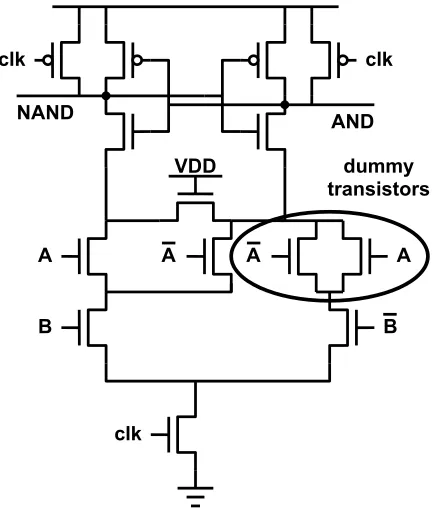
Enhanced special DPDN
The introduction of the dummy transistors has two effects. First, there is a constant resistance in the dis-charge path. As a result, each gate has a constant delay as now both C and R are independent of the in-puts. Second, no evaluation will start before all inputs are stable. As a result, the delay of an entire com-binatorial logic tree will be constant, as each gate evaluates when the input-pair with the longest delay has switched.
2. p-type gate
All SABL gates presented above are n-type gates. The dual gate is a SABL p-type gate, which is shown in Figure 2(right). This gate predischarges to GND when the clk-signal is high and evaluates one node to VDD through the differential pull up network (DPUN) when the clk-signal is low.
B. Building combinatorial and sequential logic
1. Combinatorial logic: cascading of dynamic gates
For correct operation, all transistors of the conditional path should be off at the onset of the evaluation phase. SABL, like every Dynamic Logic style, is therefore connected using either Domino Logic, in which each gate is extended with a pair of static inverters, or np-Logic, in which n-type and p-type gates are alternated. The utilization of static gates in Domino Logic does not harm our objective of transition independent power consumption. The pair of inverters fulfills the requirements presented in section II as exactly one inverter will have a switching event; no internal nodes exist; and both inverters are balanced at the input nodes and at the output nodes.
2. Sequential logic: charge storage during precharge phase
state. Consequently, there is no power consumption in the static latch and the original SAFF is vulnerable to DPA. We present a master-slave flip-flop that operates without a static latch.
A combination of a p-SA and an n-SA, as shown in Figure 7, acts as a master-slave flip-flop. The p-SA evaluates at the falling edge of the clk-signal and keeps this value till the rising edge, while the n-SA evaluates at the rising edge of the clk-signal and keeps this value till the falling edge. As a result, the value is stored during one entire clock cycle. This is a negative edge triggered flip-flop that stores the in-put-signal at the instant that the surrounding combinatorial logic will precharge. It releases the output-signal at the instant that the surrounding combinatorial logic will evaluate. For correct operation, the ac-tual precharge time has to be large enough to evaluate the correct differential input. If necessary, the hold time can be fixed by adding a delay ∆t has at the input of both the p-SA and the n-SA. This can be done with an extra load capacitance or with static inverters.
For the logic gate, which directly precedes the flip-flop, the rules presented above in subsection IIII.B.1 (Combinatorial logic: cascading of dynamic gates) do not hold. Both an n-type and a p-type gate can be directly connected to the flip-flop: the logic gate has a differential output at the negative clock edge. For the logic gates, which directly follow the fliflop, the rules hold. The fliflop needs to be followed by p-type gates or by a pair of inverters followed by n-p-type gates: the second stage of the flip-flop and the gates will both evaluate at the rising clock edge.
IV. EXPERIMENTAL RESULTS
which is the encryption algorithm in 3G cellular standard [20]. The module consists of 5 inverters, 86 NAND's and 92 XOR's and substitutes 9 input bits with 9 other bits.
Several types of CML, which can be implemented in CMOS technology, exist. We use Current Steering Logic (CSL) [21]. A CSL gate consists of a current source connected between VDD and a parallel combi-nation of a PDN and a diode-connected n-mos transistor. Depending on the input, the current is guided to GND along either the PDN (output voltage low) or the diode-connected device (output voltage high). To restrict channel-length modulation, which is the influence of the drain to source voltage (Vds) on the cur-rent of a transistor with constant gate to source voltage (Vgs) [10], we have implemented the current source using two cascoded p-mos devices. Other than the remaining channel length modulation, residual current spikes exist due to the displacement current charging the parasitic capacitances between VDD and the output [21].
For the Dynamic and Differential Logic, we use CVSL, which has been presented in section II.
Circuits are designed in a 0.18-µm, 1.8V CMOS technology. The implementations in SABL and CVSL are built according to the np-Logic design rule. The SABL implementation did not use the enhanced DPDN. Layout is created with LayoutPlus. Layout to netlist is done with Analog Artist. Simulations on the extracted circuits are done in HSPICE.
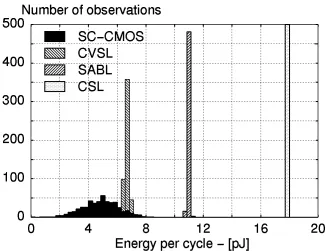
Figure 8 shows the histogram of the observed energy consumption per cycle. The SC-CMOS implemen-tation experiences a large variation on the energy consumption, whereas the deviations on the energy con-sumption of the 3 other implementations remain in a narrow band. SABL has a noticeable smaller varia-tion than CVSL, but it takes more energy to achieve this effect. CSL has the smallest variavaria-tion, yet it has the highest energy consumption. Especially if a module has many levels of logic, CSL has a high power penalty. The current of a CSL gate is set to charge the output capacitance within a certain time interval. During the rest of the period, this current is wasted.
Table I summarizes the important characteristics. The numbers confirm the observations. SABL achieves an NSD a factor of 43 smaller than the NSD of SC-CMOS. The reduction comes with a tradeoff in an increase of a factor 2.2 in energy consumption and a factor 1.8 in area. Using SABL instead of CVSL offers an additional reduction of a factor 2.5 to 3 in the variation of the energy consumption. SABL however, uses more energy and area. CSL has the smallest variation, but the highest area and the highest energy consumption of all logic styles.
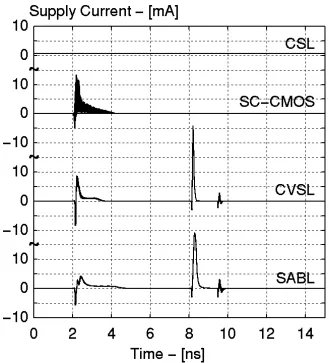
Figure 9 shows a superposition of the power supply current of the transient response. It shows that the instantaneous current of the SC-CMOS implementation is highly irregular. The SABL and CVSL imple-mentations seem to have the same behavior. Though, Table I and Figure 8 have indicated that there is an important difference. CSL shows no visible variation.
V. SABL AND OTHER SCA’S
A. Timing Attacks
clock cycle. As shown in Figure 9, an important variation exists on the time span that the SC-CMOS im-plementation draws current, or in other words on the time span that switching events take place.
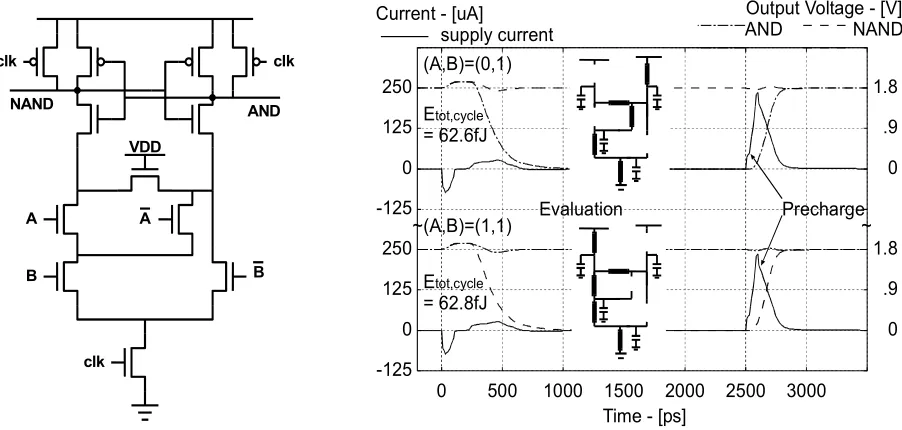
For SABL however, this is not the case. When desired, idle cycles can be inserted. Every gate has a switching event in every cycle, whether or not useful data is processed. Furthermore, we have seen in Figure 4 and in Figure 9 that the delay and the instantaneous current of a gate and the complete module are constant and independent of the input vector.
B. Attacks based on subthreshold currents
Concerns exist about the information leaked by subthreshold currents [9]. The subthreshold current, which is also called leakage current, is the current that flows through a transistor with Vds larger then 0 when Vgs is smaller then Vt [10]. The actual value depends on the terminal voltages, the width and the type of the transistor. This means that the total subthreshold current of a gate depends on which particular transistors are off, and thus on the state of the gate.
A SABL gate has basically two states: a precharged state and an evaluated state. During precharge, no data values are stored and therefore no information can be leaked. In the evaluated state, all nodes of the DPDN are at GND. As a result, these transistors have a Vds of 0 and do not carry a subthreshold current. The only part, which suffers from subthreshold current, consists of the cross-coupled inverter pair and the two clocked pmos transistors. This circuit has only two states, which since the circuit is symmetric are equivalent. As a result the leakage current is independent of the state the circuit is in.
C. Differential Fault Analysis
pos-sible. While most DFA’s seem purely theoretically, Glitch Attacks (GA’s) are viewed as a practical DFA [1]. In a GA, the clock frequency is temporarily increased with the intention to force a state-bit or a se-lected conditional branch by not giving enough time for all calculations to complete.
SABL can detect GA’s. The enhanced DPDN only evaluates if all incoming signals are stable. If at the falling edge, some input signals are not differential, which can be detected with a ready signal, the clock frequency has been increased and the circuit should be put in the alarm state. Since the delay of the en-cryption module is independent of the input vector, the critical path has always the longest delay: the de-tection only needs to be performed at the receiving flip-flop of the critical path. Good design practice is to create on purpose a critical path inside a DFA detection module.
D. Electromagnetic Analysis
The flow of electric charges produces an electromagnetic field. Electromagnetic Analysis (EMA) is the equivalent of a power attack but instead uses the electromagnetic fields generated by the (dis)charging gates as the side channel information [24]. There are differences. A power attack has only access to the global power consumption. An EMA however, can do measurements that are confined to a small area of the security IC. On the other hand, a power attack can be mounted rather quickly with off-the-shelf de-vices, whereas an EMA requires special probes and an advanced measurement setup.
VI. CONCLUSION
We have presented a voltage mode logic style that has a power consumption that is practically inde-pendent of the input vector. As a result, SABL is a technique that removes the foundation of Differential Power Analysis. Compared to SC-CMOS logic, which is the default logic style for standard cells used in security IC’s, the logic style has a reduction of more than a factor 40 in the variation of the energy con-sumption of a large module. The reduction comes with an increase in area and in power concon-sumption of a factor 2. Compared to genuine DDL, SABL offers a reduction of a factor 3.
REFERENCES
[1] E. Hess, N. Janssen, B. Meyer, and T. Schütze, “Information Leakage Attacks Against Smart Card Implemen-tations of Cryptographic Algorithms and Countermeasures - A Survey,” in Proc. of EUROSMART Security Conference, 2000, pp. 55–64.
[2] P. Kocher, J. Jaffe and B. Jun, “Differential Power Analysis,” in Proc. of Advances in Cryptology (CRYPTO’99), Lecture Notes in Computer Science, vol. 1666, 1999, pp. 388-397.
[3] J. Daemen and V. Rijmen, “Resistance Against Implementation Attacks: A Comparative Study of the AES Proposals,” in Proc. of the Second Advanced Encryption Standard (AES) Candidate Conf., http://csrc.nist.gov/ encryption/aes/round1/conf2/aes2conf.htm, March 1999.
[4] C. Clavier, J.-S. Coron and N. Dabbous, “Differential Power Analysis in the Presence of Hardware Counter-measures,” in Proc. of Cryptographic Hardware and Embedded Systems (CHES 2000), Lecture Notes in Com-puter Science, vol. 1965, 2000, pp. 252-263.
[5] S. Chari, C. S. Jutla, J. R. Rao and P. Rohatgi, “Towards Sound Approaches to Counteract Power-Analysis Attacks,” in Proc. of Advances in Cryptology (CRYPTO’99), Lecture Notes in Computer Science, vol. 1666, 1999, pp. 398-412.
[6] J.-S. Coron and L. Goubin, “On Boolean and Arithmetic Masking against Differential Power Analysis,” in Proc. of Cryptographic Hardware and Embedded Systems (CHES 2000), Lecture Notes in Computer Science, vol. 1965, 2000, pp. 231-237.
[7] T.S. Messerges, “Using Second-Order Power Analysis to Attack DPA Resistant Software,” in Proc. of Crypto-graphic Hardware and Embedded Systems (CHES 2000), Lecture Notes in Computer Science, vol. 1965, 2000, pp. 238-251.
[8] A. Shamir, “Protecting Smart Cards from Passive Power Analysis with Detached Power Supplies,” in Proc. of Cryptographic Hardware and Embedded Systems (CHES 2000), Lecture Notes in Computer Science, vol. 1965, 2000, pp. 71-77.
[9] J.-S. Coron, P. Kocher, D. Naccache, “Statistics and Secret Leakage,” in Proc. of Financial Cryptography’00, Lecture Notes in Computer Science, 2000.
[10] J. Rabaey, A. Chandrakasan, and B. Nikolic, Digital Integrated Circuits: Second Edition, Prentice Hall, 2003. [11] K. Tiri, M. Akmal and I. Verbauwhede, “A Dynamic and Differential CMOS Logic with Signal Independent
Power Consumption to Withstand Differential Power Analysis on Smart Cards”, in Proc. Of 28th European Solid-State Circuits Conference, September 2002, pp. 403-406
[12] S. Moore, R. Anderson, P. Cunningham, R. Mullins and G. Taylor, “Improving Smart Card Security using Self-timed Circuits”, Eighth International Symposium on Advanced Research in Asynchronous Circuits and Systems, 2002.
[13] P. Ng, P. T. Balsara, and D. Steisss, “Performance of Differential Circuits,” IEEE J. Solid-State Circuits, vol. 31, No. 6, pp. 841-846, June 1996.
[14] K. Bernstein, K. M. Carrig, C. Durham, P. R. Hansen, D. Hogenmiller, E. J. Nowak and N. J. Rohrer, High Speed CMOS Design Styles. Kluwer Academic Publishers, pp. 111-123, 1998.
[15] L. G. Heller, W. R. Griffin, J.W. Davis and N. G. Thoma, “Cascode Voltage Switch Logic: A differential CMOS Logic Family,” Digest of Technical Papers, IEEE International Solid-State Circuits Conference, pp. 16-17, Feb. 1984.
[16] J. Montanaro, et al., “A 160-MHz, 32-b, 0.5-W CMOS RISC Microprocessor,” IEEE J. Solid-State Circuits, vol. 31, No. 11, pp. 1703-1712, November 1996
[18] K. M. Chu and D. I. Pulfrey, “Design Procedures for Differential Cascode Voltage Switch Circuits,” IEEE J. Solid-State Circuits, vol. 21, pp. 1082-1087, December 1986.
[19] A. J. Menezes, P. C. Van Oorschot, S. A. Vanstone, Handbook of Applied Cryptography, CRC Press, 1996. [20] “Universal Mobile Telecommunications System (UMTS); Specification of the 3GPP confidentiality and
integ-rity algorithms; Document 2: Kasumi algorithm specification (3GPP TS 35.202 version 5.0.0 Release 5),” http://pda.etsi.org/pda/, June 2002.
[21] H. Ng, D. Allstot, “CMOS Current Steering Logic for Low-Voltage Mixed-Signal Integrated Circuits,” IEEE Transactions on VLSI Systems, vol. 5, no. 3, Sept. 1997.
[22] P. Kocher, “Timing Attacks on Implementations of Diffie-Hellman, RSA, DSS, and Other Systems,” in Proc. of Advances in Cryptology (CRYPTO’96), Lecture Notes in Computer Science, vol. 1109, 1996, pp. 104-113. [23] J.F. Dhem, F. Koeune, P.A. Leroux, P. Mestre, J.J. Quisquater and J.L. Willems, “A Practical Implementation
of the Timing Attack,” in Proc. of CARDIS, Sept. 1998.
FIGURES AND TABLES
clk
(0,0) input (0,1) input
(1,1) input (1,0) input
clk B
A
B
NAND AND
A clk
Figure 1: CVSL: AND-NAND gate with parasitic capacitances (left); and discharge events (right).
clk
clk clk
in1 in1
in2
inm
in2
inm
OUT OUT
clk clk
DPUN VDD
clk
in1 in1
OUT OUT
in2
inm
in2
inm DPDN
M1
X Y
Z
A
B B A
A.B A+B A B A B A.B A.B+B
DPDN Special DPDN
W W
Y Y
X X
Z Z
M2
M2
Figure 3: Transformation of DPDN to special DPDN used in SABL for AND-NAND gate.
-125 0 125 250 -125 0 125 250
0 500 1000 1500 2000 2500 3000
Time - [ps] (A,B)=(1,1)
Current - [uA]
supply current Evaluation Precharge Etot,cycle = 62.8fJ Etot,cycle = 62.6fJ (A,B)=(0,1) ~ 0 .9 1.8 0 .9 1.8 ~ Output Voltage - [V] AND NAND
VDD
clk
clk B A
NAND AND
A
B clk
1 2 3 A
C D
B A C
B D
(A+B).(C+D) A.B+C.D I) identify the connections in series
A
C D
B A C
B D
II) open the corresponding parallel connections and connect them
to the series connections
B A B A C C D D
(A.B+B).(C.D+D) A.B.(C.D+D)+C.D III) unroll the network
D) B).(C (A
x0= + + identify → x1.y1 complement→ x1+y1
transform ⇓
1 1 1y y x +
B A
x1= + identify → A+B complement→ A.B x1=A.B+B
transform
⇓ b
B B
A. + x1=A.B
D C
y1= + identify → C+D complement→ C.D y1=C.D+D x (A.B B).(C.D D)
0= + +
transform
⇓ b b
D D
C. + y1=C.D x0=A.B(C.D+D)+C.D 1
2
3
Figure 5: Transformation of DPDN to special DPDN: design example.
B VDD clk clk B A
NAND AND
A clk A A dummy transistors
Q
Q
∆t
∆t
out in
clk Ev
give out store in
Ev Pr
Q
t out
out p-SA
clk
n-SA
clk in
in
∆t
∆t
Figure 7: Negative edge triggered master-slave flip-flop: schematic (left); and operational behavior (right).
Figure 9: S9-box: superposition of the power supply current for 500 successive cycles of the simulated transient response.
TABLE I: S9-box: supply current description of simulated transient response and area
NED NSD Emean(pJ) /cycle Area (µm2)
SCMOS 1.000 0.260 4.97 22,500
CSL 0.002 0.000 18.10 45,500
CVSL 0.086 0.018 6.82 25,600