IJEDR1404047
International Journal of Engineering Development and Research (www.ijedr.org)3680
Corner Detection Techniques: An Introductory
Survey
1
Trupti P. Patel,
2Sandip R. Panchal
1PG Student, 2Assistant Professor 1, 2 Department of Electronics & Communication,Sardar Vallabhbhai Patel Institute of Technology, Vasad, Gujarat, India
________________________________________________________________________________________________________
Abstract - This paper aims to present review of various techniques used for corner detection. Corner detection is an approach used within computer vision systems to extract certain kinds of features and infer the contents of an image. Corner detection is frequently used in motion detection, image registration, video tracking, image mosaicing , panorama stitching, 3D modelling and object recognition. Corner detection overlaps with the topic of interest point detection. This paper discusses several important corner detectors. More recent developments in corner detection techniques are also presented. The advantages and disadvantages of methods are mentioned in this paper. The main goal of the paper is to provide a detailed reference source for the researchers involved in corner detection, irrespective of particular application field mentioned above.
Keywords - Corner detector, Harris corner detector, SUSAN corner detector, Moravec corner detector, Forstner corner detector, fuzzy logic for corner detection.
________________________________________________________________________________________________________
I. INTRODUCTION
A corner can be defined as the intersection of two edges. A corner can also be defined as a point for which there are two dominant and different edge directions in a local neighbourhood of the point .An interest point is a point in an image which has a well-defined position and can be robustly detected. This means that an interest point can be a corner but it can also be, for example, an isolated point of local intensity maximum or minimum, line endings, or a point on a curve where the curvature is locally maximal. Corner detection is a popular research area in image processing and therefore many corner detectors have been presented. Some of them are widely used in industries. In this paper, we will first group different corner detectors and then discuss some important corner detectors, such as Harris detector and SUSAN detector. Finally, recent developments in corner detection are also provided.
II. TYPES OF CORNER DETECTORS
According to [1][2], common corner detection methods can be divided into three groups: 2.1Template based corner detection;
2.2Contour based corner detection; 2.3Direct corner detection;
2.1 Template based corner detection:
Template based corner detection methods use different representative templates to match the image. Correlations between templates and the image are used to detect corners. However, this category of methods has several drawbacks. For example, the representative templates cannot cover all possible corner situations. Therefore, the detection performance highly depends on the choice of appropriate templates. Furthermore, after the correlations between the templates and the image are determined. An appropriate threshold should be carefully chosen to determine the existence of corners.
2.2 Contour based corner detection:
Contour based corner detection methods are based on edge detection. In this category of methods, edges in the image are detected first. Then, the corner is detected along the contour.
2.3 Direct corner detection methods:
Direct corner detection methods use mathematical computations to detect the corner. This category of methods usually applies some statistical operations to the image first. Then, corners are detected based on statistical information.
III. CORNER DETECTION METHOD
3.1Harris corner detector
IJEDR1404047
International Journal of Engineering Development and Research (www.ijedr.org)3681
the corner points [7]. Here we find the second moment matrix which requires finding the gradients of an image which is sensitive to noise and computationally expensive. There are other modifications are performed on this standard Harris corner detector that gives the better performance in several conditions. Harris - Laplace and Harris - Affine are scale and affine invariant version of it [7].Figure 1: Classification of points using Eigen values of the second moment matrix 3.2 Susan Corner Detectors
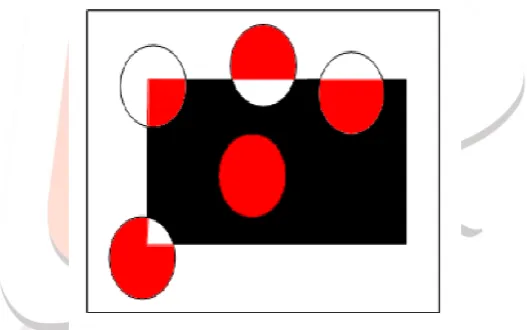
This detector does not use spatial derivatives nor smoothes the image. Instead, a circular mask is applied around every pixel, and the greyscale values of all the pixels within the mask are compared to that of the centre pixel (the “nucleus”). Calculate the number of pixels within the circular mask which have similar brightness to the nucleus. This circular mask applied to different positions of a black rectangle with the USAN shown red colour in figure 2.
Figure 2:USAN for different circular mask on uniform rectangle
It is observed that the USAN becomes smaller as it approaches an edge and this reduction is stronger at corners and SUSAN can thus be used for both line and edge detection. This corner detector computes fast, with good repeatability rate. This simple detector that is invariant to rotation, changes in illumination but and however it is sensitive noise[8].
3.3 The Moravec corner detection algorithm
This is one of the earliest corner detection algorithms and defines a corner to be a point with low self-similarity.[9] The algorithm tests each pixel in the image to see if a corner is present, by considering how similar a patch entered on the pixel is to nearby, largely overlapping patches. The similarity is measured by taking the sum of squared differences (SSD) between the two patches. A lower number indicates more similarity .If the pixel is in a region of uniform intensity, then the nearby patches will look similar. If the pixel is on an edge, then nearby patches in a direction perpendicular to the edge will look quite different, but nearby patches in a direction parallel to the edge will result only in a small change. If the pixel is on a feature with variation in all directions, then none of the nearby patches will look similar The corner strength is defined as the smallest SSD between the patch and its neighbors (horizontal, vertical and on the two diagonals). If this number is locally maximal, then a feature of interest is present.As pointed out by Moravec, one of the main problems with this operator is that it is not isotopic: if an edge is present that is not in the direction of the neighbours, then the smallest SSD will be large and the edge will be incorrectly chosen as an interest point.
3.4 The Förstner corner detector
IJEDR1404047
International Journal of Engineering Development and Research (www.ijedr.org)3682
of the corner in a given window and is a least-square solution. The algorithm relies on the fact that for an ideal corner, tangent lines cross at a single point.Figure3: forstner corner detector . T (x) at pixel is given by:
( ) = ( ) ( )
where I( ) = [Ix ,Iy] T is the gradient vector of the image I at x.The point closest to all the tangent lines in the window N is:
∫ ( )
The distance from to the tangent lines Tx’ is weighted by the gradient magnitude, thus giving more importance to tangents passing through pixels with strong gradients.
Solving for:
∫ ( ( ) ( ))
∫ ( ) ( ) ( ) ( )
( )
∫ ( ) ( )
∫ ( ) ( )
∫ ( ) ( )
Minimizing this equation can be done by differentiating with respect to X and setting it equal to 0 : 2Ax-2b = 0 =>Ax = b
Note that A R2×2 is the structure tension. For the equation to have a solution, A must be invertible, which implies that A must be full rank (rank 2). Thus, the solution. only exists where an actual corner exists in the window N.
X0 = A-1b
A methodology for performing automatic scale selection for this corner localization method has been presented by Lindeberg [11][12] by minimizing the normalized residualover scales. Thereby, the method has the ability to automatically adapt the scale levels for computing the image gradients to the noise level in the image data, by choosing coarser scale levels for noisy image data and finer scale levels for near ideal corner-like structures.
̌
Notes:
C can be viewed as a residual in the least-square solution computation: if C = 0, then there was no error.
This algorithm can be modified to compute centers of circular features by changing tangent lines to normal lines.
3.4 Robust Fuzzy Rule Corner Detector
IJEDR1404047
International Journal of Engineering Development and Research (www.ijedr.org)3683
cornerness in each point is computed by means of the fuzzy edge strength and the gradient direction. Different corner fuzzy-sets are obtained by considering different threshold values from the fuzzy edge map. However, the algorithm’s main drawback is that it uses several feature detectors which operate at different stages, yielding a high computational load. On the other hand, Várkonyi-Kóczy have proposed in [20], a fuzzy corner detector that employs a local structure matrix. It builds a continuous transient between the localized and not localized corner points. The algorithm uses a fuzzy pre-filter that improve the quality of the image under process. Despite both fuzzy approaches show a good performance, they demand an expensive computing load in comparison to other classical algorithms such as the Harris method or SUSAN.Fuzzy System
The fuzzy system is simple to implement and still fast in computation if it is compared to some existing fuzzy methods [25,26]. Also, it can be easily extended to detect other features. In the proposed approach, the fuzzy rules are applied to a set of pixels belonging to a rectangular N x N window (usually 3x3 pixels), where the gray-level differences between the center pixel and its surrounding pixels are computed and stored within matrix E as follows:
E = *
+
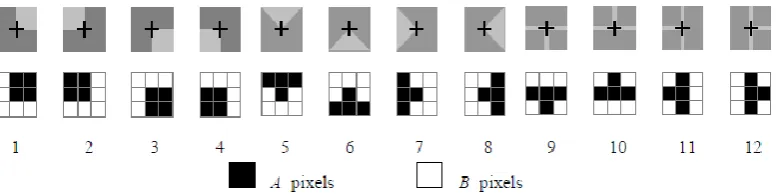
Where m and n represent the coordinates of the central pixel. If the neighbourhood is a homogenous region, then E contains values near zero. In the case of corners, the matrix E possesses a specific configuration depending on the corner type. These divide E in two connected regions, one with positive (pixel type A) and another with negative (pixel type B) difference values (see Figure 1). The reasoning structure uses two different types of rules: the THEN-rules and the ELSE-rules (don’t care conditions) respectively. Each THEN-rule includes a determined pixel configuration as antecedent and only one pixel as consequent. Antecedents are related to a corner existence test and the consequent to its presence or absence. The rule-base gathers many fuzzy rules (THEN-rules) and only one ELSE-rule (i.e. do-not-care rule). Therefore only relevant rules (i.e. configurations) are formulated as THEN-rules while other not important configurations may be handled as a group of ELSE-rules. The set of THEN-rules lies on the very core of the algorithm. The rules must deliver successful structure detection, i.e. corners in this case, while still cancelling other inconsistencies such as noise. Such tradeoff may be solved by using a reduced set of rules (configurations) which in turn represent the minimum number in order to coherently detect the structure as it is required by a given application. Such procedure allows dealing with noisy pixels or imprecision.
Fig 4 Region shaping with respect to gray level differences: (a) the resulting template and (b) the real corner that originates the template
The proposed corner detector considers twelve THEN-rules that represent the same number of possible corner configurations and only one ELSE-rule as it is graphically explained by Fig. 5. It may be also possible to consider some other corner configurations. However it may reduce the algorithm’s ability to deal with noise or uncertanty [19,23,24].
Fig 5. Different corner cases to be considered for building the fuzzy rules. The image region containing the corner is shown in the upper section while the resulting 3x3 template is shown below each case.
IJEDR1404047
International Journal of Engineering Development and Research (www.ijedr.org)3684
The principle can be explained as follows: If one region of the neighborhood, according to any of the twelve cases, contains positive/negative differences with respect to the center pixel, and if any other region contains the opposite (negative/positive) differences with respect to the center pixel, then the center pixel is a corner (see Fig. 5). The procedure can be considered as the evaluation of each one of the 12 different THEN-rules (configurations), yielding two auxiliary matrices p E and n E as follows:(i,j) = { ( )
( ) {
( )
For all the elements of being ones, and
(i,j) = { ( )
( ) {
( )
For all the elements of being ones, is a threshold that controls the sensitivity of theconsidered differences. Typical values for th normally fall into the interval (5,35). The lowestvalue of 5 would yield a higher detector’s sensitivity which may detect a great number of corners corresponding to noisy intensity changes which are commonly found in images. On the other hand, a maximum value of 35 would detect corners matching to a significant difference between several objects in the structure, i.e. object whose pixels may be considered as being connected. Although the selection of the best value for thclearly depends on the particular application, a good compromise can be obtained by taking a value on approximately half the overall interval, i.e. 20 th = . The membership values µc (m,n)(where c = 1, 2,K,12 ) are computed depending on the corner types (see Fig. 5). According to such values represent the antecedents of each employed THEN-rule. They can be calculated as follows:
( )
*( ∑ ( )
) ( ∑ ( )
) ( ∑ ( )
) ( ∑
( ))+
Considers a normalization factor equal to 20 which represents the maximum possible value,i.e. the highest product of the multiplication among the pixels between Ep and En. Hence, the membership value µc ( m,n ) falls between 0 and 1.above Eq. can be considered as the numerical member implementation of the generic rule previously defined by Eq. 2. If Rule 1 (case 1) is considered as an example, the expressions corresponding to Eq. (6) would thus be:
∑ ( )
( ) ( ) ( ) ( )
∑ ( )
( ) ( ) ( ) ( ) ( )
∑ ( )
( ) ( ) ( ) ( ) ( )
∑ ( )
( ) ( ) ( ) ( )
Analogously to above equation, membership values µ2(i, j),...,µ12 (i, j) for other rules (cases) can be calculated. Finally, the 12 fuzzy rules can be added into a single fuzzy value using the max (maximum) operator. The final fuzzy value represents the linguistic meaning of cornerness yielding:
( ) ( ( ) (m,n),... ( ))
IJEDR1404047
International Journal of Engineering Development and Research (www.ijedr.org)3685
The pixels whose value cornerness m ,n) are near to one, belong to a feature similar to a corner, while values near to zero would represent any other feature.IV. RECENT DEVELOPMENT OF CORNER DETECTOR
Recently, using the multi-scale topological features, an improved Harris method was presented in [27]. The authors used topological features to reduce the range of Harris corner detector. Details can be found in [27]. Moreover, most Harris corner point detectors use only the grayscale information of an image. However, the color information of an image is wasted. To employ the color information, a new Harris corner point detector method was proposed in [28]. In this method, Harris corner detector is applied both to the grayscale image using gray level intensity information and to the color image using the RGB information. After corner points are detected in both the grayscale image and the color image, cross correlation and Random sample consensus are used to find matching corner points. Details can be found in [28]. Furthermore, the widespread use of mobile robot demands better image processing techniques. Better corner detection techniques are especially important. To accommodate the special situations in mobile robots, the authors in [29] used both the intensity-based corner detector and the contour-based detector to detect corners. Simulation results showed that this hybrid corner detection method can improve corner detection performance. Moreover, in [30], authors compared many contour-based corner detectors in terms of corner detection performance. Interested readers can find more details in [30]. Wireless sensor networks have been a popular research area [31]-[32]. In the future, image corn detection techniques can be combined with wireless sensor networks to provide remote corn detection for many interesting applications, such as corn detection in remote health care.
V. ACKNOWLEDGEMENTS
This paper introduced some important corner detectors. Moreover, some recent developments in the corner detection area were also presented. This paper provides new researchers in this area some useful information.
REFERENCES
[1] G. Xinting, Z. Wenbo, F. Sattar, R. Venkateswarlu, and E. Sung, "Scale-space Based Corner Detection of Gray Level Images Using Plessey Operator," in Proc. of the Fifth International Conference on Information, Communications and Signal Processing, (2005), pp. 683-687.
[2] G. Xinting, F. Sattar, and R. Venkateswarlu, "Multiscale Corner Detection of Gray Level Images Based on Log-Gabor Wavelet Transform," IEEE Transactions on Circuits and Systems for Video Technology, vol. 17, pp. 868-875, (2007). [3] C. Harris and M. Stephens, “A combined corner and edge detector,” in Proceedings of the 4th Alvey Vision Conference, pp.
147–151, (1988 )
[4] LEI Huang, “Feature –based image registration using the shape context,” International Journal of Remote Sensing, June (2010 ).
[5] Indranil Misra, S. Manthira Moorthi, Debajyoti Dhar and R. Ramakrishnan, (ISRO) Ahmedabad 380015, India, “An Automatic Satellite Image Registration Technique Based on Harris Corner Detection and Random Sample Consensus (RANSAC) Outlier Rejection Model”, 1st Intl Conf. on Recent Advances in Information Technology, RAIT-(2012).
[6] Cordelia Schmid, Roger Mohr and Christian Bauckhage, “Evaluation of Interest Point Detectors,” International Journal of Computer Vision, June (2000).
[7] Tinne Tuytelaars1 and Krystian Mikolajczyk2, “Local Invariant Feature Detectors: A Survey,” Foundations and Trends Rin Computer Graphics and Vision, May (2008).
[8] Mahesh and Dr.M.V.Subramanyam “invariant corner detection using steerable filters and harris algorithm” signal & Image Processing : An International Journal (SIPIJ) Vol.3, No.5, October (2012).
[9] H. Moravec (1980). "Obstacle Avoidance and Navigation in the Real World by a Seeing Robot Rover". Tech Report
CMU-RI-TR-3 Carnegie-Mellon University, Robotics Institute.
[10] Förstner, W; Gülch (1987 1987). "A Fast Operator for Detection and Precise Location of Distinct Points, Corners and Centres of Circular Features". ISPRS.
[11] T. Lindeberg (1994). "Junction detection with automatic selection of detection scales and localization scales". Proc. 1st International Conference on Image Processing I. Austin, Texas. pp. 924–928.
[12] Tony Lindeberg (1998). "Feature detection with automatic scale selection". International Journal of Computer Vision 30 (2). pp. 77–116.
[13] Zadeh, L.A., Fuzzy sets, Information and Control 8 (1965) 338–353.
[14] Pal, S.K., Ghosh, A. and Kundu, M.K., Soft Computing for Image Processing, Physica-Verlag, (2000), pp. 44–78 (Chapter
1).
[15] Yua, D., Hu, Q. and Wua, C., “Uncertainty measures for fuzzy relations and their applications”, Appl. Soft Comput. 7 (3)
(2007) 1135–1143.
[16] Karmakar, G., Dooley, L.: A generic fuzzy rule based in image segmentation algorithm, Pattern Recognition Letters, 23, pp.
1215-1227, (2002). [17]
[18] Jacquey, F., Comby, F., Strauss, O.: Fuzzy Edge detection for omnidirectional images, Fuzzy sets and Systems, 159, pp. 1991-2010, (2008).
[19] Várkonyi-Kóczy, A.: Fuzzy logic supported corner detection. Journal of Intelligent & Fuzzy Systems, 19, pp 41-50, (2008).
IJEDR1404047
International Journal of Engineering Development and Research (www.ijedr.org)3686
[21] Tizhoosh, H.: Fast and Robust Fuzzy Edge Detection, Fuzzy Filters for image processing, Nachtegael et. al. Eds. Springer,Berlin, (2003).
[22] Yüksel, M.; Edge detection in noisy images by fuzzy processing, International Journal of Electronics and Communications,
61, pp. 82-89, (2007).
[23] Liang, L., Looney, C.: Competitive Edge detection, Applied Soft Computing, 3, pp. 123-137, (2003).
[24] Kim, D., Lee, W., Kweon, I.: Automatic edge detection using 3x3 ideal binary pixel patterns and fuzzy-based edge thresholding, Pattern Recognition Letters, 25, pp. 101-106, (2004).
[25] Banerjee M. and Kundu, M. K., “Handling of impreciseness in gray level corner detection using fuzzy set theoretic approach”, Applied Soft Computing, 8(4), pp. 1680-1691, (2008).
[26] Várkonyi-Kóczy, A.: Fuzzy logic supported corner detection. Journal of Intelligent & Fuzzy Systems, 19, pp 41-50, (2008). [27] Z. Ding and A. Ma, "Harris corner detection based on the multi-scale topological feature," in Proc. of the 2011 International
Conference on Computer Science and Network Technology, pp.1394-1397, Dec. (2011).
[28] B. Sirisha and B. Sandhya, "Evaluation of distinctive color features from harris corner key points," in Proc. of the 2013 IEEE 3rd International Advance Computing Conference, pp.1287-1292, Feb. (2013).
[29] S. Kim, I. Kweon and W. Lee, "Orientation based multi-scale corner detection for mobile robot application," in Proc. of the 12th International Conference on Control, Automation and Systems, pp.466-468, Oct. (2012).
[30] M. Awrangjeb, G. Lu, and C. S. Fraser, "Performance Comparisons of Contour-Based Corner Detectors," IEEE Transactions on Image Processing, vol.21, no.9, pp.4167-4179, Sept. (2012).
[31] Z. X. Luo, “Distributed Estimation in Wireless Sensor Networks with Heterogeneous Sensors”, International Journal of Innovative Technology and Exploring Engineering, Vol. 1, no.4, Sept (2012).