Volume 4, No. 5, May 2013 (Special Issue)
International Journal of Advanced Research in Computer Science
CASE STUDY & REPORT
Available Online at www.ijarcs.info
© 2010, IJARCS All Rights Reserved
12
Implementation of PID and Fuzzy PID controllers for Temperature control in CSTR
S. Srinivasulu Raju
Assistant Professor
Dept. of Electronics and Control Engineering Sree Vidyanikethan Engineering College
Tirupati, India
E-mail: [email protected]
K.M.N. Chaitanya Kumar Reddy
III B.Tech
Dept. of Electronics and Control Engineering Sree Vidyanikethan Engineering College
Tirupati, India
E-mail: [email protected]
T.K.S. Ravi Kiran III B.Tech
Dept. of Electronics and Control Engineering Sree Vidyanikethan Engineering College
Tirupati, India
E-mail: [email protected]
M. Viswanath
III B.Tech
Dept. of Electronics and Control Engineering Sree Vidyanikethan Engineering College
Tirupati, India
E-mail: [email protected]
Abstract: Continuous Stirred Tank Reactor (CSTR) is an importantsubject in chemical process and offering a diverse range of researches in the area of the chemical and control engineering. Various control approaches have been applied on CSTR to control its parameters. This paper gives the demonstration about the temperature control of CSTR reactor using a fuzzy PID controller to meet the desired temperature in presence of set point changes. The parameters of PID controller can be calculated by conducting Relay feedback on process. Fuzzy logic is one of the most successful applications of fuzzy set in which the variables are linguistic rather than numeric. The development of an effective methodology for the design of such control systems undoubtedly requires the synthesis of many concepts from artificial intelligence. The most commonly used controller in the industry field is the PID controller. Fuzzy logic controller (FLC) provides an alternative to PID controller, especially when the available system models are inexact or unavailable. A FLC is based on a set of control rules (fuzzy rules) among linguistic variables. CSTR system is a typical chemical reactor system with complex non-linear dynamic characteristics. The fuzzy PID control algorithm is designed for the flow process station to improve the control performance better than the conventional PID controller. PID controller works well only if the mathematical model of the system could be computed. Hence it is difficult to implement PID control for variable as well as complicated systems. The proposed method can be used to realize data process and advanced control to improve the quality of the control. The simulation is carried out and the simulation results present the flexibility of the CSTR temperature control.
Keywords: CSTR, PID, Fuzzy controller, rule base, fuzzypid, MATLAB/SIMULINK.
I. INTRODUCTION
Industrial process control systems have many features such as non-linear, inertial lag, time delay and time varying so on. Due to this, precise mathematical modeling is not possible. Traditional PID algorithm does not hold well for such systems which has disturbances. FuzzyPID has more advantages as compared to PID. It has fast response, small overshoot and good anti-interference ability. In this paper a novel method for such system is introduced, named FuzzyPID. This method has the merits of both Fuzzy and PID. The fuzzyPID control of these papers was simulated in simulation platform MATLAB. A CSTR (Continuous Stirred-Tank Reactor) is a chemical reaction vessel in which an impeller continuously stirs the contents ensuring proper mixing of the reagents to achieve a specific output. The problem of controlling of CSTR is considered as an attractive and controversial issue, especially for control engineers, corresponding to its nonlinear dynamic. Most of the conventional controllers are restricted just for linear time invariant system applications. However, in real environment, the nonlinear characteristics of the systems and their functional parameters changes, due to wear and tear, cannot be neglected. Furthermore, dealing the systems with uncertainties in real applications, is the another subject which must be noticed. In this way, the role of the adaptive and intelligent controllers, by the capability of the overcoming the above mentioned points are of the importance.
II. FUZZYLOGICCONTROLLER
The design of intelligent control systems has become an area of intense research interest. The development of an effective methodology for the design of such control systems
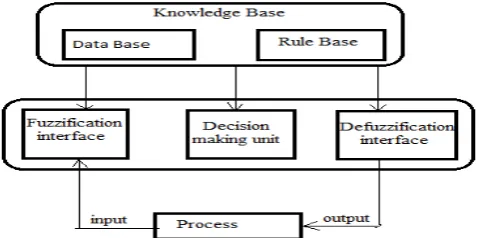
[image:1.595.320.560.627.746.2]undoubtedly requires the synthesis of many concepts from artificial intelligence, Fuzzy logic controller (FLC), especially when the available system models are inexact or unavailable. Fuzzy Logic (FL) is an approach to control engineering problems, which mimics how a person would make decisions, only much faster. FL incorporates a simple rule-based “ IF X AND Y THEN Z” approach to a solving control problem rather than attempting to model a system mathematically [7,8]. The FL model is empirically-based, relying on an operator’s experience rather than his technical understanding of the system. In other words fuzzy logic is used in system control and analysis design, because it shortens the time for engineering development and sometimes, in the case of highly complex systems, is the only way to solve the problem [9, 10]. Every Fuzzy system is composed of four principal blocks as shown in Fig:1.
S. Srinivasulu Rajuet al, International Journal of Advanced Research in Computer Science, 4 (5) Special Issue, May, 2013,12-17
© 2010, IJARCS All Rights Reserved
13
1. Fuzzification
The Fuzzy set of the Error input, Change in Error input and output Fuzzy sets which contains 7 Triangular memberships as shown in figure-5, figure-6 and figure-7.
2. Control Base Rules
Table-2 presents the knowledge base defining the rules for the desired relationship between the input and output. The knowledge base comprises knowledge of the application domain and the attendant control goals. It consists of a data “base” which provides necessary definitions, which are used to define linguistic control rules and fuzzy data manipulation in an FLC and the rule base characteristics, the control goals and Control policy of the domains experts by means of a set of linguistic control rules. Decision making logic is the kernel of an FLC. It has the capability of simulating human decision making based on fuzzy concepts and of interring fuzzy control actions employing fuzzy implication and the rules of inference in fuzzy logic.
3. Defuzzification
The center of gravity “centroid” method was used in this paper. The controller has been tested using Simulink in MATLAB.
III. CSTRMODELLING
Chemical reactions in a reactor are either exothermic or endothermic and therefore require that energy either be removed or added to the reactor for a constant
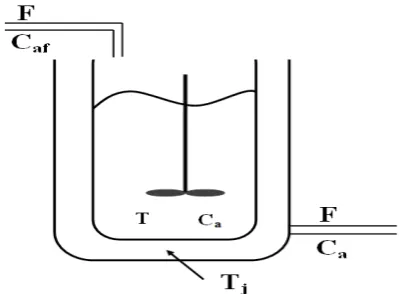
temperature to be maintained. Figure 1 illustrates the schematic of the CSTR process. In the proposed CSTR, an irreversible exothermic reaction takes place. The heat of the reaction is removed by a coolant medium that flows through a jacket around the reactor. A fluid stream A is fed to the reactor. A catalyst is placed inside the reactor. The fluid inside the reactor is perfectly mixed and sent out through the exit valve. The jacket surrounding the reactor also has feed and exit streams. The jacket is assumed to be perfectly mixed and at a lower temperature than the reactor [9],[10]. The mathematical model equations are obtained by a component mass balance (1) and energy balance principle (2) in the reactor.
[image:2.595.332.533.211.358.2]
Figure 2. Continuous Stirred Tank Reactor Process.
1
2
. . exp
. 460 3
. ∆. . . exp . . . . . . 4
Where Tj is the jacket temperature as the input, while Ca and T are concentration and temperature of reagent as the outputs respectively. It should be noted that the objective of control is to manipulate the jacket temperature Tj so it keeps the
[image:2.595.47.293.530.754.2]temperature of the system at the desired level. All parameters are considered from paper [14] as follows:
Table I. Mathematical modelling parameters of CSTR
IV. PIDCONTROLLER
A proportional-integral-derivative controller (PID controller) is a generic control loop feedback mechanism widely used in industrial control systems. A PID controller calculates an “error” value as the difference between a measured process variable and a desired set point. The controller attempts to minimize the error by adjusting the process control inputs. The diagram below shows a simplified PID controller.
The tuning parameters of PID controller are calculated by conducting the relay feedback test on the process. The ultimate gain and ultimate period will provide tuning parameters based on Z-N closed loop method.
Variables Values Units
Ca Na lbmol/ft3
T Na
Ea 32400 BTU/lbmol
K0 1.50E+13 Hr-1
ΔH -45000 BTU/lbmol
U 75 BTU/hr-ft2-of
Ρ 53.25 BTU/ft3
R 1.987 BTU/lbmol-of
V 750 ft3
F 3000 ft3/hr
Caf 0.132 lbmol/ft3
Tf 60 oF
S. Srinivasulu Rajuet al, International Journal of Advanced Research in Computer Science, 4 (5) Special Issue, May, 2013,12-17
© 2010, IJARCS All Rights Reserved
[image:3.595.332.550.57.141.2]14
Figure 3. Simplified PID controller
V. FUZZY PIDCONTROL ALGORITHM
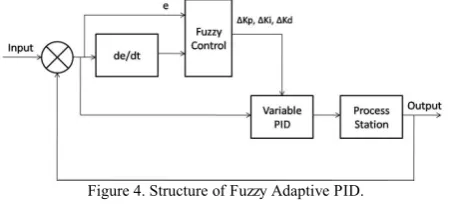
The structure of fuzzy PID is shown in fig.4. It consists of two parts, one is the conventional PID controller and the other is fuzzy controller. The inputs are the error and the error rate. The outputs are the Kp, Ki and
Kd values. The objective is to find the fuzzy relations
among Kp, Ki, Kd, error, and error rate. With continual
[image:3.595.327.556.59.262.2]testing, the three output parameters are adjusted online so as to meet different requirements and achieve good stability. Variable PID controller adds the output value of the fuzzy controller and default PID values.
Figure 4. Structure of Fuzzy Adaptive PID.
A. Design of Fuzzy PID
Fuzzy controller is the hardcore of the system. It includes the fuzzification, knowledge base, inference engine and de-fuzzification. Fuzzy controller makes the input accurate quantity to fuzzy quantity. It maps the input to the corresponding discourse. The knowledge base contains the experienced knowledge of the flow process station. Data base contains the membership function of every linguistic variable. Control rules are described by the data base.
B. Membership Function
The membership function used by fuzzy controller is triangular membership function and Gaussian function. The input ranges from -7 to +7 and the fuzzy subset are Negative Big, Negative middle, Negative small, Zero, Positive small, Positive middle and Positive Big respectively termed as NB, NM, NS, ZO, PS, PM, PB. The quantization factor and the scaling factor play an important role in the performance of the fuzzy controller.
[image:3.595.52.291.63.139.2]Figure 5. Membership Functions of Error Input in Fuzzy Set.
[image:3.595.326.564.166.270.2]Figure 6. Membership Functions of change in Error Input in Fuzzy Set.
Figure 7. Membership Functions of output in Fuzzy Set.
C. Control Rules of the Fuzzy Controller
The control rules are framed to achieve the best performance of the fuzzy controller. In this paper 49 control rules are adopted to control the Temperature of CSTR.
Table II. Rule Base Implemented in FLC
E/CE NB NM NS Z PS PM PB
NB NB NB NM NM NS NS Z
NM NB NM NM NS NS Z PS
NS NM NM NS NS Z PS PS
Z NM NS NS Z PS PS PM
PS NS NS Z PS PS PM PM
PM NS Z PS PS PM PM PB
PB Z PS PS PM PM PB PB
Using this control rules flow.fis is created. This control rules are framed in MATLAB M-File. This .fis file is implemented using M-File Program and the connection is established between Process ODE solver and FuzzyPID. The inference engine used here is the Mamdani Inference engine.
D. Rule Surface Viewer of the Fuzzy
Controller Based upon the established fuzzy rules, the surface view of fuzzy rules and rule viewer are shown in figure 7 and 8 respectively.
-3 -2 -1 0 1 2 3
0 0.2 0.4 0.6 0.8 1
Input: Error (e)
D
e
gr
ee o
f m
e
m
ber
s
hip
NB NM NS Z PS PM PB
-3 -2 -1 0 1 2 3
0 0.2 0.4 0.6 0.8 1
Input: Change in Error (ec)
D
egr
ee of
m
e
m
ber
s
h
ip
NB NM NS Z PS PM PB
-3 -2 -1 0 1 2 3
0 0.2 0.4 0.6 0.8 1
Output: U
D
egr
ee o
f m
e
m
b
e
rs
h
ip
[image:3.595.55.280.312.414.2] [image:3.595.330.553.391.566.2] [image:3.595.60.277.651.736.2]S. Srinivasulu Rajuet al, International Journal of Advanced Research in Computer Science, 4 (5) Special Issue, May, 2013,12-17
© 2010, IJARCS All Rights Reserved
15
[image:4.595.326.556.72.239.2]
[image:4.595.52.291.74.236.2]
Figure 8. Surface view of Fuzzy Rule base.
Fig. 9. Rule viewer of Fuzzy rules for CSTR Temperature control
VI. SIMULATION RESULTS
[image:4.595.62.551.301.538.2]A. Simulation Method:
Figure 10. Simulink model of continuous stirred tank reactor.
Figure 11. Simulink diagram of PID response.
B. Simulation Results:
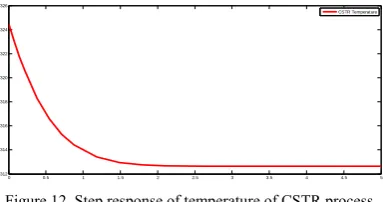
The open loop response of the first principle method is shown in fig.10 where reduction in the temperature of CSTR with the flow in coolant feed. We can also observe that concentration of CSTR will increase as shown in Fig (11). From the fig.10 we can observe that steady state value is obtained for a step change in input. The implementation of FuzzyPID controller for controlling the Temperature of CSTR process is shown in figure (14). The fuzzy controller is implemented using error and change in error and considers a membership function as a triangular. The response for tracking the change in Temperature of CSTR process is achieved by using fuzzy controller is shown in figure (14). The response of error and change in error in fuzzy sets is also shown in figure below. The response of Manipulated Variable of fuzzy controller is also shown in figure (12). From these responses, it is observed that the input variables and output variable also with in limit to
-K-k0 0.3
UA/(V*RhoCp)
T emperature
Product3
Product1 Product
eu Math Functi on
1 s Integrator1
1 s Integrator 298.15
Feed T em perature2
10 Feed Concentrati on2
1
F/V1 1
F/V 2
1.3
F/V + UA/(RhoCpV) 1
F/V
-11.92
Del taH/RhoCp 0
Cool ent T emperature1
Concentrati on1 -5963.6
-Del taE/R
1.458s+11.65
s +3.434s+3.5572
Transfer Fcn1 Step
Scope2
Scope1 PID(s)
[image:4.595.57.285.573.716.2]S. Srinivasulu Rajuet al, International Journal of Advanced Research in Computer Science, 4 (5) Special Issue, May, 2013,12-17
© 2010, IJARCS All Rights Reserved
16
[image:5.595.336.557.66.334.2]achieve the set point tracking to control Temperature of CSTR process at desired position. From the response obtained in figure (14), the fuzzy controller able to track the temperature even though the change occurs at various levels of simulation time.
Figure 12. Step response of temperature of CSTR process.
Figure 13. Step response of concentration of CSTR process
Figure 14. Behaviour of Error Input in Fuzzy Set with 7 Membership Functions.
[image:5.595.62.254.114.215.2]
Figure 15. Behaviour of Change in error Input in Fuzzy Set with 7 Membership Functions.
Figure 16. Servo Response Tracking by Using Fuzzy PID Controller for Temperature of CSTR process.
[image:5.595.60.259.245.345.2]Figure 17. Servo Response Tracking by Using Fuzzy PID Controller for Concentration of CSTR process.
Figure 18. Set point tracking using PID controller.
VII. CONCLUSION
The CSTR (continuous stirred tank reactor) process is identified as a non-linear system. The model of CSTR process is implemented with the help of first principle ordinary differential equation. MATLAB ODE45 solver is used to solve the differential equation. The PID parameters are calculated using Relay feedback test. The PID provides satisfactory results for change in set point tracking. The fuzzyPID controller is implemented to track the change in temperature and concentration of the CSTR process by using MATLAB/Simulink. The simulation results proven that the fuzzyPID control method is more effective way as compared to PID to enhance stability of time domain
performance of the CSTR process. The aim of this paper is
to introduce techniques for temperature and concentration control of the CSTR process. The fuzzyPID controller based adjustable closed-loop CSTR temperature and concentration controller system has been developed. The system is very sensitive to the distribution of membership functions but not to the shape of membership functions.
VIII. FUTURE WORK
The temperature and concentration of the CSTR process can be controlled by using adaptive controllers like Neuro fuzzy, MPC, self tuning regulator etc. These methods can be extended to implement the controller for controlling the flow and temperature of the coolant used in the CSTR process. This method can be extended to analyse the performance domain characteristics while compare with PID.
IX. REFERENCES
[1] R.Ketata, D.Geest, and A.Titli, “Fuzzy Controller: Design, Evaluation, Parallel and Hierarchical Combination with a PID Controller”, journal of Fuzzy Sets and Systems, vol 71, pp.113-129, 1995.
[2] Y. Yuan, H. Zhuang, “A Genetic Algorithm for
Generating Fuzzy Classification Rules”, Journal of Fuzzy Sets and Systems, Vol 84, pp.1-19, 1996.
[3] M. Nikravesh, A.E. Farell, T.G. Stanford, “ Control of non-isothermal CSTR with time varying parameters
0 0.5 1 1.5 2 2.5 3 3.5 4 4.5 5
312 314 316 318 320 322 324 326
CSTR Temperature
0 0.5 1 1.5 2 2.5 3 3.5 4 4.5 5
0.87 0.88 0.89 0.9 0.91 0.92 0.93 0.94 0.95 0.96
Concentration
0 50 100 150 200 250
-1 0 1 2 3 4 5
Fuzzy Output for Error
0 50 100 150 200 250
-10 0 10 20 30 40 50
Fuzzy output for CE
0 50 100 150 200 250
345 346 347 348 349 350 351
Temperature of CSTR
0 50 100 150 200 250
12.5 13 13.5 14 14.5 15
Concentration os CSTR
0 0.5 1 1.5 2 2.5 3 3.5 4 4.5 5
0 10 20 30 40 50 60 70 80
[image:5.595.50.273.504.624.2]S. Srinivasulu Rajuet al, International Journal of Advanced Research in Computer Science, 4 (5) Special Issue, May, 2013,12-17
© 2010, IJARCS All Rights Reserved
17
via dynamic neural network control (DNNC) ”, Chemical Engineering Journal.
[4] J. Xu and X.Feng, “Design of Adaptive Fuzzy PID
tuner using optimization method, ” Proceedings of the 5th World Congress on Intelligent Control and Automation, China, 2004, pp. 2454 –2458.
[5] J. Zhang, N. Wang and S. Wang, “A developed method of tuning PID controllers with fuzzy rules for integrating process,” Proceedings of the American Control Conference, Boston, 2004, pp. 1109-1114.
[6] K. Astrom and T. Hagglund, PID controllers: Theory, design and tuning. 2nd ed., The Instrumentation,
Systems and Automation Society (ISA),1995.
[7] M-Y.Shieh and T-H. S. Li, “Design and Implementation of Integrated Fuzzy Logic controller for Servo-Motor System,” Mechatronics, Vol.8, No.3, 1998.pp.217-240. Doi: 10.1016/S0957-4158(978)00052.
[8] Nader Jamali Sufi Amlashi,” Design and
Implementation of Fuzzy Position Control System for Tracking Applications and Performance Comparison with Conventional pid” Vol. 1, No. 1, pp. 31~44 IX Control Instrumentation System Conference (CISCON - 2012), 16-17 November 2012 53 ISBN vol 76, pp.1-16, 2000.
[9] S.R.Vaishnav and Z.J.Khan, “Design of PID & Fuzzy logic controller for higher order system,” International Conference on Control & Automation (ICCA'07), Hongkong, China, 2007, pp. 1469-1472.
[10] J.Maiers and Y.S.Sherif, “Applications of fuzzy set theory,” IEEE Trans. Syst. Man Cybern., vol. SMC15, no. 1, pp. 175-189, 1985.
[11] P.M.Larsen, “Industrial applications of fuzzy logic
control,” Int. J. Man Mach. Studies, vol. 12, no.1, pp.3-10, 1980.
[12] J.B.Kiszka, M.E. Kochanska and D.S. Sliwinska, “The influence of some parameters on the accuracy of fuzzy model,” in Industrial Applications of Fuzzy Control. M. Sugeno, Ed. Amsterdam: North-Holland,1985, pp.187-230.
[13] E. Sanchez and L.A. Zadeh, Approximate Reasoning
in Intelligent Systems, Decision and Control, New York: Pergamnon, 1988.
[14] Narinder Singh and Sandeep kumar, “Comparative Analysis of PID, Cascade and Fuzzy Logic Control for the Efficient Temperature control in CSTR” in International Journal of Advanced Research in Elactrical, Electronics and Instrumentation Engineering Vol.1, Issue 1, July 2012. ISSN: 2278-8875.
[15] Farhad Aslam and Gagandeep Kaur, “Comparative