Volume 2, No. 4, July-August 2011
International Journal of Advanced Research in Computer Science
RESEARCH PAPER
Available Online at www.ijarcs.info
Querying Fuzzy Object-Oriented Data Based On Fuzzy Association Algebra
Prof. Doan Van Ban Integrated Software Systems
Institute of Information Technology, Academy Science and Technology of VietNam
Hanoi City, VietNam [email protected]
Dr.Ho Cam Ha Information Technology Faculty Hanoi National University of Education
Hanoi City, VietNam [email protected]
Vu Duc Quang* Information Technology Faculty
Quang Nam University Tamky City, VietNam [email protected]
Abstract:Along with the developing fuzzy object-oriented data models for an expression and a processing of uncertain and imprecise data, the fuzzy data query languages should also be studied, is built to perform data queries in the fuzzy data models flexibly and certainly. Fuzzy association algebra is considered as a query algebra for fuzzy object-oriented data models. In this article, based on possibility distribution and the semantic measure of fuzzy data and equivalence degree of two objects, we propose a more general way to define truth values of fuzzy association patterns which mean the degree of suitability of patterns as answers for the queries. In addition, we present an illustrative example of querying fuzzy object oriented data based on fuzzy association algebra.
Keyword: Truth value, fuzzy association algebra, fuzzy OODB, association pattern, equivalence degree.
I. INTRODUCTION
Fuzzy relational algebra or fuzzy relational calculus are considered as the theoretical foundation for querying data in the fuzzy relational data models. In object-oriented database (OODB), several query algebra for the OODB have been developed on the different bases of data models such as association algebra in [12] for an object-oriented semantic association model, the query algebra for ENCORE [13], …. which are the mathematical foundations for their models.In this article, by considering three levels of fuzziness into object classes, the structure of class level, the object instance level and attribute value level, we show how to determine degree of the relationship between objects. Thereby, determining the truth value for the fuzzy association pattern.
The article is organized as follows. The basic knowledge is presented in section 2. The fuzzy object-oriented data model is give in section 3. Section 4 introduces to fuzzy association algebra. The querying a fuzzy OODB is mentioned in section 5. And the final section is the conclusion.
II. BASIC KNOWLEDGE
Fuzzy data can be described with fuzzy sets by Zadeh [13]. Let U be a universe of discourse. Then a fuzzy value on U is characterized by a fuzzy set F in U. Here a membership function F :U [0,1]is needed to
define the fuzzy set F, in which F(u), for each u U,
denotes the degree of membership of u in the fuzzy set F. The fuzzy set F is hereby represented as follows.
}
/
)
(
,...,
/
)
(
,
/
)
(
{
Fu
1u
1 Fu
2u
2 Fu
nu
nF
When the F(u) above is explained to be a measure
of the possibility that a variable X has the value u, where X takes values in U, a fuzzy value can be described by a possibility distribution.
}
/
)
(
,...,
/
)
(
,
/
)
(
{
X 1 1 X 2 2 X n nX
u
u
u
u
u
u
Here X(ui),ui U denotes the possibility that X takes
value
u
i. Let X,F be the possibility distribution representation and the fuzzy set representation for a fuzzy value, respectively. It is apparent that is X Ftrue.The semantics of a fuzzy data represented by possibility distribution corresponds to the semantic space. The semantic relationship between two fuzzy data is then described by the relationship between their semantic spaces [15]. The semantic inclusion degree is used to measure semantic inclusion and further semantic equivalence of fuzzy data.
Let A and B be two fuzzy data, and their semantic spaces be SS( A) and SS( B) respectively. Let SID( A, B) denotes the degree that Asemantically includes B. Then
) ( )) ( ) ( ( ) ,
( A B SS A SS B SS B SID
The meaning of SID( A, B)is the percentage of
the semantic space of A which is wholly included in the semantic space of B.
Let U = {u1,u2,...,un}be the universe of discourse.
possibility distribution. The degree that Asemantically includes B is defined as follows
n
i i B n
i
i A i B U u B
A u u u
SID i
1 1
) ( ))
( ), ( ( min )
, (
Let U = {u1,u2,...,un} be the universe of discourse. Let
Res be a resemblance relation on domain U, α for 0 ≤ α ≤ 1 be a threshold corresponding to Res. The degree that
Asemantically includes B is defined as follows
n
i i B j A i B n
i uu U su u B
A u u u
SID
j i j
i 1
1 , ;Re( , )
) ( )) ( ), ( ( min )
, (
Let A and B be two fuzzy data. Let
) , ( A B
SE denote the degree that A and Bare equivalent to each other.
) , ( ), , ( min ) ,
( A B SID A B SID B A SE
III. FUZZY OBJECT-ORIENTED DATA MODEL
A fuzzy object-oriented data model is defined as an enhanced the object-oriented data model by replacing objects with fuzzy objects, classes with fuzzy classes and associations with fuzzy associations on the essential characteristics of object-oriented paradigm.
A. Fuzzy Object and Fuzzy Class
Some objects having the same structural and behavioral properties are grouped together to form an object class. Object classes are categories into primitive classes and non-primitive classes. A primitive class represents a class of self-named objects serving as a domain for defining other object classes, such as a class of symbols or numerical values. A non-primitive class represents a set of objects, each of which is an assigned OID and its data are explicitly entered in a database by the user. The structural properties of an object class are represented by descriptive data which define states of objects and association data which specify relationships between its objects of some related classes.
In fuzzy object-oriented database, there are three levels of fuzziness into object classes. These three levels of fuzziness are defined as follows
- The first level (the structure of class level) in which attributes of class may be fuzzy, i.e., they have a membership degree to their class.
- The second level (object instance level) related to the fuzzy occurrences of objects. Even though the structure of an entity is crisp, it is possible that an instance of the class belongs to the class with degree of membership.
- The third (attribute value level) concerns in the values of attributes of the instance of the class. An attribute in a class defines a value domain. When this domain is a fuzzy subset or a set of fuzzy subsets, the fuzziness of an attribute value appears.
An fuzzy object of the fuzzy class Ci is represented by a pair (oij, C(oij))
i , where oijis j
th
object in fuzzy class Ci,
) ( ij
Ci o is a degree of membership of object oijin fuzzy
class Ci, 0 Ci(oij) 1.
For extensional database, a fuzzy class Ci can be defined as the following: Ci {(oij, C(oij))}
i
B. Equivalence of Two Objects Within a Class
In the context of the fuzzy object-oriented databases, objects may be fuzzy. In order to denote the possibility degree that two fuzzy objects o1 and o2 refer to the same real world object, the notion of equivalence degree of o1 and o2 is in [0, 1]. Formally, let the equivalence degree of o1 and o2 be (o1,o2). In the
following, we investigate how to calculate (o1,o2) based on the relationships between two classes that o1 and o2 belong to.
a. Equivalence of Two Objects within a Class
Let C be a class with attributes {A1, A2, …, An} and o1
and o2 be two objects belong to the same class C. Also assume that o1.Ai and o2.Ai are allowed to be fuzzy values. Then o1 and o2 are fuzzy objects.
In order to compare objects o1 and o2 and calculate
) ,
(o1o2 , we first need to compare their corresponding attributes. For each pair of values of the same attribute (say Ai (1≤ i ≤ n), we obtain their equivalence degree, denoted Ai(o1,o2),(0 ≤ Ai(o1,o2) ≤ 1). Here
) , (o1 o2 i
A = SE(o1.Ai, o2.Ai), where SE(o1.Ai, o2.Ai) is computed in a similar way to [4].
On the basis, we then combine the equivalence degrees that are obtained in the values of their attributes.
Considering that different attributes play different roles in object comparison, and some may be dominant and some may be non-dominant, a weight wi is assigned to each
attribute of C according to its importance such that 0 wi ≤ 1.
Formally, the equivalence degree of o1 and o2,
denoted (o1,o2), is expressed as follows.
n
i i n
i
i i i
A w
A w A o A o SE o
o
1 1
2 1 2
1
) (
) ( ) . , . ( )
,
( (1)
If (o1,o2) = 0, o1 and o2 do not refer to the same real- world object; if (o1,o2) = 1, o1 and o2 refer to the same
real world object. If 0 < (o1,o2)< 1, o1 and o2 refer to the same real-world object to some extent.
b. Equivalence of Two Objects of Superclasse and Subclass
Let C be a class with attributes {A1, A2, …, An} and C’
be a subclass of C with attributes {A1, A2, ..., Ak, A’k+i, ...,
A’m , Am+1,..., An}. Here attributes A’k+i, ..., A’m are
overridden from Ak+1, ..., Am and attributes Am+1,..., An are
special. Let o1 be a fuzzy object of C1 and o2 be a fuzzy object
of C2.
In order to compare objects o1 of C and o2 of C‟
and calculate (o1,o2), generally speaking, we also
need to compare their corresponding attributes and then combine their equivalence degrees together with the consideration of attribute weights. For each pair of values of the same attribute (say Ai (1≤ i ≤ k)), we obtain their equivalence degree, denoted Ai(o1,o2) (0 Ai(o1,o2) 1).
For each pair of values of the attribute and its overridden attribute (say Aj and A‟j (k + 1 ≤ j ≤ m)), we obtain their
equivalence degree, denoted (o1,o2)
j
A (0 Aj(o1,o2) 1).
) , (o1 o2
j
A = SE(o1.Ai, o2.Ai), where SE(o1.Ai, o2.Ai) is computed in a similar way in [4].
The values of the attributes Ap (m+1 ≤ p ≤ n) in o2 do not need to be considered because they have no counterpart in o1. Finally we have:
m
k j
j k
i i
m
k j
j j i k
i
i i i
A w A w
A w A o A o SE A
w A o A o SE o
o
1 ' 1
1
' ' 2 1 1
2 1 2
1
) ( ) (
) ( ) . , . ( ) ( ) . , . ( ) , (
(2)
C. Fuzzy Association
A fuzzy association is a relationship with fuzzy semantics of two classes. For examples, 'may be ‟association,‟ fluent associations are fuzzy associations. At an object level, a fuzzy association is defined as an association having a degree of relationship R 0 R 1
between two objects. A fuzzy association (FA) is defined as the followings [11]:
))} , )( ( ), , {(( )
( ij mn ij mn
im k o o R k o o
FA
Such that
) )) ( , ( , )) ( , (
,n oij C oij Ci omn C omn Cm
i i m
and R(k)(oij,omn) [0,1]
where R(k)(oij,omn) [0,1] is a relationship value
between two objects o and onm. k is an identifier of association.
For fuzzy associations, imprecise and vague linguistic terms such as 'young' can be represented, for examples, „Young People” association can be expressed as a set of fuzzy associations between object oij(an object in class Person) and an integer in the domain of the age such as
)} 3 . 0 ), 31 , (( ), 5 . 0 ), 30 , (( ), 6 . 0 ), 28 , (( ), 7 . 0 ), 26 , (( ), 9 . 0 ), 25 ,
{((oij oij oij oij oij
This possibility distribution can be decomposed with 5 fuzzy associations, such as „one person relates to object oij
is 25 years old‟ with relationship value 0.9, „one person relates to object oij is 26 years old‟ with relationship value
0.7 or as so on. The association with R(k)(oij,omn)= 0 is not
needed to be represented explicitly in database. A conventional association of OO database can be extend to an association having value 1.
D. Representations of fuzzy OO Databases
The fuzzy OODB is represented by two extended fuzzy graphs for both extensional and intensional databases. A fuzzy schema graph represents an intensional database and a fuzzy object graph represents an extensional database.
Fuzzy Schema Graph (FSG): The FSG is defined as
) , (C FA
FSG , where C {Ci, i}, is a set of vertices
representing fuzzy classes and FA {FAim(k)| i,m} is a
set of edges of fuzzy associations between two fuzzy classes.
Fuzzy Object Graph (FOG): The FOG is defined as
) , (FOFE
FOG , where FO {(oij, C(oij))}
i is a set of
vertices with truth values representing fuzzy object instances, and FE {((k):oij_omn,R(oij,omn))} is a set of edges with truth values representing fuzzy associations between two fuzzy object instances.
When one object instance is connected with another in FOG, a regular-edge (solid line) is drawn between the
corresponding vertices as
mn mn ij
ij o
o o R
o ( , ) which specifies
that jth object instance in fuzzy class Ciis related to nth object instance in fuzzy class Cmthrough the association of classes Ciand Cm with relationship valueR(oij,omn). If two
object instance oij,omn is not connected in the FOG but
their classes Ci and Cmin the corresponding FSG is directly connected, a complement-edge (dotted line) is drawn between them and is denoted by
In general OO model, an object may participate in several classes (e.g., in generalization hierarchy). Its representation in a class is called an object instance. Since in this article, “object” and “object instance” can be used interchangeably without any ambiguity.
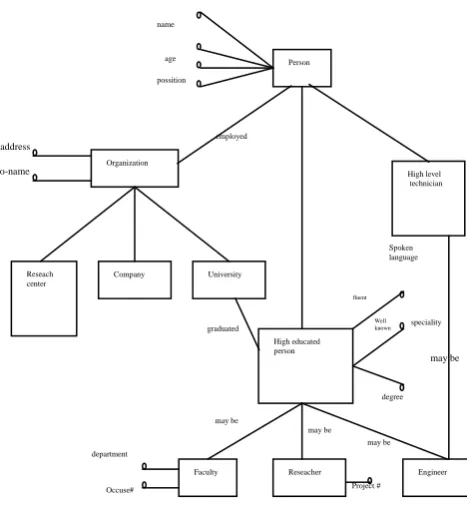
[image:3.595.323.557.264.518.2]For example, a FSG and a FOG for a human resource database are illustrated in Fig. 1 and Fig. 2.
Figure. 1 A Fuzzy schema graph of human resource database
IV. FUZZY ASSOCIATION ALGEBRA
Fuzzy association algebra is represented following as some fuzzy enhancement of Association algebra [12]. In the Fuzzy association algebra, all operators are defined to operate on fuzzy association patterns of homogeneous as well as heterogeneous structures.
A. Fuzzy Association Pattern
In order to represent a fuzzy association pattern, we use a pair of a pattern and a truth value of the pattern, algebraically represented by (P,T(P)). The truth value presents how compatible to a query a pattern is. As the value is closer to 1, the pattern is most likely a true answer pattern.
Fuzzy association patterns can be represented by representation graphical or representation algebraic. Five primitive patterns and a complex pattern are defined in [11] as follows:
Person
Organization
High level technician
Reseach center
Company University
High educated person
Faculty Reseacher Engineer
may be may be may be
Occuse# department
Project #
may be
Spoken language
speciality
degree
fluent
Well known
employed
graduated ss #
name
age
possition
address o-name
) , (oij omn R
ij
Fuzzy Inner Association Pattern is a single vertex (or fuzzy object) in FOG represented by ((ai),T(ai)), where
truth value T(ai)is defined by membership degree of
i
abelong to class C, T(ai) C(ai)
representation graphical representation algebraic
) (T
ai (ai,T)
Fuzzy Inter Association Pattern is composed of two vertices and an edge between two vertices represented by ((ai,bj),T(aibj)), where truth value T(aibj)is defined
followings as T(aibj) Min(T(ai),T(bj),R(aibj)), where
) ( ), (ai T bj
T are truth values of two fuzzy associations
i
aand bj, respectively. R(aibj)is relationship value
between two fuzzy associations aiandbj.
representation graphical representation algebraic
i
a bj(T) ((aibj),T)
Fuzzy Complement Association Pattern is composed of two vertices and a complement edge between two vertices represented by ((aibj)',T(aibj)') where T(aibj)'
)) ( 1 ), ( ), (
(T ai T bj R aibj
Min , R(aibj)' is a complement
relationship of R(aibj). Thus R(aibj)' 1 R(aibj).
representation graphical representation algebraic
i
a bj (T)
((aibj)',T)
Fuzzy Derived Inter Association Pattern is composed of two nonadjacent vertices and a derived edge between two vertices represented by ((ai,bj)~,T(aibj)~). It is
possible that there exists many sequences between ai, and bj. Let c1k,c2k,c3k,...,cnk be k
th
sequence of adjacent
vertices between ai and bj, Tk(aibj)~ be a truth value of
the sequence. ThenTk(aibj)~
)) , ( ),..., , ( ), , ( ), , (
(T ai c1k T c1k c2k T c2k c3k T cnk bj
Min
~ ) (aibj
T is the supreme of Tk(aibj)~, for all k, i.e.
~) ) ( ( ~ )
(aibj Supk Tk aibj
T .
representation graphical representation algebraic
i
a bj
(T)
((aibj)~,T)
Fuzzy Derived Complement Association Pattern is composed of two nonadjacent vertices and a derived complement edge between two vertices represented by
) ~' ) ( , ~' )
((aibj T aibj , where
) ~' ) ( ( ~' )
(aibj Supk Tk aibj
T for all k.
representation graphical representation algebraic
i
a bj
(T)
((aibj)~',T)
Complex pattern is generated by composing of the primitive patterns:
representation graphical representation algebraic
i
a bj cl
(T)
((aibj,bjcl,bjdk),T)dk
Fuzzy object-oriented data model exists many difference relationships such as Object-class relationship, Aggregation relationship, Generalization relationship, etc. Determining the degree of relationship between objects in the relationships allows us to determine the truth value of
the fuzzy association patterns when performing the query data based on fuzzy association algebra.
B. Truth Value of Fuzzy Association Pattern
a. Fuzzy Object-Class Relationship
In the OODB, determining if an object belongs to a class depends on if its attribute values are respectively included in the corresponding attribute domains of the class. Similarly, the membership degree of an object to the class in a fuzzy object-class relationship is calculated using the inclusion degree of object values with respect to the class domains, and the weight of attributes.
Let C be a class with attributes {A1,A2,...,An}, obe an
object on attribute set {A1,A2,...,An}, and o.Ai denotes the attribute value of o on A.
In C, each attribute Ai is connected with a domain
denoted dom(Ai). In the OODB, dom(Ai)is a set of crisp values and may be a set of fuzzy subsets in fuzzy databases. Therefore, in a uniform OODB for crisp and fuzzy information modeling, dom(Ai) should be the union of these two components, dom(Ai) cdom(Ai) fdom(Ai), where cdom(Ai)and fdom(Ai) respectively denote the sets
of crisp values and fuzzy subsets.
The inclusion degree of o.Ai with respect to dom(Ai)
is denoted ID(dom(Ai), o.Ai) and the evaluation of
ID(dom(Ai), o.Ai) bases on two cases followings:
Case 1: o.Ai is a fuzzy value. Let )
(Ai
fdom {f1,f2,..., fm}, where fi(1 i m)is a fuzzy value, and cdom(Ai) {c1,c2,...,ck}, where cl (1 < l < k) is a
crisp value. Then ID(dom(Ai),o(Ai))
)) . ), ( ( ), . ), ( (
max(ID cdom Ai oAi ID fdom Ai oAi
(3)
), . }, / 0 . 1 ..., , / 0 . 1 , / 0 . 1 ({
max(SID c1 c2 ck oAi
max(SID(fi,o.Ai)))
Case 2: o.Ai is a crisp value. Then 1
)) ( ), ( (dom Ai o Ai
ID if o(Ai) cdom(Ai)
Else
} . / 0 . 1 { ), ( ( )) ( ), (
(dom Ai o Ai ID fdom Ai oAi ID
The membership degree of the object o to the class C is calculated as follows, where w(Ai(C)) denotes the weight of
attribute Ai to class C.
n
i i n
i
i i i
C
C A w
C A w A o A dom ID o
1 1
)) ( (
)) ( ( )) . ), ( ( )
(
(4)
Truth value of Fuzzy Inner Association Pattern aiis defined as follows:
- If aiis an object instance of a primitive class then
) (ai
T is the inclusion degree of ai with respect to its value
domain. T(ai) ID(dom(ai), ai ), where dom(ai) denotes
value domain of the attribute which has value ai
- If aiis an object instance of a non-primitive class C then T(ai) C(ai)(calculating C(ai)in a similar way to eq. (4))
1.0/21, 0.7/22, 0.5/23}, {0.4/22, 0.6/23, 0.8/24, 1.0/25, 0.9/26, 0.8/27, 0.6/28}, {0.6/27, 0.8/28, 0.9/29, 1.0/30,
0.9/31, 0.6/32, 0.4/33, 0.2/34}} and
) (Height
dom cdom(Height) [60, 210]. Let o(Age) =
{0.6/25, 0.8/26, 1.0/27, 0.9/28, 0.7/29, 0.5/30, 0.3/31},
) (Height
o = 182. According to the definition above, we have
1 )) (
), (
(domHeight oHeight
ID
0 o(Age)) 1.0/20},
1.0/19, ..., 1.0/6, 1.0/5, ( )) ( ), (
(cdomAge o Age SID ID
60 . 0 ) 0.60 0.58, 0, max(
))) ( }, 0.2/34 0.4/33, 0.6/32, 0.9/31,
1.0/30, 0.9/29, 0.8/28, 0.6/27, ({
)), ( }, 0.6/28 0.8/27, 0.9/26,
1.0/25, 0.8/24, 0.6/23, 0.4/22, ({
)), ( }, 0.5/23 0.7/22, 1.0/21, 1.0/20, ({ max(
)) ( ), ( (
Age o SID
Age o SID
Age o SID
Age o Age f dom ID
Therefore, ID(dom(Age),o(Age))
60 . 0 ))) ( ), ( ( ), ( ), ( (
max(IDcdom Age o Age ID fdomAge o Age
Therefore, we have:
) ( )
(o _ o
T Young Students
(0.9 0.6 0.2 1.0)/(0.9 0.2) 0.67
Truth value of Fuzzy Inter Association Pattern (aibj),
where aiis an object instance of a primitive class, bj is an
object instance of a non-primitive class C, computed as follows
)) ( ), ( ), ( ( )
(aibj MinT ai T bj R aibj
T whereR(aibj)is
degree of membership of attribute has value ai to the class C.
b. Fuzzy Generalization Relationship
A new class, called subclass, is produced from another class, called superclass, by means of method of inheriting. Because a subclass is the specialization of the superclass, any one object belonging to the subclass must belong to the superclass.
In fuzzy OODB, classes may be fuzzy. A class produced from a fuzzy class must be fuzzy. The subclass-superclass relationship is also fuzzy relationship. Therefore, the relationship between an object of superclass and an object of subclass is a fuzzy. Degree of relationship between them is the possibility degree that the object of subclass is the specialization of an object of superclass. The possibility degree can also be determined based on the degree of equivalence between the two objects and the degree of membership of each object to the its class.
Therefore, we have truth value of Fuzzy Inter Association Pattern (aibj)is computed as follows
)) ( ), ( ), ( ( )
(aibj MinT ai T bj Raibj T
where ai,bjare the objects of superclass C and subclass C’
respectively. R(aibj)is computed as follows.
)) ( ) , ( ), ( ) , ( min( )
(aibj SE ai bj C ai SE ai bj C' bi
R , SE(ai,
bj) is competed in similar way to eq. 2
Similarly, the truth of Fuzzy Complement Association Pattern (aibj)~is computed as follows
)' (aibj
T Min(T(ai),T(bj),1 R(aibj))
c. Fuzzy Aggregation Relationship
An aggregation captures a whole-part relationship between an aggregate and a constituent part. These constituent parts can exist independently. Therefore, every
instance of an aggregate can be projected into a set of instances of constituent parts. Let A be an aggregation of constituent parts B1, B2, …, Bn.
For o ∈ A, the projection of o to Bi is denoted by
i B
o .Then we have o B1 B1,o B2 B2,...,o Bn Bn A class aggregated from fuzzy constituent parts must be fuzzy. The relationship between an aggregate class and a constituent class is called fuzzy aggregation relationship.
Let A be a fuzzy aggregation of fuzzy class sets B1, B2,
…, Bn. Here , Bi has a set of attributes mi
i i
i A A
A1, 2,... with
weights respectively are mi
i i
i w w
w1, 2,..., . Let o be an object of
class A, the projection of o to Bi is denoted by
i B o . Then
we have o B B o B B o B Bn
n
,...,
, 2
1 2
1
The membership degree of the object o to the class A is calculated follows, where ji
i
w denotes the weight of attribute
i
j i
A to class Bi.
n
i m
j j i n
i m
j
j i j i i j
i
A i
i i
i i i
w
w A B o A dom ID o
1 1 1 1
) ). ( ), ( ( )
(
(5)
Where ji
i
i A
B
o ).
( is a value of ji
i
A of object i B
o .
) ). ( ), (
( i ji
i i j
i o B A
A dom
ID is the inclusion degree of attribute
i
j i
A of object i B
o with respect to value domain ( ji)
i A
dom .
Truth value of Fuzzy Inner Association Pattern ai is defined as follows:
) ( ) (ai A ai
T , here calculating C(ai)in a similar way to
eq. (5), aiis an object of A.
Degree of relationship between an object of aggregate class and an object of constituent class is the possibility degree that the projection of object of aggregate class to constituent class is an object of constituent class. The possibility degree can also be determined based on the degree of equivalence between the two objects and the degree of membership of object of aggregate class and an object of constituent class to the their classes.
Therefore, truth value of Fuzzy Inter Association Pattern (aibj)is computed as follows
)) ( ), ( ), ( ( )
(aibj MinT ai T bj Raibj T
where ai,bjare the objects of classes A and Bi,
)) ( ) ), (( ), ( ) ), (( min( )
(aibj SE ai Bi bj A ai SE ai Bi bj B bj R
i
) ), ((ai Bi bj
SE is computed in similar way to eq. 1
Similarly, the truth value of Fuzzy Complement Association Pattern (aibj)'is computed as follows
)' (aibj
T Min(T(ai),T(bj),R(aibj)')
where R(aibj)' 1 R(aibj)
d. Fuzzy Association Relationship
For three levels of fuzziness within the above object class, an association relationship between two object classes is fuzzy because of some following reasons.
- First, an association relationship fuzzily exists in two associated classes C1, C2, this association relationship occurs
with a degree of possibility (0 ≤ ≤ 1).
The possibility that the two fuzziness mentioned may occur in an association relationship simultaneously.
[image:6.595.313.560.112.542.2]For example, an association relationship between Person and Organization class (in F.g 1) is represented by fuzzy UML as follows:
Figure. 2 An Fuzzy Association relationship
Figure 2 shows fuzzy association relationships. In part (a), it is uncertain if the person is employed in the organization, and the possibility is 0.9. Classes Person and Organization have the association relationship ‘employed’ with an 0.8 membership degree. In part (b), it is certain that the person is employed in the organization, and the possibility is 1.0. Classes Person and Organization have an association relationship „employed’ with 1.0 membership degree. But at the level of object instances, there exists the possibility that the instances of class Person may or may not have the association relationship „employed‟. In part (c), two kinds of fuzzy association relationships in parts (a) and (b) arise simultaneously.
Let two fuzzy classes C1, C2. The object o1 of C1 is one
with membership degree C1(o1), the object o2 of C2 is one
with membership degree C2(o2). Assume that association
relationship between C1 and C2 occurs with a degree of
possibility . Degree of association relationship between o1
and o2 is denoted (Ass(o1,o2), is defined as follows:
) ), ( ), ( min( )) , (
(Asso1 o2 C1 o1 C2 o2
.
Therefore, truth value of Fuzzy Inter Association Pattern (aibj)is computed as follows
)) ( ), ( ), ( ( )
(aibj MinT ai T bj Raibj T
where ai,bjare the objects of associated classes C1 and C2,
) , ( ( )
(aibj Ass ai bj
R .Therefore, ) ), ( ), ( ( ) ( 2 1 i C j C
j
ib Min a b
a T
Similarly, the truth of Fuzzy Complement Association Pattern (aibj)'is computed as follows
)' (aibj
T Min(T(ai),T(bj),R(aibj)')
where R(aibj)' 1 R(aibj).
V. QUERYING A FUZZY OODB
In order to query fuzzy data in fuzzy OODB, the first we introduced some fuzzy association operators in [11]. The notations that will be used in the definition of operators. A, B,..., K denote fuzzy classes. Ci denotes a variable for a
fuzzy class, which can be explicitly named by an attribute. [R(Ci, Cj)] denotes the fuzzy association between two
classes. {[R (FC, FC,)]} denotes the fuzzy set of fuzzy inter patterns having the association denoted by [R (Ci, Cj)]. ai
denotes ith fuzzy pattern of fuzzy class A. P(ai) denotes the
pattern of fuzzy pattern ai. T(ai) denotes the truth value of
fuzzy pattern ai. @ denotes a fuzzy inner pattern variable.
... , ,
, Denote sets of fuzzy associations. i Denotes ith fuzzy pattern of fuzzy association set. P( i)Denotes a set
of primitive patterns in . {W}, {X}, {Y}, ... denote sets of fuzzy classes. {X} Represents fuzzy association set which has fuzzy inner patterns from the class in {X}.
Figure. 3 A Fuzzy object graph of human resource database
A. Operators:
a. Associate (*)
} 0 ) ( ), ( ) ( )), ( ), ( ), ( min( ) ( ), a ), P( ), (P( ) P( | )) T( ), {(P( B)] [R(A, *
k k k i j m
k j n i m n m j i k n T P b and P a where b a T T T T b
b. Complement ( | )
} 0 ) ( ), ( ) ( ), )' ( ), ( ), ( min( ) ( ), ' a ), P( ), (P( ) P( | )) T( ), {(P( B)] [R(A, |
k k k i j m
k j n i m n m j i k n T P b and P a where b a T T T T b
c. Select ( )
} )) ( ( ^ , )) ( ( ^ , 1 ) ( , ) P( ) P( | )) T( ), {(P( ] C^ , ^ [ ) (
k k k i
true P C true P P where T P i i k
When only P^ is specified
} 0 ) ( , ) ) ( ( ^ ), ( ) ( , ) P( ) P( | )) T( ), {(P( ] ^ [ ) (
k k k i
i i i k T true P P where T T P
When only C^ is specified,
} )) ( ( ^ , 1 ) ( , ) P( ) P( | )) T( ), {(P( ] C^ [ ) (
k k k i
true T C T i k
The predicate C^ = T c. T is a variable of truth values. is one of comparison operators , , , , , and c is a value in [0,l]. The predicate P^ T1 1T2 2... n 1Tn,
) 1 ,..., 2 , 1
(i n
i is a boolean operator (and or or).
) ,..., 2 , 1 (i n
Ti is a term.
d. Project ( )
)} P( pattern same a to projected are ) ( ..., ), ( ), ( )) ( ..., ), ( ), ( ( ) ( , ) P( ) P( | )) T( ), {(P( ] D^ , ^ [ ) ( k k k k n j i n j i k s i P P P where T T T Max T E
where ( s)
i
P is a subpattern of P( i) which contains employed
Person
(b)
Organization
employed
.0
9
(a)
Person Organization
employed
.0
9
Person
(c)
[image:6.595.84.235.121.242.2] [image:6.595.318.551.141.317.2]subpatterns as subexpressions of E^ and the paths derived expressions of D^ between two subpatterns.
e. Intersect ( )
} ) ( (@) ), ( (@)
) ( (@) }, { (@)
) ( (@) ), ( (@)
) ( (@) }, { (@)
)) ( ), ( ( ) (
)), ( , ) P( ( ) P( | )) T( ), {(P( } {
{ } { } k k k i
i j
n n
j i
n n
j i k
j Y
X
P P P P
C P P W C that such P
P P P P
C P P W C that such P
T T Min T
P W
f. Union (+)
)} ( ) ( )
( ), ( ( ) (
) P( ) ( ) P(
) (
| )) T( ), {(P(
j i
j k i k k k
j i j
i k
k
k
P P when T
T Max
and P
P
g. Difference (-)
)} ( ) ( )
( 1 ), ( ( )
, ) P( ) (
| )) T( ), {(P(
k k k i i
j i j
i k
k P P when T
T Min
P or
B. Query Example:
A major goal of this section that use fuzzy association operators to query fuzzy object-oriented data. The truth values of the result patterns from implementing fuzzy association operators is computed by using methods of determining truth value mentioned. We consider a followed fuzzy query example on the FSG of Human Resource database in Fig. 1 and the FOG in Fig.3. “List the o-names of organizations and the names of persons who are highly educated, high level technicians and speak fluent English”.
The query can be represented by fuzzy association algebraic as follows:
( ((o-name*organization * person * name) (person * highly educated person * spoken language) (person * high level technician)) [spoken language = English]) [o-name, [o-name, o-name:name]
Processing this query includes 4 steps as follows:
Step 1: Three patterns are processed by associate operator. Pattern 1 = o-name*organization * person * name Pattern 2 = person * highly educated person * spoken language
Pattern 3 = person * high level technician
Step 2: Three Pattern 1, Pattern 2 and Pattern 3 are combined to form Pattern 4 by intersect operator.
Pattern 4 = Pattern 1 Pattern 2 Pattern 3
Step 3: Selection the patterns satisfied the condition, person is associated with 'spoken language = English', is processed from Pattern 4
Pattern 5 = (Patterns 4)[ spoken language = English]
Step 4: Project the Pattern 5 to two subpatterns o-name and name and then make derived pattern from o-name node to name node.
Result_Pattern = (Pattern 5)[o-name, name, o-name:name]
The Result_Pattern is represented by algebraic representation as follows:
((HCM, Nam)~, 0.8), ((HN, Ha)~, 0.7)
For the query, the result fuzzy patterns ((HCM, Nam)~, 0.8) mean proposition 'Nam employed in HCM is highly educated, high level technicians and speaks fluent English.' is true with degree 0.8. The result fuzzy pattern ((HN, Ha)~, 0.7) means proposition 'Ha employed in HN is highly educated, high level technicians and speak fluent English.' is true with degree 0.7. By the truth values of two patterns in Result_Pattern, we know ((HCM, Nam) ~, 0.8), is a more suitable answer for the query.
VI. CONCLUSION
To extract the necessary information in the database, we need to build a data query language with the expectation that it manipulates flexibly, versatilely and precisely. In this article, we proposed a method of determining the degree of relationship between two objects considered in the relationships between classes in the fuzzy OODB model as the basis for constructing fuzzy association algebra. In addition, we also presented an example of querying data in fuzzy OODB based on fuzzy association algebraic operators. In further studies, we will present the properties of the association algebra operators and its application in the analysis and optimization of query data.
VII. REFERENCES
[1].B.Bouchon-Meunier, Ho Thuan, Dang Thanh Ha, Fuzzy Logic and Applications, Vietnam National University, Hanoi, 2007.
[2].Bosc P, Pivert O, SQLf: a relational database language for fuzzy query, IEEE Transaction on Fuzzy System
p1 t1
(0.8) p2 t2 (0.5)
HCM o1 p1 Nam
(0.8)
HN o2 p2 Ha
(0.7)
DN o3 p3 Kim
(0.8)
(0.8)
p1 e1 English
p2 e2 English
(0.7)
p3 e3 English
(0.8)
p4 e4 English
(0.8)
p4 e4 Chines
(0.5)
p1 e1 Korean
(0.8)
(0.5)
p2 e2 Japanese
p3 e3 Chines
model, 3 (1), 1995, 1 – 19.
[3].Christophe Lécluse, Philippe Richard, Fernando Velez, 02 - an Object-Oriented Data Model, Proceedings of the
ACM SIGMOD, 17(3), june 1988, 424 – 433
[4].Doan Van Ban, Ho Cam Ha, Vu Duc Quang, Normalizing object classes in fuzzy object-oriented database schema, Journal of computer science and cybernetics, 28 (2), 2011.
[5].GShaw, S.Zdonic, A object algebra for Object-Oriented databases, In Proc. 6th Int. Conf. on Data Engineering, 1990, 154 – 162.
[6].Ho Cam Ha, An Approach to extending the relational database model for handling incomplete information, Proceedings of the third international conference on intelligent technologies and third VietNam-Japan symposium on fuzzy systems and applications InTech/VJFuzzy, 2002, 109-115.
[7].M.Carey, D.Dewitt, S.Vandenberg, A data model and query language for EXODUX, In Proc. ACM SIGMODE Int. Conf on Management of Data, 1988, 413 – 423.
[8].Roland R. Wagner, Helmut Thoma, Database and expert systems applications: 7th International Conference, DEXA ‟96, 1996, 500 – 509.
[9].S.Cluet, C.Delobe1, A general framework for the optimization of Object-Oriented queries, In Proc. ACM SIGMOD Int. Conf. on Managemeet of Data, 1992, 383 – 392.
[10] S.L.Vandenberg, D.Dewitt, Algebraic support for complex object with array, identity, and inheritance, In Proc. ACM SIGMODE Int. Conf. on Management of Data, 1991, 158 – 167.
[11] Selee Na and Seg Park, A Fuzzy Association Algebra based on A fuzzy Object Oriented Data Model, IEEE, 1996, 276 – 281.
[12] Stanley Y.W.Su, Mingsen Guo, Herman Lam, Association Algebra: A Mathematical Foundation for Object- oriented Databases, IEEE Tran. on Knowledge and Data Engineering, 5 (5), 1993, 775 – 798.
[13] Zadeh, L. A., Fuzzy sets, Information & Control, 8 (3), 1965, 338-353
[14] Zongmin Ma, Fuzzy Database Modeling with XLM, Springer, NewYork, 2005.