ISSN 2286-4822 www.euacademic.org
Impact Factor: 3.4546 (UIF) DRJI Value: 5.9 (B+)
Relation between sexual dysfunction and infertility
based on hormonal profile
AMMAR MUSTAFA OSMAN1
LIZA ADEL NASR MORSI
Department of Chemical Pathology Faculty of Medical Laboratory Sciences University of Khartoum, Sudan
Abstract:
Background: Sexual dysfunction and infertility is associated
with hormonal profile follicle stimulating hormone, prolactin, luteinizing hormone, testosterone, T4 and estradiol, so this study aimed to measure hormonal profile to patients in Khartoum-Sudan.
Methodology: This is cross sectional case control hospital
based study, it was conducted in AL-Aml National Hospital, Khartoum, Sudan from April 2016 to May 2016. In this study 50 known males with infertility, 50 males with sexual dysfunction and 50 control group were selected measure follicle stimulated hormone (FSH), prolactin(PRL), luteinizing hormone (LH), testosterone (TES), T4 and estradiol (E2).
Results: The results show significant relation between sexual
dysfunction and hormonal profile FSH (0.027), Testosterone (0.000) and estradiol (0.024). Also show significant relation between infertility and hormonal profile Testosterone (0.000) and Estradiol (0.003).
Conclusion: Follicle Stimulation Hormone, Testosterone and
Key words: Sexually Dysfunction and Infertility
INTRODUCTION
Sexual dysfunction is defined as the inability to achieve or maintain an erection required for satisfactory sexual intercourse. It is a pathology that affects men's happiness, self-esteem and popular relations and may also contribute to
serious psychological problems.1, 2
Infertility is the inability of a person to reproduce by natural means. In humans infertility may describe a woman who is unable to conceive as well as being unable to carry a pregnancy to full term. There are many biological and other causes of infertility, including some that medical intervention
can treat.[1] Infertility rates have increased by 4% since 1980s,
mostly from problems with fecundity due to an increase in age
[2]. About 40% of the issues involved with infertility are due to
the man, another 40 % due to the women, and 20% result from
complication with both partners [3.
As sure as men age, so too do there sperm (6). Most recent
data on aging sperm reported that the volume, motility (ability
to move toward its destination), an awaiting egg (7), and
structure of sperm all decline with age.
MATERIALS AND METHODS
This is cross sectional case control hospital based study. In this study 50 known males with infertility and 50 males with sexual dysfunction and 50 control groups were selected for the study group.
Permission to conduct this study was obtained from University of Khartoum faculty of medical laboratory sciences and verbal consent was obtained from volunteers.
Venous blood sample was collected about 4 ml using a disposable plastic syringe into tube of heparin. The samples were then analyzed by TOSHO AIA-360 analyzer for measuring follicle stimulated hormone (FSH), prolactin (PRL), luteinizing hormone (LH), testosterone (TES), T4 and estradiol (E2).
Statistical analysis was performed using the SPSS (SPSS for windows version 17).
RESULTS
This study was conducted to assess the relation between sexual dysfunction and infertility in male on level of serum hormone (FSH, LH, prolactin, testosterone, T4 and estradiol).
Theses study was included 150 patient divided into three groups 50 as sexual dysfunction and 50 as infertile male and 50 control group.
The age range of all groups between (20-60).
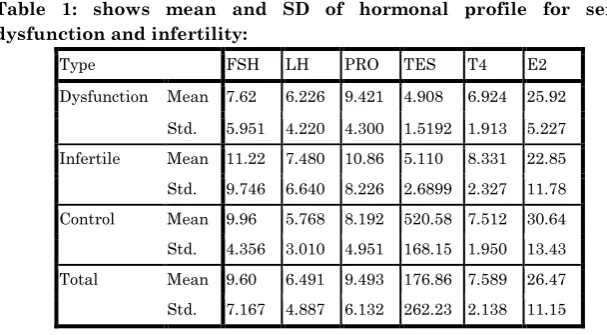
Table 1: shows mean and SD of hormonal profile for sexual dysfunction and infertility:
Type FSH LH PRO TES T4 E2
Dysfunction Mean 7.62 6.226 9.421 4.908 6.924 25.92
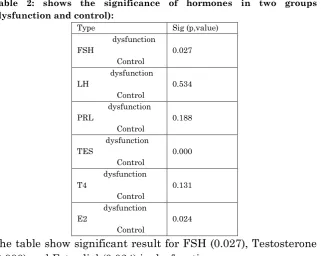
Table 2: shows the significance of hormones in two groups (dysfunction and control):
Type Sig (p,value)
dysfunction FSH Control 0.027 dysfunction LH Control 0.534 dysfunction PRL Control 0.188 dysfunction TES Control 0.000 dysfunction T4 Control 0.131 dysfunction E2 Control 0.024
The table show significant result for FSH (0.027), Testosterone (0.000) and Estradiol (0.024) in dysfunction group.
Table 3: shows the significance of hormones in two groups (infertile and control):
Type Sig (p,value) Infertile FSH Control 0.407 Infertile LH Control 0.101 Infertile PRL Control 0.052 Infertile TES Control 0.000 Infertile T4 Control 0.060 Infertile E2 Control 0.003
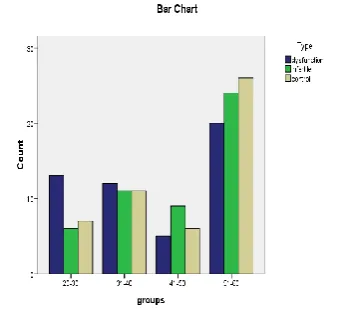
Figure 1: shows the frequency of sexually dysfunction, infertility and control groups according to the age group. The highly percentage of sexual dysfunction and infertility among age group between (51-60).
DISCUSSION
Understanding the dynamics of endocrine changes in the normally aging male is important not only because of the important role hormones play in the maintenance of sexual characteristics and sexual activity, but also for the diagnosis and management of endocrine and metabolic diseases. Data concerning the influence of age on androgens are inconsistent.
The results show decreased levels FSH, TES and E2 in sexually dysfunction and infertile groups.
Several researchers have reported a decrease in free and total testosterone concentrations, whereas others have failed to
find age-related changes in testosterone.8,12 Although
There is no relation between LH, T4 and PRL in both sexually dysfunction and infertile groups.
PRL has not been studied well in men with sexual dysfunction or infertility. Davidson et al, 1990 and Deslypere et al, 1984; found no correlation between male PRL levels and age, while Vekemans and Robyn reported, 1975 a slight rise in PRL
in 55 to 65 year-old men compared to those 20 years younger.14
-12-13.
CONCLUSION
Follicle Stimulation Hormone, Testosterone and Estradiol show decreased levels in dysfunction and infertility group. So, there is a relation between infertility and dysfunction with hormonal profile.
ACKNOWLEDGMENT
I wish to thanks firstly my supervisor Adil Nasr, Liza faculty of medical laboratory since at University of Khartoum.
Also I would like to thanks the participants and Al-Amal National Hospital.
REFERENCES
1. NIH Consensus Conference. Impotence. NIH Consensus
Development Panel on Impotence. JAMA. 1993; 270:83–90
2. Melman A, Gingell JC. The epidemiology and
pathophysiology of erectile dysfunction. J Urol. 199; 161:5–11
3 Makar RS, Toth TL"The evaluation of infertility". Am J Clin
Pathol. 117 (Suppl): S95–103 (2002).
6. McClure RD. Endocrine evaluation and therapy of erectile
dysfunction. Urol Clin North Am. 1988; 15:53–64]
7. Rosen RC, Riley A, Wagner G, Osterloh IH, Kirkpatrick J, Mishra A. The International Index of Erectile Function (IIEF): a multidimensional scale for assessment of erectile dysfunction. Urology. 1997; 49:822–830.
8. Feldman HA, Goldstein I, Hatzichristou DG, Krane RJ, McKinlay JB. Impotence and its medical and psychosocial
correlates: results of the Massachusetts Male Aging Study. J
Urol. 1994;151:54–61.
9. Gray A, Feldman HA, McKinlay JB, Longcope C. Age, disease and changing sex hormone levels in middle-aged men:
results of the Massachusetts Male Aging Study. J Clin
Endocrinol Metab. 1991;73:1016–1025.
10. Ansong KS, Punwaney RB. An assessment of the clinical relevance of serum testosterone level determination in the
evaluation of men with low sexual drive. J Urol. 1999;162(3 Pt
1):719–721.
11. Davidson JM, Camargo CA, Smith ER. Effects of androgen
on sexual behavior in hypogonadal men. J Clin Endocrinol
Metab. 1979;48:955–958.
12. Deslypere JP, Vermeulen A. Leydig cell function in normal
men: effect of age, life-style, residence, diet, and activity. J Clin
Endocrinol Metab. 1984;59:955–962.
13. Vekemans M, Robyn C. Influence of age on serum prolactin
levels in women and men. Br Med J. 1975;27:738–739.
14. Korenman SG, Morely JF, Mooradian AG, Davis SS, Kaiser FE, Silver AJ, et al. Secondary hypogonadism in older men: its
relation to impotence. J Clin Endocrinol Metab. 1990;71: 963–
969.