ISSN 2286-4822 www.euacademic.org
Impact Factor: 3.4546 (UIF) DRJI Value: 5.9 (B+)
A Study on Attitude of Physically Challenged
Students towards their Complicated Life
JAGADISH LAYA Research Scholar Dept. of Education, Sidho-Kanho-Birsha University Purulia Sainik School Ranchi Road, Purulia, West Bengal, India
PRANAB BARMAN1
Assistant Professor Dept. of Education, Sidho-Kanho-Birsha University Purulia Sainik School Ranchi Road, Purulia, West Bengal, India
Abstract:
In the present study an attempt has been made by the investigators to study the attitude of Physically Challenged Children towards their complicated life in the state of West Bengal, India. The investigators have used Descriptive Survey method for the present study. The sample consists of 100 physically challenged students who were reading in the different secondary schools which are situated in the district of Purulia, West Bengal, India. The Purposive sampling technique has been used for the selection of sample. The investigators have developed a Questionnaire by themselves to measure the attitude of Physically Challenged Children towards their complicated life. For the analysis of data Mean and S.D have been used by the investigators in the present study. The overall results of the study indicate that the level of attitude of physically challenged children towards their complicated life is poor. They expressed very poor or negative attitude against the various aspects of their complicated life that they are facing in their daily living.
Key words: Attitude, Physically Challenged, Children, Complicated Life.
Introduction:
There are various kinds of exceptional children whom we can see in our society, in our education system and across the whole world. Among these exceptional children, one of the most serious and considerable children are the Physically Challenged Children (PCC)or Physically Disabled Children who are facing and suffering from so many difficulties in their daily life, like problem of social adjustment, inferiority complex, poor educational performance, lack of self-confidence, social isolation, low self-esteem and so on (Gobala Krishnan, C, 2013).Generally we can see four types of physically challenged children in our society as well as in our education system. They are Physically Handicapped or Orthopedic Children, Blind or Visually Impaired Children, Deaf or Auditory Impaired Children and Dumb or Speech Impaired Children. (Gobala krishnan, C, 2013). All of them have some common problem that they are facing in their daily life due to their so many difficulties or disabilities. But the physically challenged children frequently suffer more due to societal prejudices than due to their disabling physical conditions.(Dalal, A.K., 2006).Because of the social and physical environment in which these physically challenged live is often designed without much consideration of their special needs.(Dalal, A.K., 2006).
their vision. Just about 2 million have speech disability, and 2 million are affected by mental retardation and other mental illnesses (Census of India, 2011).
There are 14.9 million men with disabilities as compared to 11.8 million women in India with the total number of disabled people over 18 million in the rural areas and just 8.1 million enumerated in the urban settings. The percentage of men with disabilities is 2.41 as against 2.01 in women (Census of India, 2011).
On the other side, State-wise data shows that out of 29 states of India Andhra Pradesh, Maharashtra, Orissa and Jammu and Kashmir have more than 2.51 per cent disabled population whereas in Tamil Nadu, Assam, Meghalaya, Assam and Nagaland, the percentage is less than 1.75. In the state of West Bengal out of total 91.35 million, 1.84 million people are suffering from different kinds of disability. It means that 2.02% people of the total population of the state (West Bengal) and 6.89% people of the total disabled population (26.8 million)of the country are disabled here in West Bengal (Census of India, 2011).
Table No-1: Proportion of Non-Disabled and Disabled Population in India, 2011
Groups Total No. of People Percentage (%)
Total Population 121,01,93,422 100%
Non-Disabled Population 118,33,82,865 97.79%
Disabled Population 2,68,10,557 2.21%
Source: Census of India, 2011
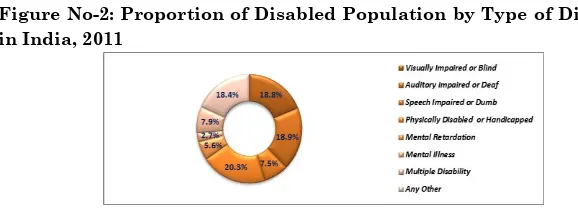
Table No-2: Proportion of Disabled Population by Type of Disability in India, 2011
Source: Census of India, 2011
Figure No-2: Proportion of Disabled Population by Type of Disability in India, 2011
Table No-3: Proportion of Disabled Population by Type of Disability against the Total Population in India, 2011
Source: Census of India, 2011
Types of Disability Total No. of People Percentage (%)
Visually Impaired or Blind 5032463 18.8
Auditory Impaired or Deaf 5071007 18.9
Speech Impaired or Dumb 1998535 7.5
Physically Disabled or Orthopaedic 5436604 20.3
Mental Retardation 1505624 5.6
Mental Illness 722826 2.7
Multiple Disability 2116487 7.9
Any Other 4927011 18.4
All Types of Disability 2,68,10,557 100%
Types of Disability Total No. of People Percentage (%)
Visually Impaired or Blind 5032463 0.42
Auditory Impaired or Deaf 5071007 0.42
Speech Impaired or Dumb 1998535 0.16
Physically Disabled or Orthopaedic 5436604 0.45
Mental Retardation 1505624 0.12
Mental Illness 722826 0.06
Multiple Disability 2116487 0.17
Any Other 4927011 0.41
Figure No-3: Graphical Representation of Proportion of Disabled Population by Type of Disability against the Total Population in India, 2011
Review of Related Literature:
In the field of education, perceptions towards children and adults with disabilities have changed significantly. According to Birch and John stone (1975), the greatest challenge in education today, is ensuring that all schools are as readily and fully accessible to persons with disabilities as to the non-disabled. From every standpoint, whether that of human rights, economic efficiency, or social desirability, the national interest should be to serve children with disabilities equally with all others.
A number of studies have been conducted in the field of attitude of people towards the physically challenged children throughout the world. Asian region shows that people experience wide discrimination because of their physical disability. Literature review in this area provides substantial evidence that the physically challenged children do feel discriminated in all societies (Lang, 1998). A National Survey has been conducted on physically challenged children in Korea (2002) and found that about 85% of the population with disabilities felt that they are discriminated against because of their physical condition (Kim, 2004).
2000) found that the prevailing disability attitudes of local communities and families of persons with disabilities were negative and patronizing. It was found through this comprehensive survey that 50% of the families in the rural sector felt that their members having disabilities could do nothing in terms of contributing to family income. These kind of negative attitudes are considered major sources of social discrimination in terms of delayed treatment and rehabilitation, school drop-out and for giving low priorities to disability services. Conducting a survey using the same measures in South India, Paterson (2000) found that the attitudes of Community–Based Rehabilitation (CBR) workers towards people with disabilities were not affected by age, gender, marital status, CBR work experience and contact with a person with a disability. Their attitudes are slightly more positive towards those with orthopaedic disabilities and more negative towards people with a visual impairment.
The Commission on Human Rights (2005) emphasized that education of persons with disabilities should be directed to the full development of the human personality and to the strengthening of respect for human rights and fundamental freedom. The knowledge of human rights, both in its theoretical dimension and its practical application, should be established as a priority in education policies. Integration constitutes an important vehicle for the elimination of stereotyped attitude, discrimination and ensuring equal opportunities through the promotion and protection of persons with disabilities (MOEST, 2003).
a victim of injustice showing arrogance, rebellion, reflection, aggressive demanding, viewing disability as a punishment for real or imagined infraction of family, becoming dependent and demanding as a form of seeking attention, affection and care.
“Children with disabilities exhibit unhappy behaviour characteristics of emotional disturbance. They may be very unhappy with very low self-esteem” (Ingule, Ronoh & Ndambuki, 1996, p.259). Physically challenged children self-concept depends on the way they view their disabilities and the way others treat them. In our society, the disabled persons are socially devalued and this gives clear evidence why disabled persons have low self-concept especially when they are in unconducive environment.
Keep in mind the problems of handicapped children that they are facing in their daily life, like family life, school life, social life, political life etc., the present researchers have intended to know and find out what perceptions or views do show the physically challenged children of the Purulia District of West Bengal, India about their complicated life that they are facing each and every moment of their daily living.
Need and Significance of the Study:
1. The present study helps to know the attitude of Physically Challenged Children of the district of Purulia, West Bengal towards their complicated life. 2. To conduct this study the present researchers have
constructed an Attitude Questionnaire which will be very helpful for other researchers to conduct future researches in the field of Physically Challenged Childrens‟ Attitude towards their complicated life. 3. The findings related to attitude of Physically Challenged
generating positive attitude among the physically challenged children and for solving their various problems which they are facing in their daily life.
4. The findings of the present study will also make awareness among the parents, teachers and peers of the physically challenged children that how to behave with this type of children in the school, society and other field of life.
Objectives of the Study:
The researcher has conducted his study on the basis of the following objectives:
1. To study the attitude of physically challenged children towards their complicated life.
Hypothesis of the Study:
H01: There would not have bad or negative attitude among the physically challenged children towards their complicated life.
Definition of the Terms:
Attitude:
Here in this study, the researchers have used the term „Attitude‟ in the sense that the opinions or views which are reflected by the School level Students of the district of Purulia, West Bengal about their challenging and complicated life.
Physically Challenged Children:
who have some kind of disability like deaf, dumb, visionless and orthopedic etc.
Complicated Life:
Here in this study, the researchers have used the term „Complicated Life‟ to mean that a such kind of life dealing by a physically challenged child in their daily living which is full of various problems, complexities, uncertainties, independency etc.
Methodology of the Study:
Method of the Study:
The present study is descriptive type in nature. The researchers have used the descriptive type survey method in the present study. Therefore, naturally the investigators have used different tools, techniques, strategies and method of descriptive survey research to collect, analyze and interpret the data.
Population of the Study:
All physically challenged children of the district of Purulia have been treated as population for the present study.
Sample of the Study:
The researchers have selected only 100 differently Physically Challenged Students (PCS-including Grade-V to Grade-XII) from 9 (Nine) selected secondary schools which are situated in the district of Purulia have been treated as a sample for the present study.
Sampling Technique:
Tool of the Study:
The investigators have used a Questionnaire as a tool for collecting the data in the present study. The Questionnaire consists of 30 items with the combination of positive (13) and negative (17) items. The Questionnaire has been constructed on the basis of Likert‟s five point scale i.e. Strongly Agree (S.A), Agree (A), Indifferent (I), Disagree (D) and Strongly Disagree (S.D).
Techniques of Data Analysis:
The present investigators have used Mean and S.D. for analyzing the data.
Techniques of Measuring the Level of Attitude:
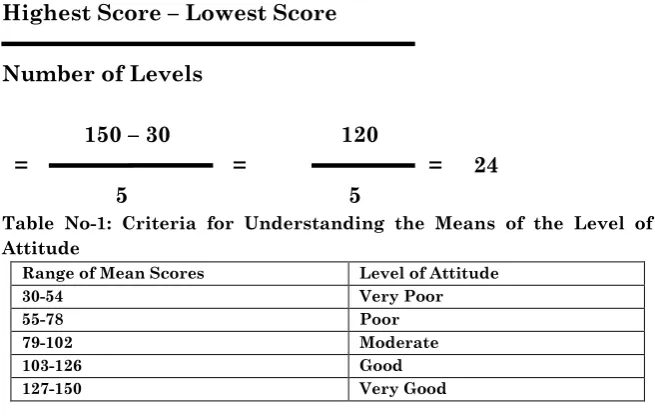
After all the items are scored, the scores of all the 30 items are added to obtain the total score of an individual on the Attitude Questionnaire. The range of the total score is 30-150 as the Questionnaire is constructed on the basis of 5 point Likert Scale. Therefore, the Level of Attitude is considered from Score of the answers and is classified into 5 levels to the Best‟s Criteria (1977) as follows-
Highest Score – Lowest Score
Number of Levels
150 – 30 120
= = = 24 5 5
Table No-1: Criteria for Understanding the Means of the Level of Attitude
Range of Mean Scores Level of Attitude
30-54 Very Poor
55-78 Poor
79-102 Moderate
103-126 Good
Results:
H1: There would have bad or negative attitude among the physically challenged children towards their complicated life.
Table No-2: Shows the Number, Mean and S.D of the Total Students
Group Number Mean S.D
Students 100 68.24 18.45
Note: 30-54=Very Poor, 55-78=Poor, 79-102=Moderate, 103-126=Good and 127-150=Very Good.
From the above table, we can see that the obtained Mean Score of the Students is 68.24 and S.D is 18.45. On the basis of the Best‟s Criteria, the obtained Mean Score of the students is 68.24 which fall under the range of Mean Scores of 55-78. It indicates that the level of attitude of the students fall under the Poor range group. Therefore, the null hypothesis is rejected and we can say that the level of attitude of the Physically Challenged Children of Purulia district towards their complicated life is at Poor level.
Item wise Analysis of the Levels of Agreement Expressed by the Students
SL. No.
Items/Statements Levels of Agreement
Frequency Percentage (%)
1 Nothing but aching and troubles in the life of Physically Challenged Children.
S.A 86 86
A 2 2
I 1 1
D 1 1
S.D 10 10
2 To spent life as being a Physically Challenged Child is very pleasurable.
S.A 2 2
A 3 3
I 3 3
D 13 13
S.D 79 79
3 Hopeless, deprivation and disrespect are the common facts to the Physically Challenged Children.
S.A 78 78
A 13 13
I 1 1
D 3 3
S.D 5 5
4 Physically Challenged Children are self dependent like other normal children.
S.A 0 0
A 32 32
D 9 9
S.D 58 58
5 Being a Physically Challenged Child the life seems to me valueless.
S.A 57 57
A 1 1
I 0 0
D 1 1
S.D 41 41
6 Physically Challenged Children can enjoy their life very smoothly like other normal children.
S.A 1 1
A 8 8
I 1 1
D 36 36
S.D 54 54
7 Being a Physically Challenged Child, I become a burden to my family members.
S.A 79 79
A 9 9
I 1 1
D 3 3
S.D 8 8
8 Like other normal children, I also get equal importance from my family, society and country.
S.A 6 6
A 9 9
I 4 4
D 43 43
S.D 38 38
9 Physically Challenged Children are deprived from all the happiness or enjoyment in this world.
S.A 41 41
A 9 9
I 3 3
D 34 34
S.D 13 13
10 In any festival organized by the school or society, I get equal importance.
S.A 3 3
A 12 12
I 3 3
D 9 9
S.D 73 73
11 Physically Challenged Children are socially deprived form various aspects.
S.A 80 80
A 3 3
I 3 3
D 7 7
S.D 7 7
12 Physically Challenged Children get love and affection from all.
S.A 20 20
A 18 18
I 2 2
D 16 16
S.D 44 44
13 There is nothing worth of education in Physically Challenged Children‟s life.
S.A 13 13
A 2 2
I 2 2
D 26 26
S.D 57 57
14 Education helps to build up personality of the Physically Challenged Children.
S.A 86 86
A 3 3
I 2 2
D 2 2
S.D 7 7
angle of mercy in the society. A 9 9
I 3 3
D 3 3
S.D 5 5
16 Physically Challenged Children are dependent to other in so many aspects of their life.
S.A 49 49
A 37 37
I 0 0
D 5 5
S.D 9 9
17 Everybody help the Physically Challenged Children.
S.A 18 18
A 25 25
I 6 6
D 16 16
S.D 35 35
18 My friends and teachers ignore me in the school.
S.A 25 25
A 6 6
I 2 2
D 14 14
S.D 53 53
19 The Physically Challenged Children are equally treated by all.
S.A 12 12
A 25 25
I 9 9
D 11 11
S.D 43 43
20 Being a Physically Challenged Child, I feel lack of confidence in various aspects of my life.
S.A 85 85
A 8 8
I 1 1
D 1 1
S.D 5 5
21 Physically Challenged Children can solve any problem of their life by themselves without the help of others.
S.A 7 7
A 5 5
I 2 2
D 36 36
S.D 50 50
22 Physical disability has reduced my natural ability to work in my life.
S.A 95 95
A 2 2
I 0 0
D 1 1
S.D 2 2
23 Inspite of being a Physically Challenged, I am also able to reach at the highest goal of my life.
S.A 74 74
A 6 6
I 2 2
D 6 6
S.D 12 12
24 Being a Physically Challenged, I have no special importance in the progress of the society as well as in the country.
S.A 19 19
A 32 32
I 5 5
D 20 20
S.D 24 24
25 Physically Challenged Children get equal honour and importance in the various aspects of the society and the life.
S.A 30 30
A 13 13
I 3 3
S.D 43 43 26 My Physical disability pulled me
behind very long in any competitions of my life.
S.A 67 67
A 7 7
I 1 1
D 24 24
S.D 1 1
27 Like other normal children, Physically Challenged Children are also equally honored by all in the field of education.
S.A 4 4
A 11 11
I 31 31
D 20 20
S.D 34 34
28 I suffer from inferiority complex in every moment for my poor physical condition.
S.A 82 82
A 12 12
I 0 0
D 2 2
S.D 4 4
29 It is an offence to born as a Physically Challenged Child.
S.A 64 64
A 1 1
I 2 2
D 0 0
S.D 33 33
30 The Life and world of Physically Challenged Children is full of darkness.
S.A 63 63
A 2 2
I 1 1
D 2 2
S.D 32 32
Note: Strongly Agree (S.A), Agree (A), Indifferent (I), Disagree (D) and Strongly Disagree (S.D).
Discussion:
Item No-1: The above table shows that out of 100 Physically Challenged Students (PCS), 86%, 2%, 1%, 1% and 10% Students have given their opinion at the level of Strongly Agree, Agree, Indifferent, Disagree and Strongly Disagree against the Item No-1 respectively. It means that the total 88% PCS are agree, 1% PCS are indifferent and 11% PCS are disagree with the item no-1. So, it can be said that most of the Physically Challenged Students think that there is nothing but aching and troubles in their life.
No-1 respectively. It means that the total 5% PCS are agree, 3% PCS are indifferent and 92% PCS are disagree with the item no-2. So, it can be said that most of the Physically Challenged Students think that to spent life as being a Physically Challenged Child is not pleasurable to them.
Item No-3: The above table shows that out of 100 Physically Challenged Students, 78%, 13%, 1%, 3% and 5% Students have given their opinion at the level of Strongly Agree, Agree, Indifferent, Disagree and Strongly Disagree against the Item No-3 respectively. It means that the total 91% PCS are agree, 1% PCS are indifferent and 8% PCS are disagree with the item no-3. So, it can be said that most of the Physically Challenged Students think that Hopeless, deprivation and disrespect are the common facts to them.
Item No-4: The above table shows that out of 100 Physically Challenged Students, 0%, 32%, 1%, 9% and 58% Students have given their opinion at the level of Strongly Agree, Agree, Indifferent, Disagree and Strongly Disagree against the Item No-4 respectively. It means that the total 32% PCS are agree, 1% PCS are indifferent and 76% PCS are disagree with the item no-4. So, it can be said that most of the Physically Challenged Students think that they are not self dependent like other normal children.
Item No-5: The above table shows that out of 100 Physically Challenged Students, 57%, 1%, 0%, 1% and 41% Students have given their opinion at the level of Strongly Agree, Agree, Indifferent, Disagree and Strongly Disagree against the Item No-5 respectively. It means that the total 58% PCS are agree, 0% PCS are indifferent and 42% PCS are disagree with the item no-5. So, it can be said that most of the Physically Challenged Students think that being a Physically Challenged Child the life seems to them valueless.
Indifferent, Disagree and Strongly Disagree against the Item No-6 respectively. It means that the total 9% PCS are agree, 1% PCS are indifferent and 90% PCS are disagree with the item no-6. So, it can be said that most of the Physically Challenged Students think that they cannot enjoy their life very smoothly like other normal children.
Item No-7: The above table shows that out of 100 Physically Challenged Students, 79%, 9%, 1%, 3% and 8% Students have given their opinion at the level of Strongly Agree, Agree, Indifferent, Disagree and Strongly Disagree against the Item No-7 respectively. It means that the total 88% PCS are agree, 1% PCS are indifferent and 11% PCS are disagree with the item no-7. So, it can be said that most of the Physically Challenged Students think that being a Physically Challenged Child, they become a burden to their family members.
Item No-8: The above table shows that out of 100 Physically Challenged Students (PCS), 6%, 9%, 4%, 43% and 38% Students have given their opinion at the level of Strongly Agree, Agree, Indifferent, Disagree and Strongly Disagree against the Item No-8 respectively. It means that the total 15% PCS are agree, 4% PCS are indifferent and 81% PCS are disagree with the item no-8. So, it can be said that most of the Physically Challenged Students think that like other normal children, they do not get equal importance from their family, society and country.
Item No-10: The above table shows that out of 100 Physically Challenged Students, 3%, 12%, 3%, 9% and 73% Students have given their opinion at the level of Strongly Agree, Agree, Indifferent, Disagree and Strongly Disagree against the Item No-10 respectively. It means that the total 15% PCS are agree, 3% PCS are indifferent and 82% PCS are disagree with the item no-10. So, it can be said that most of the Physically Challenged Students think that in any festival organized by the school or society, they do not get equal importance.
Item No-11: The above table shows that out of 100 Physically Challenged Students, 80%, 3%, 3%, 7% and 7% Students have given their opinion at the level of Strongly Agree, Agree, Indifferent, Disagree and Strongly Disagree against the Item No-11 respectively. It means that the total 83% PCS are agree, 3% PCS are indifferent and 14% PCS are disagree with the item no-11. So, it can be said that most of the Physically Challenged Students think that they are socially deprived form various aspects.
Item No-12: The above table shows that out of 100 Physically Challenged Students, 20%, 18%, 2%, 16% and 44% Students have given their opinion at the level of Strongly Agree, Agree, Indifferent, Disagree and Strongly Disagree against the Item No-12 respectively. It means that the total 38% PCS are agree, 2% PCS are indifferent and 60% PCS are disagree with the item no-12. So, it can be said that most of the Physically Challenged Students think that they do not get love and affection from all.
Challenged Students think that there is nothing worth of education in their life.
Item No-14: The above table shows that out of 100 Physically Challenged Students, 86%, 3%, 2%, 2% and 7% Students have given their opinion at the level of Strongly Agree, Agree, Indifferent, Disagree and Strongly Disagree against the Item No-14 respectively. It means that the total 89% PCS are agree, 2% PCS are indifferent and 9% PCS are disagree with the item no-14. So, it can be said that most of the Physically Challenged Students think that it is true that Education can help to build up their personality.
Item No-15: The above table shows that out of 100 Physically Challenged Students, 80%, 9%, 3%, 3% and 5% Students have given their opinion at the level of Strongly Agree, Agree, Indifferent, Disagree and Strongly Disagree against the Item No-15 respectively. It means that the total 89% PCS are agree, 3% PCS are indifferent and 8% PCS are disagree with the item no-15. So, it can be said that most of the Physically Challenged Students think that really all people perceive them in an angle of mercy in the society.
Item No-16: The above table shows that out of 100 Physically Challenged Students, 49%, 37%, 0%, 5% and 9% Students have given their opinion at the level of Strongly Agree, Agree, Indifferent, Disagree and Strongly Disagree against the Item No-16 respectively. It means that the total 86% PCS are agree, 0% PCS are indifferent and 14% PCS are disagree with the item no-16. So, it can be said that most of the Physically Challenged Students think that really they are dependent to other in so many aspects of their life.
item no-17. So, it can be said that most of the Physically Challenged Students think that everybody do not help the physically challenged children.
Item No-18: The above table shows that out of 100 Physically Challenged Students, 25%, 6%, 2%, 14% and 53% Students have given their opinion at the level of Strongly Agree, Agree, Indifferent, Disagree and Strongly Disagree against the Item No-18 respectively. It means that the total 31% PCS are agree, 2% PCS are indifferent and 67% PCS are disagree with the item no-18. So, it can be said that most of the Physically Challenged Students think that their friends and teachers do not ignore them in the school.
Item No-19: The above table shows that out of 100 Physically Challenged Students, 12%, 25%, 9%, 11% and 43% Students have given their opinion at the level of Strongly Agree, Agree, Indifferent, Disagree and Strongly Disagree against the Item No-19 respectively. It means that the total 37% PCS are agree, 9% PCS are indifferent and 54% PCS are disagree with the item no-19. So, it can be said that most of the Physically Challenged Students think that they are not equally treated by all.
Item No-20: The above table shows that out of 100 Physically Challenged Students, 85%, 8%, 1%, 1% and 5% Students have given their opinion at the level of Strongly Agree, Agree, Indifferent, Disagree and Strongly Disagree against the Item No-20 respectively. It means that the total 93% PCS are agree, 1% PCS are indifferent and 6% PCS are disagree with the item no-20. So, it can be said that most of the Physically Challenged Students think that being a Physically Challenged Child, they feel lack of confidence in various aspects of their life.
2% PCS are indifferent and 86% PCS are disagree with the item no-21. So, it can be said that most of the Physically Challenged Students think that they cannot solve any problem of their life by themselves without the help of others.
Item No-22: The above table shows that out of 100 Physically Challenged Students, 95%, 2%, 0%, 1% and 2% Students have given their opinion at the level of Strongly Agree, Agree, Indifferent, Disagree and Strongly Disagree against the Item No-22. Respectively It means that the total 97% PCS are agree, 0% PCS are indifferent and 3% PCS are disagree with the item no-22. So, it can be said that most of the Physically Challenged Students think that really physical disability has reduced their natural ability to work in their life.
Item No-23: The above table shows that out of 100 Physically Challenged Students, 74%, 6%, 2%, 6% and 12% Students have given their opinion at the level of Strongly Agree, Agree, Indifferent, Disagree and Strongly Disagree against the Item No-23 respectively. It means that the total 80% PCS are agree, 2% PCS are indifferent and 18% PCS are disagree with the item no-23. So, it can be said that most of the Physically Challenged Students think that inspite of being a physically challenged, they are also able to reach at the highest goal of their life.
Item No-24: The above table shows that out of 100 Physically Challenged Students, 19%, 32%, 5%, 20% and 24% Students have given their opinion at the level of Strongly Agree, Agree, Indifferent, Disagree and Strongly Disagree against the Item No-24 respectively. It means that the total 51% PCS are agree, 5% PCS are indifferent and 44% PCS are disagree with the item no-24. So, it can be said that most of the Physically Challenged Students think that being a physically challenged; they have no special importance in the progress of the society as well as in the country.
have given their opinion at the level of Strongly Agree, Agree, Indifferent, Disagree and Strongly Disagree against the Item No-25 respectively. It means that the total 43% PCS are agree, 3% PCS are indifferent and 54% PCS are disagree with the item no-25. So, it can be said that most of the Physically Challenged Students think that they do not get equal honour and importance in the various aspects of the society and the life.
Item No-29: The above table shows that out of 100 Physically Challenged Students, 64%, 1%, 2%, 0% and 33% Students have given their opinion at the level of Strongly Agree, Agree, Indifferent, Disagree and Strongly Disagree against the Item No-29 respectively. It means that the total 65% PCS are agree, 2% PCS are indifferent and 33% PCS are disagree with the item no-29. So, it can be said that most of the Physically Challenged Students think that it is an offence to born as a physically challenged child.
Item No-30: The above table shows that out of 100 Physically Challenged Students, 63%, 2%, 1%, 2% and 32% Students have given their opinion at the level of Strongly Agree, Agree, Indifferent, Disagree and Strongly Disagree against the Item No-30 respectively. It means that the total 65% PCS are agree, 1% PCS are indifferent and 34% PCS are disagree with the item no-30. So, it can be said that most of the Physically Challenged Students think that it is true that the Life and world of them is full of darkness.
Major Findings of the Study:
1. It is found that the level of attitude of the Physically Challenged Students of Purulia district towards their complicated life is Poor or bad. It means that the physically challenged students of Purulia district are not happy with the various aspects of their complicated life that they are facing each and every moment in their daily life. They expressed very negative or bad attitude about most of the aspects of their complicated life.
3. It is found that most of the Physically Challenged Students think that to spent life as being a Physically Challenged Child is not pleasurable to them.
4. It is found that most of the Physically Challenged Students think that Hopeless, deprivation and disrespect are the common facts to them.
5. It is found that most of the Physically Challenged Students think that they are not self dependent like other normal children.
6. It is found that most of the Physically Challenged Students think that being a Physically Challenged Child the life seems to them valueless.
7. It is found that most of the Physically Challenged Students think that they cannot enjoy their life very smoothly like other normal children.
8. It is found that most of the Physically Challenged Students think that being a Physically Challenged Child, they become a burden to their family members. 9. It is found that most of the Physically Challenged
Students think that like other normal children, they do not get equal importance from their family, society and country.
10.It is found that most of the Physically Challenged Students think that they are deprived from all the happiness or enjoyment in this world.
11.It is found that most of the Physically Challenged Students think that in any festival organized by the school or society, they do not get equal importance. 12.It is found that most of the Physically Challenged
Students think that they are socially deprived form various aspects.
14.It is found that most of the Physically Challenged Students think that there is nothing worth of education in their life.
15.It is found that most of the Physically Challenged Students think that it is true that Education can help to build up their personality.
16.It is found that most of the Physically Challenged Students think that really all people perceive them in an angle of mercy in the society.
17.It is found that most of the Physically Challenged Students think that really they are dependent to other in so many aspects of their life.
18.It is found that most of the Physically Challenged Students think that everybody do not help the physically challenged children.
19.It is found that most of the Physically Challenged Students think that their friends and teachers do not ignore them in the school.
20.It is found that most of the Physically Challenged Students think that they are not equally treated by all. 21.It is found that most of the Physically Challenged
Students think that being a Physically Challenged Child, they feel lack of confidence in various aspects of their life.
22.It is found that most of the Physically Challenged Students think that they cannot solve any problem of their life by themselves without the help of others. 23.It is found that most of the Physically Challenged
Students think that really physical disability has reduced their natural ability to work in their life.
25.It is found that most of the Physically Challenged Students think that being a physically challenged; they have no special importance in the progress of the society as well as in the country.
26.It is found that most of the Physically Challenged Students think that they do not get equal honour and importance in the various aspects of the society and the life.
27.It is found that most of the Physically Challenged Students think that really their physical disability pulled them behind very long in any competitions of their life.
28.It is found that most of the Physically Challenged Students think that like other normal children, they are not equally honored by all in the field of education. 29.It is found that most of the Physically Challenged
Students think that really they suffer from inferiority complex every moment for their poor physical condition. 30.It is found that most of the Physically Challenged
Students think that it is an offence to born as a physically challenged child.
31.It is found that most of the Physically Challenged Students think that it is true that the Life and world of them is full of darkness.
Conclusion:
children of Purulia district towards their complicated life is at Poor level. It means that physically challenged children of Purulia district think that there is nothing but full of darkness, troubles, disrespects, deprivation are the common matter in their life. They suffer from inferiority complex every moment in their life for their poor physical condition. Like other normal children, they are not equally honored by all in the field of education. They do not get equal honour and importance in the various aspects of the society and the life. They think that being a physically disabled they have no special importance in the progress of the society as well as in the country. They think that really they are dependent to other in so many aspects of their life. They think that all the people perceive them in an angle of mercy in the society. They think that being a physically disabled they become a burden to their family members. That‟s why they think that it is an offence to born as a physically challenged children. They think that they are deprived from all happiness or enjoyment in this world. But one positive thing came out through the study that the physically challenged children think that inspite of being a physically challenged, they are also able to reach at the highest goal of their life.
compliments from parents, teachers, peers and other significant persons (Wylie, 1974).
Therefore, some effective measures, like increasing job opportunities, provisions of participation in social activities, special educational treatments, giving respect and honour to them etc. should have to take by our government at both state and central level to improve the positive attitude among the physically challenged children. In this regard, the Commission of Human Rights (2000) also emphasized that, governments should work towards developing appropriate education policies and practices for children with disabilities in strategies and plans aimed at eradicating poverty, promoting education and enhancing employment and to take account of the rights of persons with disabilities to education and supportive equipment. So that gradually they become our national wealth, economically they can be self dependent and they can actively participate for the development of our Country.
That‟s why the Kothari Education Commission (1964-66) has given opinion for education of the physically challenged or backwards children. Not for humanity but need of their daily life, they should be learned. We have to make them Competitive or expert citizen by giving suitable education. National Policy on Education (NPE, 1986) and Ashok Mitra Commission (1992) have given importance for the education of the physically challenged students; they have told that every child has right to education.
REFERENCES:
Best, J.W. (1977). Research in Education, Eaglewood Cliffs, New Jersey, Prentice Hall.
Census Report-2011, Ministry of Home Affairs, Government of India, New Delhi.
Childline India Information, Child Rights Information Network (CRIN).
Chomba Wa Munyi. (2012). Past and Present Perceptions towards Disability: A Historical Perspective. Disability Studies Quarterly,Vol 32, No 2.
Dalal, A.K. (2006). Social Interventions to Moderate Discriminatory Attitudes: The Case of the Physically Challenged in India. Psychology, Health & Medicine,
11(3): 374 – 382.
Dalal, A. K., Pande, N., Dhawan, N., Dwijendra, D., & Berry, J. (2000). The Mind matters: Disability Attitudes and
Community based Rehabilitation. Allahabad: University
of Allahabad, India.
Gobalakrishnan, C. (2013). Problem Faced By Physically Challenged Persons and Their Awareness towards Welfare Measures. International Journal of Innovative Research & Development, Vol.2, Issue.4, pp.487-493. Ingule, F. O., Ronoh, R., & Ndambuki, P. W. (1996).
Introduction to Educational Psychology. Nairobi: East Africa Educational Publishers.
Kim, S. S. (2004). Korea’s Strategy for Enacting Disability Discrimination Legislation. Seoul: Korean Society for Rehabilitation of Persons with Disability.
Lang, R. (1998). Guest editorial: A Critique of the Disability Movement. Asia Pacific Disability Rehabilitation Journal, 9(1), 1 – 12.
Journal of Current Research, Vol. 4, Issue, 09, pp.225-230.
National Policy on Education (NPE-1986), Ministry of Human Resource Development, Government of India.
Paterson, J. (2000). Workers of South India their Attitudes and their Education. Asia Pacific Disability Rehabilitation Journal, 10(1), 1 – 16.
Report of Ashok Mitra Commission (1992), Government of West Bengal.
Report of the Kothari Education Commission (1964-66), Ministry of Education, Government of India.
Rose, A. C. (1971). The Social and Emotional Development of Children in Long-term Residential Care: Therapeutic Education. New York: Spring.
Wylie, C. R. (1974). The Self-Concept: a Review of Methodological Considerations and Measuring Instruments. Lincoln: University of Nebraska Press. http://censusindia.gov.in