© 2014, IJCSMC All Rights Reserved
25
Available Online at www.ijcsmc.com
International Journal of Computer Science and Mobile Computing
A Monthly Journal of Computer Science and Information Technology
ISSN 2320–088X
IJCSMC, Vol. 3, Issue. 11, November 2014, pg.25 – 31
RESEARCH ARTICLE
Network Based Traffic Control
R.T.Udhayakumar
1, L.Gomathi
21
Research Scholar
2Assistant Professor Department of BCA
12Muthayammal College of Arts & Science, Rasipuram
1[email protected]@gmail.com
2[email protected]
Abstract— In this paper, we propose to concurrently search for a number of mobile users in a wireless cellular network based on the probabilistic information about the locations of mobile users. The concurrent search approach guarantees that all mobile users will be located within time slots. It is shown that even in the worst case when mobile users appear equally in all the cells of the network, the concurrent search approach is able to reduce the average paging cost by 25%. More importantly, this is achieved without an increase in the worst case paging delay or in the worst case paging cost. Depending on the total number of mobile users to be located, total number of cells in the network, and the probabilistic information about the locations of mobile users, the reduction of the average paging cost due to the usage of the concurrent search approach ranges from 25% to 88%. The case in which perfect probabilistic information is unavailable is also studied.
Index Terms— Cellular networks, concurrent search, probabilistic location information
1. INTRODUCTION
© 2014, IJCSMC All Rights Reserved
26
1.1 Average Paging Cost
In this section, we show that even when every mobile user resides equally in all the cells, which is the worst case for improvement with the concurrent search scheme, reduction of the average paging cost can still be achieved by concurrent search. In this case, solving independent sequential paging problems can solve the concurrent search problem.
1.2 Connections
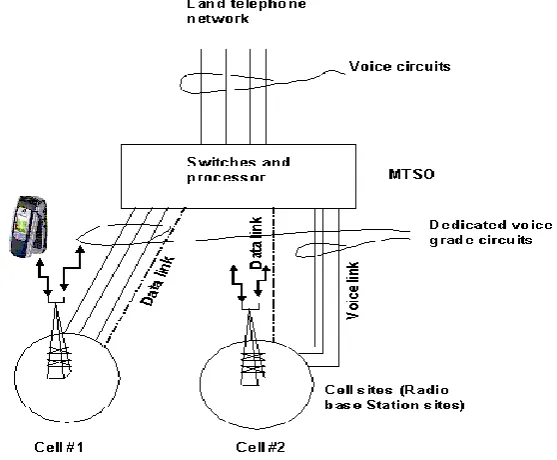
The radio and high-speed data links connect the three subsystems. Each mobile unit can only use one channel at a time for its communication link. But the channel is not fixed; it can be any one in the entire band assigned by the serving area, with each site having multichannel capabilities that can connect simultaneously to many mobile units. The radio link carries the voice and signalling between the mobile unit and the cell site.
Figure 1. Cellular system
2. OPERATION OF CELLULAR SYSTEMS
This section briefly describes the operation of the cellular mobile system from a customer’s perception without touching on the design parameters. The operation can be divided into four parts and a handoff procedure [7].
Mobile unit initialization Mobile originated call Network originated call Call termination Handoff procedure
2.1 Mobile unit initialization
When a mobile user activates the receiver of the mobile unit, the receiver scans 21 set-up channels which are designated among the 416 channels. Then it selects the strongest and locks on for a certain time. Since each site is assigned a different set-up channel, locking onto the strongest set-up channel usually means selecting the nearest cell site. This self-location scheme is used in the idle stage and is user-independent.
© 2014, IJCSMC All Rights Reserved
27
Since a large percentage of calls originate at the mobile unit, the use of self-location schemes is justified. After 60 s, the self-location procedure is repeated. In the future, when land-line originated calls increase, a feature called “registration” can be used.
2.2 Mobile originated call
The user places the called number into an originating register in the mobile unit, checks to see that the number is correct, and pushes the “send” button. A request for service is sent on a selected set-up channel obtained from a self-location scheme. The cell site receives it, and in directional cell sites, selects the best directive antenna for the voice channel to use. At the same time the cell site sends a request to the MTSO via a high-speed data link. The MTSO selects an appropriate voice channel for the call, and the cell site acts on it through the best directive antenna to link the mobile unit. The MTSO also connects the wire-line party through the telephone company zone office.
2.3 Network originated call
A land-line party dials a mobile unit number. The telephone company zone office recognizes that the number is mobile and forwards the call to the MTSO. The MTSO sends a paging message to certain cell sites based on the mobile unit number and the search algorithm. Each cell site transmits the page on its own set-up channel.
The mobile unit recognizes its own identification on a strong set-up channel, locks onto it, and responds to the cell site. The mobile unit also follows the instruction to tune to an assigned voice channel and initiate user alert.
2.4 Call termination
When the mobile user turns off the transmitter, a particular signal (signalling tone) transmits to the cell site, and both sides free the voice channel. The mobile unit resumes monitoring pages through the strongest set-up channel.
2.5 Handoff procedure
During the call, two parties are on the voice channel. When the mobile unit moves out of the coverage area of a particular cell sit, the reception becomes weak. The present cell site requests a handoff. The system switches the call to a new frequency channel in a new cell site without either interrupting the call or alerting the user. The call continues as long as the user is talking. The user does not notice the handoff occurrences. Handoff was first used by the AMPS system, then renamed handover by the European systems because the different meanings in English and American English.
2.5.1 Advantages of Handoff procedure:
If the neighbouring cells are busy, delayed handoff may take place.
When call traffic is heavy, the switching processor is loaded, and thus a lower number of handoffs would help the processor handle call processing more adequately.
A two-handoff-level algorithm is that it makes the handoff occur at the proper location and eliminates possible interference in the system
To realize that hexagonal-shaped communication cells are artificial and that such a shape cannot be generated in the real world. Engineers draw hexagonal-shaped cells on a layout to simplify the planning and design of a cellular system because it approaches a circular shape that is the ideal power coverage area.
3. DEMERITS
Increase in average paging cost Sequential searching of mobile users In Worst case, Paging delay
In earlier systems, the location of the mobile user is found by searching each and every cell of the cellular network for a single user. After locating that particular user the system goes for searching the next user. This will take more time to search a user one by one and to locate. Thus it increases the paging time. This will decrease the performance of the system.
© 2014, IJCSMC All Rights Reserved
28
3.1. Existing system
In a cellular network, when there is a call to a mobile user arrives, a mobility management scheme is present which is responsible for finding the current cell in which the mobile user resides. A mobile management scheme constitutes of a location update scheme and a paging scheme [5].
Inefficient paging scheme Paging delay
Paging cost
Sequential searching
Inefficient paging scheme occurs due to randomly searching of mobile user in a particular zone. Sometimes if the mob XISTING Stile user make call to the destination they hear busy tone even in the best case. This is due to searching of mobile user randomly in each cell. Thus it leads to delay occur in searching process and it increases the paging cost for searching the mobile user. Currently they are using the sequential searching process. This increases the time taken to search a mobile user in a cellular network.
3.2. PROPOSED SYSTEM
In proposed system, it searches a number of mobile users concurrently in a wireless cellular network based on the probabilistic information about the location of mobile users [4]. This approach guarantees that all k mobile users will be located within ktime slots and it reduces the average paging cost. This is achieved without increasing the worst case paging delay or the worst case paging cost. Depending upon the number of mobile users to be located, total number of cells in the network and the probabilistic information about the locations of mobile users, the reduction of average paging cost is due to the usage of the concurrent search approach ranges from 25% to 88% [5].
Conditional probability Heuristic Algorithm Dynamic searching
Cost estimation
To overcome these problem which is specified in the existing system go for the concurrent searching scheme .In this scheme the system searches two or more number of mobile users at a single time slot. Each cell is searched for a mobile user in a time slot. So it can easily overcome all the problems.
In this proposed system, it is applicable to all the wireless technology that is GSM, TDMA and CDMA. Each and every technology uses some additional features to this system. This system is capable for all the current systems and is mainly designed for matching the current and future technology. The algorithm is also focused on the future.
4. Global System for Mobile Communication (GSM)
GSM's air interface is based on narrowband TDMA technology, where available frequency bands are divided into time slots, with each user having access to one time slot at regular intervals. Narrow band TDMA allows eight simultaneous communications on a single 200 KHz carrier and is designed to support 16 half-rate channels. The fundamental unit of time in this TDMA scheme is called a burst period and it lasts 15/26 ms (or approx. 0.577 ms). Eight burst periods are grouped into a TDMA frame (120/26 ms, or approx. 4.615 ms), which forms the basic unit for the definition of logical channels. One physical channel is one burst period per TDMA frame. A GSM mobile can seamlessly roam nationally and internationally, which requires that registration, authentication, call routing and location updating functions exist and be standardized in GSM networks.
© 2014, IJCSMC All Rights Reserved
29
For point-to-point SMS, a message can be sent to another subscriber to the service, and an acknowledgment of receipt is provided to the sender. SMS can also be used in a cell-broadcast mode, for sending messages such as traffic updates or news updates. Messages can also be stored in the SIM card for later retrieval. The European version of GSM operates at the 900 MHz frequency (and now at the newer 1800 MHz frequency). Since the North American version of GSM operates at the 1900 MHz frequency, the phones are not interoperable, but the SIMs is Dual-band 900 -1800 and 900 -1900 phones are already released and in production. Tri-band 900 -1800 -1900 GSM phone are expected to be manufactured in the next few years, which will allow interoperability between Europe and North America.
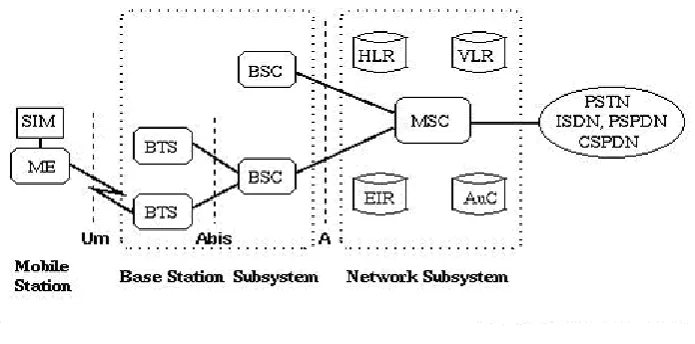
A GSM network consists of mobile stations talking to the base transceiver station, on the Um interface. Many BTS are connected to a BSC via the Abis interface and the BSC connect to the MSC (The core switching network) via the A interface. HLR and VLR provide customized subscriber services and allow seamless movement from one cell to another. The Authentication register and the equipment register provide security and authentication.
Figure 2 Components of GSM
An OMC and a cell broadcast center allow configuration of the network and provide the cell broadcast service in the GSM network (not shown in the diagram).The voice transmitted on the air interface can be encrypted. The speech is coded at 13kbps over the air interface. Using EFR the voice quality approaches the land line quality [4].
Recent developments like AMR allow speech coding and channel coding to be dynamically adjusted giving acceptable performance even in case of bad radio conditions. The GSM network supports automatic handovers. Since the mobiles are not transmitting or receiving at all times battery consumption can be conserved. Further using DTX and DRX (Discontinuous transmission and reception, mobile transmits or receives only when there is a voice activity detection) batter power can be conserved even more - a highly desirable characteristic of any mobile system. Also since the mobile is not transmitting or receiving at all times, this allows the mobile to listen to control channels and to provide useful information about other channels back to the cell.
4.1 Recent developments and initiatives include:
GSM Association together with the Universal Wireless Communications Consortium (UWCC), which represents the interests of the TDMA community, are working towards inter-standard roaming between GSM and TDMA (ANSI-136) networks.
The majority of European GSM operators plan to implement general packet radio system (GPRS) technology as their network evolution path to third-generation
© 2014, IJCSMC All Rights Reserved
30
capabilities that currently exist within WAP by enabling a more flexible user- interface, more powerful features and security.
GSM cordless telephone system to provide a small home base station to work with a standard GSM mobile phone in similar mode to a cordless phone. The base station would be connected to the PSTN. Number portability will allow customers to retain their mobile numbers when they change operators or
service providers
Location services to standardize the methods for determining a GSM subscriber's physical location Tandem free operation where the compressed speech is passed unchanged over the 64 kbps links
between the transcoders, hence improving the voice quality.
4.2. Medium Access Control (MAC) Schemes
MAC algorithms are specifically adapted to the wireless domain. In real systems, The MAC schemes always occur in combinations. A very typical combination is constituted by SDMA/TDMA/FDMA. CDMA can be used in combination with FDMA/TDMA access schemes to increase the capacity of a cell. In contrast to other schemes, CDMA has the advantage of a soft handover and soft capacity [3]. While mobile phone systems using SDMA/TDMA/FDMA or SDMA/CDMA are centralized systems- a base station controls many mobile stations - arbitrary wireless communication systems need different MAC algorithms. Some of the multiple access mechanisms are given below.
5. CONCLUSION
The concurrent search approach is proposed to locate the k mobile user in t time slot. Conditional probabilistic searching algorithm is used to find the location of mobile users by their probability value in each cell. The performance of the proposed algorithm is studied by simulations. Using this algorithm the paging cost and paging delay is reduced even in the worst case. As the total number of mobile users to be located increases, the performance of the conditional probability heuristic algorithm becomes better. Similarly, as the total number of cells in the network becomes larger, the conditional probability heuristic algorithm produces more reduction in the average paging cost.
REFERENCES
[1]. D. Munoz-Rodriguez, “Cluster paging for traveling subscribers,” in
Proc. 40th IEEE Vehicular
Technology Conf.
, May 1990, pp. 748–753.
[2] H. Xie, S. Tabbane, and D. Goodman, “Dynamic location area management and performance
analysis,” in
Proc. 43rd IEEE Vehicular Technology
Conf.
, May 1993, pp. 535–539. 130 IEEE/ACM
TRANSACTIONS ON NETWORKING, VOL. 12, NO. 1, FEBRUARY 2004
[3] A. Bar-Noy and I. Kessler, “Tracking mobile users in wireless communication networks,”
IEEE
Trans. Inform. Theory
, vol. 39, pp. 1877–1886, Nov. 1993.
[4] D. Plassmann, “Location management strategies for mobile cellular networks of 3rd generation,”
in
Proc. 44th IEEE Vehicular Technology
Conf.
, June 1994, pp. 649–653.
[5] A. Bar-Noy, I. Kessler, and M. Sidi, “Mobile users: To update or not to update?,”
Wireless
Networks
, vol. 1, no. 2, pp. 175–185, July 1995.
[6] C. Rose and R. Yates, “Minimizing the average cost of paging under delay constraints,”
Wireless
Networks
, vol. 1, no. 2, pp. 211–219, Feb.1995.
[7] U. Madhow, M. L. Honig, and K. Steiglitz, “Optimization of wireless resources for personal
communications mobility tracking,”
IEEE/ACM
Trans. Networking
, vol. 3, pp. 698–707, Dec. 1995.
[8] J. S. M. Ho and I. F. Akyildiz, “Mobile user location update and paging under delay constraints,”
© 2014, IJCSMC All Rights Reserved
31
AUTHOR’S BIOGRAPHY
R.T.Udhayakumar, Recieved BCA, at Muthayammal College of Arts & Science, Namakkal, 2010. MCA at Gnanamani College of Technology, Namakkal, 2013 & Pursuing my Mphil at Muthayammal College of Arts & Science, Namakkal, Currently am working as an Asst.Professor, Muthayammal College of Arts & Science, Namakkal, India.