Available Online atwww.ijcsmc.com
International Journal of Computer Science and Mobile Computing
A Monthly Journal of Computer Science and Information Technology
ISSN 2320–088X
IJCSMC, Vol. 4, Issue. 6, June 2015, pg.578 – 584
RESEARCH ARTICLE
PERFORMANCE ANALYSIS OF IMAGE
COMPRESSION USING DCT AND DWT
Deepika Kulkarni
Electronics and Communication Engineering, Godutai Engineering College for Women Gulbarga, India-560087
Abstract— Image compression is a key technology in transmission and storage of digital images because of vast data associated with them. This research suggests a new image compression scheme with pruning proposal based on discrete wavelet transformation (DWT). The effectiveness of the algorithm has been justified over some real images, and the performance of the algorithm has been compared with other common compression standards. Experimental results demonstrate that the proposed technique provides sufficient high compression ratios compared to other compression techniques.
Keywords-―Discrete cosine transform (DCT)‖, ―Discrete wavelet transform (DWT)‖
I. INTRODUCTION
Image compression is important for many applications that involve huge data storage, transmission and retrieval such as for multimedia, documents, videoconferencing, and medical imaging. Uncompressed images require considerable storage capacity and transmission bandwidth. The objective of image compression technique is to reduce redundancy of the image data in order to be able to store or transmit data in an efficient form. This results in the reduction of file size and allows more images to be stored in a given amount of disk or memory space.
Image compression can be lossy or lossless. In a lossless compression algorithm, compressed data can be used to recreate an exact replica of the original; no information is lost to the compression process. This type of compression is also known as entropy coding. This name comes from the fact that a compressed signal is generally more random than the original; patterns are removed when a signal is compressed. While lossless compression is useful for exact reconstruction, it generally does not provide sufficiently high compression ratios to be truly useful in image compression.
transmission, in which a certain amount of error is an acceptable trade-off for increased compression performance. Methods for lossy compression include: Fractal compression, Transform coding, Fourier-related transform, DCT (Discrete Cosine Transform) and Wavelet transform.
II. RELATED WORK
DISCRETE COSINE TRANSFORM (DCT)
Data compression ratio, also known as compression power, is used to quantify the reduction in
data-representation size produced by data compression. The data compression ratio is analogous to the physical
compression ratio it is used to measure physical compression of substances, and is defined in the same way, as
the ratio between the uncompressed size and the compressed size.
DCT is used because next reasons:
1. For high correlated data, the compression rate obtained by DCT is getting close to that
obtained using the optimum Karhunen – Loeve transform.
2. DCT is an orthogonal transform. So, if in a matrix form, the DCT output is Y=TXTt, then the
inverse transform is X=TtYT. The X Y is named the direct DCT, and is given by,
Ykl =
(2.1)
where k,1=0,…...7 &
DCT can be written in matrix form, as y=Tx, where x={x00,,…, x07,x10,…,x17,…, x77}, and T is a matrix,
whose elements are the products of the cosine functions defined before.
The inverse DCT transform can be written as:
(2.2)
An important feature of 2-D DCT and of 2-D IDCT is separability. This means these 2 bidimensional
transforms, written in matrix form, can be computed by performing 1-D DCT first on the rows, then on the
columns of this matrix.
The 1-D DCT is:
(2..3)
This equation can be written in matrix form as z=TX, where T is an 8x8 matrix, that have its elements
equal to the cosine functions defined before; x={x0,…, x7} is a row matrix, and z is a column matrix.
The result of the 1-D DCT on xij rows. The previous equations suppose that the 2-D DCT can be obtained by
performing the 1-D DCT on xij rows, then performing the 1-D DCT on zil columns. As matrix notation, Y=TXT
can be seen as Z=TX t; Y=TZ t. From an implementation point of view, this row-columns computing solution
can simplify the hardware necessities, the price being an easy growth of the total number of performed operation.
Compression Method using DWT
This section illustrates the proposed compression technique with pruning proposal based on discrete
wavelet transform (DWT). The proposed technique first decomposes an image into coefficients called sub-bands
and then the resulting coefficients are compared with a threshold. Coefficients below the threshold are set to
zero.
Finally, the coefficients above the threshold value are encoded with a loss less compression technique. The
compression features of a given wavelet basis are primarily linked to the relative scarceness of the wavelet
domain representation for the signal. The notion behind compression is based on the concept that the regular
signal component can be accurately approximated using the following elements: a small number of
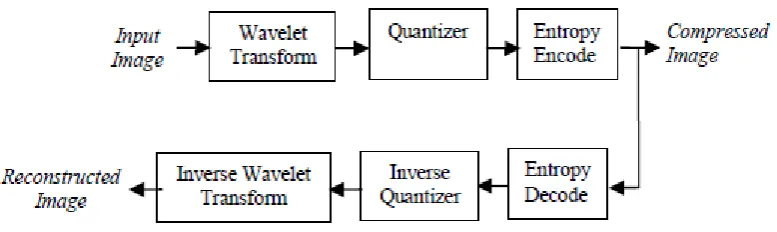
approximation coefficients (at a suitably chosen level) and some of the detail coefficients. Fig. shows the
structure of the wavelet transform based compression.
Fig 1 The structure of the wavelet transform based compression
The steps of the proposed compression algorithm based on DWT are described below
1. Decompose
Choose a wavelet; choose a level N. Compute the wavelet. Decompose the signals at level N.
2. Threshold detail coefficients
For each level from 1 to N, a threshold is selected and hard thresholding is applied to the detail coefficients.
3. Reconstruct
III.PROPOSED ALGORITHM SUB-BAND IMAGE CODING
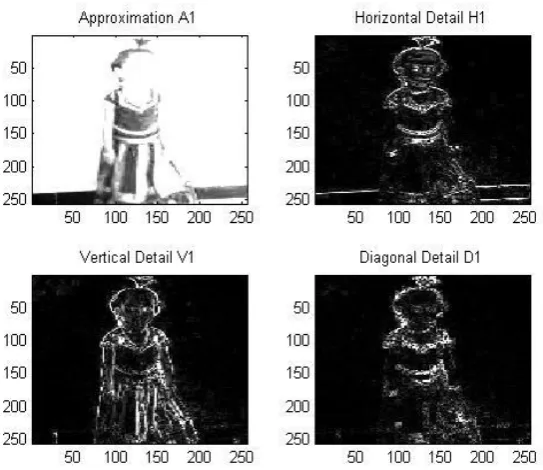
In subband coding the input image is filtered through a set of operations that divide the input into a
number of bands. The result is a number of sub-images with specific properties; for example, a smoothed
version of the original, plus a set of images with the horizontal, vertical, and diagonal edges that are missing
from the smoothed version. These sub-images can be compressed more efficiently than the original image,
because the restricted type of information in each sub-image allows well-tailored encoding. Advantages over
other compression methods include the lack of blocking artifacts, and the flexibility this scheme offers for
adaptive compression. The most successful subband coding method is the wavelet decomposition.
A signal is passed through a series of filters to calculate DWT. Procedure starts by passing this signal
sequence through a half band digital low pass filter with impulse response h(n).Filtering of a signal is
numerically equal to convolution of the tile signal with impulse response of the filter.
(3.1)
A half band low pass filter removes all frequencies that are above half of the highest frequency in the
tile signal. Then the signal is passed through high pass filter. The two filters are related to each other as
h[L-1-n]=(-1)ⁿg(n)
Filters satisfying this condition are known as quadrature mirror filters. After filtering half of the samples can be
eliminated since the signal now has the highest frequency as half of the original frequency. The signal can
therefore be subsampled by 2,simply by discarding every other sample. This constitutes 1 level of
decomposition and can mathematically be expressed as
(3.2)
(3.3)
where y1[n] and y2[n] are the outputs of low pass and high pass filters, respectively after subsampling
by 2.
This decomposition halves the time resolution since only half the number of sample now
characterizes the whole signal. Frequency resolution has doubled because each output has half the frequency
band of the input. This process is called as sub band coding. It can be repeated further to increase the frequency
resolution as shown by the filter bank.
IV.RESULTSANDDISCUSSIONS
Image compression provides sufficient high compression ratios with no appreciable degradation of image
quality. The effectiveness and robustness of this approach has been justified using a set of real images.
Fig 3 original and DCT compression image
DCT image Subband image
Fig 5 out images of DCT and subband coding
Compression Ratio PSNR
Haar 99.5733% -34.59
DCT 50% -42.07
V. CONCLUSIONS
The proposed technique is aimed at developing computationally efficient and effective algorithm for lossy image compression using wavelet techniques. From above observations it is realized that compression ratio and PSNR got by DWT is more than that of DCT. Greater PSNR gives better picture quality
REFERENCES
1. Aldroubi, Akram and Unser, Michael (editors, “Wavelets in Medicine and Biology‖, CRC Press, Boca Raton FL, 1996.
2. Benedetto, John J. and Frazier, Michael,‖ Wavelets; Mathematics and Applications‖, CRC Press, Boca Raton FL, 1996.
3. Rafael C. Gonzalez and Richard E.Woods,” Digital Image Processing” (Pearson Education, Second
Edition).
4. Edmund Y. Lam, Member, IEEE, and Joseph W. Goodman, Fellow, IEEE,‖A Mathematical Analysis
of the DCT Coefficient Distributions for Images‖, IEEE Transactions On Image Processing, Vol.9,
No. 10, October 2000
5. Sonal, Dinesh Kumar, ―A Study Of Various Image Compression Techniques‖, GJU Hissar.
6. O.Rompelman,‖Medical image compression: possible application of subband coding‖ ,in Subband Image Coding (J.W.Woods,ed.),pp.319-3 K. R. Rao and P. Yip, Discrete Cosine Transform. New
7. J. M. Shapiro, ―Embedded image coding using zero trees of wavelet coefficients,‖ IEEE Trans. Signal Processing, vol. 41, pp. 3445–3463, Dec. 1993.
8. A. Said and W. A. Pearlman, ―A new, fast, and efficient image codec based on set partitioning in
hierarchical trees,‖ IEEE Trans. Circuit Syst. Video Technol., vol. 6, pp. 243–250, June 1996.