Development of a Robotic Buggy &
Implementation of a Control Strategy for Gestures
Recognition through Leap Motion Device
#1
Sunil Gurnale, #2Harsh Panicker, #3Pawan Jaiswal, #4Prof. Atul Mokal
#123
B.E Students, Dept. of Computer Engineering, ISB&M School of Technology, Savitribai Phule Pune University,
Pune, Maharashtra, India
#4
Professor, Dept. of Computer Engineering, ISB&M School of Technology, Savitribai Phule Pune University,
Pune, Maharashtra, India
ABSTRACT: The objective of this paper has been the development of a prototype of robotic buggy and the implementation of a control strategy through gesture recognition (Leap Motion Sensor), by means the natural movement of the human hand. Leap Motion Controller is used to acquire data while changing the hand position. The novel user interface was developed, which shows the hand position to the user and combines the classical button GUI switchboard. It has also introduced as an educational complement in obligatory basic teachings. Final Year Project is an academic task that allows evaluating the skills and competences acquired by students along their university period. So students, during their development, can implement numerous theoretical bases of an entertaining and fun form. To develop and to control robotic elements locally or remotely, it has always proven to be a clear example of additional motivation on the students. The prototype developed has exceeded the initial expectations and at low cost.
KEYWORDS: LEAP Motion Controller (LMC), Robotic Buggy, Gesture Recognition, Natural User Interface, HCI.
I. INTRODUCTION
The great advances achieved by robotics in recent years, have made it possible that this discipline of knowledge, has been considered a technology available only to large companies or research centres with million dollar budgets, to be practically available to everyone. The emergence of robotic applications has increased exponentially, so it is easy to see some of them in our daily lives. This series of advances have caused that the robotics it has, also introduced as an educational complement in obligatory basic teachings, [3]. So robotics provides an efficient approach in the development of assisted devices due to its high functionality and thus it allows increasing the quality of life.
The paper focuses on new possibilities of gesture interfaces that emerged with a LMC sensor. The Leap motion is an innovative, 3D motion capturing device designed especially for hands and fingers tracking with precision up to 0.01mm. The authors examined the data provided by the sensor in context of recognition of hand poses, hand movements and in task of finger recognition.
II. RELATED WORK
In recent years, many authors have published studies on the appearance and interaction with this technology. Thereby Ellaithy et al. [4] developed a study for the implementation of the Microsoft X-Box Kinect sensor intended for robotics applications. They describe the technology of RGB and infrared cameras, which incorporates the device together with its basic operating principle. In this case the sensor is used to observe the 3D perception of the human movements.
While González-Jorge et al. [5] develop a comparative with respect to the precision offered by devices as Asus Xtion sensor and Microsoft Kinect for metrology applications in 3D environments.
On the other hand, Regazzoni et al. [6] study the efficiency and limitations of various technologies of low cost, RGB cameras and RGB-D depth sensors, intended for gesture recognition and motion capture. The paper compares the performance of two commercial applications based on optical sensors as they are: Sony Playstation Eye and Microsoft Kinect.
At the same time, Bassily et al. [7] propose a new adaptive control algorithm intended for a 6-DOF articulated arm. The user-machine communications interface is developed by the Leap Motion Controller device. Thus some features of other devices, intended for user-computer interaction through a strategy based on gesture control, are indicated; as for example: Nintendo Wii and Microsoft Kinect. Meanwhile, Vargas et al. [8] present a gesture recognition system based on the Leap Motion Sensor. This device is destined to a prototype for surgical manipulation. The paper describes the integration of the sensor on the platform, the different variables (roll, pitch and yaw) and implemented adjustments.
Moreover, Ching-Hua et al. [9] together with Mohandes et al. [10] and Elons et al. [11] use the 3D Leap Motion Controller sensor and gesture control methodology for recognition of sign language. They emphasize their easy programming due to the incorporation of APIs (Application Programming Interfaces), the Graphical User Interface (GUI) and the low cost of the device. Thereby it has been described the Leap Motion device and algorithms applied to the identification and processing of the signs: Markov model and neural networks.
Finally Kobayashi et al. [12] proposed a control system of a robot arm based on gesture recognition. In the experiment have used an industrial robot and have analyzed the different trajectories followed during displacement of the robotic arm. While Lei et al. [13] study the similarity between the position of a human and its imitation, performed by a robot. The Microsoft Kinect commercial device is used for application development. The experimental results show a satisfactory imitation and a fast learning of robot used, Aldebaran Nao robot model (25 DOF), [14].
III. LEAP MOTION CONTROLLER
Since the market launch of the Leap Motion device a wide variety of applications have been developed. The most popular are those that allow a computer control through the different hand movements. However, none of these applications has reached a high degree of popularity among the average user.
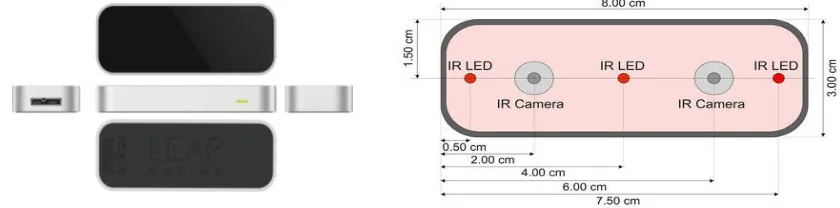
The main objective in the development of the application has been to ensure that the actions of the robotic buggy should be similar to its real equivalent. But considering the influence that cause the movement performed on the system. Thus, it can be achieved by appropriate adjustment of the movements. The recognition of the different hand gestures is developed through the Leap Motion device and a peripheral equipped with infrared sensors (IR) that recognizes the movement of the forearm, hand and fingers simultaneously, see Figure 2.
Figure 2. Number of reference point in the hand, 3D rendering. Software analyzes 22 checkpoints in total.
A. Comparison of gesture control devices
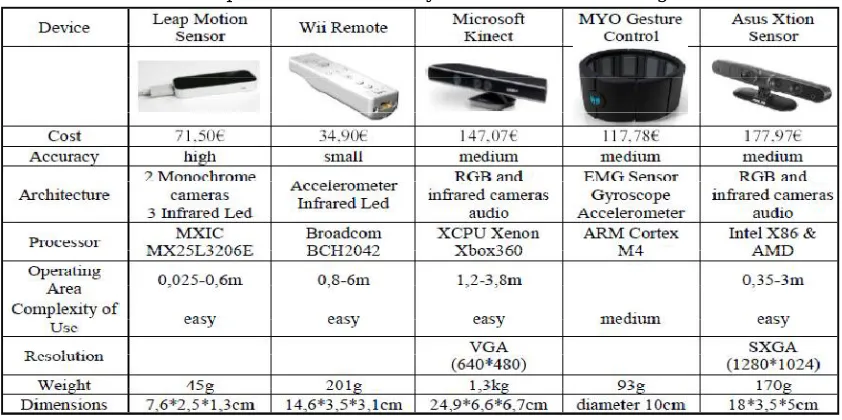
At present there are different commercial options in the market to develop a control strategy based on gesture recognition, such as: Microsoft Kinect, Asus Xtion Sensor, WiiRemote, MYO Gesture Control or Leap Motion Controller. The latter device has been finally selected. Table I includes a brief comparison of the specifications among the different devices mentioned.
Table I. Comparison of Devices and Systems used in Gesture Recognition.
B. Leap Motion Sensor
We have selected Leap Motion Sensor for our work, because its accuracy is superior to other commercial devices. Its small operating area does not cause a problem, since control is developed with the movement of hand. According to its manufacturer it can reach 200 frames per sec. through its infrared camera and accuracy up to 0.2mm. Its view field is 150o with 0.25 m3 interactive 3D space approximately, with the inverted pyramid shape centered on the device. Power supply together with the data transfer is done via the USB port.
performed by the SDK (Software Development Kit) that is downloaded from the web
https://developer.leapmotion.com/.
This software allows transforming the signals sent by the Leap Motion sensor in data and intuitive vectors as fingers, hands, positions or gestures in order to facilitate the work of the programmer, see Table II. Thus, the SDK allows developing small applications APIs (Application Programming Interface) in a wide variety of programming languages such as C++, Java, Python, JavaScript… it being possible to download multiple application resources from the user community.
Table II. Parameters obtained from the Leap Motion Software.
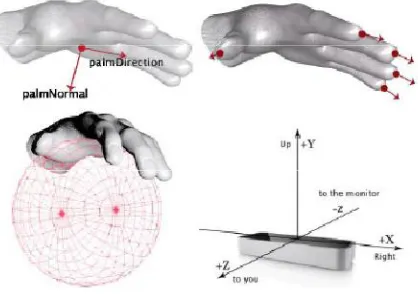
Leap Motion software detects movement of the hand and fingers, see Figure 3; observing the positions in 3D. The software analyzes the movement, considering the previous frame and current frame. Thereby the movements of translation, rotation and scaling factors in each object are recognized. The software considers the following information and data as variables: number of hands and fingers, position of each hand and finger, hand angle and palm speed. Figure 3 shows the coordinate system used by the device.
Figure 3. Axis system on the Leap Motion Sensor device and analysis of the hand palm and fingers displacement. It is also possible to appreciate the generated virtual sphere by hand curve.
IV. SYSTEM ARCHITECTURE AND WORKING
Today the free hardware market has become an expanding area. Thus there are different microcontrollers available that are of low cost and versatile and are being used in robotics, mechatronics, and many research areas. There is a wide range of free hardware cards for the construction of educational prototypes. The most important feature is the connectivity since they have a large number of output ports, allowing access to different types of peripherals.
A Robotic Buggy is programmable, with similar functions of a vehicle/car. This type robotic buggy can be used to perform any type of application such as moving objects from one place to another etc. The robotic buggy contains wheels that are used to make movement when user gives some gesture. Wheels are connected to motors that are connected to programmable chip mounted on Buggy.
Different functions corresponding to each meaningful hand gesture are written and stored for controlling the robotic Buggy. Whenever a gesture is matched with a meaningful gesture, the instruction set corresponding to that gesture is identified and passed to robot for execution. In this way the robotic system can be controlled by hand gesture using live 3D-camera.
Leap SDK provides built-in classes representing real-world object seen by the controller. The basic data unit we get from Leap Motion is a Frame. Frame contains objects like Hands and Pointables (Fingers and Tools), described by features directly related real attributes. Hand is an object representing a regular human hand. It contains Fingers, and is described by three dimensional values, like: position of center of hand, normal vector and direction vector (pointing from the center to the end of fingers).
Pointables are objects like Fingers or Tools (which are longer and thinner than Fingers). Both are described by the same set of features: position of tip, pointing direction vector, length and width. All positions are expressed in millimeters, relative to position of controller which is always located in the center of the 3D space.
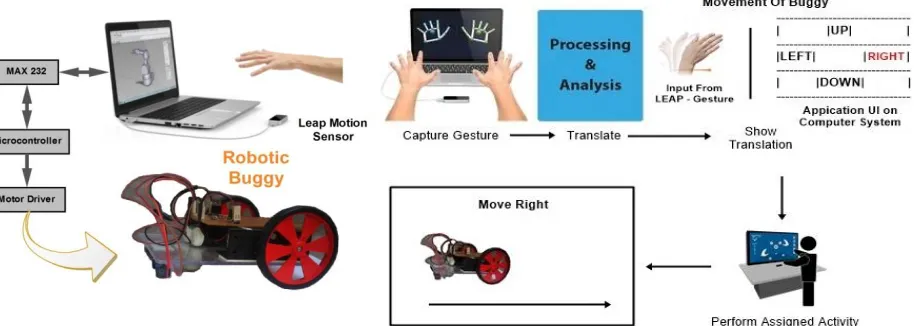
Manufacturer claims that the accuracy of device is about: 01mm. Experiments shown results better than 0:2mm, using an industrial robot moving an object in controller’s field of view. This is more than enough, as accuracy of positioning human hand is about 0:4mm.After gestures are sensed system assigns unique tasks to that gestures using LEAP SDK. When tasks are assigned user can then make use of these tasks to give commands to robotic buggy to make movement. So in this first machine would be ground station i.e. computer system connected to LEAP motion via USB, & second machine would be Robotic Buggy that would be performing various kinds of tasks given by user (human).
Figure 4. System structure of the gesture controlled robotic buggy platform.
V. RESULTS
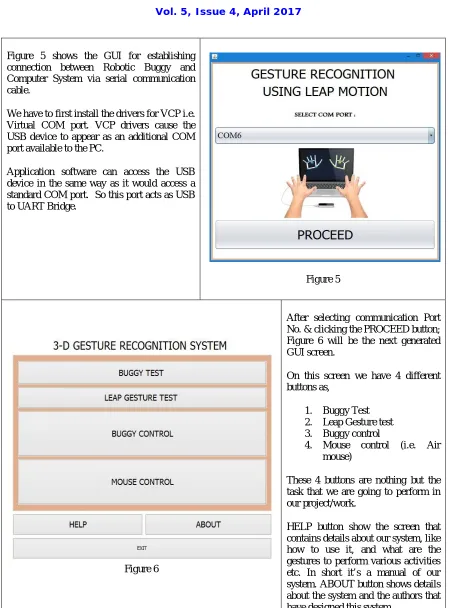
Figure 5 shows the GUI for establishing connection between Robotic Buggy and Computer System via serial communication cable.
We have to first install the drivers for VCP i.e. Virtual COM port. VCP drivers cause the USB device to appear as an additional COM port available to the PC.
Application software can access the USB device in the same way as it would access a standard COM port. So this port acts as USB to UART Bridge.
Figure 5
Figure 6
After selecting communication Port No. & clicking the PROCEED button; Figure 6 will be the next generated GUI screen.
On this screen we have 4 different buttons as,
1. Buggy Test 2. Leap Gesture test 3. Buggy control
4. Mouse control (i.e. Air mouse)
These 4 buttons are nothing but the task that we are going to perform in our project/work.
After clicking on 1st button i.e. Buggy Test in figure 6 this screen will be generated. It is a manual control test screen that would use keyboard for movement of robotic buggy.
The figure 7 shows description about some keyboard keys that can be used according to their definitions.
For example, to move robotic buggy forward press up arrow key on your keyboard etc.
Back Button is used to jump to previous GUI screen i.e. Figure 6 GUI screen would be displayed when back
button is pressed. Figure7
Figure 8
Figure 9
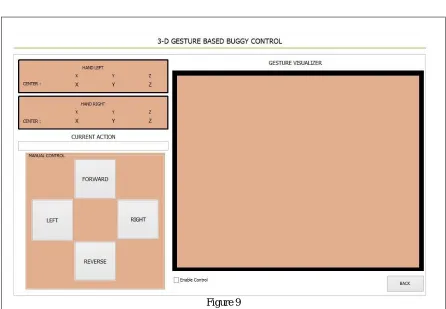
Figure 9 Screen would be generated when Buggy Control Button is pressed in Figure 6.This screen is like a virtual simulator that would show working of system in virtual form i.e. after taking input from LMC device processing is done in computer system and then appropriate signals are sent via serial communication port to robotic buggy. If we give forward command through LMC device (hand gesture) the buggy will move forward etc. Figure 4 show detailed version of how this system works when gestures are passed through LMC device.
Figure 10
Figure 10 Screen will appear when Mouse Control button from figure 6 is pressed. It is an air mouse that can be used instead of Laser mouse.
We can use gestures to open a file or close a file or to Scroll, Zoom in-out etc.
VI. CONCLUSION AND FUTURE WORK
The application of the Leap Motion Controller enabled us to develop a simple solution to the problem of a gesture control of the Robotic Buggy. By integrating the solutions, we have provided the platform that enables the control with gestures. An important benefit of the approach presented here is the development of an entire system (GUI, networking, hardware) with only one programming language. This reduces the development time significantly. Also it takes the challenge of combining both touch screen and motion detection technology to enhance human computer interaction by creating Leap sense, an application that has ability to turn any computer screen into gesture-assisted touch screen. This shows the possibility of communication between User (Human / users) and system efficiently with aid of technology. We believe the communication barriers of human can / will disappear in the future.
REFERENCES
1. Zheng Tong, and Jinghui Chu, "Dynamic Hand Gesture Recognition With Leap Motion Controller", in IEEE Signal Processing Letters, Vol. 23,No. 9,September 2016.
2. Ayanava Sarkar, Ketul Patel, Ganesh R.k., and Geet Capoor, "Gesture Control of drone Using a Motion Controller", IEEE (2016).
3. Artal J.s., Caraballo J. and Dufo R. “DTMF technology applied to the identification and control of a small mobile robot”. Technologies Applied to Electronics Teaching (TAEE 2014). IEEExplore Digital Library. 11-13 June 2014 Bilbao (Spain); pp. 01-06.
4. El-laithy R.A., Huang J. and Yeh M. “Study on the use of Microsoft Kinet for robotics applications”.IEEE/ION Position Location and Navigation Symposium (PLANS2012). IEEEXplore Digital Library. 23-26 April 2012. Myrtle Beach, SC. Pages: 1280 – 1288.
5. Gonzalez-Jorge H., Riveiro B., Vazquez-Fernandez E., Martínez-Sánchez J. and Arias P. _Metrological evaluation of Microsoft Kinect and Asus Xtion sensors . Measurement, Elsevier ScienceDirect. Volume 46, Issue 6, July 2013, Pages 1800 - 1806.
6. Regazzoni D., Vecchi G. and Rizzi C. "RGB cams vs RGB-D sensors: Low cost motion capture technologies performances and limitations". Journal of Manufacturing Systems. Elsevier ScienceDirect. Volume 33, Issue 4, October 2014, pp 719-728.
7. Bassily D., Georgoulas C., Guettler J., Linner T. and Bock T. _Intuitive and Adaptive Robotic Arm Manipulation using the Leap Motion Controller . 41st International Symposium on Robotics; Proceedings of ISR/Robotik 2014. IEEExplore ScienceDirect. 2-3 June 2014. Munich, Germany. Pages: 1 ' 7.
8. Vargas H.F. and Vivas O.A. _Gesture recognition system for surgical robot's manipulation . XIX Symposium on Image, Signal Processing and Artificial Vision (STSIVA2014). IEEExplore ScienceDirect. 17-19 September. Armenia; pages 1 to 5.
9. Ching-Hua C., Regina E. and Guardino C. "American Sign Language Recognition Using Leap Motion Sensor". 13th International Conference on Machine Learning and Applications (ICMLA 2014). IEEExplore ScienceDirect. 03-06 Decemberer. Detroit, pp 541 to 544.\
10. Mohandes M., Aliyu S. and Deriche M. _Arabic sign language recognition using the leap motion controller . IEEE 23rd International Symposium on Industrial Electronics (ISIE2014). 1-4 June 2014. Istanbul. Pages: 960 - ' 965.
11. Elons A.S., Ahmed M., Shedid H. and Tolba M.F. _Arabic sign language recognition using leap motion sensor". 9th International Conference on Computer Engineering & Systems (ICCES2014). IEEExplore ScienceDirect. 22-23 December. Cairo. Pages: 368 ' 373.
12. Kobayashi F., Okamoto K. and Kojima F. "Robot-human handover based on position and posture of human hand". 15th International Symposium on Soft Computing and Intelligent Systems (SCIS) and 7th International Conference on Advanced Intelligent Systems (ISIS), 2014. IEEExplore ScienceDirect. Volume 33, Issue 4, 3-6 December 2014, Kitakyushu (Japan), pp 918 - 921.
13. Jie Lei, Mingli Song, Ze-Nian Li and Chun Chen. "Whole-body humanoid robot imitation with pose similarity evaluation". Signal Processing. Elsevier ScienceDirect. Volume 108, March 2015, pp 136 - 146.